
An affordable solar panel is only as good as its real-world wattage under the clouds, trees, and awkward roof angles that define most installations. What looks great on a spec sheet often buckles when a passing shadow cuts your power station’s input by half, or when the included cable kit simply doesn’t fit your generator. This category demands a buyer who reads cell efficiency, connector compatibility, and bypass diode placement with the same care they give the watt rating itself.
I’m Min — the co-founder and writer behind Gadgets Feed. I’ve spent countless hours analyzing monocrystalline cell grades, junction box IP ratings, and half-cut cell circuit designs to separate the panels that deliver their rated output from those that fall short under real sky conditions.
Because a few extra percentage points in conversion efficiency can mean the difference between actually powering your fridge or watching your generator sip all day, I built this guide to help you pick the best affordable solar panels for your off-grid setup without wasting a watt.
How To Choose The Best Affordable Solar Panels
Choosing an affordable solar panel means looking past the headline wattage and understanding how the panel performs when conditions aren’t perfect. Cell type, connector compatibility, and physical durability will determine whether you get your investment’s worth in actual energy harvested.
Cell Efficiency and Type
The most critical spec for affordable panels is conversion efficiency, measured as a percentage. Panels using monocrystalline cells with ratings of 22% or higher deliver more power per square foot than older polycrystalline designs. In the entry-level and mid-range space, panels that hit 23-25% efficiency are where you want to focus, especially if you have limited roof or ground space.
Shading Tolerance and Bypass Diodes
A panel that loses all output when a single leaf covers one corner is useless in any real-world environment. Look for panels with half-cut cell technology or integrated bypass diodes in an IP68-rated junction box. These design features allow the unshaded portion of the panel to keep generating power even when part of the array is covered, boosting total daily harvest by a significant margin.
Connector Compatibility
Your panel’s output means nothing if it cannot physically connect to your power station. Ensure the included adapter cable matches your generator’s input port — common options include XT60 for EcoFlow, Anderson for older Jackery models, DC7909 or DC8020 for newer Jackery units, and standard MC4 for direct battery charging via a charge controller. A versatile 4-in-1 or 5-in-1 cable saves you from buying extra adapters.
Quick Comparison
On smaller screens, swipe sideways to see the full table.
| Model | Category | Best For | Key Spec | Amazon |
|---|---|---|---|---|
| Renogy 200W Portable | Premium | Versatile portable power | 25% N-Type cell efficiency, 13.89 lbs | Amazon |
| JJN Bifacial 200W | Premium | Bifacial dual-side power | 23% 10BB half-cut cell, 25 lbs | Amazon |
| Callsun N-Type 200W | Premium | Bifacial & anti-shade | 25% N-Type 16BB, 23.8 lbs | Amazon |
| ZOUPW 100W Portable | Mid-Range | Universal power station charging | 23.5% A+ monocrystalline, 5-in-1 cable | Amazon |
| EBL 200W Portable | Mid-Range | High-wattage portable kit | 23.5% monocrystalline, 4-in-1 cable | Amazon |
| Luvknit 100W Portable | Mid-Range | USB direct device charging | 24% monocrystalline, 8.16 lbs | Amazon |
| Topsolar 100W Kit | Entry-Level | Full rigid kit with controller | 100W monocrystalline, 30A controller included | Amazon |
| ECO-WORTHY 200W (2x100W) | Entry-Level | DIY rigid rooftop setup | 25% PERC, 11.46 lbs per panel | Amazon |
| DOKIO 200W Kit (2x100W) | Entry-Level | Budget 200W rigid kit | Half-cell layout, 24 lbs total | Amazon |
In‑Depth Reviews
1. Renogy 200W Portable Solar Panel
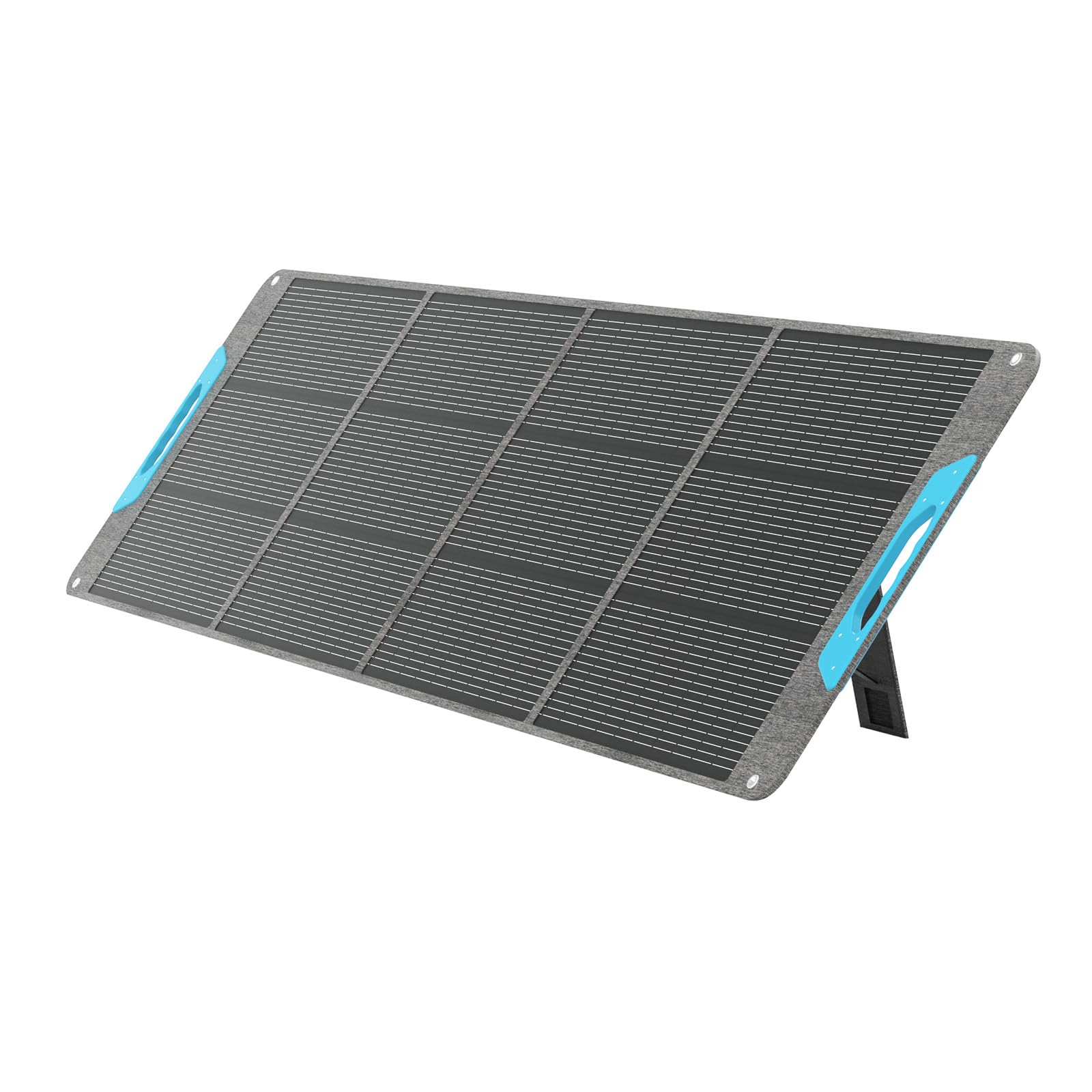
The Renogy 200W Portable Solar Panel justifies its premium position with a 25% efficiency rating achieved through 16BB N-Type cell technology that outpaces the 22.5% found on standard 9BB portable panels. Weighing only 13.89 pounds, it is the lightest 200W foldable option in this comparison, folding down to a 23.72 x 22.99 x 1.97-inch package that stores easily in tight camper spaces. The quadfold design integrates four adjustable kickstands with 40/50/60-degree angles and a magnetic closure system, avoiding the wear-prone snaps or Velcro found on cheaper competitors.
Power delivery is versatile, with an MC4 output for charging power stations or 12V battery systems alongside a USB-C PD port capable of 45W and two USB-A ports for direct device charging. Real-world tests show the panel consistently hitting 150-200W in good sun, with one user reporting 469W in parallel with a second unit in bright Florida sunlight. The IP65 rating provides solid dust and splash protection, while UL 61730 certification adds a layer of safety verification that budget panels often lack.
The built-in accessory pouch and reinforced grommets allow for mounting on an RV or tent, though some users note the kickstand adhesive patches on the back make initial setup a bit tedious. The included travel bag is basic but functional, and a solar meter is recommended for monitoring actual output in varying conditions. For those prioritizing weight savings and certified safety in a portable package, the Renogy 200W is the clear category winner.
Why it’s great
- 25% N-Type cell efficiency delivers top-tier real-world power
- Lightest 200W foldable at under 14 lbs
- UL 61730 certified for safety
Good to know
- Kickstand adhesive pads can be fiddly during setup
- Straps on included storage bag could be more robust
2. JJN Bifacial 200 Watt Solar Panel
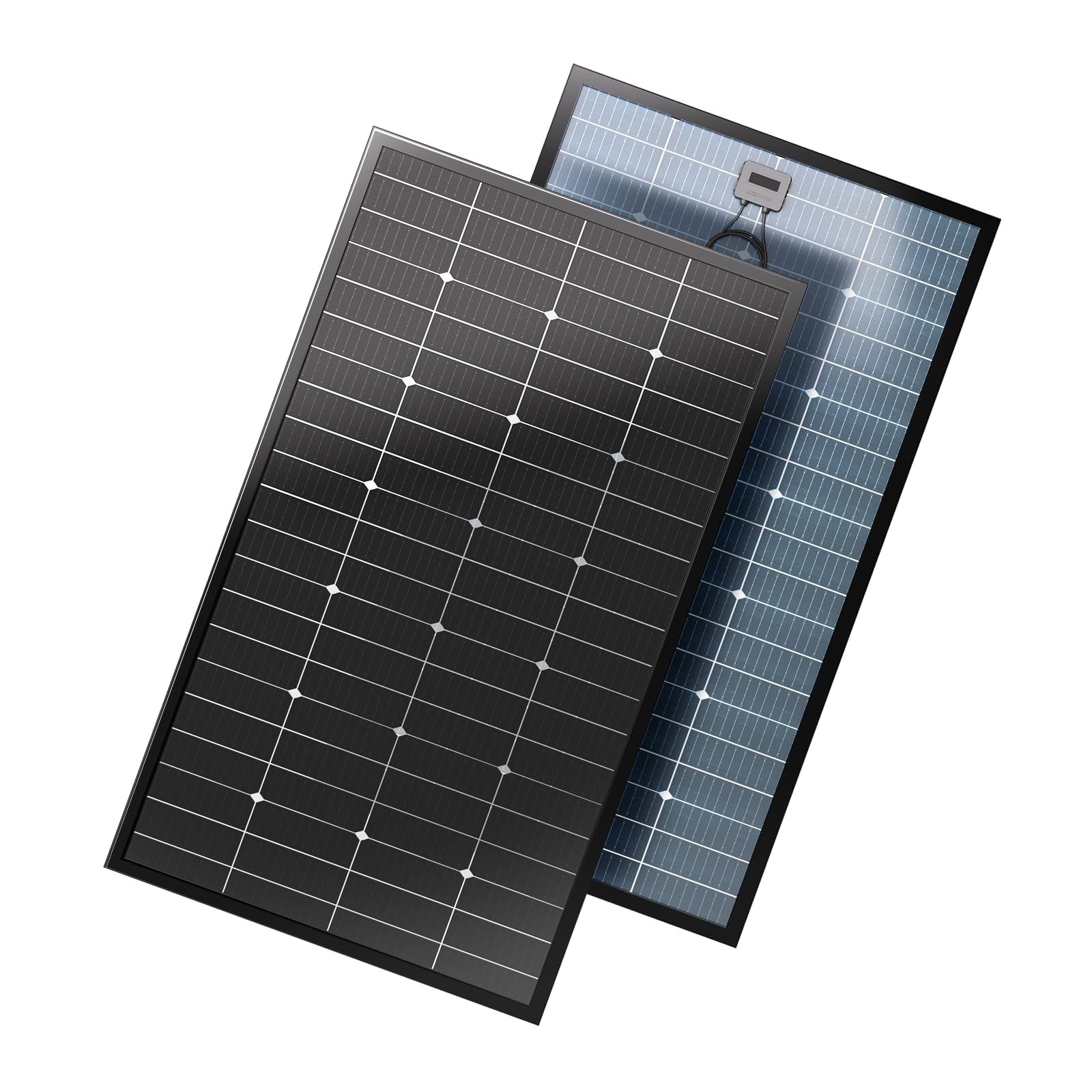
The JJN Bifacial 200W panel introduces a transparent backsheet that allows the rear side to capture reflected and diffuse light, boosting total output by up to 30% over traditional opaque-backed panels. The 10BB (busbar) half-cut cell design reduces resistive losses and minimizes the impact of shading — if one cell section is covered, the other half continues generating. With a 23% conversion efficiency rating, this rigid panel produces around 1000Wh per day in optimal conditions.
Construction quality is a standout, featuring a black corrosion-resistant aluminum frame that withstands 2400Pa wind loads and 5400Pa snow loads. The IP65 junction box paired with IP67-rated MC4 connectors ensures reliable weatherproofing for rooftop or ground-mount installations. One user reported hitting 190-194W in March sun, coming impressively close to the 200W rated output, while another used it to run a shop with AC tools and a welder during a power outage.
Pre-drilled mounting holes on the aluminum frame simplify installation, and compatibility with JJN’s ABS corner mounts, Z brackets, and adjustable tilt mounts adds flexibility. The panel is heavier than portable options at 25 pounds, making it better suited for fixed installations rather than daily carry. JJN backs it with a 30-year transferable power output warranty, a strong indicator of long-term confidence.
Why it’s great
- Bifacial rear-side harvesting boosts total output significantly
- 30-year transferable power output warranty
- Strong build with 2400Pa wind resistance
Good to know
- Reported real-world output averages around 190W, not a full 200W
- 25-pound weight limits portability
3. Callsun N-Type 200W Bifacial Solar Panel

The Callsun 200W panel leverages N-type monocrystalline cells with 16 busbars to achieve a 25% conversion efficiency, a spec that puts it among the highest in its price tier. The N-type construction inherently offers better reliability and lower degradation over time compared to P-type cells, and the 16BB design reduces hot spots and microcrack risks. The bifacial transparent backsheet allows the panel to absorb light from both sides, claiming up to 30% additional energy capture from ground reflection.
What truly sets this panel apart is the TwinCell anti-shade technology, which splits the panel into two independent parallel circuits. If one half is shaded by a tree, antenna, or nearby structure, the unshaded half continues generating at full capacity, boosting shading tolerance by up to 50% versus conventional single-circuit panels. The low temperature coefficient of -0.3%/K means power output remains stable even in extreme summer heat, a critical advantage for hot-climate installations.
Measuring 51.3 x 30.3 x 1.4 inches and weighing 23.8 pounds, it is compact enough for Class B van rooftops while still delivering serious output. One user reported consistently hitting 420W peak from a single panel, exceeding the 200W rating in good conditions. The IP68 junction box and tempered glass front with corrosion-resistant aluminum frame support a 25-year performance commitment maintaining at least 84.5% output.
Why it’s great
- N-Type 16BB cells deliver 25% efficiency with low degradation
- TwinCell anti-shade design keeps half the panel active under shade
- Bifacial design captures reflected light for extra yield
Good to know
- Open-circuit voltage is higher than typical, check charger input limits
- Rigid format not suitable for portable carry
4. ZOUPW 100W Portable Solar Panel

The ZOUPW 100W portable panel achieves a strong 23.5% efficiency rating by using premium Grade A+ monocrystalline silicon cells, outperforming the polycrystalline alternatives still common at this price level. The two adjustable kickstands allow for a 45-degree angle to capture up to 25% more sunlight than laying the panel flat, a meaningful feature when daylight hours are limited. With an IP67 waterproof ETFE coating, it offers superior durability and heat resistance compared to cheaper PET-laminated panels.
The true value proposition is the genuine 5-in-1 solar connector cable, which includes DC8020 specifically for Jackery Explorer 1000V2 and Pro series, XT60 for EcoFlow DELTA/RIVER and Anker models, Anderson for older Jackery units, DC7909/8mm for Jackery 240/300/500 and Bluetti EB3A/EB70, plus DC5521 for generic lithium batteries. This eliminates the need for separate adapters, a common headache with other portable panels. The built-in intelligent controller also provides USB-C PD at 15V/3A and two USB-A ports with QC3.0 for direct device charging without a power station in the loop.
Users consistently report strong performance, with one reviewer noting it charged a Jackery Explorer 300 from 84% to 100% in roughly 20 minutes on a cloudy day. At 9.5 pounds with a magnetic carry handle and a folded size of 24.13 x 21.06 x 1.77 inches, it is reasonably portable for camping and RV use. The 10-foot extension cable provides flexible panel placement while keeping the generator shaded. For users who need a single cable that works with nearly every power station brand, the ZOUPW 100W is the clear value choice.
Why it’s great
- True 5-in-1 connector cable works with most power station brands
- IP67 waterproof ETFE coating outperforms PET panels
- USB-C PD and QC3.0 ports for direct device charging
Good to know
- Kickstands lack fine-tune angle adjustability
- At 9.5 lbs, heavier than some 100W competitors for backpacking
5. EBL 200W Portable Solar Panel
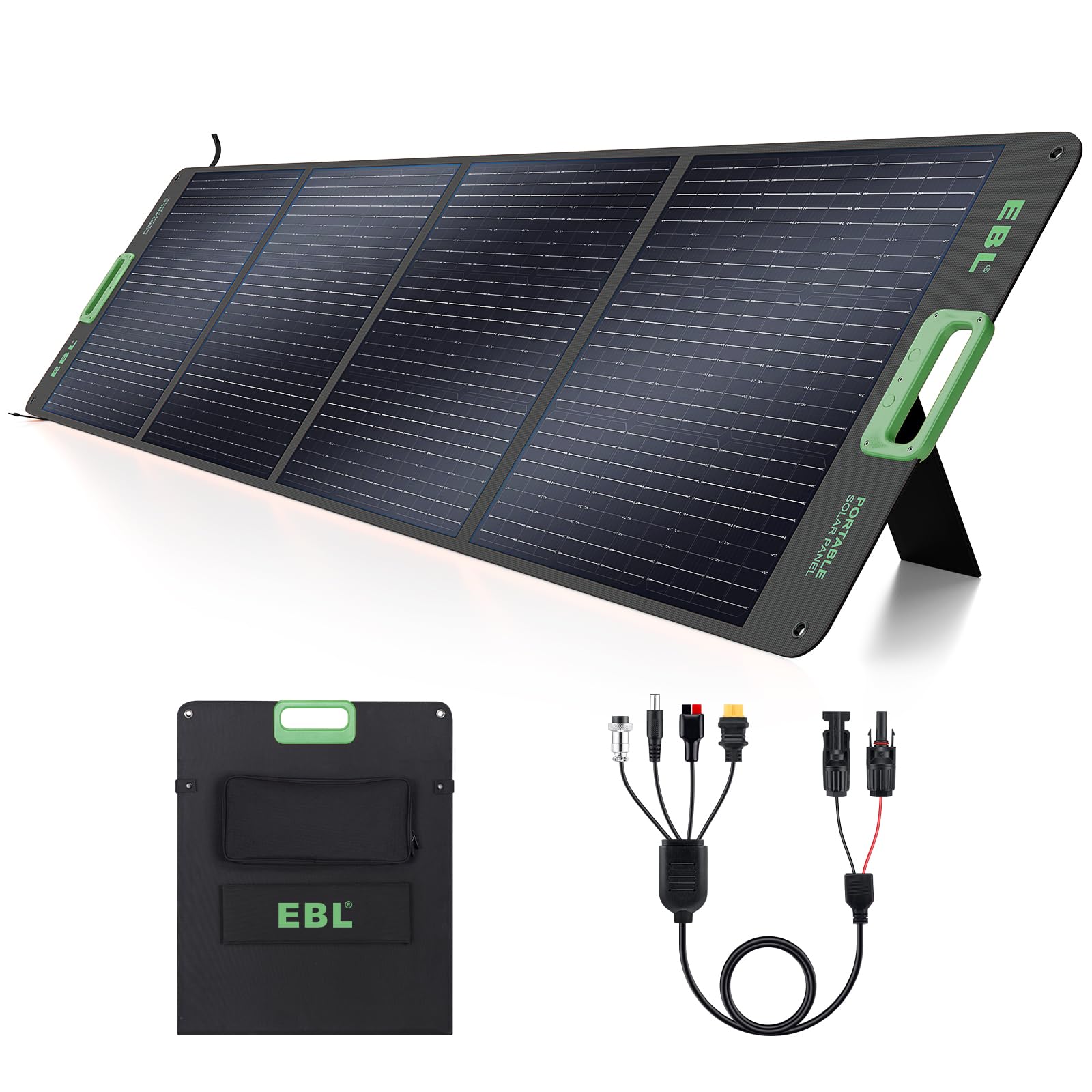
The EBL 200W foldable solar panel delivers a 23.5% conversion rate from its monocrystalline silicon cells, a notable improvement over the 17% typical of polycrystalline options. The upgraded PET lamination combined with a 840D Oxford cloth outer shell provides durability and water resistance, though the IP65 rating is more splash-proof than submersible. When folded, the unit measures 25.31 x 20.87 x 2.17 inches and weighs 17.95 pounds — manageable for vehicle-based camping but heavy for backpacking.
The MC-4 to 4-in-1 solar charge cable includes XT60, Anderson, DC79x09mm, and aviation connectors, covering most major power station brands including Grecell, Bluetti, Anker, and EcoFlow. Real-world testing showed the panel averaging 131-145W on sunny days against the 200W rating, with one user reporting it charged a 448Wh battery from 7% to 100% in about 3 hours. Another user noted 191W peak output with sustained 157W at 5 PM, suggesting good late-afternoon performance.
The panel comes with FCC, RoHS, and EMC certifications, and includes short-circuit and surge protection. Some users found the 6-foot cable too short for optimal placement, requiring an extension for shaded generator setups. A small number of units required a DC7909-to-DC8020 adapter for Jackery compatibility, though EBL’s customer service was praised for handling these issues quickly. For users who need 200W of portable power without stepping up to Renogy’s price tier, the EBL is a strong mid-range contender.
Why it’s great
- Strong 23.5% monocrystalline efficiency at a mid-range price
- 4-in-1 cable supports multiple power station brands
- Durable 840D Oxford cloth outer with PET lamination
Good to know
- Real-world output averages below 200W rating
- 6-foot included cable may be too short for some setups
6. Luvknit 100W Portable Solar Panel

The Luvknit 100W portable panel uses premium monocrystalline cells to hit 24% conversion efficiency, a spec that competes with panels costing significantly more. It features versatile DC, USB, and Type-C outputs, with the DC output including a DC5521-to-Anderson/DC/XT60 cable plus four additional adapter tips (8020, 7909, 5525, 5315) for broad power station compatibility. At 8.16 pounds with a folded size of 21 x 23.6 inches, it is one of the lighter and more packable 100W options available.
Users report strong real-world performance, with one reviewer noting it kept a Jackery 240 at 99-100% for seven hours while streaming video, and maintained 60W output even under heavy cloud cover. The IP65 water-resistant rating and reinforced fabric construction provide protection against dust and light rain, making it suitable for camping, hiking, and RV trips. The built-in kickstand allows for quick angle adjustment without needing a separate mount.
Some units experienced USB 3.0 port failure where the plastic connector snapped, though Luvknit’s customer service replaced the panel directly in those cases. The included leg stands are lightweight but can blow over in strong wind without added weight or stakes. The 1-year manufacturer warranty and 30-day money-back guarantee provide reasonable purchase protection. For users who prioritize a lightweight portable panel with high efficiency and a generous adapter kit, the Luvknit 100W is a solid choice.
Why it’s great
- 24% efficiency with monocrystalline cells
- Lightweight at 8.16 lbs for easy portability
- Includes multiple DC adapter tips plus USB/Type-C
Good to know
- USB 3.0 connector has reported durability issues
- Leg stands are lightweight and may need wind weighting
7. Topsolar 100W 12V Solar Panel Kit

The Topsolar 100W kit is the most complete entry-level package in this lineup, including the monocrystalline panel, a 30A intelligent charge controller, two 16-foot MC4 cables, two 5-foot O-ring battery cables, and V-shape mounting brackets. The panel itself features a heavy-duty anodized aluminum frame with tempered glass coating, and the included V-shape mount tilt rack bracket allows angle adjustment for better sun exposure on ground, wood, or wall installations.
The 30A charge controller provides full protection against overcharge, over-discharge, over-voltage, and short circuits, making it a safe choice for users new to 12V battery systems. The panel’s corrosion-proof aluminum frame and tempered glass construction are built for year-round outdoor exposure on RVs, boats, cabins, or sheds. Users confirm it works well for maintaining batteries in tractors, buggies, and RVs, with one reviewer running two panels in parallel to charge multiple batteries reliably.
Some users note that the pre-drilled roof mounting holes don’t always line up perfectly with existing RV roof rails, requiring drilling through the aluminum frame, which is manageable but adds installation time. The 30A controller cannot switch between 24V and 12V setups without a specific reset sequence that some users found unintuitive. Despite these minor quirks, the Topsolar kit remains one of the best values for a turnkey 12V charging solution that includes the controller and mounting hardware.
Why it’s great
- Complete kit includes controller, cables, and mounting brackets
- 30A intelligent controller with full protection features
- V-shape mount tilt rack for adjustable sun angle
Good to know
- Roof mounting holes may require alignment drilling
- Controller voltage mode switching can be confusing
8. ECO-WORTHY 200W (2x100W) Solar Panels
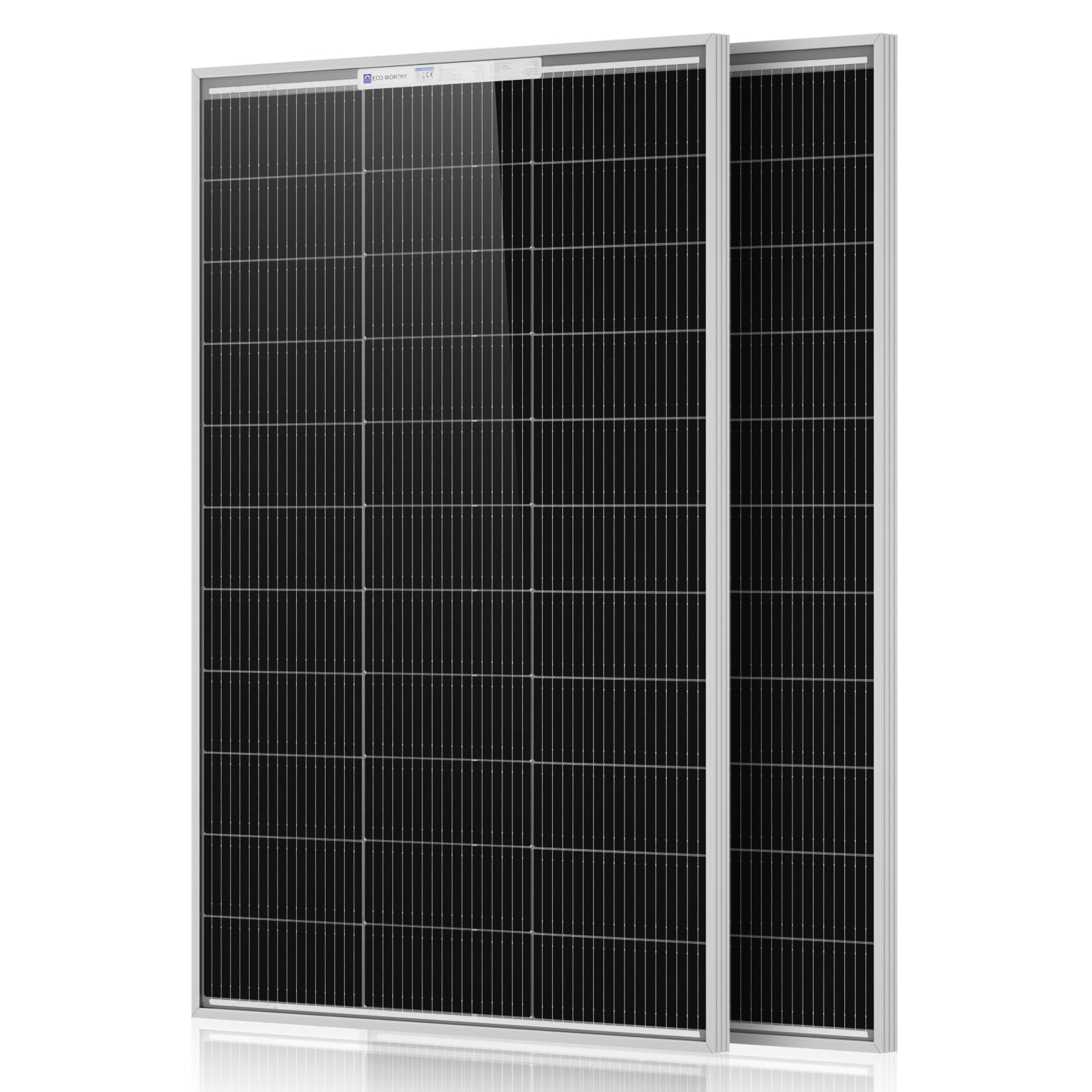
The ECO-WORTHY dual 100W panel kit utilizes PERC (Passivated Emitter and Rear Cell) technology to push cell efficiency to 25%, significantly improving sunlight utilization over standard monocrystalline panels. Each panel measures 35.63 x 23.03 x 1.18 inches and weighs just 11.46 pounds, making them among the lighter rigid panels for their wattage. The 1.18-inch frame thickness allows rapid heat dissipation for stable long-term performance.
Each panel comes with pre-installed bypass diodes in an IP68-rated junction box, ensuring excellent low-light performance and minimizing power drop from partial shading. The 25-year durability claim is supported by 2400Pa wind and 5400Pa snow load ratings, with impact-resistant tempered glass and a corrosion-resistant aluminum frame. Users report consistent real-world output of around 95W per panel in winter conditions, with one reviewer running four panels in series without issues over several years.
The pre-drilled holes on the back allow for quick installation on roofs or brackets, and the included 35-inch cables with plug-and-play MC4 connectors make wiring straightforward for beginners. Some units have arrived with shipping damage, and while ECO-WORTHY has been responsive with replacements, the packaging could use additional internal protection. For budget-conscious buyers who need reliable rigid panels with industry-standard connectors and high efficiency, the ECO-WORTHY 200W kit delivers exceptional value per watt.
Why it’s great
- 25% PERC cell efficiency rivals premium panels
- IP68 junction box with bypass diodes for shade tolerance
- Lightweight 11.46 lbs per panel for easy handling
Good to know
- Shipping packaging could use more internal protection
- 35-inch cables may be short for some installation layouts
9. DOKIO 200W Solar Panel Kit (2x100W)
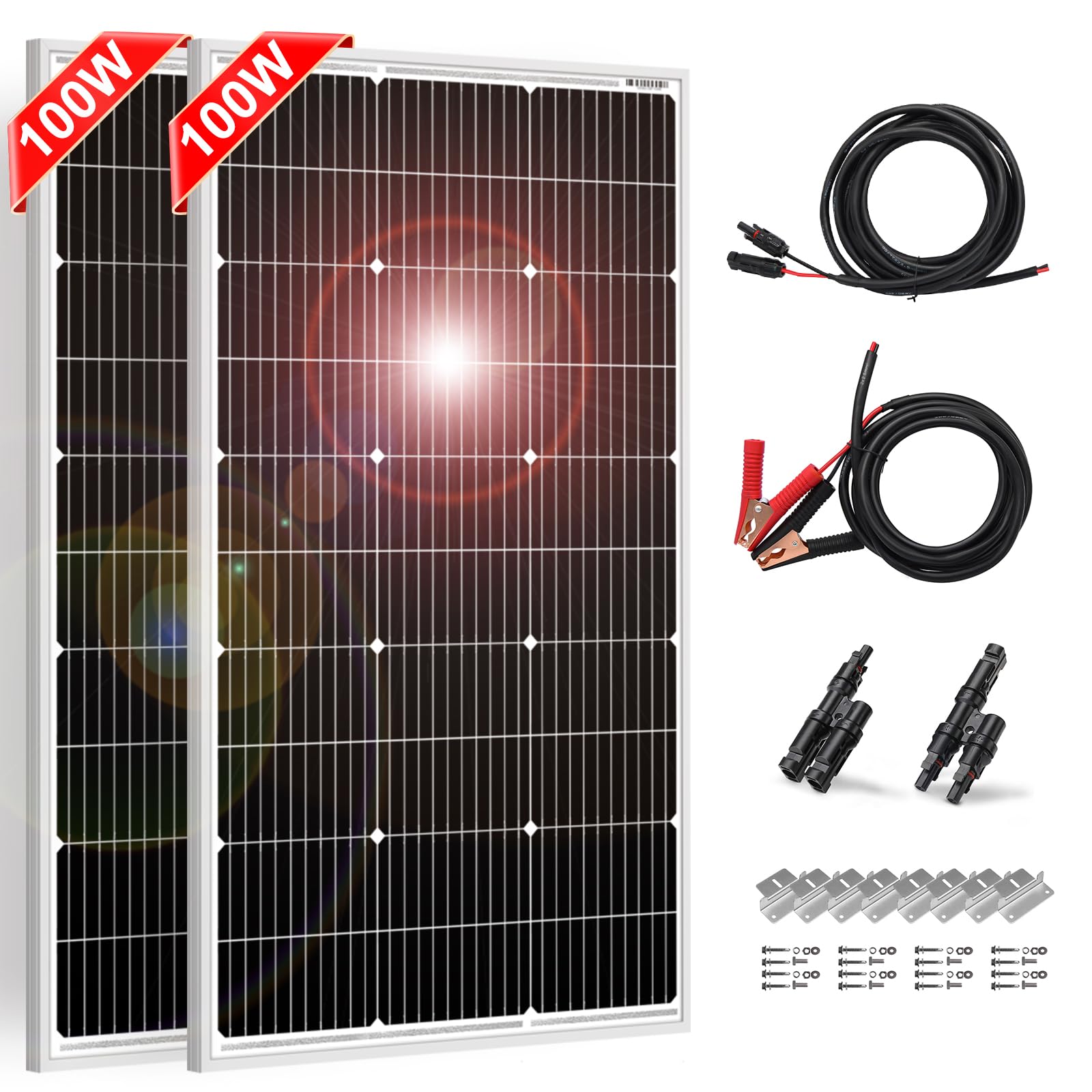
The DOKIO 200W kit pairs two 100W monocrystalline panels with a half-cell layout that uses bypass diodes to reduce the impact of shading and overheating. Each panel measures 38.2 x 22.2 x 0.98 inches, and the total kit weight comes to 24 pounds. The kit includes Z-brackets for roof or ground mounting, alligator clips, and a 5-meter MC4 cable, though a separate PWM or MPPT charge controller is required (not included).
The half-cell design provides a meaningful advantage over full-cell panels in partial shade scenarios, keeping charging steady when branches or roof vents cast shadows. The 3-meter alligator clip cable and 5-meter adaptor lead offer extended reach, allowing the controller or battery to stay shaded while the panels sit in full sun. Pre-drilled holes and included Z-brackets support flexible mounting on RVs, boats, cabins, or roofs, with compatibility for tilt or pole mounts.
Users report solid build quality and easy installation, with one reviewer successfully running 800W total (2x400W) from the same brand’s larger panels, noting impressively high output even with partial shade. The panels ship with foam corner protectors and reinforced cartons to reduce transit damage, and DOKIO offers quick resolution if issues occur. For users who need an affordable 200W rigid setup and don’t mind buying a separate controller, the DOKIO kit is the most budget-friendly way to get started with a half-cell solar array.
Why it’s great
- Half-cell layout with bypass diodes for shade tolerance
- 5m MC4 cable plus 3m alligator clip cable for flexible placement
- Budget-friendly entry into 200W rigid solar
Good to know
- Charge controller not included — must be purchased separately
- 24-pound total kit weight is heavy for portable use
FAQ
Can I use a 200W solar panel with a 100W rated power station?
What is the difference between a PWM and MPPT charge controller for affordable solar panels?
Why does my portable solar panel output drop when clouds pass by?
Final Thoughts: The Verdict
For most users, the best affordable solar panels winner is the Renogy 200W Portable because its 25% N-Type efficiency and 13.89-pound weight make it the perfect balance of performance and portability for camping and emergency backup. If you want maximum anti-shade performance for a fixed rooftop installation, grab the Callsun N-Type 200W Bifacial with its TwinCell design. And for the best value connector compatibility in a portable format, nothing beats the ZOUPW 100W with its versatile 5-in-1 cable.