
Our readers keep the lights on and my morning glass full of iced black tea. As an Amazon Associate, I earn from qualifying purchases.
Specs are compiled from manufacturer listings and verified buyer reviews and can change over time — please confirm the key details on the product page before buying.
You do not need to spend a fortune to get sound that makes you stop what you are doing and listen. The challenge is picking from a shelf full of nearly identical black boxes that all claim to be the one. This guide cuts through that noise to find the affordable stereo amplifier that actually delivers clean, detailed power for your speakers without draining your wallet.
I’m Min — the founder and writer behind Gadgets Feed. This guide is built by comparing the manufacturers’ published specifications and the patterns across verified customer reviews, so you get each pick’s real strengths and trade-offs instead of marketing spin.
Whether you are upgrading a turntable setup, adding punch to a desktop system, or building a simple living-room rig, the right choice depends on matching power, inputs, and a few smart features to your specific gear. Here is everything you need to find the best affordable stereo amplifier for your home.
Quick Picks
- AIYIMA A07 MAX — Best Overall
- Donner Stereo Audio Amplifier (MAMP2) — Most Versatile
- Fosi Audio V3 Stereo Amplifier — Audiophile Pick
- Fosi Audio MC331 Tube Integrated Amplifier — Coolest Design
- AIYIMA T9 PRO — Space-Saver Stereo
- YAMAHA R-S202BL Stereo Receiver — Full-Size Reliability
- WiiM Amp — Streaming Powerhouse
- Dayton Audio HTA100 — Vintage Vibe
How To Choose The Best Affordable Stereo Amplifier
Buying a stereo amp used to be simple — a big silver box with big knobs. Today, you have pocket-sized mini amps, hybrid tube models, and full streaming receivers all competing for the same spot. Here is what separates a smart buy from a regret.
Power Rating: Don’t Chase the Peak Number
The loudest claim on the box is the “peak” wattage. That number means very little in real use. What matters is the continuous RMS power (root mean square — essentially the average power it can sustain without distorting). You will get more usable volume from a clean 50 watts RMS per channel than from a “600-watt peak” amp that runs out of steam after ten seconds. A good rule: look at the wattage rating for an 8-ohm speaker load — that is the most honest measurement.
Inputs: Match Your Source Before You Buy
Your amplifier is the hub of your system, so the inputs it has must match the gear you already own. If you have a turntable without a built-in preamp, you need a “phono input.” If you are connecting a TV, an Optical or HDMI ARC input is the simplest path. Bluetooth is convenient for phone streaming, but the version (5.0, 5.2, 5.3) only matters for connection stability, not sound quality. A USB input is useful if you use a computer as a source.
Amplifier Class: How the Power is Made
Almost every affordable amp you will see is either Class D or Class A/B. Class D amplifiers (like the ones using the TPA3255 chip) are small, run cool, and are very efficient with power. Class A/B amplifiers (like the one in the Dayton Audio HTA100) are larger, run warmer, and tend to have a more traditional “warm” character some listeners prefer. A hybrid tube amplifier uses a tube in the preamp section to add warmth or a slight color, but the main power is still solid-state. Class D is the safe, practical pick for most people today.
Speaker Impedance and Sensitivity
Your speakers are just as important as the amp. Every speaker has an impedance rating (typically 4, 6, or 8 ohms) and a sensitivity rating (measured in decibels or dB, often called “efficiency”). An amp with 60 watts per channel into 8 ohms will drive most bookshelf speakers to satisfying room-filling levels. But if you have tough-to-drive speakers (like 4-ohm towers or speakers with a sensitivity below 88 dB), you need an amp that can double its power into lower impedances, like the WiiM Amp, which goes from 60 watts into 8 ohms to 120 watts into 4 ohms.
Quick Comparison
On smaller screens, swipe sideways to see the full table.
| Model | Best For | RMS Power (8Ω) | Weight | Key Inputs | Amazon |
|---|---|---|---|---|---|
| AIYIMA A07 MAX | Pure Power Desktop | 107Wx2@4ohm | 1 kg | RCA, AUX | $145.99$161.98Amazon |
| Donner MAMP2 | All-in-One Versatility | 60Wx2@8ohm | 4.7 kg | Phono, BT 5.3, Optical, Coax | $103.99Amazon |
| Fosi Audio V3 | Clean Audiophile Sound | Up to 300Wx2@4ohm | — | RCA, Pre-out | $109.99Amazon |
| Fosi Audio MC331 | Desktop Tube + DAC | 105Wx2@4Ω | 4.2 lbs | Bluetooth, USB, Optical | $131.99Amazon |
| AIYIMA T9 PRO | VU Meter Aesthetics | 200W Peak | 3 lbs | BT 5.2, Coax, Optical, USB | $149.99Amazon |
| YAMAHA R-S202BL | FM Tuner + Reliability | ~100Wx2 | — | Bluetooth, 2x RCA | $199.95Amazon |
| WiiM Amp | Smart Multiroom Streaming | 60Wx2@8Ω / 120Wx2@4Ω | 4.1 lbs | HDMI ARC, BT, Wi-Fi | $299.00Amazon |
| Dayton Audio HTA100 | Hybrid Tube + Phono | 50W RMSx2@8Ω | — | Phono, BT 5.0, USB DAC | $299.98Amazon |
In‑Depth Reviews
1. AIYIMA A07 MAX

A tiny metal box with a compact 6.02 x 3.94 x 1.57-inch chassis and 1-kilogram weight.
The AIYIMA A07 MAX delivers strong clean power in this guide, weighing 1 kilogram versus the Donner MAMP2 at 4.7 kilograms. It uses the TPA3255 Class D amplifier chip (a high-performance chip that keeps distortion low) and an NE5532 op-amp chip (an operational amplifier that shapes the sound), with Japanese ELNA capacitors and German WIMA capacitors inside. Buyers report it “punches above its price,” replacing more expensive traditional amps like the Cambridge Audio AXA35.
Its case measures 6.02 x 3.94 x 1.57 inches, so it fits almost anywhere on a desk. A switch on the bottom toggles between stereo mode and mono mode (bridging to a single 600-watt channel for a center channel or subwoofer). Owners mention it runs at about 100°F under load, which is warm but not alarming, thanks to side and bottom vents. The volume knob acts as the power switch, and you need to turn it to about 12 o’clock to get decent listening volume.
There is a catch: this unit has no Bluetooth, no phono input for a turntable, and no optical input. It relies on two analog RCA inputs (the standard red-and-white connectors). For buyers who want pure, transparent power for a desktop system or bookshelf speakers without paying for extra features they do not need, this is the most honest amplifier in the list.
The Raw Power Edge
- Weighs only 1 kilogram — the lightest fully-capable amp here
- Stereo mode delivers 107Wx2@4ohm with the included 36V power supply
- Swap the op-amps to change the sound signature (Sparkos, MUSES02)
- Can run on up to a 48V power supply for even more headroom
The Missing Features
- No Bluetooth, no phono, no optical — RCA input only
- Volume knob acts as the power switch, which might be inconvenient
- Case feels cheaper than the Fosi V3, according to buyers
Perfect for: anyone who wants the highest audio quality for the lowest price on a desk or shelf, and already has a source like a computer or DAC.
Look elsewhere if: you need to plug in a turntable, TV, or stream music over Bluetooth directly.
2. Donner Stereo Audio Amplifier (MAMP2)
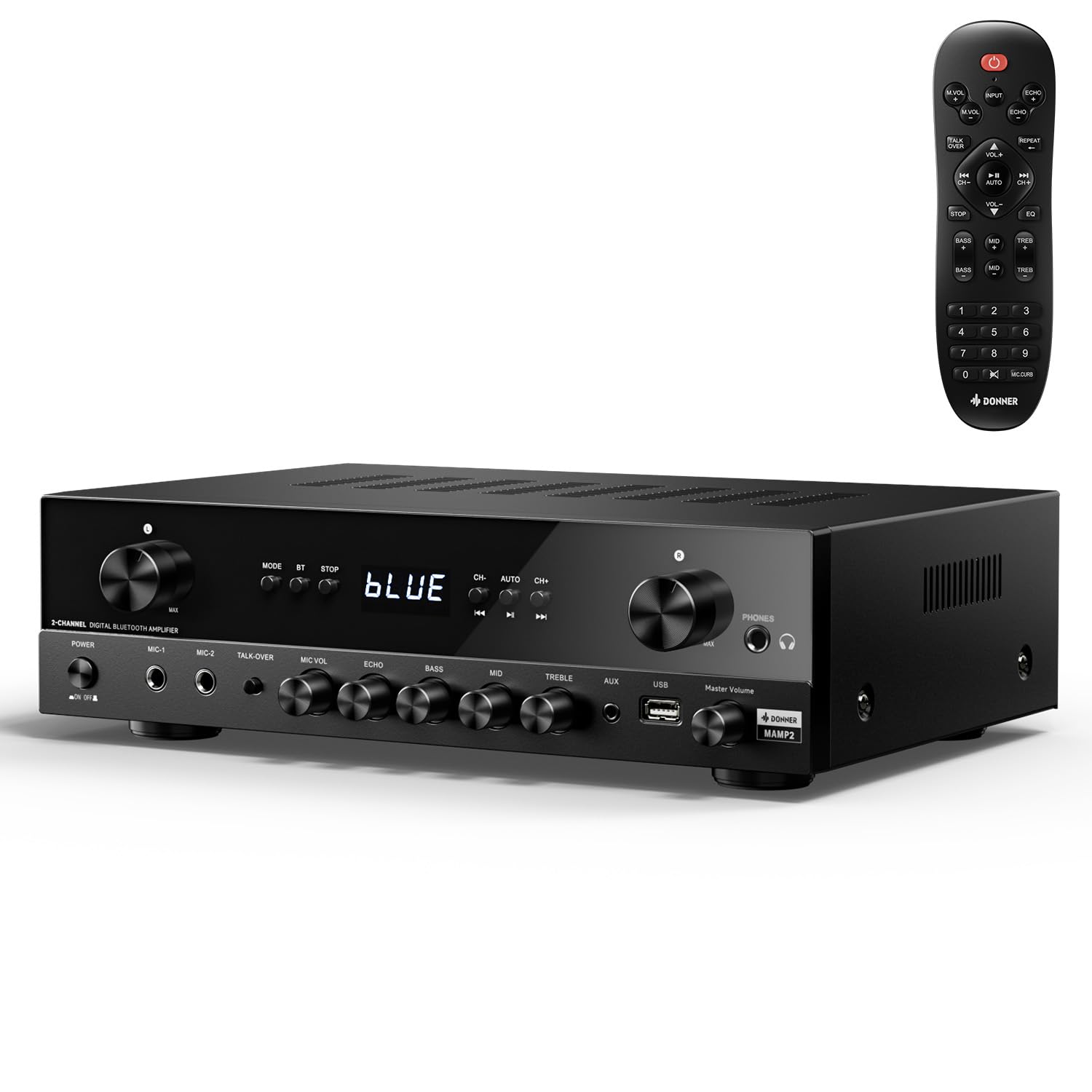
The Swiss Army knife of affordable amps — inputs for everything you own.
The Donner MAMP2 solves the one problem the AIYIMA A07 MAX has: connectivity. This stereo receiver has a phono input (so you can connect a turntable directly), Bluetooth 5.3 (the latest standard, offering more stable wireless connections), two 1/4-inch microphone jacks for karaoke, and digital inputs like Optical and Coaxial (for connecting a modern TV). It also packs an FM radio tuner and a USB port (up to 64 GB of storage). While its peak power is 600 watts, the real-world RMS rating is 60 watts per channel into 8 ohms, which is enough to fill a room cleanly with two pairs of 8-ohm speakers.
Buyers praise its “amazing value” and one reports it drives a pair of Klipsch KLF-10S speakers with a subwoofer to “powerful, clear” levels. Another reviewer noted that the remote lets you adjust treble, midrange, bass, and even echo (for karaoke) in any input mode — a level of customization rare at this price. The unit weighs 4.7 kilograms, reflecting a larger chassis with a toroidal power supply (a donut-shaped transformer that typically delivers cleaner, more stable power than the cheaper switching supplies found in mini amps).
The honest trade-offs are that some banana plugs do not fit the speaker terminals, so you might need to use bare wire. Also, one reviewer noted the optical input did not work on their unit, though the phono and RCA inputs worked fine. At this price point, you are getting a feature-packed “starter” receiver that does almost everything, but in return you trade some of the pure, clinical performance of a dedicated high-power mini amp.
Feature King: This amp gives you phono, Bluetooth 5.3, Optical, Coaxial, USB, FM radio, and dual microphone inputs — no other amp at this price offers this many connection types.
One Real Weakness: The optical input may be inconsistent, and the binding posts do not accept banana plugs, limiting your cable options.
Reach for this if… you want one box that connects your turntable, TV, and phone for karaoke or casual listening.
skip it if… your priority is maximum pure audio quality for a dedicated music system, or you need a small desktop amp.
3. Fosi Audio V3 Stereo Amplifier

A mini powerhouse built for listeners who care about every last detail.
The Fosi Audio V3 is the amplifier that audio enthusiasts on a budget gravitate toward. It uses the same TPA3255 chip as the AIYIMA A07 MAX, but it adds a higher SINAD rating (up to 88 dB — a measurement of signal-to-noise and distortion, where higher is cleaner) and an incredibly low noise floor of just 140 microvolts (the background hiss is virtually inaudible). It comes with a 48V power supply (a powerful 5-amp adapter) that delivers the best output. One reviewer advises, “Use 48V supply for best output.” That power allows it to drive 300 watts per channel into 4 ohms, giving it headroom that mini amps at this size do not usually have.
Customers note it has “natural sound with brilliant highs, smooth mids, good bass,” with a reviewer testing it against a much more expensive mainstream brand and preferring the Fosi V3. The case uses a whole-body heatsink design, meaning the entire chassis helps pull heat away from the internal parts, so it stays cooler than many comparably powerful mini amps. Like the AIYIMA, the V3 lets you swap the stock NE5532 op-amps with aftermarket parts like Sparkos SS3602 or MUSES02 to fine-tune the sound signature — a feature that is frankly unusual at this price.
The main limitation is the same as the A07 MAX: inputs are limited to a single set of RCA jacks. There is no Bluetooth, no phono, no optical. It does include a “pre-out” that is volume-controlled (a line output that lets you connect an external amplifier or a powered subwoofer). Buyers also note that while the V3 is clear and musical, one person said “the Olivier lacks thunder” at very high volume if you are seeking heavy bass impact.
The Sonic Edge
- Very low noise floor at 140uV — barely any hiss
- Full-body heatsink keeps it cooler under load than other mini amps
- 48V power supply included for best output
- Pre-out with adjustable level for adding a subwoofer
The Input Limitation
- Only one RCA input — no connectivity for TV, turntable, or streaming
- Needs at least 90dB+ speakers to really shine, per one reviewer
Choose this if… you are building a dedicated near-field listening desk for critical music enjoyment and value the cleanest signal path.
Pass on this if… you need an all-in-one receiver for a living room turntable or TV setup.
4. Fosi Audio MC331 Tube Integrated Amplifier
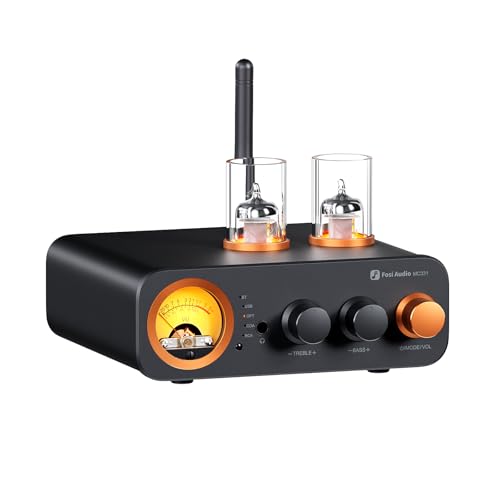
Vintage looks and modern connectivity in a compact all-in-one package.
The Fosi Audio MC331 combines a tube preamp (using two vacuum tubes — models 5725W or 6J1, shipped randomly) with a Class D power section that delivers 105 watts per channel into 4 ohms. It is a true integrated amp: it includes a DAC (digital-to-analog converter — the part that turns digital audio into sound), a headphone amp (with a 3.5mm output), a Bluetooth receiver, and a pre-out. All of this fits into a chassis that weighs just 4.2 pounds and features a front-panel VU meter (a vintage-style swinging needle that shows audio level). The tube stage is meant to soften digital sound and add warmth.
Reviewers point out that the sound is “warm, detailed” and that the all-metal build feels sturdy with satisfying controls. One buyer mentioned it “powers above its weight,” filling a 900-square-foot room with vintage BOSE 201 Series IV speakers via Bluetooth. The unit offers a wide choice of inputs: Bluetooth, USB-C, coaxial, optical, and RCA. The volume knob doubles as an input selector and power switch (using a long press to turn the unit on and off).
The catch here is consistency. A specific buyer report notes that the factory vacuum tubes “failed within 3 days,” requiring the owner to spend extra on replacement tubes. Another reviewer called the included remote “terrible” with a two-second latency and requiring direct line-of-sight to function. Also, the speaker posts only accept rigid banana plugs or very thin bare wire (14 AWG barely fits), and the power supply is fixed at 24V (it cannot be upgraded for more power). This is a great pick if you value the retro tube look and warm character, but be ready for potential tube instability from the factory.
All-In-One Appeal
- Tube preamp adds warmth and visual appeal; tubes are user-replaceable
- Versatile inputs: Bluetooth, USB-C, Optical, Coax, RCA
- Built-in headphone amp and pre-out for flexibility
The Frustrations
- Factory tubes can fail within days; budget for replacements
- Remote has a noticeable 2-second delay
- Undercut by 24V power supply (cannot upgrade for more headroom)
Best suited for: the desktop listener who wants the glow of tubes, the convenience of a DAC, and a visual centerpiece.
Not for: someone who wants plug-and-play reliability without hassle or high-power headroom for large speakers.
5. AIYIMA T9 PRO

A clever little amp with a cool needle meter and a modular future.
The AIYIMA T9 PRO is the aesthetic counterpart to the raw AIYIMA A07 MAX. It swaps the A07’s minimalist metal box for a more retro-inspired design with a VU meter on the front, which gives it a vintage receiver look. Inside, it uses a Qualcomm Bluetooth 5.2 chip (for stable wireless streaming), a Texas Instruments DAC section, and Cirrus Logic components. It puts out 200 watts peak power, though its real-world continuous power is lower than the A07 MAX; shoppers say it “clips around 85 volume” with demanding speakers.
It uses two Jan 5725 vacuum tubes in the preamp stage to warm up the sound. One owner reported it has “a full warm sound” with “crisp highs and superb HT vocals” when used as the core of a two-channel system. It has a broad selection of inputs: Bluetooth 5.2, USB, coaxial, optical, and standard RCA, making it easy to connect a TV, CD player, or computer. Some users also use it as a preamp for the A07 MAX, creating a chain where the T9 PRO handles source selection and tone shaping, and the A07 MAX supplies pure power.
The main trade-offs are that the VU meter is not very sensitive at low listening levels, and the amplifier runs warm even when idling. It is also important to note that this amp needs a volume level that moves the needle a bit to sound its best; one customer observed the highs can feel “slightly harsh” at moderate volume. If you value the look and tube warmth more than raw output, this is a fun way to bring analog-style character to a desk system.
Character and Control
- Multiple digital inputs (USB, Coax, Optical) plus Bluetooth 5.2
- VU meter adds visual appeal, tubes add warmth
- Tone control knobs for bass and treble adjustment
Performance Limits
- VU meter is not responsive at low volumes
- Amplifier runs warm; can clip at high volume (above 85 on the dial)
- Some buyers find highs harsh at moderate volume
Go for this if… you want a compact tube-hybrid amp with a cool display that looks as good as it sounds on a desk.
Stick with the A07 MAX if… you need maximum undistorted power and are willing to give up the flashier design and extra inputs.
6. YAMAHA R-S202BL Stereo Receiver

A traditional full-width receiver for those who still love radio and simple systems.
The Yamaha R-S202BL is built for a different buyer than the compact Class D mini amps above. It is a classic full-size stereo receiver with a brushed aluminum front panel, measuring 17.13 inches wide and 5.5 inches tall. It includes a built-in FM/AM tuner with 40 presets, Bluetooth 4.1 + EDR (Enhanced Data Rate — a standard wireless version for music streaming), and a speaker selector that supports two separate sets of speakers. Its amplifier is Class A/B, which typically delivers a warmer, more natural sound than the typical mini Class D amp but is also less efficient and larger.
One buyer in a metal barn 18 miles from town reported that the tuner “picks up stations” that other receivers cannot, calling the FM sensitivity “excellent like a high-end receiver.” The rated frequency response is 10Hz to 100kHz (+0 / -0.5 dB / +0 / -3.0 dB), which is a very wide range on paper. In practice, buyers describe the sound as “crisp” and “warm with strong bass.” This receiver is particularly well-suited for users who have a simple stereo setup with a CD player, a turntable (without a phono preamp — this receiver does not have a dedicated phono input), or a laptop via an adapter.
There are notable limitations for modern buyers. There is no subwoofer output, no optical or coaxial digital input, no HDMI, and no phono stage. The high-frequency performance is described by one critical listener as “soft,” noting that the treble control only acts around 3kHz and higher frequencies (like cymbals) are under-emphasized. If you are building a modern home theater or multi-input music system, this receiver will feel limited. But if you want a straightforward, reliable box with a great radio tuner and proven Yamaha build quality, this is a classic pick.
Traditional Strengths
- Excellent AM/FM tuner performance, even in weak-signal areas
- Class A/B amplification delivers natural, warm sound character
- Auto power standby and two-system speaker selector
Modern Gaps
- No phono, no optical, no subwoofer output
- High-frequency response is soft; treble emphasis above 3kHz only
- Bulky compared to today’s mini amps
Best for: the listener who uses an antenna, wants two sets of speakers, and prefers a traditional A/V component feel.
Not ideal for: anyone with a turntable, a TV to connect, or a desire for modern inputs.
7. WiiM Amp

The modern way to power speakers: small, smart, and streaming-native.
The WiiM Amp is the only amplifier in this list that is built from the ground up as a networked streaming component. It delivers 60 watts per channel into 8-ohm speakers and a more muscular 120 watts per channel into 4-ohm speakers, meaning it handles a wider range of speakers than most similarly-sized Class D amps. It connects to your home network via Wi-Fi or Ethernet, supports AirPlay 2, Google Cast, and Alexa, and lets you stream directly from Spotify, TIDAL, Qobuz, and Amazon Music without needing a phone as a bridge. The included WiiM Home App handles everything from room correction to multiroom syncing. It also includes an HDMI ARC port, so you can plug in your TV and turn the amp into the center of a simple stereo home theater.
Buyers report it has “impressive dynamic range, clarity, and openness,” and one user called it the “best Sonos Port replacement” for buyers considering the equivalent Sonos system. It has a USB port, but note that this port is for playing music from a storage drive — it does not work as a USB DAC for a computer. The unit weighs 4.1 pounds and has a compact, space-gray finish that blends in easily on a shelf.
The limitations are specific. There is no headphone jack, no phono preamp, and no coaxial digital input. Some owners mention that the 60-watt-per-channel rating limits the amp in very large rooms or with inefficient speakers. The app works well for the major services, but integration with NAS drives and Sirius XM requires some workarounds. This is not a high-power brute-force amp like the A07 MAX; it is an elegant, streamlined hub for a connected home audio system.
The Smart Advantage
- High-resolution streaming up to 24-bit/192kHz via Wi-Fi
- HDMI ARC for simple TV connection and subwoofer pre-out
- Multiroom sync with other WiiM devices and AirPlay 2 speakers
- Automatic room correction and independent EQ
The Missing Connections
- No headphone jack, no phono input, no coaxial input
- USB port is not a DAC input for a computer
- Needs high-sensitivity speakers to get loud in a large room
Choose this for: a minimalist, app-controlled streaming system that integrates TV, multiroom, and high-res streaming in one box.
Look elsewhere if: you need raw power for large speakers, a headphone jack, or a phono input.
8. Dayton Audio HTA100

A romantic-looking hybrid that brings tube warmth to modern speakers.
The Dayton Audio HTA100 is the most visually distinct amplifier here, with a sleek front panel featuring two VU meters and the warm amber glow of two exposed vacuum tubes. But unlike the Fosi MC331, which uses a Class D power stage, the HTA100 uses a Class A/B amplifier topology paired with a tube preamp. This combination delivers 50 watts RMS per channel into 8 ohms — a solid, honest power rating. The hybrid design aims to give you the classic “valve” warmth in the preamp stage while relying on the proven power and punch of a Class A/B output section.
Buyers consistently describe the sound as “warm and engaging,” capable of driving speakers to high volumes “cleanly.” One user highlighted it is a “fantastic value” that competes with much more expensive equipment. It has a built-in phono preamp (so your turntable plugs right in), Bluetooth 5.0 for wireless streaming, a USB DAC input, and a front-panel headphone jack. It also has bass and treble control knobs. The unit’s multiple inputs mean you can plug in a record player, a phone, and a computer all at once and switch between them with the front dial or included remote.
The remote, as with many affordable amps, is the weakest link — buyers describe it as “sluggish” and of poor quality. Bluetooth connectivity can occasionally drop out. It also runs warmer than a pure Class D amp because of the Class A/B design. For someone who wants a visually stunning centerpiece that also delivers warm, engaging sound with turntable support, this is a very strong pick. The main trade-off is the modest 50-watt RMS per channel if you have inefficient speakers or a large listening room.
Classic Appeal
- Class A/B amplifier with tube preamp for real analog warmth
- Phono input for turntable, plus USB DAC and Bluetooth 5.0
- Front-panel headphone jack for private listening
- Classic looks with VU meters that actually move
The Downsides
- Only 50 watts RMS per channel into 8 ohms
- Remote is sluggish and poor quality
- Bluetooth can drop out occasionally
Ideal for: the vinyl enthusiast who wants a visually arresting amp that sounds warm and provides all the basic connectivity in one box.
Not for: the user who needs high power for demanding speakers or wants a cool-running, invisible box.
Understanding the Specs
RMS Power vs. Peak Power
RMS stands for “Root Mean Square” — it is the continuous power an amplifier can deliver without distorting. Peak power is a short burst it can manage for a fraction of a second. A 50 watt RMS per channel amp will sound consistently louder and cleaner than a “600 watt peak” amp that falls apart under sustained demand. Always judge an amp by its RMS rating into the impedance (ohm rating) of your speakers.
Class D vs. Class A/B
Class D amplifiers use high-speed switching transistors that are very efficient; they run cool and stay small. Most affordable mini amps are Class D with the TPA3255 chip. Class A/B amplifiers are less efficient but some listeners prefer their natural sound character. Hybrid amplifiers put a tube preamp in front of either a Class D or Class A/B power stage to warm the sound without sacrificing modern efficiency.
FAQ
What speakers do I need for a cheap stereo amplifier?
Do I need a phono input for my turntable?
Can I use an affordable stereo amplifier with my TV?
What the difference between a stereo amplifier and an AV receiver?
Is Bluetooth 5.3 much better than Bluetooth 5.0 for music?
Do vacuum tubes in an amplifier make the sound better?
How many watts per channel do I really need?
Why does my amplifier sound worse with cheap cables?
Can I plug headphones into any stereo amplifier?
How do I connect a subwoofer to a stereo amplifier?
Final Thoughts: The Verdict
For most people, the affordable stereo amplifier winner is the AIYIMA A07 MAX because it delivers the highest clean power per dollar in a tiny chassis, with a transparent sound that lets your speakers do the talking. If you want an all-in-one box that handles a turntable, TV, and phone with Bluetooth, grab the Donner MAMP2 for its class-leading versatility. And for a streaming-ready hub that integrates AirPlay, HDMI, and multiroom wireless, the standout is the WiiM Amp.
How We Picked
We do not accept paid placement, and we did not hands-on test every unit. Instead, we match each pick to a real buyer and use-case by comparing the manufacturers’ published specifications against the patterns in verified customer reviews — so you get each pick’s real strengths and trade-offs instead of marketing copy.
Sources & Methodology
Specifications: manufacturer listings and product documentation. Review insights: verified customer reviews, as of July 2026. Pricing: not shown on this page (it changes often); check the current price via the retailer link.
As an Amazon Associate, Gadgets Feed earns from qualifying purchases. This does not affect which products we feature.
Product prices and availability are accurate as of the date/time indicated and are subject to change. Any price and availability information displayed on Amazon at the time of purchase will apply to the purchase of this product. As an Amazon Associate I earn from qualifying purchases.
CERTAIN CONTENT THAT APPEARS ON THIS SITE COMES FROM AMAZON. THIS CONTENT IS PROVIDED "AS IS" AND IS SUBJECT TO CHANGE OR REMOVAL AT ANY TIME.
Amazon and the Amazon logo are trademarks of Amazon.com, Inc. or its affiliates.