
A subwoofer is the single component that transforms a flat, lifeless audio system into one with visceral impact. The problem is that the market is flooded with boomy, one-note boxes that blur movie dialog and turn music into mud. Finding an affordable subwoofer that delivers articulate low-end punch without rattling the cabinet or port noise takes careful spec analysis, not impulse buying.
I’m Min — the co-founder and writer behind Gadgets Feed. I’ve spent hundreds of hours dissecting amplifier power ratings, driver excursion limits, cabinet resonance points, and crossover integration to separate genuine value from marketing hype in the budget subwoofer space.
After comparing nine models across real-world power, frequency extension, and build quality, the picks in my best affordable subwoofer guide target specific room sizes and listening habits without demanding a second mortgage.
How To Choose The Best Affordable Subwoofer
Buying a budget subwoofer means picking the right compromise between depth, power, and control. Understanding three key areas will prevent the most common buyer mistakes.
Driver Size and Cabinet Volume
An 8-inch driver in a compact cabinet can produce tight, musical bass down to about 35-40 Hz, making it ideal for small rooms or near-field desks. A 10- or 12-inch driver in a larger MDF enclosure moves more air, pushing extension into the mid-20 Hz range for home theater rumble. Larger drivers require stiffer cabinets to avoid resonance — check for internal bracing in the spec sheet.
Real Amplifier Power: RMS vs. Peak
Peak power numbers like “600W” attract attention, but RMS (continuous) wattage determines how cleanly the subwoofer plays at moderate volumes without distortion. A Class-D amplifier with 150-200W RMS is sufficient for most medium rooms. Look for a subwoofer that can sustain its rated RMS without thermal shutdown during long movie scenes.
Crossover, Phase, and Integration
A subwoofer must blend seamlessly with your main speakers. Variable low-pass crossover (typically 50-150 Hz) lets you set the upper frequency limit, while a phase switch (0°/180°) aligns the sub’s output with the mains at the listening position. Models with both LFE RCA and speaker-level inputs offer maximum compatibility with older or minimal receivers.
Quick Comparison
On smaller screens, swipe sideways to see the full table.
| Model | Category | Best For | Key Spec | Amazon |
|---|---|---|---|---|
| Klipsch R-100SW | Premium | Balanced home theater punch | 10″ IMG woofer, 300W peak | Amazon |
| Dayton Audio CS1200 | Premium | Deep extension with 5-year warranty | 12″ driver, 200W RMS, 26 Hz | Amazon |
| PreSonus Eris Sub 8BT | Premium | Studio monitoring and Bluetooth | 8″ driver, 100W RMS, 30 Hz | Amazon |
| Polk Audio PSW10 | Mid-Range | Entry-level music and small rooms | 10″ driver, 50W RMS | Amazon |
| Rockville Rock Shaker 12 | Mid-Range | High output for low cost | 12″ driver, 800W peak | Amazon |
| Dayton Audio CS1000 | Mid-Range | Clean 10″ bass with 5-year warranty | 10″ driver, 180W RMS, 28 Hz | Amazon |
| Klipsch R-8SW | Mid-Range | Compact footprint, reliable brand | 8″ driver, 150W peak | Amazon |
| Edifier T5s | Mid-Range | Desktop and small-room music | 8″ long-throw, 70W RMS, 35 Hz | Amazon |
| Rockville Rock Shaker 10 | Budget | Maximum bass per dollar | 10″ driver, 600W peak | Amazon |
In‑Depth Reviews
1. Klipsch R-100SW

The Klipsch R-100SW brings a 10-inch spun-copper IMG woofer paired with a 300-watt peak all-digital amplifier. Its frequency response reaches down to 32 Hz (-3 dB), which provides tangible low-end rumble for movie explosions and pipe-organ passages without sounding artificially boosted. The front-firing design and bass-reflex port produce tight, controlled output, and user reviews consistently note the lack of cabinet rattle even at moderate gain.
Volume, low-pass crossover, and phase controls (0°/180°) allow precise integration with both AV receivers and stereo amps. The auto-on feature works reliably with signal detection, and the brushed black vinyl finish blends into most entertainment centers. In small to medium rooms, the R-100SW fills the space with deep, distortion-free bass that outperforms most 8-inch competitors in the same tier.
Some users moving from a 12-inch subwoofer may find the R-100SW less authoritative in very large open-concept rooms. A few reviews mention slight boominess when the crossover is set above 100 Hz. Careful placement at least 8 inches from the wall and sub-80 Hz crossover on the receiver resolve this entirely, making the R-100SW a strong all-around choice for home theater and music.
Why it’s great
- Clean, punchy bass with low distortion down to 32 Hz
- Compact 10-inch footprint fits most room sizes
- Reliable auto-on and phase control for easy integration
Good to know
- Less output in very large or open-plan spaces
- Can sound boomy if crossover is set too high
2. Dayton Audio Classic CS1200
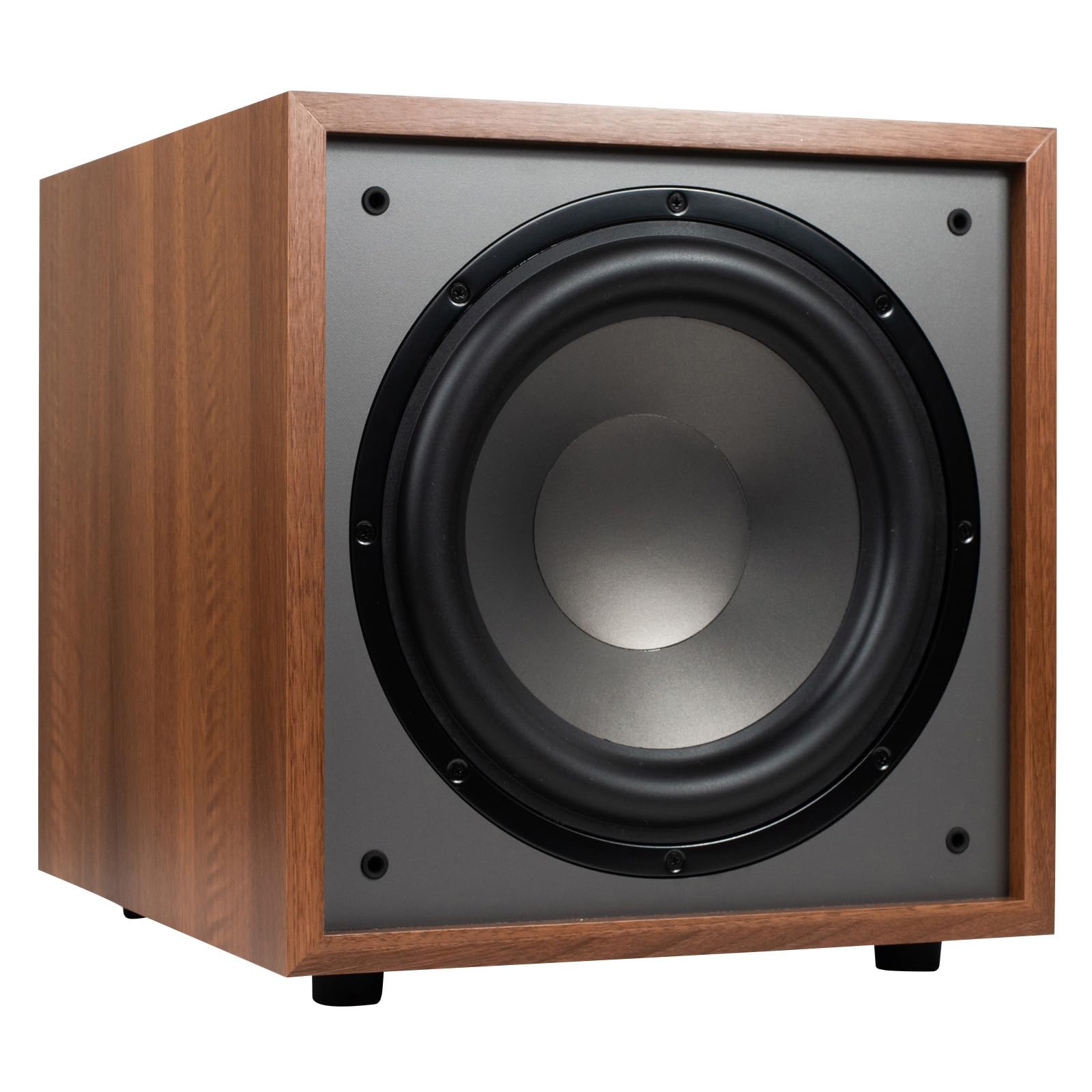
The Dayton Audio Classic CS1200 uses a 12-inch driver in a rigid, braced MDF cabinet with a 200W RMS Class-D amplifier to hit a rated extension of 26 Hz. That puts it in rare company at this price tier, where most models roll off above 30 Hz. The wood-grain finish and swappable gray grille offer visual flexibility, and the included 5-year warranty provides exceptional peace of mind for a powered subwoofer.
Connectivity includes stereo RCA, LFE, and speaker-level inputs for universal compatibility. The auto-on function engages within seconds of receiving a signal, and the continuously variable crossover (50-200 Hz) plus phase switch simplify tuning. User reviews highlight the tight, non-boomy bass character, noting that the CS1200 blends cleanly with both bookshelf speakers and full-range tower systems.
The cabinet measures 18 x 15.5 x 16.4 inches, requiring a slightly larger footprint than 10-inch competitors. A handful of users experienced loose driver screws after extended use, which is resolved by periodic tightening. For buyers who prioritize low-frequency depth and long-term reliability over absolute compactness, the CS1200 delivers exceptional value.
Why it’s great
- Deep 26 Hz extension for true sub-bass
- 200W RMS Class-D amplifier provides clean power
- 5-year warranty is best-in-class for the tier
Good to know
- Larger cabinet may not suit tight spaces
- Grill cloth attachment feels less durable than cabinet
3. PreSonus Eris Sub 8BT

The PreSonus Eris Sub 8BT packs an 8-inch woven-composite woofer with 100W RMS of Class-D power into a compact front-firing cabinet. Its frequency response extends to 30 Hz, which is exceptional for an 8-inch driver and on par with many 10-inch designs. The front-panel headphone output and Bluetooth 5.0 connectivity make it uniquely suited for desktop studio monitoring, multimedia work, and casual wireless streaming.
Variable low-pass and high-pass filters let you set precise crossover points, while the phase switch and low-frequency tuning controls compensate for room placement. Input options include balanced 1/4-inch TRS, unbalanced RCA, and a front-panel 1/8-inch aux, ensuring compatibility with professional interfaces, consumer TVs, and phone playback. User reviews confirm the tight, accurate bass avoids port chuffing and cabinet vibration.
The Eris Sub 8BT is best paired with near-field monitors or bookshelf speakers in small to medium rooms. It lacks the brute-force output of larger subs for home theater, and its 40-minute auto-standby may interrupt long playback sessions. For buyers seeking studio-grade accuracy with Bluetooth convenience, however, the Eris Sub 8BT is a standout.
Why it’s great
- 30 Hz extension from an 8-inch driver is impressive
- Bluetooth 5.0 and multiple input options
- Studio-tuned accuracy with adjustable room compensation
Good to know
- Not powerful enough for large home theaters
- Auto-standby engages at 40 minutes of silence
4. Polk Audio PSW10

The Polk Audio PSW10 is a 10-inch powered subwoofer with a 50W RMS amplifier and Polk’s Power Port technology, which aims to reduce port noise and turbulence. Frequency response is rated at 40-160 Hz (-3 dB), placing it firmly in the mid-bass region rather than deep sub-bass territory. The compact design and detachable grille make it a clean addition to small living rooms or bedroom systems.
Connectivity covers RCA line-level and speaker-level inputs, plus a phase toggle switch for dual-subwoofer configurations. Continuously variable crossover (80-160 Hz) allows basic integration, though the range is narrower than competitors offering 50-200 Hz adjustment. User reviews describe the PSW10 as musical and non-boomy, with effective auto-on/off and quiet operation — ideal for listeners who prioritize subtlety over chest-thumping impact.
The front-firing port can produce audible chuffing at high volumes, and the 50W RMS limits headroom in medium to large spaces. Some buyers resolve this by using two PSW10 units in pairs. For small-room music systems where affordability and musicality are top priorities, the PSW10 remains a budget-friendly benchmark.
Why it’s great
- Musical, non-boomy character suits music listening
- Compact design fits small entertainment centers
- High-level inputs for legacy amplifier compatibility
Good to know
- Front port may buzz at high volume
- Limited 50W RMS output and narrow crossover range
5. Rockville Rock Shaker 12

The Rockville Rock Shaker 12 delivers an 800-watt peak Class-D amplifier driving a 12-inch woofer in an MDF enclosure. Adjustable crossover (50-150 Hz), phase switch, and volume control give users flexibility to tailor output. The flared internal port design reduces air noise, and the compact cabinet for a 12-inch sub aids placement in tighter corners.
User feedback consistently emphasizes the surprising room-shaking output from such a low-cost unit. The subwoofer pairs well with budget AV receivers and bookshelf setups, reproducing deep bass for movies and electronic music without immediate distortion. The included remote control adds convenience, though response depends on line of sight.
Build-quality caveats include reported cabinet buzz around 151 Hz from panel resonance, and the laminate finish showing bubbles on some units. The amplifier/driver assembly feels lightweight relative to the cabinet size. For buyers maximizing low-frequency output per dollar who can tolerate minor fit-and-finish issues, the Rock Shaker 12 delivers big.
Why it’s great
- 12-inch driver provides deep, room-filling bass
- Very affordable for the output level
- Flared ports reduce chuffing
Good to know
- Cabinet buzz at specific frequencies reported
- Laminate finish may have cosmetic imperfections
6. Dayton Audio Classic CS1000
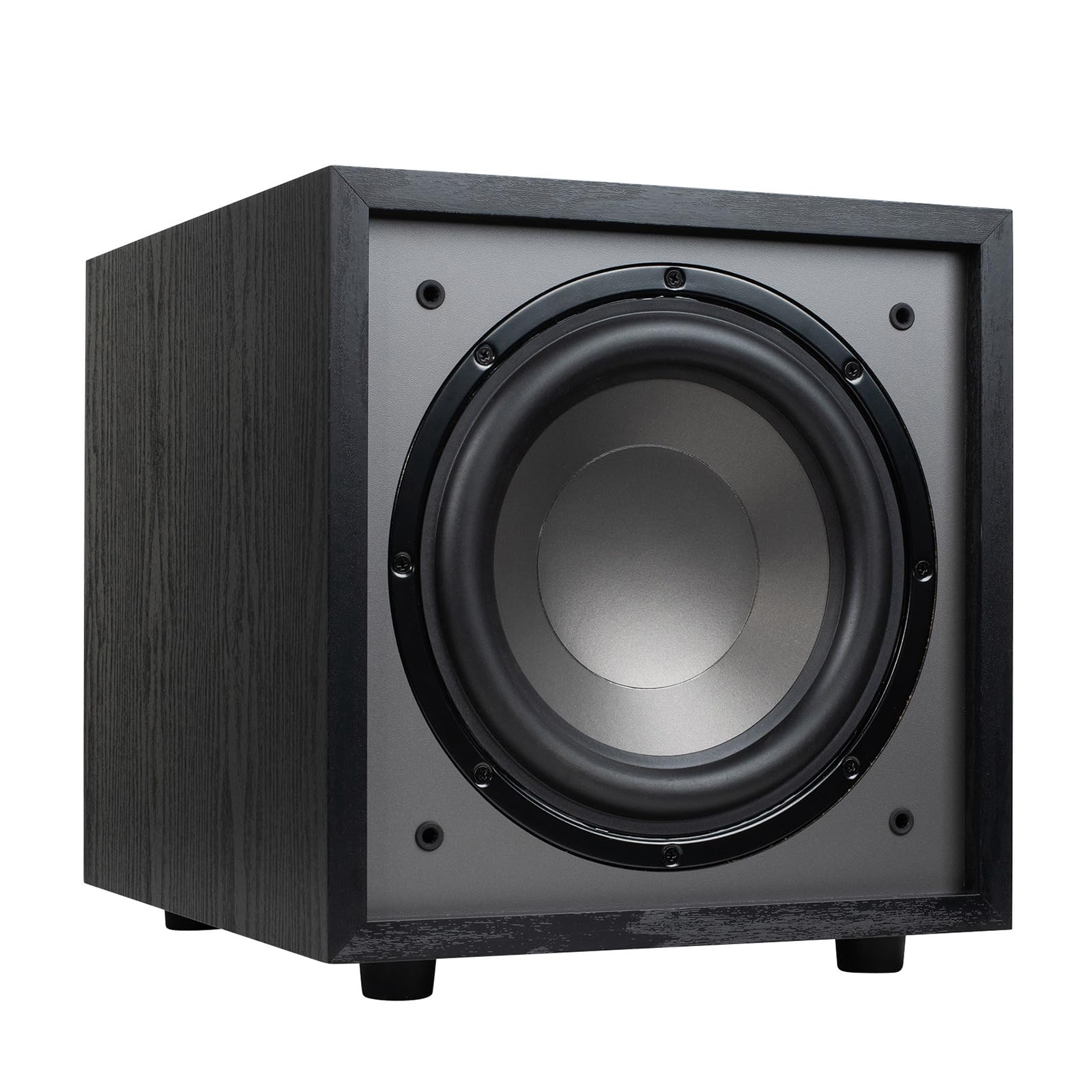
The Dayton Audio Classic CS1000 features a 10-inch driver with a 180W RMS Class-D amplifier in a braced MDF cabinet, achieving a frequency response down to 28 Hz. This extension is competitive with many 12-inch models while keeping a smaller footprint. The swappable grille (black included, gray sold separately) and black finish allow visual customization.
Stereo RCA, LFE, and speaker-level inputs support a wide range of setups, from 2-channel stereo to 5.1 home theater. The auto-on circuit is responsive, and the variable crossover plus phase switch provide fine-tuning control. User reviews note tight, accurate bass that avoids boominess, with the 5-year warranty adding peace of mind against amplifier failure.
A few users report the grill cloth feeling less robust than the cabinet itself. Placement is critical to avoid bloated mid-bass, but when properly positioned the CS1000 integrates seamlessly with satellite speakers. It is an excellent middle-ground choice for buyers who want 10-inch depth and reliability without stepping up to a 12-inch cabinet.
Why it’s great
- 28 Hz extension from a 10-inch driver
- 180W RMS Class-D amp delivers clean power
- 5-year warranty backs long-term use
Good to know
- Grill cloth feels less substantial than cabinet
- Proper placement is essential for optimal response
7. Klipsch Reference R-8SW

The Klipsch Reference R-8SW packs an 8-inch spun-copper IMG woofer and a 150-watt peak all-digital amplifier into one of the most compact enclosures in this comparison. The down-firing design directs bass into the floor, which helps reduce localization and keeps the cabinet footprint minimal. It is engineered to integrate with the Klipsch Reference speaker series for timbre-matched systems.
Users consistently praise the tight, clean bass character that avoids the sloppy overhang typical of smaller subs. The R-8SW excels in small rooms and apartments where excessive low-end would disturb neighbors. Volume, low-pass crossover, and phase controls provide adequate tuning, though the lack of LFE input may limit compatibility with some AV receivers.
Some users report a noticeable pop sound when the subwoofer powers off after signal loss. The 8-inch driver cannot match the output of larger models in medium to large living rooms, and pushing gain past 50% introduces audible distortion. For desktop systems, bedrooms, or office near-field setups, the R-8SW delivers Klipsch-quality bass without overwhelming the space.
Why it’s great
- Very compact design fits tight spaces
- Down-firing woofer reduces noise and vibration
- Tight, clean bass for small rooms
Good to know
- Pop sound on auto power-off
- Limited output for medium to large rooms
8. Edifier T5s

The Edifier T5s is purpose-built for augmenting desktop bookshelf speakers with its 8-inch long-throw woofer and 70W RMS Class-D amplifier. Its slim, vertical cabinet (just 6.7 inches wide) fits behind a monitor or beside a desk tower, while the wood-grain finish and low-profile grille blend into home decor. The front-firing driver and right-firing acoustic port minimize resonance for clean output.
Low-pass filter adjustment (30-160 Hz) and a phase selector (0°/180°) make integration with Edifier speakers and third-party active monitors straightforward. The auto-standby engages after 15 minutes of inactivity, efficiently conserving power. User reviews note that the T5s provides tight, accurate bass down to 35 Hz, ideal for near-field music listening and gaming without overwhelming the desk area.
For series wiring (audio source to T5s to main speakers), the main speakers require line-level input — Bluetooth, USB, or optical sources do not pass through. The 70W RMS output is adequate for small rooms but will not pressurize a large living space. For desktop audio enthusiasts seeking a matching subwoofer for Edifier or similar small monitors, the T5s is purpose-fit.
Why it’s great
- Slim 6.7-inch wide cabinet fits desk setups
- 35 Hz extension suits near-field music listening
- Auto-standby with 15-minute idle trigger
Good to know
- Series wiring limits main speaker input types
- 70W RMS output is for small rooms only
9. Rockville Rock Shaker 10

The Rockville Rock Shaker 10 features a 10-inch woofer with a 600-watt peak Class-D amplifier, making it one of the most powerful budget subwoofers by raw wattage. Adjustable volume, crossover (50-150 Hz), and phase controls plus both RCA and speaker-level inputs give it broad compatibility. The MDF enclosure with detachable foam grill keeps the build practical for the price tier.
Customer reviews highlight chest-thumping bass output that shakes rooms at just 50% gain, easily outperforming similarly priced 8-inch models. The remote control adds basic convenience for volume adjustments from the listening position. It pairs well with bookshelf speakers and budget AV receivers for home theater and electronic music playback.
Some users note that the bass can feel slightly loose compared to pricier sealed designs, and the crossover is a shelf-type control rather than a true variable low-pass filter, which can cause muddiness if set too high. The foam grill may show wear over time. For buyers prioritizing maximum low-end output at the lowest possible cost, the Rock Shaker 10 delivers undeniable bang for the buck.
Why it’s great
- High peak power for room-shaking bass
- Adjustable controls and remote included
- Extremely affordable for 10-inch output
Good to know
- Shelf-type crossover can cause muddiness
- Bass can feel slightly loose at extreme levels
FAQ
What crossover frequency should I set for my affordable subwoofer?
Can I use a budget subwoofer for music, or are they only for movies?
Does down-firing vs. front-firing placement affect performance?
Final Thoughts: The Verdict
For most users, the best affordable subwoofer winner is the Klipsch R-100SW because it combines a 10-inch driver, 32 Hz extension, and reliable integration controls at a price that outperforms the build-quality compromises of cheaper options. If you want deeper sub-bass for home theater impact, grab the Dayton Audio Classic CS1200. And for desktop studio accuracy with Bluetooth convenience, nothing beats the PreSonus Eris Sub 8BT.