
Our readers keep the lights on and my morning glass full of iced black tea. As an Amazon Associate, I earn from qualifying purchases.
Specs are compiled from manufacturer listings and verified buyer reviews and can change over time — please confirm the key details on the product page before buying.
New stargazers often overvalue magnification, but aperture matters more. This guide highlights affordable beginner telescopes that deliver crisp lunar and planetary views with easy setup.
I’m Min — the founder and writer behind Gadgets Feed. This guide is built by comparing the manufacturers’ published specifications and the patterns across verified customer reviews, so you get each pick’s real strengths and trade-offs instead of marketing spin.
Aperture size is the true measure of what you’ll see tonight. Our roundup of the best affordable telescope for beginners is led by a top pick that pairs a large 80mm aperture with a light, portable build for easy everyday viewing.
Our Picks at a Glance

How To Choose The Best Affordable Telescope For Beginners
Before you buy, you need to know what makes one scope worth your money and another a frustrating toy. Here are the three things that matter most when you are just starting out in astronomy.
Start With Aperture, Not Magnification
Aperture is the size of the main lens or mirror that collects light. A bigger aperture means you see fainter objects and more detail, so this is the spec that defines what your scope can do. Magnification, on the other hand, is just a marketing number. A scope with a huge advertised zoom but a tiny aperture will deliver a dim, blurry image at high power, so judge a telescope on the size of its aperture first and foremost.
Match the Mount to Your Patience
Your tripod and mount hold the tube steady, and a shaky mount will ruin the view at any magnification. An alt-azimuth (AZ) mount moves up-down and left-right, which is simple and intuitive for a beginner. A German equatorial mount is more complex but tracks the stars’ movement across the sky, which helps if you plan to do astrophotography later. For your first scope, a stable AZ mount is usually the better choice.
Check What Comes in the Box
A complete kit saves you money and hassle. Look for a set that includes a couple of eyepieces, a finderscope (a small scope that helps you aim the main tube), and a phone adapter so you can snap photos of the Moon. A carry bag is a big bonus, since it means you can transport the whole kit safely to a darker sky location.
Quick Comparison
| Model | Best For | Aperture | Focal Length | Magnification | Amazon |
|---|---|---|---|---|---|
| Celticbird 80mm★ Best Overall | Best Overall Balance | 80mm | 600mm | 30X-66X | Amazon |
| MEEZAA 80mmFamily Fun Pick | Family Flexibility | 80mm | 500mm | 20X-150X | Amazon |
| Celestron Travel Scope 70Compact Traveler | Ultra Portability | 70mm | 400mm | — | Amazon |
| MEEZAA 90mm | Bright Lunar Detail | 90mm | 800mm | 32X-240X | Amazon |
| Dianfan 90mm | Phone Astrophotography | 90mm | 800mm | 32X-240X | Amazon |
| Hawkko 90mm | High Power Reach | 90mm | 900mm | 36X-270X | Amazon |
| Celestron PowerSeeker 127EQ | Deep Space Glimpses | 127mm | 1000mm | — | Amazon |
| HUGERSTAR 90mm | Gift-Ready Simplicity | 90mm | 800mm | 32X-240X | Amazon |
| Gskyer 90mm | Versatile Viewing | 90mm | 600mm | 24X-120X | Amazon |
In‑Depth Reviews
1. Celticbird Telescope for Adults, 80mm Aperture 600mm AZ Mount
Our pick — over 4★ from 850+ verified ratings; the strongest balance of quality and price.
The sweet-spot scope that shows beginners real craters and rings without a steep learning curve.
You get bright, clear views of the Moon, Saturn, and Jupiter right away because this refractor pairs an 80mm aperture (the light-gathering lens width) with a 600mm focal length (f/6.7). Two eyepieces — a 20mm and a 9mm — give you 30X and 66X magnification, enough for a first scope. The included moon filter passes only 13% of light, boosting contrast on bright lunar nights.
The whole kit travels in a backpack, including the adjustable aluminum tripod that extends from 17.7 inches up to 52 inches tall. That range means it fits both a seated child and a standing adult. The upgraded phone adapter clips your smartphone to the eyepiece, and buyers report it is easy to capture shareable photos of the Moon through it.
Setup is tool-free, so you can have it assembled on the first clear night with the manual or a quick video. Owners mention “clear views of moon craters and Saturn’s rings,” and the general consensus is that quality, easy setup, and clarity are what win people over. The highest-praised aspect is the build quality, with ease of setup following closely behind.
Quality-focused verdict: Its 800mm focal length provides 20% more reach than the MEEZAA 80mm’s 500mm tube for finer planetary detail. The 5×24 finderscope helps you locate targets, though some note it could be upgraded later, and the mount is stable at typical magnifications but may show slight instability at the very highest settings.
Reach for this if: you want the most balanced, travel-friendly kit for a beginner adult or a child aged 8–12, and you want to see the Moon’s craters and Saturn’s rings clearly on the first try.
Look elsewhere if: you plan to push magnification beyond 66X regularly — you would need a larger aperture scope and a more sturdy mount for that.
2. MEEZAA Telescope for Adults & Kids, 80mm Aperture 500mm Refractor
A kid-friendly kit with bright yellow styling and higher zoom range that makes family nights a hit.
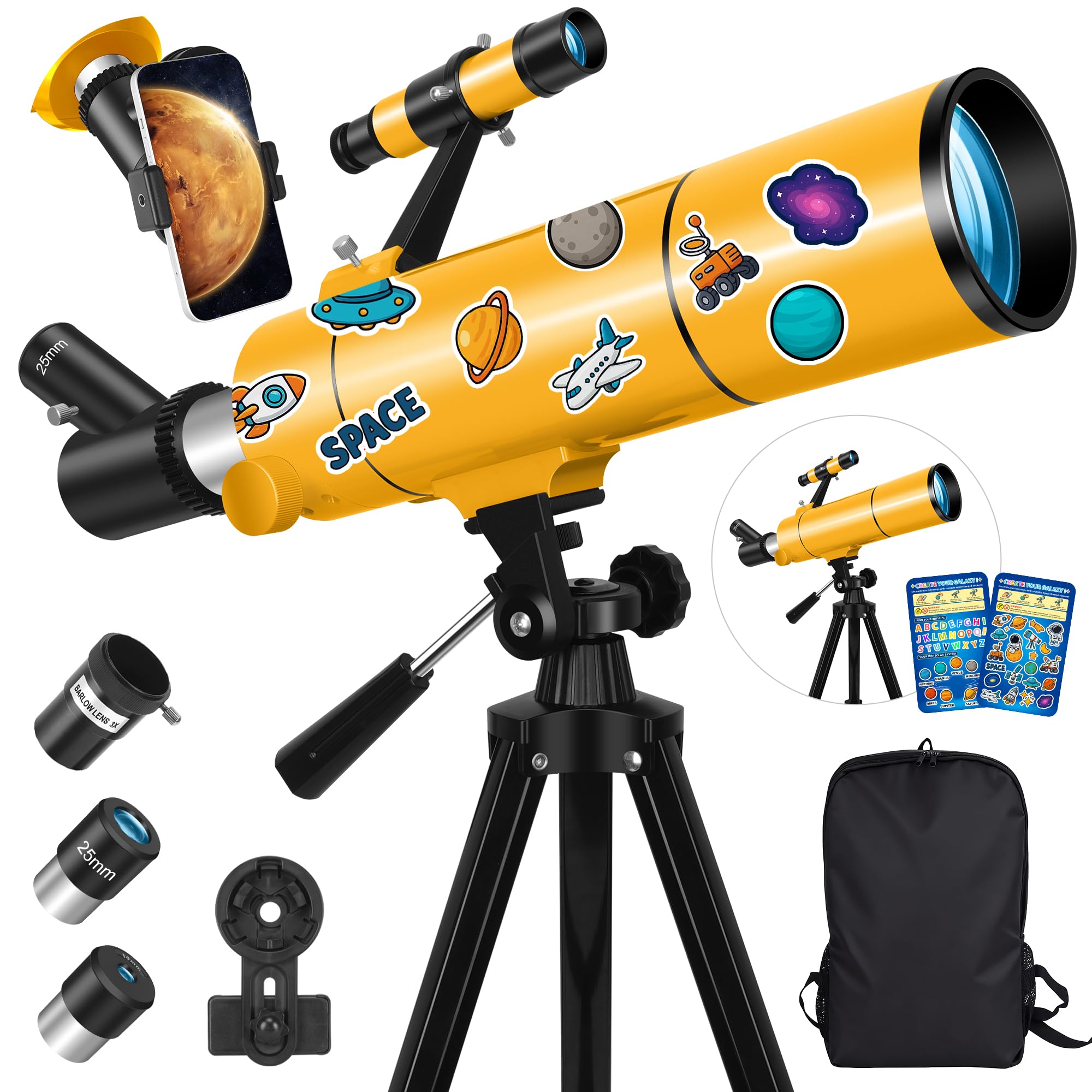
The MEEZAA keeps things simple for families, with an 80mm aperture and a shorter 500mm focal length than our top pick. The shorter tube makes it light and compact, which is ideal for small hands. The real draw here is the zoom flexibility: it ships with 25mm and 10mm eyepieces plus a 3X Barlow lens, open up a range from 20X up to 150X for crisp, detailed views.
Kids can personalize the scope with the included colorful space stickers, which makes it feel like their own. The tripod adjusts from 16.92 to 44.48 inches, and the included waterproof backpack keeps every piece organized for travel. A 45° zenith mirror delivers upright images, so daytime viewing of birds or landscapes looks natural and comfortable.
Assembly takes about 10 minutes with no tools required. The fully multi-coated optics are credited with enhancing brightness and clarity, and the general verdict is that it delivers detailed moon views for the price. Quality earns the most praise from owners, with image quality right behind it.
Why families love it
- Compact, foldable design that is easy to carry for travel, hiking, or camping
- Wide magnification range from 20X to 150X with the 3X Barlow lens
- Phone adapter included for recording and sharing astrophotography
A note on the build
- Opinions on sturdiness are split — some owners find it steady, others say it can feel flimsy
- A few owners note the adjustability could be better
Best suited for: a family with kids aged 8–12 who want a fun, colorful, portable scope for backyard moon watching and daytime nature spotting.
Trade-off to know: treat the tripod gently at full extension, since stability is the most mixed aspect among owners.
3. Celestron Travel Scope 70mm Beginner Portable Telescope with Backpack
The recognized brand-name scope engineered to slip into a backpack for trips and quick sessions.
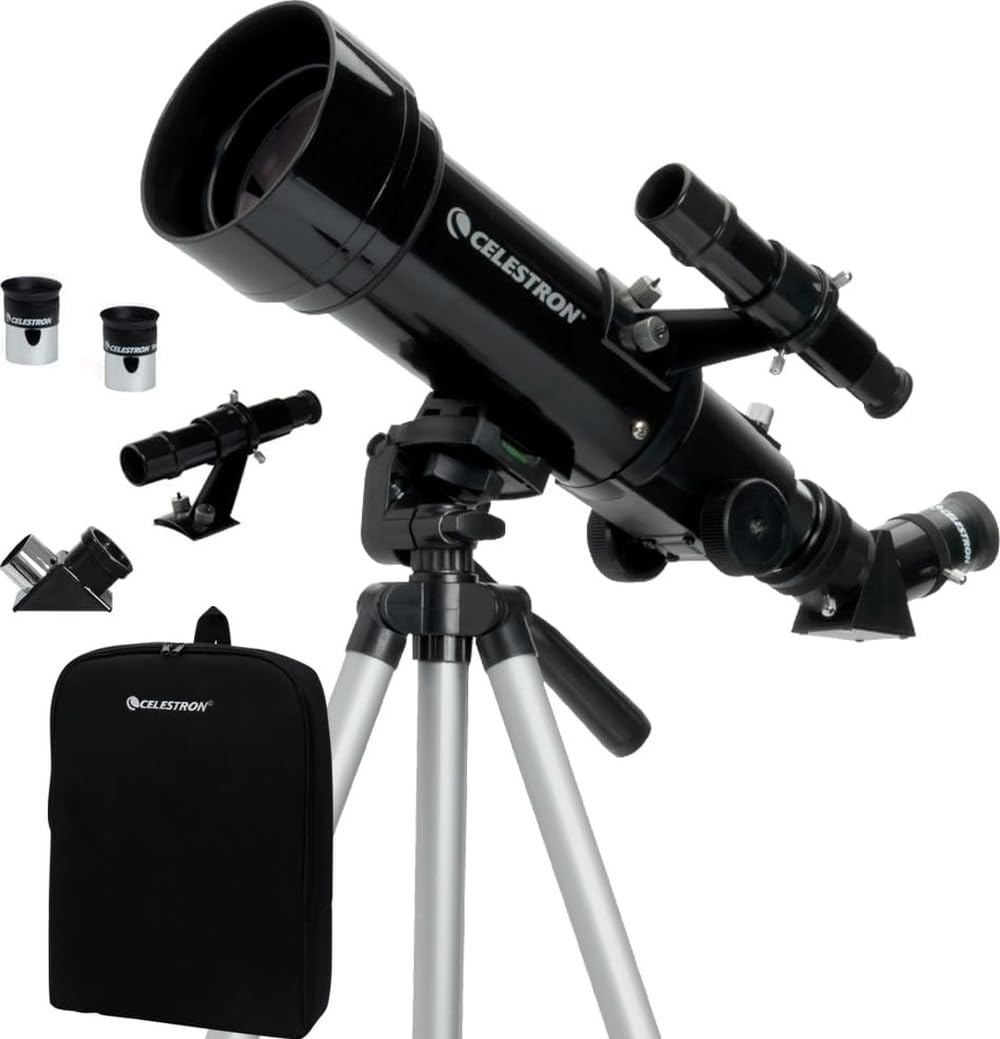
Celestron has been building telescopes in California since 1960, and this 70mm refractor is their travel-friendly entry point. With a 400mm focal length and fully coated glass lenses, it delivers crisp views of the Moon, planets, and daytime scenery in a lightweight, travel-ready design. The padded backpack swallows the scope, tripod, and accessories, and it is even roomy enough to double as a laptop bag.
Setup is genuinely tool-free — the full-height tripod and tube assemble in seconds. The 20mm and 10mm eyepieces give you wide and close-up views, and the included free download of Starry Night software helps you identify what you’re looking at and plan your sessions. A 5×24 finderscope and 45° erect image diagonal complete the kit.
Owners call it the best option for amateur newcomers, praising the crisp moon views and the daytime performance. Enjoyment and suitability for beginners are the top praised aspects, and the portability is a major plus. Note that value for money draws mixed feedback, and the tripod is the part owners say to treat carefully — it is fairly fragile when fully extended.
Reality check: The 70mm aperture is smaller than the 80mm and 90mm scopes here, so expect great Moon views and decent planetary views, not faint deep-sky objects.
Choose this for: the traveler or gift-giver who wants a trustworthy brand, a true no-tool setup, and a scope that packs away in seconds.
Who should pass: anyone who wants to do serious deep-space observing — the smaller aperture and wobbly tripod will frustrate you.
4. MEEZAA Telescope for Adults High Powered, 90mm Aperture 800mm Refractor

The step-up scope that reveals Jupiter’s cloud bands and stunning lunar craters for growing hobbyists.
Moving up to a 90mm aperture and an 800mm focal length (f/8.88), this MEEZAA is the upgrade path for someone who has outgrown a 70mm or 80mm starter. The larger lens gathers noticeably more light, and the fully multi-coated optical glass lenses with high transmission coating deliver brighter, sharper images. Owners consistently mention crisp views of the Moon’s craters and Jupiter’s bands.
The 10mm and 25mm eyepieces, combined with a 3X Barlow lens, open up a magnification range from 32X up to 240X. That’s enough power to catch unprecedented lunar detail for a scope in this class. The stainless steel tripod adjusts from 28 to 46 inches, a sturdier foundation than aluminum at this price, and everything tucks into a padded carry bag.
Assembly takes about 10 minutes for 90% of users using the paper manual. The quality and ease of use are what owners praise most, and the variety of accessories means you won’t need to buy anything else soon. It ranks as an excellent investment for beginners and families who plan to stick with the hobby.
Best for: the beginner who loves the hobby and wants an aperture upgrade that reveals Jupiter’s cloud bands alongside crisp lunar craters.
Expectation setting: at the top end of 240X, images can get soft — stick to lower magnifications for the sharpest planetary views.
5. Dianfan Telescope, 90mm Aperture 800mm for Adults High Powered

A 90mm performer with impressive phone compatibility that turns first looks into shareable photos.
The Dianfan covers the same 90mm aperture and 800mm focal length as the MEEZAA above, but it earns its spot with a reputation for phone astrophotography. Customers note it works especially well with Samsung and Pixel phones, which is a differentiator — many budget phone adapters struggle with certain models. The fully coated 90mm objective lens gathers light for brighter, clearer views, and the high-transmission coatings enhance contrast and color.
With two eyepieces and a 3× Barlow lens, you get a 32×–240× magnification range. That’s enough to observe craters and lunar seas on the Moon’s surface. The 45° zenith mirror keeps images upright and correctly oriented for terrestrial viewing, so the same scope works for birdwatching and wildlife observation during the day.
Assembly is ready in about 15 minutes, and the sturdy stainless steel tripod keeps things steady. The quality is what owners praise most, with easy setup and image quality trailing close behind. The included bag makes it genuinely portable for travel and outdoor adventures.
Standout strengths
- Sturdy stainless steel tripod provides stable, steady viewing
- Works well with Samsung and Pixel smartphones for photo capture
- 32X–240X magnification range covers lunar and terrestrial targets
Honest limits
- At 240X max, images can blur — the refractor is not ideal for faint deep-space objects
- You may need to calibrate the finder scope carefully for best targeting
Ideal for: the beginner who wants to snap photos of the Moon with their phone and also use the scope for daytime nature viewing.
A fair warning: don’t expect Hubble-level deep-space shots — this is a lunar and planetary performer, not an astrophotography rig.
6. Hawkko 90mm Aperture 900mm Telescope for Adults High Powered

The longest focal length in the lineup, giving you the most powerful magnification for planetary close-ups.
If raw reach is your goal, the Hawkko’s 900mm focal length delivers the highest top-end magnification in this roundup. With a 90mm aperture, it offers a range from 36X up to 270X — enough power to see Jupiter’s cloud bands and Saturn’s rings clearly. The fully multi-coated optics boost light transmission by about 73%, yielding brighter, sharper views.
The stainless steel AZ mount tripod supports smooth 360° rotation, so tracking an object as it drifts across the sky is simple. Height adjusts from 28 to 46 inches to suit different users. Assembly takes about 15 minutes, and The included smartphone adapter and star finder phone mount let over 80% of users capture images on their first try.
Owners consistently recommend this scope for beginners, praising the crisp, bright lunar and distant views. It’s a solid entry-level option that’s easy to assemble and disassemble, and its portability makes it simple to take to darker sky locations. The most-praised aspect is that owners would recommend it, with easy setup close behind.
Power-to-value read: At a 270X top end, this is the most powerful refractor here, but high power means nothing without a steady mount. Owners note minor shake at high magnification and a slightly finicky phone adapter.
Go with this if: you want the highest magnification ceiling in this price class for close-up planetary observation from your backyard.
Keep in mind: for the sharpest views, use lower-power eyepieces and reserve the top magnifications for nights with steady, still air.
7. Celestron PowerSeeker 127EQ Reflector Telescope

A big-aperture reflector that opens a window to the Orion Nebula, for those willing to learn.
The PowerSeeker is a different beast — it’s a 127mm Newtonian Reflector, meaning it uses mirrors instead of lenses to gather light. At 127mm (with a 1000mm focal length), it offers enough light-gathering ability to see planets, the Moon’s craters, distant stars, and even the Orion Nebula. This is the scope that can show you faint deep-sky objects that smaller refractors simply can’t reach.
It features a manual German Equatorial mount with a slow-motion altitude rod, which lets you follow objects smoothly as they drift across the night sky. This mount is more complex than an AZ mount, so there’s a learning curve. It comes with 20mm and 4mm eyepieces plus a 3x Barlow lens, and a free download of top-rated astronomy software.
Owners praise the beautiful appearance and crisp Moon views, but this scope demands patience. Collimation — aligning the mirrors — is essential, and the mount and tripod are widely described as wobbly, making stability the most-discussed negative. Owners advise learning collimation and using the 20mm eyepiece for the best results; the 4mm eyepiece is often called useless.
Why enthusiasts reach for it
- 127mm aperture reveals the Orion Nebula and faint deep-sky objects
- German Equatorial mount tracks the sky’s drift smoothly once mastered
- Compact and portable enough for campsite or dark-sky trips
The steep side of the hill
- Mount and tripod are unstable — vibration is a common complaint
- Mirror alignment (collimation) is essential and daunting for beginners
- Value is a mixed call; some find it worth it, others don’t
Best for: the curious beginner who wants to glimpse deep-space objects like the Orion Nebula and is ready to learn mirror alignment.
Think twice if: you want a grab-and-go scope — this one requires patience and tinkering, and isn’t plug-and-play.
8. HUGERSTAR Telescope for Adults High Powered, 90mm Aperture 800mm Refractor

A complete 90mm kit with a moon filter that arrives ready to wow a young aspiring astronomer.
You get clear, bright views with the HUGERSTAR because it uses a proven 90mm aperture and 800mm focal length (f/8.89), with fully multi-coated lenses. The included moon filter reduces glare and reveals more lunar detail on bright nights. The 10mm and 25mm eyepieces plus a 3X Barlow lens give a 32X-240X range, and the 5×24 finder scope makes locating objects straightforward.
It was described by one owner as “a perfect gift for a 16 year old,” and it’s easy to see why. The stainless steel tripod adjusts from 28.7 to 46.4 inches, the accessory tray holds your eyepieces, and a carry bag makes storage and travel simple. Tool-free assembly takes under 10 minutes for 90% of users.
The quality of the optics at this price surprises owners, who also praise the suitability for beginners and kids. The scope delivers clear views of the Moon and doubles as a wildlife spotting scope for daytime birdwatching. A stable build rounds out the experience.
What to know: a few owners note the phone adapter can struggle with phones that have side buttons or thick cases, so you might need a replacement adapter for certain smartphones.
Pick this up for: a teenager or beginner who wants a complete, ready-to-go kit with the added comfort of a moon filter for those bright lunar nights.
One heads-up: high magnification can get shaky from inherent mount movement, so keep it steady and use the lower-power eyepiece first.
9. Gskyer Telescope 600x90mm AZ Astronomical Refractor Telescope

A 90mm all-rounder with three eyepieces and a BAK7 prism for crisp lunar, planetary, and daytime views.
The Gskyer rounds out the lineup with a 90mm aperture and 600mm focal length (f/6.7), fully coated optics glass lenses with high transmission coatings that create stunning images while protecting your eyes. It’s the most versatile kit here, shipping with three replaceable eyepieces for 24X, 60X, and 120X magnification, plus a 3x Barlow lens that trebles each eyepiece’s power. The 48-degree erecting BAK7 prism keeps images upright for terrestrial viewing, making it just as good for birds as it is for the Moon.
The adjustable aluminum tripod extends from about 31.5 inches to 49 inches, and no tools are required for setup — even a novice can get it focused quickly. A 6×30 finderscope helps you lock onto targets, and the included astronomy software enhances the stargazing experience. The quality of the instrument is praised by owners, with assembly being a close second point of praise.
Reviewers point out clear views of faint objects and the Moon, and kids love using it. The Gskyer also includes a phone mount and Bluetooth shutter, which is a nice touch for beginning astrophotographers. Performance draws mixed feedback, with some saying it works well and others reporting issues, so it’s not the most consistent pick here.
Where it shines
- Three eyepieces plus a 3X Barlow for a wide range of viewing options
- BAK7 erecting prism gives upright images for daytime nature and cityscape viewing
- Phone mount with Bluetooth shutter included for easy photo capture
Honest drawbacks
- Some owners find the tripod too short and replace it with a photography tripod
- A minority report quality control issues, though customer service responds quickly
- High magnification can be shaky without additional stabilization
Best for: the buyer who wants one scope that handles both night sky observation and daytime terrestrial viewing with maximum versatility.
Consider this: the mixed performance reports mean you might get a perfect unit or one that needs a replacement — the responsive customer service helps, but it’s a gamble.
Understanding the Specs
Aperture and Focal Length
Aperture is the diameter of the main lens or mirror — the bigger it is, the more light your scope collects and the fainter the objects you can see. Focal length is the distance the light travels inside the tube before it reaches the eyepiece. A longer focal length generally gives you higher magnification with the same eyepiece, which is why a 900mm scope reaches further than a 500mm one.
Eyepieces, Barlow Lenses, and Magnification
Magnification is calculated by dividing the telescope’s focal length by the eyepiece’s focal length. A Barlow lens multiplies the magnification of any eyepiece — a 3X Barlow triples the power. Remember, more magnification isn’t always better; a shaky mount amplifies at high power, so a stable 66X view often looks sharper than a wobbly 150X one.
FAQ
What size aperture should a beginner telescope have?
Is higher magnification better for a beginner telescope?
What is the difference between an AZ mount and an equatorial mount?
Can I take photos of the Moon with a beginner telescope?
What is a Barlow lens and do I need one?
What is a finderscope and why does it matter?
How long does a beginner telescope take to set up?
Should I get a refractor or a reflector telescope?
Can kids use these telescopes too?
What can I actually expect to see with a beginner telescope?
Final Thoughts: The Verdict
For the majority of shoppers, the affordable telescope for beginners winner is the Celticbird 80mm because it pairs a large 80mm aperture with a 600mm focal length, a portable backpack, and a stable build — the complete package for a first scope. If you want the highest magnification in this class, grab the Hawkko 90mm. And for a family-friendly scope that kids will love to personalize, the MEEZAA 80mm is the one to reach for.
How We Picked
We do not accept paid placement. Every pick is matched to a real buyer and a real use-case; we do not hands-on test units.
Sources & Methodology
Specifications: manufacturer listings and product documentation. Review insights: verified customer reviews, as of August 2026. Pricing: not shown on this page (it changes often); check the current price via the retailer link.
As an Amazon Associate, Gadgets Feed earns from qualifying purchases. This does not affect which products we feature.