
Buying your first telescope is exciting, but the retail shelf is packed with flimsy “toy” scopes that wobble at the slightest breeze and deliver blurry, frustrating views of the Moon. The real challenge isn’t finding a telescope under a certain budget — it’s finding one with a genuinely useful aperture, a stable mount, and glass that doesn’t ruin the hobby before it starts.
I’m Min — the co-founder and writer behind Gadgets Feed. I’ve spent countless hours cross-referencing aperture sizes, focal ratios, mount stability, and real-world customer reports to isolate the telescopes that actually deliver at their price point.
This guide ranks the best telescopes for beginners based on optical clarity, build quality, and included accessories so you can confidently choose a best affordable telescope that rewards your curiosity with crisp, detailed views of the night sky.
How To Choose The Best Affordable Telescope
Choosing an affordable telescope means balancing three competing priorities: light-gathering aperture, mount stability, and included accessories. Ignore the huge “magnification” number printed on the box — it’s a marketing trick. Real performance starts with the objective lens.
Aperture: The Most Important Number
The aperture (objective lens diameter) directly determines how much light enters the telescope. A 70mm aperture is the bare minimum for seeing Saturn’s ring as a separate band. A 90mm aperture gathers about 65% more light than a 70mm, revealing Jupiter’s cloud bands and fainter star clusters. Always choose the largest aperture your budget allows.
Mount Stability: The Unsung Hero
A wobbly mount ruins every observation. Altazimuth mounts are standard on affordable refractors. Look for stainless steel tripod legs instead of aluminum — they reduce vibration transfer. Slow-motion control cables are a premium feature that let you track celestial objects smoothly across the sky.
Focal Length and Magnification
Focal length influences the telescope’s native magnification with any given eyepiece. A 900mm focal length telescope with a 10mm eyepiece produces 90x magnification. Adding a 3x Barlow lens bumps that to 270x. Realistically, usable magnification for affordable telescopes tops out around 200x due to atmospheric turbulence and optical limits. A kit that includes 25mm and 10mm eyepieces plus a 3x Barlow covers the most useful range.
Quick Comparison
On smaller screens, swipe sideways to see the full table.
| Model | Category | Best For | Key Spec | Amazon |
|---|---|---|---|---|
| MEEZAA 90mm | Premium | Best Overall for Beginners | 90mm aperture / 800mm FL | Amazon |
| HETEKAN 90mm | Premium | Highest Magnification Kit | 90mm aperture / 900mm FL | Amazon |
| Hawkko 90mm | Premium | Best Portable High-Power | 90mm aperture / 900mm FL | Amazon |
| Dianfan 90mm (800mm) | Premium | Best Terrestrial & Sky Combo | 90mm aperture / 800mm FL | Amazon |
| Koolpte 90mm | Mid-Range | Best Slow-Motion Mount | 90mm aperture / 700mm FL | Amazon |
| HUGERSTAR 80mm | Mid-Range | Best Value 80mm Starter | 80mm aperture / 600mm FL | Amazon |
| Hawkko 80mm | Mid-Range | Best Budget 80mm with Stickers | 80mm aperture / 500mm FL | Amazon |
| Dianfan 80mm | Mid-Range | Best Backpack Portable | 80mm aperture / 500mm FL | Amazon |
| Gskyer 70mm | Budget | Best Entry-Level Lightweight | 70mm aperture / 400mm FL | Amazon |
In‑Depth Reviews
1. MEEZAA 90mm Aperture 800mm Refractor

This MEEZAA telescope strikes the ideal balance for a first serious instrument. The 90mm aperture and 800mm focal length (f/8.88) collect enough light to resolve Jupiter’s equatorial cloud bands and Saturn’s rings as distinct features, not just fuzzy blobs. The fully multi-coated optics suppress ghosting and boost contrast noticeably compared to single-coated or uncoated entry-level glass.
The stainless steel tripod sets this apart from cheaper aluminum-leg models. At 28 to 46 inches of adjustable height, it offers a stable platform that resists wind vibration. The included 25mm and 10mm Kellner eyepieces, combined with the 3x Barlow lens, deliver a useful magnification range of 32x to 240x — though you’ll likely spend most of your time at 80x and 160x for the sharpest views.
Setup takes roughly 10 minutes with the paper manual, and all accessories stow neatly in the carry bag. The phone adapter works well for lunar snapshots, though deep-sky astrophotography is beyond this scope’s mount design. It’s a straightforward, no-gimmick telescope that prioritizes optical quality over inflated marketing numbers.
Why it’s great
- 90mm aperture gathers 65% more light than 70mm entry-level scopes
- Stainless steel tripod provides excellent stability for high-magnification viewing
- Comprehensive accessory kit with 25mm, 10mm eyepieces, 3x Barlow, and phone adapter
Good to know
- Not designed for deep-sky astrophotography — altazimuth mount lacks motorized tracking
- Kellner eyepieces are adequate but upgrading to Plossl eyepieces improves edge sharpness
2. HETEKAN 90mm Aperture 900mm Refractor
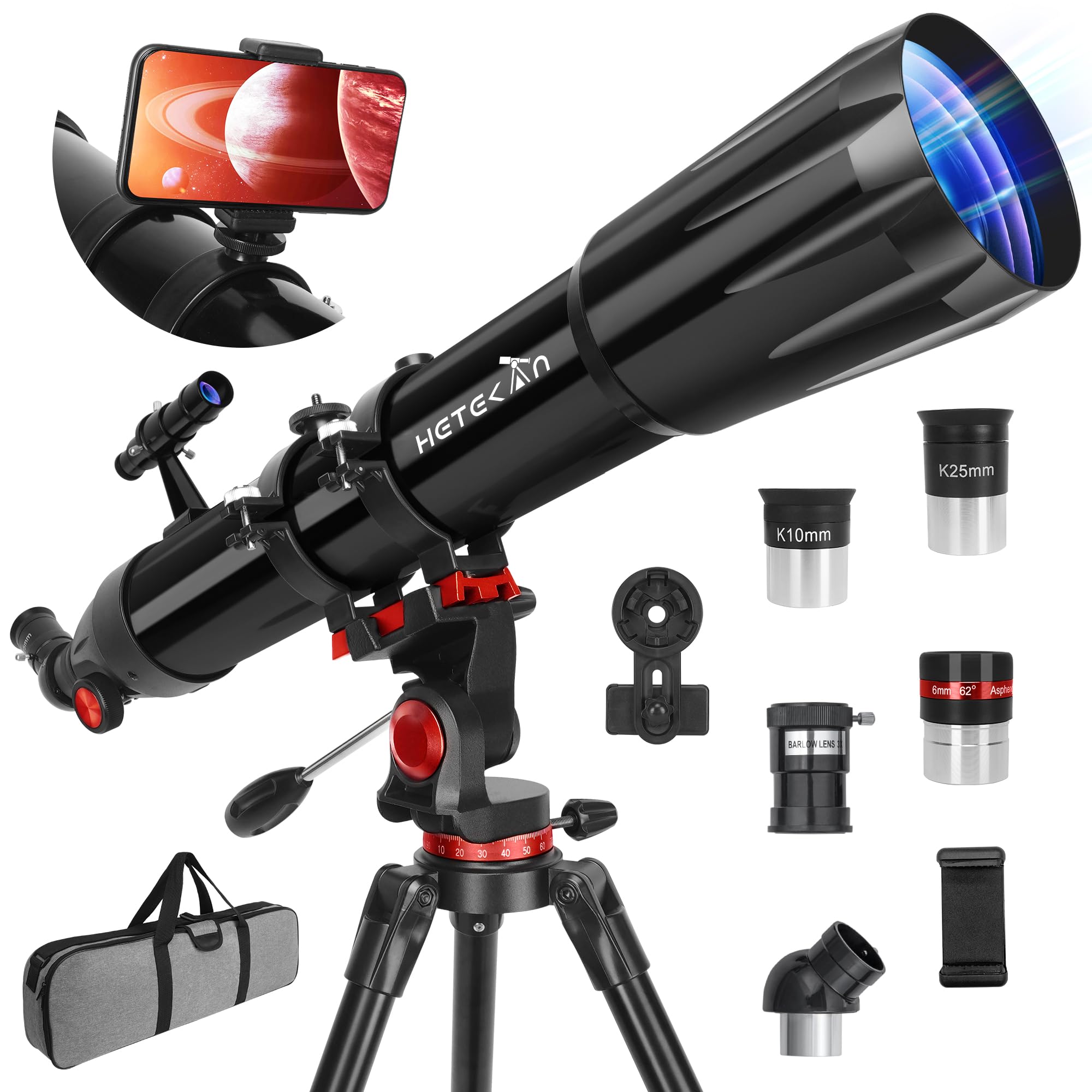
The HETEKAN stands out by including a third 6mm eyepiece, which pushes theoretical magnification to 450x with the 3x Barlow. In practice, atmospheric conditions rarely support 450x on a 90mm aperture, but the 150x from the 6mm eyepiece alone provides excellent close-up lunar and planetary detail. The 900mm focal length (f/10) reduces chromatic aberration compared to shorter tubes — expect cleaner color correction on bright objects like Jupiter and Venus.
The altazimuth mount offers full 360-degree horizontal rotation and 180-degree vertical movement, with tripod height adjustable from 29 to 46 inches. The metal construction feels substantially more rigid than budget plastic alternatives. The included 5×24 finder scope with crosshairs simplifies initial target acquisition, a significant advantage for beginners who struggle to locate objects without it.
Some users report that the instruction manual assumes basic astronomy knowledge, so you may need to consult YouTube tutorials for optimal alignment. The phone adapter works reliably for afocal photography, though images can appear blurry if the phone’s autofocus locks onto the eyepiece glass rather than the celestial target. The carrying case is generous enough to hold the tube, tripod, and all accessories without compression.
Why it’s great
- Includes three eyepieces (25mm, 10mm, 6mm) plus 3x Barlow for maximum versatility
- 900mm focal length delivers higher native magnification with minimal chromatic aberration
- Sturdy metal tripod with full-rotation altazimuth mount for smooth tracking
Good to know
- Instruction manual lacks beginner-friendly detail — expect a learning curve on assembly
- Phone adapter photos can show blur from camera autofocus conflicts
3. Hawkko 90mm Aperture 900mm Refractor

The Hawkko 90mm pairs a generous 900mm focal length with professional-grade full multi-layer coating (FMC) technology that improves light transmittance by about 73% over uncoated optics. This translates directly into brighter, higher-contrast views of the Moon’s terminator line and the subtle shading of Jupiter’s atmosphere. At f/10, the optical system is forgiving of cheap eyepieces while still providing the reach needed for serious planetary observation.
Assembly is straightforward — the included manual and accessory labeling guide you through setup in under 15 minutes without tools. The stainless steel tripod adjusts from 28 to 46 inches and includes an accessory tray that keeps eyepieces organized and prevents them from rolling off the table in the dark. The finder scope mount uses a dovetail-style bracket that stays aligned significantly better than the friction-fit alternatives found on cheaper kits.
The included smartphone adapter accommodates most phone cases without needing to remove them, a small but welcome convenience when switching between users. The 25mm eyepiece delivers a comfortable 36x wide-field view perfect for scanning the Milky Way star clouds, while the 10mm eyepiece with the 3x Barlow reaches 270x for closer looks at Saturn’s rings. The carry bag is well-padded and fits everything securely for camping trips or visits to darker skies.
Why it’s great
- Full multi-coated optics deliver 73% higher light transmission for bright, clear images
- Stainless steel tripod with accessory tray and dovetail finder mount for improved stability
- Smartphone adapter works with most phone cases for quick photo sharing
Good to know
- Long 900mm tube can feel slightly front-heavy on the altazimuth mount
- Included Kellner eyepieces are functional but upgrading to wide-angle eyepieces enhances the experience
4. Dianfan 90mm Aperture 800mm Refractor

The Dianfan 90mm distinguishes itself with a 45-degree erect-image diagonal that delivers correctly oriented views of terrestrial targets during daytime — a feature often absent from pure astronomical refractors. This makes it equally useful for birdwatching, landscape observation, and lunar/planetary astronomy. The 90mm coated objective provides a Dawes limit of 1.29 arc seconds, meaning it can theoretically resolve double stars separated by that tiny angular distance.
The stainless steel tripod and altazimuth mount assembly feels robust at full extension. The mount’s tension adjustment allows smooth panning without sudden drops — a common issue on friction-only mounts. The 25mm eyepiece gives 32x for wide-field galactic sweeping, while the 10mm with the 3x Barlow reaches 240x. The 45-degree diagonal also makes observing objects near the zenith more comfortable than straight-through designs that force awkward neck angles.
The carrying bag is compact but still accommodates the tube and tripod together without excessive force. The phone adapter captures decent lunar shots, though the 45-degree diagonal introduces a slight rotation in the image that takes some getting used to when framing photos. Overall, this is the strongest dual-purpose option in the list for users who want one telescope for both daytime and nighttime observation.
Why it’s great
- 45-degree erect-image diagonal supports both astronomical and terrestrial daytime viewing
- Dawes limit of 1.29 arc seconds delivers theoretical resolution for double-star separation
- Stable stainless steel tripod with smooth tension adjustment for panning
Good to know
- Erect-image diagonal introduces slight image rotation for astrophotography
- Kellner eyepieces are entry-level — consider upgrading to Plossl for improved edge-to-edge sharpness
5. Koolpte 90mm Aperture 700mm Refractor
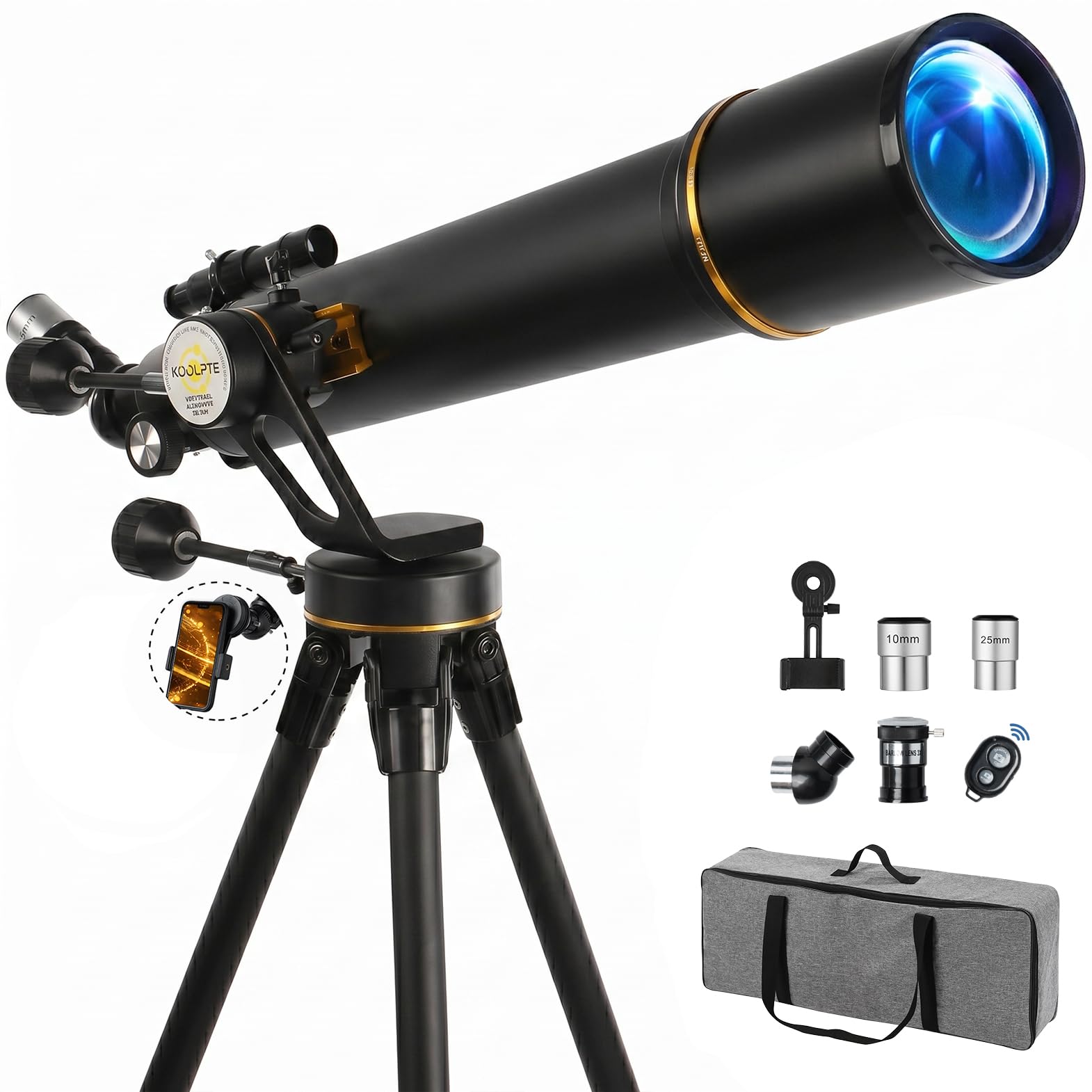
The Koolpte 90mm introduces a Vertisteel AZ Slow-Motion mount that is the standout feature at this price tier. The slow-motion control cables allow precise micro-adjustments in both altitude and azimuth, virtually eliminating the overshoot and wobble that plague basic friction mounts when tracking planets at 210x magnification. The 700mm focal length (f/7.78) is a sweet spot — it offers enough focal ratio to control chromatic aberration while remaining compact enough for the carry bag.
The fully multi-coated optics achieve 99% light transmission per surface, translating to noticeably brighter lunar images and improved contrast on Jupiter’s Great Red Spot (when visible). The included 25mm and 10mm Kellner eyepieces plus the 3x Barlow provide 28x, 70x, and 210x magnification steps — a well-spaced progression that covers low-power sweeping through high-power planetary scrutiny. The stainless steel tripod legs have reversible rubber/steel feet for indoor and outdoor use.
Assembly takes under 10 minutes for most users, and the wireless remote plus phone adapter make astrophotography feasible without touching the tube and introducing vibrations. The accessory tray holds three eyepieces securely, though the tray attachment can feel slightly loose if not fully tightened. Some 6-foot-plus users report that observing near the zenith requires a low stool, as the tripod height maxes out at a typical seated level.
Why it’s great
- Vertisteel AZ Slow-Motion mount provides precise tracking without overshoot
- 99% light transmission from FMC coatings delivers exceptionally bright high-power views
- Wireless remote and phone adapter included for shake-free astrophotography
Good to know
- Tall observers may need a stool for zenith viewing due to tripod height limits
- Accessory tray can loosen during transport — check tightness before each session
6. HUGERSTAR 80mm Aperture 600mm Refractor
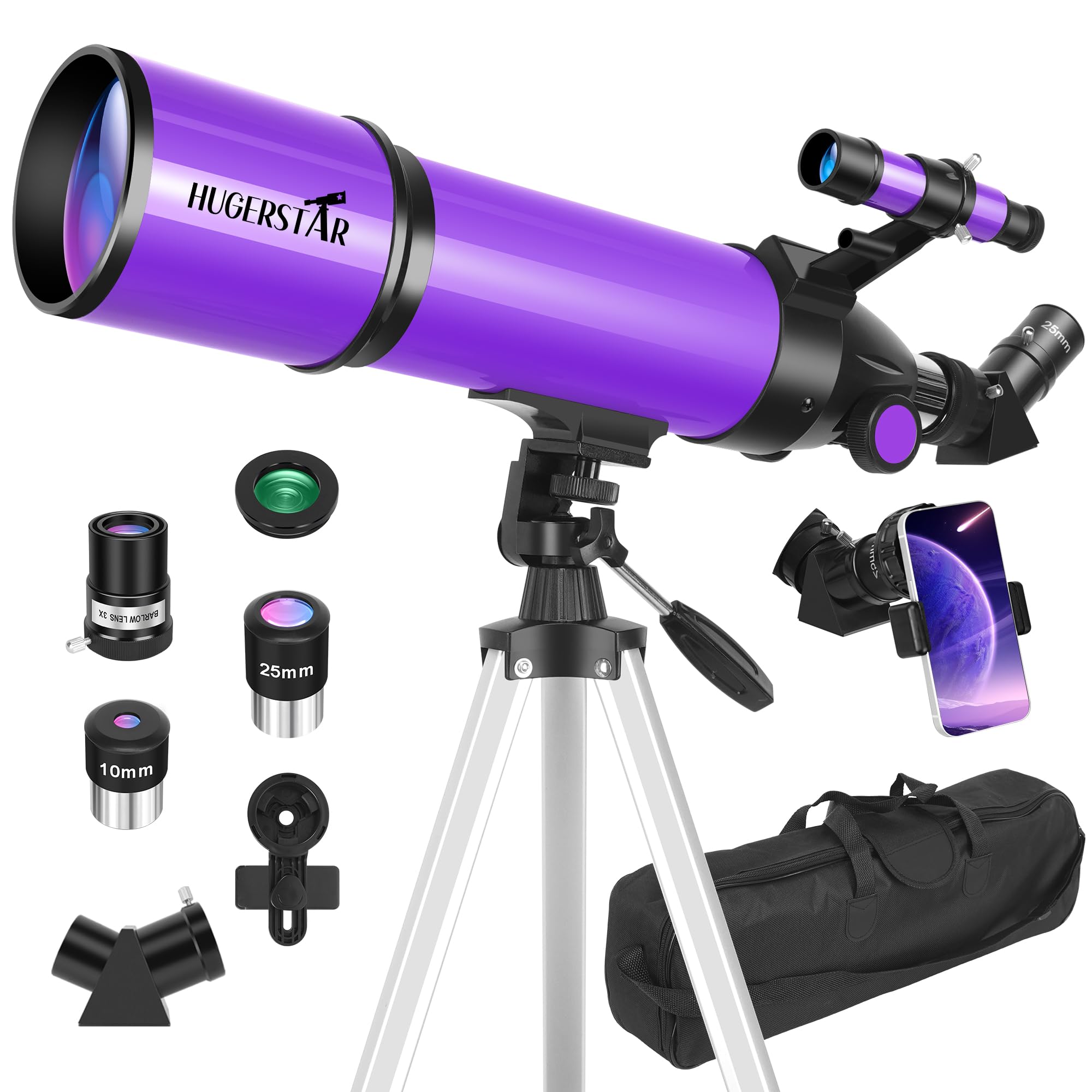
The HUGERSTAR 80mm hits the sweet spot between aperture size and portability. The 80mm objective with fully multi-coated optics captures 60% more light than a 70mm scope, making the difference between seeing Jupiter as a bright disk versus identifying its main cloud bands. The 600mm focal length (f/7.5) provides a moderately wide field of view that works well for both lunar detail and larger deep-sky objects like the Pleiades open cluster.
The kit includes a rare-in-this-class moon filter that threads onto the eyepiece barrel to reduce glare and enhance contrast on the lunar surface — particularly useful during the gibbous phase when the Moon is painfully bright through an 80mm scope. The 25mm and 10mm eyepieces plus 3x Barlow deliver 24x, 60x, and 180x magnification. The 180x setting pushes the limits of what an 80mm aperture can resolve cleanly, but on steady nights it reveals Saturn’s rings as a separate structure from the planet’s disk.
The tripod adjusts from 21.2 to 44 inches and includes a central spreader for added rigidity. The AZ mount rotates 360 degrees horizontally and 180 degrees vertically, though it lacks slow-motion controls. Beginners will appreciate that 90% of users report completing setup in under 10 minutes. The carry bag accommodates all components and is light enough for a child to carry on camping trips.
Why it’s great
- 80mm aperture gathers 60% more light than 70mm entry-level telescopes
- Included moon filter reduces glare and enhances lunar surface contrast
- Tool-free assembly in under 10 minutes with comprehensive carry bag
Good to know
- No slow-motion controls — manual nudging required for high-power tracking
- 180x magnification can exceed atmospheric stability on some nights
7. Hawkko 80mm Aperture 500mm Refractor
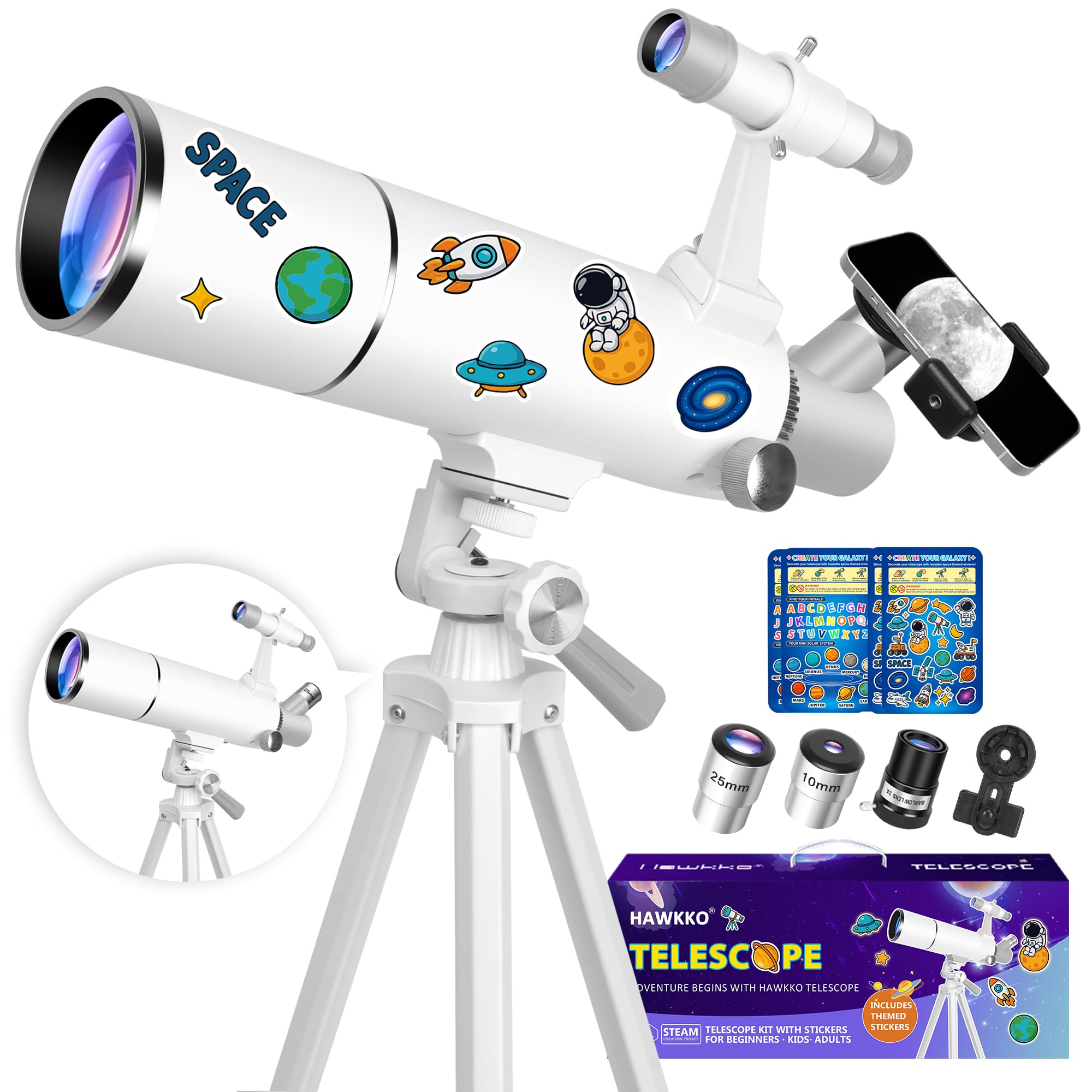
The Hawkko 80mm is the only telescope in this guide that comes with a sheet of space-themed, rocket, and alphabet stickers to personalize the tube. While this may sound like a gimmick, it genuinely helps engage younger stargazers who want to own and customize their instrument. Under the decoration-friendly exterior, the 80mm fully multi-coated objective and 500mm focal length deliver the same light-gathering advantage over 70mm scopes, with clear lunar crater details visible at 50x using the 10mm eyepiece.
The magnification range spans 20x to 150x using the 25mm eyepiece, 10mm eyepiece, and 3x Barlow lens. The 500mm focal length produces a faster f/6.25 ratio, which gives wider fields of view for terrestrial and Milky Way scanning but shows more chromatic aberration on bright planets than longer telescopes. The altazimuth mount uses aluminum alloy legs with rubber feet that grip indoor floors without scratching. Setup is tool-free and takes roughly 5 minutes for experienced users.
The included phone adapter has a universal spring-loaded clamp that fits most smartphones. Some users initially struggle with aligning the smartphone camera perfectly with the eyepiece, but once adjusted, it captures surprising detailed lunar snapshots. The instructional manual is clear and includes diagrams for first-time users. The 2-year manufacturer warranty adds peace of mind for families purchasing their first telescope.
Why it’s great
- Decorative sticker set encourages kids to personalize and bond with the telescope
- 80mm aperture and fully multi-coated optics outperform 70mm entry-level alternatives
- Tool-free assembly in under 5 minutes with 2-year manufacturer warranty
Good to know
- 500mm focal length shows more chromatic aberration on bright planets than 700mm+ tubes
- Phone adapter alignment requires initial calibration for sharp astrophotography
8. Dianfan 80mm Aperture 500mm Refractor
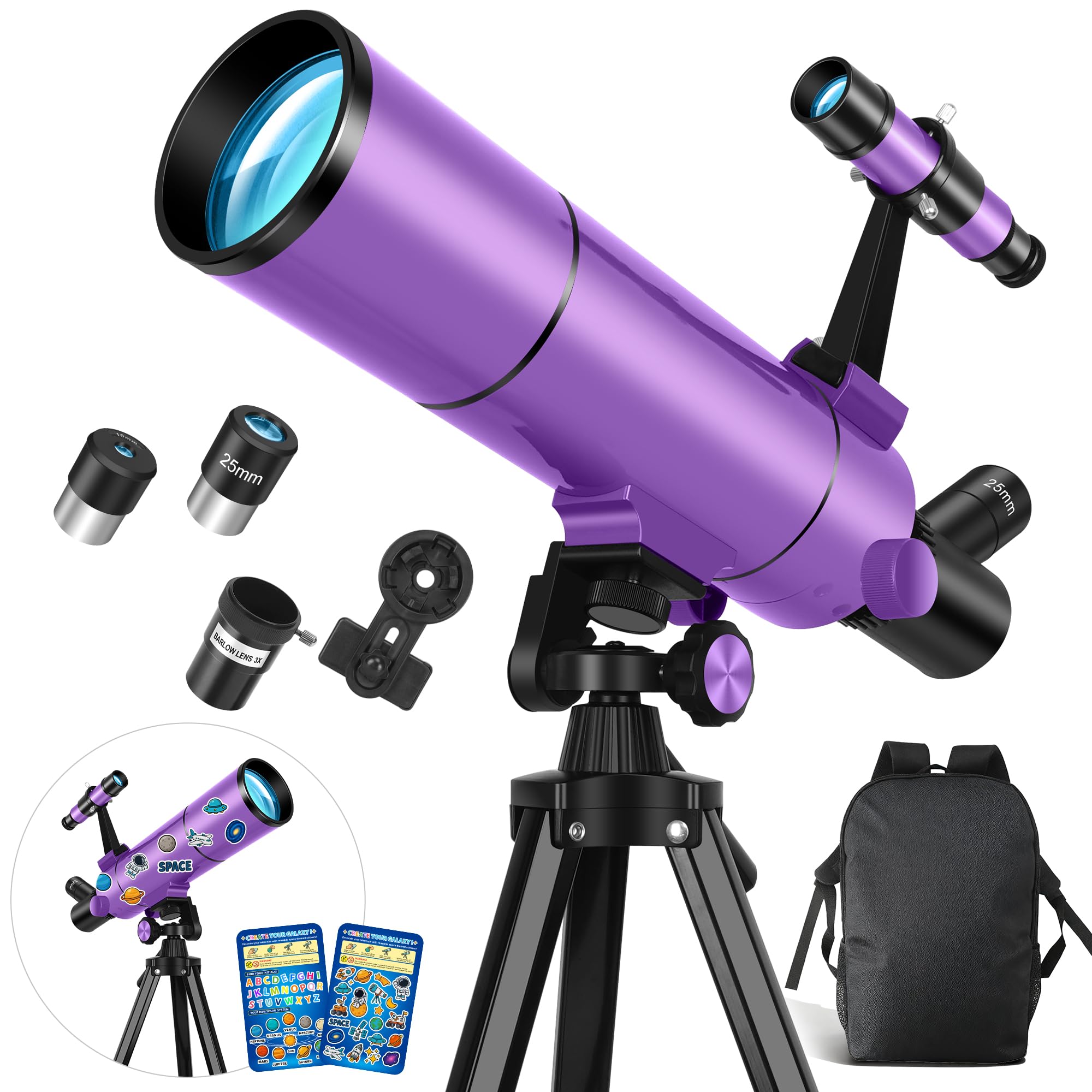
The Dianfan 80mm distinguishes itself with a dedicated custom-fit backpack that allows hands-free transport of the entire telescope kit. This makes it the best choice for families who plan to bring the telescope on hikes, to parks, or to remote dark-sky sites. The purple tube finish and included reusable astronomy-themed stickers appeal strongly to kids without compromising the 80mm aperture that delivers genuine lunar and planetary observation capability.
The 500mm focal length and 80mm objective provide a Dawes limit of 1.45 arc seconds, theoretically capable of resolving double stars separated by that small angular distance. The 25mm and 10mm eyepieces with the 3x Barlow produce 20x, 50x, and 150x magnification. At 50x, the Moon’s craters appear crisp with visible central peaks, and the 150x setting reveals Jupiter’s four Galilean moons as distinct points of light. The 45-degree diagonal keeps images oriented correctly for terrestrial use during daytime.
The backpack is water-resistant and includes padded compartments that protect the tube and eyepieces during transport. The phone adapter fits securely and the manual includes QR codes linking to video assembly guides. Some users note that the mount tension knobs require periodic tightening during extended sessions. The 3+ age recommendation means small parts require adult supervision, but the overall build quality is solid for the price tier.
Why it’s great
- Custom-fit backpack enables hands-free transport to dark-sky locations
- 80mm aperture produces a Dawes limit of 1.45 arc seconds for double-star observation
- Purple finish and stickers appeal to young astronomers without sacrificing optical quality
Good to know
- Mount tension knobs can loosen during use and require periodic re-tightening
- Phone adapter alignment may need trial and error for perfectly centered images
9. Gskyer 70mm Aperture 400mm Refractor

The Gskyer 70mm is the lightest and most portable telescope in this selection at 5.7 pounds complete with tripod. The 70mm aperture and 400mm focal length (f/5.7) create a fast, wide-field instrument ideal for low-power sweeping of the Moon and bright planets. While 70mm gathers less light than the 80mm and 90mm alternatives, it still shows lunar craters clearly and reveals Jupiter’s main cloud bands under steady skies. Saturn appears as a small disk with rings visible as a separate structure at 120x.
The kit includes a wireless camera remote that lets you trigger smartphone exposures without touching the phone — essential for minimizing vibration during astrophotography. The 25mm and 10mm eyepieces plus the 3x Barlow produce 16x, 40x, and 120x magnification. The 5×24 reflex finder scope with crosshairs simplifies initial target acquisition compared to straight-through finders that require awkward head positioning. The aluminum alloy tripod with adjustable legs accommodates both seated and standing observers.
The carry bag is compact and fits the disassembled telescope and tripod without wasted space, making it genuinely suitable for backpacking. The fully coated optics reduce glare but don’t reach the multi-coated standard of pricier models — expect slightly lower contrast on bright targets. The altazimuth mount provides smooth panning but lacks any slow-motion control, so high-power tracking requires patient manual adjustment. This telescope is best suited for young children or as a grab-and-go companion for experienced observers who want a lightweight travel scope.
Why it’s great
- Ultra-light 5.7-pound complete kit is ideal for hiking and backpacking
- Wireless remote enables shake-free smartphone astrophotography from a distance
- Reflex finder scope makes target acquisition faster than straight-through alternatives
Good to know
- 70mm aperture limits light gathering — dimmer deep-sky objects may remain invisible
- Single-coated (not multi-coated) optics show lower contrast than 80mm+ competitors
FAQ
Can I see Saturn’s rings with an affordable 80mm telescope?
What does “fully multi-coated” optics mean for image quality?
Why shouldn’t I buy a telescope based on magnification number?
Final Thoughts: The Verdict
For most users, the best affordable telescope winner is the MEEZAA 90mm because it delivers the largest aperture in the class with a stainless steel tripod, comprehensive eyepiece kit, and a phone adapter — all at a price that doesn’t compromise optical quality. If you want a slow-motion mount for precise planetary tracking, grab the Koolpte 90mm. And for a portable, kid-friendly telescope with a dedicated backpack, nothing beats the Dianfan 80mm.