
A thermal imaging camera translates invisible infrared radiation into a visible heat map, letting you see temperature differences that your naked eye misses. Whether you’re hunting for an electrical hot spot, tracing a plumbing leak behind a wall, or checking insulation gaps in your attic, an affordable thermal camera puts professional-grade diagnostic vision into your hands without requiring a six-figure tool budget.
I’m Min — the co-founder and writer behind Gadgets Feed. I’ve spent hundreds of hours analyzing thermal sensor specifications, detector resolutions, refresh rates, and real-world accuracy data to build this buying guide, ensuring every recommendation is grounded in measurable performance metrics rather than marketing claims.
After comparing detector pixel counts, temperature range limits, frame rates, and build quality across dozens of models, this guide delivers the definitive verdict on the best affordable thermal imaging camera for homeowners, DIYers, and field professionals alike.
How To Choose The Best Affordable Thermal Imaging Camera
Not all thermal cameras under a certain price point are equal. The biggest trap beginners fall into is mistaking a high price tag for high performance, while ignoring the detector resolution and refresh rate that actually determine image quality. Here’s what to prioritize.
IR Detector Resolution — The Image Quality Gate
Every thermal camera has an infrared detector array measured in pixels (e.g., 160×120, 256×192, or 640×480). More pixels mean a sharper heat map with finer detail. At the affordable end, 256×192 (roughly 49,000 pixels) is the sweet spot — sufficient for spotting insulation gaps, electrical faults, and plumbing issues clearly. Anything below 160×120 produces blocky, indistinct images that are hard to interpret.
Frame Rate (Refresh Rate) in Hz
A 9 Hz camera refreshes its image nine times per second, resulting in a choppy, laggy view that makes it difficult to track moving heat sources or pan across a scene. A 25 Hz or 60 Hz camera delivers near-video-smooth motion, essential for scanning large areas quickly or inspecting rotating machinery. For general home inspection, 25 Hz is the minimum acceptable rate.
Temperature Range and Accuracy
Most affordable units cover -4°F to 1022°F (-20°C to 550°C), which handles residential HVAC, electrical panels, and pipe diagnostics. Accuracy is typically ±2°C or ±2% of the reading. For professional inspections requiring tighter tolerances or sub-zero measurements, look for a VOx (vanadium oxide) detector and adjustable emissivity settings to compensate for different surface materials.
Quick Comparison
On smaller screens, swipe sideways to see the full table.
| Model | Category | Best For | Key Spec | Amazon |
|---|---|---|---|---|
| Thermal Master Thor 002 | Premium Handheld | High-res field inspections | 512×384 X³IR / 60 Hz | Amazon |
| TOPDON TC005 | Premium Dual-Lens | Professional reporting | 512×384 TISR / 8 h battery | Amazon |
| VEVOR SC256M | Premium All-Rounder | Long-duration inspections | 256×192 / AI anomaly detection | Amazon |
| Klein Tools TI290 | Premium Pocket Imager | Portable electrical checks | 76,800 pixels / Wi-Fi transfer | Amazon |
| FLIR C3-X | Mid-Range Compact | Cloud-based reporting | 128×96 / MSX enhancement | Amazon |
| HSFTOOLS F2W | Mid-Range Standalone | AI scene detection | 256×192 / 640×480 super res | Amazon |
| Klein Tools TI250 | Mid-Range Compact | Energy audits | 19,200 pixels / USB-C capture | Amazon |
| TOPDON TC004 | Mid-Range Handheld | General DIY diagnostics | 512×384 TISR / 64 GB storage | Amazon |
| InfiRay P2 Pro | Budget Phone Add-On | PCB & microcircuit inspection | 256×192 / 9 g / magnetic macro | Amazon |
In‑Depth Reviews
1. Thermal Master Thor 002
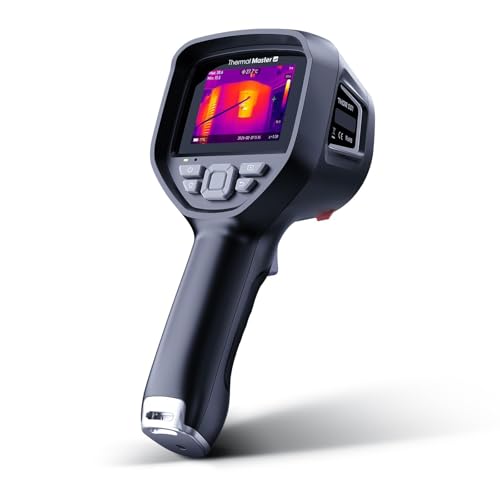
The Thermal Master Thor 002 punches well above its price tier with a native 256×192 detector that gets boosted to a sharp 512×384 effective resolution via X³IR upscaling. At 60 Hz refresh rate, the live feed is fluid enough to track a moving heat plume or scan a wall cavity without motion blur — a rarity at this price point. The 3.5-inch 640×480 IPS display makes interpreting the heat map straightforward even in bright conditions.
A 2 MP visible-light camera allows blended image overlays, and the 5000 mAh battery delivers up to 10.5 hours of continuous use with 18 W fast charging. The temperature range spans -4°F to 1022°F with a ±3.6°F accuracy tolerance, and the six-point measurement system (center, hottest, coldest, plus three user-defined spots) provides comprehensive diagnostic data in a single frame. The IP54 rating and 2-meter drop resistance add confidence for field use.
Users consistently report that the Thor 002 matches or beats the image clarity of units costing twice as much, with several noting they replaced older FLIR models after experiencing the Thor 002’s superior refresh rate and app stability. The only recurring concern is a rare boot failure that resolves with a forced reset, but Thermal Master’s 2-year warranty provides a safety net.
Why it’s great
- Upscaled 512×384 resolution rivals high-end units
- Smooth 60 Hz refresh for real-time scanning
- 10.5-hour battery with fast charging
Good to know
- Occasional boot hang requires reset sequence
- Heavier than pocket-sized competitors
2. TOPDON TC005 Dual-Lens
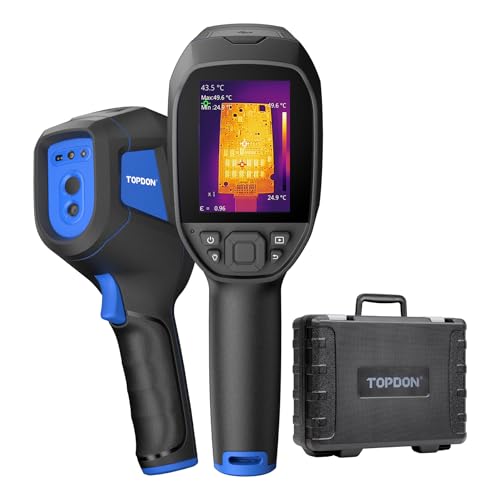
The TOPDON TC005 builds on the TC004 platform by adding a 2 MP visual-light camera and an integrated laser distance meter that measures targets up to 4 meters — a feature normally reserved for units above the premium threshold. The TISR super-resolution engine upscales the 256×192 IR detector to a usable 512×384, providing crisp thermal contours for professional-grade reports.
Wi-Fi connectivity pairs with the TopInfrared mobile app and TopView PC software for image transfer, analysis, and report generation. The 64 GB internal storage holds tens of thousands of images, and the 8-hour battery life with 2-hour recharge time keeps downtime minimal. IP54 protection and 2-meter drop resistance match the ruggedness of field tools twice the price.
Experienced users highlight the TC005’s accuracy when diagnosing stuck brake calipers (reading 400°F vs 108°F on a healthy wheel) and finding air leaks in building envelopes. The Windows analysis software is noted as beta-quality and the USB connectivity can be finicky, but the build quality and thermal performance earn consistent praise. The carrying case is sold separately, which is a minor inconvenience.
Why it’s great
- Built-in laser distance meter eliminates external tools
- Upscaled 512×384 resolution with TISR
- 64 GB internal storage for extensive documentation
Good to know
- PC analysis software feels unfinished
- No carrying case included
3. VEVOR SC256M
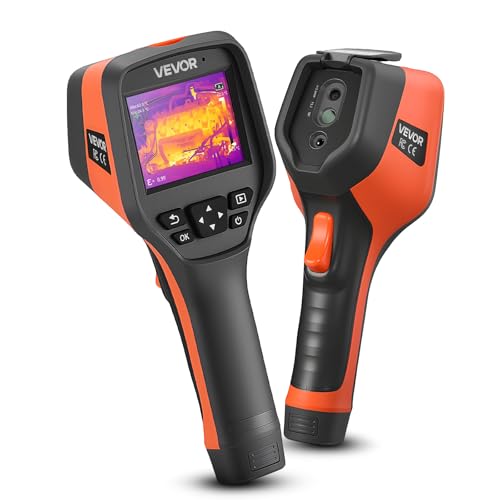
The VEVOR SC256M packs an AI chip for real-time anomaly detection, automatically flagging hot and cold spots as you scan. The 256×192 IR detector with ≤35 mK thermal sensitivity captures subtle temperature gradients, while the integrated 2 MP visual camera overlays context onto the thermal feed. The 3.5-inch touchscreen supports voice annotations, streamlining on-site note-taking.
Dual 4500 mAh batteries provide extended runtime, and the 32 GB built-in storage can hold over 120,000 images. Wi-Fi transfer and 13-language support make it accessible across teams. The 56°×42° field of view is wider than many competitors, covering more area per scan. IP54 and 2-meter drop protection ensure survival in construction and industrial environments.
Users in niche fields like beekeeping have adopted the SC256M to monitor hive health via temperature differentials, while coffee shop owners use it to track heat loss from espresso machines. The 20 Hz refresh rate is adequate for stationary scans but produces noticeable stutter when panning quickly. Startup time is slower than preferred, but the image quality and accuracy justify the wait.
Why it’s great
- AI-driven anomaly detection simplifies fault finding
- Dual 4500 mAh batteries for all-day work
- Wide 56° FOV covers more area per pass
Good to know
- 20 Hz refresh feels sluggish during movement
- Slower boot sequence than leading competitors
4. Klein Tools TI290
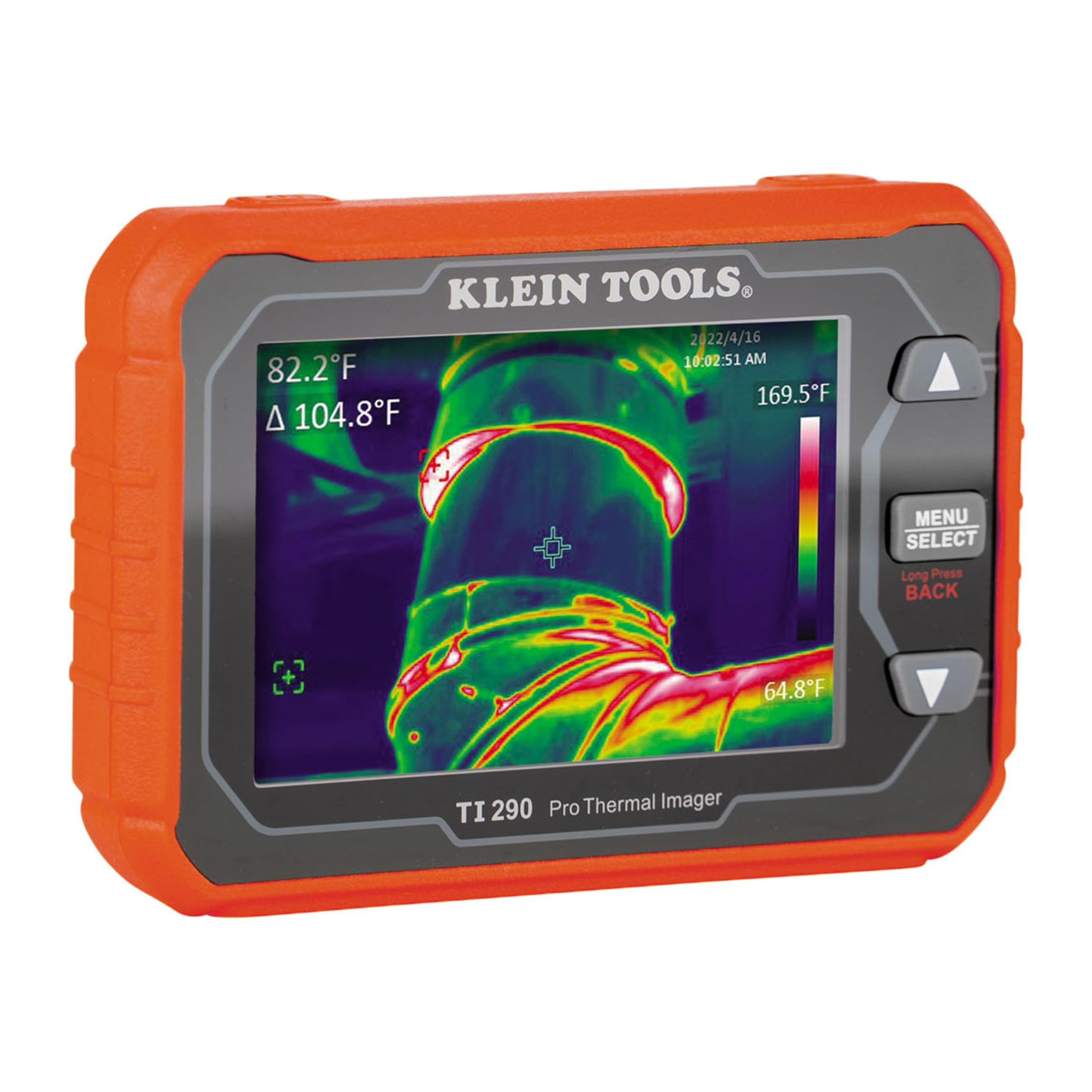
The Klein Tools TI290 packs over 76,800 pixels into a pocket-sized 7.5-ounce body, making it one of the most portable high-resolution thermal imagers on the market. Wi-Fi connectivity pairs with Klein’s free app for quick image transfer and sharing, eliminating the need to cable-connect after each inspection. The micro-USB charging cable and soft-molded pouch with carabiner clip are included.
Three color palettes (ironbow, rainbow, grayscale) let you adapt the display to different environmental conditions, and the adjustable emissivity from 0.01 to 0.99 ensures accurate readings on reflective, glossy, or matte surfaces. The temperature range covers -40°F to 752°F (-4°C to 400°C), which is narrower than some competitors but sufficient for most electrical and mechanical diagnostics. The 6.6-foot drop rating adds peace of mind.
Users praise the TI290 for identifying hot spots on electrical components and for its fast recharge time. The app, however, requires repeated connection attempts and drops the Wi-Fi link intermittently, making reliable image transfer a frustration. Several reviewers also note the refresh rate is low compared to similarly priced models, so fast panning produces a laggy image.
Why it’s great
- Ultra-portable 7.5-ounce design with carabiner
- 76,800 pixels in a pocket form factor
- Adjustable emissivity from 0.01 to 0.99
Good to know
- App connectivity is unreliable and drops frequently
- Low refresh rate causes lag during fast movement
5. FLIR C3-X
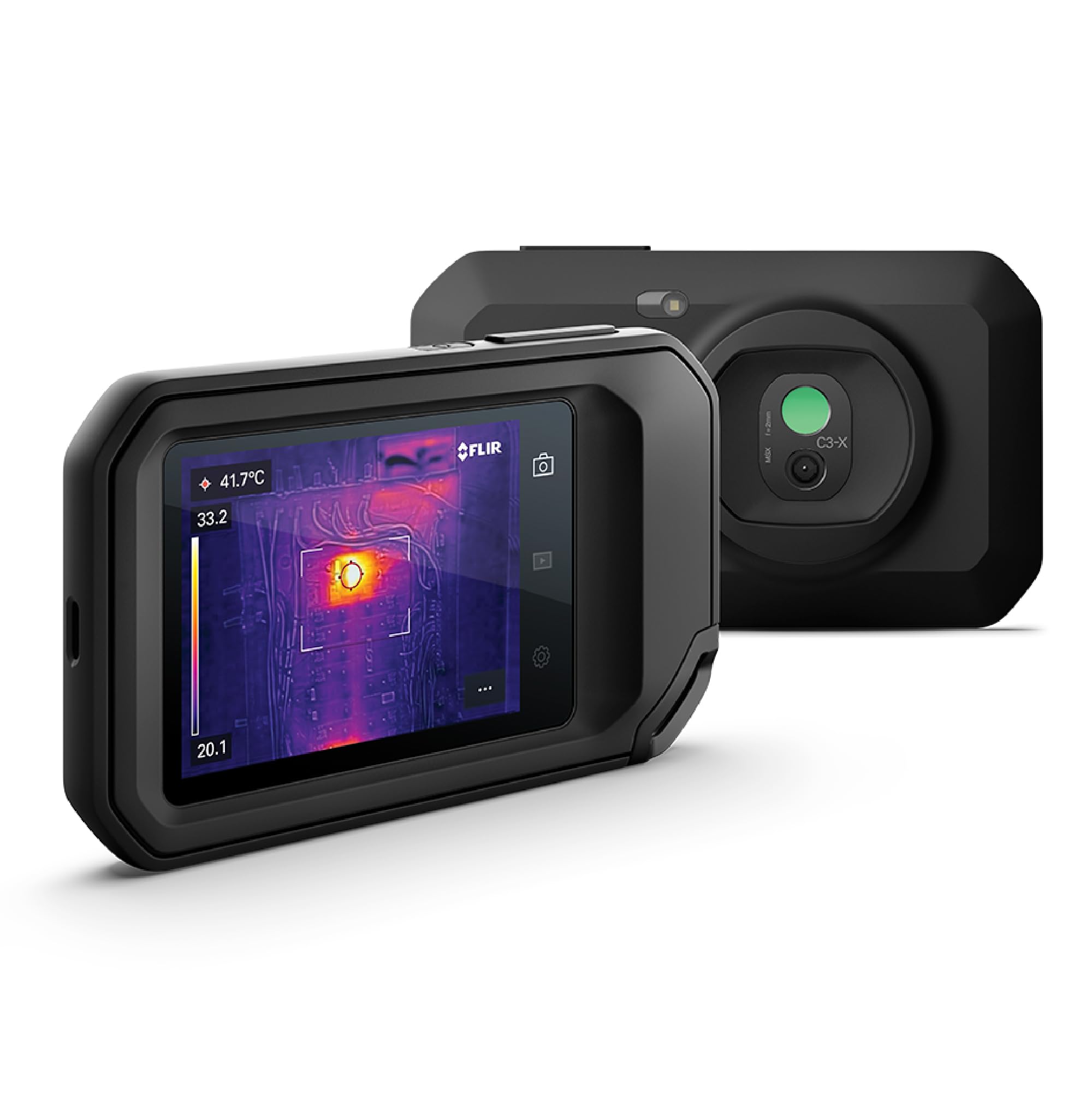
The FLIR C3-X is a compact 6.72-ounce thermal camera designed for quick diagnostics and cloud-based reporting. The 128×96 detector (12,288 pixels) is low by today’s standards, but FLIR’s patented MSX technology embosses visual-edge details onto the thermal image, creating a sharper composite picture than the raw pixel count suggests. This makes it easier to identify a hot breaker against a cool wall without needing higher native resolution.
FLIR Ignite cloud connectivity enables direct image uploads to the cloud, where you can generate professional reports and email them to clients — a workflow advantage for home inspectors who need fast turnaround. The -4°F to 572°F temperature range (-20°C to 300°C) is narrower than most competitors, but sufficient for residential HVAC, electrical panels, and building envelope checks. The 2-year camera warranty plus 10-year detector warranty is the best coverage in this guide.
The C3-X lacks a laser pointer for spot targeting, which makes identifying the exact source of a hot spot harder. Users also report 3-hour battery life as insufficient for a full workday, and the slow frame rate makes live scanning feel disorienting. For professionals who need cloud reporting and brand reliability, the C3-X delivers — but its raw specs trail the competition.
Why it’s great
- MSX overlay produces sharper images than raw resolution suggests
- FLIR Ignite cloud reporting simplifies client documentation
- Industry-best 2+10 year warranty coverage
Good to know
- 128×96 resolution is low for detailed diagnostics
- 3-hour battery life is short for field work
6. HSFTOOLS F2W
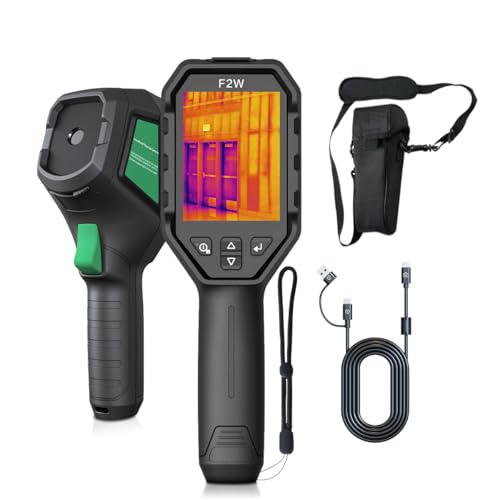
The HSFTOOLS F2W delivers a native 256×192 VOx detector with AI-driven super resolution that upscales the live feed to 640×480 — a feature typically found on units above the mid-range threshold. The IntellFault AI scene detection automatically identifies and flags suspicious hot or cold areas, reducing the guesswork for novice users. Thermal sensitivity below 40 mK captures fine temperature differences.
The 3.2-inch LCD display is slightly smaller than the 3.5-inch panels on competing models, but the 25 Hz refresh rate keeps the image smooth. Wi-Fi connectivity allows wireless image transfer to a smartphone or tablet, and the 16 GB eMMC storage holds up to 35,000 images. The 6-hour battery life covers a full shift, and the IP54 rating with 6.6-foot drop protection ensures durability on active job sites.
Users consistently compare the F2W’s image quality favorably to FLIR models costing over , noting that the super-resolution algorithm eliminates the blocky pixelation typical of budget detectors. The lack of a secondary visual camera means no blended overlay, and the temperature readouts are noted by some as unreliable for precise measurement — use the F2W as a relative-heat-spotting tool rather than a calibrated thermometer.
Why it’s great
- 640×480 super resolution rivals premium units
- AI scene detection flags anomalies automatically
- 6-hour battery with IP54 ruggedness
Good to know
- No visible-light camera for image blending
- Temperature readouts unreliable for absolute measurements
7. Klein Tools TI250

The Klein Tools TI250 is a compact, no-frills thermal imager with over 19,200 pixels of detector resolution. The 8.6-ounce body fits comfortably in a tool pouch, and the three color palettes (ironbow, rainbow, grayscale) let you adapt to different environments. Emissivity is adjustable from 0.01 to 0.99, ensuring accurate readings on varied surfaces — a feature often missing at this price tier.
High and low temperature alarms can be set across the -4°F to 752°F range (-20°C to 400°C), and images are captured and shared via USB-C. The rechargeable lithium-ion battery provides enough runtime for several inspection sessions. The TI250 excels in home energy audits: one user reported cutting their electricity consumption from 11,000 to 5,500 kWh per year after identifying thermal leaks around recessed lights.
The 19,200-pixel detector is the lowest resolution in this guide, producing blocky images that make it hard to distinguish fine details like a single overheated wire within a bundle. The camera also lacks visible-light blending or Wi-Fi, so image transfer requires a physical cable connection. For basic leak detection and energy auditing where pixel-perfect clarity isn’t required, the TI250 delivers reliable results.
Why it’s great
- Adjustable emissivity for accurate multi-surface readings
- Ultra-portable at just 8.6 ounces
- Proven track record in home energy auditing
Good to know
- 19,200 pixels produce blocky, low-detail images
- No Wi-Fi — requires USB-C cable for file transfer
8. TOPDON TC004
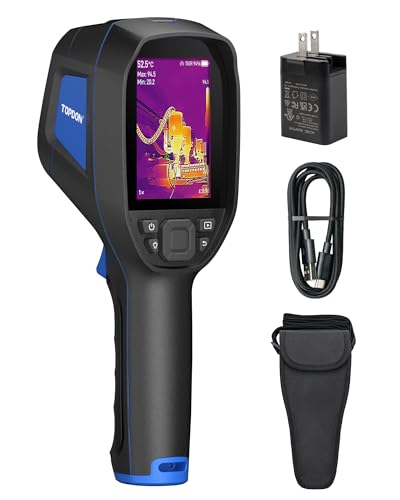
The TOPDON TC004 uses the same TISR super-resolution engine as the TC005 to boost the 256×192 detector to 512×384 effective resolution. The 3.5-inch display is large enough to interpret thermal contours without squinting, and the built-in red laser pointer helps align the thermal view with the physical target. The 64 GB internal storage can hold thousands of images and videos without needing an SD card.
IP54 protection and 2-meter drop resistance make the TC004 suitable for construction and industrial environments. Wi-Fi connectivity enables wireless image transfer to the TopInfrared app, and the included LED light improves visibility in dark crawlspaces and attics. Users report battery life approaching 8-12 hours, which is excellent for a single-shift inspection tool.
Some users note that extracting image files from the TC004 for analysis on a Mac or iPhone requires a Windows PC, as the internal format isn’t readable by Apple devices. The included software requires extracting a RAR archive (WinZip license required in some cases), which adds an unexpected cost. For Windows-based users who need high-resolution thermal imaging on a budget, the TC004 is a strong contender.
Why it’s great
- Upscaled 512×384 resolution for detailed heat maps
- 64 GB storage eliminates need for external media
- Long 8-12 hour battery life
Good to know
- File format incompatible with Mac/iOS devices
- Software extraction may require additional WinZip license
9. InfiRay P2 Pro

The InfiRay P2 Pro is a Type-C Android dongle weighing just 9 grams, transforming your smartphone into a 256×192 thermal camera. The all-metal housing feels premium, and the included magnetic macro lens focuses on millimeter-scale objects — making it uniquely suited for PCB inspection, microcircuit repair, and detailed electronics diagnostics. The 25 Hz refresh rate provides smooth video-like feedback.
No battery is required — the P2 Pro draws power from the host phone’s USB-C port. The -20°C to 550°C temperature range covers most electronic and HVAC use cases, and the ±2°C or ±2% accuracy is competitive with standalone models. Full-frame temperature measurement includes max, min, and center spot readouts, and captured images can be re-analyzed in the app without the dongle attached. The 2-year warranty provides peace of mind.
The biggest limitation is compatibility: the P2 Pro app is not supported on the Google Pixel 9, Pixel 7, or Samsung Tab A8, and users report a fake unsafe app on the Play Store that must be avoided. It’s also USB-C only, so iPhones and earlier Android devices require an adapter that may not work reliably. For Android users with a compatible phone who need a pocketable electronics inspection tool, the P2 Pro is unbeatable value.
Why it’s great
- 9-gram dongle slips into any pocket
- Magnetic macro lens enables PCB-level inspection
- No battery needed — powered by phone’s USB-C
Good to know
- Compatibility limited — Pixel phones not supported
- Fake app on Play Store can cause security concerns
FAQ
What is the minimum IR resolution I should look for in an affordable thermal camera?
Can a phone-based thermal dongle like the InfiRay P2 Pro replace a standalone camera?
Is a higher refresh rate always better for a thermal camera?
Final Thoughts: The Verdict
For most users, the best affordable thermal imaging camera winner is the Thermal Master Thor 002 because it delivers upscaled 512×384 resolution, a 60 Hz refresh rate, and 10.5-hour battery life without crossing into premium pricing territory. If you want a standalone tool with AI scene detection and super-resolution upscaling, grab the HSFTOOLS F2W. And for ultra-portable PCB and microcircuit inspection on a tight budget, nothing beats the InfiRay P2 Pro.