
Our readers keep the lights on and my morning glass full of iced black tea. As an Amazon Associate, I earn from qualifying purchases.
Specs are compiled from manufacturer listings and verified buyer reviews and can change over time — please confirm the key details on the product page before buying.
An affordable trail camera should reliably capture the wildlife that passes through your property without breaking your budget. The real challenge is finding one with a fast enough trigger speed to catch a deer mid-step and a good enough night vision system to see what happens after dark. The five models here balance those must-have features with things like solar charging, Wi‑Fi connectivity, and solid waterproofing so you do not have to compromise on quality just to save some money.
I’m Min — the founder and writer behind Gadgets Feed. This guide is built by comparing the manufacturers’ published specifications and the patterns across verified customer reviews, so you get each pick’s real strengths and trade-offs instead of marketing spin.
if you need a simple no‑frills camera or one that lets you preview shots from your phone, these picks represent the best affordable trail camera options available right now based on concrete specs and real buyer experiences.
Our Picks at a Glance

How To Choose The Best Affordable Trail Camera
Trail cameras look pretty similar until you look at the numbers that actually matter in the field. The three specs that separate a frustrating camera from one you set and forget are trigger speed, image resolution, and power source. Focus on those and you will end up with a camera that does its job without constant trips to swap batteries or cards.
Trigger Speed
This is the time it takes for the camera to detect motion and snap a picture. Every millisecond matters when a deer walks through your frame. A 0.2-second trigger is fast enough for most wildlife, but a 0.1-second trigger gives you an even better chance of catching animals moving at a full trot. Slower triggers — around 0.5 seconds or more — often produce photos of a tail or an empty spot where the animal just was.
Image and Video Resolution
Higher megapixel counts (like 48MP or 64MP) let you zoom into the photo later to identify a specific antler point or a bird’s marking without the picture turning into a blurry mess. Video resolution matters too — 1080p at 30fps gives you smooth footage, while 4K video captures even finer detail for identifying animals at a distance or in tricky lighting conditions.
Power Source and Battery Life
Nobody wants to hike out to a camera every week to replace batteries. Solar‑powered models with a built‑in rechargeable battery are the easiest option because they keep running as long as the sun hits the panel. Cameras that run on AA batteries are fine but you will want to factor in the long‑term cost of lithium cells, especially in cold weather where standard alkaline batteries drain fast.
Connectivity
Wi‑Fi and Bluetooth built into the camera let you browse and download photos from a short distance (around 45–55 feet) without pulling the SD card. That is a huge time‑saver if your camera is mounted close to your house or cabin. No‑Wi‑Fi models are simpler and cheaper, but you will need to physically retrieve the card and plug it into a computer or phone adapter to see what the camera captured.
Quick Comparison
| Model | Best For | Trigger Speed | Image Resolution | Night Vision Range | Amazon |
|---|---|---|---|---|---|
| Assark Solar Trail Camera 48MP★ Best Overall | Budget solar with included SD card | 0.2s | 48MP / 1080p Video | Not specified (850nm LEDs) | $49.98$59.99Limited time dealAmazon |
| XTU 4K 64MP Solar Trail CameraTop Performer | High‑resolution Wi‑Fi scouting | 0.2s | 64MP / 4K Video | 65 ft | $53.99$59.99Limited time dealAmazon |
| MAXDONE Solar WiFi Trail Camera | Long‑lasting solar with Wi‑Fi | 0.2s (PIR driven) | 64MP / 4K Video | 65 ft | $49.99$65.99PrimeAmazon |
| Meidase P70 Trail Camera | Simple no‑Wi‑Fi reliability | 0.1s | 64MP / 1296p Video | 100 ft | $54.99$65.99Amazon |
| WOSODA 2 Pack Trail Cameras | Best value two‑pack | 0.3s | 48MP / 1080p Video | 60 ft | $59.97$99.99Limited time dealAmazon |
In‑Depth Reviews
1. Assark Solar Trail Camera 48MP 30FPS, WiFi Bluetooth Game Camera
The Assark is the entry point into solar‑powered Wi‑Fi trail cameras that still delivers reliable 48MP images without a high upfront cost.
This model combines a large solar panel with a rechargeable lithium battery, and the kit includes a 32GB micro SD card so you do not need to buy anything extra. The 48MP resolution and 1080p video at 30fps are a step below the XTU and MAXDONE, but still sharp enough to identify the animals visiting your yard or food plot. One reviewer accidentally stress‑tested the battery — a twig triggered the sensor continuously for over two days, and the camera still managed to record over 2,000 25‑second videos before the battery ran out. That real‑world endurance is impressive for a budget‑friendly solar unit.
The built‑in Wi‑Fi connects your phone directly to the camera’s hotspot (no home Wi‑Fi support) within a range of roughly 45 feet. Several buyers report that the connection is stable within that distance and that the camera has been running for months without needing a battery change. The 850nm low‑glow LEDs provide clear night vision without startling animals, making this a solid pick for budget‑conscious wildlife watchers.
Why It Works
- Includes a 32GB micro SD card in the box — zero extra purchases needed.
- Solar panel keeps the battery running for months according to long‑term owner reports.
- 0.2‑second trigger speed catches fast wildlife movement reliably.
The Downsides
- Photo resolution (48MP) and video (1080p) are lower than the top two picks.
- Wi‑Fi requires a direct hotspot connection — no remote viewing from a home network.
Reach for this if: you want an affordable solar camera that works from the start with everything included and has proven battery endurance.
Look elsewhere if: you need 4K video or higher‑resolution stills for identifying animals at long range.
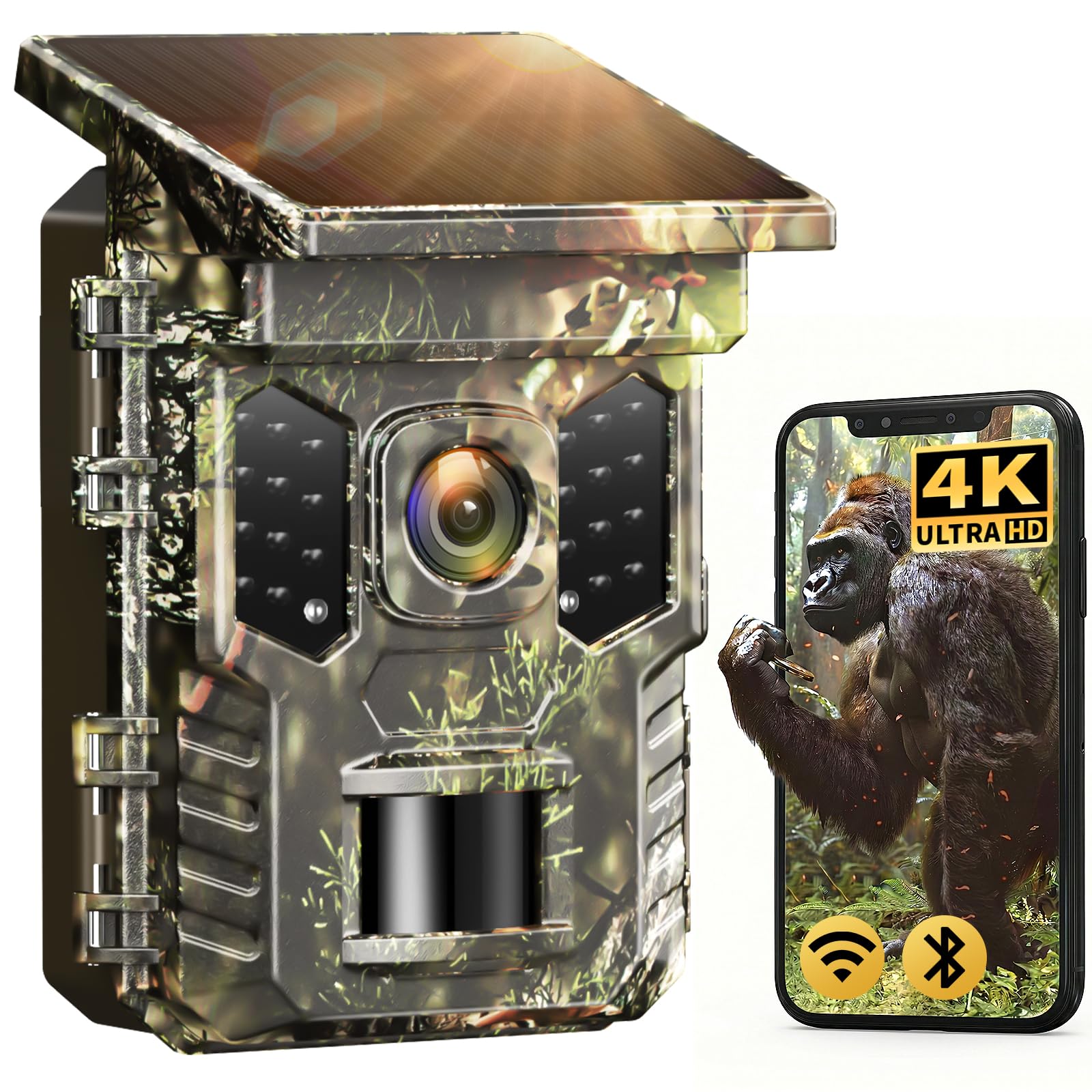
2. XTU 4K 64MP Solar Trail Camera with WiFi & Bluetooth
The XTU combines the highest photo resolution with reliable solar recharging for as‑close‑to‑set‑and‑forget as trail cameras get.
The XTU captures 64MP stills and 4K video, making it the sharpest option in this roundup — you get enough detail to count antler points or identify a specific bird from across a clearing. It captures 64MP stills and 4K video, while the Assark and WOSODA capture 48MP stills and 1080p video. A 0.2‑second trigger speed means you will catch a bounding deer without a blurry tail frame, and the 2×850nm IR LEDs throw night vision out to 65 feet.
The solar panel keeps the internal rechargeable battery topped up even in partially shaded spots, as multiple owners reported. One reviewer noted the Wi‑Fi connection range (up to 49 feet) drops through walls, so mount it where you have a clear line of sight from your house or cabin. The camera does not include a micro SD card, and the instruction manual could be clearer, but for the resolution and power autonomy, this is the most capable pick here.
Why It Wins
- 64MP stills and 4K video provide the highest image detail in this price bracket.
- Solar panel plus a USB‑C backup port means you almost never have to change batteries.
- Fast 0.2‑second trigger and 70‑foot detection zone reduce missed shots.
The Trade‑offs
- No micro SD card included (you will need to buy a separate 256GB card).
- Wi‑Fi range drops noticeably through walls and windows according to several buyers.
Grab this if: you want the highest‑resolution photos and 4K video with solar autonomy so you can set it and rarely touch it again.
Look elsewhere if: you need reliable Wi‑Fi from inside your house — the short 49‑foot range requires clear line of sight.
3. MAXDONE Solar WiFi Trail Camera Bluetooth Game Camera
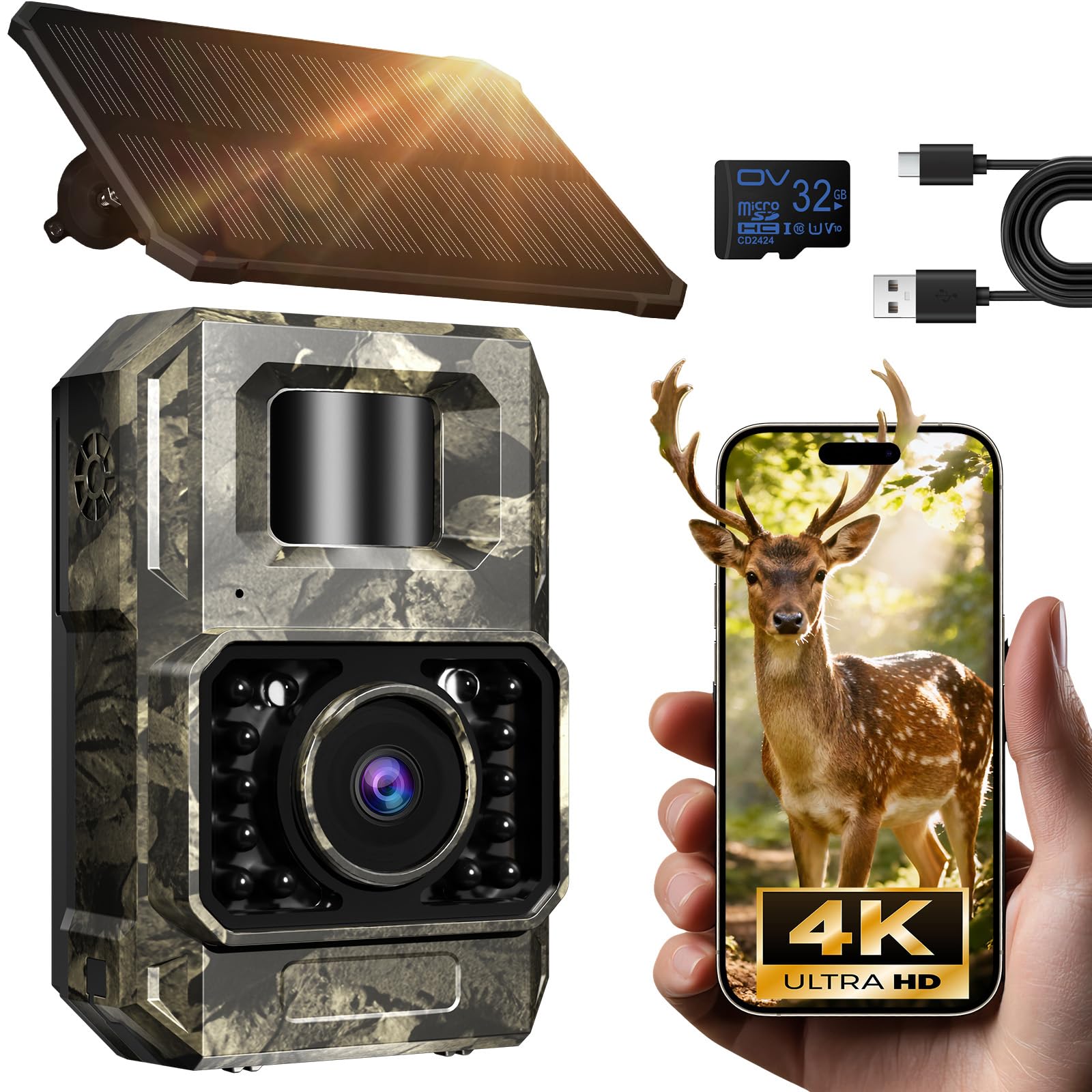
This MAXDONE delivers 64MP images and 4K video with a detachable solar panel that keeps the 2000mAh internal battery charged.
Buyers consistently praise the battery life on this model — one buyer mentioned the camera has been running for over two years without issues when paired with the solar panel. The detachable panel lets you angle it for maximum sun exposure while mounting the camera itself in a shady spot under a tree canopy. That is a clever design choice because the camera body does not need direct sun to stay powered.
The 0.2‑second PIR trigger captures quick movement well, and the 100‑degree wide‑angle lens means you cover a broader area than many rivals. Buyers do note the Wi‑Fi range is short — you need to be within about 55 feet of the camera to connect via the app. Since the camera creates its own hotspot (it does not connect to your home Wi‑Fi), you will need to switch back to your home network manually after checking footage. That is a minor friction but worth knowing if you plan to check it frequently.
What Stands Out
- Detachable solar panel with 2000mAh battery runs for months and even years according to several owners.
- 4K video and 64MP photos with a 100‑degree wide‑angle field of view.
- Comes with a pre‑installed 32GB micro SD card so you can start using it immediately.
What to Watch
- Wi‑Fi hotspot range is short — around 55 feet in open space and less through walls.
- The app forces you to switch away from your home network every time you check footage.
Best for: anyone who wants a solar‑powered camera that runs for months without attention and comes ready to use with the included card.
skip it if: you need longer Wi‑Fi range or dislike manually switching networks every time you check pictures.
4. Meidase P70 (Non-Cellular,Non-WiFi) Trail Camera
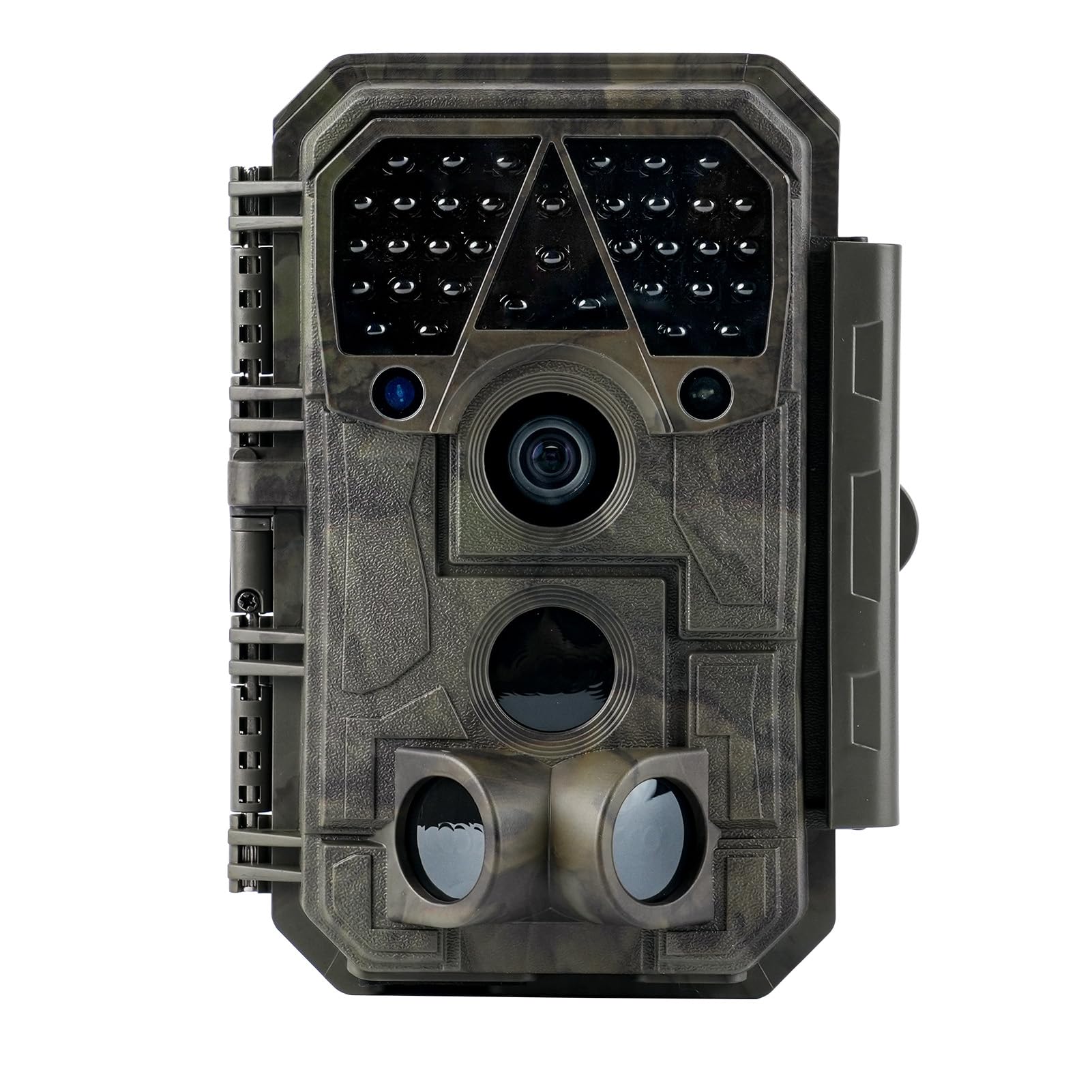
The Meidase P70 skips Wi‑Fi and cellular entirely to focus on the fastest trigger in the group and the longest night vision range.
A 0.1‑second trigger speed (compared to 0.2‑second for the other picks) makes this the best choice for capturing sprinting animals like coyotes or deer on a run. The 100‑foot no‑glow night vision uses 940nm LEDs, which are invisible to wildlife, so you will not spook anything while still getting usable footage in total darkness. That night vision range handily beats the 60‑65 feet offered by the XTU and WOSODA cameras.
The big trade‑off is connectivity — there is no Wi‑Fi, no Bluetooth, and no cellular capability. You pull the SD card and view footage on a computer or card reader. The camera runs on 8 AA batteries (not included) and an SD card (not included), so the upfront cost is lower but the ongoing battery expenses add up unless you invest in rechargeable cells. Several owners mention that Energizer Lithium AA batteries give the best performance, with one reviewer saying the camera runs for months on a set. This camera is ideal for anyone who just needs rock‑solid image capture without the app fuss.
What Makes It Special
- 0.1‑second trigger speed is the fastest here — you will catch every bounding animal.
- 100‑foot no‑glow night vision using invisible 940nm LEDs.
- 64MP stills and 1296p HD video with a bright f/1.6 aperture lens for low‑light capture.
What You Give Up
- No Wi‑Fi or app — you must physically retrieve the SD card to view images.
- Requires 8 AA batteries (lithium recommended) plus an SD card, both sold separately.
Perfect for: hunters and researchers who prioritize the fastest possible capture and the longest night vision range over app convenience.
pass on it if: you want to preview photos from your phone or dislike buying lithium batteries and SD cards separately.
5. WOSODA 2 Pack Trail Cameras with Night Vision Motion Activated Waterproof
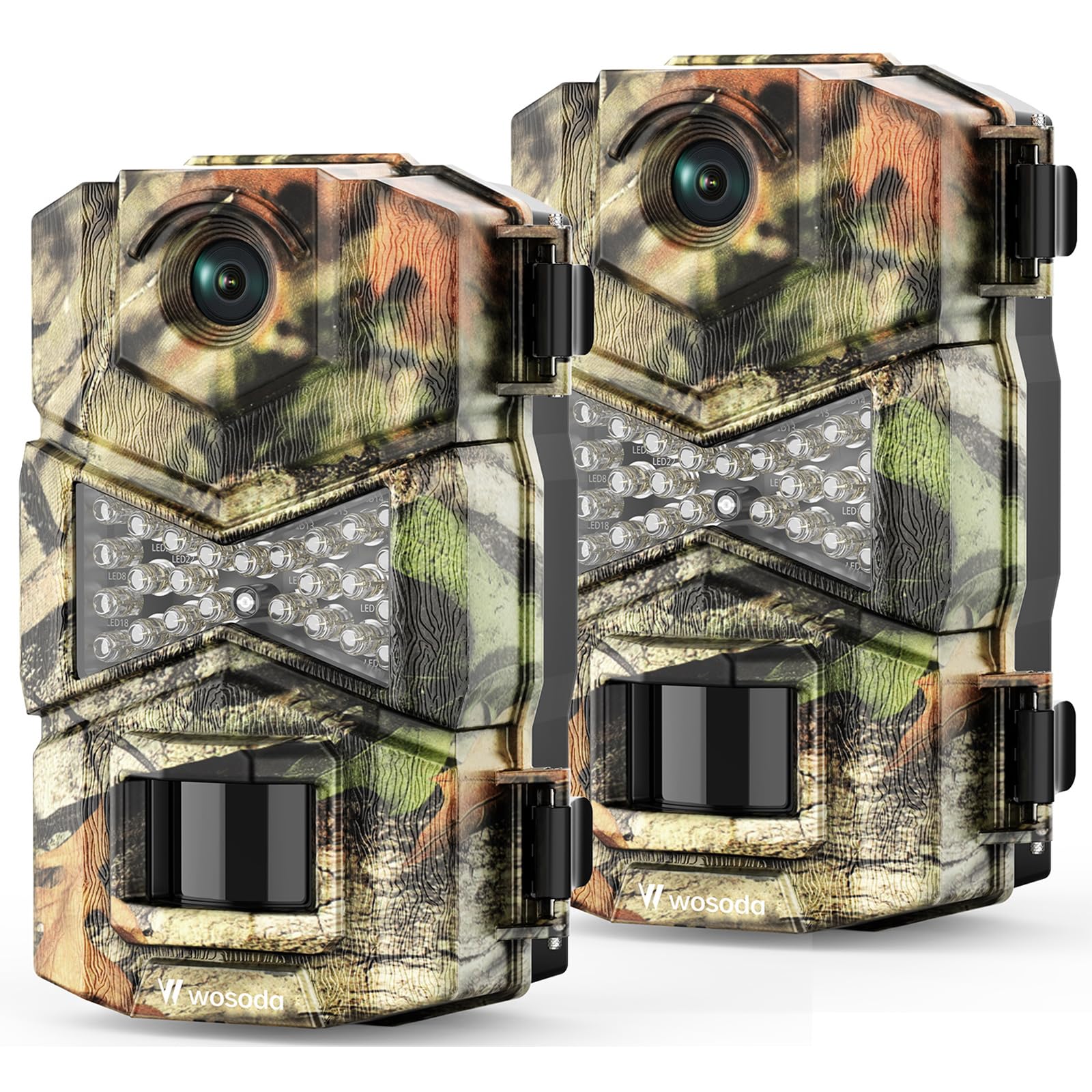
The WOSODA two‑pack is the budget winner — you get two functional 48MP cameras for roughly the price of one premium model.
Each camera captures 48MP stills and 1080p video, and the 0.3‑second trigger speed (the models above have 0.2 seconds) is still fast enough for most walking animals. The 850nm low‑glow LED night vision extends to 60 feet, so you get decent black‑and‑white footage at night without a bright flash that would scare off deer or raccoons. Buyers consistently mention that the image quality is clear for the price and that the cameras are easy to set up using the included mounting straps.
The biggest savings here is the two‑camera bundle. You can cover two corners of a property, monitor a food plot and a trail simultaneously, or keep one as a backup. The trade‑off is that the WOSODA cameras lack solar charging and Wi‑Fi — they run on AA batteries (not included), and you must pull the SD card to view images. A few owners reported that the strap buckle broke on the first use, so you might want to use a third‑party mounting strap for a permanent install. Still, for the price of a single camera elsewhere, this pack gives you double the coverage.
Why People Buy It
- Two cameras in one box — the best value if you need to cover multiple spots.
- 48MP photos and 1080p video provide clear daytime captures.
- 60‑foot night vision with 850nm low‑glow LEDs works well in total darkness.
The Catch
- No solar panel and no Wi‑Fi — you buy batteries and retrieve the SD card manually.
- 0.3‑second trigger is slightly slower than the 0.2‑second rivals here.
Choose this for: covering a large area with two cameras on a tight budget — you get full coverage without the premium price tag.
Consider alternatives if: you need solar recharging, Wi‑Fi previews, or a trigger faster than 0.3 seconds for sprinting wildlife.
Understanding the Specs
Trigger Speed
This is the delay between the sensor detecting motion and the camera actually taking the picture. Measured in seconds, a lower number means a faster reaction. A 0.2‑second trigger works well for most walking deer and raccoons, but a 0.1‑second trigger on the Meidase P70 catches animals that are already moving at speed. Anything over 0.5 seconds will consistently produce empty frames or tail shots — not worth your money for wildlife.
Night Vision Range and LED Type
Night vision range tells you how far from the camera the infrared LEDs can illuminate a scene so the sensor captures something usable. Most affordable models reach 60–65 feet. The LED type matters too — 850nm “low‑glow” LEDs produce a faint red glow that some animals notice, while 940nm “no‑glow” LEDs are completely invisible and better for skittish wildlife like coyotes and foxes. The Meidase P70 uses 940nm and reaches 100 feet, which is exceptional at this price.
Image Resolution (Megapixels and Video)
Higher megapixel counts (48MP vs 64MP) let you zoom into the picture later without losing detail. That matters when you need to read a ear tag, count antler points, or identify a specific marking. Video resolution — 1080p vs 4K — affects how much detail you see in motion. 4K captures about four times as many pixels as 1080p, so fast movements like a trotting deer stay sharper when you pause the playback.
Power Source: Solar vs Battery
Solar‑powered cameras with an internal rechargeable battery are the most hands‑off option. As long as the solar panel gets direct sunlight for a few hours each day, the camera can run for months or even years without manual charging. Battery‑only models (like the Meidase P70 and WOSODA) use standard AA cells — you must replace them every few weeks to months depending on activity. Lithium AA batteries last significantly longer in cold weather than alkaline ones, so factor that into the long‑term cost.
FAQ
Can I view trail camera photos from my home Wi‑Fi?
How long does a trail camera battery last with solar charging?
What trigger speed do I need for deer?
Do I need to buy a separate SD card?
What is the difference between 850nm low‑glow and 940nm no‑glow night vision?
Can I use rechargeable AA batteries in a trail camera?
Which trail camera is best for a no‑Wi‑Fi setup?
How far can a trail camera detect motion?
Are trail cameras waterproof in rain and snow?
Which affordable trail camera has the best video quality?
Final Thoughts: The Verdict
For most buyers, the affordable trail camera winner is the XTU 4K 64MP Solar Trail Camera because it combines the highest image resolution (64MP and 4K video) with reliable solar charging and a 0.2-second trigger that catches fast movement. If you want a solar camera that runs for years on a single charge without any extra purchases, grab the Assark Solar Trail Camera 48MP. And for the fastest possible trigger and longest night vision range without needing an app, the Meidase P70 Trail Camera is the best pick.
How We Picked
We do not accept paid placement. Every pick is matched to a real buyer and a real use-case; we do not hands-on test units.
Sources & Methodology
Specifications: manufacturer listings and product documentation. Review insights: verified customer reviews, as of July 2026. Pricing: not shown on this page (it changes often); check the current price via the retailer link.
As an Amazon Associate, Gadgets Feed earns from qualifying purchases. This does not affect which products we feature.
Related Guides
Product prices and availability are accurate as of the date/time indicated and are subject to change. Any price and availability information displayed on Amazon at the time of purchase will apply to the purchase of this product. As an Amazon Associate I earn from qualifying purchases.
CERTAIN CONTENT THAT APPEARS ON THIS SITE COMES FROM AMAZON. THIS CONTENT IS PROVIDED "AS IS" AND IS SUBJECT TO CHANGE OR REMOVAL AT ANY TIME.
Amazon and the Amazon logo are trademarks of Amazon.com, Inc. or its affiliates.