
Our readers keep the lights on and my morning glass full of iced black tea. As an Amazon Associate, I earn from qualifying purchases.
Specs are compiled from manufacturer listings and verified buyer reviews and can change over time — please confirm the key details on the product page before buying.
You know the pain: you drag the playhead across your timeline and the preview freezes, stutters, then lags behind your cursor. What you really need is a laptop that plays back 4K footage smoothly and exports your project without making you wait all day — all without draining your savings. Before we dive in, one note: this list matches RAM and storage flexibly, meaning the nearest same-type size (like 16GB vs 32GB) serves the same purpose, so you always know exactly what you’re getting.
I’m Min — the founder and writer behind Gadgets Feed. This guide is built by comparing the manufacturers’ published specifications and the patterns across verified customer reviews, so you get each pick’s real strengths and trade-offs instead of marketing spin.
Whether you edit wedding films or YouTube vlogs, an affordable video editing laptop needs three things working together: a dedicated graphics card (a separate chip that handles video effects and rendering), 16GB of RAM (memory for running your editing software and previews), and a fast SSD (solid-state drive for quick file access). The picks below balance that trio with honest trade-offs, so your money goes where it matters most for your timeline.
Our Picks at a Glance

How To Choose The Best Affordable Video Editing Laptop
Editing software leans hard on three parts of a laptop: the graphics card for effects and previews, the processor for encoding, and the RAM for holding your timeline. If one of them is weak, you will feel it as lag the moment you stack a few effects.
Start with the dedicated graphics card
A discrete GPU (a separate graphics chip, not one built into the processor) handles things like color grading, motion blur, and rendering previews. Most serious editors look for an NVIDIA RTX card because software like Premiere Pro and DaVinci Resolve use its CUDA cores (specialized processing units) to speed up effects-heavy tasks. A card with at least 8GB of its own memory lets you work with 4K footage comfortably.
Ram and storage are your real multitasking muscles
16GB of RAM is the minimum for serious editing, and 32GB is better if you run the editor plus a browser and music at once. Fast SSD storage (a solid-state drive with no moving parts) determines how quickly your project files load and save. A 512GB drive works for a few projects, but 1TB gives you room for raw footage and exports without constantly juggling an external drive.
Quick Comparison
| Model | Best For | GPU | RAM | Refresh Rate | Amazon |
|---|---|---|---|---|---|
| ASUS ROG Strix G16★ Best Overall | High-FPS gaming & 4K edits | RTX 5060 | 16GB DDR5 | 165Hz | Amazon |
| acer Nitro V 15.6 | Budget 1080p editing | RTX 5050 8GB | 16GB DDR4 | 165Hz | Amazon |
| Dell 14 Plus | Portable productivity | Intel Arc | 32GB LPDDR5X | — | Amazon |
| Acer Nitro V 16S | Color-accurate 4K work | RTX 5060 (572 TOPS) | 32GB DDR5 | 180Hz | Amazon |
In‑Depth Reviews
1. ASUS ROG Strix G16 (2025)
Our pick — over 4★ from 550+ verified ratings; the strongest balance of quality and price.
The do-it-all performer that renders previews and games without breaking a sweat
This ASUS pairs an Intel Core i7 14650HX that boosts up to 5.2 GHz with an NVIDIA RTX 5060 GPU, so you get the two engines a 4K timeline needs. The 165Hz FHD+ display (a screen that refreshes 165 times a second) keeps motion smooth, which makes judging fast pans and action cuts much easier. Buyers report a clear, bright screen and note it “runs most games at 100+ FPS,” indicating headroom for effects-heavy editing.
Storage and memory are where this pick shines for editors. The 1TB Gen 4 SSD (a solid-state drive with the fastest current interface) holds plenty of raw footage, while 16GB of DDR5-5600MHz RAM keeps your timeline responsive. The ROG Intelligent Cooling system uses a vapor chamber and liquid metal on the chip, which owners say runs cool and quiet in performance mode. The trade-off is heat on non-flat surfaces and battery life that some find poor, so you will want it plugged in during long export sessions.
Reviewers consistently talk about build quality as a standout — one notes the tool-free bottom casing, making future RAM or SSD upgrades easier. The 360° RGB light bar can be switched off with Stealth Mode for a professional look, but the core verdict is simple: this handles demanding Steam games flawlessly, which tells you it will chew through your render queue.
Editor’s High Points
- Blazing 1TB Gen 4 SSD for fast project loads
- Liquid metal cooling keeps renders stable
- Excellent build with tool-free upgrade access
Fair Trade-offs
- Battery life runs short unplugged
- Bottom gets hot on soft surfaces
Reach for it: if you edit 4K footage and also game on the same machine — this is the strongest all-rounder here.
Look elsewhere: if you need all-day battery life away from a wall outlet; this wants to stay plugged in.
2. acer Nitro V 15.6
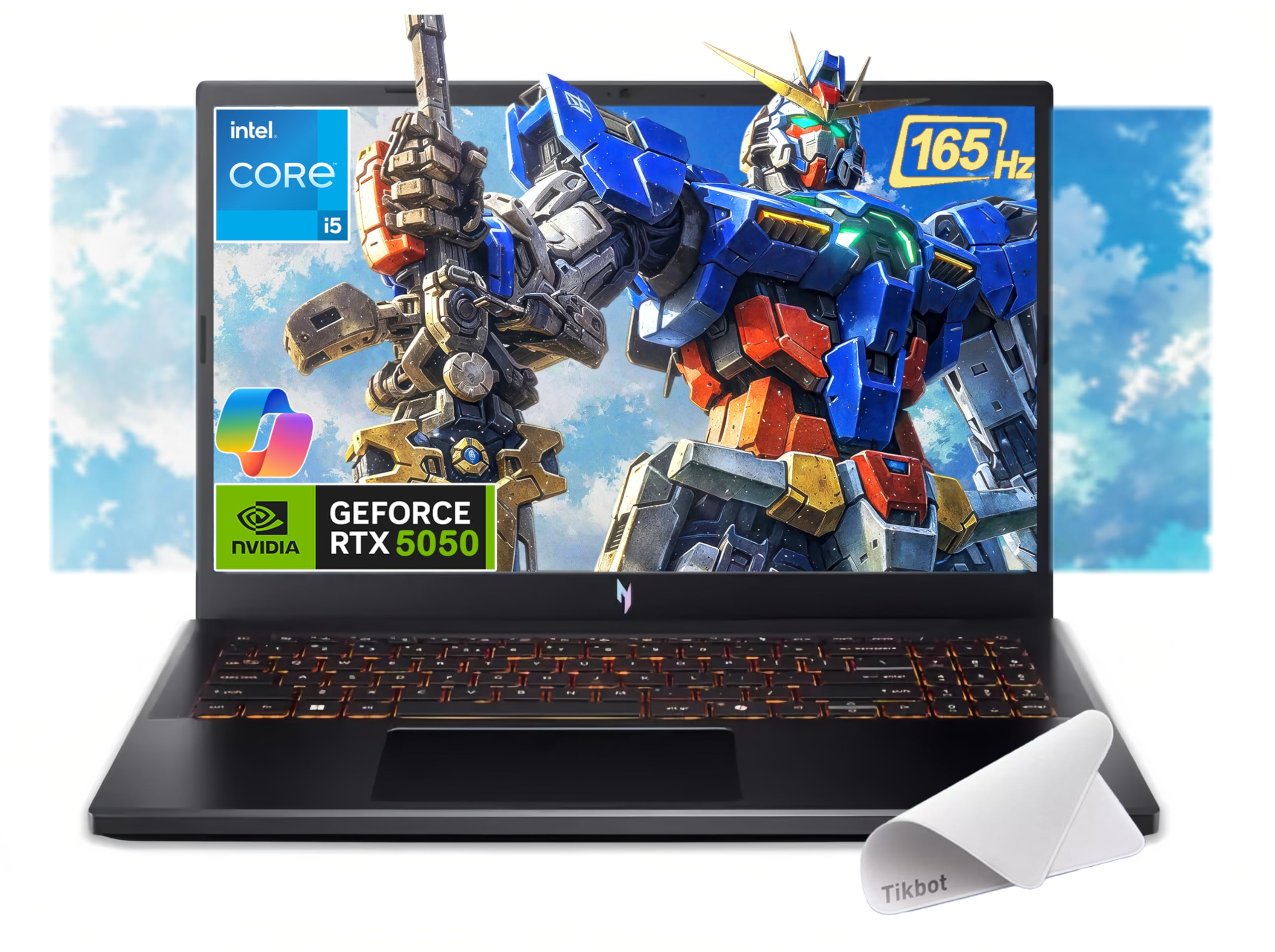
A budget-friendly entry that cuts 1080p timelines with zero lag and saves your wallet
The Acer Nitro V is the pick that proves you don’t need a premium badge for smooth edits. Inside sits an Intel Core i5-13420H that boosts to 4.6 GHz — noticeably slower than the 5.2 GHz ASUS above — paired with an RTX 5050 GPU carrying 8GB of GDDR7 VRAM (the latest high-speed graphics memory standard). That combo handles 1080p editing comfortably, and owners confirm it “runs AAA Steam games (Cyberpunk, etc.) at medium/high,” which translates to clean previews on your timeline.
The 165Hz IPS panel keeps fast action smooth without ghosting—a rare perk at this price. The 16GB DDR4 memory and 512GB PCIe Gen 4 SSD give you a responsive start, though the storage fills fast if you shoot in 4K. One practical bonus: the USB Type-C port supports Thunderbolt 4 and USB charging up to 65W, so you can top up with a phone charger in a pinch.
Owners consistently praise its value, calling it “the best gaming laptop owned” for the price. The honest gripes are a skimpy charger that can drain the battery under heavy load and a single SSD slot with no second M.2 bay for easy expansion. If you edit mostly 1080p and want change left over, this is the smart money move.
Smart-money verdict: the best raw editing performance per dollar in this list, with a screen that outperforms its price tag.
Know before you buy: the 512GB drive fills quickly and the stock charger struggles under full load — budget for a stronger adapter.
Pick this if: you edit 1080p projects on a budget and want a screen that does not ghost during fast cuts.
skip it if: you shoot 4K raw; the 512GB drive and single SSD slot will make you juggle external storage.
3. Dell 14 Plus

A feather-light aluminum editor with 32GB RAM and a pin-sharp 2.5K screen for travel
The Dell 14 Plus is the outlier here — a slim aluminum laptop that skips the discrete GPU in favor of Intel Arc integrated graphics, yet still packs a 32GB punch. That RAM is the story: LPDDR5X memory (the fastest laptop memory standard) paired with a 1TB SSD means you can run your editor, dozens of browser tabs, and a music app without a hiccup. Owners describe it as fast with excellent battery life, one noting it “works like a dream” for BYOC office work with multiple tabs open.
The 14-inch 2.5K display (2560×1600 resolution) is significantly sharper than the 1080p panels on the other picks, so fine details in your footage stay crisp while grading. The 16:10 ratio gives extra vertical room for your timeline, which editors genuinely appreciate.
Reliability reports are mixed: some owners cite freezing and battery degradation, others call it fast and reliable. One review warns of battery degrading to 25% in two months, though others praise excellent battery life. This is the one to choose if portability and a gorgeous screen outweigh raw effects power, and if you are comfortable with a bit more variance in the unit you receive.
Sharp start: the crispest display and the most RAM here, wrapped in a genuinely portable frame for on-the-go edits.
Honest caution: mixed reliability reports and integrated graphics mean this fits lighter editing workloads, not heavy 4K effects.
Who it suits: editors who value a sharp, portable screen and massive RAM for multitasking over raw GPU muscle.
Who it doesn’t: anyone pushing 4K timelines with heavy color grading — the RTX options above will serve you better.
4. Acer Nitro V 16S AI
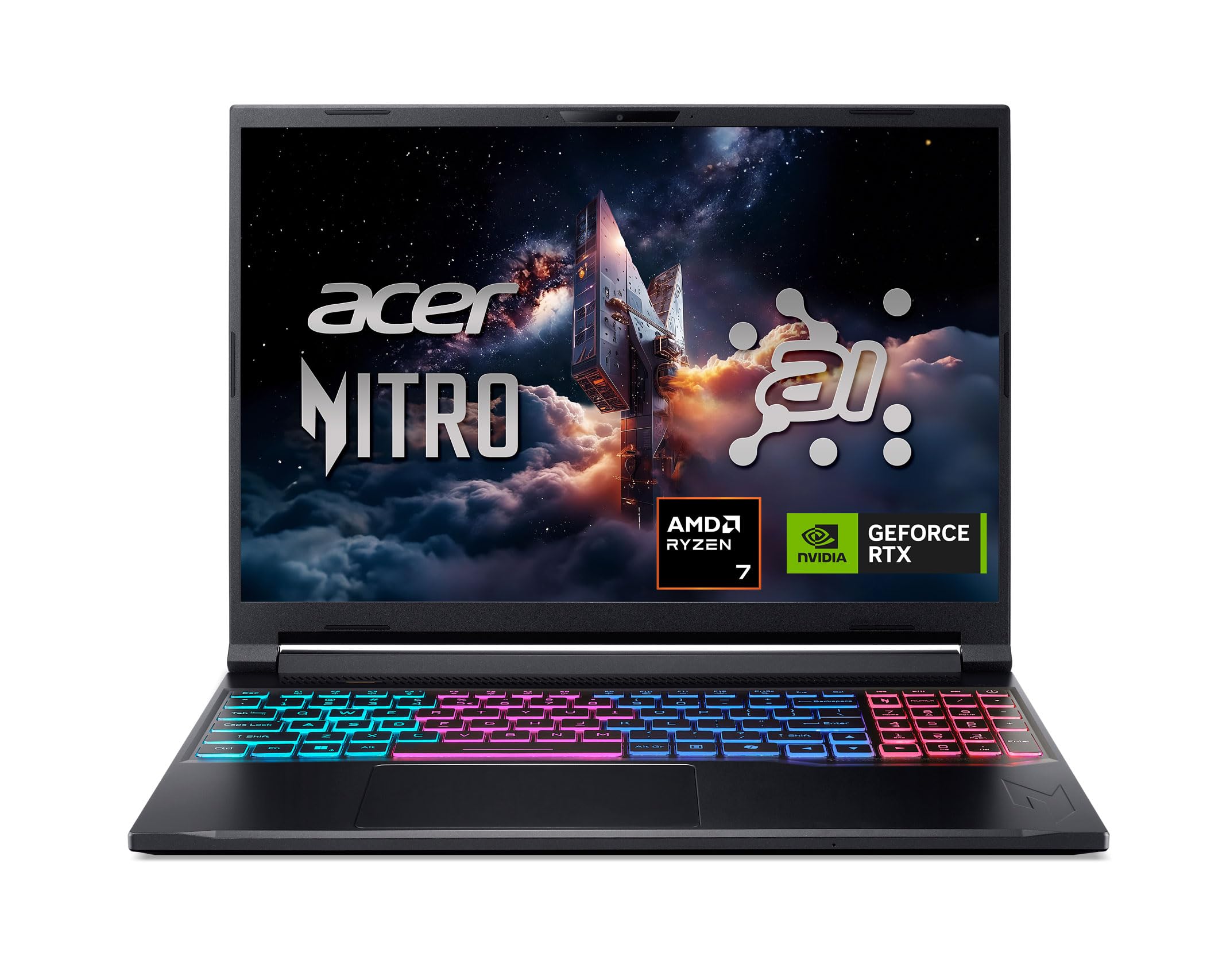
The color-accurate 16-inch powerhouse that makes 4K grading feel easy
The Acer Nitro V 16S is the pick for editors who obsess over color accuracy. Its 16-inch WUXGA display (1920×1200) covers 100% sRGB — the standard color space for web and video — so what you grade is what your viewers see. The 180Hz refresh rate (180 refreshes per second) is the smoothest panel here, and for editors that means buttery motion previews on panning shots. Owners specifically praise the display quality and the smooth performance delivered by 32GB of DDR5 RAM.
Under the hood sits an AMD Ryzen 7 260 boosting to 5.1 GHz with an RTX 5060 GPU rated at 572 AI TOPS (trillions of operations per second, a measure of AI processing muscle). That AI horsepower powers DLSS 4 (an upscaling tech that boosts frame rates), which helps previews stay fluid. The internal specs are generous: 32GB DDR5 5600MHz memory and a 1TB PCIe Gen 4 SSD, with a second M.2 slot free for future storage expansion — a feature editors will actually use as footage libraries grow.
Owners mention strong performance: one owner notes the CPU stays at a cool 79°C under load, and Cyberpunk 2077 runs at 65fps with ray tracing on, over 100fps with it off. The trade-offs: the FHD (Full HD, 1920×1080) screen is dim for outdoor use, the chassis picks up fingerprints easily, and fans get loud during heavy rendering. ECO mode runs silent and cool, delivering 6-7 hours of battery life. If you prioritize color accuracy for 4K work, this is your pick.
The Color Pro Edge
- 100% sRGB coverage for accurate grading
- 32GB RAM + free second M.2 slot
- Excellent thermals under load
Reality Check
- Screen is dimmer than ideal outdoors
- Fans get loud during heavy renders
Choose this for: color-critical 4K work where 100% sRGB accuracy and smooth 180Hz previews matter most.
Think twice if: you mostly edit in bright rooms; the dimmer panel may frustrate you next to the Dell’s sharper display.
Understanding the Specs
Dedicated GPU (Discrete Graphics Card)
This is a separate chip, like an RTX 5060, built specifically for graphics work. It handles effects, color grading, and preview rendering far better than a processor’s built-in graphics. More VRAM (video memory, like 8GB) means you can work with larger 4K timelines without stuttering.
RAM and SSD Speed
RAM (random access memory) holds your active timeline, and 16GB is the floor for smooth editing. SSD storage (a solid-state drive) loads your projects — a Gen 4 interface is the fast current standard, and 1TB gives you room to breathe. Together they decide whether your editor feels instant or sluggish.
FAQ
Is a gaming laptop good for video editing?
How much RAM do I really need for 4K video editing?
Does a high refresh rate display matter for editing?
Will the Acer Nitro V 15.6 handle 4K editing on 512GB of storage?
Is integrated graphics ever enough for video editing?
What does 100% sRGB color coverage mean for my edits?
How important is the processor’s maximum speed for editing?
Should I worry about laptop heat during long render sessions?
Final Thoughts: The Verdict
For most people, the affordable video editing laptop winner is the ASUS ROG Strix G16 because it pairs a 5.2 GHz processor with an RTX 5060 and a 1TB SSD — the complete package for serious 4K work. If you want smooth 1080p editing on a tighter budget, the acer Nitro V 15.6 delivers the best value per dollar with a 165Hz screen. And for color-critical grading with 100% sRGB accuracy, the Acer Nitro V 16S is the one to reach for. With 4.4 stars across hundreds of owners, the ASUS is the proven pick for editors who also game.
How We Picked
We do not accept paid placement. Every pick is matched to a real buyer and a real use-case; we do not hands-on test units.
Sources & Methodology
Specifications: manufacturer listings and product documentation. Review insights: verified customer reviews, as of August 2026. Pricing: not shown on this page (it changes often); check the current price via the retailer link.
As an Amazon Associate, Gadgets Feed earns from qualifying purchases. This does not affect which products we feature.