
Our readers keep the lights on and my morning glass full of iced black tea. As an Amazon Associate, I earn from qualifying purchases.
Specs are compiled from manufacturer listings and verified buyer reviews and can change over time — please confirm the key details on the product page before buying.
You want real VR without spending like a pro gamer. The Oculus Quest 2 Advanced All-in-One 128GB Set is the one worth buying — 128GB of storage, a 3664 x 1920 display, and included knuckle straps for far less than premium headsets. Every pick below is standalone, so you can play standing or sitting the moment you unbox it.
I’m Min — the founder and writer behind Gadgets Feed. This guide is built by comparing the manufacturers’ published specifications and the patterns across verified customer reviews, so you get each pick’s real strengths and trade-offs instead of marketing spin.
Below you’ll find breakdowns of the storage, display clarity, and comfort trade-offs so you can pick the right one.
Our Picks at a Glance

How To Choose The Best Affordable VR Headset
What really decides if you’ll enjoy VR daily is comfort and if you need a PC. A headset that presses hard on your cheekbones after twenty minutes ends up on a shelf. A headset that needs a computer to run games defeats the point of a standalone setup.
Standalone vs PC-tethered
Standalone headsets run everything from inside the goggles — no cables, no computer, no base stations bolted to the wall. That’s what keeps the total cost down. PC-tethered VR gives you higher-fidelity graphics, but you pay for the PC as well, and you’re leashed by a USB cable that can break up mid-session.
Display resolution and lens type
Resolution is quoted per-eye or as a total combined pixel count. The higher the number, the less you notice individual pixels — that “screen-door” grid effect veterans complain about. Lens type matters just as much: newer pancake lenses keep the image sharp across almost the whole view, while older fresnel lenses go blurry near the edges.
Quick Comparison
| Model | Best For | Display | Storage | Field of View | Amazon |
|---|---|---|---|---|---|
| Oculus Quest 2 Advanced All-in-One 128GB Set★ Best Overall | First-time VR buyers | 3664 x 1920 | 128GB | 95 degrees | Amazon |
| Meta Quest 3S 128GB (Renewed Premium) | Families and casual gaming | 2064 x 2208 | 128GB | — | Amazon |
| Oculus Quest All-in-one 64GB | Fitness and room-scale play | 1440 x 1600 | 64GB | 110 degrees | Amazon |
| Meta Quest 3 512GB (Renewed Premium) | Mixed reality and media | 4K+ | 512GB | — | Amazon |
In‑Depth Reviews
1. Oculus Quest 2 Advanced All-in-One Virtual Reality Gmaing VR Headset 128GB Set, White
Our pick — over 4.5★ from 750+ verified ratings; the strongest balance of quality and price.
The all-in-one that nails the basics: sharp pixels, comfy straps, and 128GB to spare.
Storage is where this one separates itself from the aging entry-level Quest. The Quest 2 carries 128GB of onboard space — double the 64GB on the original Oculus Quest — so you can keep a full library of VR games installed without deleting titles every time a new one drops. At 3664 x 1920 combined pixels, its LCD display holds a 2.5x resolution advantage over the older Quest’s 1440 x 1600 panel, which translates to visibly finer detail in menus and text inside VR.
You get everything to start playing right from the start: the headset, two Touch controllers, two AA batteries, silicone grip covers, a glasses spacer for anyone who wears frames, a charging cable, and a power adapter. The grip covers are made of silicone that resists sweat, dust, and scratches, with raised bumps that improve handgrip. Knuckle straps let you relax your fingers without dropping the controllers, and the PU material and velcro adjustment make them easy to resize.
Durability wins people over: parents report the headset surviving months of use around kids and objects, and one long-term owner sums it up as a year of use with “no issues whatsoever.” The one real caveat is the 95-degree field of view — narrower than the original Quest’s 110 degrees, so the virtual world closes in around you a touch more. That trade-off buys sharper pixels, and most new buyers won’t miss the extra width. Consider a Quest 3 if you want a wider view and mixed reality.
What earns its keep
- 128GB storage — twice the space of the base Quest for a bigger game library
- 3664 x 1920 display for sharper in-VR text and detail
- Silicone grip covers plus adjustable knuckle straps come included
- 90Hz refresh rate keeps motion smooth enough for most games
Where it asks for patience
- 95-degree field of view is tighter than the original Quest’s 110 degrees
- LCD panel, not OLED — blacks look flatter than they could
My pick for most people: a first-time VR buyer who wants a complete kit with storage headroom and doesn’t need the newest model.
skip it if: you want the widest possible view and mixed-reality passthrough — the Meta Quest 3 below covers both.
2. Meta Quest 3S 128GB | Virtual Reality — VR Headset (Renewed Premium)
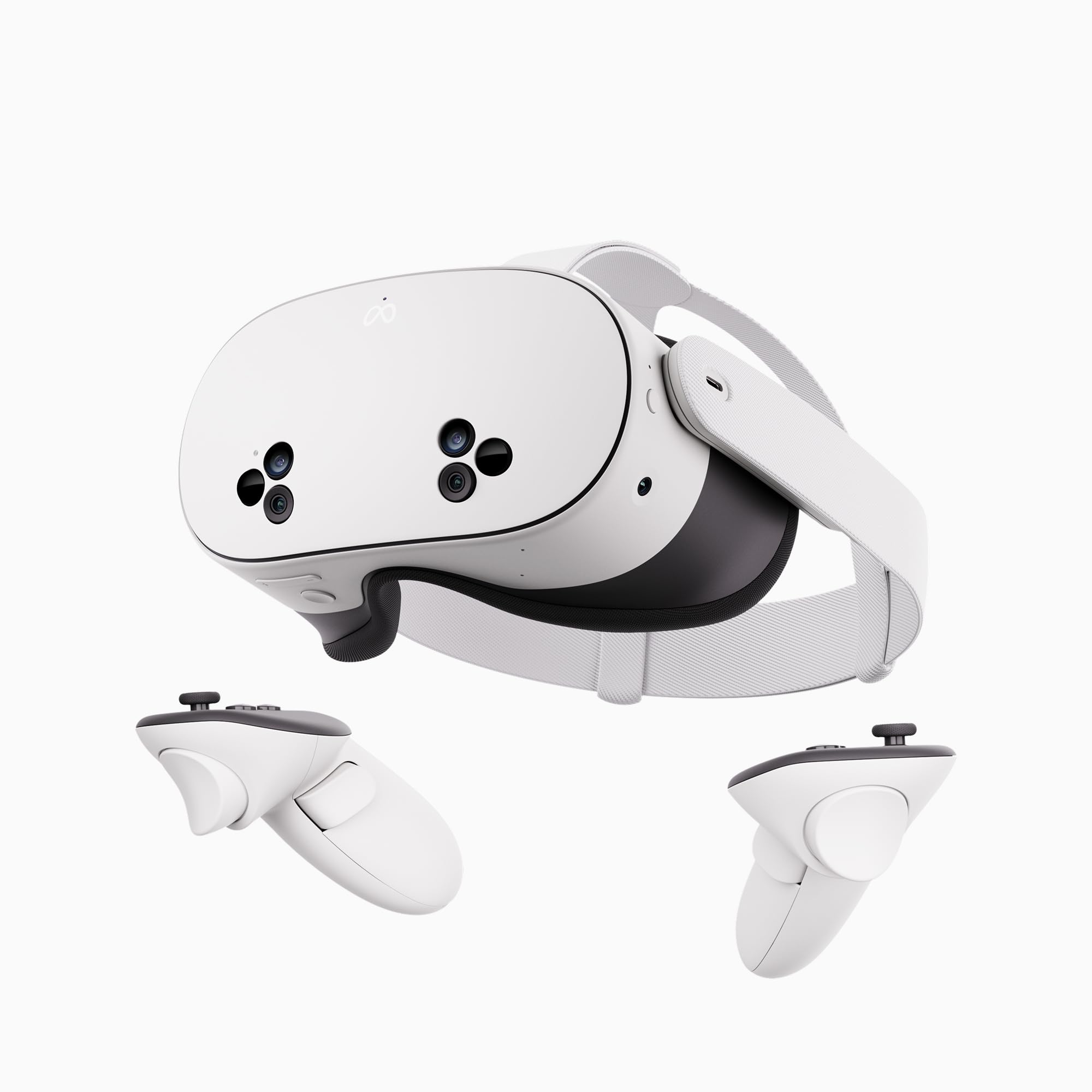
The family-friendly VR pick that arrives looking brand new and stays comfortable for hours.
The thing everyone raves about with the Quest 3S is simply how much fun it delivers for the outlay — enjoyment is by far the most-talked-about quality in owner feedback, with value for money right behind it. Family use dominates the reviews: it’s a headset that gets passed between kids and parents rather than gathering dust. The passthrough cameras deserve credit here too. Two full-color RGB cameras (regular color lenses, not the blurry black-and-white kind on older models) let you see your real room while wearing the headset, so you can check your surroundings without pulling it off.
Under the hood it runs the Snapdragon XR2 Gen 2 processor — the same chip family Meta uses to drive its next-gen graphics and faster load times — paired with 8GB of RAM. Around 90% of the Quest 3S is identical to the Quest 3, and the 128GB storage matches the Quest 2’s capacity exactly. Display resolution comes in at 2064 x 2208 pixels with a 90Hz refresh rate, and the unit ships with a 3.5mm jack and USB Type-C connector so wired headsets work from the start. Battery capacity is listed at 4324 mAh with an average life around 3 hours.
Owners get pickier about comfort, battery life, and image quality — those three sit in the mixed column, meaning a fair share of buyers wish the stock headstrap and speaker setup were a touch better. The Renewed Premium angle is the real story here: the device arrives in excellent condition and feels like a new unit, per buyer consensus, which is how you get 3S performance without paying full retail. If you want low-maintenance VR for the whole household, this is the one to reach for.
Where it lands: The Quest 3S is the safe middle ground — new-gen chip, wireless freedom, and a library that spans games, fitness, and entertainment without needing a PC.
What to know going in: Expect to recharge more often than you’d like on long sessions, and budget for a better headstrap if you plan marathon play sessions.
Best for: households where kids and adults share one headset, or anyone who wants the newest chip without the premium pricetag.
Look elsewhere if: you want the highest-resolution display available — the Quest 3 with its 4K+ panel is the step up.
3. Oculus Quest All-in-one VR Gaming Headset – 64GB
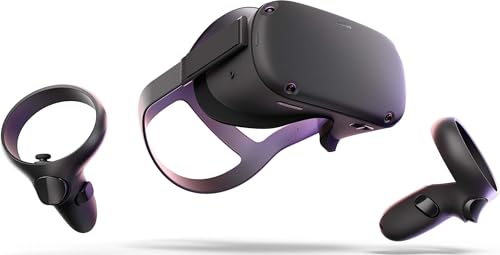
The original all-in-one that made wireless room-scale VR a reality — and swept the widest view.
Quality is the runaway winner in owner feedback, and it’s easy to see why: this headset pioneered the standalone formula that every model after it copied. The killer spec is the 110-degree field of view — noticeably wider than the Quest 2’s 95 degrees — which cuts down on the “scuba mask” tunnel sensation that bothers a lot of first-time users. The OLED panel here (organic LEDs that produce true blacks) also delivers deeper contrast than the LCD displays on competing Quests, giving dark environments a richer feel.
The tracking system is the other standout. Oculus Insight tracks your head and hands through cameras built into the headset — no base stations or external sensors cluttering the room. Setup takes about five minutes the first time, then seconds on every return, and room-scale works in spaces big or small because the headset adapts to whatever’s around you. The Touch controllers recreate your hands and gestures accurately enough that the movement feels natural once you’re inside.
The honest trade-offs matter with this aged model. At 1440 x 1600 combined pixels, its display resolution lags the newer Quest 2’s 3664 x 1920 — you’ll see some screen-door texture and blurry edges compared to modern headsets. Battery runs about 2-3 hours per charge, which is standard for the era but will feel short for marathon sessions. Nighttime play doesn’t work either, since the tracking cameras need light. All that aside, a two-month controller-strap failure appears occasionally in owner feedback, so treat the stock straps gently — most users never hit the issue, but it’s the one recurring gripe worth knowing.
The case for it: You get the widest field of view in this lineup, true OLED blacks, and the simplest room-scale setup on the market — no sensors, no base stations, no PC.
The honest limits: Older display resolution, shorter battery life, and no nighttime play. This is the pick for buyers who value immersion and portability over raw pixel count.
Best for: buyers who want the most rich view and don’t mind a lower-resolution panel, especially fitness-focused users and first-time VR explorers.
Look elsewhere if: screen-door texture bothers you or you need maximum pixel density — the Quest 2 above wins on clarity.
4. Meta Quest 3 512GB | Virtual Reality — VR Headset — Renewed Premium
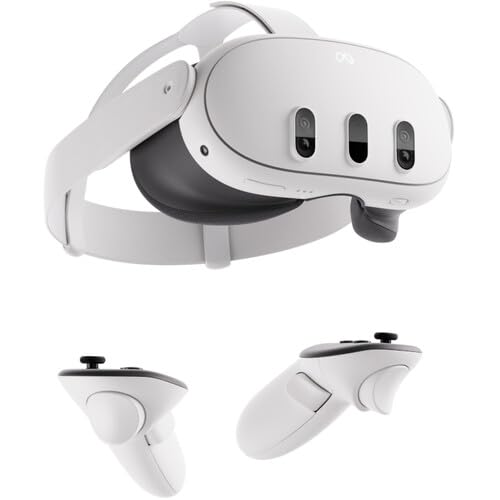
The sharpest, most loaded Quest in the lineup — and the one you’ll notice the weight of, in every sense.
Storage changes how you use it, so start there. The Quest 3 here carries 512GB — four times what the Quest 3S 128GB and Quest 2 128GB offer, and eight times the base Quest’s 64GB — which means you can install dozens of VR apps and games without ever opening the delete menu. The display is the other headline: it uses an OLED panel rated 4K+ with a 120Hz refresh rate, and pancake lenses (a flatter lens design that keeps the image sharp across nearly the whole viewing area) eliminate the blurry edges older fresnel optics suffered from.
Under the hood is the Snapdragon XR2 Gen 2 processor with 8GB of RAM, delivering the same lightning-fast load times as the Quest 3S. Dual RGB color cameras handle full-color passthrough so virtual objects can mingle with your physical room. Battery average life is listed at 2.2 hours, and the unit ships with a touch controller and an AC adapter. The 512GB of storage plus the sharp OLED display is what separates this from the mid-range picks.
Owner sentiment is more split than the other headsets on this list, which is worth knowing before you buy. Comfort is a mixed bag — some find the stock strap comfortable, others report headaches on longer sessions, and the stock strap gets called out for feeling flimsy compared to aftermarket options. Most buyers still find the visuals and functionality excellent, and 3 months of use with no issues is common. There’s no field-of-view figure in the spec sheet for this one, so I won’t guess.
Why owners reach for it
- 512GB storage — enough for the whole VR catalog without deleting anything
- 4K+ OLED display with pancake lenses for edge-to-edge clarity
- 120Hz refresh rate for the smoothest motion of any pick here
- Snapdragon XR2 Gen 2 with 8GB RAM for fast load times
What you’re signing up for
- Comfort is divisive — some buyers report headaches and find the stock strap flimsy
- 2.2-hour battery life is short for marathon sessions
My pick for: the buyer who wants the sharpest display and the biggest storage on this list and will tolerate a shorter battery to get both.
Consider a step down if: you mostly play in short bursts — the Quest 3S delivers 90% of the same chipset experience for less.
Understanding the Specs
Display Resolution and Lens Type
Resolution is the total pixel count across both eyes, written as a width x height figure like 3664 x 1920 or 1440 x 1600. Higher numbers mean sharper text, cleaner edges, and less of that visible pixel grid. Lens design matters just as much: newer pancake lenses hold sharpness across nearly the whole view, while older fresnel lenses get blurry near the edges. If a spec sheet skips the field-of-view figure, don’t guess — assume it isn’t a selling point.
Storage Capacity and Battery
Storage is how many VR games and apps you can install before you have to delete things. VR titles are large, so 64GB fills up fast, 128GB gives you solid breathing room, and 512GB means you basically never think about it. Battery capacity is measured in milliamp-hours (mAh) or quoted as average life in hours. A 2-3 hour runtime is normal for standalone headsets — plan on charging between sessions or picking up an aftermarket battery strap if you like long play sessions.
FAQ
Do I need a PC or console to use an affordable VR headset?
Is 64GB enough storage for a VR headset?
What does “Renewed Premium” actually mean?
Why do some VR headsets cause headaches?
How long does the battery last on a standalone VR headset?
Can I wear glasses inside a VR headset?
Do I need a Facebook account to use an Oculus Quest?
Do VR headsets work around kids?
Final Thoughts: The Verdict
If you want one dependable pick, the affordable vr headset winner is the Oculus Quest 2 Advanced All-in-One 128GB Set because it pairs 128GB of storage and a 3664 x 1920 display with a comfortable strap setup that new buyers won’t fight with. If you want the newest Snapdragon XR2 Gen 2 chipset and full-color passthrough for the whole family, grab the Meta Quest 3S 128GB. And if you want the sharpest OLED display plus 512GB of storage without ever managing your library, the Meta Quest 3 512GB is the one to reach for.
How We Picked
We do not accept paid placement. Every pick is matched to a real buyer and a real use-case; we do not hands-on test units.
Sources & Methodology
Specifications: manufacturer listings and product documentation. Review insights: verified customer reviews, as of September 2026. Pricing: not shown on this page (it changes often); check the current price via the retailer link.
As an Amazon Associate, Gadgets Feed earns from qualifying purchases. This does not affect which products we feature.