
Our readers keep the lights on and my morning glass full of iced black tea. As an Amazon Associate, I earn from qualifying purchases.
Specs are compiled from manufacturer listings and verified buyer reviews and can change over time — please confirm the key details on the product page before buying.
When your heart flutters, skips, or races, you need to know fast if it is anxiety or atrial fibrillation (an irregular and often rapid heart rhythm). An AFib monitoring device gives you that answer in seconds — right when symptoms hit, not three weeks later at a cardiologist appointment. But the devices differ in how they work (wallet card, blood pressure cuff, smartwatch, full-body scan). Picking the wrong one means you never have it on you or get flooded with data you cannot use. This guide breaks down what each type really does, where the accuracy holds up, and which one fits how you live.
I’m Min — the founder of Gadgets Feed. This guide is built by comparing the manufacturers’ published specifications and the patterns across verified customer reviews, so you get each pick’s real strengths and trade-offs.
After looking at how each device detects atrial fibrillation, whether it stays in a wallet or straps to a wrist, and what real buyers report about their daily experience, the field narrows to five serious contenders.
Quick Picks
- KardiaMobile Card — Best Overall
- OMRON Gold Blood Pressure Monitor (BP5360) — Best Value
- Fitbit Sense Advanced Smartwatch — Best for All-Day Wear
- WITHINGS Body Scan (White) — Premium Pick
- WITHINGS Body Scan (Black) — Premium Pick
How To Choose The Best AFib Monitoring Devices
The hardest part of AFib monitoring is not the technology — it is having the device with you when the palpitations start. A blood-pressure-cuff-based detector is useless mid-hike, and a smartwatch is pointless if the battery dies on day three. Match the form factor to your routine.
ECG Lead Type: Single-Lead vs Multi-Lead
Most personal AFib detectors use a single-lead ECG (an electrocardiogram that measures your heart’s electrical activity from two contact points, usually two fingers or a wrist and a button). This is enough to spot atrial fibrillation, bradycardia (a slow heart rate, typically under 60 beats per minute), and tachycardia (a fast heart rate, generally over 100 beats per minute). A six-lead ECG (measuring from six angles across your chest and limbs) is found only in premium units like the WITHINGS Body Scan. It gives the doctor a more complete picture but is far bulkier. For catching AFib alone, a single-lead device is sufficient — cardiologists review these traces routinely.
FDA Clearance vs General Wellness Claims
Look for the phrase “FDA-cleared” in the product description, not just “FDA-registered” or “general wellness.” An FDA-cleared device has been tested against a clinical standard for detecting atrial fibrillation. A device marketed only as a “wellness tracker” that mentions AFib has not passed that review. The Fitbit Sense runs an ECG app that received FDA clearance in select countries, but its optical heart-rate sensor alone is not cleared for AFib.
Subscription Trap: Can You See the ECG Without Paying?
Some devices let you record an ECG and view the raw waveform for free, but they charge a monthly fee to interpret it. The KardiaMobile Card gives you a free AI-powered “Normal” or “AFib” reading on each recording. But deeper analysis or a full cardiologist review costs extra with the KardiaCare membership. The OMRON Gold cuff stores all your readings in the free app with no subscription. The WITHINGS Body Scan also offers the six-lead ECG readout without a paid plan. If you want to avoid another monthly bill, choose a device that gives you the interpreted result at no extra cost.
Quick Comparison
| Model | Best For | ECG Type | Battery Life | FDA-Cleared AFib | Amazon |
|---|---|---|---|---|---|
| KardiaMobile Card | On-the-go spot checks | Single-lead | 2,000+ EKGs | Yes | Amazon |
| Omron Gold BP5360 | Daily BP + AFib screening | Single-lead | 4 AA (included) | Yes | Amazon |
| Fitbit Sense | Wrist-based all-day tracking | Single-lead ECG app | 6+ days | Yes (select countries) | Amazon |
| WITHINGS Body Scan (White) | Full body composition + ECG | 6-lead | Rechargeable (USB-C) | Yes | Amazon |
| WITHINGS Body Scan (Black) | Same as above, black finish | 6-lead | Rechargeable (USB-C) | Yes | Amazon |
In‑Depth Reviews
1. KardiaMobile Card
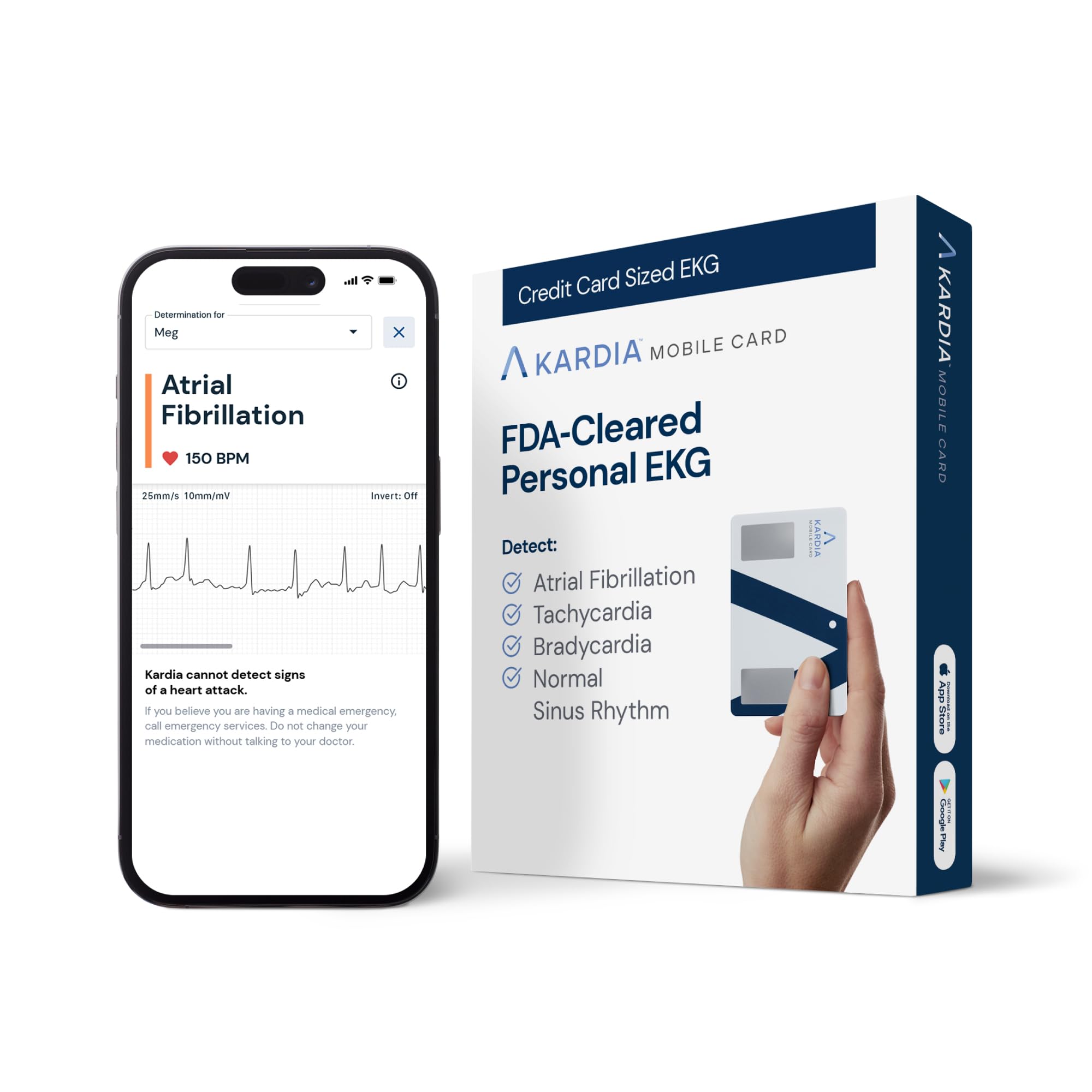
The EKG that slides into your wallet and catches an episode the moment palpitations start.
AFib waits for nobody, and neither does this monitor — it is about the size of a credit card at only 0.04 inches thick (the thickness of 4 stacked credit cards). You rest two fingers on the metal sensors, and within 30 seconds the free Kardia app tells you if the rhythm is normal sinus, AFib, bradycardia (a slow heart rate), or tachycardia (a fast heart rate). No WiFi needed, just Bluetooth to your phone. Owners mention that the built-in battery lasts a minimum of 2,000 EKGs (electrocardiograms, or heart-rhythm recordings) before the non-replaceable cell dies — about two years for most people.
The catch is the subscription pressure. Several customers note that the app strongly pushes the KardiaCare membership at per month or per year, and one buyer felt the free tier is too limited. You do get the basic AFib reading for free on each recording, but extras like full PDF reports or a cardiologist review cost extra. A physician reviewing the device notes that shaky thumbs can make the trace messy; placing the card on a flat surface keeps the trace clean enough for a doctor to read. The card is not tested with pacemakers or ICDs (implantable cardioverter-defibrillators), and it does not detect a heart attack — so any chest pain or emergency still requires a call to 911.
Compared to the OMRON Gold cuff, this card is vastly smaller (7.5 x 4.6 x 3.3 inches for the OMRON versus 3.4 x 2.1 x 0.04 inches for the card). The trade-off is that the KardiaMobile Card gives you zero blood pressure data — it is a pure rhythm monitor. If you need both numbers, the OMRON wins. But if you need a spot-check AFib detector that is always on you, this card is the one.
Why it travels better than any other
- True credit-card size — thin enough to live in a wallet
- 30-second recording gives an instant AFib reading with no subscription required for the basic result
- Brand claims it is the #1 cardiologist-recommended personal EKG brand with over 350 million EKGs recorded
The two things to know before buying
- Battery is built-in and non-replaceable; when it dies after roughly 2,000 EKGs, you replace the whole card
- Free app tier is limited — deeper analysis requires the optional KardiaCare membership
Grab it if: you experience occasional palpitations and want a device you will actually have in your pocket when they happen — the form factor guarantees you carry it.
Look elsewhere if: you need blood pressure readings alongside your rhythm check, or you dislike any device with a subscription upsell baked into the app experience.
2. OMRON Gold Blood Pressure Monitor (BP5360)
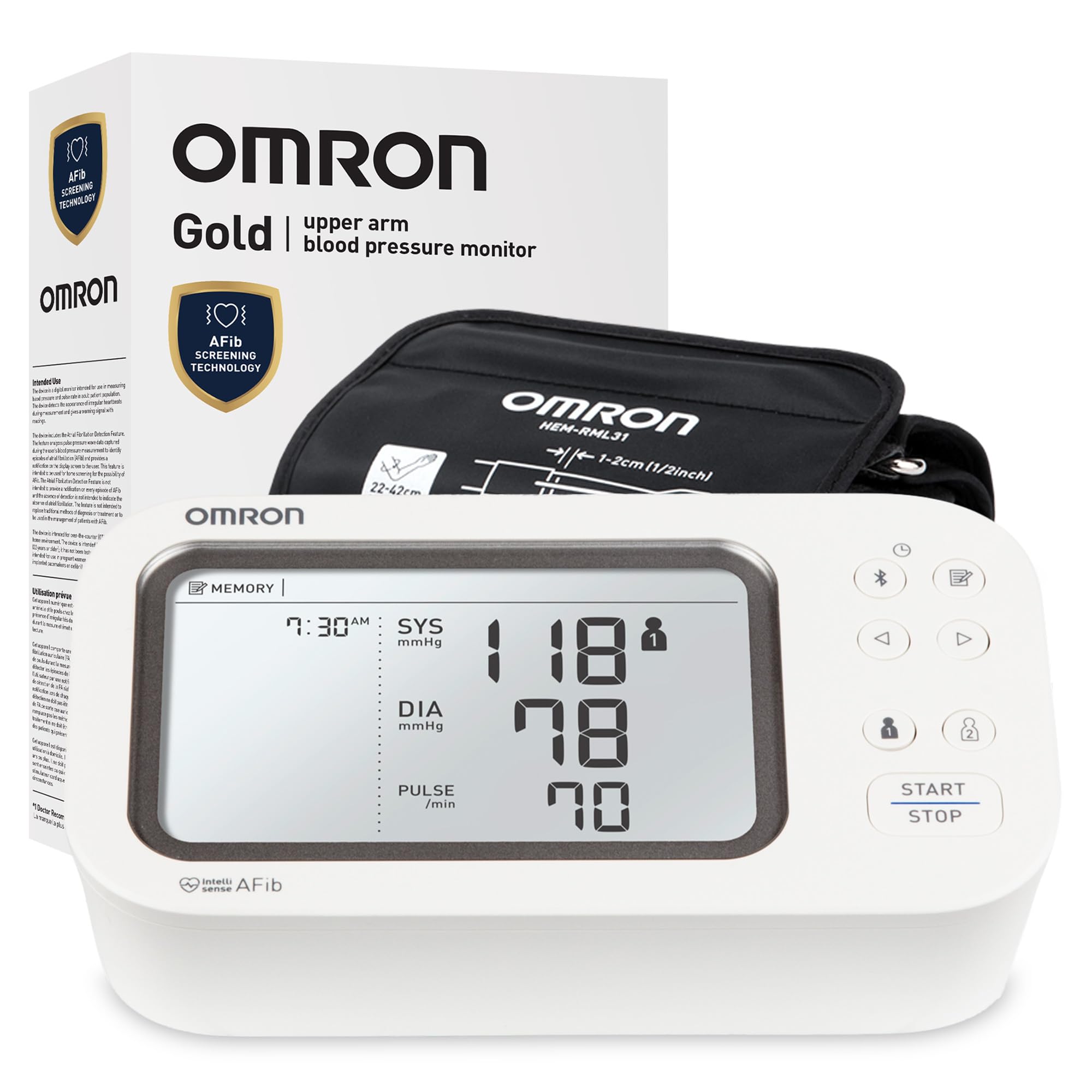
The home blood pressure cuff that doubles as an AFib screener every time you pump it up.
OMRON’s Gold model wraps AFib detection into a routine you already do — checking your blood pressure. Each time the cuff inflates, the monitor analyzes your heart rhythm for irregularities and flags potential atrial fibrillation. The device also uses OMRON’s TruRead technology, which automatically takes three consecutive readings and averages them, giving you a more reliable blood pressure number than a single snapshot. A dual-display screen shows the current reading next to your previous one, so you instantly see the trend without opening any app.
There is a critical honesty caveat that real buyers flag immediately — the device explicitly avoids taking a reading if it detects atrial fibrillation, because the irregular rhythm makes the blood pressure measurement inaccurate. One verified reviewer warns: “If you have atrial fibrillation, it will NOT read your B/P due to inaccurate readings.” So if you already know you have persistent AFib, this monitor will frequently refuse to give you a blood pressure number, which defeats its primary purpose. For users without AFib who want to screen for it while tracking BP daily, the Gold model works exactly as intended.
At 7.5 x 4.6 x 3.3 inches and 1.37 pounds, the OMRON Gold is far bulkier than the KardiaMobile Card — you will not carry it in your pocket. But it supports two users with separate tracking profiles, syncs via Bluetooth to the OMRON connect app (which pushes data to Apple Health and Google Fit), and includes four AA batteries from the start. Compared to the Fitbit Sense, which also detects AFib via an ECG app, the OMRON has no rechargeable battery worries and no screen-time distractions — it is a medical device first, a lifestyle gadget second.
The real trade-off to weigh: If you do not already have diagnosed AFib, this cuff gives you a dual benefit — accurate blood pressure numbers plus an AFib screening every time. But if you have persistent AFib, the device will often refuse to give a BP reading, making it frustrating for its intended use.
Why it beats the KardiaMobile Card here: The OMRON Gold includes the TruRead three-reading average and dual-user support with no subscription required — you get all your historical data in the free app with no monthly cost.
Reach for this if: you are over 50 or have hypertension (high blood pressure) and want to screen for AFib as a secondary benefit during your daily blood pressure routine.
skip it if: you already have confirmed persistent atrial fibrillation, because the cuff may refuse to give you a blood pressure reading during an episode.
3. Fitbit Sense Advanced Smartwatch

The wrist-worn ECG that lets you check your heart rhythm without reaching for a separate device.
The Fitbit Sense puts an FDA-cleared ECG app right on your wrist — you open the app, hold your fingers on the bezel, and after 30 seconds you get a reading that classifies the rhythm as normal sinus or AFib. This is a single-lead ECG (an electrocardiogram using two contact points), similar to what the KardiaMobile Card delivers. The advantage is that the watch is already on your wrist all day long. You do not have to remember to grab a card; if a symptom hits during a walk, a meeting, or in the middle of the night, the tool is already there.
Real reviewers point out a mixed experience with battery life. The company claims 6+ days of use, but several shoppers say that real-world battery is closer to 4 to 5 days, even with the screen set to manual mode. That is still longer than an Apple Watch, but it means you need to charge the watch twice a week — and you cannot record an ECG while it is on the charger. The fast-charge feature gives you a full day’s charge in 12 minutes, which helps if you remember to top it off during a shower. One reviewer also flagged that the heart rate sensor during exercise can be 20 to 80 BPM (beats per minute) off during cardio, so the optical sensor is not a substitute for a chest strap during workouts.
Compared to the OMRON Gold cuff, the Fitbit Sense is dramatically smaller at 1.59 x 1.59 x 0.48 inches (the same thickness as the KardiaMobile Card) and only 7.05 ounces — you wear it, not store it. The ECG app is available only in select countries and is not intended for people under 22 years old. The watch also includes an EDA scan (a sensor that measures your skin’s sweat response, designed to detect stress), a skin temperature sensor, built-in GPS, and Amazon Alexa voice control. It tracks sleep, SpO2 (blood oxygen saturation), and steps, making it a full health wearable that includes AFib detection, rather than a dedicated medical monitor.
The everyday ease it delivers
- ECG app is on your wrist and accessible within seconds — no digging in a bag or wallet
- Fast charging gives a full day’s charge in 12 minutes, so short top-ups keep you running
- Includes built-in GPS, SpO2, skin temperature, and sleep tracking as secondary benefits
Where the reality diverges from the hype
- Real battery life lands at 4-5 days, not the claimed 6+, which means charging twice a week is the norm
- Heart rate tracking during exercise can be 20-80 BPM off, so the optical sensor is not reliable for cardio zone training
Best for: anyone who wants a single device for daily fitness tracking, sleep monitoring, and on-wrist AFib checks — the convenience of not carrying a separate ECG gadget is the real draw.
Not for: those with persistent AFib who need a dedicated medical monitor with guaranteed accurate HR tracking during exercise — the optical sensor struggles with high-intensity movement.
4. WITHINGS Body Scan (White)
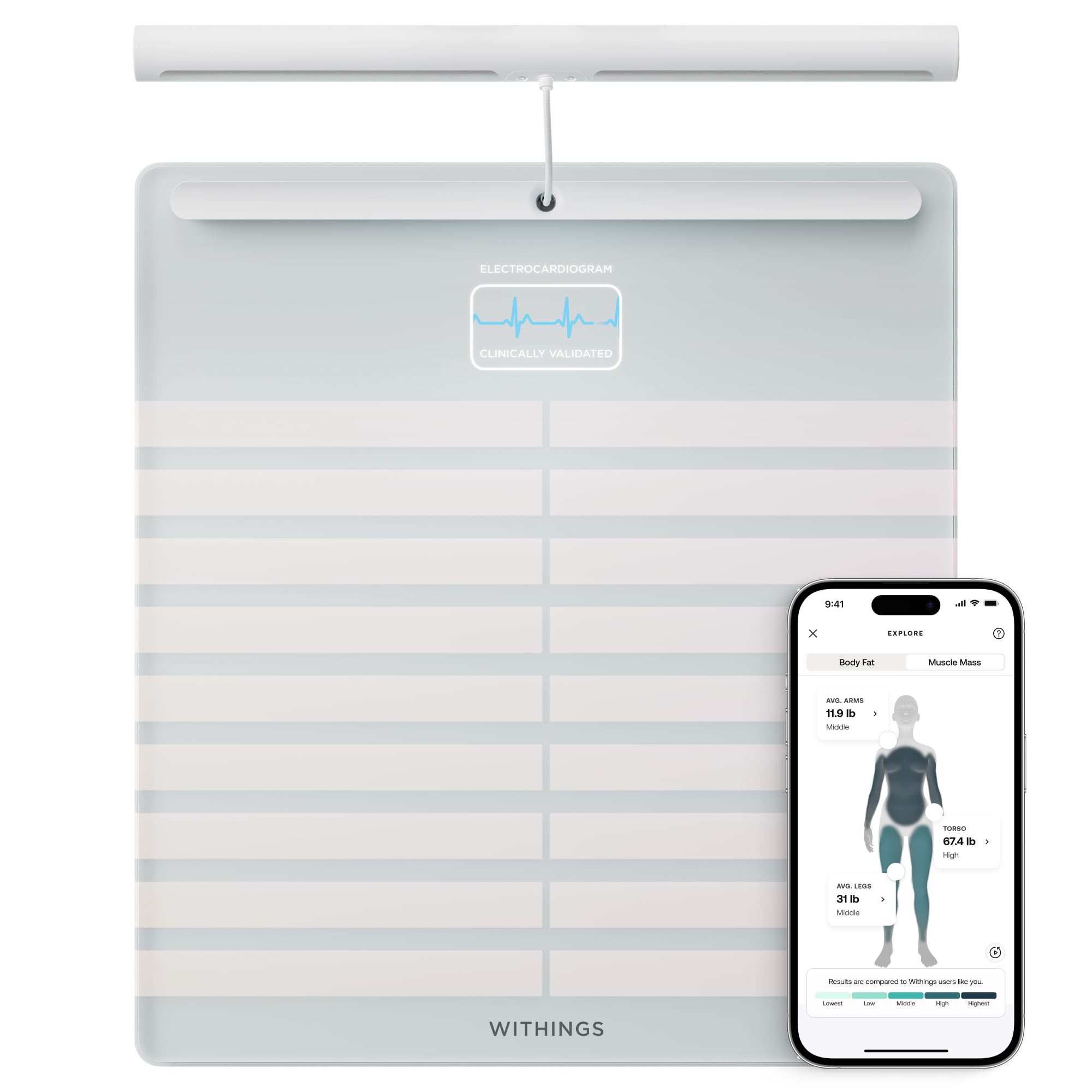
The smart scale that runs a six-lead ECG and measures your artery stiffness every morning.
WITHINGS Body Scan is not just a scale — it is a station that performs a six-lead ECG (an electrocardiogram using six contact points, measuring from six angles across your body) through the handle and your feet. This gives a far more detailed picture of your heart’s electrical activity than the single-lead devices above. It is clinically validated and FDA-cleared for detecting atrial fibrillation, so the ECG result carries medical weight. The scale also measures segmental body composition (fat and muscle percentages for each arm, leg, and torso), vascular age (how stiff your arteries are, compared to a healthy person of your age), arterial stiffness, and sweat-gland activity in the feet.
The rub is the price point — this is the most expensive device on this list. Some real buyers report serious inconsistency in the body composition numbers. One reviewer who compared the Body Scan to a DEXA scan (dual-energy X-ray absorptiometry, the clinical gold-standard for measuring body fat) found the body fat percentage was off by 5.4% and the weight itself was understated by over 4 pounds. Another noted that the ECG is fussy after exercise because a high heart rate makes the reading inconclusive. The scale also ships with a USB-C cable and a wall handle mount, and it weighs about 8.8 pounds (4 kilograms), so it is not something you travel with.
Compared to the Fitbit Sense, which runs a simpler single-lead ECG on your wrist, the WITHINGS Body Scan gives a broader cardiovascular assessment (arterial stiffness, vascular age) but requires you to stand still on the scale at the same time each day. The body composition readings are trend-oriented — the absolute accuracy may be off, but the direction of change (muscle going up, fat going down) is what matters for diet and exercise tracking. Several reviewers emphasize that the scale integrates poorly with Garmin and Samsung Health, so if you are in a non-Withings ecosystem, you may lose smooth data flow.
The big differentiator: A six-lead ECG gives your doctor a more complete trace than a single-lead device, and the vascular age measurement is unique in this category. No other consumer device on this list assesses arterial stiffness.
The honest drawback: Body composition numbers can differ significantly from a gold-standard DEXA scan, so treat the fat and muscle percentages as trend data, not absolute truth.
Choose this if: you are a health-data enthusiast who wants vascular age and a six-lead ECG alongside your weight — and you already use the WITHINGS app ecosystem.
Pass if: you just need occasional AFib spot checks and do not want a costly scale that is bulkier than a dedicated ECG card.
5. WITHINGS Body Scan (Black)

The same six-lead ECG scale in a black finish, with all the same precision and the same quirks.
This is the black version of the same WITHINGS Body Scan — identical six-lead ECG for AFib detection, identical segmental body composition analysis, and the same 0.1-pound readout accuracy (so it can detect a tenth of a pound change in weight). It includes the same USB-C charging cable, cable stopper, and wall handle mount, and it is slightly heavier at about 9.7 pounds versus the white model’s 8.8 pounds. The core function remains: stand on the scale, grab the retractable handle, and within seconds the device evaluates your heart rhythm, body fat distribution, muscle mass, and arterial stiffness.
Real buyers confirm that the six-lead ECG works well for spotting AFib. But one reviewer with a right bundle branch block (a common, usually benign, electrical conduction condition in the heart) found that most of their ECG readings came back as inconclusive — the algorithm struggles to interpret certain pre-existing conduction patterns. Another buyer who tested the body fat measurement against a DEXA scan reported that the Body Scan understated their body fat by 5.4% while overstating muscle mass, and the segmented arm readings showed an impossible 2% body fat. These are the same accuracy complaints that appear on the white model, which suggests this is not a unit-to-unit variation but a limitation of the BIA (bioelectrical impedance analysis, a method that sends a tiny electrical current through your body to estimate composition) technology itself.
For pure AFib detection, the Body Scan is the only device here that gives you a six-lead ECG at home, a meaningful advantage over the single-lead KardiaMobile Card and the Fitbit Sense. But for most buyers, the KardiaMobile Card catches AFib just as reliably for a fraction of the price and fits in a pocket. The Body Scan’s real value is for someone who wants the full cardiovascular picture — weight, hydration, muscle balance, artery health, and heart rhythm — all in one morning routine. If you are that person, the black finish matches more bathroom decors, but the performance is identical to the white model.
The compelling strengths
- Six-lead ECG provides a more detailed cardiac trace than any single-lead device — your cardiologist gets richer data
- Wi-Fi sync works automatically without needing your phone nearby, so data pushes smoothly every time you step on
- Rechargeable battery (USB-C) removes the ongoing cost of replacing AA or button cells
The meaningful weaknesses
- Body fat and muscle readings can differ significantly from a DEXA reference — one reviewer noted a 5.4% body fat error
- ECG is often inconclusive if you have a pre-existing conduction condition like right bundle branch block
Best for: the health-data enthusiast who wants a daily full-body scan that includes a six-lead ECG alongside body composition — and who prefers a black look for their bathroom.
For most buyers though, the KardiaMobile Card is the smarter pick: it does the same AFib detection job for much less money and fits in a pocket.
Understanding the Specs
Single-Lead vs Six-Lead ECG
A single-lead ECG (electrocardiogram) measures the electrical signal of your heart from two contact points — essentially one angle of view. This is enough to detect atrial fibrillation, bradycardia (slow heart rate), and tachycardia (fast heart rate), and cardiologists routinely use single-lead traces from personal devices to make clinical decisions. A six-lead ECG measures from six angles, giving the doctor a more complete picture of how the electrical impulse travels through different chambers of the heart. The WITHINGS Body Scan is the only device in this roundup that offers six leads. For catching AFib, a single-lead device is sufficient, but a six-lead trace can help rule out other arrhythmias.
FDA Clearance and Its Real Meaning
FDA clearance means the device has been through a 510(k) review where the manufacturer demonstrated it is “substantially equivalent” to a legally marketed predicate device — essentially, it meets a known standard for safety and effectiveness. A “general wellness” device has no such obligation. When a product label says “FDA-cleared for AFib detection,” the algorithm has been tested against a clinical-grade 12-lead ECG in a controlled study. The KardiaMobile Card, OMRON Gold, and WITHINGS Body Scan all carry this clearance. The Fitbit Sense ECG app received clearance in select countries, but its optical heart-rate sensor alone is not cleared for rhythm analysis — only the intentional ECG recording is.
FAQ
Can an AFib monitoring device replace a visit to a cardiologist?
Will the KardiaMobile Card work with a pacemaker or ICD?
Does the OMRON Gold cuff measure blood pressure during an AFib episode?
How does the Fitbit Sense ECG compare to the KardiaMobile Card for accuracy?
Do I need a subscription to use the WITHINGS Body Scan ECG?
Can the KardiaMobile Card be used by two people in one household?
How long does the battery last in each device?
Is the WITHINGS Body Scan accurate for body fat percentage?
Which device is the easiest to travel with?
Can I use a personal AFib monitor if I have persistent AFib?
Final Thoughts: The Verdict
For the majority of shoppers, the best afib monitoring devices winner is the KardiaMobile Card because it is small enough to carry every day, gives a medical-grade ECG within 30 seconds, and the free app tier tells you Normal or AFib without a subscription. If you want AFib detection built into your daily blood pressure routine, grab the OMRON Gold. And for a full cardiovascular scan including a six-lead ECG and arterial stiffness measurement, the standout is the WITHINGS Body Scan.
How We Picked
We do not accept paid placement. Every pick is matched to a real buyer and a real use-case; we do not hands-on test units.
Sources & Methodology
Specifications: manufacturer listings and product documentation. Review insights: verified customer reviews, as of July 2026. Pricing: not shown on this page (it changes often); check the current price via the retailer link.
As an Amazon Associate, Gadgets Feed earns from qualifying purchases. This does not affect which products we feature.