
Your engine lives and dies by the air it breathes. A restrictive or clogged aftermarket air filter chokes horsepower, dulls throttle response, and lets abrasive particulates slowly grind down cylinder walls. Whether you’re daily-driving a turbo-diesel truck through construction dust or squeezing extra miles per gallon from a compact sedan, the right filter is a spec-level decision, not a commodity grab.
I’m Rikta — the co-founder and writer behind Gadgets Feed. I’ve spent years deep-diving filtration media construction, micron-efficiency lab data, dust-holding capacity benchmarks, and real-world fitment reports so you know exactly what each pleat and gasket delivers. (And Homer 🐱 supervised every unboxing from his perch on the cardboard pile).
Below, I break down seven proven contenders across price tiers, from budget-friendly cabin-air packs to premium washable drop-ins that outlast the vehicle itself. Here’s the definitive guide to finding the best aftermarket air filter for your specific ride and driving conditions.
How To Choose The Best Aftermarket Air Filter
Not all filters are created equal. The cheapest paper element may meet OEM minimums, but it won’t survive dusty job sites or extended service intervals. A high-flow cotton gauze filter improves throttle response but lets through more fine particles than a dense synthetic media. Matching the filter type to your driving environment and maintenance willingness is the entire game.
Filtration Media & Efficiency
The three dominant constructions are pleated paper, oiled cotton gauze, and synthetic non-woven. Paper offers the highest initial efficiency (99%+ at 3–5 microns) but clogs faster and is single-use. Oiled cotton gauze — the K&N standard — flows more air for a slight power gain but typically tests around 97–98% efficiency, meaning more ultrafine dust passes through. Synthetic non-woven blends (used by brands like Spectre) aim for a middle ground: washable, decent airflow, and higher efficiency than cotton when new.
Fitment & Gasket Integrity
A filter that doesn’t seal is useless. The gasket — whether polyurethane, rubber, or silicone — must compress evenly against the air-box lid. Silicone stays pliable in extreme cold and heat without cracking. Measure the width, length, and height of your stock filter before ordering; the ASIN cross-reference charts are helpful, but physical dimensions don’t lie. Many aftermarket failures stem from a loose fit around the housing edges that lets unfiltered air bypass the media entirely.
Service Life & Maintenance Cost
Disposable paper filters cost – and need changing every 12,000–15,000 miles. A washable cotton filter costs – upfront but can last 50,000–75,000 miles between cleanings, paying for itself after two or three replacement cycles. However, cleaning requires a specific aerosol solvent and re-oiling kit — skip this step and efficiency drops. Factor in your willingness to perform periodic maintenance before committing to a reusable design.
Quick Comparison
On smaller screens, swipe sideways to see the full table.
| Model | Category | Best For | Key Spec | Amazon |
|---|---|---|---|---|
| K&N 33-2387 | Premium Washable | Full-size trucks & SUVs | 75,000-mile cleaning interval | Amazon |
| K&N 33-2498 | Premium Washable | Acura/Honda 2.4L engines | Four-layer cotton gauze | Amazon |
| K&N 33-3080 | Premium Washable | Fiat/Toyota/Lexus models | Limited lifetime warranty | Amazon |
| Doc’s Diesel DPA11885 | Diesel Performance | Ford 6.7L Powerstroke | 344.2g dust holding capacity | Amazon |
| Doc’s Diesel DPA6314 | Diesel Performance | Ram 6.7L Cummins | 99.25% filtration efficiency | Amazon |
| Spectre HPR5056 | Performance Washable | Ford/Lincoln/Mercury V8s | 50% more airflow than paper | Amazon |
| Cabiclean FLT4825 | HEPA Replacement Set | Guardian air purifiers | 4 HEPA + 8 carbon pre-filters | Amazon |
In-Depth Reviews
1. K&N High-Flow 33-2387 (Toyota Tundra/Sequoia/Land Cruiser)

The K&N 33-2387 is the gold standard for full-frame Toyota and Lexus V8s, covering the 5.7L and 4.6L engines found in Tundra, Sequoia, and Land Cruiser models from 2007 through 2021. Its oiled cotton-gauze media flows dramatically more air than the factory paper element, and owners consistently report a 1–3 MPG improvement along with noticeably sharper throttle tip-in. The polyurethane frame seals tightly against the factory air box, and the cleaning interval — 75,000 miles under normal highway driving — means you’ll likely service it only once or twice during your ownership.
The trade-off is a known high-pitch whistle on the 5.7L engine at around 2,000 RPM, caused by the filter’s airflow interacting with the throttle-body mesh screen. Several long-term users solved this by swapping the rubber gasket with Toyota part 22271-50050 or removing the restrictive screen behind the throttle body — a five-minute fix. Once addressed, the filter runs silently and delivers consistent filtration for years. The Million-Mile Limited Warranty adds peace of mind, though it requires proof of proper cleaning with the K&N recharge kit.
For Tundra and Sequoia owners who keep their trucks past 100,000 miles, this filter pays for itself within two paper-filter replacement cycles. The combination of measurable fuel economy gains and lifetime reusability makes it the most cost-efficient upgrade for this engine family. Just be prepared for the minor whistle tweak on 5.7L applications.
Why it’s great
- Real-world MPG gains of 1-3 miles per gallon reported by owners
- 75,000-mile service interval cuts maintenance to nearly zero
- Limited lifetime warranty backs the purchase long-term
Good to know
- May produce a whistle at 2k RPM on 5.7L engines without the throttle-body mesh fix
- Requires specific K&N cleaning oil — generic solvents will damage the media
- Higher upfront cost than paper disposables
2. K&N High-Flow 33-2498 (Acura/Honda 2.4L)

Designed for the 2.4L four-cylinder in the 2013-2020 Honda Accord and 2015-2020 Acura TLX, the K&N 33-2498 delivers a noticeable bump in throttle response without any permanent modifications. Owners of the TLX 2.4L report smoother acceleration and roughly 2 MPG improvement in mixed driving, a meaningful gain for a commuter car. The drop-in fitment is flawless — no trimming, no adapters — and the four-layer oiled cotton gauze traps particles down to the manufacturer’s spec while allowing higher volumetric flow.
The trade-off is filtration efficiency. Independent testing shows that oiled cotton filters let through marginally more fine particles than a fresh paper element, especially in the sub-5-micron range. For a daily-driven sedan on paved roads this is rarely a problem, but if you frequently drive on unpaved roads or in heavy construction zones, a premium synthetic filter may offer better long-term engine protection. The K&N’s 75,000-mile cleaning interval (under normal conditions) means you’ll service it about every five years at average mileage.
The included Million-Mile Limited Warranty is hard to argue with, though you must save receipts for the cleaning kit to maintain coverage. For Accord and TLX owners seeking a simple, reversible performance bump with long-term cost savings, this filter hits a sweet spot. Just keep the cleaning schedule honest — a clogged oiled filter flows worse than a dirty paper one.
Why it’s great
- Noticeably sharper throttle response on the 2.4L earth dreams engine
- Drop-in fit with zero modifications required
- Lifetime warranty and reusability save money over a decade
Good to know
- Slightly lower fine-particle efficiency than premium paper filters
- Requires dedicated cleaning and oiling every ~75k miles
- Not recommended for extreme dust environments
3. K&N High-Flow 33-3080 (Fiat/Toyota/Lexus)

The K&N 33-3080 covers a wide cross-section of 2016-2026 models from Fiat, Toyota, and Lexus, making it one of the most versatile drop-in filters in the K&N catalog. Owners of the latest RAV4 Woodland and various Lexus crossovers report a five-minute installation and immediate improvement in intake sound and part-throttle response. The construction is identical to the rest of the K&N Original line: four layers of oiled cotton gauze sandwiched between epoxy-coated wire mesh, encased in a durable urethane frame that won’t crack in extreme temperatures.
The key differentiator here is cleanliness out of the box. K&N pre-oils every filter at the factory, so there’s no messy first-time treatment — just pull the old paper element, drop this in, and drive. The 75,000-mile cleaning interval is based on 15,000 miles per year of normal highway driving; if most of your miles are stop-and-go city traffic, expect to clean it closer to every 50,000 miles. A RAV4 owner noted the filter saved them roughly in disposable replacements over the first three years alone.
The main hesitation with any oiled cotton filter is the potential for mass airflow sensor contamination if over-oiled during cleaning. K&N recommends their specific aerosol recharge kit and cautions against saturating the media. Follow the instructions and you’ll never have an issue; rush the job and you risk a check-engine light. For most drivers, the performance gain and long-term value easily outweigh this minor maintenance discipline.
Why it’s great
- Pre-oiled and ready to install straight from the box
- Covers a huge range of popular Toyota/Lexus/Fiat models
- Proven 1-2 MPG improvement in real-world driving
Good to know
- Careful re-oiling is essential to avoid MAF sensor issues
- Higher initial cost than a standard paper filter
- Effectiveness depends on proper cleaning intervals
4. Doc’s Diesel DPA11885 (Ford 6.7L Powerstroke)

Doc’s Diesel builds their filters for the specific demands of turbo-diesel tow rigs, and the DPA11885 is purpose-engineered for the Ford 6.7L Powerstroke found in 2020-2025 F-250 through F-550 trucks. The deep-pleated paper media is third-party tested at 99.25% filtration efficiency with a dust-holding capacity of 344.2 grams — roughly triple what a standard passenger-car filter can trap. That capacity matters when you’re pulling a gooseneck through agricultural dust or construction debris for hours at a time.
The heavy-duty silicone gasket is a standout feature. Unlike rubber gaskets that harden and crack after a few heat cycles, silicone stays pliable from -60°F to 400°F, maintaining a consistent seal against the Powerstroke’s factory air-box lid. Owners of 2023 F-350s confirm the filter slides in with the same resistance as the Motorcraft FA2031 it replaces, but at a significant savings. The recommended change interval is 5,000-10,000 miles per Doc’s, though many users stretch to 12,000 miles in mixed driving.
The only downside is that this filter is strictly disposable — no wash-and-reuse option. For a heavy-duty diesel, that’s actually preferable: paper media delivers the highest consistent efficiency, and the massive dust-holding capacity means you’re not swapping it any more often than you would a cotton filter anyway. If you’re running a modern Super Duty, this filter delivers OEM-grade protection without the dealer markup.
Why it’s great
- 344.2-gram dust-holding capacity handles extreme conditions
- Silicone gasket won’t crack or harden under heavy heat
- Identical fit to Motorcraft FA2031 at a much lower cost
Good to know
- Not washable — single-use paper construction
- Change interval of 5k-10k miles in dusty environments
- Only fits 2020+ 6.7L Powerstroke applications
5. Doc’s Diesel DPA6314 (Ram 6.7L Cummins)

The Ram 6.7L Cummins is one of the most popular diesel platforms in North America, and the Doc’s DPA6314 gives owners a compelling alternative to the Mopar 53034051AB. Like its Powerstroke counterpart, this filter uses deep-pleated paper media with a third-party verified 99.25% efficiency and 344.2-gram dust-holding capacity. The fitment covers 2007 through 2026 model years, making it a one-stop replacement for almost two decades of Cummins-powered trucks.
The silicone gasket here is especially important. The Cummins air box sits low on the engine and is exposed to significant vibration and temperature swings. A standard rubber gasket can lose its seal over time, letting dust bypass the filter entirely. Doc’s uses the same high-temperature silicone as their Ford filter, ensuring a snug, long-lasting seal. Owners of 2011 6.7L trucks report zero issues after six months of hard use, noting that the filter holds up well under towing loads and extended highway runs.
The downside is the same — this is a disposable paper filter. For a light-duty diesel used mostly for commuting, a washable cotton option might save money over time. But for trucks that actually work — towing, hauling, off-road — the high dust-holding capacity and consistent efficiency of this paper element make it the smarter choice. At roughly half the price of the dealer replacement, it’s an easy recommendation for any Cummins owner.
Why it’s great
- Covers 2007-2026 Ram 6.7L Cummins models in one filter
- Silicone gasket resists vibration and extreme temperatures
- Third-party tested at 99.25% efficiency with high dust capacity
Good to know
- Not reusable — must be replaced at service intervals
- 5k-10k mile change interval recommended for heavy use
- Best suited for work trucks, not daily commuters
6. Spectre HPR5056 (Ford/Lincoln/Mercury V8)

The Spectre HPR5056 is the smart-money alternative to K&N for owners of 1985-2011 Ford, Lincoln, and Mercury vehicles with V8 engines — particularly the modular 4.6L 2V and 3V platforms. Spectre claims up to 50% more airflow than a standard paper filter, and owners of 2003 Mercury Grand Marquis and early Mustang GTs confirm an immediate snappier throttle response and a more aggressive intake growl. The non-woven synthetic media is washable and reinforced with steel mesh on both sides, offering durability comparable to cotton gauze at a lower price.
The cost advantage is significant. At roughly half the price of the equivalent K&N filter (E-0945 or similar), the Spectre delivers comparable performance gains without the premium branding markup. Multiple reviewers note that the build quality is slightly below K&N’s — the urethane frame feels a touch less dense — but the fitment is identical and the filtration performance is more than adequate for street-driven vehicles. The 50,000-mile cleaning interval under normal highway driving means most owners will clean it once a year or less.
The main limitation is vehicle compatibility. Spectre’s fitment list is narrower than K&N’s, and the HPR5056 covers mostly older Ford platforms. If you own a 4.6L or 5.4L Modular V8 from the 1990s or 2000s, this is an excellent budget-friendly upgrade. But for newer Ford models or non-Ford applications, double-check the fitment guide carefully. The 3-month manufacturer warranty is short compared to K&N’s Million-Mile coverage, reflecting the lower price tier.
Why it’s great
- Noticeable throttle and intake sound improvement on Modular V8s
- Washable and reusable at half the cost of the premium competitor
- 50,000-mile cleaning interval reduces maintenance hassle
Good to know
- Narrower vehicle fitment list than K&N equivalents
- Shorter 3-month warranty compared to lifetime options
- Build quality slightly less refined than premium brands
7. Cabiclean FLT4825 (Guardian Air Purifier)
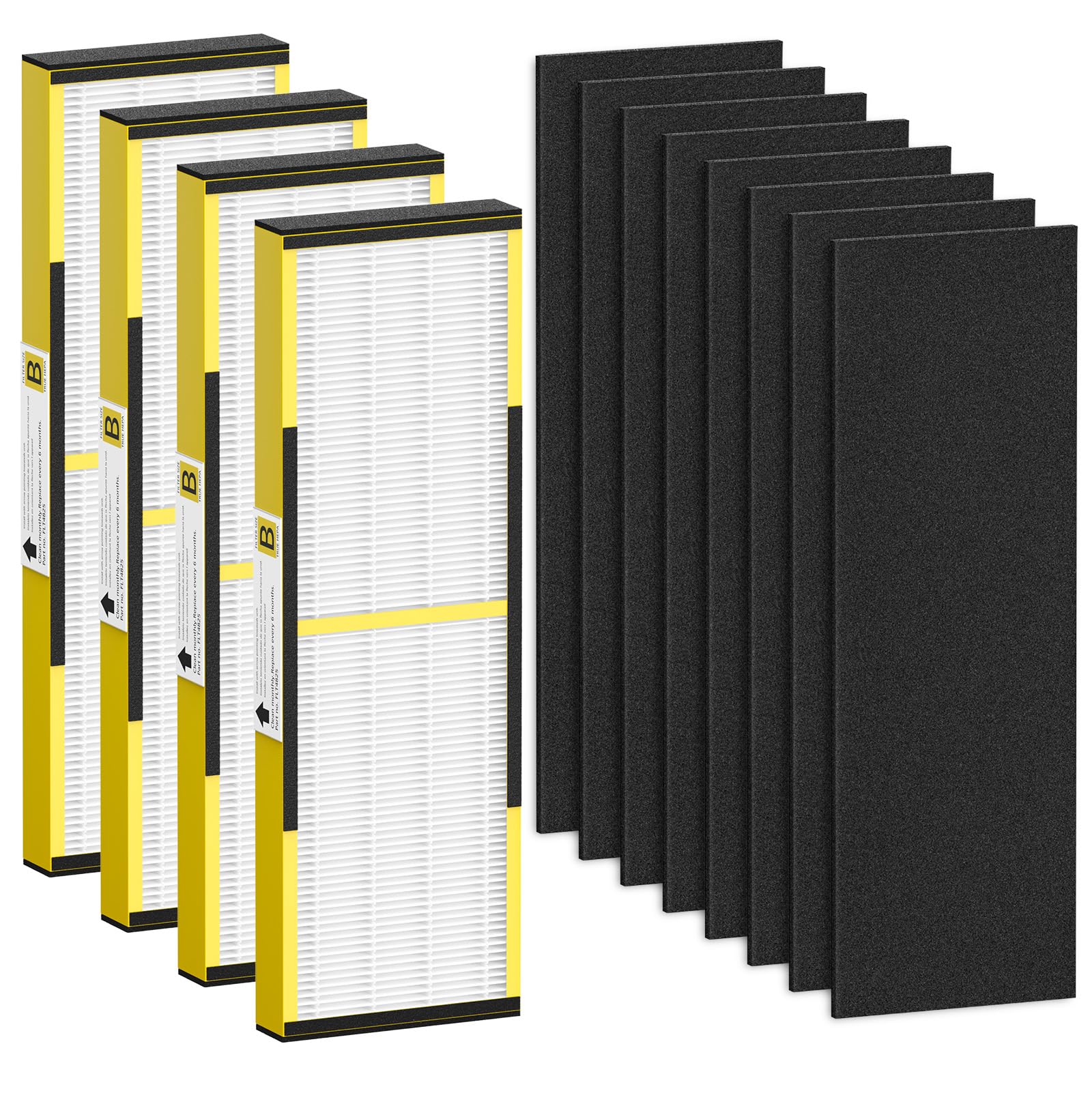
The Cabiclean FLT4825 set is a departure from engine filters — it’s a replacement kit for Guardian Technologies air purifiers (models AC4825, AC4300, AC4900, and several others). But it earns its spot here because it represents the other critical air filtration need in a home: breathing clean air. The kit includes four true HEPA filters and eight activated carbon pre-filters, capturing 99.97% of particles down to 0.3 microns, including pollen, pet dander, smoke, and mold spores.
The value proposition is outstanding. You’re getting four complete filter cycles for roughly what a single OEM replacement costs, and the carbon pre-filters handle odor removal from cooking, smoking, and pets while extending HEPA life. The seamless sealing technology and plastic frame ensure no unfiltered air bypasses the media — a common issue with bargain HEPA replacements. Cabiclean uses FSC-certified paper for the media, so you’re getting a responsibly sourced product that matches OEM performance.
The only catch is compatibility — this set only fits specific Guardian and Black+Decker models listed in the description, so verify your unit’s model number before ordering. The filters last roughly 6-12 months depending on usage and air quality, making this a reliable budget-friendly solution for allergy sufferers or anyone looking to improve indoor air quality on a tight budget.
Why it’s great
- Four full filter cycles at a fraction of OEM replacement cost
- True HEPA captures 99.97% of particles down to 0.3 microns
- Included carbon pre-filters extend HEPA life and reduce odors
Good to know
- Compatible only with specific Guardian/Black+Decker models
- HEPA filters need replacement every 6-12 months
- Pre-filters require more frequent changing in dusty homes
FAQ
Will a high-flow air filter void my vehicle warranty?
How often should I clean a washable cotton air filter?
Final Thoughts: The Verdict
For most users, the best aftermarket air filter winner is the K&N 33-3080 because it combines proven performance gains, a vast vehicle fitment list, and a lifetime warranty that pays for itself in under three years. If you drive a diesel work truck and need maximum filtration for severe conditions, grab the Doc’s Diesel DPA11885 for its 344-gram dust capacity and silicone gasket reliability. And for budget-conscious owners of older Ford V8s, nothing beats the Spectre HPR5056 for washable convenience at entry-level pricing.