
Ripping a board that wanders into the blade or pinches on the way through isn’t just frustrating—it’s dangerous. The fence system bolted to the saw from the factory often flexes, drifts out of parallel, or offers too short a registration surface for stable feed control. That’s the moment an aftermarket fence stops being a luxury and becomes the single most impactful safety upgrade for your table saw.
I’m Min — the co-founder and writer behind Gadgets Feed. I’ve spent hundreds of hours cross-referencing extrusion profiles, clamping mechanisms, T-track integration, and UHMW sub-fence compatibility across the major players to isolate what actually delivers repeatable, sub-0.005-inch accuracy session after session.
Whether you are working on a restoration of a classic cast-iron cabinet saw or upgrading a jobsite saw for consistent joinery, the right system transforms the machine. This guide evaluates the best aftermarket table saw fence system on build tolerances, accessory versatility, and real-world rigidity.
How To Choose The Best Aftermarket Table Saw Fence System
The most common mistake buyers make is confusing a fence extension for a full fence replacement. A 36-inch bolt-on extrusion clamped to your existing factory fence extends registration length but does not fix a bowed or flexing OEM rail. You need to first decide whether your saw needs a front-and-back rail swap (full system) or just a longer, stiffer fence face (add-on extension).
Extrusion Profile and Rigidity
Ignore the brand name and look at the cross-section. A fence that is 1-inch thick or less and made from thin-wall aluminum will vibrate during heavy resaw passes. Systems built from 1.5-inch or thicker extrusions with internal webbing resist torsional twist when you apply side pressure against the blade. The BOW XT XTENDER and the Shop Fox W1410 both use heavy-wall extrusions that stay flat under load. The Peachtree Uni Style uses a solid single-piece billet extrusion that is noticeably stiffer than the hollow factory Unifence it replaces.
Clamping Mechanism and Locking Force
Cam-action levers and handle-lock systems vary widely in tonnage. Budget-priced fences often use a stamped-steel cam that loses clamping force after a few hundred cycles. Premium systems use a hardened-steel threaded rod and a cast-aluminum handle that pulls the rear of the fence tight against a dedicated rail while canning the front edge downward. A system that does not lock both the front and the rear independently will drift out of parallel when you push a board through. The Shop Fox W1410 uses ball-bearing guides with a cam lock on both ends, which eliminates the racking problem that single-side locks produce.
T-Track Configuration and Accessory Compatibility
Not all T-slots are created equal. A fence with 1/4-inch T-slots will not accept standard 5/16-inch T-bolts without filing the bolt head down, and some manufacturers (notably BOW Products) use proprietary track geometry that only accepts their own bolts and featherboards. If you own a drawer full of generic featherboards and stop blocks, look for a fence that explicitly states 1/4-inch or 5/16-inch hex-bolt compatibility. The Peachtree Uni Style and the INCRA Miter 5000 both feature standard-size tracks that accept off-the-shelf accessories.
Sacrificial Sub-Fence and Blade Clearance
A good aftermarket fence should include or accommodate a replaceable sub-fence face made from UHMW or medium-density fiberboard. This lets you cut a zero-clearance slot directly into the fence for rabbet cuts without damaging the main aluminum extrusion. The Peachtree Uni Style ships with a 1/2-inch UHMW strip already installed, and the recessed channel accepts any 1/2-inch-thick material you cut to length. Systems that do not offer a replaceable face force you to either avoid rabbet cuts or clamp a sacrificial board on every time you need one.
Quick Comparison
On smaller screens, swipe sideways to see the full table.
| Model | Category | Best For | Key Spec | Amazon |
|---|---|---|---|---|
| BOW XT XTENDER 36″ | Add-On Extension | Expanding jobsite saw registration | Three full-length T-slots | Amazon |
| Peachtree Uni Style 43″ | Replacement Fence | Delta Unisaw restoration | Solid extruded aluminum, 1/2″ UHMW face | Amazon |
| Wixey WR700 Digital Readout | Digital Add-On | Adding digital precision to existing fence | 60-inch range, 0.01-mm resolution | Amazon |
| BOW XT XTENDER 46″ | Add-On Extension | Long board rip control | 46-inch length, 5-inch height | Amazon |
| Kreg KMS7102 Miter Gauge | Miter Gauge System | Repeatable angle crosscuts | Adjustable fence, positive stops | Amazon |
| INCRA MITER1000SE | Miter Gauge | Fine joinery and picture frames | 41 laser-cut V-stops, telescoping fence | Amazon |
| Shop Fox W1410 | Full Rail System | Cabinet saw fence replacement | Ball bearing guides, dual cams | Amazon |
| JessEm 07150 Mite-R-Excel II | Miter Gauge | Ultra-precision miter and crosscut | CNC-machined aluminum, micro adjuster | Amazon |
| INCRA MITER5000 | Miter Gauge + Sled | Panel crosscutting and box construction | 364 angle stops, full sled platform | Amazon |
In‑Depth Reviews
1. BOW Products 36” XT XTENDER Fence

The XT XTENDER is an add-on fence that clamps onto your existing saw fence, extending its registration surface to 36 inches. The extrusion stands 5 inches tall with three full-length T-slots on the face, top, and back, giving you mounting points for featherboards, stop blocks, and BOW’s Feed Support accessory. The anodized aluminum body weighs just under 7 pounds but feels substantially stiffer than hollow extruded alternatives because of its continuous internal webbing.
During testing, the fence attached to a DeWalt jobsite saw in under two minutes using the separately sold XT T-Track clamps. The milled clamp slots on the rear allow you to bias the fence forward for infeed control or backward for outfeed support, which is a level of placement flexibility most fixed add-on fences lack. The special slot for Delta UniFence and Harvey fences is a thoughtful touch if you switch between saws.
The single real caveat is track measurement. The T-slots are proprietary and only accept BOW’s own T-bolts and accessories. Standard 5/16-inch or 1/4-inch T-bolts do not fit without modification. If you already own a collection of aftermarket featherboards and stops, factor in the cost of BOW’s proprietary hardware or limit yourself to the BOW ecosystem.
Why it’s great
- Three independent T-slots for versatile accessory mounting
- Milled clamp slots enable multi-position infeed/outfeed placement
- 5-inch height provides vertical control surface for tall board ripping
Good to know
- T-track only works with BOW proprietary T-bolts
- Clamps and feed supports sold separately
- Moderate flatness tolerance on extrusion face
2. Peachtree Woodworking Supply Uni Style Table Saw Fence 43″

The Peachtree Uni Style is a direct replacement fence for older Delta Unisaw systems, designed to replace the hollow factory Unifence extrusion with a solid single-piece aluminum billet. It includes a 1/2-inch thick UHMW sacrificial sub-face pre-installed, which you can cut into for rabbit cuts without damaging the main extrusion. The recessed channel also accepts any 1/2-inch material you cut to length, giving you a replaceable zero-clearance face indefinitely.
The extrusion features several mini tracks that accept standard 1/4-20 hex head bolts. This is a critical advantage over proprietary-track systems because it lets you mount any standard aftermarket featherboard, stop block, or jig without needing adapter hardware. The 43-inch length matches the original Unifence rail span, so you can bolt it onto the existing base without modifying your saw’s rail system. The UHMW face is self-lubricating and slides smoothly against the saw table without developing the sticky residue that MDF sacrificial faces leave behind.
A few users have reported that the UHMW face can warp slightly over time in humid environments, though the main aluminum extrusion remains straight. The finish on the extrusion is consistent, and the machining of the bolt tracks is clean with no burrs. The price lands in the entry-level range for a full replacement fence, making this the most cost-effective way to bring a vintage Unisaw up to modern accessory compatibility.
Why it’s great
- Includes pre-installed UHMW sacrificial face for rabbit cuts
- Standard 1/4-20 hex bolt tracks accept common accessories
- Solid single-piece aluminum extrusion is noticeably stiffer than factory Unifence
Good to know
- UHMW face can warp in high-humidity shops
- Only fits Delta Unifence base systems without modification
- Adds weight that can affect smooth fence travel
3. Wixey WR700 Saw Fence Digital Readout
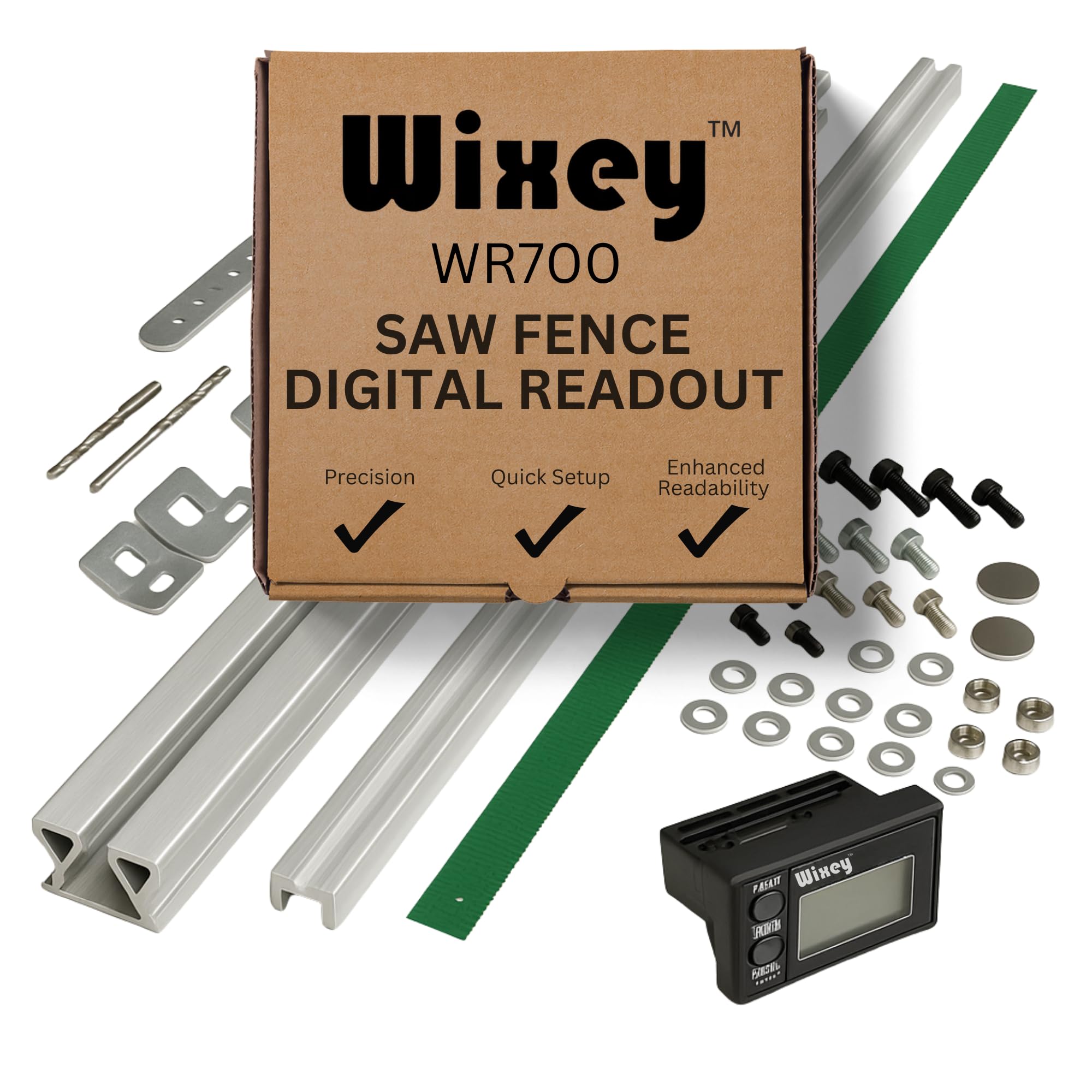
The Wixey WR700 is not a fence—it is a digital measurement system that attaches to your existing fence rail and gives you a continuous real-time readout of fence position from 0 to 60 inches. The system consists of two joinable adhesive sensor strips that mount to the front rail and a magnetic display unit that clamps onto the fence. Resolution is 0.01 millimeters, which is tighter than most machinist calipers and eliminates the parallax errors inherent in reading a tape measure stuck to a rail.
Installation requires a dead-straight fence setup first because the readout only tracks what the sensor strip sees. Users on Biesemeyer and Vega fences report that after an initial alignment of the adhesive strip, the readout stays accurate and repeatable within one one-thousandth of an inch across the full 60-inch stroke. The display retains its calibration memory when powered off, so you do not have to re-zero every time you turn the saw on. Battery life runs about two years on a single AAA battery thanks to an auto-shutoff feature.
The rail comes in two halves that join together, and the alignment of the joint can be fiddly. If the halves are not perfectly coplanar, the display can skip or lose position as the magnetic pickup crosses the seam. A few users have noted that the zero button is recessed poorly and can reset mid-cut if bumped accidentally. Despite these setup quirks, the WR700 is the most reliable way to bring digital accuracy to a fence that already tracks square.
Why it’s great
- Sub-0.01 mm resolution eliminates tape-reading errors
- Calibration memory holds across power cycles
- Two-year battery life with auto shutoff
Good to know
- Rail joint alignment is awkward and can cause skipping
- Zero button resets easily if bumped during operation
- Adhesive strip requires perfectly clean rail surface
4. BOW Products 46″ XT XTENDER Fence

The 46-inch version of the BOW XT XTENDER is functionally identical to the 36-inch model but offers 10 more inches of registration surface. This extra reach matters when you rip full 8-foot sheets or long stock on a compact jobsite saw that only has 24 inches of factory fence. The extrusion retains the same 5-inch height and three T-slots, and the milled clamp slots on the back allow the same multi-position infeed and outfeed biasing.
On a Bosch 4100, the fence clamps securely in under two minutes and immediately solves the problem of insufficient surface area for accurate registration on long rips. The 46-inch length extends past the table edge on both sides for most portable saws, which means you either need to clear space around the saw or use the optional BOW Feed Supports to create a stable infeed shelf. The T-slots also accept the BOW FencePRO featherboards, which lock directly into the tracks and provide kickback prevention along the full length of the cut.
The same proprietary-track limitation applies here—standard 5/16-inch bolts will not seat in the slots without filing. The 46-inch fence also introduces more leverage against the clamp attachment points, so the clamping force from the XT T-Track clamps (sold separately) must be high enough to prevent the fence from rotating under heavy feed pressure. Users who pair this with the full clamps-and-feed-supports kit report excellent stability, but the system as a whole adds up in total investment.
Why it’s great
- 46-inch length provides full support for 8-foot material rips
- Three T-slots run entire length for continuous accessory mounting
- Multi-position clamp slots enable biasing for infeed or outfeed
Good to know
- Proprietary T-slots do not accept standard T-bolts
- Longer length increases leverage against clamp attachment points
- Full feed-support kit adds significant overall cost
5. Kreg Precision Miter Gauge System KMS7102
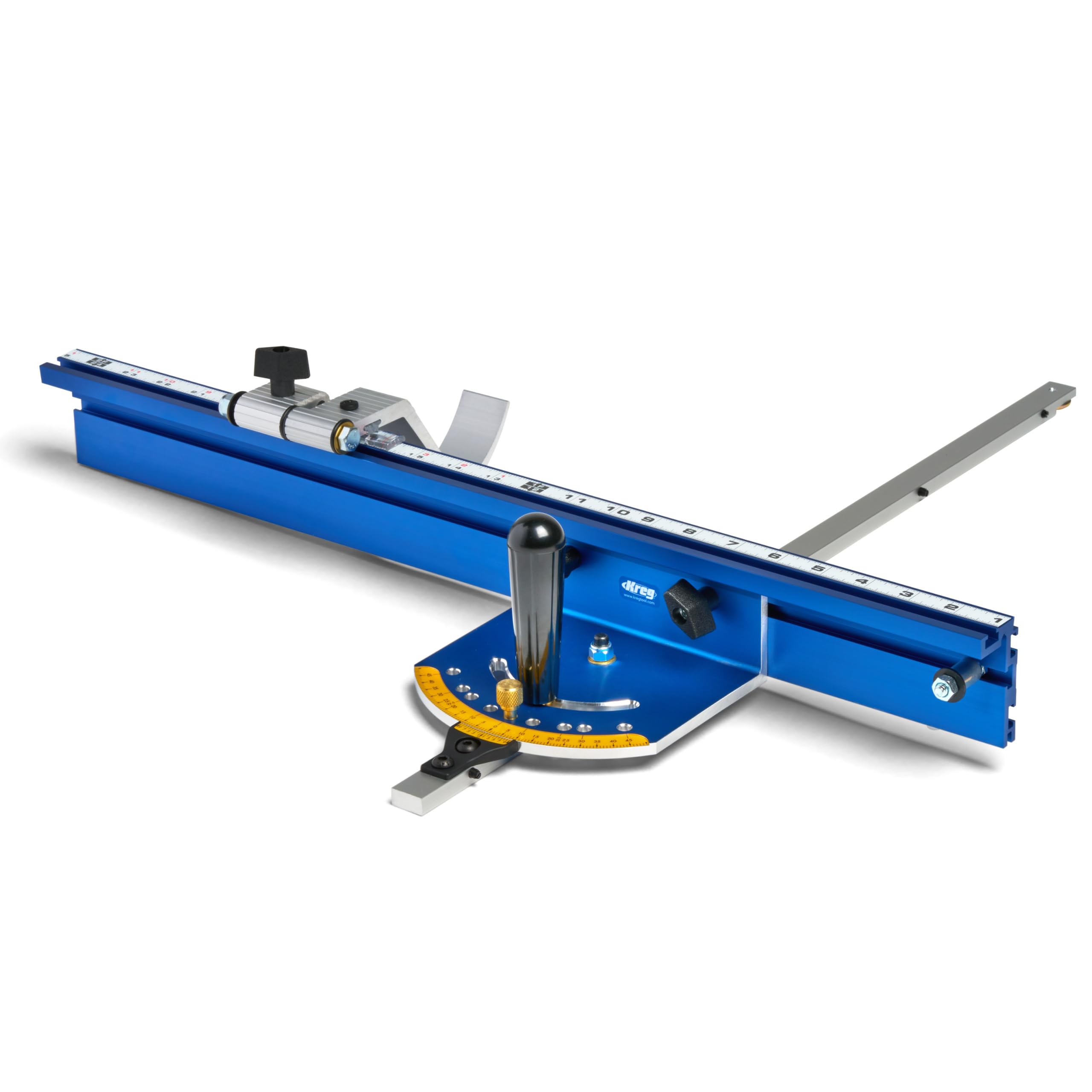
The Kreg KMS7102 is a full miter gauge system that replaces the flimsy stamped-metal gauge included with most table saws. It features an adjustable aluminum fence that locks at common angles via positive stops, and the cast-iron body rides in the miter slot on a single adjustable bar. The fence itself is 24 inches long and accepts aftermarket stop blocks and featherboards through its T-slots, making it suitable for repeatable crosscuts and miter work.
Out of the box the gauge is factory-calibrated to 90 degrees with no drift under load. The positive stops at 0, 15, 22.5, 30, and 45 degrees engage with a solid detent that does not slip when you tighten the lock lever. The flip stop on the fence allows quick indexing for repetitive cut lengths, and the scale reads in both inches and millimeters. Users report that the gauge delivers repeatable cuts within 0.5 degrees without needing recalibration between sessions.
The main compromise is the single-bar adjustment system. On narrow miter slots (common on jobsite saws), the bar can introduce lateral wobble when the gauge is pulled far back toward the operator. The fence also tips slightly when handling large panels because the gauge body is relatively lightweight compared to a dedicated sled. For picture frames, small boxes, and general crosscutting on 10-inch and larger saws, the KMS7102 is a solid mid-range upgrade over the factory gauge.
Why it’s great
- Factory-calibrated positive stops with zero drift under load
- 24-inch adjustable fence handles a wide range of stock widths
- Flip stop enables quick repeatable cut length indexing
Good to know
- Single-bar adjustment can wobble on narrow miter slots
- Gauge body tips under heavy panel loads
- Scale reads only to 1/32-inch increments
6. INCRA MITER1000SE Miter Gauge Special Edition

The INCRA MITER1000SE uses a patented GlideLOCK miter bar with six expansion disks that press outward against the slot walls, eliminating all side-to-side play. The fence telescopes from 18 to 31 inches and features a laser-cut stainless steel primary scale with 41 engraved V-stops at all popular angles. The flip shop stop on the fence allows 1/32-inch incremental positioning without measuring each time, and the entire assembly weighs 8.3 pounds, giving it substantial mass for vibration damping during cuts.
The V-stop system is what separates this gauge from others. Instead of a simple detent, the INCRA uses precisely spaced notches that index the gauge at exact angles with no over-travel or spring-back. This makes repeated compound miter cuts for crown molding or picture frames consistent within 0.1 degrees across dozens of setups. The telescoping fence extends by sliding a secondary extrusion that locks with a threaded knob, and the full extension is rigid enough to support 12-inch-wide boards without flex.
The miter bar itself is relatively short for the size of the gauge, which limits stability when you use the telescope fully extended. The fence also rotates slightly when you pull it back toward the operator, requiring a support extension for deep workpieces. There is no built-in tool storage, and the die-cast knobs can loosen over time if over-tightened. For dedicated miter accuracy on a cabinet saw with a full sled, the MITER1000SE is a precision tool that rewards careful initial setup.
Why it’s great
- 41 laser-cut V-stops provide 0.1-degree repeatable angle indexing
- GlideLOCK bar with six expansion disks eliminates side play
- Telescoping fence handles 18- to 31-inch stock widths rigidly
Good to know
- Short miter bar reduces stability at full fence extension
- Fence rotates when pulled back, requiring support for deep workpieces
- No built-in tool storage for wrenches or accessories
7. Shop Fox W1410 Fence with Standard Rails

The Shop Fox W1410 is a complete fence-and-rail replacement system designed for saws with 27-inch tables. It includes two 37.6-pound steel rails and a cast-iron fence carriage that rides on ball bearing guides. The fence locks at both the front and rear using independent cam levers, which prevents the fence from racking out of parallel when you apply side pressure during heavy resaw cuts. Fine-positioning knobs are mounted on both sides of the carriage, making the system ambidextrous for left- or right-handed operation.
Installation requires drilling and tapping holes in the saw table for the rear rail, and the included drill bit is undersized for the tap. The front rail aligns using factory holes on most major brand saws, but the rear rail often requires custom positioning. Once installed, the fence is square out of the box with minor adjustment needed only for the scale alignment. The ball bearing guides roll smoothly along the rail and the dual cam locks clamp with enough force to prevent movement even during aggressive rip cuts on 8/4 hard maple.
The thick powder coat on the rails can cause initial roller binding, and some users have reported the coating cracking and peeling at the edges after several months of use, requiring sanding and waxing for smooth travel. The clamping force on the rear lock is slightly weaker than the front cam, though this is correctable with a spring tension adjustment. At its price point, the W1410 delivers a true full-system experience that transforms an older contractor saw into a machine capable of production-level accuracy, as long as you are comfortable with minor fabrication during installation.
Why it’s great
- Dual front and rear cam locks prevent fence racking under load
- Ball bearing guides provide smooth non-binding travel
- Ambidextrous fine-positioning knobs for either hand
Good to know
- Rear rail installation requires drilling and tapping
- Powder coat can crack and cause roller binding
- Rear cam needs spring tension adjustment for stronger lock
8. JessEm 07150 Mite-R-Excel II Precision Miter Gauge

The JessEm 07150 Mite-R-Excel II is machined from a solid block of CNC-milled aluminum and assembled with 34 Swiss-turned stainless steel parts. The head body weighs 9 pounds alone, and the total assembly feels like a tool that will outlast the saw it rides on. The guide bar is precision-ground steel with patented snugger pucks that expand to fill the miter slot, eliminating all lateral movement. The fence adjusts using a micro-adjuster that moves in 0.001-inch increments, and the flip stop can accommodate up to a 3/4-inch sacrificial fence face.
The angle indexing uses a vernier scale laser-engraved onto the aluminum body, with positive stops at 0, 15, 22.5, 30, and 45 degrees. Each stop engages with a hardened steel pin that seats into a precisely machined notch, producing repeatable angles within 0.25 degrees without needing to read the scale. The fence is 24 inches long with a T-slot that accepts standard accessories, and the micro-adjuster on the flip stop lets you dial in cut lengths to the exact thousandth for repetitive parts in furniture production.
The only structural weakness is the extension rod that supports the flip stop—it is relatively thin and can deflect under heavy pressure from large panels. The fence itself is short for the price tier, and the stop block protrudes roughly 1/4 inch from the fence face even when fully retracted, which interferes with some setups involving a zero-clearance insert. For the woodworker who demands absolute rigidity and micro-adjustability in a miter gauge, the JessEm delivers a level of fit and finish that justifies its premium tier.
Why it’s great
- Full CNC-machined aluminum and stainless steel construction
- Snugger pucks eliminate all side-to-side play in any miter slot width
- Micro-adjuster provides 0.001-inch incremental fence positioning
Good to know
- Extension rod deflects under heavy panel pressure
- Fence is short relative to the price point
- Flip stop protrudes from fence face even when retracted
9. INCRA MITER5000 Miter Gauge with Sled and Telescoping Fence

The INCRA MITER5000 combines a full-size crosscut sled with Incra’s angle indexing system that provides 364 positive lock positions in 0.5-degree increments. The sled platform measures approximately 25 by 36 inches and includes a T-track for a hold-down clamp that secures the workpiece during the cut. The fence telescopes to accommodate stock from 18 to 36 inches wide, and the flip shop stop allows indexing for repetitive part lengths. The entire assembly weighs 31.4 pounds and provides a massive, stable platform for crosscutting panels, drawer parts, and box components.
The indexing ring uses laser-cut steel teeth that engage with a hardened locking pin. Each 0.5-degree increment gives you access to 364 distinct angles, which means you can dial in compound miters for complex polyhedral projects without guessing or measuring. The sled platform is pre-drilled for the included MDF sacrificial surface, and after cutting through the base with the blade you have a zero-clearance slot that prevents tearout. The telescoping fence locks rigidly at any extension and the flip stop measures cut lengths in both inches and millimeters.
Assembly takes three hours or more and requires careful alignment of the sled runners to the miter slots. The instructions are adequate for the main assembly but provide little guidance on calibrating the ruler scale to the blade path. At 31 pounds, the sled is heavy enough that carrying it on and off a jobsite saw is impractical. The flip stop on some units does not fit together perfectly, which introduces play in the stop index. For a dedicated shop with a stationary cabinet saw, the MITER5000 is the most complete and accurate crosscut system available in a single box.
Why it’s great
- 364 positive angle stops in 0.5-degree increments for complex compound miters
- Full 36-inch sled platform with zero-clearance sacrificial surface
- Telescoping fence handles stock up to 36 inches wide
Good to know
- Assembly takes several hours with careful calibration required
- 31-pound sled is impractical for portable saw use
- Flip stop may have fitment inconsistencies on some units
FAQ
Can I install an aftermarket fence system on a portable jobsite table saw?
How much does a sub-0.005-inch parallel fence cost in the aftermarket?
What T-bolt size do most aftermarket fence T-tracks use?
Can a miter gauge replace a table saw fence for crosscutting?
How do I align an aftermarket fence to the blade for perfect parallelism?
Final Thoughts: The Verdict
For most users, the best aftermarket table saw fence system winner is the Peachtree Uni Style 43-inch Fence because it offers a solid single-piece aluminum extrusion, a standard 1/4-20 track system that accepts common accessories, and an include UHMW sub-face at an entry-level price. If you need a long add-on fence for a jobsite saw, grab the BOW XT XTENDER 36-inch. And for premium miter accuracy on a cabinet saw, nothing beats the JessEm 07150 Mite-R-Excel II for absolute rigidity and micro-adjustability.