
Our readers keep the lights on and my morning glass full of iced black tea. As an Amazon Associate, I earn from qualifying purchases.
Specs are compiled from manufacturer listings and verified buyer reviews and can change over time — please confirm the key details on the product page before buying.
Adding a trailer brake controller to your truck or SUV is the difference between a tow that feels planted and one that makes your knuckles go white. The job is simple: tell the trailer’s brakes to work in sync with your vehicle’s brakes, so a sudden stop doesn’t turn into a jackknife scare. But the aftermarket market is crowded with boxes, dials, and cryptic acronyms — picking the wrong one means either a harsh jerk every time you touch the pedal or brakes that feel mushy when you need them most.
I’m Min — the founder and writer behind Gadgets Feed. This guide is built by comparing the manufacturers’ published specifications and the patterns across verified customer reviews, so you get each pick’s real strengths and trade-offs instead of marketing spin.
Whether you tow a camper, a boat trailer, or a utility flatbed, you want a controller that anticipates the load — not one that lags or lunges. The aftermarket trailer brake controller that fits your life depends on your trailer’s axle count, your tolerance for tucking wires under the dash, and how much fine-tuning you want at your fingertips during a long descent.
Our Picks at a Glance

How To Choose The Best Aftermarket Trailer Brake Controller
Three decisions define your choice: braking type, axle count, and where you want the knob to live. Nail these, and you won’t overpay or under-brake.
Proportional vs. Time-Delay Braking
Proportional controllers use an internal accelerometer or inertia sensor to measure how hard you are braking and match that force on the trailer. They feel natural — the trailer stops in line with the tow vehicle. Time-delay units send a fixed pulse of power once you hit the brake pedal; you adjust the delay and power level manually. Proportional is the crowd favorite for daily towing because it self-adjusts on hills and in stop-and-go traffic, while time-delay gets the job done for lighter, infrequent hauls at a lower cost.
Axle Count and Brake Count
Every controller lists a supported range — most handle 1-to-3 axles (2-to-6 brakes) or 1-to-4 axles (up to 8 brakes). Picking a controller that is rated for your trailer’s brake count is a non-negotiable safety step. A unit maxed out at 6 brakes won’t properly drive an 8-brake system on a heavy fifth-wheel camper.
Mounting Style and Dash Space
Split designs hide the main module behind the dash and run a thin cable to a small knob or display you mount in a blank panel. All-in-one units clamp under the dash and present a box with a slider or lever. If you hate clutter, the split approach gives a factory-like look; if you want the cheapest and simplest wire-up, the under-dash box is still the most common.
Quick Comparison
| Model | Best For | Braking Type | Axle Support | Mount Type | Amazon |
|---|---|---|---|---|---|
| REDARC Tow-Pro Liberty★ Best Overall | Clean OEM-style install | Proportional | 1–2 | Split (dial) | Amazon |
| Tekonsha Brake-EVNTop Performer | Reliable proportional | Proportional | 1–4 | Under-dash box | Amazon |
| CURT Spectrum 51170Premium Pick | High-end accelerometer | Proportional | 1–4 | Split (rotary knob) | Amazon |
| Kolasina 90160 | Budget value | Proportional | 1–3 | Dash bracket | Amazon |
| CURT Venturer Next | Simple time-delay | Time-delay | 1–3 | Under-dash box | Amazon |
| HRepair 90160 | Plug-and-play budget | Proportional | 1–3 | Dash bracket | Amazon |
| Hopkins Impulse 47235 | Rock-solid time-delay | Time-delay | Up to 6 brakes | Under-dash box | Amazon |
| Kohree KR3588 | Split design with LCD | Proportional | 1–4 | Split (LCD screen) | Amazon |
| Tekonsha Prodigy iD | Bluetooth smartphone setup | Proportional | 1–4 | Split (rotary knob) | Amazon |
In‑Depth Reviews
1. REDARC Tow-Pro Liberty
Our pick — over 4.5★ from 750+ verified ratings; the strongest balance of quality and price.
A compact dial that blends into your dash and brakes with the poise of an Aussie Outback survivor.
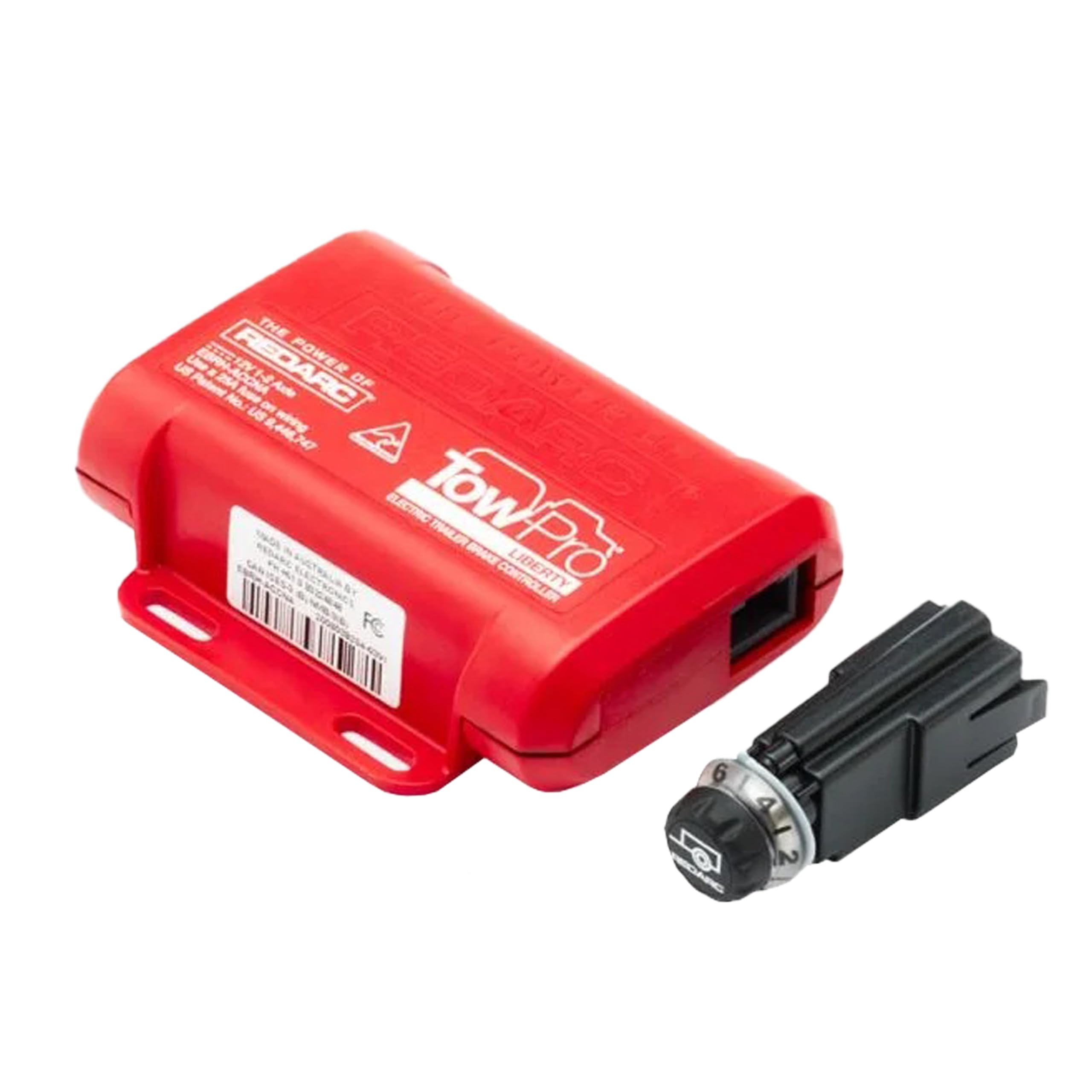
The REDARC Tow-Pro Liberty earns the top spot because it solves the two biggest annoyances with older controllers: a bulky box under your knee and a braking curve that feels mismatched. It runs on proportional braking — the internal sensor reads your deceleration and applies trailer brakes accordingly — and adds active calibration that self-adjusts whether you are hooked to a camper or driving empty. At 8.8 ounces, it is a lightweight controller, and its split design lets you mount the main module out of sight while the remote head (with a nut, bezel, and a 3-foot-3-inch cable) tucks into a factory blank panel. The crowd agrees: this is the unit that wins on functionality, with owners praising its smooth operation and smooth factory-like appearance. The manual override through the compact dial is straightforward, and the sway control helps settle a nervous trailer without you reaching for the lever.
Where the Tow-Pro Liberty falls short is its support limit — it handles 1-to-2 axles, so heavy fifth-wheel setups with more brakes need a different solution. The wiring harness (TPH-025 or a vehicle-specific one) is sold separately, which adds to the upfront cost. Buyers also note that in some trucks the control button’s neck is too short for thick dashes, requiring a small spacer to engage the button properly.
Why owners love it
- Compact dial mounts in a blank dash plate for a factory-integrated look
- Active calibration and sway control keep stops smooth on highways
- Designed and torture-tested in the Australian Outback, backed by a 2-year limited warranty
The trade-offs
- Supports only 1–2 axles (not for heavy multi-axle trailers)
- Vehicle-specific harness sold separately, which adds to the total cost
- Button neck may be too short for thick dash panels; a tiny spacer might be needed
Reach for this if: you want an ultra-clean dash install, tow a single- or dual-axle trailer, and value natural-feeling proportional braking over budget savings.
Look elsewhere if: your trailer has three or four axles, or you plan to skip buying the separate wiring adapter.
2. Tekonsha Brake-EVN
A proportional controller that delivers smooth, self-adjusting braking without the premium price.
The Tekonsha Brake-EVN is the balance for owners who want proportional braking — the kind that automatically scales force based on how hard you are stopping — but do not need a flashy split-dial setup. It uses an internal inertia sensor to sense deceleration, so every stop feels natural, from a gentle creep in traffic to a hard brake on a downhill exit. The LED digital display shows real-time diagnostics and alerts, and the manual control lever lets you apply full trailer brake power instantly by sliding it left. It handles up to 4 axles (8 brakes total), making it a fit for heavier fifth-wheel and horse trailers, unlike the 2-axle limit on the REDARC above. The Brake-EVN is a compact under-dash box that stays out of the way.
The catch is that the vehicle-specific Plug & Play wiring harness is sold separately, so your total cost climbs by – depending on your truck. A few owners mention the initial setup takes a few test stops to dial in the boost setting, but once set, the unit holds its tune across trips. The build quality is solid, and the value-for-money sentiment is strong across the board.
The big win: proportional braking for up to 4 axles at a mid-range price — the crowd favorite for reliable, self-adjusting stops.
Who it fits: anyone towing a 2-to-4 axle trailer who wants proportional braking without the split-design cost.
Who should skip: buyers who want a complete kit with the harness included, or those set on a hidden dial-style mount.
3. CURT Spectrum 51170
A motion-sensing controller with a triple-axis accelerometer for stops that feel pre-calculated.
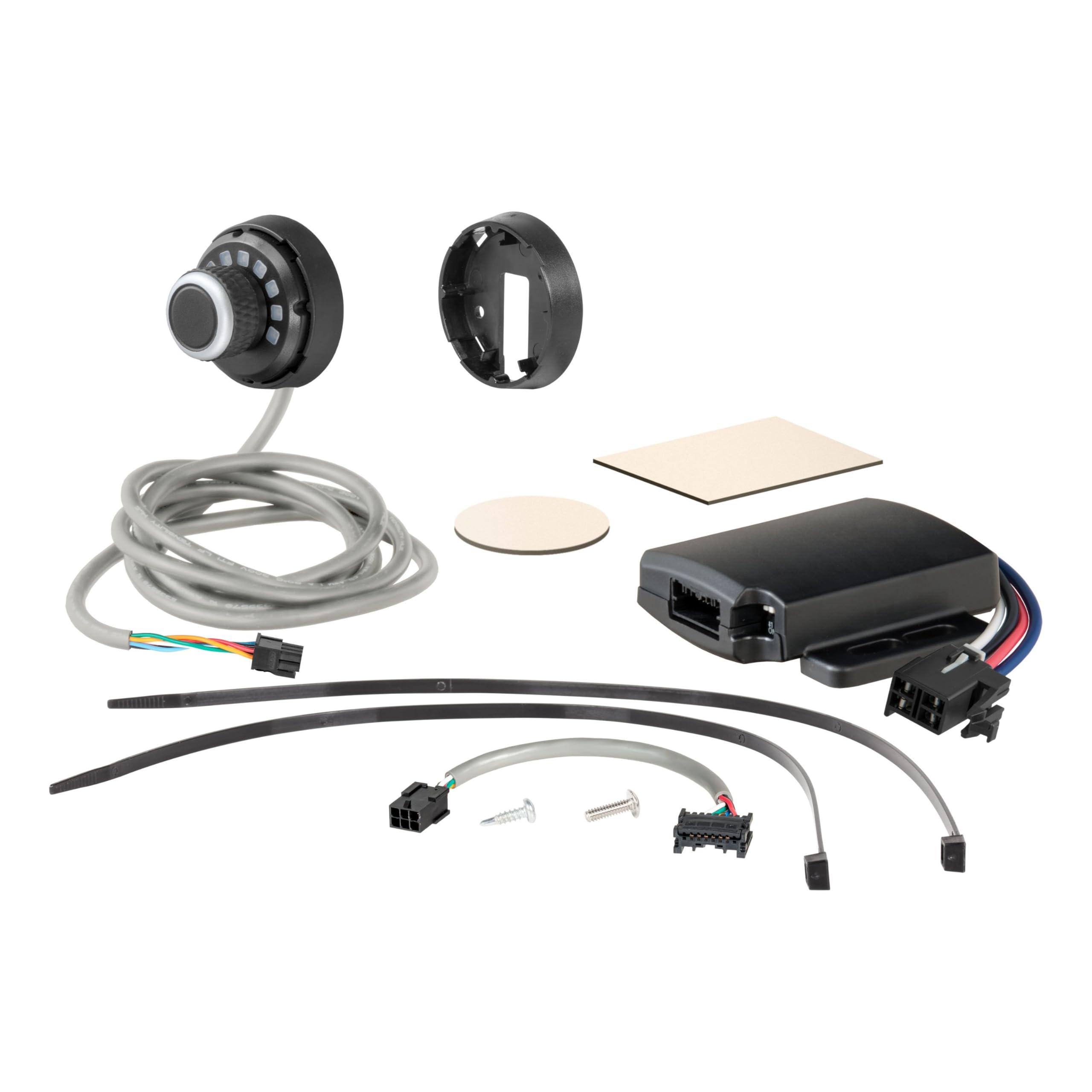
The CURT Spectrum is the high-end proposition for those who want every braking detail fine-tuned. Its key spec is the triple-axis motion-sensing accelerometer, which reads deceleration in three dimensions — so even braking on a crowned road or a slanted drive remains consistent. The interface is a clean push-button rotary knob with 10 tri-color LEDs, and the main module hides completely out of sight. Owners who have used controllers for decades call it the best they have owned, noting that once you set it up and tweak it once, you do not touch it again over a thousand miles of towing. At about 9.9 ounces (281 g), it is light enough to mount anywhere, and the manufacturer stands behind it with a limited lifetime warranty.
The mixed feedback centers on the braking feel below 10 mph — some find it grabs a bit aggressively at parking-lot speeds, and the overall functionality gets a mixed verdict from owners. If you want the smoothest highway braking and appreciate the lifetime warranty, the Spectrum delivers; if you do low-speed maneuvering all day, it might feel less refined.
What makes it special: the triple-axis accelerometer and lifetime warranty — a set-and-forget controller for highway towers who want OEM-like integration.
Ideal for: towers who cover long highway miles with a heavy trailer and value premium build quality.
Not for: those who primarily back up and park in tight spaces at low speeds, where the braking feel gets mixed reviews.
4. Kohree KR3588
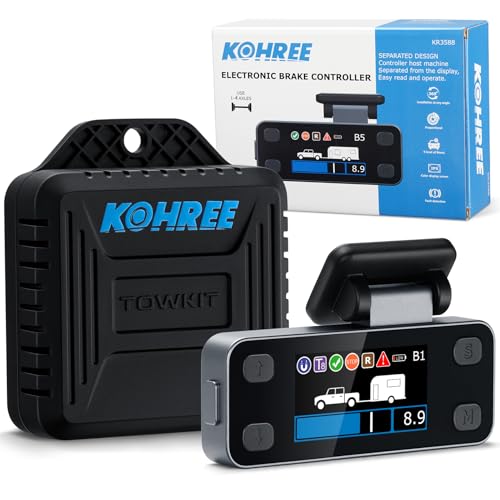
A split-design controller with an LCD screen and four 32-bit processor chips for safety redundancy.
Kohree’s KR3588 brings a unique architecture to the table: the display and the brake controller each run two independent 32-bit processor chips, meaning the braking logic is processed and validated on separate circuits for what the brand describes as a linear, comfortable experience. The split design lets you place the LCD screen on your windshield or dash and hide the controller module behind a rear interior panel, connected via a Type-C data cable. It supports 1-to-4 axles and offers 9 incremental boost levels, so you can dial in the sensor sensitivity to match anything from a light utility trailer to a heavy enclosed car hauler.
The kit includes everything in one box: the LCD display, the brake controller module, wiring connections, a Type-C cable, and a manual. Owners find the three-wire hookup remarkably simple, and one called it “the best electric brake controller for your money.” The recurring quibble is that the LCD display stays on all the time, which can be distracting at night. A few buyers also note that the included 3M tape holds fine even in Florida heat, but the module needs to be secured so it does not shift around under braking.
Standout feature: four 32-bit processor chips for independent braking validation — a safety-minded design you rarely see at this price.
Best for: owners who like seeing brake data on an LCD screen and want a split unit that covers up to 4 axles.
Trade-off: the always-on display is a genuine nighttime distraction for some — a tint film or a dimmer setting would help.
5. Tekonsha Prodigy iD

A Bluetooth-connected controller that lets you tune braking from the palm of your hand.
The Prodigy iD is the only controller in this list that pairs with your phone via Bluetooth wireless technology — you download the Tekonsha EDGE app to adjust power output, boost level, braking type, and more without reaching under the dash. The main unit is a split design: a rotary-style knob (the “big knob” owners appreciate for easy use while driving) lives in the dash, and the power module hides securely behind it. The front-facing color LED display shows settings, real-time diagnostics, and alerts, and you can log notifications to share with Tekonsha’s technical support team if something comes up. It handles 2-to-8 brakes (1-to-4 axles), matching the Brake-EVN and Spectrum in capacity.
Installation is straightforward with a vehicle-specific harness (sold separately), and the OEM-style look scores high marks — owners call it “factory-integrated” and like the clean finish. The downside is that the Bluetooth app gets described as “janky but functional” by some, and a subset of buyers report that the app compatibility has been a negative experience. Reliability gets a mixed verdict: a unit failing within a year is rare but documented, and the knob itself feels slightly less premium than the price suggests. Still, for someone who wants smartphone configurability and a big, easy-to-turn dial, the Prodigy iD is unique.
The hook: full smartphone control via the Tekonsha EDGE app — the only Bluetooth-equipped unit in the roundup.
Fit for: tech-savvy towers who like tweaking brake settings from a phone and want a large knob for easy driving adjustments.
Think twice if: you prefer a dead-simple mechanical setup or you have read the reliability feedback — the app and long-term durability are the least settled aspects.
6. CURT Venturer Next

A low-profile, no-fuss time-delay controller that drops in where space is tight.
The CURT Venturer Next is for the buyer who knows exactly what they want: a time-delay (timed) brake controller that works without leveling sensors, internal moving parts, or complex setup. It operates 2-to-6 trailer brakes (1-to-3 axles) and gives you fully adjustable power and ramp time — meaning you control how much force goes to the trailer and how quickly it reaches that force after you press the pedal. The slim, low-profile design and unique bracket system improve dash clearance, which is a real help in smaller cabs where an under-dash box usually bumps your knee. At 9.6 ounces, it is a lightweight unit, and its dimensions (8.13 x 5.38 x 2.75 inches) form a tight rectangular block.
Owners call the installation “10 minutes with a screwdriver” and praise the CURT-specific plug-and-play harness compatibility for older Ford trucks. The unit serves as a drop-in replacement for Hayes G45 controllers without rewiring. The mixed aspect is adjustability — several owners find the rotary dial for ramp time less intuitive during driving compared to a slider or toggle. The time-delay nature also means you will feel a slight pulse rather than the smooth ramp of a proportional unit, which is totally fine for occasional towing but less ideal for heavy stop-and-go.
Bottom line: a low-cost, easy-to-install time-delay controller that does its job without any leveling fuss.
Great for: owners of single- or tandem-axle trailers who want a simple, affordable drop-in replacement.
Not for: anyone who needs proportional braking for hilly daily towing or wants on-the-fly adjustments without taking their eyes off the road.
7. Hopkins Impulse 47235
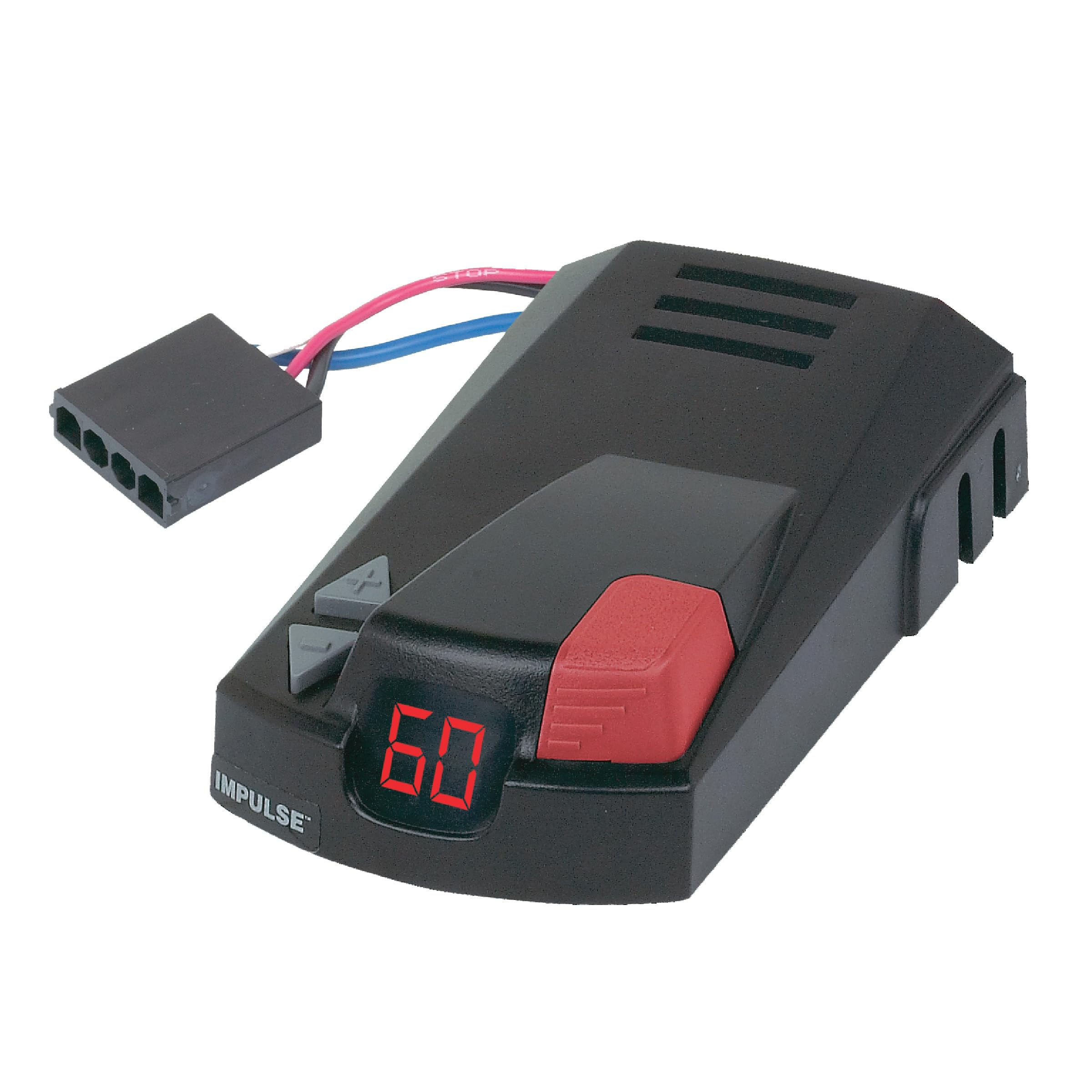
A no-nonsense time-based controller that is short circuit protected and can be mounted at any angle.
The Hopkins 47235 Impulse is one of the oldest designs on this list, and that is a compliment — it has been the go-to for value-minded towers since 2004. It uses time-based actuation (you set the delay and power, and it sends a timed pulse every time you brake), mounts at any angle without affecting performance, and controls up to 6 trailer brakes for heavy-duty towing. The display shows the braking level on a 0-to-100 scale, a straightforward readout that owners prefer over cryptic codes on pricier units. Installation is “Plug-In Simple!” and the short circuit protection adds a layer of safety.
Functionality is the most-praised aspect by a wide margin, and owners specifically call out the manual red button for quick actuation when you need an extra nudge. Adjustability also scores well — you can tweak the response for varying loads, from an empty utility trailer to a loaded RV. The trade-off is a bulkier under-dash box at 10.2 ounces, which is the heaviest unit here but still manageable. It lacks the sophistication of proportional controllers, but for simple, predictable braking on a budget, it is a well-loved choice.
The takeaway: reliable time-based braking with a clear display and a manual override button — a proven design that owners trust.
Best for: budget-conscious towers who want a straightforward, durable controller with a clear readout and a history of satisfied owners.
Avoid if: you want the smooth feel of proportional braking or need a compact unit that tucks completely under the dash.
8. Kolasina 90160
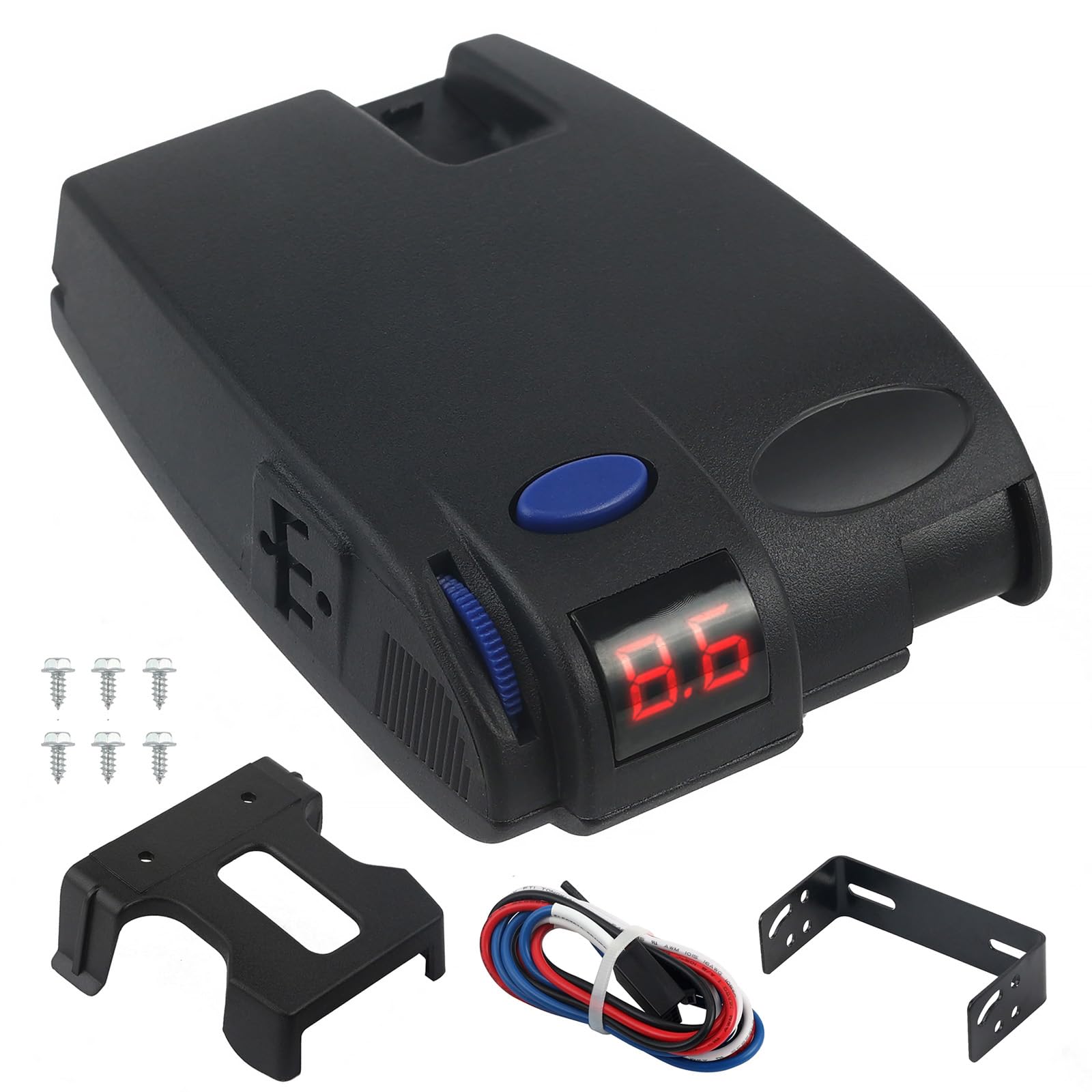
A proportional controller that brings advanced braking tech at a price that undercuts almost everything else.
The Kolasina 90160 is the surprise of the group: a proportional brake controller — meaning it automatically adjusts trailer brake force based on how hard you stop — for a price that typically only buys time-delay units. It features a high-contrast digital screen for real-time monitoring of brake settings and connection status, and a continuous self-diagnostic function that alerts you to anomalies. The bracket lets you rotate the unit 180 degrees horizontally or vertically, and the manual slider gives instant braking force for sudden situations. Owners mention it works well on everything from a 2006 Chevy Express to a 93 F250 pulling a 12,000-lb trailer.
The price (the lowest of the nine) does come with some rough edges. A single owner reported a ground compatibility issue with a 2001 F350, and the brand (Kolasina) is less established than CURT or Tekonsha. The auto-off feature that turns the unit off after a few minutes is a nice touch to protect the battery.
The edge: proportional braking with a digital display at a price that beats many time-delay controllers — a true bargain if your vehicle is compatible.
Pick this if: budget is your primary concern but you still want the safety of proportional braking and a digital readout.
skip it if: your truck is an early-2000s Ford with known ground issues, or you want a brand with a longer service history.
9. HRepair 90160

A near-twin to the Kolasina, offering the same proportional features with a slightly different brand and packaging.
The HRepair 90160 is essentially the same part number (90160) and same feature list as the Kolasina above: proportional braking, a clear digital display, self-leveling technology, three boost settings, and a manual override lever. It also adds the claim of advanced circuit protection and a 90-day low-maintenance return policy with lifetime free replacements. The package dimensions are nearly identical at 7.64 x 5.63 x 2.76 inches, and the weight is 1.08 pounds. Customers note it works great on a 2015 E450 Forest River Sunseeker and appreciated the simple installation — plugging into the factory trailer brake plug under the dash.
The standout here is that the HRepair version leans into a “zero-risk purchase” promise with lifetime support, which may appeal to first-time buyers nervous about compatibility. However, there is a single vocal 1-star review stating the description did not match the product, so double-checking the wiring diagram before purchase is wise. Overall, the functionality is praised much more often than it is faulted, and at this price point, the HRepair 90160 is a worthy alternative to the Kolasina if the warranty terms sway you.
what separates it: lifetime free replacements and a 90-day return policy on a sub- proportional controller — rare in this category.
Great for: first-time installers who value a no-risk return policy and want proportional braking without overspending.
Avoid if: you have a vehicle with a complex wiring history that might not match the included harness — check your factory plug first.
Understanding the Specs
Proportional vs. Time-Delay
A proportional controller uses an internal sensor (inertia sensor or accelerometer) to measure how fast you are slowing down and applies matching power to the trailer brakes. It is the smoother, more natural option for daily towing. A time-delay (or “timed”) controller sends a fixed pulse of power once you press the brake, and you manually adjust the delay and power level beforehand. Time-delay is fine for occasional use but feels less refined on hilly terrain or in heavy traffic.
Axle and Brake Capacity
Controllers list how many trailer brakes they can drive, often expressed as “2-6 brakes” or “1-4 axles.” Most trailers have one brake per axle, so a 1-to-3 axle controller handles 2-to-6 brakes. More is not always better — pick a controller that matches your trailer’s count exactly to avoid under-powering or buying unnecessary capacity.
Boost and Sensitivity Settings
Boost adjusts how aggressively the controller responds to your brake pedal input. A higher boost setting translates to more trailer brake force for the same pedal pressure, useful when you are hauling near the trailer’s weight limit. Most controllers offer 3 to 9 boost levels or a simple power knob. Adjustable boost gives you fine-tuning between a light load (low boost) and a maxed-out camper (high boost) without rewiring anything.
FAQ
Do I need a proportional or a time-delay brake controller?
Will any aftermarket controller fit my truck?
How do I know how many axles my controller needs to support?
Can I install a brake controller myself?
What does the boost setting actually do?
Why does my brake controller need a manual override?
Is a split-design controller better than an all-in-one unit?
How long do aftermarket brake controllers last?
What does the self-diagnostic display tell me?
Can I use a Bluetooth brake controller without the app?
Final Thoughts: The Verdict
For the majority of shoppers, the aftermarket trailer brake controller winner is the REDARC Tow-Pro Liberty because it combines a clean factory-style dial mount with proportional braking that actually feels natural. If you want the best value in a proportional unit, the Tekonsha Brake-EVN is the crowd favorite for its easy installation and 4-axle support. And for the budget-conscious tower who still wants proportional tech, the Kolasina 90160 delivers surprising performance at a price that undercuts the rest.
How We Picked
We do not accept paid placement. Every pick is matched to a real buyer and a real use-case; we do not hands-on test units.
Sources & Methodology
Specifications: manufacturer listings and product documentation. Review insights: verified customer reviews, as of July 2026. Pricing: not shown on this page (it changes often); check the current price via the retailer link.
As an Amazon Associate, Gadgets Feed earns from qualifying purchases. This does not affect which products we feature.