
Our readers keep the lights on and my morning glass full of iced black tea. As an Amazon Associate, I earn from qualifying purchases.
Specs are compiled from manufacturer listings and verified buyer reviews and can change over time — please confirm the key details on the product page before buying.
If your AGM battery keeps dying after short drives or long storage, you have two choices: keep buying replacements, or pick a charger that actually understands the chemistry. That second option is what this page is about. AGM batteries sit at slightly different voltages than standard flooded lead-acid, so a generic trickle charger can quietly undercharge them until they sulk and refuse to start your car. The right charger reads the battery, adjusts current to temperature, and holds a safe float voltage for months.
I’m Min — the founder and writer behind Gadgets Feed. This guide is built by comparing the manufacturers’ published specifications and the patterns across verified customer reviews, so you get each pick’s real strengths and trade-offs instead of marketing spin.
Charging amperage is the number that decides everything: a low-amp maintainer protects a stored motorcycle AGM forever, while a high-amp unit is the one that brings a flat truck battery back overnight. This breakdown of the best agm battery charger covers both ends.
Our Picks at a Glance


How To Choose The Best AGM Battery Charger
An AGM (Absorbent Glass Mat) battery packs its electrolyte into fiberglass mats instead of free-flowing liquid. That design makes it spill-proof and vibration-tolerant, but it also means the battery wants a slightly higher charge voltage than a flooded cell. Buying a charger that lists AGM as a supported type — not just “lead-acid” — is the first thing to check before anything else.
Match the amperage to the battery, not the price tag
Amperage, measured in amps, sets how fast current flows into the battery. A 1 to 2 amp charger is a maintainer: it holds a stored motorcycle or classic car battery at full charge without cooking it. A 10 to 20 amp charger can bring a deeply drained car battery back up overnight. Bigger is not automatically better — 20 amps into a tiny powersport battery adds heat and stress, so match output to battery size.
Look for AGM-specific modes and desulfation
Sulfation is the buildup of lead sulfate crystals on the battery plates, and it is the usual reason an older AGM battery stops holding charge. Desulfation mode sends high-frequency pulses through the plates to break that buildup down. Some chargers call it “repair” or “recond” mode. It helps a neglected battery, not one with a physically broken cell.
Temperature compensation and float mode protect your investment
A battery in a freezing garage needs more voltage to accept a charge than the same battery on a summer afternoon. Temperature compensation, often handled by a built-in sensor, adjusts the output automatically so you are not undercharging in winter or overcharging in heat. Float mode is the companion feature — it drops current to a safe trickle once the battery is full so you can leave the charger connected for weeks.
Quick Comparison
| Model | Best For | Amperage | Battery Types | Weight | Amazon |
|---|---|---|---|---|---|
| NOCO GENIUS5★ Best Overall | All-round garage charger | 5 A | 6V/12V lead-acid (AGM, Gel, SLA, VRLA) & LiFePO4 | 1.6 lb | Amazon |
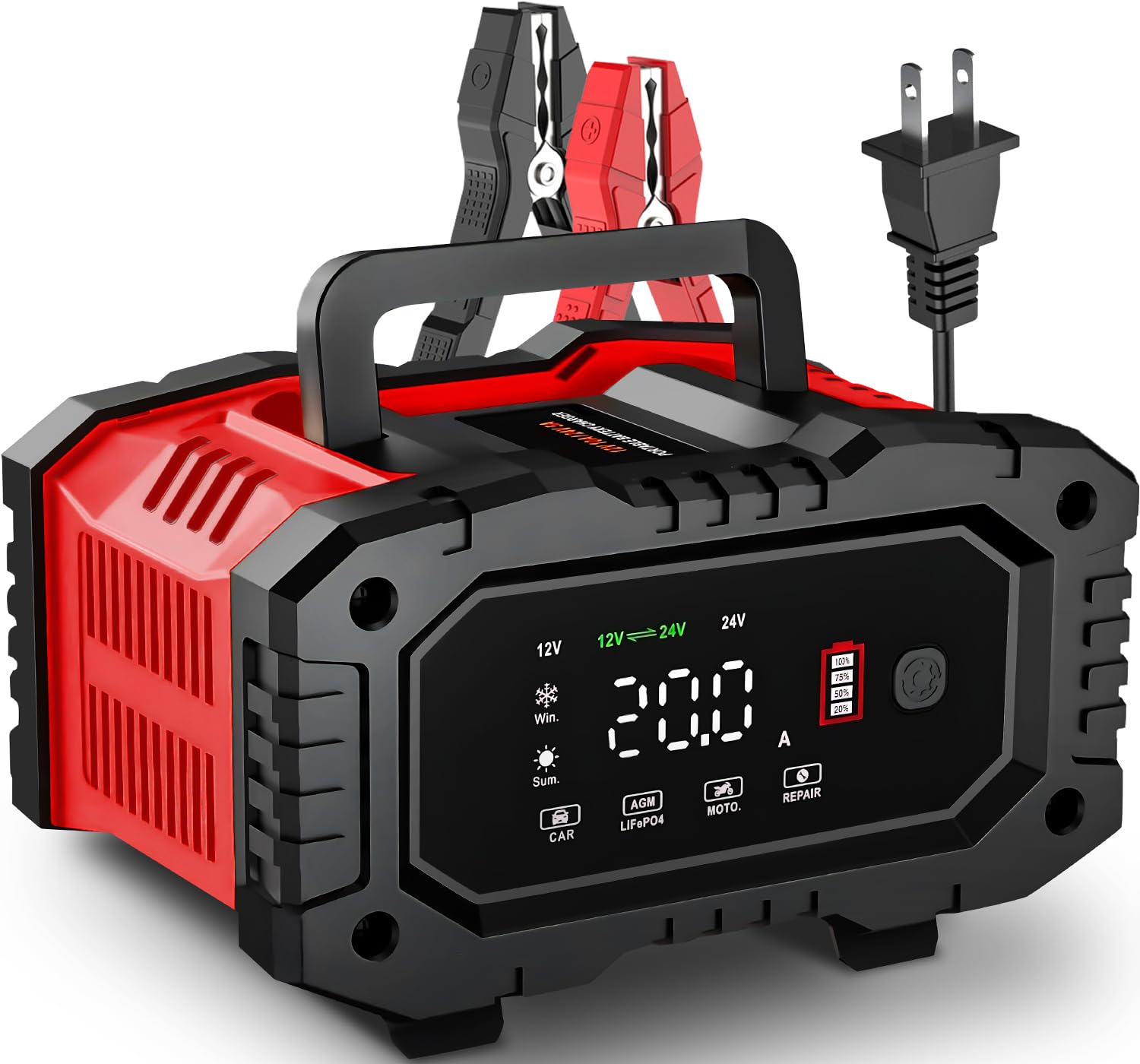
| 20-Amp Car Battery Charger (Huiaipaic)Best Value | Fast charging big batteries | 20 A (12V) / 10 A (24V) | 12V/24V lead-acid (AGM, Gel, SLA) & LiFePO4 | 1020 g | Amazon |
| VEVOR Smart Battery ChargerBudget Champion | Budget multi-voltage versatility | 20 A | 6V/12V/24V lead-acid & 12V/24V LiFePO4 | 1.8 lb | Amazon |
| CRAFTSMAN CMXCESM258 | Lawn mower & garage duty | 12 A | 6V/12V standard, AGM, deep-cycle & LiFePO4 | 3.4 lb | Amazon |
| CTEK CT5 | Motorcycle & powersport storage | 1.1 A | 12V lead-acid (incl. AGM) & LiFePO4 | — | Amazon |
| HTRC 40A Charger | Heavy-duty truck & RV batteries | 40 A (12V) | 6V/12V/24V lead-acid (AGM, Gel, SLA) & LiFePO4 | — | Amazon |
| NOCO GENIUS10 | Faster versions of the classic | 10 A | 6V/12V lead-acid (AGM, Gel, SLA, VRLA) & LiFePO4 | 4 lb | Amazon |
| BatteryMINDer 2012-AGM | Dedicated AGM-only care | 2 A | 12V AGM only | 2 lb | Amazon |
| Battery Tender 15 AMP | Switchable power for mixed fleets | 15 A / 8 A / 2 A | 12V lead-acid (AGM, Gel) & LiFePO4 | 3.5 lb | Amazon |
In-Depth Reviews
1. NOCO GENIUS5 5A 6/12V Smart Battery Charger, Trickle Charger & Maintainer
Our pick — over 4.5★ from 21,000+ verified ratings; the strongest balance of quality and price.
The 5-amp all-rounder that revives a flat AGM overnight and then babysits it all winter.
If you want one charger that covers a car, a motorcycle, a mower and a boat, this is the pick most people land on — the crowd favorite at 4.6 stars across 21,000+ owners. It steps down to 5 amps so it is gentle enough to leave connected indefinitely, and the built-in thermal sensor reads the ambient temperature so the output voltage rises in cold garages and eases off in summer heat. That single feature prevents the two most common AGM disappointments: an undercharged battery in winter and a cooked one in July.
What wins people over is its recovery ability. The Genius5 charges from as low as 1 volt, and its Force Mode lets you push current into a battery that has dropped to zero volts — the situation that kills most cheap chargers. Pulse charging also hunts down sulfation (that lead-sulfate crust tying up the plates) and works it loose. Owners describe resurrecting an AGM battery that a jump-starter box had given up on, then running it through AGM mode and a repair cycle overnight. It ships with a 72-inch AC cable, an 80-inch DC cable with clamps and eyelet terminals, and a 3-year warranty.
The honest catch is speed. At 5 amps, a large heavily drained battery takes a full 8-hour charge cycle, and a few owners note it is not the tool for a 100 amp-hour truck battery in a hurry. It is also a couple of pounds heavier than a pocket maintainer if you plan to carry it around. Sub-5-amp chargers hold the full battery while this one does; the Genius5 is the one you leave bolted to the garage wall or tucked in the trunk.
What stands out
- Charges and holds 6V/12V lead-acid (AGM, Gel, SLA, VRLA) as well as LiFePO4, so one unit covers almost any battery in the shed
- Thermal sensor adjusts voltage to ambient temperature, protecting against both winter undercharge and summer overcharge
- Force Mode reaches batteries as low as 0 volts that have been parked too long
- Can stay connected indefinitely as a maintainer thanks to surge and overcharge protection
Worth knowing
- 5 amps means longer charge times on big batteries — an overnight cycle, not an hour
- Indicator lights are basic; there is no digital readout of exact voltage or percentage
- Charge time listed at up to 8 hours for a full cycle
Buy it if: you want one proven charger for cars, boats and powersports, and you value safe all-season maintenance over raw speed.
Look elsewhere if: you need to refill a 100 amp-hour battery in an hour — the bigger NOCO GENIUS10 below is the faster sibling.
2. Huiaipaic 20-Amp Car Battery Charger, 12V/20A and 24V/10A LiFePO4, Lead-Acid (AGM/Gel/SLA)
Four times the charging amperage of the Genius5 for a smaller ask — if you can live with its LCD quirks.
Here is the head-to-head that matters most in this category: this unit pushes 20 amps into a 12V battery, while the NOCO GENIUS5 above tops out at 5 amps. That is a 4.0x gap in raw charging current, which translates directly to how fast a drained AGM comes back to life. Users report a dead battery recharged in roughly 5 hours. It handles 12V at 20A and 24V at 10A, so it covers cars, trucks, RVs and 24-volt systems in one box, and it also charges LiFePO4 alongside AGM, Gel, SLA, VRLA and flooded lead-acid.
The board carries a large LCD that shows charging voltage, current, power percentage, temperature and even summer/winter modes, and the whole unit is built with heat-resistant copper alligator clips and a high-frequency transformer rated at 300W output. A built-in MCU (the small controller chip running the show) guards against overcharge, overvoltage, over-temperature, sparks, short circuits and reverse polarity. What wins people over is its repair program — a 16-hour pulse cycle that owners describe bringing a costly AGM battery back as good as new.
Two honest trade-offs. The screen is dim and the night-visible complaint recurs, so plan to read it in daylight. And a small number of buyers have had a LiFePO4 battery overcharged — treat the automatic chemistry selection with care and verify it matches your battery before walking away.
Why the amps matter: 20A output and a 6Ah–200Ah battery range let it charge a lawn mower AGM in minutes and a deep-cycle truck battery overnight — the same job the 5A NOCO takes all night to finish.
The screen trade-off: the LCD is hard to read in bright light, so you will do your monitoring in the garage or the shade.
Pick this one if: charging speed matters and you juggle 12V and 24V batteries in the same garage.
Think twice if: you need a dead-simple set-and-ignore maintainer — the 5-amp NOCO is more forgiving for permanent hookup.
3. VEVOR Smart Battery Charger, 20-Amp, LiFePO4 Lead-Acid (AGM/Gel/SLA) with LCD Display
A 20-amp multi-voltage charger with real thermal compensation at a budget-tier price.
You get pro-level charging power without the pro price tag. Four modes cover nearly every job: a charging mode that auto-detects 6V, 12V or 24V batteries, a lower-current maintain mode, a desulfation mode for pulse repair (a process that can break down sulfate buildup on the plates), and a supply mode that will push current into batteries as low as 1 volt. That 1-volt floor matters — it means the charger can wake a battery that most others would refuse to touch, like a deeply discharged battery that has been sitting for months. It handles lead-acid from 6V to 24V, plus 12V and 24V lithium and LiFePO4 packs (a type of lithium battery known for safety and long life), all through a 7-level charging algorithm that drops to trickle (a low, safe current) once the battery is full.
The 3.6-inch LCD shows mode, voltage, current and power percentage, and an independent button row keeps operation simple. Thermal compensation technology adjusts the current and voltage based on heat, and the safety stack includes over-current, short-circuit, reverse-polarity, overheat and overvoltage protection. What wins people over is the utility: it wakes a dormant LiFePO4 BMS (the battery’s internal management board) when other chargers cannot, and it handles a 24V 50Ah marine battery that stumps smaller units. Owners describe 12V 100Ah batteries fully charged in 4 to 6 hours with automatic shutoff.
The recurring gripe is the screen. In direct sunlight the LCD becomes almost unreadable, so you will want to check it indoors or under cover. There is also a fair warning that it is happiest on smaller and mid-size setups — a severely locked-down lithium pack may need a kickstart first.
The 1-volt trick: support down to that threshold is what lets this charger wake neglected batteries other units write off, making it unusually capable for the price.
Read the screen indoors: outdoor light washes out the display, so treat the readout as a garage or workshop tool.
Reach for this if: you want high amperage, multi-voltage flexibility and 1V wake-up support on a budget.
skip it if: you need a screen you can read outdoors in bright light — that is its weakest point.
4. CRAFTSMAN 12A Car Battery Charger & Maintainer, 6V/12V – CMXCESM258

The garage workhorse that keeps a riding mower and a seasonal car both ready to fire.
CRAFTSMAN built this as a 4-in-1: it charges, maintains, tests and restores, which suits anyone with a battery that sits for months at a time. The 12-amp output is a comfortable middle ground — noticeably faster than a 5-amp maintainer but gentler than a 20-amp blast. It covers standard, AGM, deep-cycle and 12V lithium (LiFePO4) batteries, and it automatically detects whether it is looking at a 6V or 12V unit, so there is no dip switch to flip on a cold morning.
Two design details help on a practical level. A 6-foot AC cord and 6-foot battery cables combine for 12 feet of total reach, so you can plug the charger into a wall outlet without dragging the car closer or unbolting the battery. And reverse hook-up protection means the clamps being crossed will not fry the charger — it just refuses to power up until you correct the connection. The desulfation mode and multi-stage charging algorithm round out the package, and the digital display shows charge progress so you can walk away and spot the state of things from across the garage.
Two things to flag honestly. One reviewer’s deeply sulfated battery, confirmed past saving by a local shop, was beyond the maintainer’s reach. And the unit arrives lighter than you might expect for a 12A charger, so some owners prefer to check the co-brand sticker when it lands.
Made for lawn mowers: a 12-amp charge routinely takes a dead mower battery from flat to starting in a few hours, and the tests-and-restores functions keep seasonal gear alive through winter storage.
Reach matters: 12 feet of combined cable length means one outlet handles vehicles parked at either end of a bay.
Pick this if: you store a mower, boat or seasonal car and want one charger that charges, tests and maintains it.
Look elsewhere if: you need to revive a battery that is already confirmed dead — no charger policy will fix that.
5. CTEK CT5, 12V Automotive Battery Charger for Auto, Motorcycle, ATV, Snowmobile

The whisper-quiet motorcycle maintainer built to sit hooked up in a cold garage all winter.
If your AGM lives in a bike, an ATV, a jet ski or a snowmobile that sits for months, this is the specialist’s pick. The 1.1-amp output is deliberately small — enough to hold a charge and safely keep it topped up indefinitely without stressing a compact battery. A normal mode tune for all lead-acid batteries including AGM handles everyday use, and a reconditioning mode (‘recond’) is there for a deeply discharged battery that needs waking up before the normal charge cycle. Both settings are selectable on the unit itself, so you tell it what is connected rather than trusting it to guess.
The design assumes permanent installation. A compact footprint, a pair of comfort-connect clamps and a pair of 1/4-inch eyelet terminals let you bolt a pigtail to the battery and plug in whenever you park — no removing the seat each time. It comes with a storage bag, a user guide and a 5-year warranty, and buyers report leaving it connected for long storage stretches with batteries returning to full health at the end of it. Porsche owners’ forums recommend it for long-term storage.
Two honest limits. It is only 1.1 amps, so it is a maintainer first and a recovery tool second — do not expect it to charge a flat car battery overnight. And the recond mode is for deeply discharged batteries, not a general top-up, so reserve it for neglected packs. If you have a 12V car battery that is completely dead, a 20-amp unit will get you back on the road faster.
Where it shines
- Normal mode is tune for lead-acid including AGM, so cold-stored powersport batteries stay correctly charged
- Recond mode reconditions deeply discharged batteries that a basic trickle charger cannot reach
- Comfort-connect eyelets let you leave a pigtail on the bike and skip battery removal
- 5-year warranty with a storage bag and full accessory kit included
Know before you buy
- 1.1-amp output is a maintainer limit — slow for reviving a full-size car battery
- Compact size means fewer amp-hour capabilities; you will not want this as your only charger for a truck
- No digital voltage readout — you go by the mode indicator lights
Made for the stored bike: riders, ATV owners and snowmobilers who leave gear sitting for weeks at a time will get the most out of the CT5’s always-on maintenance.
Not for flat truck batteries: if your car died and you need charge now, that is a bigger-amp job than this little unit is built for.
6. HTRC Car Battery Charger 40A, 6V/12V/24V, Battery Maintainer Trickle Charger

The high-amperage tool for anyone who needs a dead RV or truck battery running the same day.
Forty amps is a lot of current. Its high current mode can push a 12V battery up at 40A, which makes this the fastest pick here for large batteries. It also steps down to 15A medium and 3A low current modes, so you can trickle-maintain a motorcycle battery and then swap to the high setting for a flat dual-battery diesel truck. Voltage auto-detection handles 6V, 12V and 24V, and it supports LiFePO4, lithium and every common lead-acid variant including AGM, Calcium, GEL, MF, EFB, SLA, VRLA and WET.
The safety stack is complete — overcharge, overcurrent, overheating (with a built-in cooling fan), reverse polarity, short circuit and spark-free contact — plus a fireproof-material shell. The nine-stage automatic charging cycle runs through battery detection, desulfurization, trickle charging and more, so you can plug in and walk away. A large LCD shows voltage, current, battery charge percentage and temperature while the charger works, and a foldable handle and cord-wrap design make it easy to carry between jobs.
The honest catch here is the real-world output. Owners mention the charger delivers closer to 30 amps than the advertised 40, and voltage readings on the LCD do not always match a separate meter — mixed reports rather than a universal failure, but worth knowing. A few owners also report it cannot fully charge a 24V LiFePO4 pack because the current is not high enough for that chemistry in one pass.
Where it wins: when you need a dead battery back now, the sizeable 40A peak and 9-stage charging simply out-muscle a maintainer (a low-amp charger that only holds a charge). The selectable 3A / 15A / 40A modes let you scale the current to the battery in front of you — 3A for a small battery, 40A for a big one.
Honest note on output: reported real-world amperage is often around 30A rather than 40 — still plenty for anything short of a full RV bank.
Best if: your priority is raw amperage for a truck, RV or farm vehicle, and you want adjustable current so one charger covers a mower and a diesel.
Look elsewhere if: your target is a 24V LiFePO4 battery — that specific job needs more current than this unit reliably delivers in one pass.
7. NOCO GENIUS10 10A 6/12V Smart Battery Charger, Trickle Charger & Maintainer

Twice the amperage of its smaller sibling, with the same carefully engineered smart charging brain.
Think of this as the NOCO GENIUS5 with the dial turned up. The Genius10 runs at 10 amps versus the 5A on the pick above — double the current in the same family of features. That means the same thermal sensor, the same charge-from-1-volt recovery, the same Force Mode for zero-volt batteries, the same pulse desulfation, and a battery charge time rated at 10 hours for a full cycle. It handles the same 6V and 12V lead-acid mix — AGM, Gel, SLA, VRLA, flooded, maintenance-free, deep-cycle, marine and powersport — plus lithium-ion LiFePO4.
The extra amperage is real-world useful. Owners describe taking a Jeep battery from 40% to 90% in about 3 hours using a power station, and reviving two deeply discharged car batteries in roughly a day. A Ford Maverick owner uses it to keep the hybrid’s 12V AGM topped up and stave off battery-management sleep mode. It ships with the same 72-inch AC cable and 80-inch DC cable with clamps and eyelet terminals, plus a mounting bracket with screws and a 3-year warranty. The heavy-duty ABS housing and thick cords feel smoother than the price suggests.
Two caveats. The manual is thin and several owners rely on online videos, so factor in a few minutes of research. And there is a durability question mark — a small number of units have failed within a year, though owners say the warranty replacement was painless.
What you pay more for
- 10 amps roughly doubles the charge rate of the 5A GENIUS5 for faster turnarounds on bigger batteries
- Same thermal sensor, Force Mode, desulfation and indefinite maintenance capability as the family
- 10-hour rated charge cycle means most cars are done overnight
- Ships with mounting bracket, eyelet terminals, clamps, 3-year warranty
Small trade-offs
- Instruction manual is minimal — expect to look up a video for Force Mode and 6V setup
- A handful of failures within the first year, though replacements are easy
- Heavier than the GENIUS5 at 4 lb, so it is a bench charger rather than a pocket one
Right for you if: you want the same proven NOCO reliability with twice the speed for a seasonal car or a Jeep that sits a lot.
Not the fit if: a 5-amp GENIUS5 is already fast enough for your battery and you want the lighter, cheaper option.
8. BatteryMINDer 2012-AGM 12V 2Amp Smart Battery Charger, Maintainer & Desulfator

One trick, done obsessively: keep high-performance AGM batteries alive for a decade or more.
This is the only pure AGM-only charger on the list, and it earns its place by being very good at one thing. The 2-amp output runs continuously through a patented high-frequency pulse desulfation routine that targets sulfation — the lead-sulfate crystal buildup that is the usual cause of early AGM failure — without using high voltage. The maker claims up to four times the life of an unmaintained battery. That claim is the manufacturer’s, not a measured field result, so read it as marketing rather than a promise.
Two features stand out for serious AGM owners. A built-in ambient temperature sensor adjusts the charge voltage to whatever temperature the battery is in, which keeps the charge correct whether it is freezing cold or hot. And the unit will maintain up to six 12V AGM batteries at once when wired in parallel through Y-connectors (sold separately) — ideal for a fleet of jet skis or a stack of seasonal equipment. It ships with the temperature sensor installed, a 2-foot battery clip cord, a 2-foot fused ring terminal, a 6-foot AC cord, and a 6-foot DC cord, and it accepts worldwide 100-240 VAC 50/60 Hz input.
The catch is scope. The maker is explicit: it is for AGM batteries only, and specifically for high-performance AGM with Pure Lead Thin Plate Technology (PLT). It will not charge a flooded, gel or lithium battery, so it does not replace a general-purpose charger in a mixed garage. Customers note four-year stretches and one Odyssey battery still at capacity after a decade.
what separates it
- AGM-only tuning with high-frequency desulfation makes it a specialist’s choice for Optima, Odyssey and PLT AGM batteries
- Ambient temperature sensor auto-adjusts voltage for cold garages and hot sheds alike
- Can maintain six 12V AGM batteries at once with Y-connectors
- Worldwide 100-240 VAC input with a fused ring terminal and clips included
Fine print
- AGM-only — it will not charge flooded, gel or lithium batteries
- 2-amp output is a maintainer, not a fast charger
- The four-times-life claim is the manufacturer’s, not a published benchmark
Reserved for AGM loyalists: if every battery you own is an AGM (especially PLT types) and you want maximum lifespan, this is the specialist tool.
Wrong tool if: your garage mixes lead-acid, gel and lithium — this charger refuses to work with any of them.
9. Battery Tender 15 AMP Battery Charger and Maintainer — 12V Switchable 15/8/2 AMP

Flip a switch and it becomes a 2-amp motorcycle tender or a 15-amp truck revival tool.
Battery Tender’s switchable design is the standout feature: the same unit will push 15 amps into a dual-battery diesel truck, drop to 8 amps for a standard car battery, or step down to 2 amps to maintain a motorcycle battery over winter. You select the amperage on the unit rather than trusting it to auto-detect, so you are never guessing which current your battery is receiving. It is compatible with lithium (LiFePO4), lead-acid, flooded and sealed maintenance-free batteries including AGM (Absorbent Glass Mat, a type of lead-acid battery) and Gel, and the display confirms charge rate, battery type and percentage charged.
Once the battery hits full, the charger drops into float mode to hold voltage without overcharging, and the ISM adaptive charging logic will resume full output if voltage sags under a load. It is spark-proof during connection and detects reverse polarity before it powers up. A two-color LED tells you at a glance whether the battery is charging or full, and the LCD shows error messages if something is off. The package includes the charger, alligator clips, a convenient handle, a 5-year warranty and lifetime customer service.
The recurring honest complaint is fan noise. The unit includes a cooling fan that runs from the moment it powers up, and reviewers point out both the noise and occasional fan failure after months of use. A second quirk: after a power loss the charger defaults back to 2A standard mode, which means an AGM battery could be charged at the wrong voltage if you do not re-select the AGM setting when power returns. Neither issue is a dealbreaker, but both are worth checking.
The switch is the selling point: having 15A / 8A / 2A in one box removes the awkward choice between a maintainer for the bike and a big-amperage charger for the truck.
Watch the fan: shoppers say noise and some units losing their cooling fan after months of use, so treat the fan as the wear item here.
Right pick if: you maintain a mixed fleet — a bike, a car and a diesel — and want one switchable unit instead of three chargers.
Consider alternatives if: you want a silent indoor charger or need one that survives an unplug without forgetting the AGM setting.
Understanding the Specs
Amperage: Matching the charger to the battery
Amperage is the current flowing into the battery, measured in amps, and it decides how fast the battery recharges. A 1 to 2 amp charger is a maintainer — it holds a stored battery at full charge without stressing small cells, which is why the CTEK CT5 at 1.1A and the BatteryMINDer at 2A are ideal for motorcycle and powersport batteries you leave parked. A 5 to 12 amp charger handles a standard car battery overnight. A 15 to 40 amp charger is what you want when a dead truck or RV battery needs to be running the same day. The rule of thumb is 10% of the battery’s amp-hour capacity for a healthy charge rate, so a 20-amp charger is well matched to a 200Ah battery but aggressive for a 50Ah motorcycle battery.
Desulfation and repair modes
Sulfation is the buildup of lead sulfate crystals on the battery plates, and it is the most common reason an older AGM battery stops holding charge. Desulfation mode — sometimes called repair, recond or pulse repair — sends high-frequency current pulses through the plates to break that buildup down and let the battery accept charge again. It is a recovery tool, not a cure-all: it helps a neglected or undercharged battery, but manufacturers note it cannot restore a fully dead or physically damaged one. Look for it as a separate selectable mode rather than a claim buried in a spec sheet.
Temperature compensation
A battery’s ideal charge voltage shifts with temperature: cold batteries need a slightly higher voltage to take on charge, and hot batteries need less to avoid being cooked. Temperature compensation uses a built-in sensor (or an external one, as on the BatteryMINDer) to adjust the output automatically. Without it, a charger that works fine in a 70°F garage can undercharge a battery sitting in a freezing shed or overcharge one in a hot summer car. If your batteries live in an unheated space, this is a feature worth prioritizing.
Float mode and long-term maintenance
Float mode — also called trickle charge or maintenance mode — is what lets you leave a charger connected for weeks or months without damaging the battery. Once the battery reaches full voltage, the charger drops current to a safe level and holds it there, resuming higher output only if voltage sags. It is the difference between a charger you hook up once a month and one that lives plugged in on a stored bike or seasonal car. Most modern chargers in this guide offer it; the pick to look for is one that specifically advertises indefinite or long-term maintenance capability.
FAQ
Can I use a regular car battery charger on an AGM battery?
What amperage charger do I need for my AGM battery?
Is desulfation mode worth having on a charger?
Can an AGM charger be left connected all winter?
Will a trickle charger charge a completely dead AGM battery?
What is the difference between a battery charger and a maintainer?
Can I charge a lithium LiFePO4 battery with an AGM charger?
Does charging AGM need a special voltage?
Can I charge an AGM battery in a sealed trunk or under a seat?
How long does it take to recharge a dead AGM battery?
What does the AGM mode actually do differently on a charger?
Final Thoughts: The Verdict
For most buyers who want one do-everything charger, the NOCO GENIUS5 earns its spot at number one — its 5-amp output, thermal sensor (a sensor that adjusts charging based on temperature), Force Mode for zero-volt batteries and 6V/12V AGM-to-LiFePO4 compatibility handle a whole garage of batteries without fuss. If charging speed matters more and you own a 12V/24V fleet, the Huiaipaic 20A gives you 4.0x the NOCO’s amperage for faster turnarounds. If your batteries all live in unheated storage and you leave them connected for months, the CTEK CT5 is the quiet low-amp specialist built for that routine, and if every battery in your life is an AGM, the BatteryMINDer 2012-AGM is the one that treats them with the most care. Whichever you pick, an AGM-aware charger that names your chemistry and holds a proper float voltage pays off the first time it saves a battery from the scrap pile.
How We Picked
We do not accept paid placement. Every pick is matched to a real buyer and a real use-case; we do not hands-on test units.
Sources & Methodology
Specifications: manufacturer listings and product documentation. Review insights: verified customer reviews, as of September 2026. Pricing: not shown on this page (it changes often); check the current price via the retailer link.
As an Amazon Associate, Gadgets Feed earns from qualifying purchases. This does not affect which products we feature.