
Our readers keep the lights on and my morning glass full of iced black tea. As an Amazon Associate, I earn from qualifying purchases.
You want the feel of real wooden pieces sliding, the satisfying click of a clock, but you also want the bottomless challenge of a chess engine that never sleeps. Picking the right AI chess board means deciding how much of the tech you want hidden and how much you want to see. That choice decides everything — from a pocket-sized travel buddy you throw in a bag to a full robotic arm that moves the pieces for you.
I’m Min — the founder and writer behind Gadgets Feed. This guide is built by comparing the manufacturers’ published specifications and the patterns across verified customer reviews, so you get each pick’s real strengths and trade-offs instead of marketing spin.
Ready to turn your living room, desk, or coffee table into a command center? These are the models worth your time right now — the best ai chess board for every style of player.
Quick Picks
- Chessnut Evo AI Chess Computer — All-in-One Powerhouse
- Millennium eONE Chess Computer — Longest Battery Life
- ChessUp 2 by Bryght Labs — Best AI Coach
- Chessnut Air+ Electronic Chess Set — Best Wooden Value
- Chessnut Pro Tournament Size Electronic Chessboard — Tournament Grade
- Chessnut Go Portable Travel Electronic Chess Board — Best Travel Companion
- SenseRobot AI Chess Robot — Robotic Arm Spectacle
How To Choose The Best AI Chess Board
The market splits into two camps: boards that let you play against a screen-based AI using physical pieces, and boards with a robotic arm that physically moves the opponent’s pieces. Your choice changes how immersive and how fast the game feels.
Piece Recognition Technology — How The Board Sees Your Moves
Three systems do this job. RFID (a tiny chip in the base of each piece) is the most reliable and common — it knows exactly which piece is on which square. Touch-screen boards read where you tap. Camera-based systems (like the robotic arm models) track every piece visually. RFID is nearly flawless; cameras can occasionally miss a piece if the lighting changes or a piece is in shadow.
Connectivity — The Difference Between Playing Alone and Playing the World
Bluetooth ties you to a phone or tablet that runs the chess app. Wi-Fi lets the board connect directly to Chess.com or Lichess without a phone nearby. If you want quick casual games, Bluetooth is fine. If you plan to play long ranked matches online, Wi-Fi saves you the hassle of keeping your phone’s screen on the whole time.
Portability — How Much Board Do You Really Need?
Travel boards shrink to around 10 inches square and weigh under a pound. Full tournament boards are about 21 inches square and can weigh 13 pounds. A tournament-size board will not fit on an airplane tray table. Think honestly about where you will actually play most.
Quick Comparison
On smaller screens, swipe sideways to see the full table.
| Model | Best For | Piece Type | Battery Life | Connectivity | Amazon |
|---|---|---|---|---|---|
| Chessnut Evo | Built-in Screen & Dual AI | Plastic (RFID) | Internal battery | Wi-Fi + Bluetooth | $629.99Amazon |
| Millennium eONE | Best Battery Life | Plastic (RFID) | 12 Hours | USB + Bluetooth | |
| ChessUp 2 | AI Coaching & Lessons | Plastic (TouchSense) | 6 Hours | Built-in Wi-Fi | $399.99Amazon |
| Chessnut Air+ | Wooden Feel & Value | Wooden (RFID) | ~20 Hours | Wi-Fi + Bluetooth | $399.99Amazon |
| Chessnut Pro | Tournament Size & Wood | Wooden (RFID) | Rechargeable battery | Wi-Fi + Bluetooth | $649.00Amazon |
| Chessnut Go | Travel & Portability | Plastic (RFID) | Internal battery | Bluetooth | $199.00Amazon |
| SenseRobot | Robotic Arm Experience | Plastic (Camera) | AC-powered | Wi-Fi + App | $899.98Amazon |
In‑Depth Reviews
1. Chessnut Evo AI Chess Computer
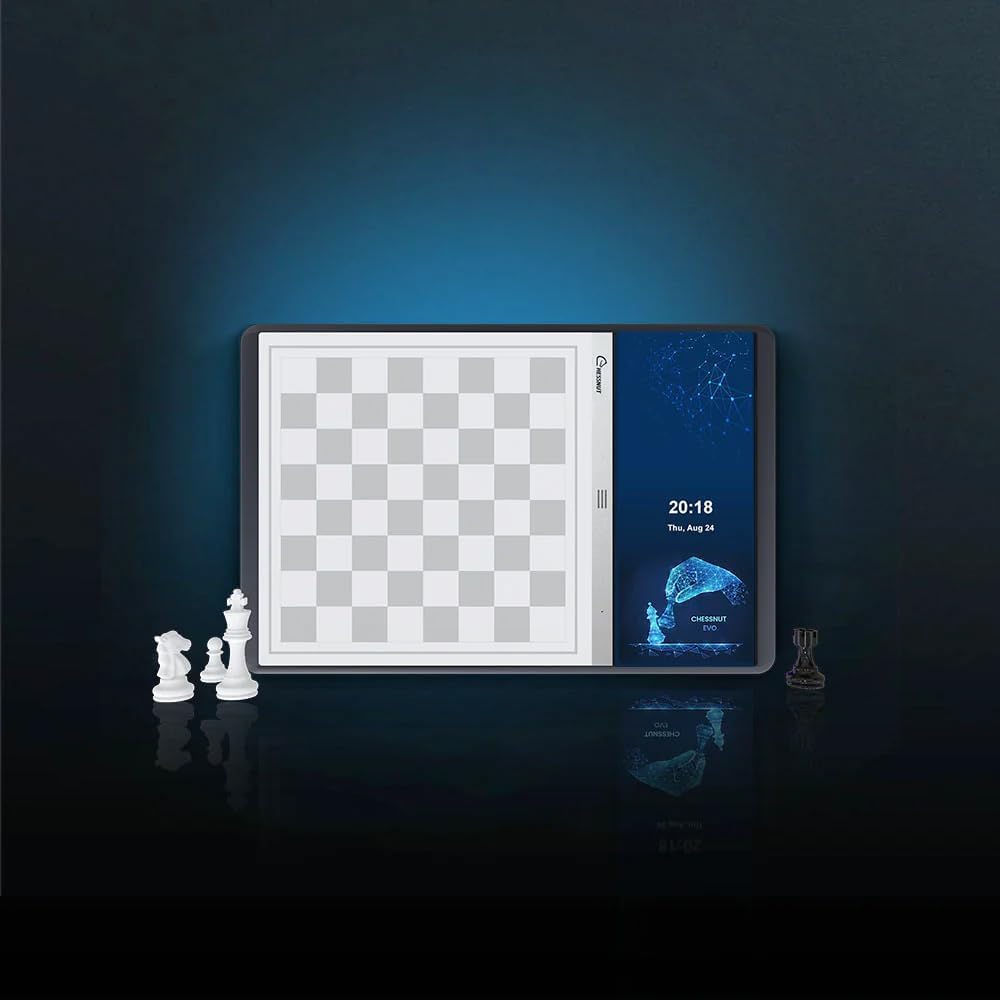
The only board that ditches the phone completely — it has its own high-resolution screen built in.
You never have to pair a phone or tablet because the Evo includes its own screen. That screen gives you direct access to Chess.com, Lichess, and two built-in AI engines — Stockfish (a raw calculation engine) and the Maia engine (an AI designed to play like a human, complete with realistic mistakes). You can practice against a bot that feels like a real opponent rather than a perfect machine.
The piece recognition uses RFID chips (tiny radio chips) in each of its 34 plastic pieces. The board shows suggested moves and best responses through its LED lights — so you see the line the engine recommends directly on the board. Buyers report that the “Castling and take backs work well” and that the device is “well-made with built-in tablet — no pairing needed, frees phone.” The catch? The plastic pieces feel lightweight; one reviewer noted they are the “only pitfall” but said it did not “bring it down.” The Evo also includes a camera that, according to reviewers, can import positions from YouTube videos and convert them directly into PGN (a standard chess notation file).
Because it ships with over 100 adjustable ELO levels (the rating system that measures player strength) and supports over-the-air updates, this board will grow with you from beginner to advanced club player. Unlike the ChessUp 2, which relies on a companion app for deeper analysis, the Evo does everything on-device.
Why it’s great
- Built-in screen frees your phone for other tasks
- Dual AI engines (Stockfish + Maia) offer human-like practice partners
- Wireless updates keep the software current
Good to know
- Plastic pieces feel a bit cheap for the price point
- No wall charger included; you need a USB-PD charger (USB Power Delivery)
Best for: Players who want a standalone device with no phone dependency and the most versatile AI training tools.
skip it if you prefer the feel of real wooden pieces or need a travel-friendly size.
2. Millennium eONE Chess Computer

The marathon runner that keeps playing after the rest have died — 12 hours of play means you charge far less often.
You get an estimated 12 hours of play — a full 2.0x gap compared to the ChessUp 2’s 6 hours. The eONE is the board to pick if you hate hunting for a charger mid-game. It connects to Lichess via Bluetooth and to Chess.com via an Android app (iPhone users can play Lichess, but Chess.com is Android-only). Owners mention that “the eONE connects every time with Lichess, and the battery lasts forever.” At 12.2 inches square, it is compact enough to sit on a desk next to your computer monitor, unlike the larger 21-inch tournament boards.
The pieces are plastic but “feel surprisingly high quality” according to one reviewer, and they are weighted with anti-slip bases. The sensors occasionally have trouble registering fast moves — one buyer mentioned they can be “finicky, sometimes fail to register moves, causing forfeits” — so this board rewards a deliberate playing style rather than blitz speed. It uses USB for offline play against its built-in AI and Bluetooth to sync with your phone for online matches.
Compared to the Chessnut Go, the eONE is slightly larger but offers significantly more battery life and a more stable connection for serious online play.
Why it’s great
- 12-hour battery lasts for days of regular play
- Compact 12-inch size is perfect for home or travel
- Weighted plastic pieces with anti-slip bases feel solid
Good to know
- Chess.com only works via Android app (not iOS)
- Sensors can miss quick or sliding moves
Best for: Players who prioritize battery life and a reliable connection to Lichess for long sessions.
pass on it if you are an iPhone user who wants native Chess.com support on the board.
3. ChessUp 2 by Bryght Labs
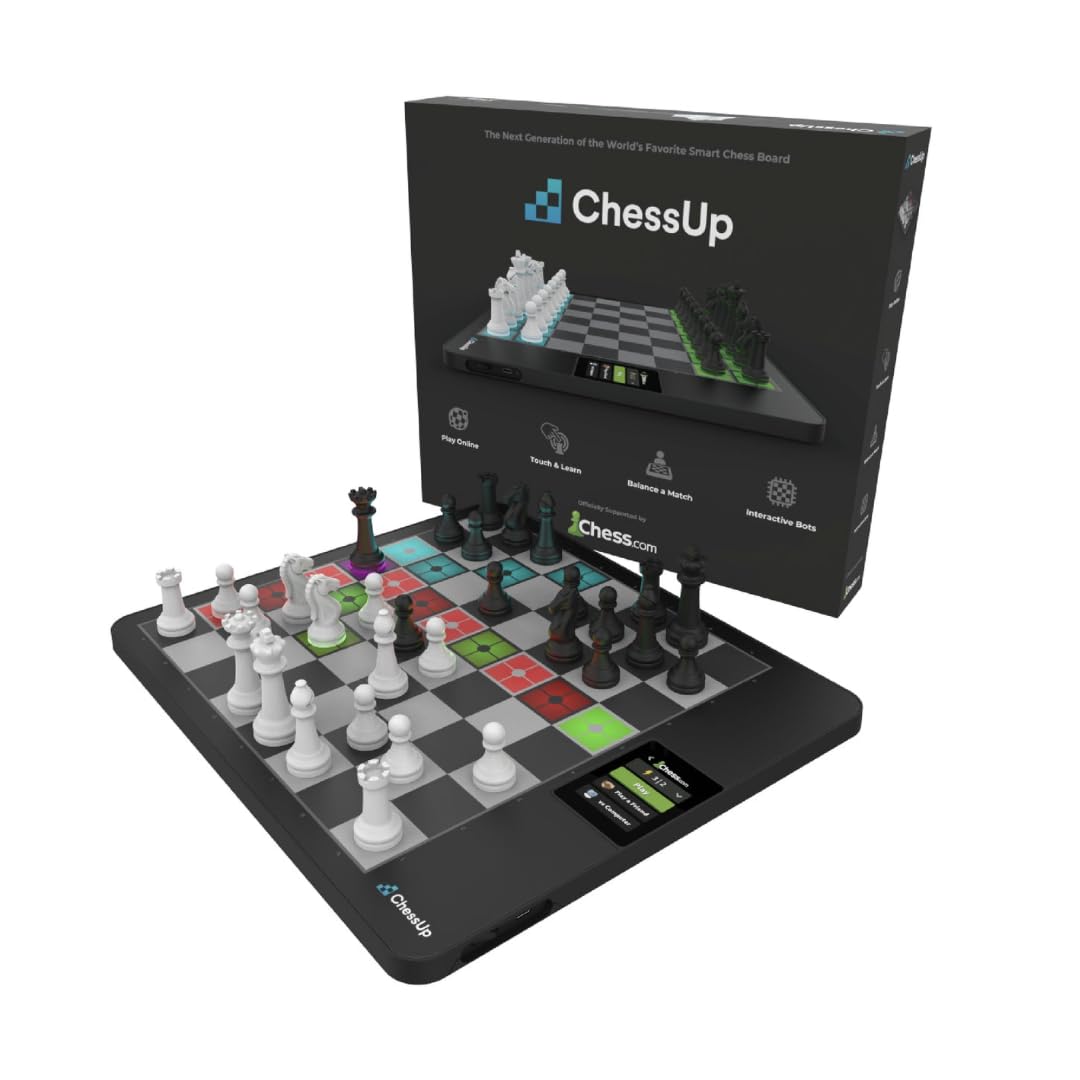
The coach that lights up the board to teach you without saying a word — touch a piece and see every legal square.
ChessUp 2 is built around an unusual idea: instead of just tracking your moves, the board uses its LED system to show you what your options are. Touch a piece and the squares it can legally move to light up. Touch an opponent’s piece and the board highlights any threats. This makes it the most beginner-friendly board on the list — it is genuinely useful for a child or an adult learning the game, not just a gimmick. It connects directly to Chess.com and Lichess via built-in Wi-Fi, so you do not need a phone nearby to play online, though the companion app is required for deeper analysis and lessons.
The board itself is 15 x 14 inches — bigger than the eONE but still fits in a laptop backpack according to buyers. Battery life is 6 hours, which is half the eONE’s runtime, so you will want to keep it near a charger. The pieces use a system called TouchSense (capacitive sensing that detects your finger on the piece) rather than RFID chips, meaning the board detects which piece you are holding by touch, but the pieces themselves are not sensor-laden plastic like on the Chessnut models.
Customers note it “connects seamlessly to Chess.com for bots/practice” and that the LEDs are great for showing hints to a child while the adult plays without help. The built-in AI opponents are challenging enough for experienced club players.
Why it’s great
- LED coaching system shows legal moves and threats in real time
- Built-in Wi-Fi connects directly to Chess.com and Lichess
- Large enough for serious play but still portable
Good to know
- 6-hour battery is significantly shorter than the Millennium eONE
- Wi-Fi setup can be clunky according to some buyers
Best for: Families with mixed skill levels where one player wants coaching and the other wants a fair game.
it’s not for you if you need all-day battery life or prefer the tactile feel of real wooden pieces.
4. Chessnut Air+ Electronic Chess Set
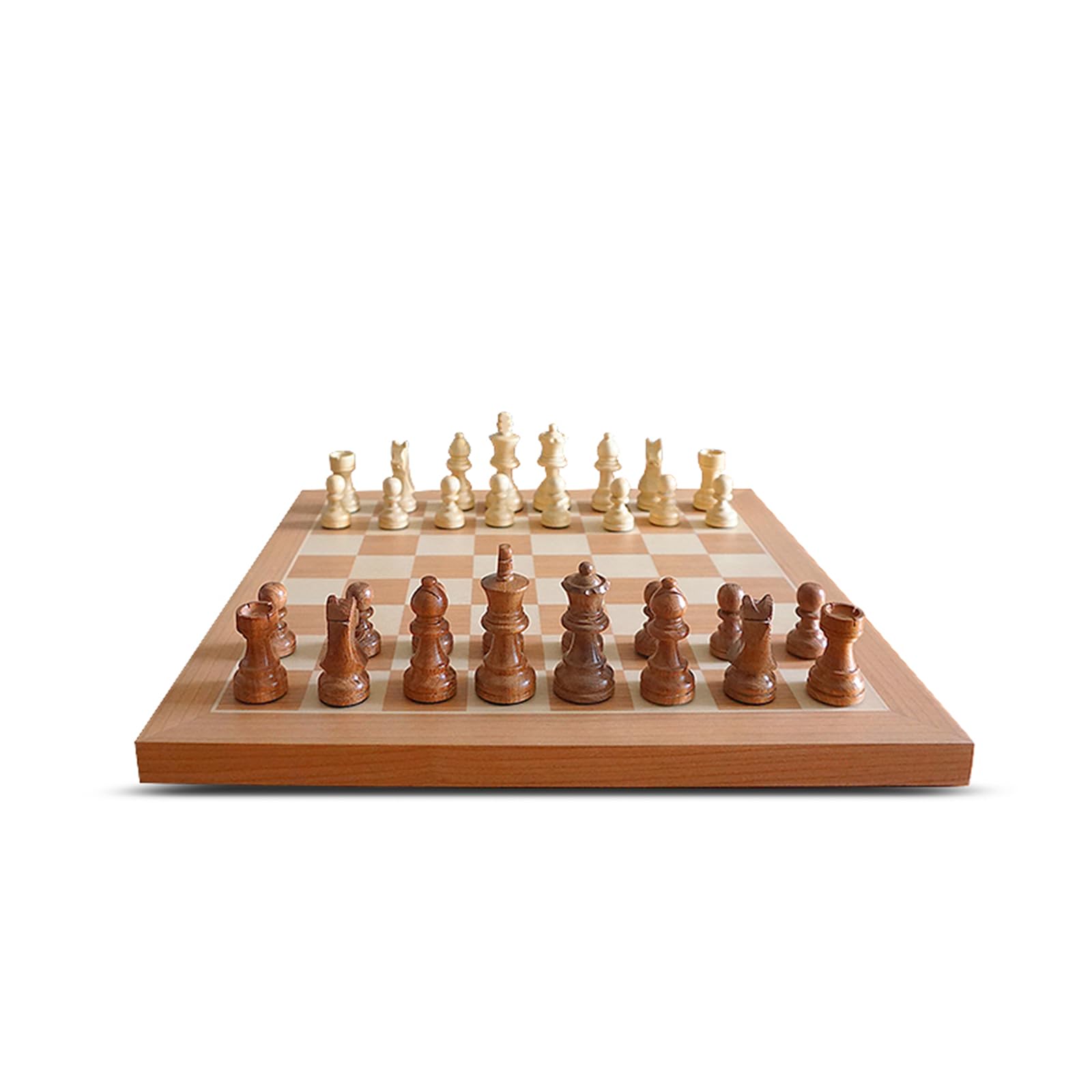
The board that finally brings wooden elegance to the smart board party — 20 hours of battery and real handcrafted wood.
If you cannot stand the feel of plastic pieces but still want full RFID piece recognition (tiny chips that ID each piece), the Chessnut Air+ is your sweet spot. It comes with 34 real wooden pieces (including two extra queens) that are weighted and fitted with sensor chips. The board itself is a handcrafted wooden frame with embedded LEDs that guide your moves and show incoming online opponent moves. Reviewers consistently call it “beautiful” and note that the “wood finish is stunning, smooth, and feels premium.”
Battery life is estimated at around 20 hours — significantly better than both the eONE and ChessUp 2 — and it connects via both Wi-Fi and Bluetooth, supporting Chess.com, Lichess, and third-party software like Chessbase and Shredder. The Air+ has 20 adjustable AI difficulty levels that adapt to your skill, plus weekly puzzles and leagues for practice. It measures 15.74 inches square, so it is desk-friendly but not quite travel-sized.
The downside: a small number of buyers reported that their set arrived with felt peeling off the bottom of a few pieces, suggesting occasional quality-control issues. The piece weight, while wooden, was described by one disappointed reviewer as “so light they topple over.” Compared to the Chessnut Pro, the Air+ is smaller and less expensive, but the Pro uses thicker, heavier wood pieces that feel more like a tournament set.
Why it’s great
- Real handcrafted wooden pieces and board look great on any table
- Roughly 20-hour battery outlasts almost every other board here
- Dual Wi-Fi and Bluetooth give flexible online play options
Good to know
- Some reviewers point out quality control issues with felt peeling on pieces
- Wood pieces are lighter than traditional tournament sets
Best for: Players who want the tactile warmth of a real wooden board without sacrificing smart features.
look elsewhere if you need tournament-weight pieces that won’t tip over in fast play.
5. Chessnut Pro Tournament Size Electronic Chessboard

The full 21-inch tournament board with hidden electronics that looks like a classic wooden set — but weighs 12.78 pounds.
At 21.26 inches square and weighing 12.78 pounds, the Chessnut Pro is the real deal for club players who want a regulation-size board. The electronics are hidden inside a wooden frame that looks like a normal luxury chess set, but it recognizes every piece via RFID chips (tiny radio chips), lights up moves with LEDs, and connects to Chess.com and Lichess. One reviewer summed it up: “Exceeds expectations. Full tournament-size wooden set with hidden electronics — looks like a normal board.”
The 34 wooden pieces are weighted (not as heavy as some club players might like, but one owner reported they are “standard… not heavy but not too light”) and the board has 20 adjustable AI difficulty levels (ELO ratings). It works with third-party software through a browser extension called Chessconnect. But there are real downsides: multiple buyers reported electronics that simply did not work. One customer observed “the app sucks and after a day the board would not turn off,” while another wrote at length about a board where the “power button does not turn on board (no green light).” At this price point, those quality complaints are hard to ignore, even if most shoppers say a perfect experience.
Compared to the Chessnut Air+, the Pro is significantly larger and heavier, but its tournament dimensions mean you cannot play a casual game on your lap or on a small desk. The Air+ is a better choice for most home users, while the Pro is strictly for the serious player with dedicated table space.
Why it’s great
- Full tournament-size (21-inch) board with regulation spacing
- Hidden electronics make it look like a classic wooden set
- Weighted wooden pieces with RFID sensors feel premium
Good to know
- Some buyers received defective units where electronics failed
- Very heavy (12.78 lbs) — not portable at all
Best for: Club players and serious enthusiasts who need a regulation board and can accept the reliability risk.
steer clear if you want a flawless out-of-box experience or need something portable.
6. Chessnut Go Portable Travel Electronic Chess Board
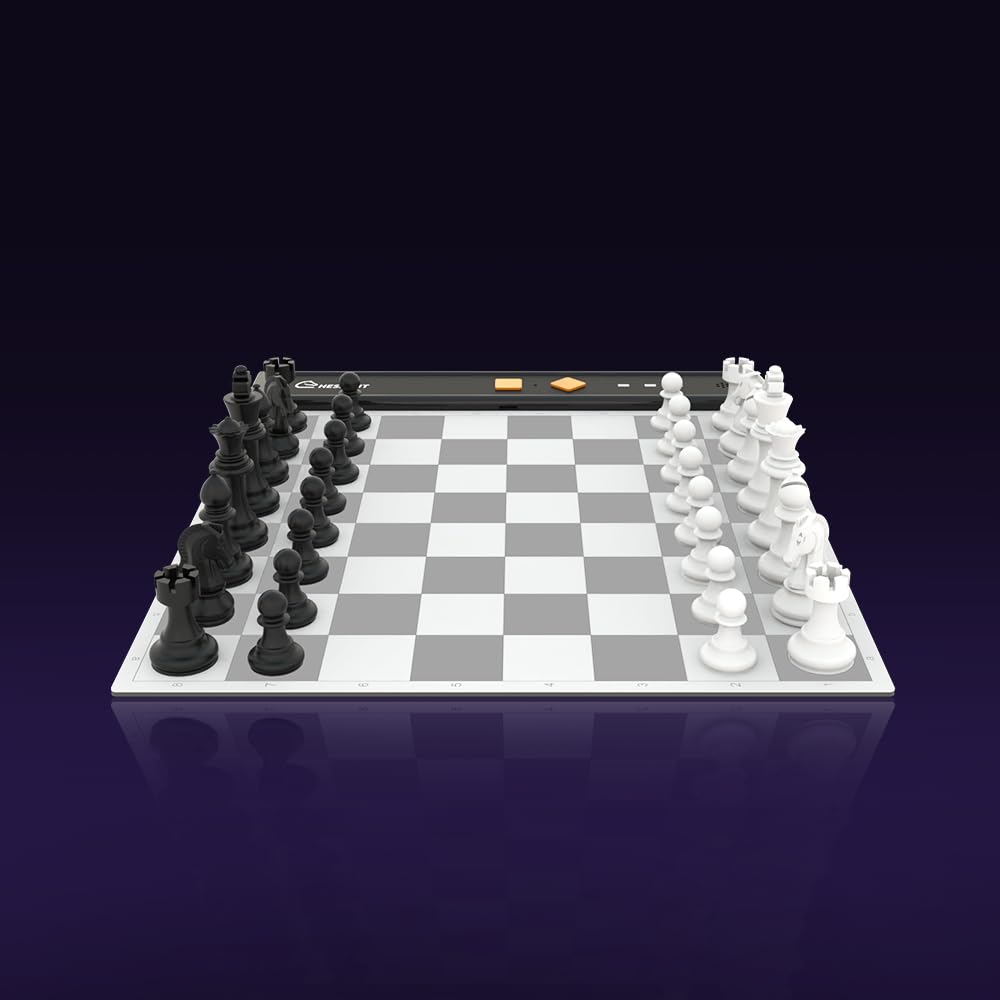
The pocket-sized board at 10.35 x 9.1 inches that fits on a plane tray table without a fuss — under one pound.
At 10.35 x 9.1 inches and under one pound, the Chessnut Go is the smallest and lightest AI board on the list. The pieces are magnetic and use RFID chips for recognition (tiny chips in each base), so they stay put during travel and the board knows exactly where every piece is. Buyers call it “great value” and say the “smaller travel size fits well on a table with other items.” The board comes with a carrying bag and a USB-C cable, making it genuinely grab-and-go.
It connects to your phone via Bluetooth and works with Chess.com and Lichess through the Chessnut app. The built-in AI opponent is fine for casual games, but the real value is using the board as a physical controller for online play while traveling. One catch — the magnetic strength is weaker than shown in promotional videos. Buyers report that while the pieces stay on the board on a flat surface, the board is “better as a study board than travel board” in a bumpy car or airplane seat. The plastic pieces also feel cheap, and one user highlighted replacing them.
Compared to the Millennium eONE, the Go is smaller and lighter but has a shorter battery life estimate and weaker magnets. The Go wins purely on portability.
Why it’s great
- Ultra-compact 10-inch size fits in any bag or on a crowded desk
- Magnetic pieces stay in place during normal use indoors
- Full piece recognition in a compact package
Good to know
- Magnets are weaker than advertised — not ideal for bumpy travel
- Plastic pieces feel cheap; some buyers replaced them immediately
Best for: Travelers, commuters, or anyone who needs a compact smart board for a desk setup with limited space.
skip it if you want a premium feel out of the box or strong magnets for truly mobile play.
7. SenseRobot AI Chess Robot
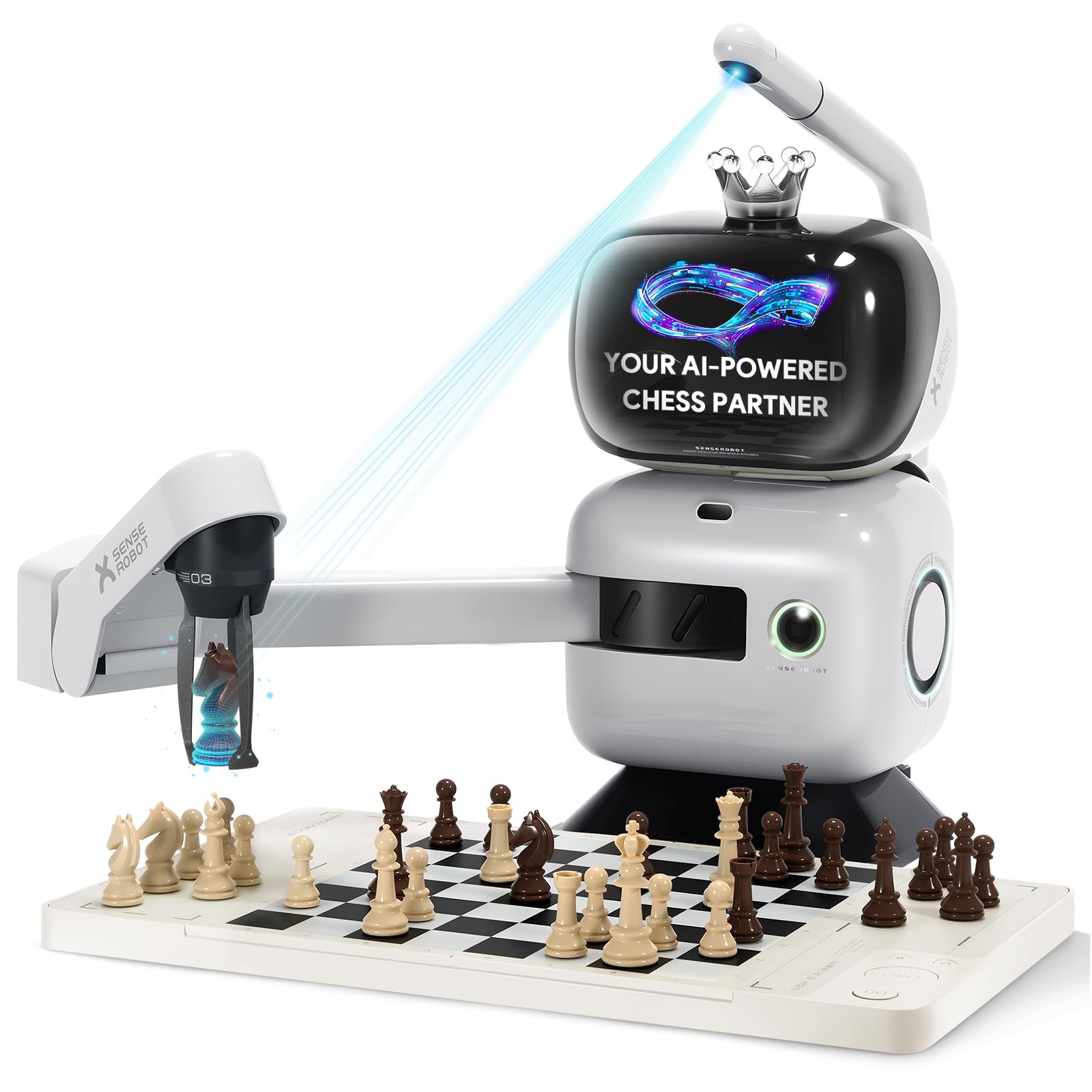
The robot that reaches across the board and moves its own pieces with a physical arm — 25 AI levels and 1200+ built-in exercises.
The SenseRobot is the only board here that physically moves the opponent’s pieces with a robotic arm, creating an experience closer to playing a human than any LED-based board can. It uses a camera vision system (not RFID chips) to track every piece, and four servo motors (small electric motors that control the arm’s joints) drive the arm. Reviewers love the novelty: “Interactive robotic arm feels like real opponent.” The board has 25 AI difficulty levels, 1200+ built-in exercises, and voice coaching, making it both a game and a training tool.
Because the arm moves physically, play is slower — owners mention it is “too slow for speed games.” This is a board for thoughtful rapid or classical time controls. The arm also occasionally misses a piece (easily corrected manually) according to one reviewer. Setup requires Wi-Fi and a companion app for Lichess integration and progress tracking, and the board itself is powered by AC (no battery, since the arm needs constant power). At 20 x 18.5 inches, it is large but not as big as the 21-inch tournament Chessnut Pro.
The biggest limitation is speed: if you play 5-minute blitz, the robotic arm will frustrate you. But for a child learning the game, a family game night, or an adult who wants the most immersive solo chess experience available, the SenseRobot is unmatched. Unlike every other board here, it works right out of the box for a single player with no phone or tablet needed.
Why it’s great
- Physical robotic arm moves pieces for the most immersive solo play
- 25 AI levels and 1200+ exercises cover beginner to advanced
- Voice coaching and guided feedback help new players learn
Good to know
- Arm is too slow for blitz or speed chess games
- Requires AC power — not portable at all
- Camera can occasionally miss a piece in low light
Best for: Solitaire players, families, and anyone who wants the closest thing to playing a real opponent without a screen.
pass on it if you play mostly fast online games or need a portable board.
Understanding the Specs
Piece Recognition — RFID vs. Camera vs. TouchSense
RFID (Radio-Frequency Identification) uses a tiny chip inside each chess piece that the board reads to know which piece is on which square. This is the most reliable system — it never gets confused by lighting or shadows. Camera-based systems use a small camera to visually track pieces; they work well but can glitch if a piece is in shadow or tilted. TouchSense, used by ChessUp 2, detects which piece you are holding by sensing your finger on the piece. It is simpler but cannot tell if you accidentally brushed a piece.
Battery Life — The Real Cost of Convenience
Battery life on these boards ranges from 6 hours (ChessUp 2) to roughly 20 hours (Chessnut Air+). The difference is massive if you forget to charge. A 6-hour board might last you two evenings of casual play. A 12-hour board (Millennium eONE) could last a full week of daily 45-minute games. Boards with robotic arms (SenseRobot) need AC power — they simply cannot run on a battery because the motors draw too much current.
Wi-Fi vs. Bluetooth — How You Connect to Play Online
Bluetooth boards (like the Chessnut Go) require a nearby phone or tablet running an app — the board is essentially a physical controller for the app. Wi-Fi boards (like the ChessUp 2 and Chessnut Evo) can connect directly to Chess.com or Lichess over your home network, meaning you can play online without a phone. The Evo goes a step further by including its own screen, so you do not need any external device at all.
Board Size — Why 21 Inches Matters
A standard tournament chess board has 2.25-inch squares, making the board about 20-21 inches square. Boards like the Chessnut Pro use this dimension, which means the pieces are larger and easier to handle, and the spacing matches what you would find in a club or tournament. Smaller boards (like the 10-inch Chessnut Go) have proportionally smaller squares and pieces — fine for travel but cramped for serious analytical play.
FAQ
Can I use an AI chess board without a phone or tablet?
What is the difference between RFID piece recognition and a touch-screen board?
Will an electronic chess board work with Chess.com and Lichess?
How long does the battery last on an AI chess board?
Are the pieces on electronic chess boards standard size?
Can I set up a custom position on an AI chess board?
How do over-the-air updates work on these boards?
Is a robotic arm chess board better than a regular electronic board?
What does ELO mean on an AI chess board?
Can I use an electronic chess board for hours every day?
Final Thoughts: The Verdict
If you want one dependable pick, the ai chess board winner is the Chessnut Evo because it combines a built-in screen, dual AI engines (Stockfish for analysis and Maia for human-like play), and Wi-Fi connectivity that cuts the phone out of the equation entirely. If you want the classic feel of real wood while staying affordable, grab the Chessnut Air+. And for the pure wow factor of a robotic arm that moves pieces for you, the standout is the SenseRobot AI Chess Robot.
How We Picked
We do not accept paid placement, and we did not hands-on test every unit. Instead, we match each pick to a real buyer and use-case by comparing the manufacturers’ published specifications against the patterns in verified customer reviews — so you get each pick’s real strengths and trade-offs instead of marketing copy.
Sources & Methodology
Specifications: manufacturer listings and product documentation. Review insights: verified customer reviews, as of June 2026. Pricing: not shown on this page (it changes often); check the current price via the retailer link.
As an Amazon Associate, Gadgets Feed earns from qualifying purchases. This does not affect which products we feature.
Product prices and availability are accurate as of the date/time indicated and are subject to change. Any price and availability information displayed on Amazon at the time of purchase will apply to the purchase of this product. As an Amazon Associate I earn from qualifying purchases.
CERTAIN CONTENT THAT APPEARS ON THIS SITE COMES FROM AMAZON. THIS CONTENT IS PROVIDED "AS IS" AND IS SUBJECT TO CHANGE OR REMOVAL AT ANY TIME.
Amazon and the Amazon logo are trademarks of Amazon.com, Inc. or its affiliates.