
Our readers keep the lights on and my morning glass full of iced black tea. As an Amazon Associate, I earn from qualifying purchases.
Specs are compiled from manufacturer listings and verified buyer reviews and can change over time — please confirm the key details on the product page before buying.
Picking an AI lawn mower used to mean burying a boundary wire around your entire yard. That is no longer true. The newest models use cameras, LiDAR (a type of laser sensor), GPS, or a mix of all three to learn your lawn’s shape without a single wire — then they map it, cut it, and go home to charge on their own.
I’m Min — the founder and writer behind Gadgets Feed. This guide is built by comparing the manufacturers’ published specifications and the patterns across verified customer reviews, so you get each pick’s real strengths and trade-offs instead of marketing spin.
Whether you have a flat postage-stamp lawn or a steep hillside, the right ai lawn mower can turn a weekend chore into a low-maintenance routine that saves you hours every week and keeps your grass looking its best automatically.
Quick Picks
- DREAME LiDAR 2500 Robot Lawn Mower A3 AWD Pro — Best Overall
- Segway Navimow X450 Robot Lawn Mower — Lawn Tank
- Mammotion LUBA 3 AWD 3000H — Turf Architect
- MOVA LiDAX Ultra 1000 Robot Lawn Mower — Edge Master
- ECOVACS Goat A2000 LiDAR PRO — RTK-Free Power
- WORX Landroid Vision Cloud WR320 — Compact Power
- Segway Navimow i210 AWD with Garage S — Slope King
- ECOVACS Goat O1000 LiDAR PRO — Smart Value
- Mammotion LUBA 3 AWD 1500H — Best Bang for the Acre
- YARDCARE 2026 New M800Plus — Weekend Liberator
- ANTHBOT Genie 3000 (Robot Lawn Mower NO Wire) — Heavy-Duty Navigator
- eufy Robot Lawn Mower E15 — Tiny Yard Hero
How To Choose The Best AI Lawn Mower
Buying your first robot mower is notable, but the spec sheets can be confusing. Focus on these three factors to find a mower that simplifies lawn care instead of complicating it.
Navigation: The Brain Behind the Blades
This is the single most important choice. RTK (Real-Time Kinematic) mowers use a satellite signal and a small antenna for centimeter-level GPS accuracy — they work anywhere with a clear sky but can struggle under dense tree cover. Vision-based mowers use cameras and AI to “see” the lawn, so they never lose signal, but they need good light and clear visual boundaries like a fence or a curb. LiDAR mowers use spinning laser sensors to build a 3D map of your yard, which works in the dark and under trees but costs more. Some mowers combine two or all three for the best of every world — but you pay for that redundancy.
Yard Size and Slope: Match the Machine to Your Land
Every mower lists a maximum acreage, but that number assumes a flat, open lawn with perfect conditions. If your yard has slopes, tight corners, or multiple zones separated by a driveway, the real-world coverage will be lower. Check the slope rating carefully — a mower rated for 35% (around 20 degrees) is fine for gentle hills, but a steep 45% slope demands a model with all-wheel drive and serious traction. Also look at the cutting width: a wider deck (8+ inches) mows faster, but a narrower one navigates tight garden paths better.
Obstacle Avoidance: The Difference Between “Smart” and “Frustrating”
A mower that collides with obstacles like hoses, toys, or pets is not truly smart. Top AI mowers use cameras and neural networks trained on thousands of objects to recognize and avoid obstacles like furniture, sprinklers, and animals. Some models identify over 300 object types and reroute smoothly instead of bumping and turning. Check owner reviews to confirm a mower’s obstacle avoidance is reliable enough for unsupervised operation.
Quick Comparison
| Model | Best For | Navigation | Cutting Width | Slope Rating | Amazon |
|---|---|---|---|---|---|
| YARDCARE M800Plus | Value & ease | GPS + 3D Vision | 7 “ | 35% | $853.44Amazon |
| ANTHBOT Genie 3000 | Heavy terrain | Full Band RTK + 4-Eye Vision | 7.9 “ | — | $899.00$1,589.00Limited time dealAmazon |
| WORX WR320 Vision Cloud | Feature-rich mid-size | RTK Cloud + AI Vision | 8.7 “ | 30% | $1,064.50$1,299.99Amazon |
| eufy E15 | Small, flat yards | Pure Vision (V-SLAM) | 8 “ | 18° | $1,199.99$1,799.99Amazon |
| MOVA LiDAX Ultra 1000 | Edge precision | 360° LiDAR + AI Vision | 8 “ | 45% | $1,299.00Amazon |
| Segway Navimow i210 AWD | Steep slopes | EFLS NRTK + Vision | 7.1 “ | 45% | $1,498.99Amazon |
| ECOVACS Goat A2000 | Edge trimming built-in | 360° Dual-LiDAR | 3.6 “ | — | $1,319.12Amazon |
| ECOVACS Goat O1000 | Tight spaces | Dual-LiDAR + AI Vision | 8.66 “ | — | $1,499.99Amazon |
| DREAME A3 AWD Pro | Large, complex lawns | 360° LiDAR + Binocular AI Vision | 15.75 “ | 80% | $2,499.99$3,399.99Amazon |
| Mammotion LUBA 3 1500H | Multi-zone precision | 360° LiDAR + Dual-Camera AI | 15.75 “ | 80% | $2,608.00Amazon |
| Segway Navimow X450 | Largest lawns | EFLS Tri-Frequency RTK + 360° Vision | 17 “ | 84% | $2,999.00Amazon |
| Mammotion LUBA 3 3000H | Peak automation | 360° LiDAR + NetRTK + AI Vision | 15.75 “ | 80% | $3,008.00Amazon |
In‑Depth Reviews
1. DREAME LiDAR 2500 Robot Lawn Mower A3 AWD Pro
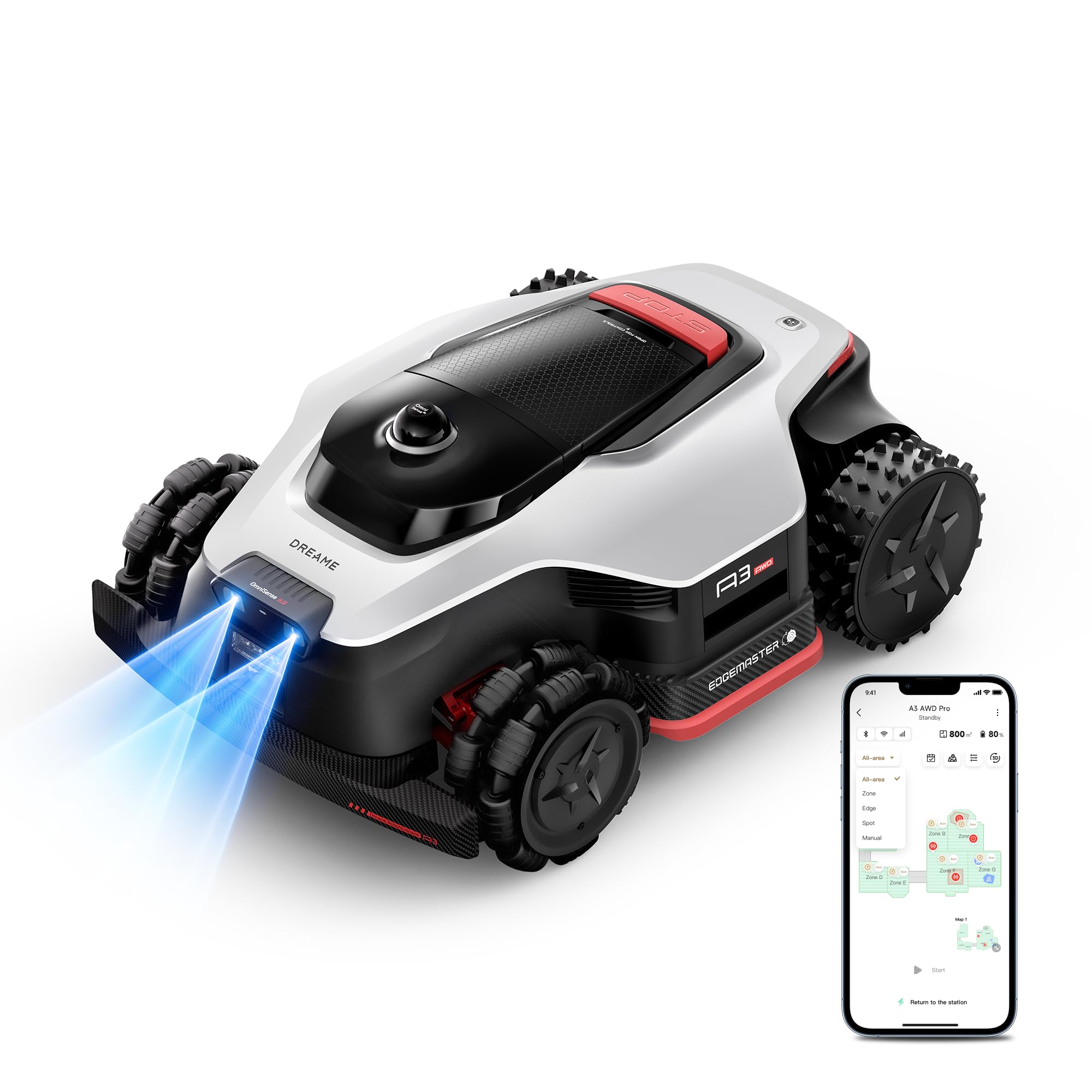
The 4WD monster that knocks out a half-acre without breaking a sweat.
If your yard is big, bumpy, and has a serious slope, this is the mower you want. The Dreame A3 AWD Pro uses 4WD hub motors to climb slopes up to 38.7 degrees (that is an 80% grade), so a steep hill feels like flat ground to it. Reviewers confirm it handles serious inclines without slipping or getting stuck — one owner with a Michigan slope said it “climbs hill like flat” and turns automatically at the top.
Navigation is handled by a combination of 360-degree 3D LiDAR and binocular AI Vision (called OmniSense 3.0), meaning it never loses position even under trees or near fences where a pure-GPS mower would drift. The AI detects over 300 obstacle types in real time, including furniture and pets. And with dual floating cutting discs that give you a 15.8-inch cutting width — far wider than the 7-inch average of budget mowers — it covers ground fast, claiming up to 8,611 square feet per hour in Rush mode.
One real trade-off: setup can be finicky on lawns that are not perfectly manicured. A reviewer noted the mapping process on a yard with trees and bumps was “nightmarish” compared to a flat, open lawn. But once dialed in, the EdgeMaster 2.0 system cuts extremely close to borders, and the automatic height adjustment (1 to 4 inches) handles overgrown grass up to 8 inches tall by trimming it down gradually.
What Stands Out
- 4WD climbs 80% slopes with zero slipping — owners confirm it mows steep hills easily.
- Dual 15.75-inch discs cut far faster than single-blade mowers on large lawns.
- LiDAR + vision avoids over 300 obstacle types, including pets and garden furniture.
What to Watch For
- Mapping process can be frustrating on lawns with many trees or irregular perimeters.
- Rolls over tall weeds rather than cutting them cleanly, according to one owner.
- Premium price reflects its pro-grade hardware and 3-year warranty.
The take-home: This is the best AI lawn mower for anyone with a large, sloped, or complex yard who wants a single machine that handles everything — steep hills, thick grass, and full autonomy. The learning curve during initial setup is real, so be patient during the first week.
Who should look elsewhere: If your lawn is under a quarter-acre and pancake-flat, a simpler vision-based mower will cost half as much and be easier to set up.
2. Segway Navimow X450 Robot Lawn Mower
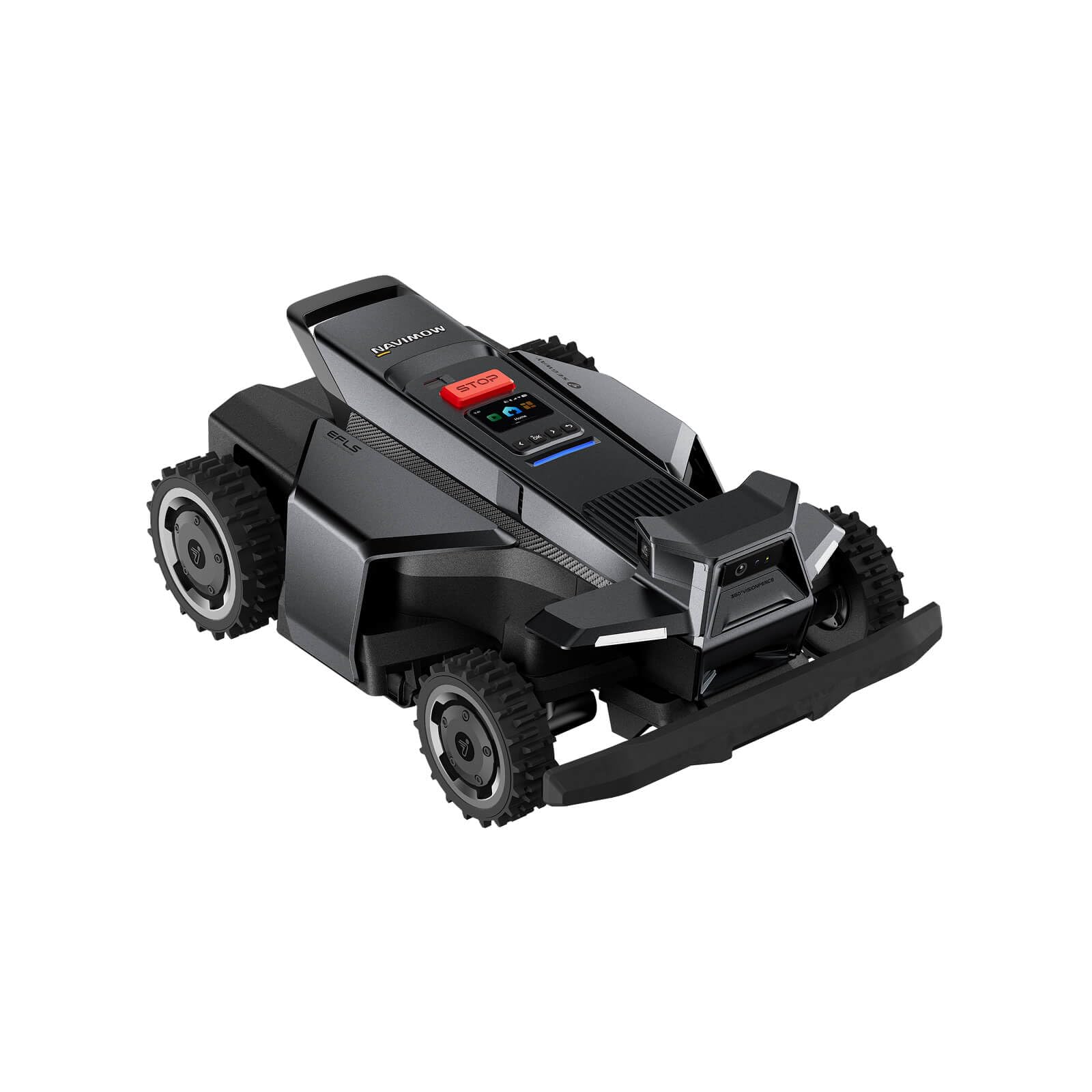
The fast, wide-cutting beast made for lawns up to 1.5 acres.
For the biggest yards, the Segway Navimow X450 is in a class of its own. It combines a massive 17-inch cutting width with dual 180W motors — that is two cutting discs with 12 blades total, mowing at 2.6 feet per second. You can cover a lot of ground fast, and the EdgeSense system trims within 2 inches of borders. Owners say it is “the best of the best” for steep grades and does not tear up the lawn, unlike some competitors.
Navigation uses Segway’s EFLS tri-frequency Network RTK combined with 360-degree vision and VIO (Visual Inertial Odometry) for centimeter-level accuracy, even under trees or in narrow passages. The AI-powered VisionFence detects over 200 obstacle types. One reviewer came from a Mammotion Luba 2 and noted the X450 has double the battery life, a wider cut, and protected blades that prevent grass buildup — though its turning pattern is less uniform.
The big trade-off is weight: at over 63 pounds, this is a heavy machine. It handles extreme 84% (40-degree) slopes thanks to its ORV-tuned dual suspension and 4WD, but you will feel that weight if you ever need to carry it. Setup is straightforward — one-tap Auto Mapping with no boundary wire or antenna — but the app and steering take a little practice to learn for the initial perimeter mapping.
Standout Features
- 17-inch dual-disc cutting width lets it finish a 1.5-acre lawn in fewer passes than any other mower here.
- Can climb 84% slopes — the steepest rating of any mower on this list.
- EdgeSense reduces the trimming margin to under 2 inches, so you barely need a string trimmer afterward.
Considerations
- At 63.71 pounds, moving it manually is a two-person job for most people.
- Voice control via Alexa or Google Home works, but the app UI takes some getting used to.
- Premium price reflects professional-grade build and coverage area.
Who it fits: Homeowners with a full acre or more of lawn, especially if there are steep slopes, who want the fastest possible mowing with minimal human involvement.
One realistic downside to know: At this size and weight, it is not a mower you move between properties or store in a basement without help.
3. Mammotion LUBA 3 AWD 3000H
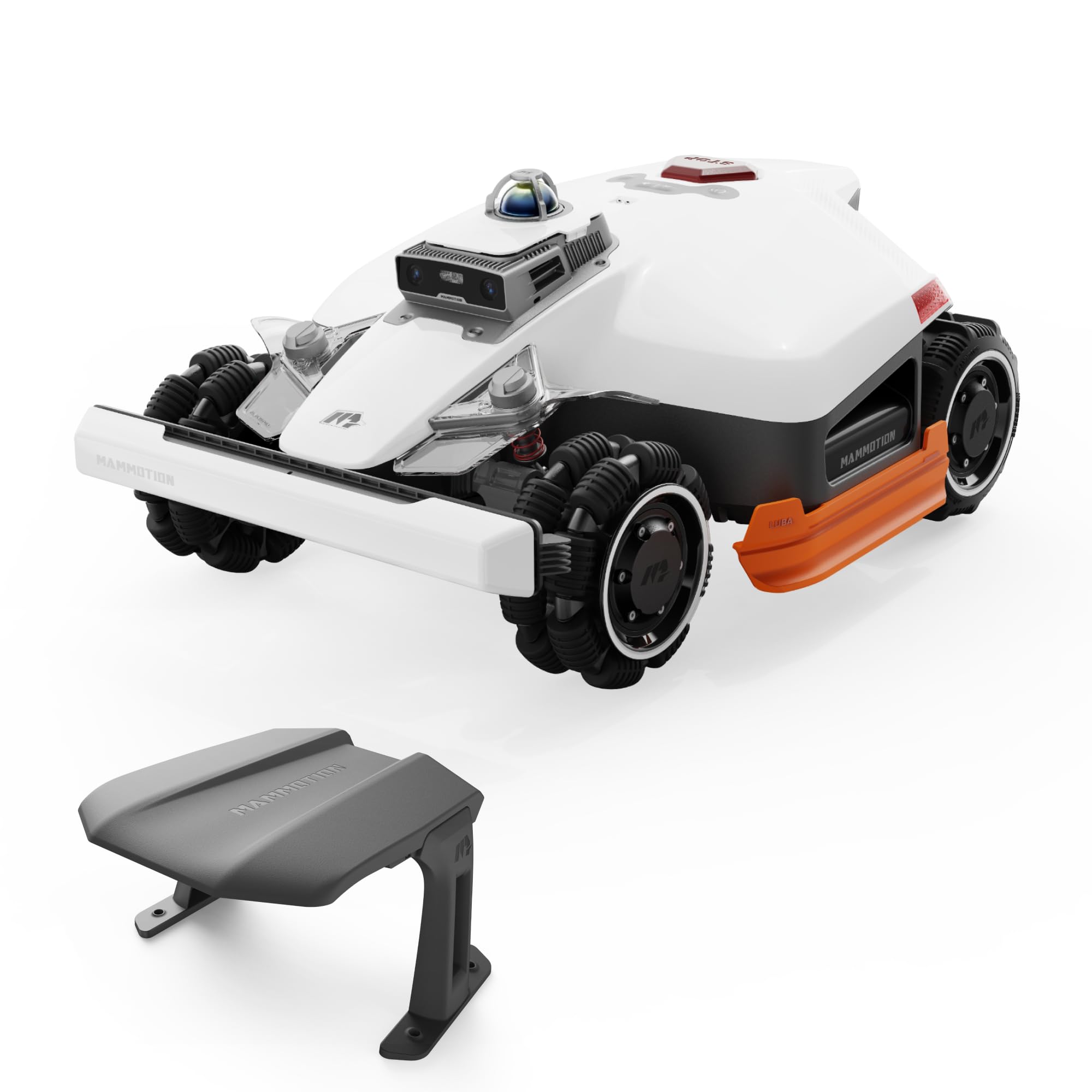
A triple-navigation master that refuses to get lost or stuck.
The Mammotion LUBA 3 3000H uses a Tri-Fusion system that combines 360-degree LiDAR, NetRTK satellite corrections, and dual-camera AI vision — so even if one sensor struggles, the other two keep the mower perfectly on track. Its 230-foot LiDAR range builds a dense point cloud of your entire yard, mapping everything from ground level to tree canopies. With four independent motors and adaptive suspension that steps over 50 mm curbs and roots, owners say it “just works” and is “peak robo-mower.”
Cutting performance comes from two 165W motors with six blades and a 15.75-inch cutting width. The battery lasts up to 175 minutes per charge — the longest runtime of any mower here — and the mower covers up to 500 square meters per hour. One reviewer noted that after two months, the mower required no RTK antenna setup, and a full mow of 0.75 acres costs roughly in electricity versus over for a gas mower. The AI automatically adjusts motor speed based on grass density to boost both cutting quality and battery life.
A potential reliability concern: one owner experienced a WiFi hardware failure just past the 30-day return window, leaving the mower unable to map or mow. While the cutting performance is excellent, the long-term parts availability (replacement batteries not yet sold separately) is a worry for early adopters. The 4-week review noted real-world battery life is lower than the advertised 175 minutes — still good, but worth knowing.
Tri-Fusion Advantages
- LiDAR + RTK + Vision means zero signal loss even under heavy tree cover or near buildings.
- 175-minute runtime with 12Ah battery covers a large yard in one session.
- Supports 30 mowing zones with zigzag, checkerboard, or adaptive patterns.
Known Limitations
- One reported WiFi hardware failure after the return window — factory reset did not fix it.
- No replacement batteries currently sold separately, raising long-term repairability concerns.
- Real-world battery coverage is roughly 60% of the marketing figure, per one owner’s measurement.
Reach for this if: You want the most advanced navigation system on the market, with triple redundancy so your mower never gets lost — plus the longest single-charge runtime available.
Look elsewhere if: You need proven long-term parts support, or you want a simpler setup with fewer potential failure points.
4. MOVA LiDAX Ultra 1000 Robot Lawn Mower
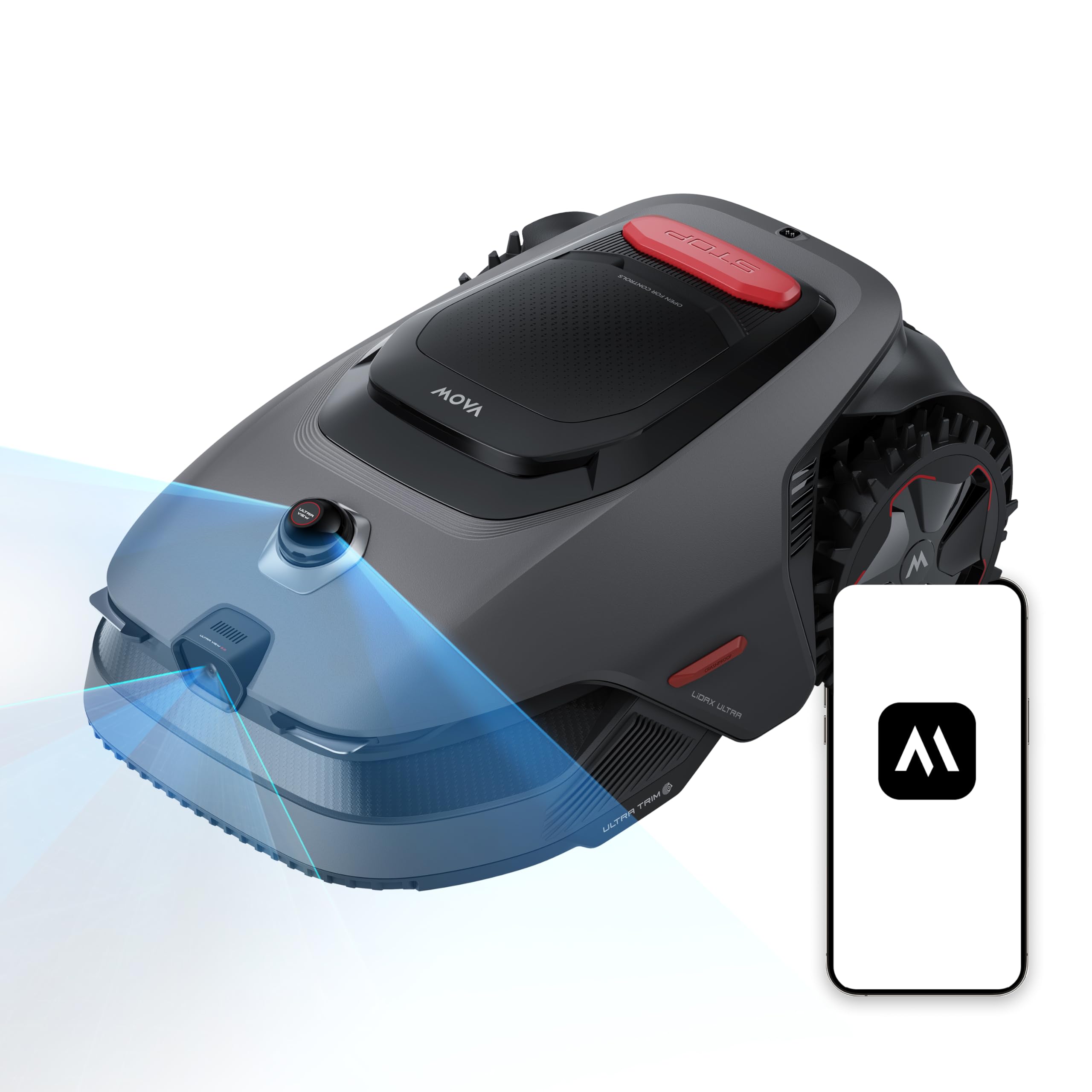
The one that cuts your edge-trimming time down to almost nothing.
The headline feature of the MOVA LiDAX Ultra 1000 is its UltraTrim 1.0 movable disc, which lets it cut within 2 inches of walls, hedges, and raised edges — a level of border precision most robot mowers cannot touch. Buyers report this handles around 95% of what a string trimmer would normally do. The mower uses 360-degree 3D LiDAR and AI vision, with no RTK station or perimeter wire needed, so you can power it on and start mowing within about 20 minutes of setup.
It handles slopes up to 45%, has off-road wheels for strong traction, and uses smart U-shaped path planning so it does not miss spots. Obstacle avoidance detects over 300 object types, and reviewers confirm it smoothly navigates around hoses, toys, and dogs. You can manage two independent maps (handy for front and back yards separated by a driveway) and up to 150 managed zones with custom schedules.
The strongest complaint: on sandy soil, the spiky off-road wheels can dig ruts, especially when turning. One reviewer also said the software felt unfinished — unintuitive map creation, unclear settings, and persistent error popups. On the plus side, the 3-year warranty gives some confidence, and the quiet operation means neighbors will not complain about early-morning mowing.
UltraTrim Benefits
- Movable disc cuts within 2 inches of edges, eliminating most post-mow trimming.
- Dual maps support separate front and back yards without needing a second mower.
- LiDAR + vision detects 300+ obstacle types, including dogs and toys.
Trade-Offs
- Wheels can dig ruts in sandy soil, especially during turns.
- Software experience feels rough — unintuitive maps and persistent notification errors.
- Battery covers about 1,200 sq ft of a 1,600 sq ft area per charge, per one owner’s measurement.
Grab it for: The best edge-cutting performance of any wire-free mower — you will genuinely use a string trimmer far less often, and the LiDAR navigation works flawlessly in shaded and complex yards.
skip it if: Your soil is sandy or loose, as the wheel design may damage the lawn surface during tight turns.
5. ECOVACS Goat A2000 LiDAR PRO
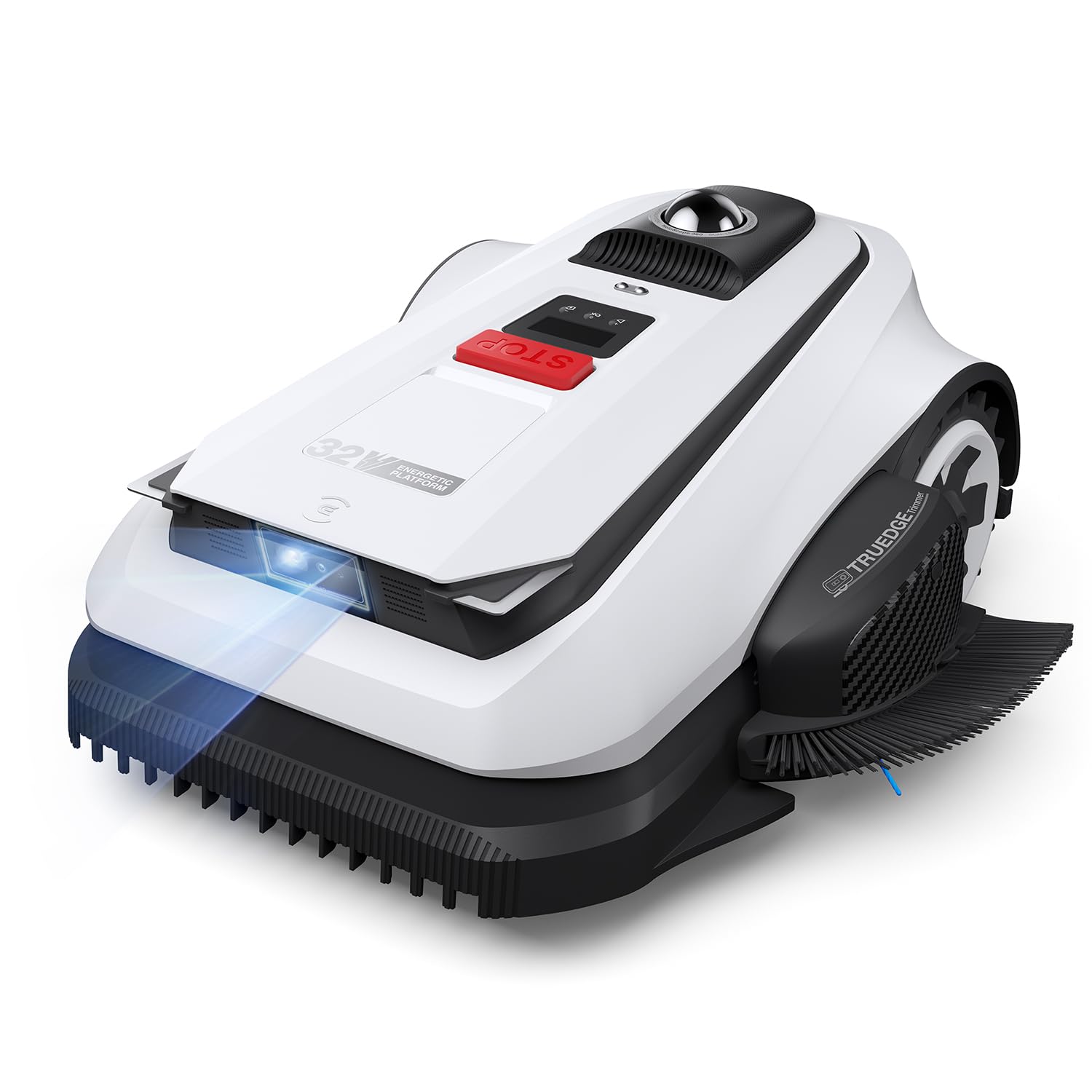
The mower that includes its own string trimmer for true edge-to-edge lawns.
The ECOVACS Goat A2000 is one of the rare robot mowers with a built-in TruEdge string trimmer — a spinning head that trims along driveways, flower beds, and sidewalks as it mows. It comes with two rolls of trimming line, each covering approximately 3 km of edging. The HoloScope 360-degree Dual-LiDAR system provides precise 2 cm positioning without needing any perimeter wire or RTK antenna, even in shaded areas where GPS mowers typically lose signal.
It runs on a 32V motor platform with a dual-blade disc system designed to tackle American lawns with Bermuda, Zoysia, Fescue, and St. Augustine grass. The battery charges in about 50 minutes (113.4W fast charging) and runs for about 50 minutes. One reviewer who owns both the Goat A2000 and a Yarbo mower found the ECOVACS to be more practical for everyday use, praising its quick LiDAR navigation in tight spaces — it is “much quicker” and more confident navigating narrow passages.
The most significant downside: a few owners mention that the mower can take three charging cycles to cover just an eighth of an acre, which is far below the claimed half-acre capacity, suggesting either a battery issue or a mapping problem. The built-in trimmer also has its limits — it works well along open borders but may miss complex corners or raised edges that still need manual attention.
Key Perks
- Integrated TruEdge trimmer reduces the need for a separate string trimmer around borders.
- Dual-LiDAR navigation performs well under trees and near fences without RTK.
- 32V motor with dual blades handles tough St. Augustine and Bermuda grass.
Watch Out For
- Several customers note far less coverage per charge than advertised — 3 cycles for 1/8 acre.
- Edging is good but not perfect; complex corners and raised borders still need manual trimming.
- Grinding noise from the blade disc reported by one owner after a couple months of use.
Best suited for: Homeowners who want a wire-free mower with integrated edge trimming on a medium-sized lawn that is mostly open, with clear borders.
Reconsider if: You need guaranteed half-acre coverage on a single charge, or you want a mature, bug-free product — this first-generation model still has some reliability questions.
6. WORX Landroid Vision Cloud WR320
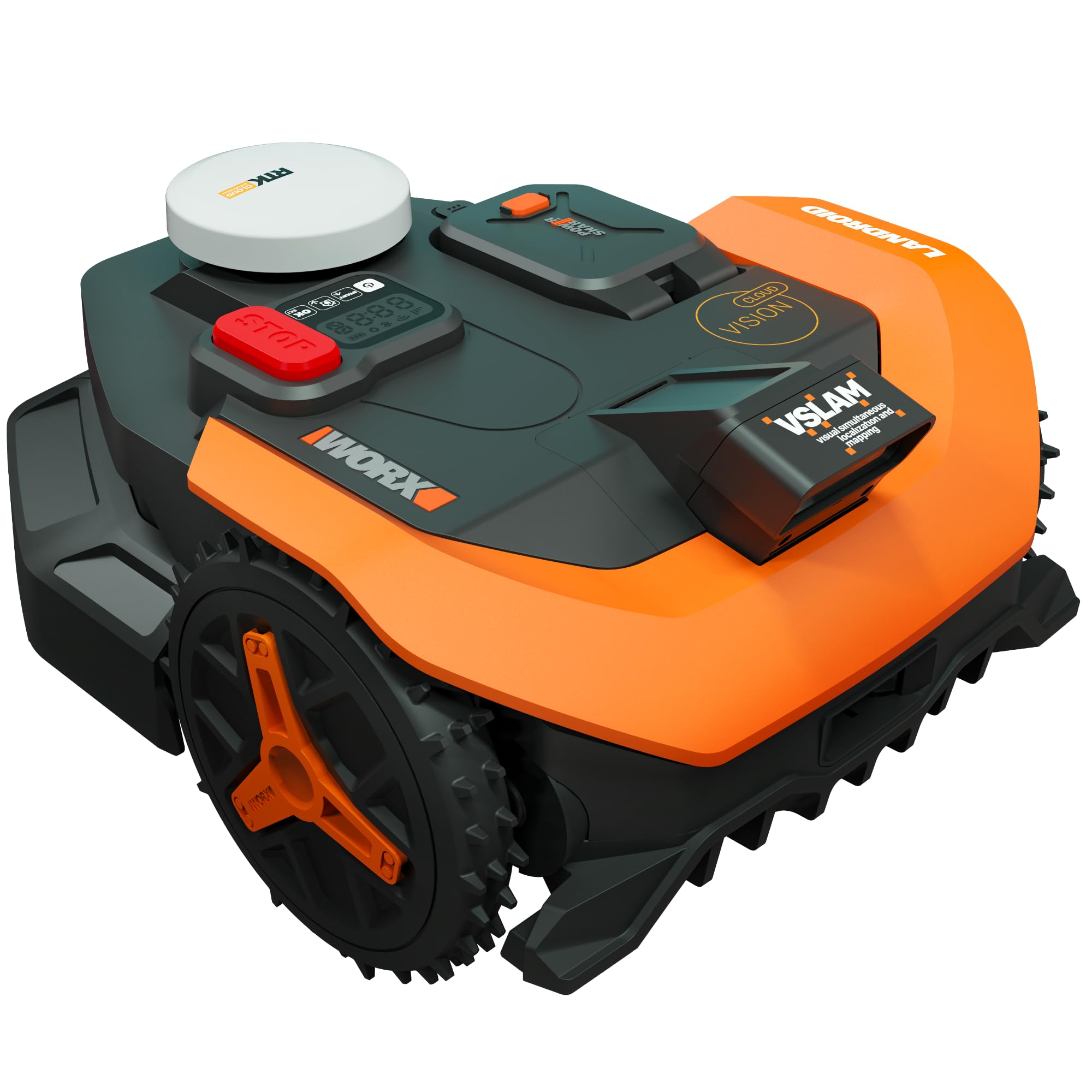
The smart mower that delivers cloud-grade accuracy without a local antenna.
The WORX WR320 uses commercial-grade RTK accuracy streamed directly from the cloud — no local antenna installation and no additional subscription fees. Its Vision AI system is powered by a neural network capable of processing up to 10 trillion operations per second, so it recognizes objects rather than just bumping into them. After using this mower for a while, one buyer mentioned being “very happy with this purchase,” saying the AI is reliable and does a great job recognizing obstacles — unlike many mowers that just bump into everything.
The cutting specs are solid: a wide 8.7-inch cutting width, height adjustable from 1.57 to 3.54 inches, and the ability to handle slopes up to 30%. You get three classic mowing patterns — Parallel, Checkerboard, and Diamond — plus a Natural look for a less manicured finish. RadioLink connectivity extends Bluetooth and Wi-Fi range beyond normal limits, so you stay connected even on large properties. Owners confirm the auto-mapping works well and the mower gets out and cuts the yard consistently.
But the 2-wheel-drive design is a real limitation: reviewers report it struggles for traction on inclined sections of the yard, even mild ones. One owner noted “it does not cut all the way to the edge even when running the edge routine,” so some manual trimming is still needed. And while the mapping works well initially, after three months one owner found it skipping certain patches of the yard.
Smart Features
- Cloud-based RTK means no local antenna — just power on and map via the app.
- Vision AI with 10 TOPS processing recognizes and understands obstacles intelligently.
- Unlimited zones with custom pathways and no-go areas accessible from the app.
Downsides
- 2WD design slips on mild slopes — a clear weakness vs. 4WD competitors.
- Edge cutting is not perfect; you will still need a trimmer for fence lines and borders.
- Customer support was unhelpful for one owner — long holds and suggestions that did not work.
Reach for this if: You want cutting-edge AI obstacle recognition and cloud RTK without installing an antenna, and your yard is mostly flat or has gentle slopes.
Step back if: You have even moderate inclines — the 2WD traction is the weakest link here, and the reported edge-cutting gaps mean you still grab a trimmer.
7. Segway Navimow i210 AWD with Garage S
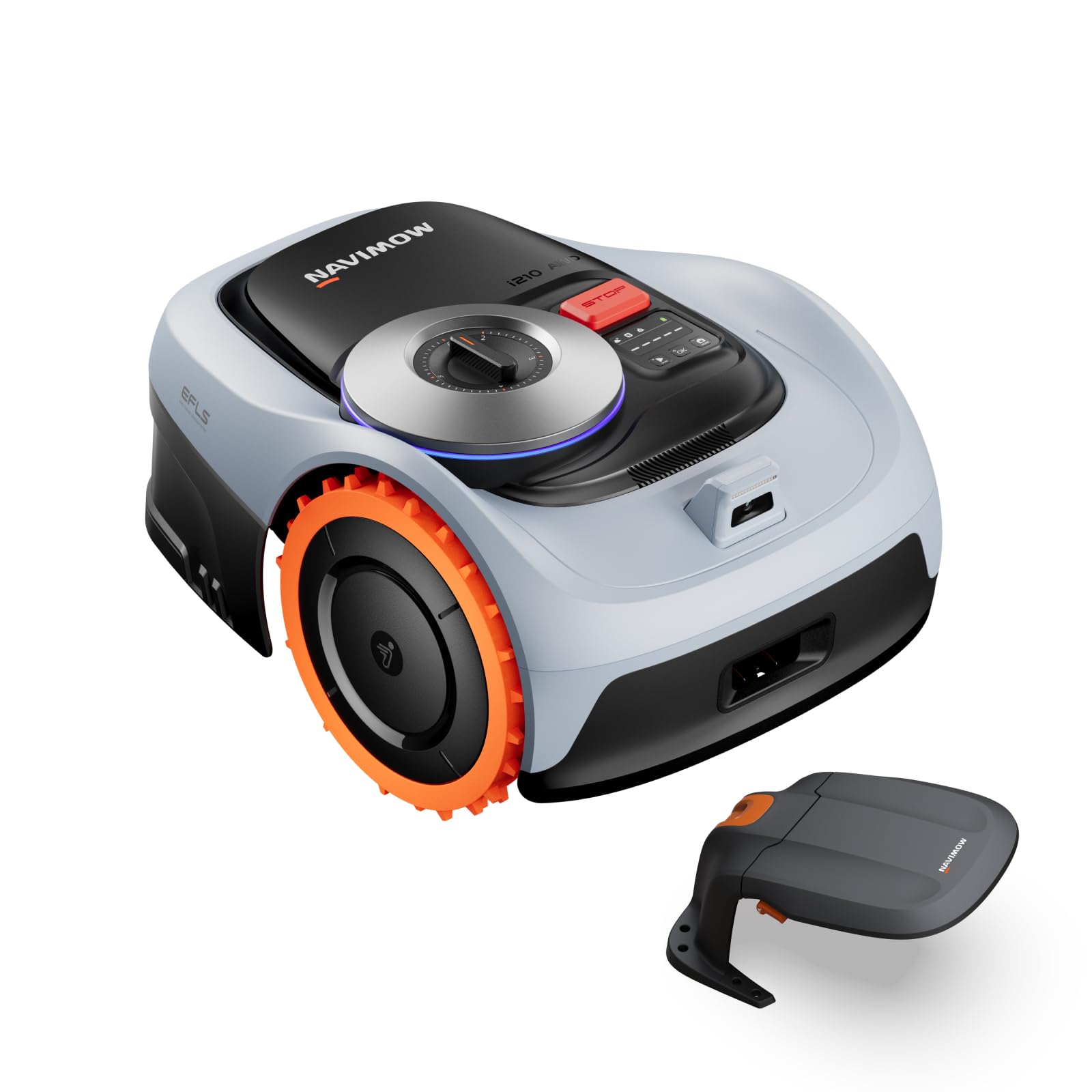
The compact AWD mower that handles 45% slopes without tearing up the grass.
The Segway Navimow i210 AWD packs all-wheel drive into a surprisingly compact 27.1-pound package. It uses automotive-grade stability control to handle 45% (24-degree) slopes, and its unique triple-wheel design enables zero-turn steering — meaning it pivots instead of scraping, so your grass stays clean. Owners confirm the AWD handles steep banks well, though one noted it struggles sideways on the steepest parts. It is rated for up to a quarter-acre and includes the Garage S (shipped separately) for weather protection.
Navigation uses EFLS NRTK (a form of Network RTK) combined with vision for wire-free auto-mapping. You can manage up to 20 zones with tune paths, and the mower auto-resumes after charging. GPS alerts notify you if the mower is lifted or leaves its designated area. On-demand drive saves battery by boosting torque only when needed, so the 5.1Ah battery covers up to 2,690 square feet per charge. One owner said it “exceeds expectations” and covers 5,300 square feet in two charges with auto-charging, and handles a 2,800-square-foot area on a single charge.
The main limitation: the battery is not enough for the full rated quarter-acre on one pass. Owners recommend splitting the lawn into smaller zones or accepting that the mower will return to charge and resume. Additionally, thick St. Augustine grass gives it trouble — one owner needed a string trimmer first to bring the grass down before the mower could handle it. The app also restricts total mapped area to the rated 0.25 acres, so if your property is larger, you cannot simply map more.
Standout Traits
- Only 27.1 pounds with AWD — an easy-to-carry mower that still climbs 45% slopes.
- Zero-turn steering avoids scraping or tearing grass during turns.
- On-demand drive system saves battery by boosting torque only when climbing.
Limitations
- Battery cannot cover the full 0.25-acre rating in one charge — expects a recharge mid-job.
- Struggles with thick St. Augustine grass; needs a trimmer to pre-cut tall growth.
- App restricts mapped area to exactly 0.25 acres — no way to exceed the rating.
Ideal for: Homeowners with a steep but relatively small lawn (under a quarter acre) who want a lightweight AWD mower that includes a garage and reliable Segway support.
Not for: Anyone with a larger yard or thick, tall grass varieties that require serious cutting power on the first pass.
8. ECOVACS Goat O1000 LiDAR PRO
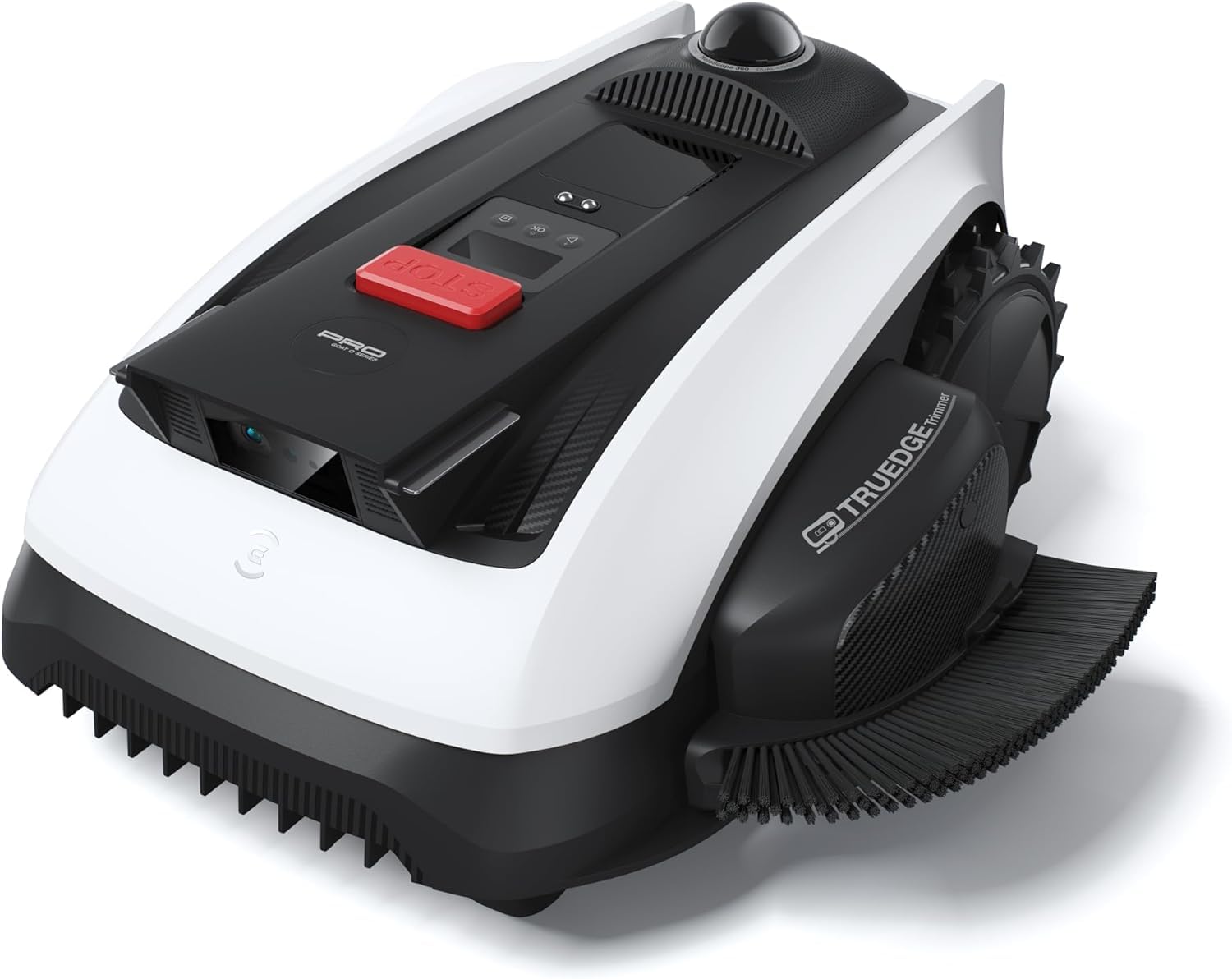
A super-narrow body that squeezes through spaces other mowers simply cannot fit.
The ECOVACS Goat O1000 is built for tight yards. Its body is slim enough to pass through narrow corridors as narrow as 0.8 meters (about 31 inches), making it perfect for side lawns, garden paths, and complex layouts where larger mowers get stuck. Like its bigger sibling, it uses HoloScope 360-degree Dual-LiDAR for wire-free mapping with 2 cm precision, and it has a built-in TruEdge trimmer that cuts along borders. AI Vision and 3D ToF LiDAR detect over 200 obstacle types with precision down to 5 cm.
Owners rave about the cut quality and the ease of a wire-free setup. One Florida reviewer called it “wonderful,” noting it is quiet, saves weekends, and rarely needs manual intervention. Another who compared it to RTK mowers found the LiDAR setup far easier to get running. The “Backtrack” mapping feature is a time-saver — you can walk the mower around your yard once to create the map, rather than drawing zones manually on a phone screen.
The built-in trimmer, while handy, has a notable limitation: it sees fences as obstacles and avoids them, so it cannot trim the grass right along a fence line. One owner called this “false advertising” and returned the mower. The maximum cutting height is also only 3.2 inches on the review unit, which is too short for tall fescue that needs 3.5 to 4.5 inches. The adjustable range is officially listed at 1.2 to 3.6 inches — fine for most grasses, but not for deep-rooted tall fescue.
Why It Wins
- Narrow body fits through 0.8-meter gaps — the best choice for tight, complex yard layouts.
- LiDAR + vision obstacle detection with 5 cm precision avoids small objects reliably.
- Easy wire-free setup with Backtrack mapping — one walkaround creates the map.
Why It Falls Short
- Built-in trimmer avoids fences, so it cannot cut grass right along fence lines.
- Max cutting height of 3.6 inches is too low for tall fescue lawns that need higher cuts.
- One owner found the app’s manual mapping joystick nearly impossible to control.
Grab this for: A compact yard with narrow passages and clear borders — the LiDAR navigation is the easiest wire-free setup we have tested, and the quiet operation is a bonus.
Avoid if: You need to trim right up to a fence line, or you grow tall fescue that needs a cutting height above 3.6 inches.
9. Mammotion LUBA 3 AWD 1500H
Half the price of its big brother, nearly all the same AWD brain.
The Mammotion LUBA 3 AWD 1500H is essentially the slightly smaller sibling of the 3000H — you get the same 360-degree LiDAR navigation with a 230-foot range and dual-camera AI vision, the same four independent motors that climb 80% slopes, and the same adaptive suspension that steps over 50 mm curbs. The main difference is the rated lawn size: 0.37 acres versus 0.75 acres. It covers 15 mowing zones with zigzag, checkerboard, or adaptive zigzag patterns.
The cutting width is listed as 400 mm (roughly 15.75 inches), and the cutting height adjusts from 2.2 to 4.0 inches. The battery lasts a generous 175 minutes per charge. The AI chip processes 10 trillion operations per second to detect over 300 obstacle types in real time. One owner switching from a Segway said the LUBA 3 delivers a better cut and is smaller, with superior LiDAR navigation — a strong endorsement from someone who owned both brands.
Because this is a new product (zero customer reviews yet on Amazon at the time of writing), there is no real-world feedback to confirm the claimed battery life or obstacle avoidance. The lack of verified reviews is the biggest risk — you are buying on specs alone. The 26-position cutting height adjustment is the most granular of any mower here, so you can fine-tune the grass length precisely.
Value Highlights
- Same 360° LiDAR and AI vision as the 3000H for a significantly lower cost.
- 175-minute runtime covers a 0.37-acre yard on a single charge.
- 26-position cutting height gives class-leading precision in grass length.
Unknown Risks
- Zero customer reviews at launch — you are trusting the spec sheet and brand reputation.
- At 27.2″ x 21″ x 11″, it is still a large mower that needs proper storage.
- Cutting width listed in millimeters — the manual mower depth is unclear without specs.
Best for: Shoppers who want the LUBA 3’s top-tier navigation and AWD for a smaller yard, at a more approachable price point.
Wait if: You prefer buying after other owners have validated the real-world performance — check back in a few months for reviews.
10. YARDCARE 2026 New M800Plus
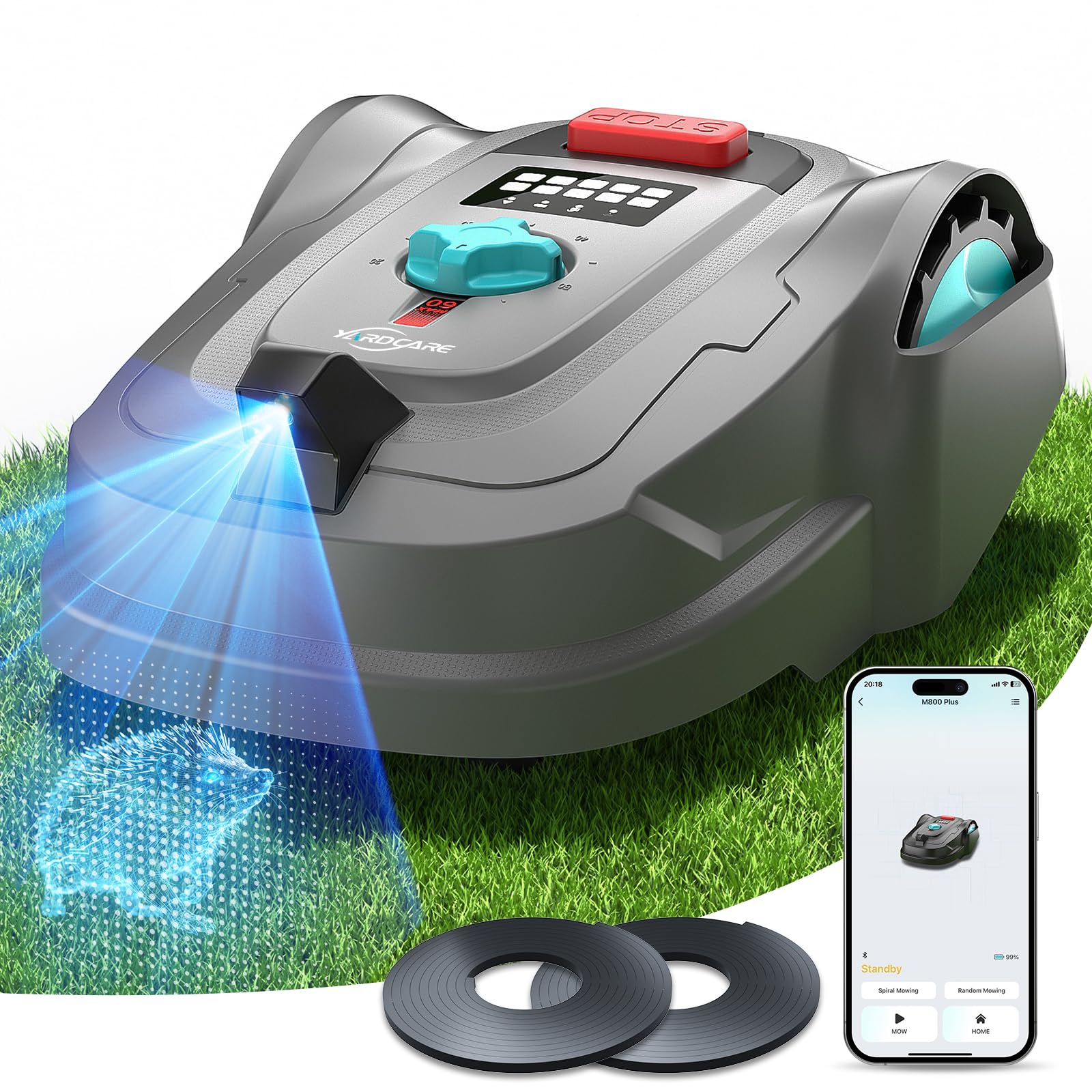
The entry-level AI mower that proves you do not need to spend a fortune.
The YARDCARE M800Plus is the most affordable AI lawn mower on this list, but it still packs GPS plus 3D vision navigation — no perimeter wire needed. It uses a camera-based system to identify grass versus non-grass areas, then follows the visual boundaries of your lawn. A 32-foot magnetic strip lets you create no-go zones without any digging or wiring. The cutting height adjusts from 0.8 to 2.4 inches, and the 7-inch cutting width is paired with a three-blade disc. One buyer reports it “saves 3 hours/week on a 0.5-acre yard” — a real-world time-saving claim that repeats across multiple reviews.
At just 18 pounds, this is the lightest mower here by a wide margin — at 18 pounds versus the ANTHBOT Genie 3000’s 46 pounds. It handles slopes up to 35% (20 degrees), which covers most residential lawns. The Spiral Spot Mowing mode concentrates on thick or fast-growing patches, and the app lets you adjust schedules, patterns, and firmware. Quiet operation under 60 dB means early-morning mowing will not annoy the neighbors.
The biggest catch is the cutting deck — at 7 inches, it is noticeably narrower than the 8.7-inch WORX WR320 or the 8-inch MOVA. That means more passes to cover the same area. Also, the YARDCARE has a lower maximum cutting height (2.4 inches versus 3.54 inches on the WORX), so if you like longer grass, this mower cannot deliver it. The manufacturer recommends manual trimming for grass above 2.6 inches before the first use, and routine blade replacement is essential for consistent cuts.
Budget-Friendly Wins
- Only 18 pounds — easy to carry and move between lawn sections.
- GPS plus 3D vision with a magnetic strip for no-go zones, no wire burial.
- Quiet under 60 dB, with spiral spot-mowing for thick patches.
Limitations at This Price
- Narrow 7-inch cutting width means more passes to cover the lawn.
- Max cutting height of 2.4 inches — not suitable for lawns kept above 3 inches.
- Magnetic strip no-go zones are functional but less flexible than app-based zones on pricier models.
Who should pick this: The budget-conscious buyer with a small to medium flat lawn who wants wire-free AI mowing and is okay with a slightly narrower cut and shorter grass height.
Look elsewhere if: You need a wide cutting deck, a tall cutting height for fescue, or advanced multi-zone management with dozens of zones.
11. ANTHBOT Genie 3000 (Robot Lawn Mower NO Wire)
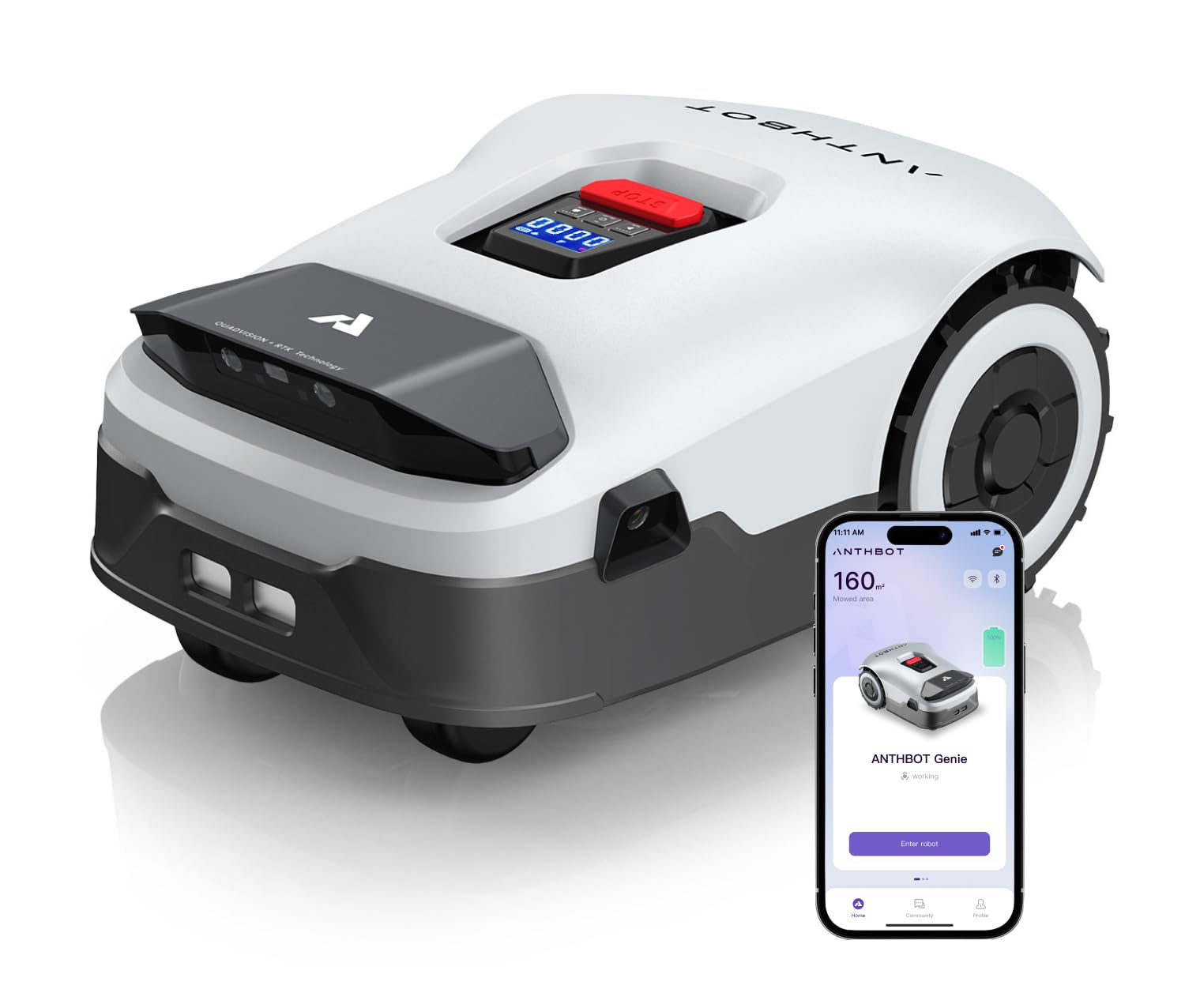
The RTK-vision hybrid built for extreme terrain and spotty GPS conditions.
The ANTHBOT Genie 3000 is built for the hard stuff. It uses Full Band RTK plus a 4-eye, human-like 3D vision positioning system — a dual setup that keeps mowing precisely even under dense trees, near eaves, or in areas with weak GPS signals. At 46 pounds with a 25 x 11 x 16-inch frame, it is the heaviest mower here alongside the WORX WR320. The 7.9-inch cutting width and 5-position cutting height (1.18 to 2.76 inches) give it a sturdy feel. One owner who has a steep, uneven, large lawn with spotty GPS reported it “works well on most of the lawn, cuts neat stripes, and handles obstacles like a rake.” They did note it gets stuck on the steepest slopes.
The AI-powered 300-degree field-of-view camera detects over 1,000 types of objects — a larger library than most competitors — and adaptively follows edges for clean borders. You can manage 30+ zones with custom settings and define no-go areas around pools or flower beds. After 5 weeks, another owner was impressed: the mower keeps the lawn “perfect, short, and golf-course-like” with a setup time of about one hour. The app allows remote start, and firmware updates have improved edge mowing over time.
The biggest concern is long-term reliability: one 1-star review describes a mower that after about a year gets stuck repeatedly, fails to charge, and throws random “suspended” errors. The same owner also mentions a new subscription fee for the app, which was not originally required. The cutting height range is also quite shallow — it cannot cut below 1.18 inches or above 2.76 inches, which limits its flexibility for different grass types and seasons.
Why It Excels
- RTK + 4-eye vision maintains precision under trees and near buildings where GPS is weak.
- Detects over 1,000 object types — the largest obstacle library of any mower here.
- 30+ multi-zone management for complex yards with diverse areas.
Concerns
- Reports of reliability issues after one year — stuck errors, charging failures, and a new subscription fee.
- Narrow cutting height range (1.18 to 2.76 inches) limits seasonal flexibility.
- At 46 pounds and a large footprint, it is a heavy machine to move if needed.
Reach for this if: Your yard has challenging GPS conditions (heavy tree cover, narrow gaps between buildings) and you want the most comprehensive object detection available — the 1,000+ object library is class-leading.
Be cautious if: You want long-term reliability from a less established brand, or you need a wider cutting height range for warm and cool season grasses.
12. eufy Robot Lawn Mower E15
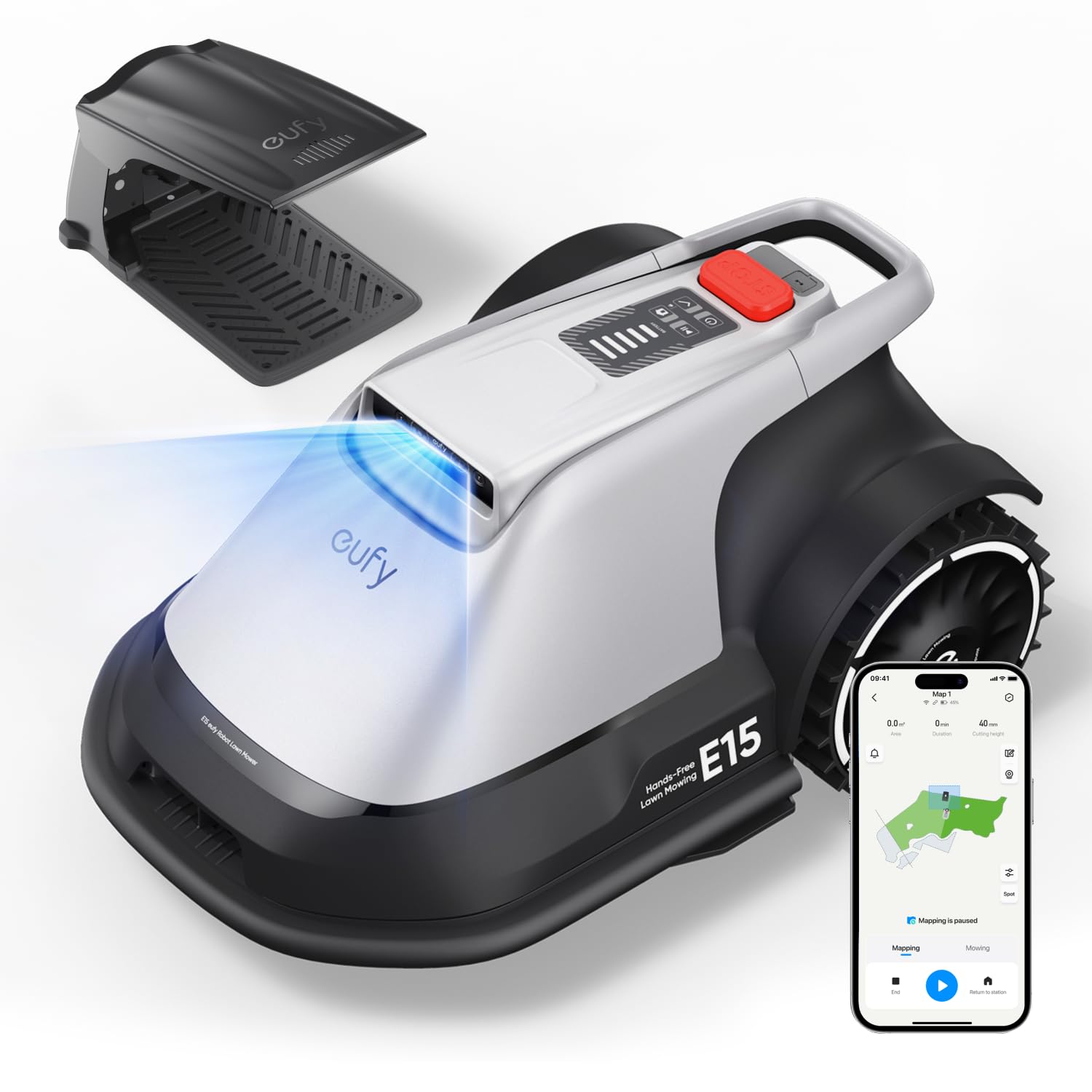
The pure-vision mower that works without a wire OR a GPS antenna.
The eufy E15 uses Pure Vision navigation — high-precision stereo cameras and AI called V-FSD 1.0 — so it maps, navigates, and mows entirely on its own without any boundary wire, RTK station, or GPS antenna. It is designed for lawns up to 0.2 acres (roughly 8,700 square feet) with slopes under 18 degrees. Owners love the quiet operation and simple setup. One owner reported it “replaces lawn service” and mows 840 square feet in about 1.5 hours, then recharges in 1.5 hours. The app even has a camera joystick for manual driving.
The E15’s 3D perception system uses stereo cameras and Vision SLAM to detect both low obstacles (rocks, toys) and tall obstacles (trees, pool borders). Ride-on Edge technology cuts right to boundaries for a clean look. Built-in GPS anti-theft tracking keeps the mower secure, and automatic recall kicks in during rain or low light. The cutting height adjusts from 1 to 3 inches with 5 positions, and the 8-inch cutting width is reasonable for its class. Multiple owners confirm the stripes look neat and the optical sensors avoid obstacles effectively.
There are clear limitations: it only mows in daylight (no camera-based night mowing), it creates only one map (no multi-level lawn support), and it is not suitable for St. Augustine grass or dense Zoysia. One owner whose lawn is sandy and patchy found the mapping “an absolute pain” — the mower got stuck in soft sand and lost position tracking. If your lawn is not lush and well-defined, the vision system struggles. Also, the 1.5-hour runtime for an 840-square-foot area means it is not a speed demon.
Where It Shines
- True wire-free, antenna-free, RTK-free setup — just place the base, open the app, and go.
- GPS anti-theft tracking adds security that many budget mowers lack.
- Quiet operation and dog-friendly — reviewers point out their pets ignore it completely.
Where It Struggles
- Only works in daylight — no night mowing since it relies on cameras.
- Mapping fails on sandy, patchy, or non-lush lawns — needs clear visual boundaries.
- Not suitable for St. Augustine grass or dense Zoysia, per the manufacturer.
Best for: A small, flat, fenced yard with clear grass borders — the E15 is incredibly simple to set up and maintain, and it is quiet enough to run during a backyard dinner.
pass on it if: Your lawn has sandy patches, poor grass coverage, St. Augustine or dense Zoysia grass, or if you need to mow at night.
Understanding the Specs
Navigation: RTK, LiDAR, and Vision
These three words describe how the mower sees and moves around your lawn. RTK (Real-Time Kinematic) uses a satellite signal with an antenna for centimeter-level GPS accuracy; it is great in open areas but can lose signal under thick trees. LiDAR (Light Detection and Ranging) uses spinning laser beams to build a 3D map of your yard — it works in the dark and under tree cover but costs more. Vision uses cameras and AI to “see” the lawn like a human does; it needs good daylight and clear borders like a fence or curb. Many premium mowers combine two or three of these for redundancy so one sensor’s weakness is covered by another.
Slope Rating and All-Wheel Drive
The slope rating tells you the steepest incline a mower can handle without losing traction or tipping. It is usually given as a percentage (like 45%) or in degrees (like 24°). A 45% slope is roughly a 24-degree angle — steep enough that many standard mowers slip. If your yard has any significant hill, look for a mower with All-Wheel Drive (AWD) or 4WD. These models use independently powered wheels to climb without sliding. For flat lawns under 15% slope, a 2WD mower is perfectly fine and costs less.
FAQ
Do I still need to bury a perimeter wire with an AI lawn mower?
How does an AI lawn mower handle rain and wet grass?
What happens if the mower encounters a child’s toy, a garden hose, or a pet?
Will an AI lawn mower work on a steep slope?
How long does the battery last, and how long does it take to recharge?
Can an AI lawn mower handle multiple separate zones in my yard?
What is the difference between a vision-only mower and a LiDAR mower?
How do I set up a no-go zone for a flower bed or a pool?
Does an AI lawn mower work with Alexa or Google Home?
What maintenance does an AI lawn mower need?
Final Thoughts: The Verdict
For the majority of shoppers, the ai lawn mower winner is the DREAME A3 AWD Pro because it combines 4WD for steep slopes, wide 15.75-inch dual-disc cutting for speed, and a LiDAR-vision hybrid navigation that never loses signal under trees. If you have a massive yard over an acre, the Segway Navimow X450 is a fast, tank-like machine with a 17-inch cutting deck and the steepest slope rating. And for a smaller, flat lawn, the eufy E15 offers the simplest wire-and-antenna-free setup at a mid-range price — just place the base and go.
How We Picked
We do not accept paid placement. Every pick is matched to a real buyer and a real use-case; we do not hands-on test units.
Sources & Methodology
Specifications: manufacturer listings and product documentation. Review insights: verified customer reviews, as of July 2026. Pricing: not shown on this page (it changes often); check the current price via the retailer link.
As an Amazon Associate, Gadgets Feed earns from qualifying purchases. This does not affect which products we feature.
Related Guides
Product prices and availability are accurate as of the date/time indicated and are subject to change. Any price and availability information displayed on Amazon at the time of purchase will apply to the purchase of this product. As an Amazon Associate I earn from qualifying purchases.
CERTAIN CONTENT THAT APPEARS ON THIS SITE COMES FROM AMAZON. THIS CONTENT IS PROVIDED "AS IS" AND IS SUBJECT TO CHANGE OR REMOVAL AT ANY TIME.
Amazon and the Amazon logo are trademarks of Amazon.com, Inc. or its affiliates.