
Our readers keep the lights on and my morning glass full of iced black tea. As an Amazon Associate, I earn from qualifying purchases.
Specs are compiled from manufacturer listings and verified buyer reviews and can change over time — please confirm the key details on the product page before buying.
Your rope’s life and your safety hinge on small gear choices. A chest ascender that bites too hard can chew up your rope’s outer jacket (the protective woven sheath). A foot ascender that glides smoothly might slip at the wrong moment if its cam (the moving part that grips the rope) is toothless and the rope is wet. And a progress-capture pulley (a pulley that lets rope pass one way but locks if you let go) that handles heavy loads can feel like a brick on your harness. The trick is balancing grip, weight, and rope diameter compatibility (8 mm to 13 mm) for your climbing style. This guide matches published specs with buyer reports to highlight four top-performing pieces.
I’m Min — the founder and writer behind Gadgets Feed. This guide is built by comparing the manufacturers’ published specifications and the patterns across verified customer reviews, so you get each pick’s real strengths and trade-offs instead of marketing spin.
These four picks represent the smartest options for aid climbing equipment right now, each suited to a different role on the rope, whether you are building a basic rope-walking system or upgrading an existing kit.
Quick Picks
- Notch Rope Runner Vertec — Canopy Commander
- PETZL Pro Traxion — Haul System Hero
- PETZL Croll Ventral Chest Ascender — Rope-Walking Anchor
- Notch Jet Step Foot Ascender — Rope-Safe Step
How To Choose The Best Aid Climbing Equipment
Choosing aid climbing equipment requires matching gear to rope diameter, climbing style (SRT vs DRT), and desired weight or durability. Lock in these three factors before buying.
Rope Diameter Compatibility
Every ascender, pulley, and rope-runner has a published rope-diameter range that tells you what rope thickness it can grip. For example, the PETZL Croll handles ropes from 8 mm to 13 mm, while the Notch Rope Runner Vertec only accepts 11 mm to 12.9 mm. Pushing a fat rope through a narrow cam can cause binding. Using a thin line in a wide-channel device means you lose grip. Measure your rope with calipers (a tool that measures thickness precisely) and check the spec sheet before you click buy.
Single Rope vs. Double Rope Technique
Not all devices work well with both SRT (single rope technique — climbing on one line) and DRT (double rope technique — climbing on two parallel lines). The Notch Rope Runner Vertec, according to buyers, excels at SRT but requires a paw plate (a small metal part that prevents accidental release) in DRT. Chest ascenders like the PETZL Croll are designed for the upright posture of rope walking on a single line. Pick the technique you climb most and choose gear that fits it naturally.
Cam Type and Rope Wear
Toothed cams bite hard and self-clean in mud and ice — useful for dirty or frozen ropes where you need aggressive grip. Toothless cams, like the dual cam design on the Notch Jet Step, eliminate virtually all rope wear and reduce drag (resistance as the rope slides through). The trade-off is that toothless ascenders need a clean, dry rope to grip reliably. If you climb in wet or gritty conditions, a toothed cam is safer. If you want your rope to last many seasons, go toothless.
Quick Comparison
On smaller screens, swipe sideways to see the full table.
| Model | Best For | Weight | Rope Diameter | Cam Type | Amazon |
|---|---|---|---|---|---|
| Notch Rope Runner Vertec | SRS / canopy work | 1.7 lbs | 11–12.9 mm | Friction-plate | $514.99Amazon |
| PETZL Pro Traxion | Progress-capture hauling | 265 g | 8–13 mm | Cam (self-cleaning) | $298.09Amazon |
| Notch Jet Step | Foot ascender, minimal rope wear | 0.43 lbs | 8–13 mm | Toothless dual cam | $89.99Amazon |
| PETZL Croll | Chest ascender, rope walking | — | 8–13 mm (L version) | Toothed (self-cleaning) | $89.77$109.95Amazon |
In‑Depth Reviews
1. Notch Rope Runner Vertec

The tree-dweller’s upgrade that merges friction finesse with tool-free speed.
This is the only pick here that lets you adjust friction on the fly without tools, so you can fine-tune how much resistance the rope feels without stopping to dig for a screwdriver. The Notch Rope Runner Vertec has seven different friction settings you dial through for instant rope feel. It is also midline attachable without needing separate splices or slic pins — you set it up mid-rope without pulling the whole thing through, saving time in the canopy.
The Vertec weighs 1.7 pounds, while the Notch Jet Step foot ascender weighs 0.43 pounds, and it accepts ropes from 11 mm to 12.9 mm in diameter. It is CE certified (meets European safety standards) under EU Regulation 2016/425, with a WLL (working load limit — the maximum safe load under normal use) of 130 kg. The integrated tending point (a clip point for your chest harness) clips directly to a chest harness and is compatible with the Notch Magneato. Buyers report that a one-handed climber finds this device excellent for SRT (single rope technique), and that it also works well on 11.8 mm Drenaline rope. In DRT (double rope technique), reviewers suggest using a paw plate to prevent accidental release.
The catch is the narrow rope window: 11 mm to 12.9 mm only, so thinner lines are out. At 1.7 pounds, it is noticeably heavier than the PETZL Croll chest ascender, so it feels more at home on a long canopy day than on a fast alpine pitch.
Feather-Touch Control
- Tool-free friction dial offers seven settings for instant rope feel adjustment.
- Midline attachable — no need to cut or rethread the rope.
- SRT performance is excellent, especially for one-handed climbers.
Two Real Limits
- Accepts only 11–12.9 mm ropes — not compatible with skinny lines.
- At 1.7 lbs versus the Jet Step foot ascender at 0.43 lbs, it adds harness weight.
Reach for this if: you climb SRT (single rope technique) in the canopy and want instant friction control without tools.
Look elsewhere if: your ropes are under 11 mm, or you want a single ultralight device for alpine speed.
2. PETZL Pro Traxion

The progress-capture pulley that turns a heavy haul into one-handed work.
This piece converts a simple pull into a mechanical advantage system (gearing that multiplies your pulling strength) and locks the rope if you let go. The PETZL Pro Traxion is a progress-capture pulley — a pulley with a cam that lets rope pass one way but prevents it from slipping backward — weighing only 265 grams, about the same as a big apple. It works on ropes from 8 mm to 13 mm in diameter, which covers almost everything aid climbers and riggers use, unlike the Vertec’s 11–12.9 mm window.
It is built from aluminum, stainless steel, and polyamide (a strong, lightweight plastic), and carries CE EN 567 certification (a European standard that confirms strength and rope compatibility). One buyer at 140 pounds reported excellent performance under moderate loads and attached a micro pulley (a tiny pulley) to create a smooth 5:1 haul system (a setup that multiplies your pull by five). Another reviewer uses it to pull 2-ton chains on stadium rigs, which says a lot about the real-world durability. The self-cleaning cam (a cam with a slot that clears mud and ice) handles muddy or frozen lines without losing bite.
The trade-off: premium pricing excludes budget buyers. You buy it for the cert, the corrosion-resistant build, and the decades of field testing behind the PETZL brand.
Pull-Weight Power
- 265 g weight makes it light enough to carry on any harness.
- CE EN 567 certified for strength and rope compatibility.
- Works with 8 mm to 13 mm ropes — the widest diameter range here.
One Honest Catch
- Premium pricing puts it out of reach for budget-first buyers.
- Single-pulley design means you still need additional pulleys for complex mechanical-advantage systems.
Best for: the climber or rigger who needs a certified, lightweight progress-capture pulley that handles heavy loads on a wide range of rope diameters.
skip it if: you only climb with skinny ropes under 8 mm or you need an all-in-one device for ascent, not hauling.
3. PETZL Croll Ventral Chest Ascender
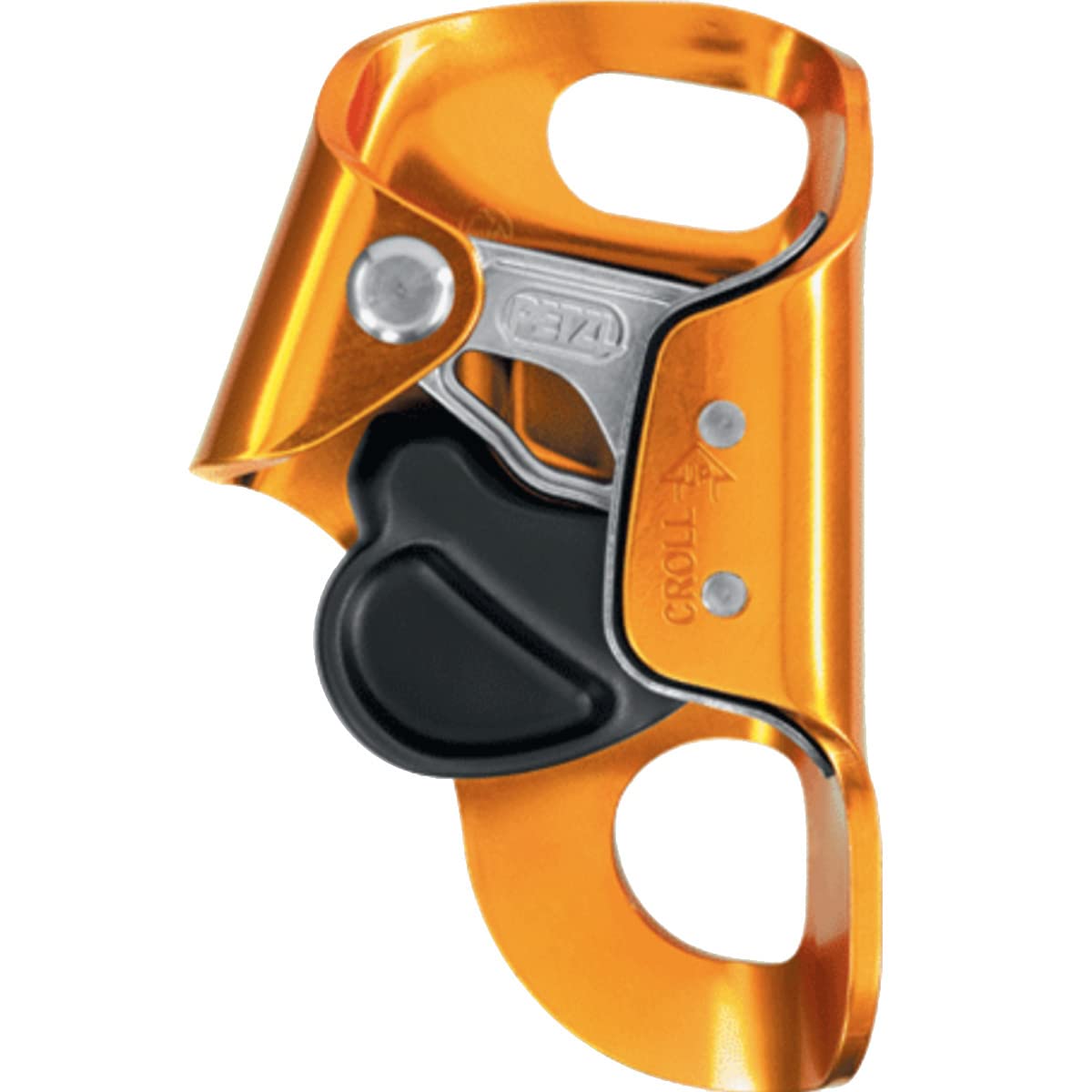
The chest ascender that keeps your body upright while you glide up the rope.
If you are building a rope-walking system (a technique where you use a chest ascender and foot ascender together to climb smoothly), this is the anchor point that keeps your torso upright as you ascend. The PETZL Croll is a ventral chest ascender — it sits on your chest harness — and the large version (CROLL L) has a wider rope groove that cuts friction, making it especially good for thick, swollen, or stiff ropes from 8 mm to 13 mm. Compared with the Notch Rope Runner Vertec at 11–12.9 mm, that means you can switch between thinner and thicker lines without swapping ascenders. The toothed cam includes a self-cleaning slot, so frozen or muddy lines do not kill your grip.
The ergonomic safety catch is integrated into the body — nothing juts out to snag on gear or branches. Owners mention that it is “easy to use with chest/waist harness” and that it “grips 8mm rope very well.” One climber rigged it into a knee ascension system for rope walking, reporting that it “advances beautifully on rope.”
The trade-off is that a chest ascender is a one-trick piece — it ascends. It does not offer friction settings like the Vertec, and it is not a progress-capture pulley. But for its specific job, it remains the benchmark.
Upright Advantage
- Benchmark chest ascender for rope walking — keeps body upright for smooth gliding.
- Wide rope channel handles 8–13 mm ropes, including swollen or stiff lines.
- Self-cleaning toothed cam grips well on frozen or muddy ropes.
The Price of Focus
- Single-function ascender — no friction adjust or progress-capture.
- Some buyers wish the thumb release lever were bigger for gloved use.
Perfect for: the rope-walker who wants a reliable chest ascender that handles varied rope diameters and dirty conditions.
Not for you if: you need an all-in-one device that can also act as a pulley or rope-runner.
4. Notch Jet Step Foot Ascender

The foot ascender that climbs without tearing up your climbing line.
This is the toothless wonder. The Notch Jet Step uses a unique dual-cam design with toothless cams that eliminate virtually all rope wear. Buyers confirm this: they report this “gear-type ascender doesn’t damage rope” and call it “easier on rope since it’s not a tooth device.” At 0.43 pounds versus the Notch Rope Runner Vertec at 1.7 pounds, it is the lightest piece in this lineup. You barely know it is there on your harness until you step onto the rope. It grips on dry lines smoothly and pops on and off with zero fuss.
The cams have less spring tension than a traditional toothed ascender, which means reduced drag as the rope moves through. The rope diameter range is 8 mm to 13 mm, so it pairs naturally with the PETZL Croll or the Pro Traxion. It is ambidextrous (works on either foot) — use it on either foot — and made in the USA with a lifetime warranty against defects. The one hiccup multiple buyers mention: the strap buckles are awkward to adjust and may require two hands, especially when you are on rope. One reviewer recommends tightening the lower strap first, then cranking down on the upper strap for a secure fit.
On wet, frozen, or muddy ropes, a toothless cam may grip less reliably than a toothed one. But on dry lines, this foot ascender slides smoothly.
Rope-Saving Gear
- Toothless dual cam eliminates rope wear — highly durable for frequent use.
- Weighs 0.43 lbs, the lightest foot ascender here.
- Ambidextrous design works on either foot, with easy rope entry and removal.
Two Annoyances
- Strap buckles are hard to adjust with one hand; may need two hands.
- Toothless cam grip is weaker on wet, frozen, or muddy ropes compared to toothed ascenders.
Reach for this if: you want to protect your rope from wear and prefer an ultralight, ambidextrous foot ascender for dry-condition climbing.
Look elsewhere if: you frequently climb on wet, frozen, or gritty lines where a toothed cam provides better bite.
Understanding the Specs
Rope Diameter Compatibility
This is the single spec that determines whether a piece of gear works with your rope. Measured in millimeters, it tells you the range of rope thickness the device can grip and release reliably. The PETZL Croll and Pro Traxion accept 8–13 mm, giving you flexible rope choices. The Notch Rope Runner Vertec accepts only 11–12.9 mm, so thinner lines are out. Using a rope outside the published diameter range risks slippage or binding at the wrong moment.
Cam Type / Friction Mechanism
The cam is the moving part that bites the rope to grip it. A toothed cam uses sharp teeth to dig into the rope jacket — great for frozen or muddy lines, but it wears the rope faster. A toothless (gear-type) cam uses friction without teeth, so it is gentle on the rope but needs a clean, dry surface to work well. A friction-plate device like the Notch Rope Runner Vertec uses a series of friction channels instead of a cam, offering multiple adjustment settings for a custom feel.
FAQ
Can I use a chest ascender like the PETZL Croll with any rope diameter?
Does the Notch Jet Step damage rope over time?
What does CE EN 567 mean on the PETZL Pro Traxion?
Can the Notch Rope Runner Vertec be used for DRT climbing?
How does the weight of the Notch Rope Runner Vertec compare to the Jet Step?
Is the PETZL Pro Traxion worth the premium price for occasional use?
Can the Notch Jet Step be used on either foot?
What rope diameter does the Notch Rope Runner Vertec require?
Final Thoughts: The Verdict
For the majority of shoppers, the aid climbing equipment winner is the Notch Rope Runner Vertec because it combines tool-free friction adjustment, midline attachability, and excellent SRT performance into one device. If you want a lightweight, certified progress-capture pulley for hauling, grab the PETZL Pro Traxion. And for building a rope-walking system around a benchmark chest ascender, the PETZL Croll remains the go-to choice.
How We Picked
We do not accept paid placement, and we did not hands-on test every unit. Instead, we match each pick to a real buyer and use-case by comparing the manufacturers’ published specifications against the patterns in verified customer reviews — so you get each pick’s real strengths and trade-offs instead of marketing copy.
Sources & Methodology
Specifications: manufacturer listings and product documentation. Review insights: verified customer reviews, as of July 2026. Pricing: not shown on this page (it changes often); check the current price via the retailer link.
As an Amazon Associate, Gadgets Feed earns from qualifying purchases. This does not affect which products we feature.
Product prices and availability are accurate as of the date/time indicated and are subject to change. Any price and availability information displayed on Amazon at the time of purchase will apply to the purchase of this product. As an Amazon Associate I earn from qualifying purchases.
CERTAIN CONTENT THAT APPEARS ON THIS SITE COMES FROM AMAZON. THIS CONTENT IS PROVIDED "AS IS" AND IS SUBJECT TO CHANGE OR REMOVAL AT ANY TIME.
Amazon and the Amazon logo are trademarks of Amazon.com, Inc. or its affiliates.