
Our readers keep the lights on and my morning glass full of iced black tea. As an Amazon Associate, I earn from qualifying purchases.
Specs are compiled from manufacturer listings and verified buyer reviews and can change over time — please confirm the key details on the product page before buying.
If you are staring at a wall of antenna boxes, the first thing to know is this: the “mile range” printed on the box is the marketing number, not a promise. Real reception depends on your distance to broadcast towers, the terrain between you and them, and whether you pick an indoor, outdoor, or attic model. This guide cuts through those claims to show you which antennas actually pull in clear, free channels for the long haul.
I’m Min — the founder and writer behind Gadgets Feed. This guide is built by comparing the manufacturers’ published specifications and the patterns across verified customer reviews, so you get each pick’s real strengths and trade-offs instead of marketing spin.
Your TV antenna choice depends on where you live and how far you are from broadcast towers. A design that works in a dense city may fail in a fringe rural area, so match the antenna to your signal reality rather than the biggest claim on the box.
Our Picks at a Glance


How To Choose The Best Air Antennas For TV
Before you buy, pull up a transmitter locator map for your address. Your distance to the towers and the obstacles in between — trees, hills, even your roof material — matter more than any spec on the box. The right antenna for you is the one whose design matches where the towers are relative to your home.
Directional vs. Multi-Directional vs. 360°
If all your local towers sit in one area, a directional yagi antenna focuses all its power one way, giving you the longest reach. If your towers are scattered around you, a multi-directional or 360° omni-directional design pulls from all directions at once — but it trades raw gain for that flexibility. This single choice drives most of the difference between the picks below.
Amplified vs. Passive Design
An internal amplifier (a preamplifier) boosts the signal right at the antenna, which helps overcome long cable runs and splitting to multiple TVs. However, if you live close to the towers, too much amplification can overload the tuner and actually wipe out channels. Look for antennas with smart gain control that adjust amplification automatically when the signal fluctuates, so you avoid both weak reception and overload.
VHF and UHF Coverage
Broadcast TV uses two frequency bands. UHF covers most channels, but many local stations (especially CBS and NBC) broadcast on High VHF. If you need those, your antenna must explicitly handle both bands — some cheap indoor models are UHF-only and will silently leave out your most important local news.
Quick Comparison
| Model | Best For | Max Range | Channels | Design | Amazon |
|---|---|---|---|---|---|
| Televes DAT BOSS Mix LR★ Best Overall | Fringe rural reception | 100 miles | 29 | Directional Yagi | Amazon |
| intelbras Indoor AntennaBudget Champion | Renters & apartments | — | — | Indoor Flat | Amazon |
| McDuory YagiBudget Outdoor | Budget outdoor installs | 70+ miles | 2 | Yagi | Amazon |
| GE Outdoor Yagi | 4K/ATSC 3.0 readiness | 80 miles | 200 | Yagi | Amazon |
| PIBIDI Outdoor | Long cable runs | 200 miles | 100 | Yagi | Amazon |
| 1byone Omni-Directional | No-rotation setups | 100 miles | 2 | 360° Omni | Amazon |
| Five Star Outdoor | Multi-TV households | 200 miles | 100 | Yagi | Amazon |
| ClearStream 2V | Suburban multi-direction | 60+ miles | 8 | Bow-tie | Amazon |
| ClearStream 4V | Heavy tree cover | 70+ miles | — | Bow-tie | Amazon |
In‑Depth Reviews
1. Televes DAT BOSS Mix LR 149884 HDTV Antenna
Our pick — over 4.5★ from 450+ verified ratings; the strongest balance of quality and price.
The premium brute-force answer for rural homes where other antennas give up.
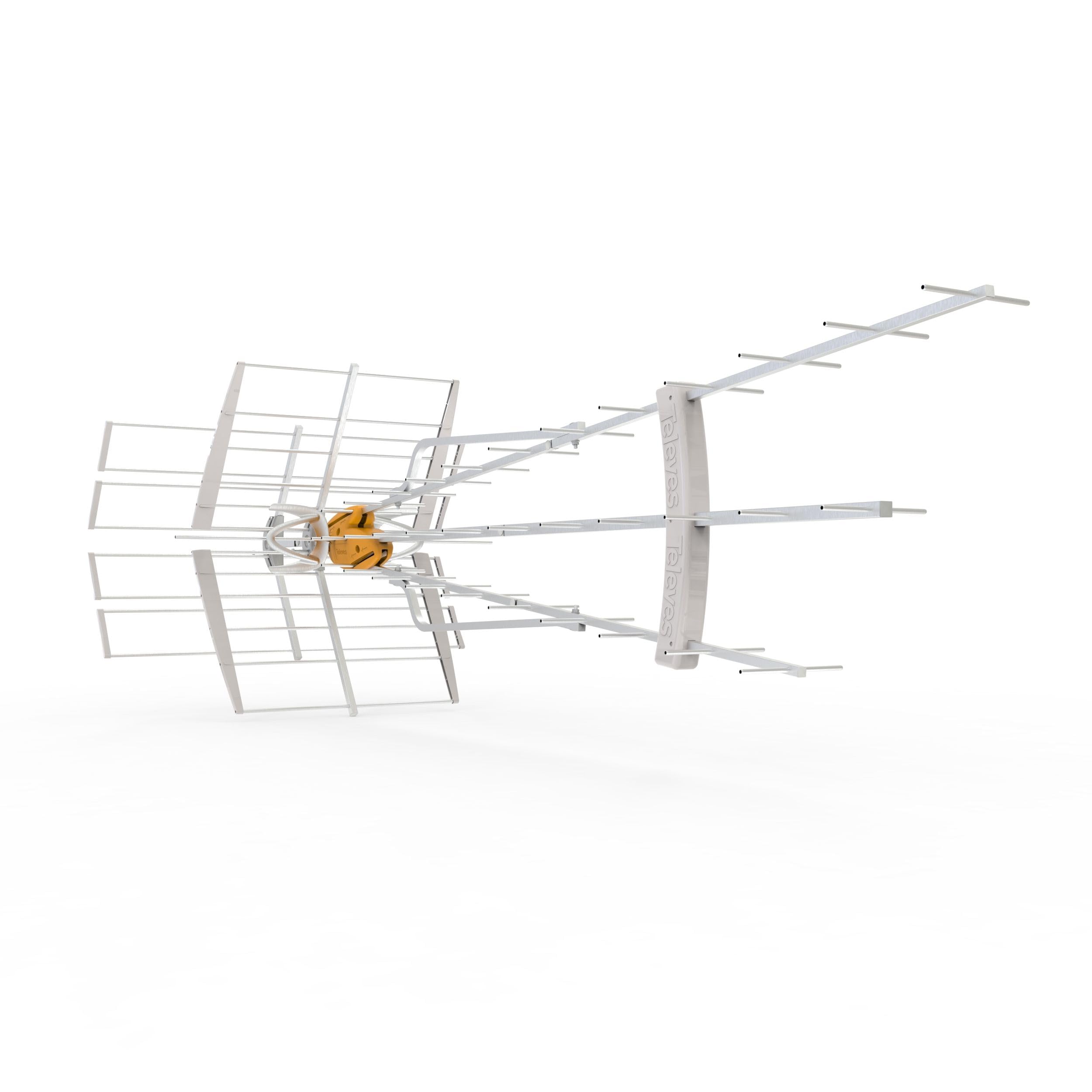
Buy this antenna when weak distant signals are your main problem. Its built-in TForce preamplifier (a signal booster that adjusts itself) automatically tunes gain in two bands — 38 dBi on High VHF and 46 dBi on UHF — so output stays stable even when signal conditions change, preventing both weak reception and overload. The directional stacked triple-boom design focuses power toward the towers, with front-to-back ratios of 12 dB on High VHF and 25 dB on UHF that strip away multipath interference (signal reflections that cause ghosting).
This antenna is built for the edge of the map. The spec sheet rates it up to 100 miles from transmitters, and owner stories back that up: buyers report “Between 50 and 80 miles great reception,” with one install 60 feet up between trees pulling in strong signals at that span, and another grabbing local plus Tucson channels around 100 miles out. The built-in filtering for FM, LTE, 4G, and 5G means nearby cell towers and radio sources won’t muddy your picture.
The honest trade-off is the size and the assembly. Its massive frame — 84.13″L x 33.98″W x 28.94″H — makes the compact picks below look like toys; it is more than 30 times the length of the little indoor intelbras unit, so it needs serious mounting space. Assembly earns genuinely mixed feedback; some call it easy, others call it a headache, and one owner had to fix a coax issue before landing on 26 stations. It also carries a premium price tag that only makes sense if you actually need that fringe performance.
long-range signal hunter
- Build quality is the most-praised trait, with 130 owners singling it out
- Channel count is second at 99 mentions — owners mention first scans of 80 channels, then 114 on a rescan
- Handles rural and mountain-range conditions that defeat cheaper antennas
bulky roof mount
- Assembly feedback is mixed — a motivated person finishes in 45 minutes to an hour, but it takes patience
- Its huge frame demands a sturdy mast (it fits masts 0.78″ to 2.4″ wide)
- Premium investment best reserved for true fringe locations
long-range reach: you live in rural or hilly terrain, want the most powerful directional reception, and are willing to invest in a serious install.
tight spaces: you want a quick plug-in-and-go setup or your towers are all within 30 miles, where simpler antennas do the job for less.
2. intelbras Digital TV Antenna for Local Channels
A tiny paper-sized panel that proves indoor antennas still deserve a shot.
Do not judge this one by its 2.7″L x 1.7″W x 6.7″H frame, which leaves it a fraction of the Televes’ footprint above. It is a compact flat panel with a magnetic base, and it has earned a serious following for one simple reason: it works for a huge number of people at a tiny cost. Setup is genuinely a 5-minute job — strip the red rubber sleeve off the magnetic base, screw it onto the linkage, connect to the ‘CABLE-ANT IN’ port, and run a channel scan.
The defining voice here is the buyer who just wanted their locals back. As one review page sums it up: “As soon as I connected this OTA antenna all channels come in crisp.” It targets ABC, CBS, NBC, Fox, and PBS in full HD and 4K 1080p formats, and the included 16.5-foot cable gives you room to walk it around the room hunting for the best spot. The dual mounting options — wall, table, screws, or window — make it flexible for apartments.
The catch is physics. Indoor antennas depend on your building and your distance to towers, and owner reports reflect that split. Some walk away with everything they need, but a ground-floor condo dweller trying for a specific channel 20 miles away walked away empty-handed, and another within 20 miles of all three major towers could not grab CBS or NBC. If your home blocks signals or your towers are far, an outdoor model is the real answer.
city dwellers: renters and apartment dwellers who want free local channels with zero install hassle and a budget-friendly price.
rural areas: you are in a basement, a ground-floor unit, or more than 20 miles from towers — the outdoor picks are built for that reality.
3. McDuory TV Outdoor Yagi Antenna
The entry-level yagi that fixes the pixelation your indoor antenna never could.
If you are stepping up from rabbit ears for the first time, this yagi is a low-risk way to get real outdoor-grade reception. It supports 720p, 1080i, 1080p, and 4K, with a working frequency covering VHF 170~230MHz and UHF 470~860MHz. One attic install with an HDHomeRun went from 65 pixelated channels to 101 perfect ones, and another owner solved high-VHF channel 8/19 pixelation where two previous antennas had failed.
The value story is the headline. It costs a fraction of the premium directional units above, yet it repeatedly outperformed indoor amplified antennas — one attic mount 30 miles from towers pulled in Fox, NBC, ABC, and CBS with full signal where an indoor unit managed 1-2 channels. The list price makes it one of the cheapest ways to get a real yagi (a directional antenna with multiple parallel elements) up on a roof or in an attic. Assembly is mostly pre-done, with only a few elements needing to be combined, and the included 40-foot coax saves you a separate cable purchase.
The honest friction is durability and assembly care. Owners note the long rods can fit loosely in their sockets — one fixed it with pop rivets, another used a mallet to fully seat the rods so they make solid contact with the spine. There is a durability concern that the hardware may rust, and the range is realistically a local-channel play; customers note solid performance within about 20-50 miles of towers, far short of the 150-mile total claim on the box.
fixed direction: a first-time outdoor or attic install where you want a big jump in channels from an indoor antenna, on a tight budget.
moving targets: you need a unit that survives harsh coastal weather for years — the premium weatherproofed models are built for that abuse.
4. GE Outdoor HD Digital TV Antenna

A compact yagi from a household name, ready for the next broadcast standard.
GE brings brand trust and forward compatibility here. The antenna is 4K Ultra HD-ready and explicitly NEXTGEN TV (ATSC 3.0) compatible, so when the new broadcast standard rolls into your area you get superior picture, premium audio, and richer color without buying new hardware. It pulls HDTV, VHF, and UHF channels up to 80 miles from the broadcast source, and the compact footprint — 37″L x 26.5″W x 19″H — is noticeably smaller than the premium fringe units, which makes it easier to tuck into an attic.
The owner consensus is impressive for a compact yagi. A rural mountain peak install over 40 miles out pulled in 34 free stations, an attic mount under a concrete tile roof at 35 miles exceeded expectations with no pixelation, and one owner picked up a distant station 60 miles away without even using the mast. The included weather-resistant mounting bracket, mast clamp, and J-mount give you wall, roof, or mast options right from the start.
The recurring gripe is the instructions — owners call them confusing and unclear, particularly the screw placement diagram, though the build itself is simple enough to work through. There is also mixed feedback on build quality; some call it sturdy and durable for attic use, while cautioning that it is not built for the harshest outdoor conditions. If you are in a mild climate or mounting indoors, that is moot, but a coastal roof install deserves a more weatherproofed pick.
suburban setups: a compact outdoor or attic antenna that future-proofs you for ATSC 3.0 and carries the backing of a trusted name.
deep fringe: you need maximum weather toughness or you are beyond the 60-mile fringe range — the premium yagis push further.
5. PIBIDI Outdoor TV Antenna

An extended-element yagi that brings a whole cable kit right in the box.
This one wins on completeness. The PIBIDI arrives with a 40-foot RG6 coaxial cable and a detailed guide, so you are not hunting for extra parts before you can mount it. The extended antenna design — longer and larger receiving elements than typical yagis — is built for stable, strong signal capture, covering VHF 170~230MHz and UHF 470~790MHz for 1080p and 4K reception. On paper it advertises up to 200 miles, though real-world results land far more modestly.
The performance pattern is a clear step up from typical budget antennas. One owner replaced a 12-15-year-old larger antenna that cost more and got superior performance, receiving all stations 40-100 miles away with a sharp, clear picture. Another ditched a motorized 150-mile antenna and found the PIBIDI delivered a strong signal in bad weather with 28 channels, requiring no re-adjustment after wind. The build quality and easy assembly earn consistent praise.
The honest caveat is that the range claims outpace reality. Despite the 200-mile rating, owners note it requires an optional booster to approach that reach — one owner’s old Radio Shack booster made the difference, and another saw a vast improvement only after a free amplifier arrived. The reception feedback is genuinely mixed: outstanding signal for many, poor for some. Treat this as a strong mid-range local-to-regional performer, not a true 200-mile fringe monster.
tight budgets: buyers who want a complete outdoor kit with a long cable included and solid 40-100 mile reception without paying premium prices.
harsh weather: you expect the full advertised 200-mile range from the start — plan on adding a booster for fringe distances.
6. 1byone 360° Omni-Directional Outdoor TV Antenna

The low-maintenance answer when your towers surround you in every direction.
If your local towers are scattered around the compass, a directional antenna forces you to pick a side. This 1byone solves that with true 360° omni-directional reception — it pulls UHF and VHF signals from all directions with no rotating, no remote control, and no endless adjustment. It is uniquely designed to support one TV, with a built-in Smart pass amplifier that boosts the signal right at the antenna and a 4G/LTE filter that strips out cell-phone interference. The included 32-foot RG6U coax gives you freedom to place it high in a good reception zone.
The real-world stories are dramatic when placement works out. One owner initially saw poor reception until extending it to a dining room window with a 15-foot cable — then landed 118 channels, all clear; in their own apartment, 130+ channels came in. Another describes a crisp signal on the basic networks straight from the box, and the easy install earns mass appreciation. It is a strong fit for apartments, RVs, and marine use thanks to the moisture-proof, flame-retardant construction.
The fair warning is that placement is everything and weather matters. One owner watched channel counts drop from 124-149 down to roughly 70, mostly foreign and shopping channels, with ABC unclear — placement and weather were the culprits. Another found it excellent in an attic but not waterproof outdoors, with water ingress corroding the preamp and RF connector after two years on an exterior wall. This is a placement-sensitive antenna, not a scattergun that works anywhere.
multi-directional: your towers point in multiple directions and you want a single, easy, no-rotation setup for one TV.
weak signals: you plan a fully exposed outdoor mount for years — treat it as an attic or protected install for longevity.
7. Five Star Outdoor HDTV Antenna

The multi-TV package that bundles the splitter and the J-mount for you.
This is the pick for households where one antenna has to feed the whole house. The Five Star package includes the antenna, mounting bracket, J-pole, and a TV splitter, so you can distribute signal to up to 4 TVs without a separate parts run. It is 1080p and 4K capable with superior VHF and UHF reception, advertised up to 200 miles, and ATSC 3.0 ready for the next broadcast standard. The extended element design aims for stable, strong gain over typical yagis.
The owner results show real reach in hard conditions. One rural owner 50 miles from stations assembled it easily, placed it on a porch pointing south, and got 77 channels instantly. Another picked up 128 OTA channels from 45+ miles away using the included 40-foot coax. Even a 45-mile install with a 2,500-foot mountain in the line of sight pulled 60 channels, thanks to the 11dB VHF gain — an outlier performance in tough terrain.
The honest limitations are the usual suspects for this tier. The 200-mile claim is marketing, not reality — reviewers point out the practical range tops out around 75-90 miles, with one noting it simply doesn’t reach the advertised distance. The lightweight frame is easy to install but moves in the wind, and that movement can cause some channels to drop out occasionally. Assembly is simple, though the VHF section alignment is not clearly documented — screw heads need to face the same way.
weak signal areas: a multi-TV household that wants a complete kit with splitter and J-mount, plus genuine 50-90 mile reception.
off-grid use: you are in an exposed, windy spot — look for a heavier, sturdier build that will not sway in gusts.
8. Antennas Direct ClearStream 2V
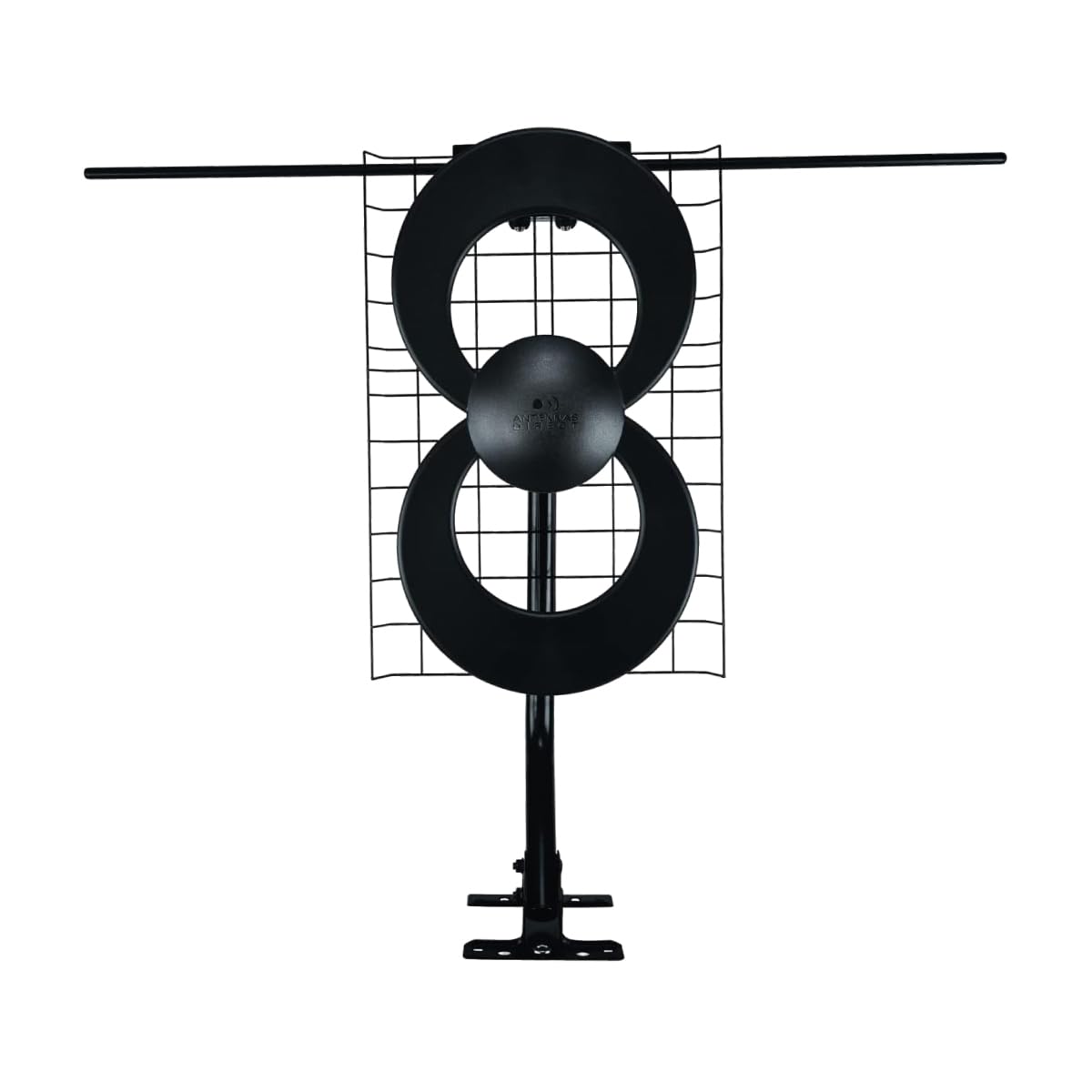
The bow-tie hybrid that quietly beats the big boys on flexibility and value.
Antennas Direct builds this double-loop antenna with multi-directional UHF and Hi-VHF elements plus a signal reflector that adds forward gain and shields the incoming signal from interference. The result is a 60+ mile range that works indoors, in an attic, or outdoors — an unusually flexible footprint for a suburban or rural home. It is NEXTGEN TV, 4K, 8K UHD, and full HD 1080p compatible with no internet required, and the 20-inch mast’s pivoting base mounts on vertical or horizontal surfaces. The whole antenna weighs just 2 pounds, making it remarkably easy to handle.
The owner stories reveal a genuinely versatile performer. A brick-apartment dweller 25 miles southwest of Chicago reported excellent reception on all OTA channels except one VHF station. A roof-mounted install 43 miles from Los Angeles pulled 144 channels, crisp on ABC, CBS, NBC, Fox, and PBS. Another in a wooded valley at 20-30 feet grabbed 14-30 channels from four different cities up to 100 miles away. The ability to punch through cinderblock and brick is a recurring theme, which is rare for any antenna.
The trade-off is setup nuance. Assembly is easy but the instructions are unclear — owners turned to YouTube for guidance, and the indoor mounting lacks proper documentation, leaving some with a less stable setup than they would like. The Channel count spec in the data (8) reads oddly against owner reports of 14-144 channels, so treat it as a conservative number that your location will heavily influence. It also works best aimed properly, so a little patience with positioning pays off.
small homes: a flexible indoor/outdoor/attic install in a brick or suburban home where you want multi-directional coverage without a huge frame.
large estates: you want a single-focused directional reach beyond 70 miles — the ClearStream 4V or the Televes extends further.
9. Antennas Direct ClearStream 4V
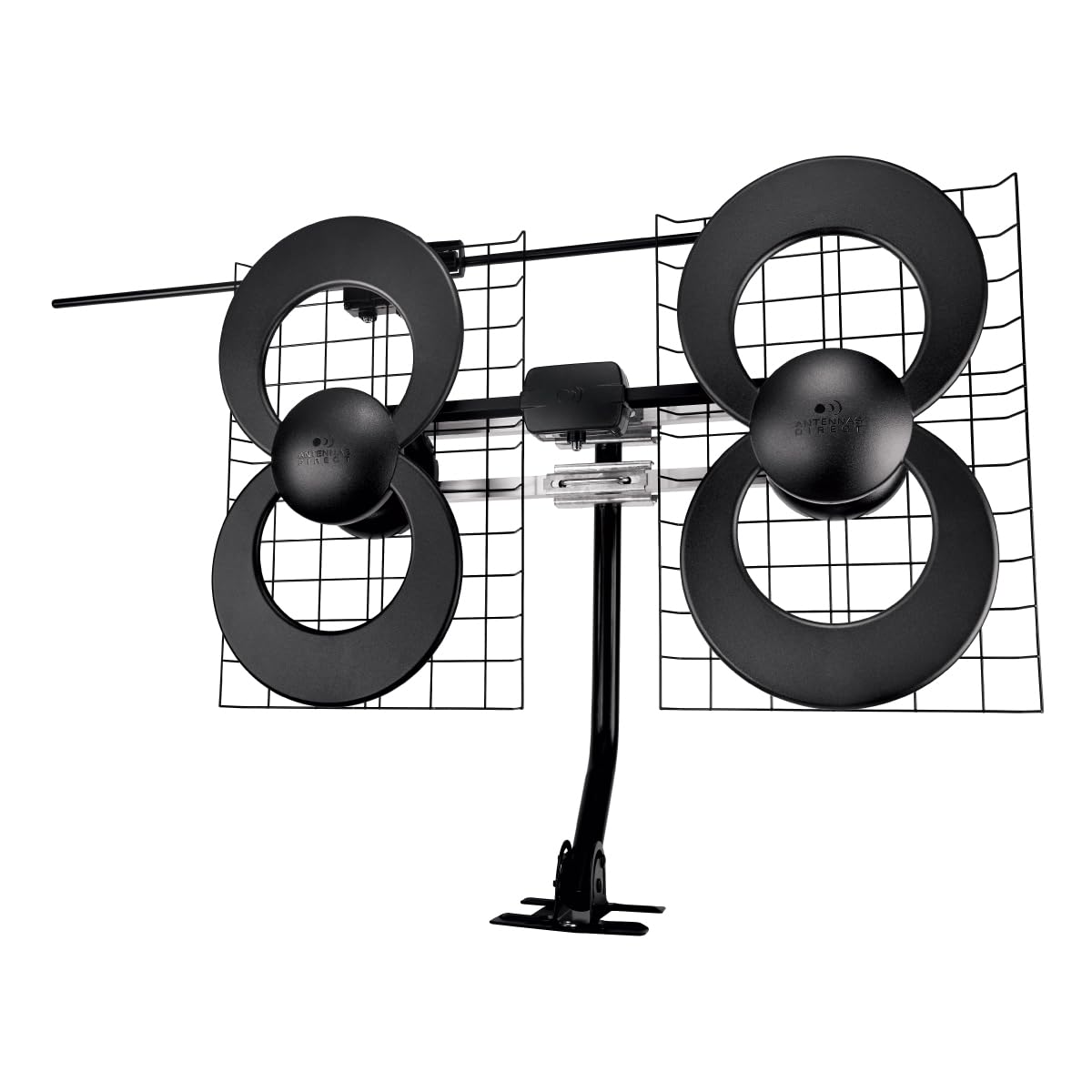
The bigger sibling that was built for the tree-lined nightmare scenarios.
Where the 2V is the flexible all-rounder, the 4V is the power upgrade for the worst signal environments. It uses four patented loops to receive HDTV signals 70+ miles out, with reflectors that add forward gain and focus the antenna’s power against interference that causes pixelation. The heavier 4.1-pound build and the 20-inch pivoting mast make it a solid, serious piece of hardware for suburban and rural installs. Like its sibling, it handles NEXTGEN TV, 4K, 8K UHD, and full HD 1080p with no internet required.
The owner evidence is emphatic about heavy tree cover. One extensive review — written specifically for people with heavy tree cover and high pixelation — went from 20 channels to 60 at 35 miles out, with clear sports and no pixelation. Another attic install pulled 70 channels, and a third grabbed all 42 OTA channels in western Kentucky at up to 60 miles with excellent strength, including the trickier VHF channel 12. The clear picture quality draws comparisons to cable, which is the highest compliment for an over-the-air antenna.
The honest friction is the same as the 2V’s — the instructions are cursory, and the base mount bolts are insufficient for some, needing extra clamping for a rock-solid install. There is a realistic note among the praise: many sub-channels are SD or compressed, and some shopping and duplicate channels inflate the raw count. One 20-year antenna veteran called it a top performer that fixed pixelation and stuttering that cheaper antennas could not handle, and the durable construction earns consistent respect.
maximum range: wooded properties and pixelation problems where you need serious gain plus multi-directional flexibility in one sturdy package.
limited space: you are on a tight budget or only need one or two close-in channels — the 2V or a budget yagi covers that for less.
Understanding the Specs
Directional vs. Multi-Directional
A directional antenna (like a yagi or the Televes) focuses all its power one way, giving maximum reach toward a single cluster of towers. A multi-directional or 360° design (like the ClearStream or 1byone) pulls from all directions but with less raw gain per direction. If your towers are in one area, go directional; if they surround you, go multi-directional — this is the single biggest decision you will make.
VHF and UHF Bands
Broadcast TV splits into two frequency bands. UHF carries most channels, but many key local stations — often CBS and NBC — broadcast on High VHF. An antenna that only mentions UHF will silently miss those. Check the working frequency range: the McDuory covers VHF 170~230MHz and UHF 470~860MHz, while the PIBIDI covers VHF 170~230MHz and UHF 470~790MHz. If your channels live in the VHF range, that coverage matters.
Mile Range Claims
The mileage on the box is best-case marketing, not a guarantee. The Televes advertises up to 100 miles, the Five Star and PIBIDI claim 200, yet real-world results almost always land below that. Shoppers say the Televes delivering great reception between 50 and 80 miles, while the Five Star’s practical range tops out around 75-90 miles. Use the advertised number for rough tiering, but trust owner reports and your local terrain for the real picture.
Amplifiers and Filtering
A built-in preamplifier boosts signal at the antenna, which helps on long cable runs and when splitting to multiple TVs. But close to the towers, too much gain causes overload that wipes out channels. The Televes solves this with TForce intelligent gain control that adjusts each band automatically (38 dBi High VHF, 46 dBi UHF). LTE/4G/5G filtering — found on the Televes and the 1byone — strips cell-tower interference that can degrade your picture. If you are close to towers, a passive antenna often works fine without an amp.
FAQ
How do I know if I need an indoor or outdoor TV antenna?
What does the “mile range” on the box actually mean?
Why is my indoor antenna missing CBS or NBC?
Will a TV antenna work in an apartment or condo?
Can one antenna feed multiple TVs?
What is ATSC 3.0 and why should I care?
Why do my channels come and go with the weather?
Do I need an amplifier for my antenna?
How do I aim a directional TV antenna?
Is a cheap TV antenna worth buying?
Final Thoughts: The Verdict
For most people, the air antennas for tv winner is the Televes DAT BOSS Mix LR because it is the only pick in this lineup that couples a 100-mile rated reach with automatic per-band gain control and LTE/5G filtering — the rare combination that actually delivers fringe reception when you need it most. If you want flexibility for a brick-walled apartment or suburban home, grab the ClearStream 2V. And for a budget-friendly outdoor install that beats indoor antennas, the McDuory Yagi is the one to reach for. Whichever you choose, check your tower distance first — that single number decides which of these is genuinely right for you.
How We Picked
We do not accept paid placement. Every pick is matched to a real buyer and a real use-case; we do not hands-on test units.
Sources & Methodology
Specifications: manufacturer listings and product documentation. Review insights: verified customer reviews, as of August 2026. Pricing: not shown on this page (it changes often); check the current price via the retailer link.
As an Amazon Associate, Gadgets Feed earns from qualifying purchases. This does not affect which products we feature.