
A weeping check valve on your well line or an air compressor that bleeds down pressure overnight points to the same culprit—a failed internal seal. The solution is a precision-machined brass or composite valve with a spring-loaded poppet that slams shut the instant flow reverses. Choosing the wrong thread size, pressure rating, or body material can strand your pump primeless or drain your compressor tank before morning.
I’m Min — the co-founder and writer behind Gadgets Feed. I’ve spent countless hours cross-referencing thread standards, cracking pressures, and real-world user reports across well pumps, irrigation systems, and pneumatic setups to find which valves actually hold under sustained pressure.
The right valve stops reverse flow dead, protects your equipment from pressure spikes, and handles years of cycling without galling or seizing. This guide breaks down the seven strongest contenders for the best air check valve based on build materials, thread compatibility, and real-world sealing performance.
How To Choose The Best Air Check Valve
An air check valve is a simple one-way gate, but the wrong selection can cause pressure loss, pump cycling, or even system damage. You need to match the valve to your fluid medium (air vs. water), pressure range, pipe size, and thread standard before you even look at materials.
Thread Standard & Pipe Size
NPT (National Pipe Tapered) is the most common standard for compressed air and well water systems. FIP (Female Iron Pipe) and MIP (Male Iron Pipe) are functionally identical to NPT. Flare fittings, like the 5/8” inverted flare on the Industrial Air Power valve, are specific to compressor tanks. Always measure the outside diameter of your pipe—what the label calls “1 inch” NPT actually measures about 1.050 inches on a tape. The wrong thread pitch will not seal, even with abundant thread tape.
Body Material: Brass vs. PVC vs. Nickel-Plated Brass
Cast brass is the standard for high-pressure air and water systems because it resists corrosion and maintains thread integrity under repeated torque. Lead-free brass (certified to NSF/ANSI-61 or IAPMO) is required for potable water lines. PVC valves like the Valterra 200-C10 are lighter and chemically resistant, but their maximum pressure rating of 150 psi makes them unsuitable for most air compressor applications. Nickel-plated brass adds a corrosion-resistant layer ideal for moist or outdoor installations, but the plating can flake if over-torqued.
Pressure Rating & Cracking Pressure
The valve’s maximum pressure rating must exceed your system’s peak operating pressure—a 200 psi CWP (Cold Working Pressure) valve works for most residential well systems, while a compressor check valve needs at least 300 psi. Cracking pressure, the minimum pressure needed to open the valve, matters most for low-pressure applications like aquarium pumps or drip irrigation. A spring tension of 0.5 lb or less is ideal for gravity-fed or low-head systems; anything stiffer may never open fully.
Quick Comparison
On smaller screens, swipe sideways to see the full table.
| Model | Category | Best For | Key Spec | Amazon |
|---|---|---|---|---|
| Merrill CVNL100 | Lead-Free Brass | Potable water backflow prevention | 200 psi max pressure, 1” NPT | Amazon |
| Midline Valve 372U256 | Cast Brass | Well pump / lawn pump prime retention | 200 psi CWP, lead-free cast brass | Amazon |
| Industrial Air Power 85582229 | Compressor OEM | Ingersoll Rand compressor replacement | 5/8” inverted flare, 135 psi | Amazon |
| New In Tank Check Valve | High-Pressure Air | Air compressor tank installation | 450 psi max, 30 SCFM, 3/4” NPT | Amazon |
| Valterra 200-C10 | Clear PVC | Irrigation / sump pump / visual flow check | 150 psi, slip-fit, clear body | Amazon |
| Viair 92831 | Nickel-Plated | 12V air systems / air horns / limited space | 1/4” NPT, nickel-plated brass | Amazon |
| Merrill CVNL125 | Large-Diameter Brass | Deep well submersible / high-flow lines | 1-1/4” NPT, 200 psi, IAMPO certified | Amazon |
In‑Depth Reviews
1. Merrill MFG CVNL100 1″ No-Lead Brass In-Line Check Valve

The Merrill CVNL100 hits the sweet spot for residential well and irrigation systems where lead-free certification is non-negotiable. Its no-lead brass body and IAPMO listing mean it can go straight into a potable water line without compromising code compliance. The 200 psi CWP rating covers the majority of shallow well and booster pump setups, and the abrasion-resistant O-ring on the poppet provides a positive seal that holds prime reliably over years of cycling.
Installation is straightforward with 1-inch female NPT ports on both ends—just thread into your line with appropriate sealant and a pipe wrench. The valve works equally well in vertical and horizontal orientations, which gives you flexibility in tight mechanical rooms or pitless adapter assemblies. Multiple reviewers have used it directly on well pump pressure tank tees with zero leakage reported after months of service.
The only caution is the California Prop 65 warning, which is standard for brass alloys that may contain trace lead at the molecular level even in “no-lead” formulations. For total peace of mind on drinking water, verify your local code accepts this certification. But for the price-to-performance ratio, this is the valve you buy when you want one-and-done reliability without overspending.
Why it’s great
- Fully IAPMO certified for potable water systems
- Precise NPT threading for leak-free installation
- Abrasion-resistant O-ring holds seal under pressure spikes
Good to know
- Not recommended for sand-laden or dirty water—debris can foul the O-ring
- Prop 65 warning may concern some users despite no-lead construction
2. Merrill CVNL125 1-1/4″ No-Lead Brass In-Line Check Valve
When your system demands higher flow volume—like a deep well submersible pushing water up 400 feet or a large irrigation manifold—the 1-1/4” porting of the Merrill CVNL125 becomes the differentiator. The larger internal bore minimizes flow restriction compared to downsized 1-inch valves, and the 200 psi CWP rating remains consistent with its smaller sibling. One reviewer installed this valve at 100-foot intervals down a 400-foot well column with zero backflow leaks after years of service, which speaks to the sealing consistency under real hydrostatic pressure.
The no-lead brass body and IAMPO certification are identical to the CVNL100, ensuring the same code compliance for potable water applications. The threads are precisely cut, as multiple users noted they sealed without leaks using standard PTFE tape or pipe dope. The spring-loaded poppet uses an abrasion-resistant O-ring that provides a positive seal even when the valve is mounted horizontally, which is a common failure point for swing-type check valves relying on gravity.
The trade-off is weight and size—at roughly in the market, this is a premium component for a critical system, not a throwaway part. But when you consider that a single failed check valve on a deep well can cost hundreds in service call fees, the Merrill CVNL125 is the right choice for users who need a valve that will outlast the pump it protects.
Why it’s great
- 1-1/4” FNPT ports handle high-flow irrigation and well applications
- Proven sealing on deep well submersible installations at 400+ feet
- No-lead IAMPO-certified brass suitable for potable water
Good to know
- Larger diameter makes it unsuitable for tight 1-inch plumbing runs
- Prop 65 warning present despite no-lead alloy
3. Viair 1/4″ NPT Nickel Plated Check Valve (92831)

The Viair 92831 is purpose-built for small-bore air systems—air horns, on-board compressors, snow-making rigs, and portable tire inflators. At 1/4” NPT with nickel-plated brass construction and stainless steel internals, it resists the moisture and vibration common in 12V mobile air setups. The recommended torque spec of 12-15 ft-lb for the NPT threads prevents the overtightening that can crack smaller brass valves.
One experienced failure report came from an air horn installation where the valve leaked within a day—this suggests that very high-cycling, low-pressure applications may need a heavier spring or a different seal design. However, the vast majority of buyers report perfect function in compressor lines and homemade snow machines where the valve separates high-pressure water from air. The nickel plating adds a layer of corrosion resistance that helps this valve outlast unplated brass in wet environments.
Where this valve excels is its small footprint. At barely 0.1 pounds, it fits into tight hose assemblies, distribution manifolds, and custom tubing setups where a full-size check valve would be physically impossible. Consider it the specialist of the group—not for main lines, but perfect for the secondary air circuits that larger valves simply cannot serve.
Why it’s great
- Compact 1/4” NPT profile fits tight spaces in 12V air systems
- Nickel-plated brass and stainless steel internals resist corrosion
- Specified torque range prevents overtightening damage
Good to know
- May fail under very high-frequency cycling in air horn setups
- Limited to small-diameter air circuits—not for main compressor tank lines
4. Midline Valve 372U256 Lead-Free Spring Loaded Check Valve

The Midline Valve 372U256 is a heavy-duty cast brass check valve that competitors cannot match at its price tier. With 3/4-inch FIP connections, a lead-free body certified to NSF/ANSI-61/372, and a 200 psi CWP rating, it is the budget-friendly choice for anyone with a 3/4” well line or lawn pump. Users consistently praise it for maintaining prime between weekly uses—a common problem with plastic valves that warp or crack under temperature changes in outdoor pump houses.
The inner spring-loaded design blocks reverse flow immediately when the pump shuts off, preventing water hammer from draining the drop pipe. The threads comply with ANSI.B2.1, so they cut cleanly into standard NPT fittings without cross-threading. Multiple buyers report zero leaks after direct installation on well pressure tanks and pitless adapters, and the corrosion-resistant casting means it can handle damp environments better than zinc or plated alternatives at this price point.
The only consideration is the 3/4” size—if your main line is 1 inch, you will need a reducing bushing. Additionally, the 8-ounce weight is relatively light for a brass valve, which may indicate thinner wall sections compared to the Merrill or CVNL125. For typical residential systems under 100 psi, however, this valve delivers sealing performance that punches well above its cost.
Why it’s great
- NSF/ANSI-61 certified lead-free brass for potable water safety
- Spring-loaded poppet provides instant backflow prevention
- Exceptional value for cast brass construction at entry-level price
Good to know
- Limited to 3/4” FIP—larger systems need adapters
- Wall thickness may be thinner than premium brass competitors
5. New In Tank Check Valve 3/4″ FPT x 3/4″ MPT
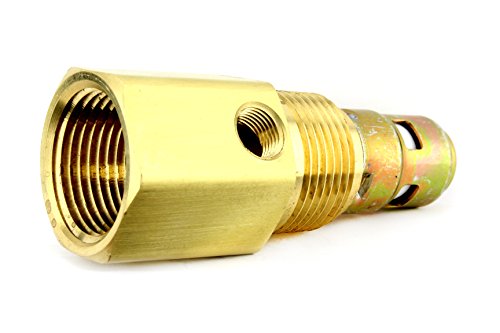
This in-tank check valve is built specifically for air compressor applications, not water lines, and its specs reflect that focus. The 450 psi maximum pressure rating is more than double most brass water check valves—essential for any compressor system that runs near 150-175 psi with safety margins. The 30 SCFM flow rate ensures minimal restriction even with high-demand tools like impact wrenches or sandblasters.
Two design details make this valve stand out: the integrated 1/8” unloader port and the 400°F maximum temperature rating. The unloader port bleeds pressure between the pump and the check valve when the compressor stops, allowing the motor to restart without a loaded head. The high temperature tolerance means it can handle the heat generated by continuous-run pumps without the seal degrading. Users report perfect fit on aging compressors including older models where OEM parts are discontinued.
The body is constructed for a straightforward drop-in replacement: 3/4” female NPT on top and 3/4” male NPT on the outlet that threads directly into the compressor tank. Made in the USA, it offers a reliable alternative to plastic or pot-metal valves that fail after a few years of thermal cycling. For the compressor owner looking to rebuild a tired pump assembly, this is the functional core that makes the whole system hold pressure.
Why it’s great
- 450 psi rating exceeds any residential or pro-sumer compressor need
- Integrated 1/8” unloader port for compressor unloader valve connection
- Handles 400°F without seal degradation
Good to know
- Not for water systems—no lead-free certification
- 3/4” NPT only—does not fit 1/2” or 1” compressor ports without adapter
6. Industrial Air Power 85582229 Brass Check Valve

If you own an Ingersoll Rand T30 or SS5L5 compressor and the stock check valve has failed, this aftermarket replacement from Industrial Air Power is the exact drop-in part you need. The 5/8” inverted flare connection on the outlet side matches the OEM thread pattern perfectly, while the 3/4” NPT inlet threads into the compressor tank. It is made in America and guaranteed to match or exceed OEM quality—a claim backed by hundreds of successful replacements.
The brass body is not lead-free, but in a compressed air system that does not matter—the priority is handling the 135 psi continuous cycling that compressor valves endure. One experienced user recommended cleaning the old valve seat with an ultrasonic cleaner and vinegar before installation, as debris trapped under the new poppet can cause persistent weeping. They also noted that thread sealer (not tape) is preferred for the tank-side connection to prevent tape shreds from fouling the valve.
The key performance detail is the exact thread pitch match to Ingersoll Rand’s original part. Generic check valves with “close enough” threading may seal initially but often weep under the heat and vibration of compressor operation. This valve avoids that gamble entirely. For anyone restoring a classic IR compressor or replacing a failed OEM valve, this is the only part to buy.
Why it’s great
- Exact fit for Ingersoll Rand #8558229 and SS5L5 compressors
- Made in America with quality equal to or better than OEM
- 5/8” inverted flare connection eliminates thread mismatch
Good to know
- Not lead-free—do not use in potable water systems
- Requires 1-1/4” socket for removal of old valve
7. Valterra 200-C10 PVC Swing/Spring Combination Check Valve

The Valterra 200-C10 is the only valve in this lineup that offers full visual inspection of the internal mechanism—a clear PVC body that lets you see exactly when the swing-flapper or spring closes. This makes it invaluable for irrigation systems, sump pump discharge lines, and aquarium loops where you need to confirm operation without disassembly. The schedule 40 PVC construction is resistant to corrosion, mild chemicals, and UV degradation when used outdoors.
The combination swing/spring design uses a flapper assisted by a 0.5 lb spring for positive closure. This is ideal for applications with variable flow rates where a pure swing check might hang open on low flow or a pure spring check might restrict high flow. The EPDM seal resists water and oil, making it suitable for light-duty greywater or condensate lines. The slip-fit connectors are designed to glue directly onto standard 1-inch schedule 40 PVC pipe, giving you a permanent leak-free joint without threading.
There are two important limitations. First, the 150 psi maximum pressure rating is too low for any compressed air system or high-pressure well setup. Second, the spring tension is surprisingly strong—several aquarium users reported it would not open at full pump flow and had to remove the spring altogether. For gravity-fed or low-head systems, test the cracking pressure before installation. But for visible backflow prevention in PVC plumbing at moderate pressure, this is a uniquely useful tool.
Why it’s great
- Clear PVC body enables visual confirmation of valve operation
- Combination swing/spring design handles variable flow rates
- Corrosion-resistant EPDM seal suitable for water and mild chemicals
Good to know
- 150 psi limit makes it unsuitable for air compressors and high-pressure water
- Spring tension may prevent opening in low-pressure applications
- Cannot be disassembled for internal cleaning
FAQ
Can I use a water check valve for compressed air?
How tight should I tighten the check valve threads?
What causes a check valve to make a clunking noise?
Can I install a check valve vertically?
Final Thoughts: The Verdict
For most users, the best air check valve winner is the Merrill CVNL100 because its IAPMO certification, precise 1-inch NPT threading, and durable no-lead brass body offer reliable backflow prevention for the widest range of residential well and irrigation applications. If you need a dedicated compressor replacement part, grab the New In Tank Check Valve for its 450 psi rating and integrated unloader port. And for visual flow monitoring in low-pressure PVC systems, nothing beats the Valterra 200-C10 clear body valve.