
A regulator that can’t hold a steady pressure or a filter that lets moisture through will degrade your paint finish, shorten tool life, and waste your time bleeding water from the tank. The right air compressor filter regulator solves these problems by conditioning the air before it reaches your pneumatic equipment.
I’m Min — the co-founder and writer behind Gadgets Feed. I’ve spent countless hours analyzing the technical specifications for dozens of FRL combos, comparing micron ratings, flow rates, bowl materials, and port sizes so you don’t have to dig through conflicting specs.
This guide breaks down the seven best models on Amazon, each selected for its ability to deliver clean, regulated air. Whether you’re running a plasma cutter, paint sprayer, or air tools, finding the best air compressor filter regulator means matching your system’s flow and pressure needs with the right filtration stage.
How To Choose The Best Air Compressor Filter Regulator
Selecting the right FRL unit involves understanding your compressor’s output, the tools you power, and how clean the air needs to be. Start with port size — 1/4-inch fittings suit portable compressors and most DIY tools, while 3/4-inch or 1/2-inch ports handle the higher flow of industrial setups. Flow rate matters too; a heavily filtered unit delivering 16 SCFM starves a 100 SCFM sandblaster. Finally, decide on filtration depth: a basic 5-micron particulate filter stops rust and large debris, but painting requires a 0.01-micron coalescing or desiccant stage to remove oil vapor and moisture.
Micron Rating & Filtration Stages
A 5-micron filter catches the bulk of pipe scale, dirt, and water droplets — sufficient for impact wrenches and cylinders. For spray finishing or plasma cutting, you need a secondary coalescing filter (0.3 microns or finer) that captures oil aerosols and sub-micron particles. Desiccant dryers eliminate virtually all remaining water vapor by passing compressed air through moisture-absorbing beads. A three-stage system (particulate, coalescing, desiccant) delivers dry, oil-free air down to 0.01 microns.
Bowl Type & Drain Mechanism
Polycarbonate bowls let you see water accumulation and filter condition at a glance but degrade in environments with solvents or UV exposure. Metal bowls with sight glasses handle higher pressures and harsh conditions without cracking. Drains range from manual petcock valves, which require daily attention, to semi-automatic floats that self-purge when the pressure drops. For unattended operation or large tanks, auto-drain models save you from remembering to open the valve after each session.
Regulator Features: Relieving vs. Non-Relieving
A relieving regulator vents excess downstream pressure to atmosphere when you lower the set point, allowing tools to safely depressurize without bleeding air through the tool itself. Non-relieving types require a separate exhaust valve and are less common on consumer FRLs. Look for a T-handle adjustment knob for easy, repeatable changes — especially if you switch between high-flow tools and low-pressure paint guns regularly. The gauge should be large enough to read at a glance in dim shop lighting.
Quick Comparison
On smaller screens, swipe sideways to see the full table.
| Model | Category | Best For | Key Spec | Amazon |
|---|---|---|---|---|
| NANPU 3/4″ 3-Stage | Industrial | Bone-dry air for painting & plasma | 0.01 micron coalescing + desiccant | Amazon |
| ARO C38121-600-VS | Industrial | Reliable shop air with tool lubrication | 44 CFM, 1/4″ NPT, 2-year warranty | Amazon |
| PneumaticPlus PPC3C-N02G | Dual-Filter | Clean, stable air for airbrushing | 5 + 0.3 micron particulate/coalescing | Amazon |
| THB Heavy Duty 3-Stage | Heavy-Duty | Central shop air lines with high flow | 1/2″ NPT, 7-225 PSI, 5oz metal bowls | Amazon |
| PneumaticPlus SAU220T-N02G | Compact | Precise pressure for painting & detail work | 10 micron filter, 35 SCFM @ 90 PSI | Amazon |
| SNS FRL Combo AC3010-N02A | Mid-Range | General shop tools & CNC setup | 60 SCFM, metal bowl guard, semi-auto drain | Amazon |
| LNCHKA FRL Unit | Budget | Entry-level FRL for small compressors | 60 SCFM, 3/8″ NPT, semi-auto drain | Amazon |
In‑Depth Reviews
1. NANPU 3/4″ 3-Stage Compressed Air Dryer & Filter Regulator

The NANPU delivers industrial-grade air quality in a single assembly by combining a 5-micron particulate filter, a 0.01-micron coalescing filter, and a desiccant dryer stage. Each stage has a metal bowl with a visible sight glass, so you can monitor water accumulation and desiccant color change (blue to pink signals replacement). The regulator adjusts pressure between 30 and 175 PSI, and the 3/4-inch NPT ports handle a massive 141 CFM flow rate — enough for continuous sandblasting or multiple tools running simultaneously.
Build quality is excellent, with all-metal construction and an auto-drain that purges moisture without manual intervention. The kit includes extra filter elements and desiccant bags, adding immediate value. This is the only unit in the roundup that can produce air dry enough to prevent pinholes in automotive paint and extend plasma cutter consumable life significantly.
A few users noted that the pipe threads on the fittings were slightly overcut, requiring liquid thread sealant to prevent leaks at the connections. At 7.4 pounds and with a sizable footprint, the NANPU needs a solid mounting surface. If your compressor output is 3/4 inch or you’re running a central shop air system, this is the definitive choice for moisture-free air.
Why it’s great
- Three-stage filtration removes moisture down to 0.01 micron
- 141 CFM flow supports high-demand tools
- Auto-drain saves daily maintenance
Good to know
- Large and heavy; requires sturdy mounting
- Threads may need sealant for leak-free install
2. Ingersoll Rand ARO C38121-600-VS

The ARO by Ingersoll Rand is a piggyback FRL that packs filter, regulator, and lubricator into a compact footprint with 1/4-inch NPT ports. The regulator is relieving-type with a locking knob that holds pressure steady even under heavy tool cycling. Users report holding 80 PSI for over 48 hours after the supply was shut off, confirming minimal internal leakage. The lubricator feeds an adjustable oil drip into the downstream air, ideal for automatic tool lubrication without manual pre-oiling.
Body construction feels notably more substantial than consumer-grade units, with thick castings and well-sealed bowl gaskets. The manual drain is a push-valve design that clears water instantly without fumbling with a tiny petcock. Separating the lubricator via a T-fitting lets you create a dedicated dry-air line for painting while keeping oiled air for impacts and drills — a shop layout advantage no other unit here offers as seamlessly.
Some owners experienced a regulator diaphragm failure after a year, though Ingersoll Rand sent a free service kit even past the warranty period. The gauge is small and could be larger for quick visual checks. At this price, you pay for consistency and brand support rather than exotic filtration depth, making the ARO a smart choice for shops needing dependable tool protection and regulation.
Why it’s great
- Locks pressure for days with minimal drop
- Separable lubricator for wet/dry line flexibility
- Strong manufacturer support and parts availability
Good to know
- Regulator diaphragm may need replacement after 1-2 years
- Small gauge hard to read in low light
3. PneumaticPlus PPC3C-N02G Dual-Filter Regulator
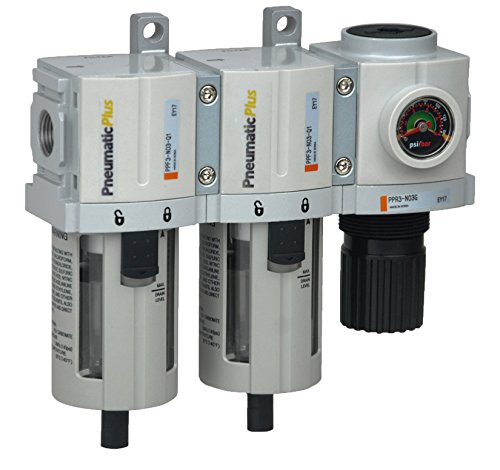
The PneumaticPlus PPC3C stacks a 5-micron particulate filter and a 0.3-micron coalescing filter in one compact body, then adds the regulator downstream — all in a space smaller than many single-filter combos. The coalescing stage removes oil aerosols and fine mist that a standard filter lets through, making this unit ideal for spray painting, airbrushing, and sensitive pneumatic controls. The bracket included is robust, and the poly bowl with metal guard gives you a clear view of the water level without risking bowl rupture from solvent exposure.
Rated flow is 16 SCFM at 90 PSI, which matches a single HVLP spray gun or an airbrush setup perfectly. The embedded gauge reads 0-140 PSI and is integrated into the regulator body, keeping the overall profile slim. Users upgrading from a basic sponge filter on a small compressor saw immediate improvements in paint finish consistency and reduced clogging in fine-tip airbrushes.
Reliability reports are mixed after 1-2 years, with some units developing leaks at the drain and bowl seals. The gauge is quite small and difficult to read if mounted above eye level. If your priority is getting clean, regulated air for finishing work in a compact footprint, the PPC3C delivers performance that justifies its premium over standard single-stage FRLs.
Why it’s great
- True dual-filtration in a compact package
- Coalescing filter removes oil vapor for clean painting
- Easy bracket mounting with included hardware
Good to know
- Seal durability concerns after 1-2 years
- Small pressure gauge hard to read
4. THB Heavy Duty 3-Stage Combination FRL

The THB combination FRL brings heavy-duty construction with 1/2-inch NPT ports and 5-ounce metal bowls on the filter and lubricator stages, plus a wall-mounting bracket. The filter uses a 5-micron element, which handles the bulk of moisture and particulates in a shop air environment. Regulation spans from 7 to 225 PSI with a max input of 250 PSI, and the lubricator has a visible sight glass with adjustable oil drip rate — enough coverage for a multi-tool production line.
Owners running central 3/4-inch PEX air systems praised the THB for having no leaks and the ability to separate the lubricator for dedicated wet and dry lines. The all-metal housings inspire confidence that this unit will outlast cheaper plastic alternatives, especially in environments where solvent fumes could damage polycarbonate bowls. At under 5.3 pounds, the THB is heavy enough to signal quality but manageable to mount on a wall bracket or compressor frame.
Several units arrived with a leaky pressure gauge that needed replacement immediately. The supplied gauge appears to be the weakest component. If you factor in the cost of a replacement gauge, the value proposition narrows. For tradesmen who want a robust central FRL on a budget and are willing to address the gauge, the THB offers the best bang for the industrial buck.
Why it’s great
- All-metal construction with large 5oz bowls
- Wide 7-225 PSI regulation range
- 1/2-inch NPT suits high-flow shop lines
Good to know
- Pressure gauge may leak and need replacement
- Thread sealant recommended for leak-free install
5. PneumaticPlus SAU220T-N02G Mini Filter Regulator
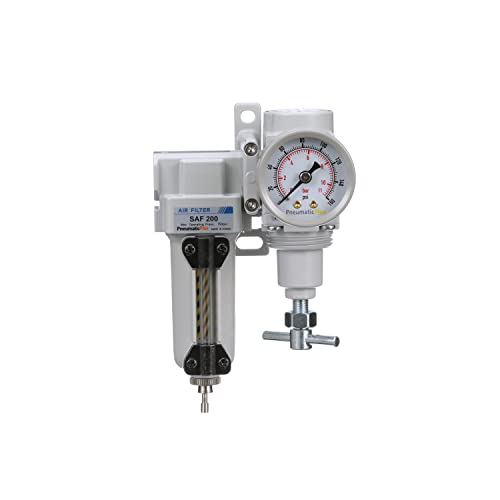
The SAU220T is a lightweight, compact combo built for tight spaces, weighing only 15.8 ounces with a T-handle regulator that makes pressure changes tool-free. Max supply pressure is 250 PSI, operating range 0-150 PSI, and the 10-micron filter element protects downstream tools without excessive restriction. At 35 SCFM at 90 PSI, the flow capacity is enough for a standard impact wrench, die grinder, or paint sprayer.
The poly bowl with metal guard gives good visibility, and the manual drain lets you clear water in seconds. Users running the unit on 60-gallon compressors reported zero leaks and improved plasma cutter cut quality after installation. The T-handle locks positively and doesn’t drift, which matters when you’ve dialed in 80 PSI for a framing nailer and don’t want it creeping up as the compressor cycles.
There are durability concerns at the upper end of the pressure range: two owners reported the drain bowl knob and air adjustment knob breaking within two years of use near 140 PSI. If you frequently adjust between high and low pressures, the plastic components may wear faster than metal alternatives. For light-to-medium workshop use at moderate pressures, the SAU220T is a space-saving performer with solid regulation accuracy.
Why it’s great
- Ultra-compact and lightweight for tight installations
- T-Handle adjustment locks pressure reliably
- Leak-free operation with 250 PSI max input
Good to know
- Plastic knobs may crack after 2 years of frequent adjustment
- 10 micron filter is less effective for fine painting
6. SNS FRL Combo AC3010-N02A

The SNS AC3010 is a two-unit FRL combo that joins the filter/regulator with a lubricator via a bracket, all in 1/4-inch NPT. It offers a 60 SCFM flow rate at 102 PSI, which is generous for the price and supports running multiple tools off a single line. The poly bowls come with metal guards for added impact resistance, and the semi-auto drain automatically ejects water when air pressure drops, reducing daily maintenance.
Regulation range is 7-120 PSI with a gauge that reads clearly enough for most shop tasks. Users have installed these on CNC turning centers and bar feeders, finding them more robust than the factory OEM units they replaced. The metal bowl covers fit securely and give the unit a finished look that belies the entry-level price.
Build quality inconsistency is the main trade-off: some units arrived with loose-fitting bowl covers that felt chintzy, and a few owners doubted the lubricator was actually metering oil into the air stream. The fit and finish doesn’t match premium brands, but for the price, the SNS delivers acceptable performance for general shop use where absolute precision isn’t critical.
Why it’s great
- 60 SCFM flow at a very accessible price
- Semi-auto drain reduces daily purges
- Metal bowl guards add durability
Good to know
- Inconsistent quality on bowl cover fitment
- Lubricator performance may be unreliable
7. LNCHKA FRL Unit (3/8″ NPT)
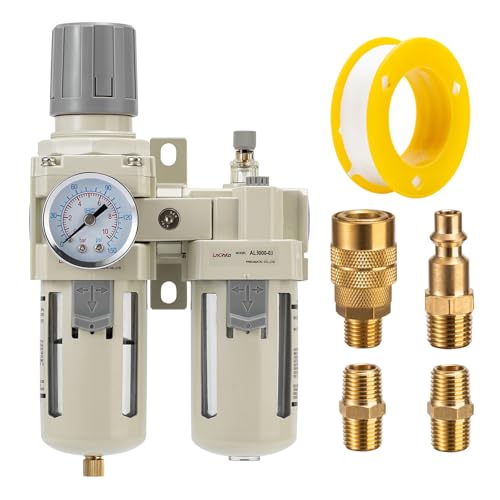
The LNCHKA FRL unit provides a three-function filter-regulator-lubricator in a 3/8-inch NPT package, offering 60 SCFM flow with a recommended pressure adjustment of 0-120 PSI. The transparent polycarbonate filter cup and brass filter element resist corrosion and let you see water accumulation. A semi-auto drain clears the bowl when the compressor cycles off, while the lubricator’s oil mist cup conditions tools for smoother operation.
This is the most budget-friendly entry in the roundup, and the build quality reflects that: the body is primarily metal, but the plastic bowl and drain assembly feel less robust than pricier units. Still, real-world buyers reported using it successfully on tire machines and small workshop compressors with no leaks and accurate regulation. For the price, it includes two 3/8-inch NPT brass couplers and thread seal tape, saving a trip to the hardware store.
The main limitation is the 3/8-inch port size — it won’t fit standard 1/4-inch or 1/2-inch systems without adapters, and the 145 PSI max pressure is lower than many standalone regulators. If you have a small compressor and need an all-in-one solution to start cleaning and lubricating your air lines immediately, the LNCHKA delivers functional performance without straining your tool budget.
Why it’s great
- Complete FRL function at the lowest investment
- Semi-auto drain simplifies water removal
- Includes brass fittings and thread tape
Good to know
- 3/8″ NPT requires adapters for common 1/4″ or 1/2″ lines
- Plastic bowl and lower max pressure limit
FAQ
Do I need a desiccant dryer or is a coalescing filter enough for painting?
Can I use a 1/4-inch FRL on a compressor with 1/2-inch output?
How often should I replace the filter element in my FRL?
Final Thoughts: The Verdict
For most users, the best air compressor filter regulator winner is the NANPU 3-Stage unit because it combines particulate, coalescing, and desiccant filtration in a single robust package with industry-leading 141 CFM flow. If you want a proven shop workhorse with excellent regulation stability and separate lubrication, grab the ARO C38121. And for the most compact clean-air solution tailored to painting, nothing beats the PneumaticPlus PPC3C dual-filter combo.