
Laying down a flawless paint job on a car requires more than just a good spray gun — it demands a steady, consistent supply of compressed air that never dips below the pressure your gun needs. The wrong compressor introduces pulsation, moisture, and pressure drops that turn a promising paint session into a runny, orange-peel nightmare before you’ve even finished the first panel.
I’m Min — the co-founder and writer behind Gadgets Feed. I’ve spent years analyzing market trends, reading spec sheets, and comparing the real-world CFM ratings, tank recovery times, and noise levels that separate a dedicated painting compressor from a general-shop tool..
Whether you are a weekend restorer chasing a wet-look finish or a shop owner pumping out production work, you need a compressor that holds output above 90 PSI while the gun is running. This guide breaks down the critical specs and real user feedback to help you pick the absolute best air compressor for painting cars without wasting a cent on features you will never use.
How To Choose The Best Air Compressor For Painting Cars
Automotive painting is one of the most demanding applications for an air compressor. Unlike nailing or tire inflation, spraying paint demands a non-stop, steady air supply at a specific pressure range — typically 90 PSI at the tank, regulated down to 20-40 PSI at the gun. The compressor must deliver its rated CFM (cubic feet per minute) continuously without the pump struggling to keep up. A machine that seems beefy enough for impact wrenches may fall flat the moment a high-flow HVLP gun starts drawing air.
CFM at 90 PSI: The Only Number That Matters
Ignore peak horsepower claims. The single spec that determines painting performance is CFM at 90 PSI. A standard HVLP touch-up gun consumes roughly 3.5 to 6 CFM, while a full-size production sprayer may need 10 to 12 CFM. If the compressor’s output at 90 PSI falls below what the gun demands, pressure drops instantly, causing the gun to spit, pulsate, or fail to atomize paint properly. For small panels and spot repairs, a compressor delivering at least 4.5 CFM at 90 PSI can work. For complete car repaints, look for 6 CFM or more.
Tank Size and Recovery Time
The tank acts as a buffer. A larger tank (15 to 60 gallons) provides a reservoir of dry air and keeps the pump from cycling on and off during a single gun pass. Recovery time — how quickly the pump refills the tank — is equally important. A compressor that takes 30 seconds to refill while you are mid-panel forces you to pause and let the gun idle. Painting compressors with oil-lubricated pumps typically recover faster than oil-free models of the same horsepower, because they run cooler and sustain output longer under load.
Oil-Lubricated vs. Oil-Free Pumps
Oil-lubricated pumps (like the cast-iron design on the Makita MAC5200) run cooler, last longer under continuous use, and deliver cleaner air with less moisture carryover — critical for a defect-free paint surface. Oil-free pumps require less maintenance and produce no oil mist, but they run hotter, tend to be noisier, and often have shorter duty cycles. For a dedicated painting setup, an oil-lubricated pump is almost always the better choice. If you plan to move the compressor frequently or hate oil changes, a premium oil-free unit like the Stealth or California Air Tools can still deliver acceptable results with careful filtration.
Air Filtration and Moisture Management
Compressed air naturally contains water vapor. When that vapor hits the spray gun, it creates fisheyes and blisters in fresh paint. A compressor intended for painting must have an accessible drain valve on the tank (manual or auto) and enough space in the air line to add a desiccant dryer and a coalescing filter. Many experienced painters install a refrigerated air dryer between the compressor and the gun, but for most home-shop setups, a good three-stage filter system and daily tank draining is sufficient.
Quick Comparison
On smaller screens, swipe sideways to see the full table.
| Model | Category | Best For | Key Spec | Amazon |
|---|---|---|---|---|
| California Air Tools CAT-60040CAD | Premium Stationary | Full-car production painting | 10.6 CFM @ 90 PSI / 60 Gallon | Amazon |
| VEVOR 20-Gallon 4HP (220V) | High-Output Workshop | Continuous HVLP spraying | 10.6 CFM @ 90 PSI / 20 Gallon | Amazon |
| Makita MAC5200 | Portable Pro | Spot repairs and small panels | 6.5 CFM @ 90 PSI / Cast Iron Pump | Amazon |
| Stealth 20 Gallon Ultra Quiet | Quiet Mid-Range | Detail shop painting | 5 CFM @ 90 PSI / 68 dB | Amazon |
| Craftsman 20 Gal (CMXECXA0232043) | Solid Workshop | General auto body + painting | 4 CFM @ 90 PSI / 20 Gallon | Amazon |
| Klutch 29-Gallon | Value Big Tank | Long sessions with tools + paint | 5.1 CFM @ 90 PSI / 175 PSI max | Amazon |
| WIILAYOK 13 Gallon | Budget Power | Light painting + nail guns | 6.5 CFM @ 90 PSI / 13 Gallon | Amazon |
| VEVOR 13-Gallon | Quiet Budget | Home detailing and touch-ups | 4.6 CFM @ 90 PSI / 66 dB | Amazon |
| Craftsman 10 Gal (CMXECXA0331042) | Compact Entry | Small touch-ups and DIY | 4 CFM @ 90 PSI / 10 Gallon | Amazon |
In‑Depth Reviews
1. California Air Tools CAT-60040CAD 60 Gallon

This is the gold standard for a serious automotive painting setup. The twin 2.0 HP motors spin at only 1680 RPM, which keeps noise at a remarkably low 75 dB while delivering a true 10.6 CFM at 90 PSI. That volume of air supports a full-size production HVLP gun continuously without the tank pressure ever dropping below the gun’s operating window. The 60-gallon ASME-certified tank provides a massive buffer, meaning the pumps cycle on much less frequently than any smaller unit — critical for keeping moisture regulated and paint consistency stable over a long session.
The oil-free dual-piston pump is rated for over 3,000 hours of service life, and the factory-installed auto drain valve eliminates the biggest maintenance headache: forgetting to drain the tank and sending water through your gun. Users report that the build quality — tight welds, zero air leaks out of the box, and smooth-running motors — justifies the premium price. The 213-pound weight makes it a stationary unit, but the included wheels and handle allow repositioning within a large shop. It requires a dedicated 20-amp circuit, so plan your electrical layout accordingly.
For anyone repainting entire cars or running a detail shop that sprays multiple panels daily, the CAT-60040CAD is the most reliable way to eliminate compressor-induced paint defects. It also includes a regulator with a 3/8-inch port, which simplifies connecting a desiccant dryer. While the price is steep for a hobbyist, it is a one-time investment that outlasts multiple smaller units and delivers the steady, clean airflow that separates a professional finish from a frustration.
Why it’s great
- True 10.6 CFM at 90 PSI supports any HVLP gun continuously
- 75 dB operation is quiet enough for noise-sensitive residential shops
- Auto drain valve prevents moisture buildup without manual attention
Good to know
- Requires a dedicated 20-amp circuit; may need an electrician
- 213-pound weight makes it essentially a stationary installation
- Premium price may exceed a weekend hobbyist’s budget
2. VEVOR 20-Gallon 4HP (220V)

VEVOR’s 20-gallon, 4HP oil-free compressor matches the California Air Tools unit on raw CFM output — 10.6 CFM at 90 PSI — but does it at a fraction of the price and with a 220V power requirement. This is a machine built for high-throughput spraying where budget matters. The 78 dB noise level is still impressively quiet for an oil-free design, thanks to a quality silencer system with a thickened muffler cover and rubber intake pipe. The 20-gallon tank is smaller than a 60-gallon unit, but the pump’s 1680 RPM speed means it recovers fast enough to keep feeding the gun during most single-panel passes.
The build uses a three-layer process: Q235B structural steel with rust-resistant coating, seamless welding to prevent leaks, and a large cooling fan paired with automatic overheat protection. Several users noted the power cord is quite short at roughly 40 inches, so plan to install a dedicated 220V outlet very close to the compressor location. The unit is heavy at 134 pounds, but the wheels and handle make it mobile enough to move across a garage floor. Importantly, the intake uses high-temperature silicone with a stainless steel braided mesh, which reduces the risk of drawing in fine dust that could contaminate paint.
This compressor is ideal for the serious DIY user or small shop that wants production-level air volume without spending over a thousand dollars. It will drive a full-size HVLP gun continuously on a 20-gallon buffer, and the quiet operation means you can hold a conversation next to it while spraying. The trade-offs are the 220V requirement (not all home garages have it) and a slightly smaller tank that will cycle more frequently on long spray sessions. Add a good external filter/dryer and this unit delivers near-professional painting capability at a compelling price.
Why it’s great
- Delivers 10.6 CFM at 90 PSI — enough for continuous HVLP spraying
- 78 dB noise level is remarkably quiet for its output class
- Three-layer steel construction with overheat protection
Good to know
- Requires a 220V outlet; not plug-and-play for standard garages
- Short power cord forces specific placement near the outlet
- Some users experienced overheating-related auto shutoff delays
3. Makita MAC5200 Big Bore 3.0 HP
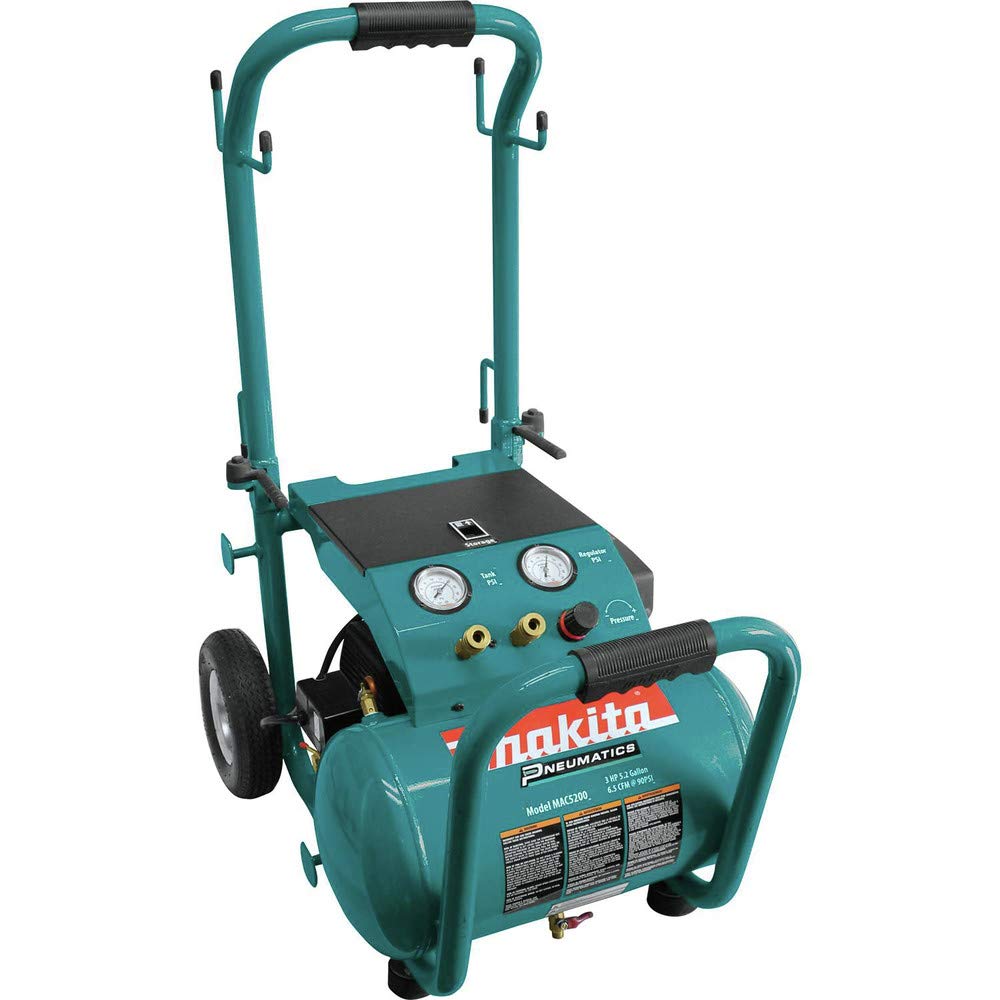
The Makita MAC5200 is an industry legend for a reason: the cast-iron, oil-lubricated Big Bore pump delivers a genuine 6.5 CFM at 90 PSI, which is enough to run a touch-up gun or a small HVLP gun for spot repairs without the pressure dropping below atomization requirements. The 5.2-gallon tank is surprisingly small, but the pump recovery is so fast (1 minute 17 seconds to 120 PSI per user tests) that it can keep up with intermittent spraying on small panels. The folding handle and wheels make this one of the most portable compressors that can still handle automotive painting tasks.
Oil-lubrication means the pump runs cooler and quieter than any oil-free competitor in its size class. Users consistently report that the noise level — while not silent — is a lower-pitched hum that is less irritating than the high-pitched whine of oil-free pumps. The cast-iron cylinder reduces wear significantly, extending the pump life well beyond what a comparable oil-free unit would deliver. It comes with a universal quick coupler and a bottle of compressor oil, so you can set it up and start spraying the same day. The unit weighs 75 pounds, making it possible to load into a truck bed for mobile detailing work.
This compressor excels for the painter who does partial repaints, fender repairs, or custom jobs where the compressor needs to move between vehicles. The MAC5200 will also drive an impact wrench, a cut-off tool, and a DA sander, making it a versatile auto-body companion. The limitation is the small tank: for a full car repaint, the pump will cycle frequently, and you may need to pause between sections. A secondary storage tank or a larger auxiliary tank can help smooth out delivery. For most spot-repair work, this is the best balance of portability and painting-grade air delivery.
Why it’s great
- 6.5 CFM at 90 PSI from a proven cast-iron oil-lubricated pump
- Fast recovery keeps you spraying on small panels
- Folding handle and wheels for genuine portability
Good to know
- 5.2-gallon tank is small; pump cycles often during full-car painting
- Oil-lubricated pump requires periodic oil changes
- Not quiet enough for same-room conversation without hearing protection
4. Stealth 20 Gallon Ultra Quiet

Stealth has carved out a niche by building oil-free compressors that are genuinely quiet enough for residential neighborhoods and enclosed detailing vans. The 20-gallon model delivers 5 CFM at 90 PSI, which meets the minimum requirement for a standard HVLP touch-up gun. The 68 dB noise level is quieter than most household vacuum cleaners, so you can spray late into the evening without drawing complaints. The 8-inch rubber wheels and steel tank make it stable on uneven garage floors, though the 121-pound weight is substantial enough that you will not want to lift it onto a workbench.
Owner reviews consistently praise the low noise and fast pressure build. The pump fills the 20-gallon tank quickly and holds pressure well overnight, which indicates good check-valve sealing. Several users run this unit for automotive detailing — including Tornador cleaning and spot painting — and report that the 20-gallon capacity keeps up with high air demand during interior cleaning. The two quick couplers allow switching between a blow gun and a spray gun without climbing behind the compressor. The limited lifetime warranty on the tank adds peace of mind for a purchase that is meant to last.
The main limitation for serious painters is the 5 CFM output. If you attach a high-flow production spray gun, the compressor will struggle to keep the tank at pressure during continuous spraying. It works beautifully for touch-up work, motorcycle tanks, and small panels where the gun runs intermittently. For a full-size car, you would need to spray in short bursts and wait for recovery. If your painting needs are detail-level or you simply must have the quietest unit in the neighborhood, the Stealth is a strong choice. Add a secondary receiver tank to extend its continuous-spray capability.
Why it’s great
- 68 dB operation — quiet enough for residential use without disturbing neighbors
- 20-gallon tank with 8-inch rubber wheels for stable mobility
- Limited lifetime warranty on the steel tank
Good to know
- 5 CFM at 90 PSI limits it to touch-up guns, not full-production HVLP
- Heavy at 121 pounds; lifting into a truck bed is difficult
- Some users reported pressure-switch issues after light use
5. Craftsman 20 Gallon Oil-Free (CMXECXA0232043)

Craftsman’s 20-gallon oil-free compressor is a staple in many home auto shops, and for good reason: it offers a 175 PSI maximum tank pressure, which stores more usable air in the same 20-gallon volume compared to a 125 PSI tank. The 4 CFM at 90 PSI is enough for smaller HVLP touch-up guns and detail spraying, but not for continuous full-panel work with a high-flow gun. The stainless steel tank resists corrosion better than painted steel, and the oil-free pump eliminates maintenance. Users who replaced older Craftsman units report that this model is noticeably quieter than its predecessors.
The dual quick couplers allow simultaneous connection to a spray gun and an air hose for cleaning. The rubber feet reduce vibration transfer to the floor, which helps keep the compressor from walking during operation. Setup is straightforward — attach the wheels, plug it in, and it is ready to run. Several long-term owners have noted that the unit holds pressure for days when not in use, indicating solid check-valve and fitting seals. The 1-year warranty is shorter than some competitors, but Craftsman’s parts network makes repairs straightforward if something fails after the warranty period.
This compressor fits the painter who also runs nail guns, inflates tires, and uses air tools around the shop. It is a generalist that can handle light painting duties. The 4 CFM output means you need to match it with a gun that sips air — a small touch-up gun or a low-flow HVLP gun — and you should plan to pause between coats for the tank to recover. Adding a 10-gallon auxiliary tank in line can help smooth out delivery. For a dedicated painting rig, there are better options, but as an all-around shop compressor that can paint when needed, it delivers dependable value.
Why it’s great
- 175 PSI max pressure stores more usable air per tank volume
- Stainless steel tank resists corrosion from moisture
- Oil-free pump means zero maintenance and no oil mist
Good to know
- 4 CFM at 90 PSI is marginal for continuous HVLP spraying
- 1-year warranty is shorter than many premium competitors
- Some units arrived with shipping damage or missing parts
6. Klutch 29-Gallon 2.5 HP
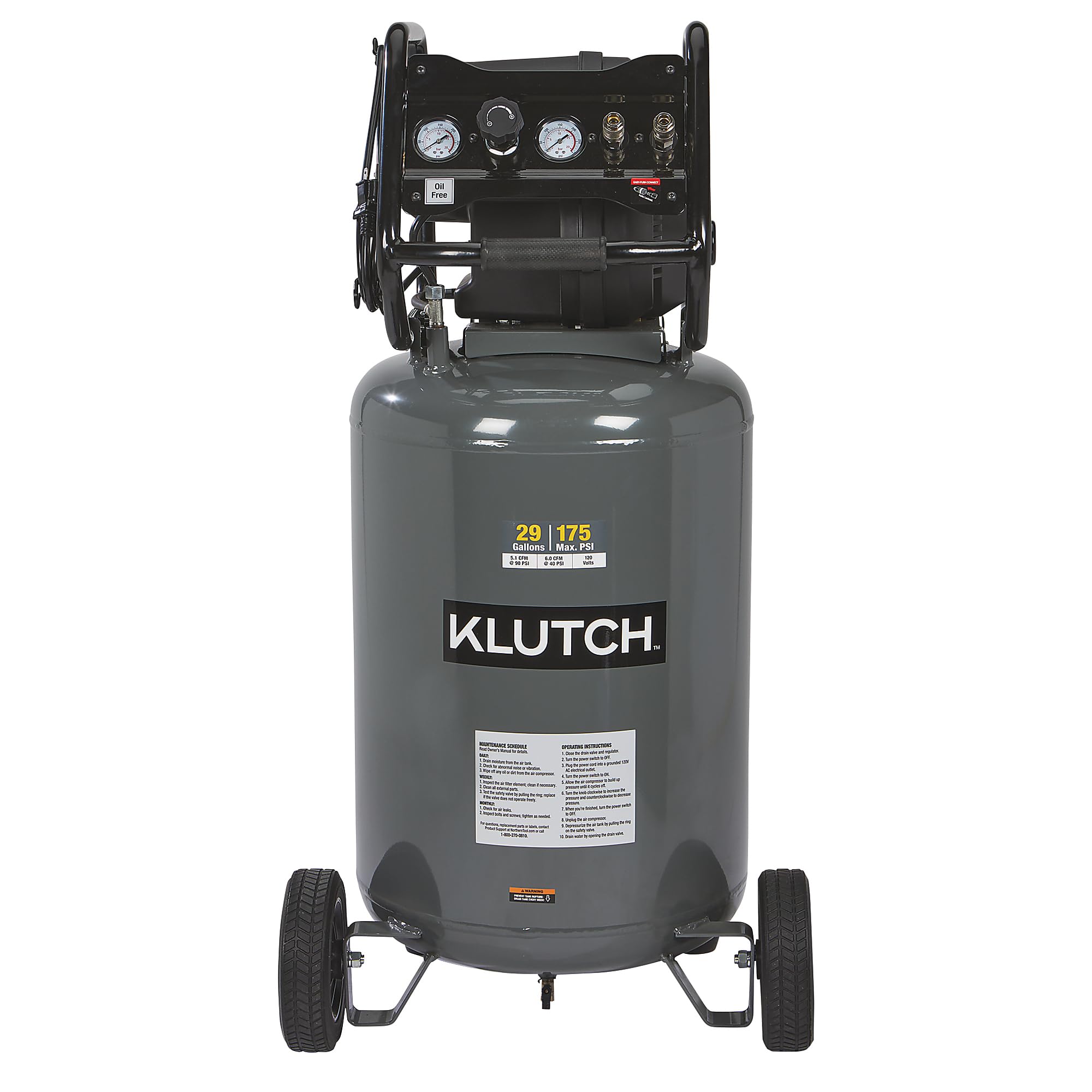
Klutch’s 29-gallon compressor brings a large tank and a 175 PSI maximum pressure to the table, which effectively gives you more air storage than a standard 20-gallon unit running at 125 PSI. The 5.1 CFM at 90 PSI places it in the same output range as the Stealth, but the larger tank means you have a bigger buffer before the pump kicks on. The oil-free design keeps maintenance simple, and the large flat-free tires make it easy to roll across a shop floor despite the 127-pound weight. Users who run impact guns and tire service alongside painting report that it handles mixed-use shops well.
The brass quick-connect coupler is a nice upgrade over plastic fittings, and the front-mounted drain valve makes daily moisture draining less awkward than reaching underneath the tank. The vertical tank design saves floor space compared to horizontal tanks of similar capacity. Owner feedback emphasizes that the compressor is quieter than expected for its size class and that it holds air without leaking. Some units arrived with minor cosmetic damage from shipping — a bent foot or scratched tank — but functionally they worked perfectly after a brief break-in period. The 175 PSI rating allows you to run tools at higher pressures while still having headroom for the regulator.
For painting, the 5.1 CFM at 90 PSI works with smaller HVLP guns and detail sprayers. The 29-gallon tank gives you a longer spray window before the pump restarts, which is useful for laying down a coat on a door or fender without interruption. This is not a production-level painting compressor, but for a multi-tool shop where painting is one of several tasks, the Klutch offers a compelling mix of tank capacity, pressure, and CFM at a mid-range price. Add a good in-line moisture filter and you can get acceptable paint results on smaller projects.
Why it’s great
- 29-gallon tank at 175 PSI provides a large air buffer for painting
- Oil-free pump with brass quick-connect for easy tool swaps
- Front drain valve and large flat-free tires for convenient use
Good to know
- 5.1 CFM at 90 PSI limits use to smaller HVLP touch-up guns
- Some units arrive with minor cosmetic damage from shipping
- 127-pound weight makes it a stationary shop fixture
7. WIILAYOK 13 Gallon 3.7HP
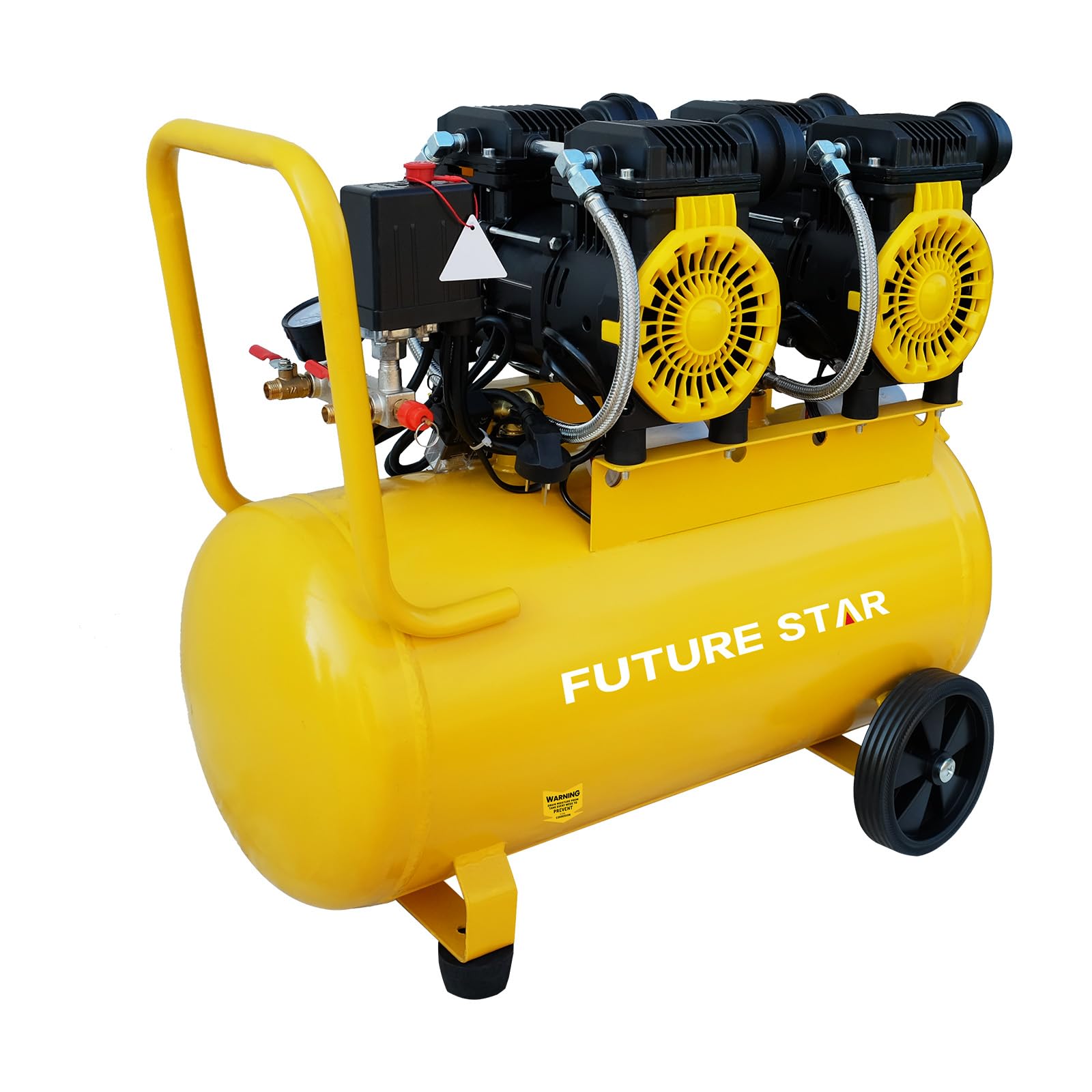
The WIILAYOK 13-gallon compressor punches above its price class with a claimed 6.5 CFM at 90 PSI — matching the output of the Makita MAC5200 in a more budget-friendly package. The 3.7 HP oil-lubricated pump runs cooler and quieter than oil-free units of similar output, and the horizontal tank design keeps a low profile for under-bench storage. Users confirm that it provides enough air for light painting work and air tools, with one reviewer noting it worked well for light painting and impact wrench use on a single outlet. The 115 PSI maximum pressure is standard for this class, but the oil lubrication extends the pump’s duty cycle for longer painting sessions.
The three-layer reinforced structure — thickened steel inner layer, plastic powder attachment layer, and rust-resistant outer layer — is designed to prevent leaks and corrosion. The 64-pound weight makes this one of the more portable options in its output range, and the top handle combined with bottom wheels means you can move it around a workspace without straining. Noise levels are described as medium for the size and type, which is acceptable for a garage environment. Some units arrived with minor build-quality issues like missing hose connections or capacitors held on with double-sided tape, so a thorough inspection upon arrival is advisable.
For the painter on a budget who needs enough CFM for a decent HVLP gun, the WIILAYOK offers the best CFM-per-dollar ratio in this lineup. The 13-gallon tank will cycle more frequently than a 20-gallon unit, but the fast pump recovery minimizes downtime between spray passes. This is a strong choice for a first painting compressor or for mobile work where weight matters. Just budget for a good moisture filter system — the oil-lubricated pump produces cleaner air than oil-free models, but you still need to catch any condensation before it reaches your gun.
Why it’s great
- 6.5 CFM at 90 PSI for under — excellent CFM-per-dollar value
- Oil-lubricated pump runs cooler, lasts longer than oil-free alternatives
- Three-layer rust-resistant construction for durability
Good to know
- 13-gallon tank is small; pump cycles frequently on full panels
- Some units arrived with loose components or cosmetic damage
- Noise level is described as medium; not ultra-quiet
8. VEVOR 13-Gallon 2HP Oil-Free

VEVOR’s 13-gallon oil-free compressor is the quietest unit in the budget tier at just 66 dB — barely louder than a normal conversation. The 4.6 CFM at 90 PSI is enough for a small low-flow HVLP touch-up gun used for spot repairs, motorcycle parts, or small panels. The 2HP motor and 13-gallon steel tank build pressure in under three minutes, and the leak-proof valve system maintains stable output during short spraying sessions. The rubber wheels and 71-pound weight make it genuinely portable, so you can roll it out of the corner for a quick paint job and store it away easily.
Customer feedback is overwhelmingly positive about the noise level. Users describe it as dramatically quieter than previous compressors, with no need for hearing protection during operation. The oil-free design means no oil changes and no risk of oil mist contaminating a paint job. The package includes two 1/4-inch plastic air filters, which help catch particulate before it enters the tank. Several DIYers have used this unit for woodworking and auto repairs, with one reviewer specifically noting it works well for a wood shop that also does painting. The tank holds enough air for about 20 seconds of continuous blowout use with a Tornador tool.
This compressor is best suited for the DIYer who paints occasionally and values a quiet, low-maintenance tool. The 4.6 CFM output limits it to smaller spray guns, and the 13-gallon tank will require the pump to run frequently during any extended spraying. It is a fantastic entry-level painting compressor for someone restoring a single vehicle or painting parts in a residential garage where noise matters. For continuous full-panel work, you will want more CFM and a larger tank, but for the price and noise level, this unit is hard to beat as a starter painting compressor.
Why it’s great
- 66 dB noise level — quiet enough for residential garages
- Oil-free design with zero maintenance and no oil mist
- Portable at 71 pounds with rubber wheels for easy movement
Good to know
- 4.6 CFM at 90 PSI limits use to smaller low-flow spray guns
- 13-gallon tank cycles frequently during continuous spraying
- Not suitable for production-level full-car painting
9. Craftsman 10 Gallon Oil-Free (CMXECXA0331042)

The smallest and most affordable option in this lineup, Craftsman’s 10-gallon compressor delivers 4 CFM at 90 PSI with a 150 PSI maximum pressure. This is a compact unit designed for light-duty use — the upright configuration with a folding handle saves floor space, and the 68-pound weight makes it easy to lift onto a workbench. The oil-free pump keeps maintenance to zero, and the dual quick couplers let you run a spray gun and a blow gun simultaneously. Users who have used this for HVLP painting report it works for small touch-ups and filling tires, though it is louder than some expect from a small compressor.
The 10-gallon tank provides roughly 30% more air flow than Craftsman’s smaller pancake compressors, which helps keep multiple nailers running. For painting, the 4 CFM output limits you to very small guns with low air consumption. The unit’s upright design allows it to fit under a workbench when not in use. Several reviewers noted that the compressor arrived with minor shipping damage — dented wheels or scratched paint — but functioned correctly after inspection. The foldable handle and integrated wheels make it one of the most space-efficient painting compressors available if storage is a primary concern.
This is a good choice for the absolute beginner or someone who needs a compressor for occasional small paint jobs and general shop tasks. It will not support a full-size HVLP gun through a complete panel, but for spot repairs, small parts, or priming, it gets the job done in a very small footprint. If your painting ambitions grow, you will eventually want to upgrade to a larger tank and higher CFM. But for the price and size, it is a capable starter unit that can also handle nail guns, tire inflation, and dusting.
Why it’s great
- Compact upright design with folding handle saves workshop space
- 150 PSI max pressure provides good air storage for its size
- Oil-free pump requires no maintenance or oil changes
Good to know
- 4 CFM at 90 PSI is minimal for HVLP painting tasks
- 10-gallon tank cycles very quickly during spray gun use
- Noise level is moderate to high, not ultra-quiet
FAQ
Can I use a 6-gallon pancake compressor for painting a car?
Is an oil-free or oil-lubricated compressor better for painting cars?
Final Thoughts: The Verdict
For most users, the best air compressor for painting cars winner is the California Air Tools CAT-60040CAD because its 10.6 CFM at 90 PSI and 60-gallon tank deliver production-level airflow with whisper-quiet operation. If you want a more portable setup for spot repairs and small jobs, grab the Makita MAC5200 for its proven cast-iron reliability. And for the best CFM-per-dollar value in a painting compressor, nothing beats the VEVOR 20-Gallon 4HP (220V) — just make sure you have the correct electrical outlet.