
Water in your compressed air line is not a minor annoyance — it is the primary cause of rusted tools, failed paint jobs, and sputtering plasma cutters. Every cubic foot of air your compressor pulls in carries atmospheric humidity that condenses into liquid water inside your pipes and tanks. An effective moisture filter traps that water before it reaches your equipment, saving you hundreds in tool replacement and material waste.
I’m Min — the co-founder and writer behind Gadgets Feed. I spent dozens of hours cross-referencing micron ratings, bowl capacities, pressure limits, and customer feedback across the full spectrum of particulate filters, desiccant dryers, and multi-stage systems to separate real performance from marketing noise.
This guide breaks down the critical specs that actually determine whether an air compressor moisture filter will solve your wet-air problem or become another leak in your system.
How To Choose The Best Air Compressor Moisture Filter
Selecting the right moisture filter depends entirely on three variables: your compressor’s output pressure, the tools you run downstream, and the humidity level in your workspace. A filter that works for a nail gun will fail for an automotive spray booth. Understanding the filter’s job — particulate removal, coalescing, or desiccant drying — is your first step.
Match the Port Size and Flow Rate to Your System
Every filter is built around a National Pipe Thread (NPT) size — 1/4″, 3/8″, 1/2″, or 3/4″ are the common standards. Using an undersized port creates a bottleneck that starves your tools of airflow. Check your compressor’s output port and piping diameter, then buy a filter with the same or larger NPT. The CFM (cubic feet per minute) rating must equal or exceed your highest-demand tool’s consumption; a plasma cutter pulling 8 CFM will suffer with a filter rated for 6 CFM.
Choose Your Filtration Stage Wisely
A single-stage particulate filter with a 5-micron element removes about 95% of bulk water and debris — sufficient for impact wrenches and air hammers. For painting, sandblasting, or CNC plasma cutting, you need a coalescing filter (0.01 micron) to strip oil vapor and microscopic moisture, often followed by a desiccant dryer that chemically absorbs the remaining vapor. The proper sequence is particulate filter first, coalescing filter second, desiccant dryer third. Skipping stages forces your desiccant beads to saturate in hours instead of weeks.
Manual Drain vs. Automatic Drain
Manual push drains require you to bleed water periodically — easy to forget when you are focused on a job. Auto drains use an internal float mechanism that purges water automatically when the compressor cycles off. For stationary shop setups, an auto drain is nearly mandatory; for portable compressors used intermittently, a manual drain saves cost and complexity without sacrificing performance.
Quick Comparison
On smaller screens, swipe sideways to see the full table.
| Model | Category | Best For | Key Spec | Amazon |
|---|---|---|---|---|
| THB 3-Stage System | Multi-Stage | Zero-moisture painting & plasma cutting | 100 CFM, 0.01 micron coalescing | Amazon |
| GX-PUMP PCP Filter | High Pressure | 5800 PSI PCP air rifle compressors | 5800 PSI, 0.01μm dual-layer | Amazon |
| THB 3/4″ Metal Bowl Auto Drain | Industrial Particulate | High-flow shop air with auto drain | 160 CFM, 11oz metal bowl | Amazon |
| THB 1/2″ Auto Drain | Particulate Filter | Mid-flow auto-drain convenience | 175 PSI, semi-auto drain | Amazon |
| THB Desiccant Dryer | Desiccant Dryer | Vapor removal after particulate filter | 215 PSI, 88 CFM, 3/8″ NPT | Amazon |
| THB 1/2″ Metal Bowl | Industrial Particulate | 100% metal bowl for rugged use | 225 PSI, 140 CFM, 5 micron | Amazon |
| THB 1/2″ Polycarbonate | Budget Particulate | Entry-level moisture removal | 175 PSI, 106 CFM, 5 micron | Amazon |
In‑Depth Reviews
1. THB 3-Stage Heavy Duty Industrial Grade Filter Regulator Coalescing Desiccant Dryer System

This is the complete solution for anyone who demands laboratory-grade dry air from their compressor. Stage 1 uses a 5-micron particulate filter and a regulator adjustable from 7 to 175 PSI, paired with a 5oz metal bowl and sight glass. Stage 2 is a 0.01-micron coalescing filter that removes 99.98% of moisture vapor and oil mist, with a red indicator that pops up when the element needs changing. Stage 3 finishes the job with a desiccant dryer that turns blue beads pink when saturated. All three metal bowls include auto drains via internal float mechanisms.
Customers report flawless car painting results and zero moisture reaching plasma cutters after installing this system. One review noted that the color indicator on the coalescing element makes maintenance foolproof — you never guess when to swap filters. The 100 CFM flow rating supports most two-stage compressors up to 150 PSI without noticeable pressure drop at the tool.
The 3/4″ NPT ports require adapter bushings for 1/2″ or 3/8″ lines, and the unit is heavy at 6 pounds — plan for solid wall mounting using the included bracket. A few buyers reported initial seal leaks that resolved after tightening bolts, but the majority confirm leak-free operation straight out of the box. For the price, you get three separate filtration technologies in one integrated package, saving the cost and complexity of piecing together individual filters.
Why it’s great
- Three-stage system handles bulk water, oil vapor, and residual moisture vapor in one setup
- Auto drains on all three bowls eliminate manual maintenance
- Visible change indicators on coalescing filter and desiccant beads
Good to know
- Requires 3/4″ NPT or adapter fittings; may need additional adapters for smaller systems
- Some units may need gasket lubrication to prevent minor leaks at start
2. GX-PUMP Professional-Grade High Pressure PCP Air Compressor Filter

Standard air compressor filters top out around 175-225 PSI, but PCP airguns and paintball tanks require 4500 PSI or more. This GX-PUMP filter is built for that extreme pressure range, rated to 5800 PSI with seamless aerospace-grade aluminum walls measuring 9.68mm thick. The dual-layer filtration uses activated carbon and molecular sieves to capture 99% of oil, water, and microparticles down to 0.01 microns — critical because even a few drops of moisture inside a PCP tank can cause corrosion and valve failure.
The pressure-maintaining valve is a patented feature: it only allows air to flow to the tank once internal pressure reaches about 1800-2000 PSI, forcing the compressor to push moisture through the filter media instead of bypassing it at low pressure. The M10x1 thread and 8mm quick-connect hose fit GX pumps and over 95% of PCP compressors without adapters. Dual mounting options — industrial-strength magnets or screw holes — let you attach the filter directly to the compressor body.
Users consistently praise the build quality and the peace of mind it provides for expensive PCP rifles. The replaceable cotton wads and filter element (ASIN B0FKB8M7WR) extend the unit’s lifespan. The manual drain valve at the bottom purges collected oil and water easily, though you must remember to drain it periodically. At 1.83 kilograms, it is portable enough to move between compressors but substantial enough to feel industrial-grade.
Why it’s great
- 5800 PSI rating handles PCP compressors that blow past standard air filter limits
- Pressure-maintaining valve forces full filtration before air reaches tank
- Magnetic mount provides tool-free attachment to most compressor bodies
Good to know
- Not suitable for standard shop compressors operating below 200 PSI
- Magnets may interfere with electronics on certain compressor models — check placement
3. THB Heavy Duty Industrial High Flow Particulate Filter 3/4″ NPT with Auto Drain

When your compressor runs continuously for hours in a humid shop, a manual drain becomes a forgotten chore. This THB filter solves that with an internal float auto drain that purges water automatically as the compressor cycles. The 11oz metal bowl holds more than double the capacity of standard 5oz filters, meaning less frequent maintenance even during heavy use. The 5-micron element removes 95% of moisture and debris, and the visible sight glass lets you confirm water levels without disassembly.
With a 175 PSI max input/output and 160 CFM flow rate, this filter keeps up with high-demand tools like sandblasters and industrial spray guns. The 3/4″ NPT ports match large-diameter main lines, but the included wall-mounting bracket and clear instructions make installation straightforward even for first-time buyers. Customers running 60-gallon two-stage compressors report that the auto drain catches nearly all the water that would otherwise accumulate in their receiver tanks.
A few users noted that the auto drain mechanism can stick if debris gets lodged in the float valve, but periodic cleaning resolves the issue. The metal bowl eliminates the risk of polycarbonate cracking from exposure to certain solvents or UV light, making this a long-life choice for shops that keep the unit outdoors or near chemical vapors. The 4.16-pound weight reflects the heavy-gauge construction.
Why it’s great
- 11oz metal bowl holds significantly more water than standard 5oz units
- Auto float drain eliminates manual maintenance for busy shop environments
- 160 CFM flow supports high-demand pneumatic tools without restriction
Good to know
- Auto drain float may need occasional cleaning to prevent sticking
- 3/4″ NPT requires adapters for standard 1/2″ or 3/8″ lines
4. THB 1/2″ Particulate Filter Water Trap with Auto Drain

This filter bridges the gap between basic manual-drain units and fully automatic systems. The semi-automatic drain opens when compressor pressure drops to zero, releasing trapped water without requiring a button push. When the compressor repressurizes, the valve seals closed automatically. This design is particularly useful for compressors that are drained at the end of each workday — you simply shut down the compressor, and the filter drains itself overnight.
The 1/2″ NPT ports and 175 PSI max input match most standard 60-gallon stationary compressors. Customers frequently pair this filter between the compressor outlet and tank inlet as a first-stage water trap, reporting that almost no water reaches their receiver tank when combined with proper plumbing practices like using a dead-leg drop tube. The polycarbonate bowl with metal guard provides impact resistance while still letting you see moisture levels.
The filter element is a 5-micron particulate type, so it handles bulk water and debris but does not remove oil vapor or fine mist. For painting applications, you will want a coalescing or desiccant stage downstream. The package weight of 1.68 pounds and compact dimensions make this one of the easiest filters to install in tight spaces, though the lack of a wall-mounting bracket means you will need to fabricate or buy your own bracket.
Why it’s great
- Semi-auto drain removes water automatically when pressure drops to zero
- 1.68 pounds and compact profile fit easily into tight compressor setups
- Polycarbonate bowl with metal guard balances visibility and protection
Good to know
- Does not include a wall-mounting bracket — requires separate solution for fixed install
- 5-micron particulate only; not sufficient alone for spray-paint or CNC applications
5. THB In Line Desiccant Air Dryer 3/8″ NPT

This is not a bulk water trap — it is a desiccant dryer designed to remove the vapor-phase moisture that particulate filters cannot catch. The bowl is packed with color-changing silica gel beads that shift from dark blue to pink as they absorb water vapor. Each fill lasts for weeks of intermittent shop use before needing regeneration or replacement, and the unit includes two bags of beads to extend service life.
The 3/8″ NPT ports and 88 CFM flow rate make it suitable for final-stage drying after a particulate filter in a painting or plasma-cutting setup. At 215 PSI max pressure, it can be plumbed into the high-pressure side of most single-stage and two-stage compressors. Customers report that pairing this dryer with an aftercooler and a particle filter keeps moisture out of CNC plasma tables and powder-coating guns for entire work sessions.
The polycarbonate bowl lets you visually confirm bead color without disassembly, but the lack of a mounting bracket or mounting holes in the head is a common complaint — you will need to secure it with a clamp or strap. The 0.84-kilogram weight is light enough for inline mounting. Keep in mind that the desiccant volume is modest; continuous heavy use may require mid-job bead swaps. Regenerating the beads in an oven at 250°F for a few hours restores them for re-use several times.
Why it’s great
- Color-changing desiccant beads provide clear visual indication of saturation
- Beads can be oven-regenerated multiple times before replacement
- 215 PSI rating fits most standard shop compressor outputs
Good to know
- Requires a particulate filter upstream to prevent desiccant from being flooded with bulk water
- No mounting holes in the head make fixed installation more difficult
6. THB Heavy Duty Industrial Particulate Filter 1/2″ NPT Metal Bowl

The defining feature of this filter is its all-metal bowl — no polycarbonate, no risk of UV degradation, no solvent cracking. The 5oz metal bowl is paired with a 5-micron particulate element that removes 95% of moisture and debris, but the real upgrade is the pressure rating: 225 PSI max input and 215 PSI max output, well above the 175 PSI standard. This makes it a safe choice for compressors that output at the upper end of typical shop pressures, especially in cold weather when pressure can spike as air cools.
The manual push drain at the bottom is straightforward and durable, with a visible sight glass that lets you check water accumulation without draining. The 140 CFM flow rate keeps pace with tools like 1/2″ impact wrenches and die grinders. A wall-mounting bracket is included, along with operating instructions — one less item to buy separately. Customers report that the drain mechanism feels robust and does not develop leaks over months of use.
Users running 60-gallon compressors frequently install this between the compressor outlet and tank inlet as part of an aftercooler setup, with one reviewer noting that it keeps the downstream desiccant dryer dry for extended periods. The 5-ounce weight is deceptive — the metal bowl adds significant heft compared to polycarbonate versions, so ensure your mounting surface is solid. The lack of an auto drain means you must remember to twist the knob manually, but many buyers prefer the simplicity of a manual mechanism.
Why it’s great
- 225 PSI pressure rating exceeds standard 175 PSI filters for higher-output compressors
- All-metal bowl eliminates cracking, UV, and solvent damage concerns
- Includes wall-mounting bracket for immediate installation
Good to know
- Manual push drain requires periodic attention — no auto drain option
- Metal bowl hides water level without the sight glass window; rely on the sight glass
7. THB 1/2″ Particulate Filter Water Trap Separator
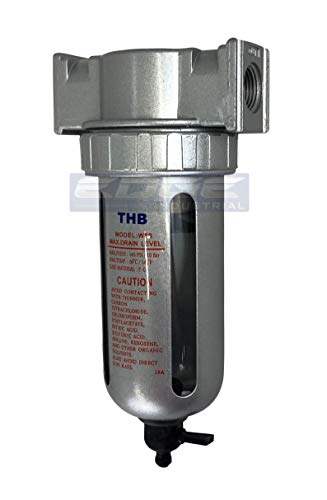
This is the entry point into dedicated moisture filtration — a 1/2″ NPT particulate filter with a 5oz polycarbonate bowl protected by a metal guard. The 5-micron element removes 95% of moisture and debris, adequate for impact tools, air hammers, and general shop air where minor condensation is acceptable. With 175 PSI max input, 145 PSI max output, and 106 CFM flow rate, it handles most single-stage compressors without starving downstream tools.
The semi-automatic drain works on a pressure-sensing principle: when the compressor is charged, the valve holds water in the bowl; when pressure drops to zero (overnight or during shutdown), the valve opens to release accumulated moisture. This is a practical compromise between full manual and full auto — you get the convenience of self-draining without the complexity of a float mechanism. Customers report it works well under 125 PSI and collects noticeable water in humid conditions.
The main trade-off is the polycarbonate bowl, which can become brittle with age or crack under exposure to certain solvents. The metal guard adds a layer of protection, but if you are running the filter in a harsh environment, the all-metal bowl models are safer long-term bets. The lack of a mounting bracket means you will need to build a support or use pipe clamps. Replacement filters are easy to find (ASIN B01MTC8AAH), keeping maintenance costs low.
Why it’s great
- Semi-auto drain releases water automatically when compressor is off
- 106 CFM flow supports most standard tools without restriction
- Affordable entry into moisture filtration with easy replacement filter sourcing
Good to know
- Polycarbonate bowl may crack with age or chemical exposure; not for harsh environments
- No wall-mounting bracket included — requires creative mounting solution
FAQ
Can I use a desiccant dryer without a particulate filter upstream?
What size NPT port do I need for my compressor?
How often should I regenerate or replace desiccant beads?
Why does my moisture filter leak at the bowl seal?
Is a moisture filter necessary for nail guns and staplers?
Final Thoughts: The Verdict
For most users, the air compressor moisture filter winner is the THB 3-Stage System because it combines particulate filtration, coalescing oil removal, and desiccant drying in one integrated package with auto drains. If you want a high-pressure solution for PCP compressors, grab the GX-PUMP Filter. And for budget-conscious shops that need reliable bulk water removal without vapor-phase drying, nothing beats the value of the THB 1/2″ Particulate Filter.