
The difference between a rotary screw compressor and a reciprocating piston compressor isn’t just the sound—it’s the total absence of the air-starved panic when a DA sander bogs down mid-stroke. Where piston compressors spike and drop, screw compressors deliver a continuous, pulseless stream of compressed air that lets you run multiple high-volume tools without the compressor cycling on and off every twenty seconds. For any shop running bodywork, sandblasting, or production-level pneumatic tools, that uninterrupted air delivery separates a productive day from a frustrating one.
I’m Min — the co-founder and writer behind Gadgets Feed. I’ve spent countless hours analyzing pump configurations, CFM curves, decibel ratings, and duty-cycle specs across dozens of compressor models to understand what actually determines long-term reliability in rotary screw and high-end reciprocating systems.
Finding the best air compressor rotary screw means balancing continuous output capacity, noise tolerance, and maintenance intervals against the real demands of a busy shop floor.
How To Choose The Best Air Compressor Rotary Screw
Choosing between a true rotary screw compressor and a premium two-stage reciprocating compressor comes down to a single question: do you need continuous, pulseless air for hours at a time, or do you work in cycles with recovery time between bursts? Rotary screw compressors excel in the first scenario; high-end two-stage piston compressors handle the second with lower upfront cost. The following factors will guide your decision.
CFM at 90 PSI — The Real Power Metric
Horsepower ratings are marketing signals. The number that tells you whether a compressor will actually run your tools is the CFM (cubic feet per minute) delivered at 90 PSI. A DA sander can easily consume 12–15 CFM continuously; a sandblasting cabinet may need 18–25 CFM. If your peak tool demand exceeds the compressor’s CFM at 90 PSI, you will experience pressure drop mid-task. Look for a minimum of 14 CFM @ 90 PSI for general shop use, and 20+ CFM for media blasting or continuous multi-tool operation.
Two-Stage vs Single-Stage Pumps
Single-stage compressors compress air to a final pressure in one piston stroke. Two-stage compressors compress air in a first cylinder, cool it, then compress it again in a second cylinder to a higher pressure—typically 145–175 PSI versus 125 PSI. This means a two-stage unit delivers more usable CFM per horsepower, runs cooler, and produces air with significantly less moisture content. For any task where air quality matters—painting, blasting, or running precision tools—two-stage is the minimum entry point.
Duty Cycle and Receiver Tank Volume
Continuous-duty compressors are rated for 100% duty cycle: they can run non-stop without overheating. Reciprocating compressors with cast-iron pumps and adequate oil cooling can also approach continuous duty, but they cycle on and off. Receiver tank volume (measured in gallons) acts as a buffer—larger tanks store more air, allowing the pump to run less frequently. For a serious shop, 60 gallons is the standard; 80 gallons provides more headroom for high-volume tasks like sandblasting or running a plasma cutter with an air dryer.
Quick Comparison
On smaller screens, swipe sideways to see the full table.
| Model | Category | Best For | Key Spec | Amazon |
|---|---|---|---|---|
| Ingersoll Rand 2475N7.5 | Premium Two-Stage | High-volume continuous blasting | 24 CFM @ 90 PSI / 80 Gal | Amazon |
| Quincy QT-54 | Premium Reciprocating | Small shop / heavy-duty home shop | 5 HP / 60 Gal / Cast Iron | Amazon |
| Ingersoll Rand 2340L5-V | Two-Stage Recip | Quiet two-stage performance | 14 CFM @ 90 PSI / 60 Gal | Amazon |
| California Air Tools CAT-60040CAD | Ultra Quiet | Noise-sensitive garages | 10.6 CFM @ 90 PSI / 60 Gal | Amazon |
| Metabo HPT EC2610EA | Gas-Powered | Jobsite framing/roofing teams | 9.5 CFM @ 90 PSI / 9 Gal | Amazon |
| Metabo HPT EC2510E | Gas-Powered | Remote job sites without power | Honda GX Engine / 8 Gal | Amazon |
| Ingersoll Rand SS3L3 | Single-Stage | Budget-conscious shop start | 10.3 CFM @ 90 PSI / 60 Gal | Amazon |
In‑Depth Reviews
1. Ingersoll Rand 2475N7.5 7.5HP Two-Stage

This is the compressor that changes what you think is possible from a single-phase shop air system. The Ingersoll Rand 2475N7.5 delivers 24 CFM at 90 PSI from its 7.5 HP two-stage pump—enough output to run a full-size sandblasting cabinet, a DA sander, and a blow gun simultaneously without the pressure gauge dropping below 100 PSI. The 80-gallon ASME receiver tank stores a massive air reserve, so even during peak draw you have a deep cushion before the pump kicks back in. With cast-iron cylinders, an overhung crankshaft, and one-piece connecting rods, the pump is rated for over 15,000 hours of trouble-free service—you will likely retire before this compressor does.
At 611 pounds, this is not a mobile unit. It arrives on a pallet and demands a dedicated 230V circuit with appropriate amperage, ideally 40A. The pump runs continuously at 100% duty cycle, meaning it can produce air all day without overheating. The synthetic All-Season Select lubricant extends oil change intervals to 2,000 hours—four times longer than standard petroleum oil. For a shop that uses air without pause—auto body, fabrication, production woodworking—the 2475N7.5 eliminates the air bottleneck entirely.
Noise is noticeable; Ingersoll Rand doesn’t market these as quiet machines, and at full tilt the intake and pump mechanics generate typical industrial compressor volume. However, the sound is a smooth, continuous hum rather than the sharp cycling of a piston unit. Some users report cosmetic damage from freight shipping—scrapes and dents on the tank—but the pump and motor typically arrive in functional condition. The extended two-year warranty is available with the purchase of a start-up kit that includes the synthetic oil and maintenance parts.
Why it’s great
- 24 CFM @ 90 PSI handles sandblasting and multiple continuous tools
- 15,000-hour pump life with cast-iron construction
- 100% continuous duty cycle for all-day production use
- 2,000-hour oil change intervals with synthetic lubricant
Good to know
- Very heavy at 611 pounds; requires permanent placement
- Needs a dedicated 40A, 230V circuit
- Freight delivery may result in cosmetic damage
- Operates at typical industrial noise levels
2. Quincy QT-54 5HP Splash Lubricated

Quincy compressors carry a near-mythical reputation among serious hobbyists and small-shop owners, and the QT-54 justifies that reputation. This 5 HP, 60-gallon vertical unit uses splash lubrication—a system where the connecting rod dipper carries oil from the sump to the bearings with every rotation, eliminating the need for an oil pump while providing consistent lubrication at any operating angle. The cast-iron pump cylinder and head are machined to tight tolerances, and the 475-pound unit delivers noticeably smoother operation than similarly priced alternatives. On anti-vibration pads, the QT-54 is genuinely quiet enough for a residential garage without disturbing neighbors.
The QT-54 is a single-stage compressor, meaning it compresses air to its final pressure in one stroke rather than two. For most shop applications—impact wrenches, nailers, air hammers, and light sanding—single-stage is entirely adequate. Where you feel the limitation is in continuous high-CFM tasks like media blasting or running a high-volume sander for extended periods; the pump will cycle on more frequently than a two-stage unit. Many owners pair the QT-54 with a 60-gallon tank and report excellent performance for personal auto restoration, woodworking, and general fabrication.
Anecdotal mentions of Baldor motor failure exist, though these appear to be rare and often tied to voltage issues or improper installation. Quincy offers a standard warranty, but some users report difficulty with direct warranty support. The compressor is designed for stationary installation and ships on a pallet weighing nearly a quarter ton. Many long-term owners describe the QT-54 as a “buy once, cry once” purchase—they have owned the same unit for a decade or more with zero maintenance beyond regular oil changes and belt adjustments.
Why it’s great
- Quiet enough for a garage; much quieter than oil-free or cheap piston units
- Cast-iron splash-lubricated pump designed for decades of service
- Strong resale value and readily available replacement parts
- Excellent power-to-weight ratio for a 5 HP single-stage unit
Good to know
- Single-stage design limits continuous high-CFM tool runs
- Heavy at 475 pounds; delivery logistics matter
- Some reports of motor reliability issues in isolated cases
- Quincy warranty support can be inconsistent
3. Ingersoll Rand 2340L5-V 5HP Two-Stage

The Ingersoll Rand 2340L5-V fills the gap between budget single-stage units and the industrial 7.5 HP monsters. With 14 CFM at 90 PSI from a 5 HP, two-stage cast-iron pump and a 60-gallon ASME tank, this compressor can run a DA sander continuously without bogging—something a single-stage unit at the same horsepower simply cannot sustain. The two-stage design compresses air to an intermediate pressure in the first cylinder, cools it through the intercooler, then compresses it again to 150 PSI in the second cylinder. The result is cooler, drier air and roughly 20% more CFM per horsepower compared to single-stage designs.
Users consistently describe this unit as significantly quieter than the oil-free compressors they replaced. The cast-iron pump absorbs vibration, and the 400-pound weight keeps the unit planted. At 230V single-phase, wiring is straightforward for any shop with an existing 220V outlet. The 60-gallon tank provides enough reserve for most tasks, though users performing heavy sandblasting would benefit from the larger 80-gallon tank found on the 2475 model. For a general repair shop, this is the sweet spot: two-stage efficiency without the jump to 7.5 HP electrical requirements.
Build quality concerns have surfaced in a small number of reviews—pump bolts not torqued, stripped drain plugs, and cross-threaded fittings. These appear to be quality-control variance rather than a systematic issue, but they warrant a thorough inspection upon delivery. The compressor ships with a manual drain; many users add a motorized ball valve for automatic draining. The Type 30 pump design is well-proven, and parts availability through Ingersoll Rand’s dealer network is excellent. For anyone stepping up from a contractor-grade compressor, the 2340L5-V represents a genuine performance upgrade.
Why it’s great
- Two-stage design delivers 14 CFM @ 90 PSI for continuous tools
- Cast-iron pump runs quieter and cooler than single-stage alternatives
- 60-gallon tank provides adequate reserve for most shops
- Ingersoll Rand parts and service widely available
Good to know
- Some units arrive with assembly quality issues
- Manual drain requires periodic attention
- Not enough CFM for heavy sandblasting without frequent cycling
- Heavy at 400 pounds; stationary installation required
4. California Air Tools CAT-60040CAD

The California Air Tools CAT-60040CAD redefines what a 60-gallon shop compressor sounds like. Twin 2.0 HP motors running at a low 1,680 RPM drive an oil-free dual-piston pump that produces only 75 decibels—quieter than a household vacuum cleaner. For anyone working in a garage attached to a living space, or in noise-regulated environments, this compressor makes it possible to run air tools without ear protection and without disturbing neighbors. The oil-free design also means zero oil changes, no oil carryover into air lines, and cleaner air for painting or pneumatic controls.
The trade-off is airflow. At 10.6 CFM @ 90 PSI, this unit positions itself in the upper tier of oil-free compressors but below the two-stage reciprocating units with cast-iron pumps. It can handle impact wrenches, die grinders, and nail guns with ease, but a DA sander or a sandblasting cabinet will push it to its limits. The 60-gallon ASME tank provides good reserve capacity, and the 125 PSI maximum pressure is standard for most common air tools. The factory-installed auto drain valve is a genuine convenience—set the timer and forget it.
Durability data from long-term owners is mixed. Some report using this compressor for 6+ years with no issues; others have experienced premature pump failure or units that failed to meet rated CFM from the start. The twin-motor design adds complexity and potential failure points compared to a single, larger motor. At 213 pounds, it is significantly lighter than cast-iron reciprocating units, making installation easier. For a hobbyist garage where noise sensitivity is the primary concern and tool demand stays moderate, the CAT-60040CAD is a category unto itself.
Why it’s great
- 75 dB operation is genuinely quiet enough for attached garages
- Oil-free pump delivers clean, maintenance-free air
- Factory-installed auto drain valve simplifies maintenance
- Low 1,680 RPM motor speed reduces wear and noise
Good to know
- 10.6 CFM @ 90 PSI limits continuous high-volume tool use
- Twin-motor design adds complexity vs single-motor units
- Some reports of reliability issues and CFM not meeting spec
- Lighter construction may not tolerate heavy industrial use
5. Metabo HPT EC2610EA The Tank XL
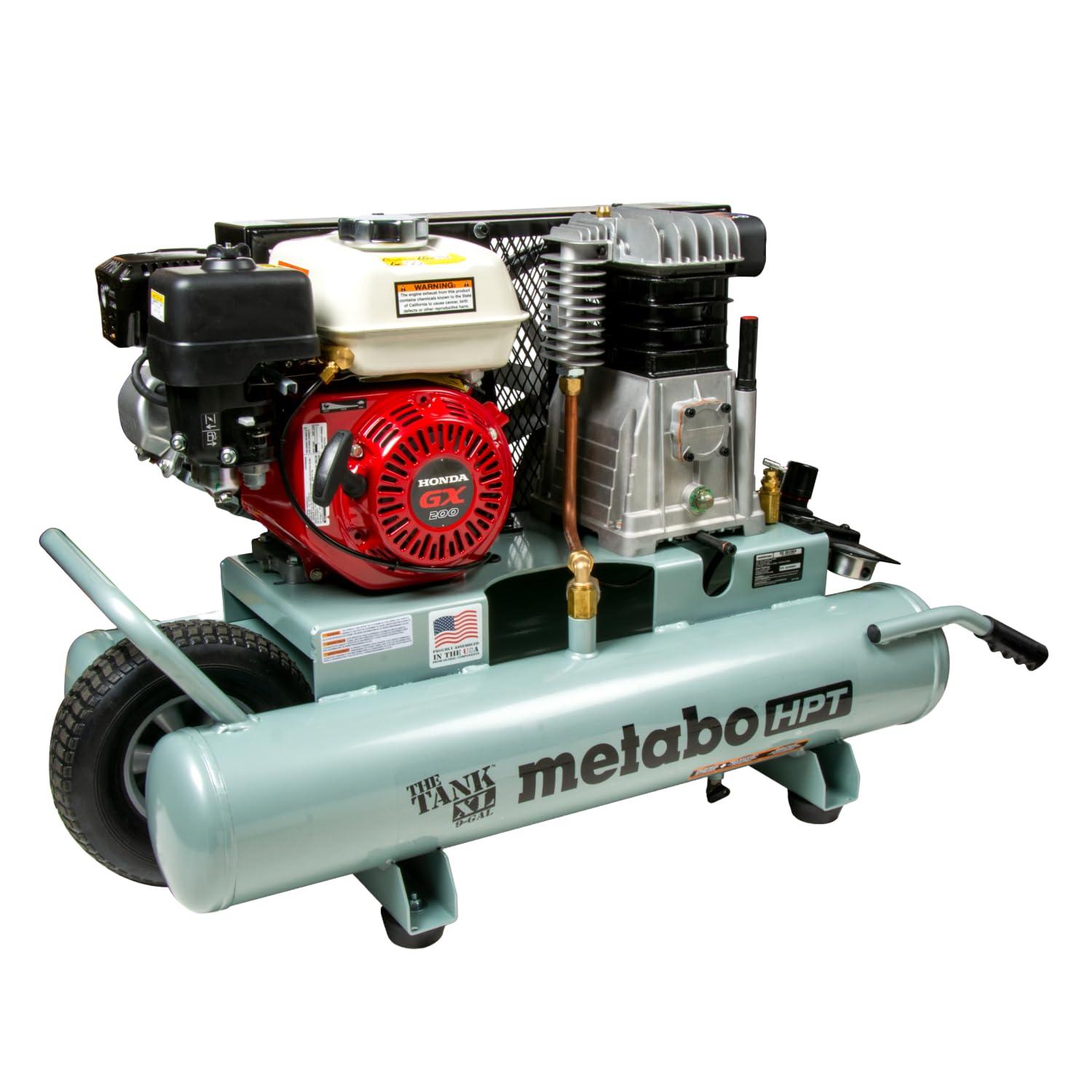
When job sites lack electrical infrastructure, a gas-powered compressor is the only practical option, and the Metabo HPT EC2610EA is the benchmark. Powered by a Honda GX 200 engine—one of the most reliable small engines in the world—this 9-gallon wheelbarrow compressor delivers 9.5 CFM at 90 PSI. That is enough air to simultaneously run five framing nailers, five roofing nailers, or five siding nailers, making it a legitimate workhorse for construction crews. The wheelbarrow design and solid rubber tire allow one person to move the 159-pound unit across rough terrain.
The oil-lubricated pump and aftercooler extend service life on dirty job sites, and Metabo HPT assembles these units in the USA. The 145 PSI maximum pressure provides headroom for consistent nail drive even as the tank pressure drops between engine cycles. Users report that the compressor recovers from empty to full pressure in about 45 seconds, and from the cut-in pressure to cut-out in roughly 15 seconds. The idle-down feature reduces engine speed when no air is being used, saving fuel and reducing noise.
A few users have reported oil leaks and hard-starting issues—the engine may require the choke to start even when warm, which is unusual for a Honda GX. The 1-year warranty is shorter than some competitors, and the price point places it firmly in premium territory for a gas-powered unit. The engine requires regular oil changes and fuel management similar to any small engine tool. For a crew that needs untethered compressed air on multi-story framing or roofing projects, the EC2610EA delivers where electric units cannot go.
Why it’s great
- Honda GX 200 engine provides legendary reliability and easy starting
- 9.5 CFM @ 90 PSI runs up to 5 nailers simultaneously
- Wheelbarrow design with solid tire allows true jobsite mobility
- Recovers quickly—45 seconds to full from empty
Good to know
- Gas engine requires regular oil and fuel maintenance
- Some reports of oil leaks and hard starting when warm
- 1-year warranty is shorter than some competitors
- Premium price for a gas-powered unit
6. Metabo HPT EC2510E Gas Powered

The Metabo HPT EC2510E is a smaller, more affordable cousin to the EC2610EA, trading the GX 200 engine for the Honda GX engine family and a slightly smaller 8-gallon tank. It still delivers the same fundamental advantage: compressed air without an electrical outlet. The 8-gallon tank cycles from 116 PSI to a maximum of 145 PSI, ensuring tools always have adequate pressure. The baseplate-integrated control panel keeps the gauge, regulator, and plumbing protected from jobsite abuse while centralizing controls for gloved hands.
At 144 pounds, this unit is slightly lighter than the EC2610EA but still demands two people for loading. The cast-iron cylinder is a genuine advantage for longevity, reducing oil carryover and maintaining consistent compression over years of use. The pneumatic throttle control adjusts engine speed to match air demand, saving fuel during idle periods. For a small crew doing siding, trim, or roofing work where electrical drops are infrequent, the EC2510E provides the same mobile air capability at a lower entry cost.
Customer reports are polarized. The majority describe a well-built machine that exceeds expectations, but a single critical review describes a unit that blew all its oil out on first use after ten months of storage, with a warranty that covered only 30 days. Some owners note that the bottom plate is stamped steel rather than cast iron, contradicting marketing language. As with any gas-powered compressor, seasonal storage requires fuel stabilization and oil level checks. For those who need an occasional gas-powered backup or work on sites without power, the EC2510E represents an entry point into Metabo HPT’s portable line.
Why it’s great
- Honda engine provides reliable starting and consistent power
- Cast-iron cylinder reduces oil carryover and extends pump life
- Integrated control panel protects gauges from jobsite damage
- Lighter than the EC2610EA at 144 pounds
Good to know
- Some reports of oil blowout and very limited warranty coverage
- Bottom plate is stamped steel, not cast iron
- 8-gallon tank provides less runtime than larger models
- Requires fuel stabilization for seasonal storage
7. Ingersoll Rand SS3L3 3HP Single-Stage

The Ingersoll Rand SS3L3 brings the brand’s reputation for cast-iron durability into a single-stage, 3 HP package with a 60-gallon vertical tank. At 10.3 CFM @ 90 PSI, it provides enough volume for impact wrenches, air ratchets, nail guns, and blow guns—the typical toolset of a general DIY garage or light automotive shop. The pump is cast-iron construction and Ingersoll Rand rates it for over 5,000 hours of trouble-free use, which represents exceptional value for the price point.
Operating at 135 PSI maximum, the SS3L3 uses a 3 HP, single-phase motor on a 230V circuit. The auto start/stop pressure switch, easy-change filter, and oil sight gauge simplify day-to-day operation. At 60 gallons, the tank provides enough reserve for intermittent heavy draws, but the single-stage pump will cycle noticeably when running a DA sander or any tool that draws near its 10.3 CFM ceiling. Users report the intake filter can melt under continuous heavy use, suggesting the unit works best in its sweet spot: moderate-duty tasks with recovery time between bursts.
The SS3L3 ships fully assembled and pre-wired—just bolt it to the floor and connect power. For a budget-conscious buyer who wants Ingersoll Rand reliability and a 60-gallon tank, this is the most affordable path into that setup. Some reviewers note that after 17 years of ownership of the same model, replacement parts are easy to find and service is straightforward. The downsides are clear: single-stage means less efficiency and higher moisture content in the air, and 10.3 CFM limits tool choices. For a home shop that doesn’t run sanders or blasters continuously, the SS3L3 delivers genuine value without sacrificing build quality.
Why it’s great
- Cast-iron pump rated for 5,000+ hours of service
- 60-gallon tank provides large air reserve for intermittent use
- Ingersoll Rand parts and service network is industry-leading
- Fully assembled and pre-wired for quick installation
Good to know
- 10.3 CFM @ 90 PSI limits continuous high-draw tool use
- Single-stage design produces warmer, more humid air
- Intake filter can melt under sustained heavy use
- Not suitable for multi-tool continuous production work
FAQ
What CFM rating do I need for running a DA sander continuously?
Is a rotary screw compressor better than a two-stage reciprocating compressor?
How often should I change the oil in a cast-iron reciprocating compressor?
Final Thoughts: The Verdict
For most users, the best air compressor rotary screw alternative is the Ingersoll Rand 2475N7.5 because its 24 CFM at 90 PSI and 100% continuous duty cycle handle the most demanding shop tools without air starvation. If you want quieter operation and lower electrical demands, grab the Ingersoll Rand 2340L5-V which delivers two-stage efficiency at 14 CFM. And for noise-sensitive garages where moderate air volume is acceptable, nothing beats the California Air Tools CAT-60040CAD at a whisper-quiet 75 decibels.