
Our readers keep the lights on and my morning glass full of iced black tea. As an Amazon Associate, I earn from qualifying purchases.
Specs are compiled from manufacturer listings and verified buyer reviews and can change over time — please confirm the key details on the product page before buying.
The spray gun you buy has to match your compressor, full stop. Most first-time buyers pick a gun by looking at the finish on the box, then discover their compressor cannot feed it. Before anything else, check one thing: how many cubic feet per minute (CFM, the measure of air volume) your compressor can push at the pressure the gun needs.
I’m Min — the founder and writer behind Gadgets Feed. This guide is built by comparing the manufacturers’ published specifications and the patterns across verified customer reviews, so you get each pick’s real strengths and trade-offs instead of marketing spin.
A gun that needs 3.0–3.9 CFM will run off a small workshop compressor, while an 18 CFM model needs serious air behind it. Work out your compressor’s output first, then use this list of the air compressor spray gun options to match a gun to the air you actually have.
Our Picks at a Glance


How To Choose The Best Air Compressor Spray Gun
A spray gun is only as good as the air feeding it. Get the air supply wrong and the nicest gun on the shelf will sputter, spit, and lay down a dry, grainy coat. Get the air supply right and even a budget gun lays down a smooth, even coat.
Start With Your Compressor’s Air Output
Every gun lists an air consumption figure in CFM — cubic feet per minute, the volume of air it swallows while you hold the trigger. This is the number that decides whether your compressor can keep up. A low-draw LVLP (low volume, low pressure) gun sips as little as 3.0–3.9 CFM. A big siphon-feed unit can pull 18 CFM, which a small hobby compressor simply cannot supply.
If your compressor’s CFM rating sits below the gun’s figure, the tank empties faster than the pump refills it. Pressure drops mid-panel and your finish goes patchy. Always compare the gun’s CFM at the same pressure the compressor is rated at.
Match The Nozzle To The Paint
The nozzle is the small tip the paint squeezes through, and its size in millimetres decides what the gun can handle. Small tips in the 1.0mm to 1.3mm range are for thin finishes like clearcoat and basecoat. A 1.4mm tip is the all-purpose middle ground for primer and general topcoat. Move up to 1.7mm or 2.0mm and you can push thicker, higher-viscosity material without thinning it to water.
Buying a set that includes several nozzle sizes is the smart move if you paint more than one type of job. Swapping a tip takes minutes; buying a whole second gun does not.
Gravity Feed Or Siphon Feed
Gravity-feed guns sit the paint cup on top, so paint flows down into the gun by its own weight. That means less wasted paint left sloshing in the cup and a more consistent flow as the level drops. Siphon-feed guns hang the cup underneath and suck paint up through a tube, which lets you use a bigger cup and reach awkward angles. Gravity guns tend to be easier to clean because there is no pickup tube to flush.
Quick Comparison
| Model | Best For | Nozzle Size(s) | Cup Capacity | Air Consumption | Amazon |
|---|---|---|---|---|---|
| REFINE Spray Paint Gun Set★ Best Overall | Two-gun auto and furniture work | 1.0 / 1.4 / 1.7mm | 100cc & 600cc | — | Amazon |
| PNTGREEN Gravity Feed 1.4mmBudget Champion | Small wood and touch-up work | 1.4mm | 600cc | 15 cfm | Amazon |
| ENDOZER Professional HVLP SetMost Beginner-Friendly | Beginners wanting a full nozzle set | 1.4 / 1.7 / 2.0mm | 600cc | — | Amazon |
| Throohills Siphon Feed Set | Large batches with a big cup | 1.4 / 1.7 / 2.0mm | 1000cc | — | Amazon |
| NEIKO 31216A | Thicker coatings and latex | 2.0mm | 600cc | 4.5 CFM | Amazon |
| PNTGREEN Siphon Feed 1.8mm | Walls and larger DIY jobs | 1.8mm | 1000cc | 18 cfm | Amazon |
| HIUHIU R500 LVLP Kit | Fine automotive finishing | 1.3mm | 600cc | 3.0–3.9 cfm | Amazon |
| Campbell Hausfeld AT706099 | A two-gun starter kit with filters | — | — | 2.1 & 0.7 SCFM at 40 PSI | Amazon |
| Ingersoll Rand 210G | Precision control on a big compressor | .05in fluid nozzle | 20oz | 11 cfm | Amazon |
In‑Depth Reviews
1. REFINE Spray Paint Gun HVLP Set with 1.0/1.4/1.7mm Nozzles
Our pick — 4.5+★ from 200+ verified ratings; the strongest balance of quality and price.
Two aluminum-bodied guns in one box — a big cup for panels and a small one for touch-ups.
This is the pick that covers the widest spread of jobs without you buying twice. You get two complete HVLP spray guns, and between them three nozzle sizes — 1.0mm, 1.4mm and 1.7mm. That spread means one gun and tip combination for fine basecoat, another for primer, and another for thicker topcoat, all from the same case.
Both gun bodies are die-cast aluminum, with brass air caps and stainless steel nozzles and needles. Both gun bodies are die-cast aluminum, and the air caps are pure brass with stainless steel nozzles and needles. That combination is why it cleans up easily and resists corrosion instead of gumming up after a few sessions. For a tool you will be flushing out with solvent every time you use it, corrosion resistance is the spec that actually decides how long the gun lasts.
Carrying this kit to a job site costs you weight. The full set weighs 2.86 kg, against 1.2 kg for the single-gun ENDOZER set — a real difference if the box travels with you rather than staying on a bench. What you get for that weight: a black toolbox, a 360-degree adjustable nozzle (it turns the spray fan to any angle), three adjustment knobs for fan length, paint flow and air volume, both a 100cc and a 600cc container, an air pressure regulator, mesh filters, a wrench and brushes. The data lists no air consumption figure, so match your compressor to the gun’s rated pressure before you commit.
Where It Pays Off
- Two complete guns with 1.0mm, 1.4mm and 1.7mm nozzle options in one case
- Die-cast aluminum bodies, brass air caps and stainless steel nozzles resist corrosion
- Both a 100cc and 600cc cup so you can swap between touch-up and full panels
- Three knobs for fan length, paint flow and air volume give you real control
What To Weigh Up
- 2.86 kg for the set is noticeably heavier to carry than single-gun kits
- No air consumption figure published, so match it to your compressor carefully
Buy this if: you paint cars, furniture and everything between and want one case that handles all of it.
Think twice if: you are hauling gear to sites daily and every bit of carry weight counts.
2. PNTGREEN Gravity Feed Spray Gun with 600CC Cup and 1.4mm Nozzle
A simple 1.4mm gravity gun that does honest work on wood and small projects.
What you are getting is a single-purpose gun: 1.4mm stainless steel nozzle, 600CC detachable gravity cup, brass airflow cap, and a 360-degree adjustable nozzle cap. It sprays at 3 bar (43 PSI) with 15 cfm of air consumption and lays down a 230mm spray width. If your compressor can feed 15 cfm at 43 PSI, it will run smoothly; below that, expect the pressure to sag mid-panel.
Owners painting furniture and cabinetry report it keeps running project after project without skipping or spitting. The three adjustment valves let you dial liquid volume, air volume and spray range separately, which is a lot of control for an entry-level gun. Cleaning is a split verdict: the detachable cup makes flushing easy, but the gun itself can be fiddly to get fully clean, so plan on a proper solvent flush rather than a quick rinse.
It would be a stretch to call this a finishing gun for full car panels. The 600CC cup and 1.4mm tip are happiest on furniture, cabinetry and touch-up work where you are not trying to lay a full wet coat across a door skin. For that job, the Throohills set below with its larger 1000cc cup makes more sense.
What holds up: owners keep coming back to how it runs — a consistent, even pattern on the projects it was made for, at a budget price.
Reach for this: woodworkers and small-project painters who need one reliable 1.4mm gun.
Look elsewhere: if you need to spray full automotive panels or heavier coatings.
3. ENDOZER Professional HVLP Spray Gun Set Gravity Feed
Three stainless nozzles, a brass hood and a pressure gauge — a full kit without the two-gun bulk.
Three real stainless steel nozzles — 1.4mm, 1.7mm and 2.0mm — plus matching needles, a 20 oz (600 ml) gravity cup, an air pressure gauge and a quick adapter set. That is the complete list of things a beginner needs to stop guessing and start spraying. The 15-hole brass hood is the part doing the heavy lifting on finish quality; its job is even atomization, so the paint lands as a uniform mist rather than spitting droplets onto your panel.
At 1.2 kg it is the lighter of the two full-kit options here — the REFINE set carries 2.86 kg. For anyone holding the gun through a long priming session, that gap translates into less wrist fatigue by the end of the afternoon. Fluid control handles paint volume, pattern control sets the fan size, and the air conditioning valve adjusts airflow, so you are tuning three separate variables rather than one.
The honest limitation is the adjustability itself. Some owners find the controls take more dialling in than expected before the pattern settles, and that is a normal learning curve on a gun with this many knobs rather than a fault. Start at low fluid, wide fan, and work your way in. It handles furniture repair, mural work, car painting and model making, but the listing is clear that it is not for latex paint — for that, the NEIKO below is the one built with thicker material in mind.
Suits you if: you want a nozzle for every job and a gauge to see what pressure you are actually spraying at.
skip it if: you plan to run latex through your gun.
4. Throohills HVLP Siphon Feed Spray Gun Set with 1000cc Cup
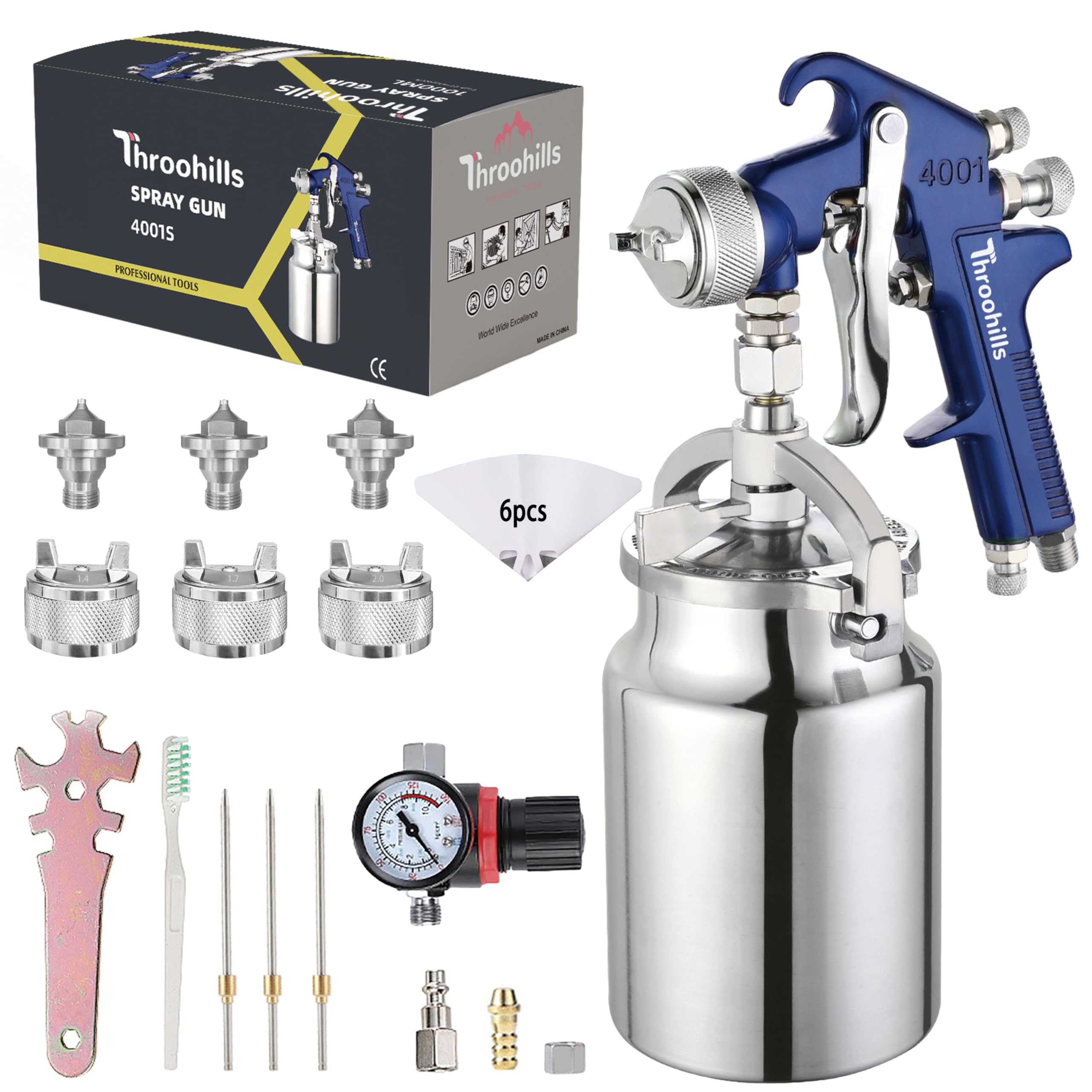
The large-cup siphon gun that keeps going when other guns need a refill.
For jobs where stopping to top up the cup breaks your rhythm, this is the one. The aluminum cup holds 1000cc and hangs under the gun in siphon-feed style, pulling paint up through a tube so you can spray at angles a top-mounted cup will not reach. The kit ships with seven items in total: the gun, a 1.4/1.7/2.0mm nozzle set, an air regulator with pressure gauge, the 1000cc cup, six paint strainers, and a wrench. Note that this set ships with seven items in total, while the single-cup PNTGREEN gravity gun is sold as a single gun.
Buyers report it pushes oil-based paint quickly and cleanly, with setup taking only minutes. Reports describe it pushing through oil-based paint quickly and cleanly, without splatter or clumps, and setting up takes minutes. The 360-degree adjustable nozzle cap lets you point the fan where you need it, and the stainless nozzles with brass airflow cap are built to take wear. The strainers in the box matter more than they look — filtering the paint before it hits the gun is how you avoid dried flakes clogging the nozzle mid-panel.
The catch with any siphon gun is that you have to keep the cup level to draw paint properly, so spraying overhead or upside down takes some practice. Also, this set weighs 3 pounds versus the PNTGREEN gravity gun at 1.5 pounds — the bigger cup has to live somewhere.
The one thing to plan around: siphon feed wants the cup kept reasonably upright, so overhead work takes more care than a gravity gun would.
Worth grabbing if: your priority is fewer refills and the ability to spray at awkward angles with a large cup.
Keep looking if: you mostly spray overhead or upside down.
5. NEIKO 31216A Air Spray Paint Gun HVLP Gravity Feed 2.0mm

A one-piece steel gun with a wide 2.0mm tip built for thicker paint.
The 2.0mm nozzle is the whole point of this gun. That wide opening lets thicker material flow through where a 1.4mm tip would clog, and the listed operating pressure is 40 PSI with an average air consumption of just 4.5 CFM. That low draw is the pleasant surprise here — a compressor feeding a 2.0mm gun usually needs far more air, so 4.5 CFM makes this one easier to power than the air-hungry siphon guns above.
Owners mention the spray itself stays steady and predictable, and that pattern holds up on household and automotive work. The one-piece steel body, stainless nozzle and brass cap hold up to solvent flushing between jobs. The listed spec also points to a wide reach: a 600cc aluminum cup with lid, plus a metal air gauge and regulator, a cleaning brush and a multi-size wrench to take it apart.
Where this gun divides people is the cleanup and the long haul. Nozzle removal is the most-discussed weak spot — some units come apart easily for cleaning while others resist the nozzle tip coming off — and durability over time is the other honest caveat, with internal corrosion reported. Flush it properly after every use and it earns its keep; treat it as a workhorse rather than a buy-once tool.
Strengths Worth Backing
- 2.0mm tip handles thicker coatings, including latex, where smaller tips struggle
- Only 4.5 CFM average air draw at 40 PSI operating pressure
- All-steel one-piece body with stainless steel nozzle and solid brass cap
- Includes air gauge/regulator, cleaning brush and multi-size wrench
The Honest Caveats
- Nozzle removal is hit and miss — flush it fully to avoid seizing
- Internal corrosion can show up over time if the gun sits dirty
Pick this one when: thick paint is your daily job and your compressor is modest.
Different pick if: you want low maintenance and long-term durability above all.
6. PNTGREEN HVLP Siphon Feed Spray Gun 1000CC with 1.8mm Nozzle

A 1000cc siphon gun that swallows thick wall paint and keeps spraying.
Walls, fences and big flat surfaces are where this gun belongs. Its 1000CC detachable siphon cup (a cup that pulls paint up from below) means longer runs between refills. The 1.8mm stainless nozzle sits between the fine finishing tips and the wide 2.0mm jobs, and the 360-degree adjustable nozzle cap lets you point the fan along a wall. It is rated at 3.45 bar (50 PSI) and draws 18 cfm of air — the highest demand on this list, so you need a substantial compressor behind it.
It lays down a uniform spray across a full wall pass and flushes out easily afterward. It lays down a uniform spray and cleans up easily, and the three-valve adjustment covers liquid volume, air volume and spray range. For DIY projects, larger home paint jobs and general spraying, it does the job without fuss. At 1.9 pounds it is manageable to hold for a full pass along a wall.
The one caution to weigh honestly is durability over the long term — a small number of units have failed within the first month, though most owners run theirs for project after project without trouble. Given the high 18 cfm draw, the bigger risk for most buyers is actually underpowering it. Pair it with a compressor that genuinely delivers that volume or the finish will suffer before the gun ever does.
The real gate: 18 cfm consumption is the deciding number — if your compressor cannot sustain it, look at the HIUHIU R500 or NEIKO instead.
What’s inside: one spray gun and a user manual; cleaning accessories and extra nozzles are not included, so budget for those separately.
Best matched to: anyone with a large compressor doing walls, fences and broad surface work.
Poor fit if: you own a small hobby compressor that cannot deliver 18 cfm.
7. HIUHIU R500 LVLP Spray Gun Kit with 1.3mm Nozzle and Regulator

The low-air gun that sprays a smooth panel without fogging your whole workshop.
LVLP means low volume, low pressure — this gun moves less air (3.0–3.9 cfm) at lower pressure (2.0–3.5 bar). It breaks the paint into a fine mist, so less overspray drifts up around your breathing space and onto your walls. That matters if you spray in a garage you also want to keep clean. The 1.3mm nozzle and 280mm maximum spray width suit fine automotive work — basecoats, clears and topcoats where a smooth, even finish matters.
Owners compare its atomization to guns costing far more, and it does it on 3.0–3.9 cfm. Owners compare its atomization to far more expensive models, and the kit arrives ready to go with an air regulator, an oil-water separator, filter, cleaning brush and multi-size spanner. The two-gear trigger — first click for blowing off dust, second for painting — is a small touch that makes long body-shop sessions easier on your hand. Trigger pull has a gentle, controlled feel, and the PE cup is corrosion resistant and easy to flush.
Paint coverage is where opinions split — some owners find it needs a couple of coats to build up, while others are happy first time. That depends on dialling in your fan width and distance. Also note the 1.3mm nozzle is a fine-finish tip, so this is not the gun for thick primer or bulky coatings; for those, step up to a 2.0mm gun.
This is your gun if: you spray automotive finishes in a home garage and want less overspray and a smoother coat.
Not the right fit if: you need to push thick primers and heavy material.
8. Campbell Hausfeld Paint Spray Gun Kit, Gravity Feed (AT706099)

Two gravity guns, ten filters and a carrying case — a complete starter setup.
The box is generous: two complete spray guns, two adjusting valves, ten paint filters, five in-line paint filters, three cleaning brushes, a metal file, a coupler, PTFE thread tape and a wrench, all in a carrying case. The two guns draw 2.1 SCFM and 0.7 SCFM at 40 PSI (SCFM is a standard measure of air flow), so the lower-draw gun is a realistic match for a small compressor. The filter supply alone saves you buying cleaning accessories separately.
The guns are built to atomize paint into an even particle size for a smooth, consistent coat, and the design reduces paint waste — note when you are spraying expensive automotive paint. For carpentry work, furniture and home projects the two-gun setup lets you keep one gun on primer and the other on topcoat rather than flushing between.
Functionality is the honest question mark — some kits work exactly as promised from the first trigger pull, while a few arrive needing attention before they perform. Approach it as a starter kit you may need to test-drive and adjust, rather than a plug-in-and-go tool. With the right setup, both the 2.1 SCFM and 0.7 SCFM guns at 40 PSI give you two very different air demands in one box.
Smart buy because: the accessory haul — 10 paint filters, 5 in-line filters, valves, brushes — turns one kit into a full starter station.
Good fit for: beginners who want two guns and every filter they will need in one case.
Look at the PNTGREEN 1.4mm instead if: you want the simplest single-gun setup with the least to set up.
9. Ingersoll Rand 210G Gravity Feed Spray Gun

The precision gun — a gauge, a pattern knob and a non-drip cup for fine control.
Everything about the 210G is aimed at control. The air regulator with gauge lets you see and set the exact pressure you are spraying at, a filter adjustment knob dials airflow for any project, and a spray pattern knob sets the precise shape of the fan. The non-drip cup is the sleeper feature — no paint loss and far less mess to wipe up, which saves time on every cleanup. The max air pressure is 60 PSIG with 11 cfm average consumption, and the ¼-inch air inlet wants a minimum 5/16-inch hose to feed it properly.
The 20oz gravity cup and 2.6 pounds weight keep it well within reach for detail work, and the built-in filter cleans the paint before it sprays for a cleaner finish. Owners describe it spraying smoothly and predictably, and it will run off a small air compressor if that is what you have — the 11 cfm draw is modest compared to the 18 cfm siphon guns above. Suspension hook for storage and a 1-year limited warranty round it out.
The realistic caution is the air supply. Even a modest-draw gun needs the compressor to keep up when you are holding the trigger for a full panel; at 11 cfm the tank empties on a small unit sooner than you would like. It is the most controlled gun here, not the fastest one.
The call: choose the 210G when precise, repeatable control on a home-compressor budget matters more than raw speed.
Caveat to note: a small tank will still need to keep up with the 11 cfm it pulls while you paint.
Understanding the Specs
Air Consumption (CFM)
CFM — cubic feet per minute — is how much air the gun swallows while you hold the trigger. It is the single most important number for matching a gun to your compressor. A lower draw like 3.0–3.9 cfm on an LVLP gun runs easily off a modest compressor; a siphon gun demanding 18 cfm needs a genuinely powerful pump behind it. If your compressor’s rating falls short, pressure drops and the finish goes patchy mid-panel.
Nozzle Size (mm)
The nozzle is the tip paint squeezes through, and its diameter in millimetres decides what the gun can handle. Small tips around 1.0mm to 1.3mm are for thin finishes like clears and basecoats. A 1.4mm tip is the all-rounder for primer and general topcoat. Move to 1.7mm or 2.0mm and thicker, higher-viscosity material flows without being thinned down. Sets offering multiple tips let one gun cover several jobs.
Gravity vs Siphon Feed
Gravity-feed guns mount the cup on top so paint flows down by weight — less waste in the cup, cleaner flow as the level drops, and easier flushing because there is no pickup tube. Siphon-feed guns hang the cup underneath and suck paint up, which suits bigger cups and awkward angles but wants the cup kept upright.
Working Pressure (PSI / bar)
Pressure is the force pushing the paint out, and it interacts with air volume. Listed operating pressures here run from 40 PSI to 60 PSIG. More pressure atomizes paint finer but increases overspray; less pressure lays material down wetter and slower. Always match the gun’s rated pressure to what your regulator can hold steady while spraying.
FAQ
Will this type of spray gun run on a small hobby compressor?
What size nozzle do I need for car painting?
Can I spray thick paint or latex with a 1.4mm gun?
Gravity feed or siphon feed — which is easier to clean?
Why does my spray pattern come out dry and grainy?
Do I need an air regulator and gauge on the gun?
How do I stop paint from clogging the nozzle?
Is HVLP or LVLP better for spraying in a home garage?
How much pressure should I run through these guns?
Final Thoughts: The Verdict
For most people the winner is the REFINE Spray Paint Gun Set because it puts two aluminum-bodied guns and three nozzle sizes in one case, so one purchase covers primer, topcoat and touch-up. If fine automotive finishing on a low air supply is your game, the HIUHIU R500 LVLP kit with its 1.3mm nozzle and low 3.0–3.9 cfm draw is the smarter reach. And if thick paint and a large cup matter most, the NEIKO 31216A with its 2.0mm nozzle and just 4.5 CFM average draw is the workhorse to grab. Check your compressor’s CFM before you click buy — that one number decides which of these guns is right for you.
How We Picked
We do not accept paid placement. Every pick is matched to a real buyer and a real use-case; we do not hands-on test units.
Sources & Methodology
Specifications: manufacturer listings and product documentation. Review insights: verified customer reviews, as of November 2026. Pricing: not shown on this page (it changes often); check the current price via the retailer link.
As an Amazon Associate, Gadgets Feed earns from qualifying purchases. This does not affect which products we feature.