
Our readers keep the lights on and my morning glass full of iced black tea. As an Amazon Associate, I earn from qualifying purchases.
Specs are compiled from manufacturer listings and verified buyer reviews and can change over time — please confirm the key details on the product page before buying.
You need a stationary air compressor that keeps your tools running without long waits or deafening noise. The wrong pick either starves your nail gun or floods your garage with sound. To match a machine to your workshop, focus on three specs: tank size (how much air is stored), CFM (cubic feet per minute, the airflow your tools need), and pump type (single-stage for light work, two-stage for heavy duty).
I’m Min — the founder and writer behind Gadgets Feed. This guide is built by comparing the manufacturers’ published specifications and the patterns across verified customer reviews, so you get each pick’s real strengths and trade-offs instead of marketing spin.
We’ve matched each unit to the jobs it handles best, from weekend garage projects to continuous industrial use. air compressor stationary buyers need honest CFM numbers and real noise levels to avoid costly mistakes.
Our Picks at a Glance


How To Choose The Best Air Compressor Stationary
Before you compare models, understand that a stationary compressor’s job is to store a large volume of compressed air and refill it quickly. Your buying decision hinges on three numbers: tank gallons, CFM output, and the pressure rating in PSI.
Match CFM to Your Most Demanding Tool
CFM (cubic feet per minute) tells you how much air the pump delivers. A tool like a paint sprayer or an impact wrench needs a high CFM to run continuously. Check your tool’s requirement, then pick a compressor that exceeds it at 90 PSI so you never starve the tool mid-task.
Decide Between Oil-Free and Cast Iron Pumps
Oil-free pumps are lighter, cheaper, and easier to maintain, but they run hotter and tend to have shorter lifespans. Cast-iron two-stage pumps cost more and are heavier, yet they handle continuous duty and can last for years in a busy shop.
Quick Comparison
| Model | Best For | Tank Size | Max Pressure | Air Flow (CFM) | Amazon |
|---|---|---|---|---|---|
| Klutch 20-Gallon★ Best Overall | Home garage & DIY | 20 gallons | 175 PSI | 5.2 CFM | Amazon |
| NorthStar 20-GallonQuiet Performer | Quiet home shop work | 20 gallons | — | 5.0 CFM | Amazon |
| VEVOR 80-Gallon | Industrial & manufacturing | 80 gallons | 145 PSI | 15.5 CFM | Amazon |
| California Air Tools 60-Gallon | Noise-sensitive workshops | 60 gallons | 125 PSI | 10.6 CFM | Amazon |
| DEWALT 60-Gallon | Two-stage power in a vertical footprint | 60 gallons | 175 PSI | 15.3 CFM | Amazon |
| Ingersoll Rand 2340L5-V | Continuous shop duty | 60 gallons | — | 14 CFM | Amazon |
| Ingersoll Rand 2475N7.5 | Heavy industrial & large shops | 80 gallons | 175 PSIG | 24 CFM | Amazon |
In‑Depth Reviews
1. Klutch 20-Gallon Air Compressor, 2 HP, 120V, 175 PSI, 4.2 SCFM at 90 PSI
Our pick — over 4★ from 700+ verified ratings; the strongest balance of quality and price.
A quiet 20-gallon tank that keeps pace with home garage tools.
This Klutch is the crowd favorite because it nails the balance of price, noise, and pressure for home use. The 175 PSI maximum pressure (the force that pushes air out) matches what larger, pricier units deliver, and it reaches that level quietly enough that buyers report a dramatic drop in noise compared to older compressors.
Performance is what wins people over here—over 150 owners single out how well it keeps up. The oil-free pump cuts maintenance chores, and the 20-gallon vertical design saves floor space while the large rubber wheels and handle let you roll it where it’s needed, despite being a stationary-style tank. As buyers put it: “decently quiet and plenty of air pressure to keep up with my air tools without having to stop and let the tank fill up constantly.”
The Strengths
- Quiet 175 PSI operation that rivals pricier box-store units
- Oil-free pump means minimal maintenance for home users
- Vertical 20-gallon tank fits neatly into a garage corner
The Trade-offs
- Refill time draws mixed feedback—some find initial fill slow
- No built-in accessory storage on the unit
Reach for this if: you want a dependable, quiet compressor for home garage projects without spending premium money.
Think twice if: you run continuously demanding tools—the CFM may be optimistic for a busy shop.
2. NorthStar Single-Stage Air Compressor, 20-Gallon, 2 HP, 5.0 CFM
A quiet cast-iron pump that’s easy on the ears for weekend garage work.
What sets the NorthStar apart is its 2-cylinder cast iron single-stage pump, a step up in durability from oil-free designs. It delivers 5.0 CFM at 90 PSI (cubic feet per minute—the volume of air the pump pushes out at that working pressure), and owners consistently note it runs quieter than expected with a low-frequency hum.
The dual-voltage induction motor (115V/230V) means you can plug into a standard wall outlet or rewire for higher capacity with a qualified electrician. Its value shines brightest on the durability front—owners mention years of trouble-free service, and the 4-year warranty sealed the deal for many who worried about brands outsourcing cheap parts. One recurring note: the regulator can feel restrictive for a 1/2″ impact wrench, and the unit runs a bit top-heavy.
Built to last: cast iron construction and a 4-year warranty give this a longevity edge over cheaper oil-free rivals.
A fair warning: the regulator limits high-volume tools, and a side drain doesn’t fully empty the tank.
Best for: the homeowner who wants quiet, reliable service and plans to keep a compressor for years.
Not for: heavy continuous duty where a two-stage pump would be the better fit.
3. VEVOR 80 Gallon Air Compressor, 145PSI Oil Free, 6.5HP 15.5SCFM

Massive 80-gallon reserve and a 6.5 HP motor built for industrial-scale demand.
The VEVOR earns its spot for heavy-duty jobs because it holds a full 80-gallon tank—a 4.0x capacity jump over the Klutch’s 20 gallons—so you can paint a car without waiting for refills. Its 6.5 horsepower motor delivers 15.5 SCFM (standard cubic feet per minute, the airflow measure) at 90 PSI (pounds per square inch, the pressure), roughly three times the airflow of a typical home-shop unit. Customers note it fills fast and holds 120+ psi while painting a car, with no water in the lines, so your spray gun stays consistent.
At 264.6 pounds, this is a firmly-anchored stationary machine, not something you move around. It runs on 220V/60Hz single-phase power, and owners note you’ll need to supply accessories like a regulator and water separator. The oil-free design keeps maintenance low, but a handful of buyers flagged quality-control issues on delivery, so inspect the tank weld carefully on arrival.
The big win: 15.5 CFM and massive reserve mean you can run spray guns and multiple tools without waiting for recovery.
Be prepared: it’s top-heavy, needs a 240V hard-wire hookup, and the given power cable is short.
Pick this when: you need industrial-scale air delivery for a workshop or manufacturing floor.
skip it if: you only have a standard 120V outlet—this requires dedicated 220V wiring.
4. California Air Tools CAT-60040CAD 4.0 HP, 60 Gallon Steel Tank, 75 dBA

A 75 dBA whisper-quiet unit that lets you talk while it works.
If noise is your top concern, this is the standout because it operates at 75 decibels—quiet enough that owners say conversation is possible nearby. That quiet comes from twin 2.0 HP motors spinning at just 1680 RPM (revolutions per minute, a measure of how slowly the motor turns, which cuts both noise and wear), so you can work in a shared garage without shouting. It delivers 10.60 CFM at 90 PSI from a hefty 60-gallon steel tank, giving you steady airflow for most shop tools.
The oil-free dual piston pump is rated for over 3,000 hours of life, a solid figure for its class., and the factory-installed EZ-1 Automatic Drain Valve removes the chore of manually draining moisture. Owners find the build quality excellent with perfect welds and no leaks, and the low amp draw means it’s cheaper to run. Some report small slow leaks can cause the motor to kick on every day or two at rest, a minor quibble for such a quiet machine.
Why Owners Love It
- 75 dBA noise level is among the quietest in its class
- Auto drain valve means zero daily maintenance
- Long 3000+ hour pump life for the oil-free category
What To Watch
- 125 PSI max pressure is lower than some two-stage rivals
- Small leaks at rest can trigger the motor periodically
Choose this for: a home shop where you value conversation-friendly quiet over raw maximum pressure.
Move on if: you need high-pressure two-stage output for heavy industrial tools.
5. DEWALT 60-Gallon Stationary Vertical Air Compressor (DXCMV5076055)
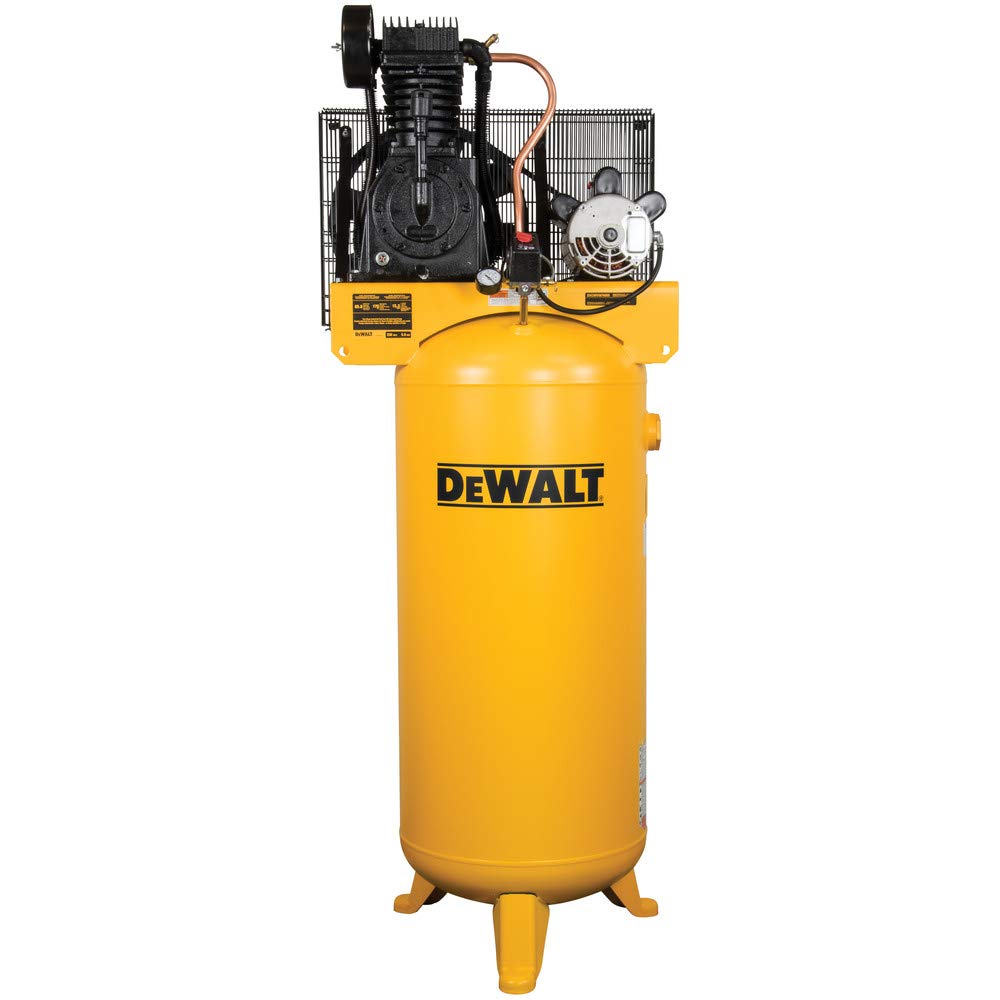
A 5 HP two-stage vertical that packs serious punch in a space-saving footprint.
DEWALT brings the heavy artillery for continuous, high-demand work—it delivers 15.3 SCFM at 100 PSI and pushes a strong 175 PSI maximum, so you can run sanders and impact wrenches without pressure drops. The sturdy 5 HP, 230-volt motor includes thermal overload protection (a safeguard that shuts the motor down before it overheats during prolonged use), keeping performance consistent on long jobs. This two-stage unit (which compresses air in two steps for higher pressure) suits a professional shop better than the VEVOR’s single-stage design.
Owners praise the build quality, noting it “functions flawlessly” and holds pressure even after a week of sitting idle. The vertical design stands 80 inches tall but takes minimal floor space. A few buyers did flag a serious quality-control issue with a welded seam, so a careful inspection on delivery is worthwhile.
The payoff: 15.3 CFM at 100 PSI gives you the air volume for demanding shop tools without a huge footprint.
The caution: wiring instructions drew complaints, and the occasional weld defect means check seams before setup.
Best for: the serious DIYer or small shop wanting two-stage power in a vertical, space-conscious design.
Not ideal if: you want a unit that arrives fully ready—verify wiring and seams first.
6. Ingersoll Rand 2340L5-V 5 HP Type 30 Two-Stage Air Compressor

A cast-iron legend rated for 100% continuous duty that outlasts cheaper pumps.
Ingersoll Rand is a name that commands respect in compressed air, and the 2340L5-V earns it. The 5 HP two-stage motor is rated for 100% continuous duty, so it won’t overheat during long runs. (meaning it’s designed to run without interruption at high volumes and high pressure), and it delivers 14 CFM into a 60-gallon vertical tank. Owners call it “very quiet for being 5 HP” and praise the phenomenal performance versus industry-standard equipment.
The individually cast cylinders, overhung crankshaft, and one-piece connecting rod simplify maintenance and service. At 430 pounds, this is a permanent fixture in a shop, running on 230 volts single phase. One buyer warned that pump bolts arrived unstarted and a drain plug was cross-threaded, so a pre-use bolt check is wise.
The edge: true continuous-duty design means it won’t quit during long production runs.
Look closer: it’s a 230V hard-wire install, and a few units need a bolt check on arrival.
Reach for this: when your shop runs air tools for hours and you need a pump that won’t overheat or stop.
Think twice if: you lack 230V wiring or need something movable around a small space.
7. Ingersoll Rand 2475N7.5 7.5 HP Two-Stage Air Compressor

The 7.5 HP two-stage titan with 24 CFM that even a medium shop won’t outrun.
This is the top of the food chain here. The 2475N7.5 delivers a massive 24 CFM (cubic feet per minute) from a 7.5 hp two-stage pump, with a 175 psig maximum operating pressure and an 80-gallon ASME receiver tank. Owners say it’s “probably more substantial of a unit than I actually need” and that even a medium-sized shop will “never run out of air.”
Its cast-iron construction is rated for over 15,000 hours of trouble-free use, ideal for continuous industrial work., and The All Season Select synthetic lubricant needs changing every 2,000 hours—four times longer than petroleum-based oils.. At 611 pounds on a 38″L x 24″W x 70″H frame, this is a permanent installation for serious industrial work.
The payoff: 24 CFM and continuous-duty rating mean you can run multiple high-volume tools simultaneously.
The reality: it’s a 230V professional install, and the synthetic oil is pricey when it’s time to change it.
Get this if: you operate a professional shop where downtime is not an option and you need maximum airflow.
Pass on it if: your needs are modest—this is far more machine than a hobby garage requires.
Understanding the Specs
CFM at 90 PSI
CFM (cubic feet per minute) at 90 PSI is the real measure of a compressor’s working power. It tells you how much air the pump delivers at the pressure most tools use. Check your most demanding tool’s requirement and make sure the compressor exceeds it—otherwise you’ll wait for the tank to refill mid-project.
Tank Size and Duty Cycle
Tank size in gallons dictates how much compressed air you store. A 60-gallon tank gives you a long burst of air before the pump kicks in, while an 80-gallon tank extends that further. Duty cycle describes how long the pump can run without overheating—two-stage cast-iron units handle continuous duty, while oil-free pumps need break time.
FAQ
What size air compressor do I need for a home garage?
What’s the difference between single-stage and two-stage compressors?
Do I need 230V or 120V power for a stationary compressor?
How does tank size affect performance?
How loud is a stationary air compressor?
What maintenance does an oil-free compressor need?
Is a cast iron pump worth the extra cost?
How much CFM do I need for a paint sprayer?
Final Thoughts: The Verdict
If you want one dependable pick, the air compressor stationary winner is the Klutch 20-Gallon because it delivers 175 PSI and quiet operation for a home garage price. If you want whisper-quiet performance in a serious shop, grab the California Air Tools 60-Gallon. And for industrial-scale airflow with a 24 CFM output, the Ingersoll Rand 2475N7.5 is the one to reach for. Match the tank size and CFM to your real workload, and you’ll buy once and buy right.
How We Picked
We do not accept paid placement. Every pick is matched to a real buyer and a real use-case; we do not hands-on test units.
Sources & Methodology
Specifications: manufacturer listings and product documentation. Review insights: verified customer reviews, as of August 2026. Pricing: not shown on this page (it changes often); check the current price via the retailer link.
As an Amazon Associate, Gadgets Feed earns from qualifying purchases. This does not affect which products we feature.