
Our readers keep the lights on and my morning glass full of iced black tea. As an Amazon Associate, I earn from qualifying purchases.
Specs are compiled from manufacturer listings and verified buyer reviews and can change over time — please confirm the key details on the product page before buying.
If your compressor kicks on every time you pull the trigger on a nailer, you don’t need a bigger compressor — you need a buffer tank. A correctly sized air compressor tank stores pressurized air to deliver steady tool output and prevent your pump from cycling constantly. This guide compares standalone tanks and tank-compressor combos on capacity, pressure rating, and port count.
I’m Min — the founder and writer behind Gadgets Feed. This guide is built by comparing the manufacturers’ published specifications and the patterns across verified customer reviews, so you get each pick’s real strengths and trade-offs instead of marketing spin.
You need an air compressor tank that matches your tools, but the right size and pressure rating depend on whether you’re topping off tires or framing a house. The choices below span portable 5-gallon units for inflation up to high-capacity 10-gallon reserves that keep up with pro-grade nailers.
Our Picks at a Glance

How To Choose The Best Air Compressor Tanks
An air tank is a storage buffer, not a power source. It stores compressed air from your existing compressor so you can run tools without waiting for the pump to catch up. Getting the size and pressure rating right prevents the two most common complaints: a pump that cycles too often and a safety valve that pops unexpectedly.
Match capacity to your tool’s air appetite
Tank capacity, measured in gallons, matters only if your tools demand high air volume. A roofing nailer sips air, so a 10-gallon reserve can power five or more nailers at once. A sandblaster or die grinder gulps air, so even a large tank will empty fast — the tank’s job is simply to extend your run time between pump cycles.
Check the PSI ceiling before you buy
The PSI rating indicates the maximum safe pressure the tank can hold. If your compressor outputs more pressure than the tank’s relief valve is set to, the valve will pop open and vent air. Look for a tank rated at or above your compressor’s maximum output so you can fill it fully without waste.
Count the ports you actually need
Ports are threaded openings for attaching hoses, gauges, and regulators. A tank with more ports lets you run multiple tools or leave a gauge and a drain valve installed simultaneously. The 1/4″ NPT thread size is standard for most air tools and hoses.
Quick Comparison
| Model | Best For | Capacity | Max Pressure | Ports | Amazon |
|---|---|---|---|---|---|
| Metabo HPT 10 Gallon★ Best Overall | Pro nailer reserves | 10 gallons | 150 PSI | 5 couplers | Amazon |
| ECOMAX 6 Gallon PancakeKit Value | Portable inflation + tools | 6 gallons | 150 PSI | 2 couplers | Amazon |
| Master Airbrush Cool Runner IIQuiet Studio Pick | Quiet airbrushing | 3 liters | 57 PSI cutoff | 1 regulator | Amazon |
| VEVOR 6.3 Gallon Compressor | Quiet mobile work | 6.3 gallons | 116 PSI | 1 outlet | Amazon |
| VIAIR 91050 5 Gallon | Onboard vehicle air | 5 gallons | 150 PSI | 4 ports | Amazon |
| Performance Tool W10011 11-Gallon | Extra storage volume | 11 gallons | 125 PSI | 1 outlet | Amazon |
| BIG RED 7 Gallon | Farm tire inflation | 7 gallons | 125 PSI | 1 hose | Amazon |
| VIAIR 2.5 Gallon | Compact under-vehicle installs | 2.5 gallons | 200 PSI | 6 ports | Amazon |
| MaxWorks 5 Gallon | Budget portable inflation | 5 gallons | 140 PSI | 1 hose | Amazon |
In-Depth Reviews
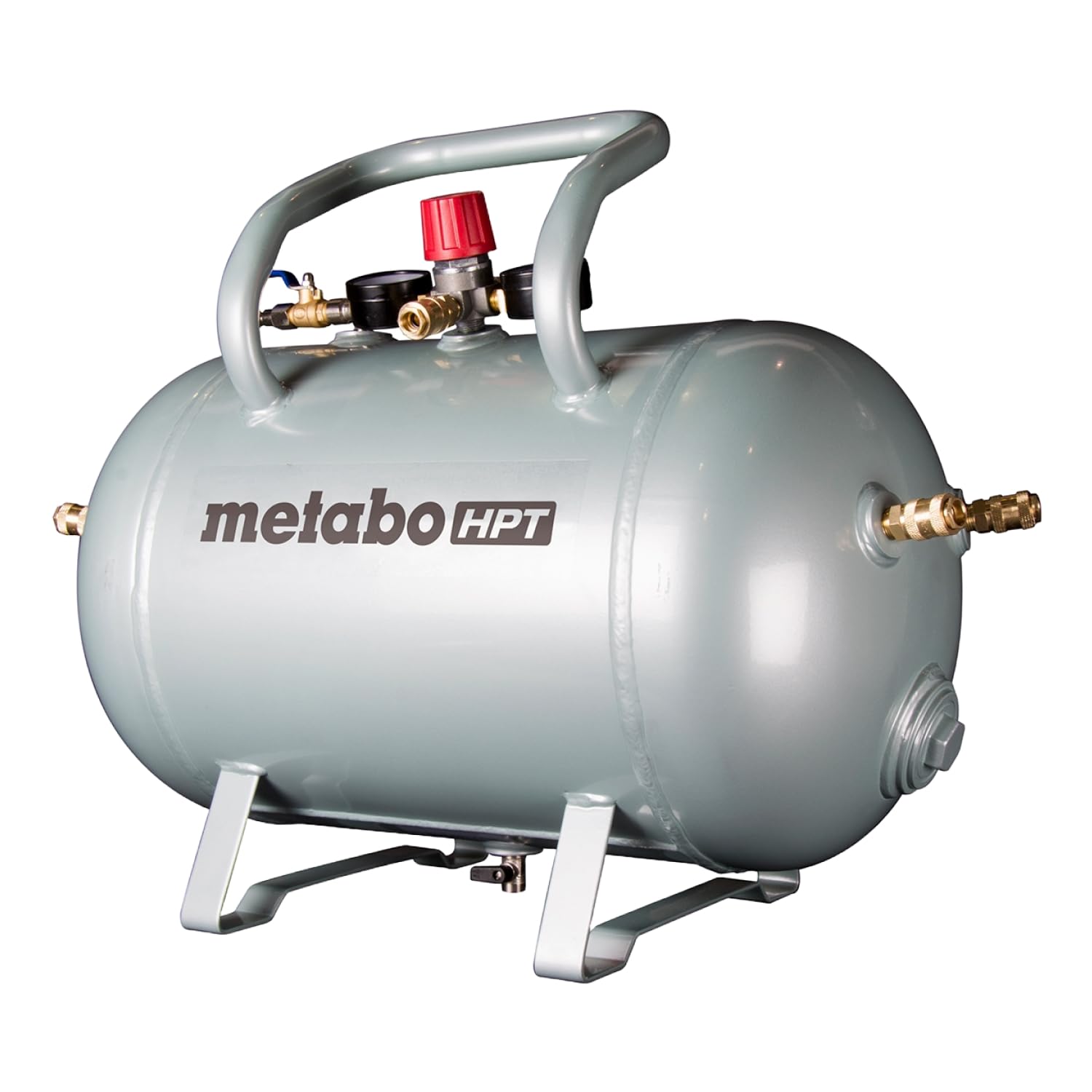
1. Metabo HPT 10 Gallon Air Tank
Our pick — over 4.5★ from 350+ verified ratings; the strongest balance of quality and price.
The heavy-duty reserve that keeps five nailers firing at full power, even 200 feet from the compressor.
This stationary buffer is for jobsite pros, not portable tire top-offs. The 10-gallon capacity holds enough air to power five or more nailers simultaneously, which means your main compressor stops its constant cycle-and-rest rhythm. Owners describe using it as an add-on reserve for a 36-gallon compressor to smooth out demand during painting and framing.
The 150 PSI rating and five quick-connect couplers (four unregulated plus one regulated) let you attach multiple hoses and tools at once. Buyers report that the tank is stamped 175psi but the relief valve pops at 150psi — so you need to set your compressor to 145psi to avoid the valve venting. The angled steel legs and roll cage design protect the regulator and gauges from hostile jobsite abuse.
At 39.6 pounds it is the heaviest pick here, roughly 2.8 times the weight of the portable 5-gallon MaxWorks. The weight is offset by a long handle for manageable two-hand carrying. For a busy contractor wanting to stop their small compressor from working overtime, this is the one that delivers.
Why It Earns the Top Spot
- The thing everyone raves about is the quality — owners consistently call it well-made and durable
- Five couplers run multiple tools without swapping hoses constantly
- ASME certification means it complies with U.S. state regulations
- Adds real reserve to small compressors, reducing duty-cycle strain
The Trade-Offs You Feel
- At 39.6 pounds it demands respect when moving — several find it heavy
- The relief valve pops at 150 PSI despite the 175 PSI tank stamp, so dial your compressor down
Reach for it when: you run multiple nailers or paint from a small compressor and need steady, constant pressure without the pump cycling.
Look elsewhere if: you need something to carry to the driveway for tire inflation — this is a stationary jobsite tool, not a portable one.
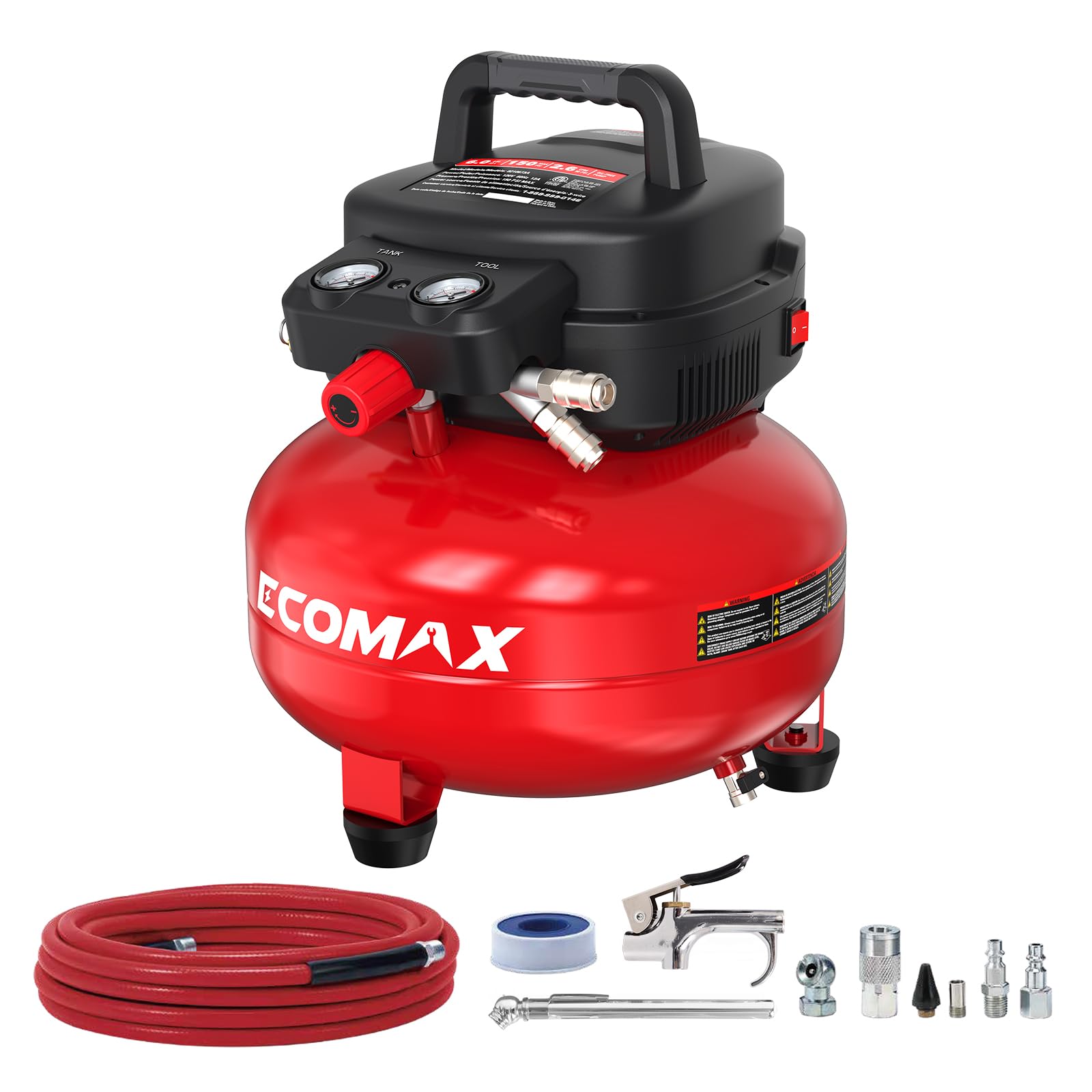
2. ECOMAX Air Compressor 6 Gallon Pancake
A full compressor setup with a 10-piece accessory kit that handles inflation and brad nailing straight from the start.
If you want a ready-to-work setup rather than a bare tank, the ECOMAX is a full pancake compressor with a 6-gallon tank and a 1.5 HP motor. Its 150 PSI maximum output is what owners highlight — it reaches full pressure reliably, so you can drive nails or inflate tires without waiting. The pump delivers 3 cubic inches of air at 90 PSI, which supports extended tool use and quick recovery between firings, meaning less downtime on the job.
The included 10-piece kit is the real value story here: a 25-foot PVC hose, a tire pressure gauge, a blow gun, nozzles, couplers, and thread seal tape. That means you don’t need to buy anything else for basic tire filling or cleaning. Owners using it for motorcycle lifts and RC car chassis cleaning find it powerful and portable — at 34.17 pounds it’s easy to carry out to the driveway.
The honest caveat is audible: owners describe it as “very, very loud” during charging, and one notes the quick air coupler has blow-by. Dual gauges track tank pressure and adjustable outflow pressure separately, which owners find genuinely useful for precision work. For a multi-purpose home setup with low-maintenance oil-free operation, this delivers.
Quality Check: Owners consistently praise the build and power — it’s a super quality product that works well and reaches the full 150 PSI.
Noise Reality: This is not a quiet unit; plan to wear hearing protection or run it where noise won’t bother anyone.
3. Master Airbrush Cool Runner II
The whisper-quiet dedicated compressor that delivers pulsation-free air for serious airbrush detail work.
This isn’t a general-purpose air tank — it’s a purpose-built airbrush compressor with a 3-liter storage tank that delivers constant pressure with zero pulsation. The 1/5 HP single-piston motor pushes a high air volume of 25 liters per minute and 0.8 CFM, which is plenty for detailed spray work. Owners running Badger and Harder & Steenbeck airbrushes find it maintains steady 40 PSI without pressure drop.
The defining trait here is quiet operation at 47 dB. Owners describe being able to airbrush at any time of day without disturbing anyone — a massive upgrade from a garage compressor. Two built-in cooling fans let it run much cooler for longer continuous sessions without overheating, and the premium rotor windings extend the compressor’s lifespan.
The “Air-On-Demand System” auto-shuts off when not in use, preset to turn off at 57 PSI and back on at 43 PSI. The true diaphragm pressure regulator with water trap filter delivers clean, dry air. One fair note: it needs hose adapters for non-Master airbrushes, so check your fittings if you own other brands.
Quiet Power: Noise level is what wins people over here — owners consistently report it’s quiet and reliable enough for any-time-of-day studio work.
Who It’s Not For: If you need to drive framing nailers or impact wrenches, this small piston unit is the wrong tool — it’s built for fine spray work only.
4. VEVOR 6.3 Gallon Air Compressor

The quiet 2 HP compressor that fills a 6.5-gallon tank to 120 PSI in under a minute, without rattling the garage.
This compact compressor-tank combo delivers fast refill with a 1450W oil-free motor that drives the pump to 3500 r/min and 3.35 CFM at 90 PSI. Owners who replaced leaking Stanley units are impressed by how quickly it reaches pressure — under 60 seconds to hit 120 PSI. That fast recovery means no work pause even when the tank empties.
The noise reduction design is the standout feature owners praise most. Two high-quality silencers, each with a thickened muffler cover, rubber muffler pipe, and filter cotton, drop the sound dramatically versus typical hotdog or pancake compressors. It’s quiet enough for mobile detailing work, running a Tornador at max capability without disturbing customers.
The real-world catch is voltage sensitivity. Owners mention it fails on some extension cords and needs a dedicated circuit without other loads — it pulls significant power on startup. The 43-pound unit with wheels is portable enough to move around a shop. For auto repair, spray painting, and woodwork nailing, this is a strong value in a complete package.
What Owners Love
- The noise level earns the most praise by far — it’s genuinely quiet
- Value for money is strong against far pricier competitors
- Refill speed and compact size get consistent positive mentions
Know Before You Buy
- It’s voltage picky — needs a dedicated outlet or the right extension cord
- Performance is mixed for some, so set expectations for light-to-moderate use
5. VIAIR 91050 5 Gallon Reservoir Tank
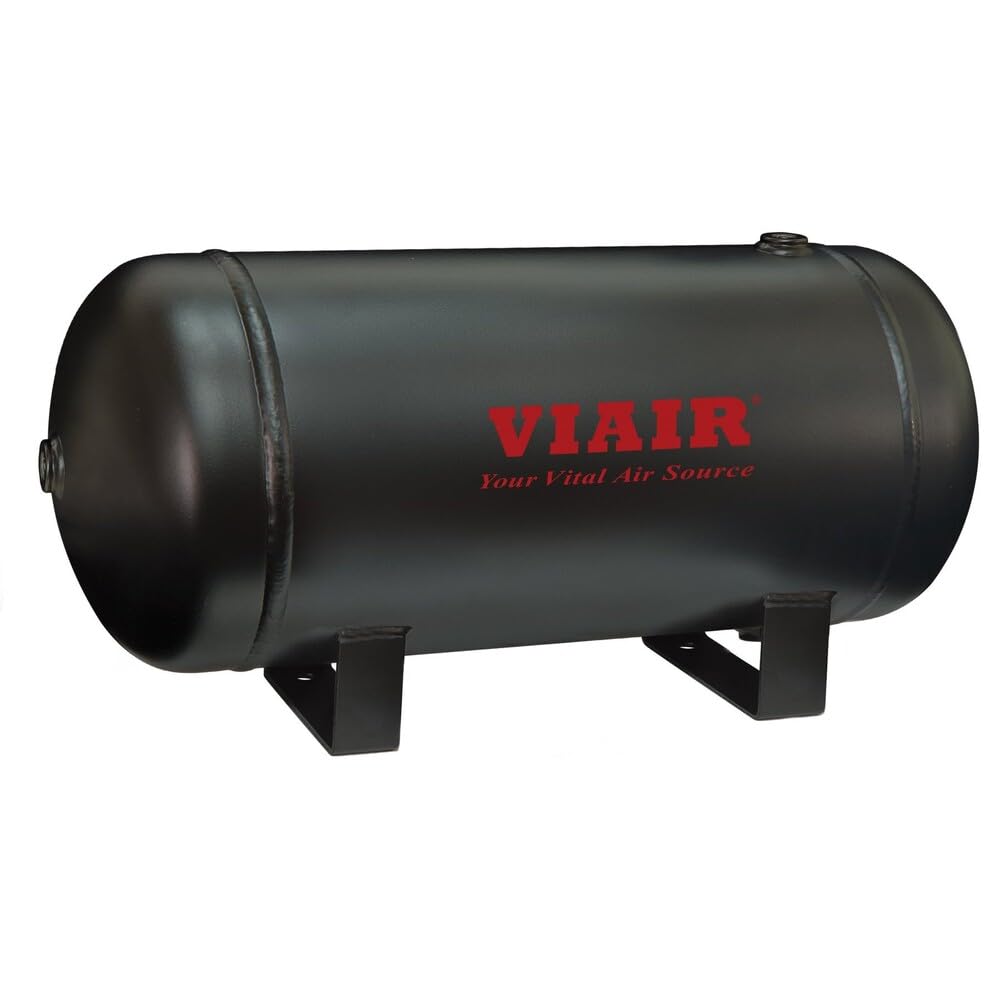
The steel reservoir built to bolt under a truck and feed air horns, air ride, and tire inflation for years.
This is a dedicated onboard air reservoir for vehicles, not a portable carry tank. The 5-gallon steel tank with a 150 PSI maximum working pressure is designed to mount beside truck frame rails or under a truck bed. Its compact footprint — 20.5″L x 9″W x 10.5″H — fits in tight spaces where bulkier tanks won’t go. Owners have run these for multiple years on trucks for air ride systems and horns, reporting the black powdercoat finish still looks like new.
The port configuration is what makes it versatile for custom builds: two 3/8 inch NPT ports and two 1/4 inch NPT ports. That’s enough openings for a pressure switch, relief valve, drain, compressor inlet, gauge, and quick disconnect all at once. Owners value the multiple connection points, though some wish for even more ports — a recurring request rather than a defect. The steel construction with corrosion-resistant coating handles the harsh environment under a vehicle.
One fair technical note from an owner with engineering expertise: the tank comes with a 175 PSI relief valve, and they swapped it for a 140 PSI unit to stay safely under the 150 PSI working rating. Daily bottom discharge of moisture is advised to prevent internal corrosion. For a serious onboard air setup, this is the dependable foundation.
Built to Mount: Functionality and construction earn the top praise — owners call it well-made steel that works exactly as described before, during, and after installation.
One Upgrade Path: If you plan to run many accessories, consider adding a tee or manifold because the four ports fill up fast when you add a gauge, drain, and two inlets.
6. Performance Tool W10011 11-Gallon Tank

The high-visibility yellow reservoir that adds serious storage volume to a small compressor and holds pressure for weeks.
With an 11-gallon capacity, this is one of the largest portable horizontal tanks you can add to an existing compressor. Owners use it to expand the reserve of smaller compressors, preventing constant cycling when running air tools. The capacity is the headline — it holds 110 PSI well, and customers note it retains pressure for literally weeks between uses. That’s a genuine set-and-forget advantage for topping off car tires.
The high-visibility yellow color and 125 PSI maximum pressure make it a clear, safe choice for the garage. Built-in safety pressure bypass valve with manual override provides the expected protection, and the on/off air adjustment dial gives you control over output. The included standard tire chuck means it works right away for vehicle inflation.
The honest trade-off is two-fold. At 23.9 pounds, owners note the handle demands padding for comfortable carrying — one used a pool noodle to cushion it. And the stock manifold and hose are restrictive; owners recommend replacing them with a T-fitting for a faster fill. One owner notes the gauge doesn’t move until about 80 PSI, so don’t expect precise low-pressure readouts. For pure storage volume at a reasonable weight, this delivers.
Big-Volume Strengths
- The air chuck quality gets more praise than anything else — it’s solid and reliable
- Holds pressure for weeks, making it ideal for intermittent tire top-offs
- Sturdy 12-gauge steel walls handle real abuse, even welding projects
Heavyweight Caveats
- At 23.9 pounds with a hard handle, carrying it far is a two-hand chore
- The stock hose and manifold restrict airflow — plan a quick fitting upgrade
7. BIG RED 7 Gallon Air Storage Tank

The alloy-steel portable tank that farmers use to carry tire inflation pressure across the whole property.
This 7-gallon horizontal tank is built for the classic use case of moving air to where there’s no compressor. On a farm, that means carrying pressure around to various vehicles — and owners confirm it shines as a portable tire inflator for exactly that. The compact footprint at 20.3″L x 9.8″W x 12.6″H stores easily in a truck bed or shop corner, and at 18.3 pounds it’s manageable to haul.
The 4-foot industrial-grade 1/4 inch male NPT hose with a standard tire chuck reaches wheel stems without fighting. A built-in pressure release valve with manual override provides the safety layer you want, and the shut-off valve on the input lets you fill it and disconnect from the compressor without the tank draining itself. The alloy steel construction with clean welds and powder coat earns praise for build quality.
Owners find it holds 120 PSI with no leak initially, though the gauge reads about 5% low. After a few months, some report an overnight leak if the hose and inflator are left attached — disconnecting solves it. The plastic valve wheel feels flimsy to some, so treat it gently. For remote inflation duty, this is a dependable workhorse.
Portable Pressure: Owners praise its performance as a portable inflator that retains 100+ PSI indefinitely when the hose is disconnected.
Care Note: The short included hose pushes some to swap in a 6-foot whip, and leaving accessories attached invites slow overnight leaks.
8. VIAIR 2.5 Gallon Air Tank

The high-pressure 2.5-gallon tank with six ports that tucks under a truck to feed horns and tire refills.
This compact steel tank is engineered for tight vehicle installs — it slides under a truck bed or beside frame rails where full-size tanks won’t fit. At just 23.9 x 5.94 x 7.62 inches, owners confirm it’s small and compact enough to fit under a truck with room to spare. The high 200 PSI rated working pressure is the standout spec, giving you a big safety margin over typical compressor output.
The six 1/4″ NPT ports are positioned on various sides of the tank, which owners find gives lots of options for installation and setup. You could run a train horn setup, air lockers, and a tire inflator from one small tank. The black coating and steel construction hold up well, with owners running them for extended periods without issues.
The honest trade-off is volume. At 2.5 gallons, it holds limited air — owners note it has to refill often because it doesn’t store much. That makes it ideal for horns and occasional inflation but not for sustained air tool use. One owner ran a tap through the threads as a precaution before installing, a tip worth knowing. For a compact, reliable, high-pressure foundation, this is a favorite.
Small But Solid: Quality earns the top praise — owners call it well-built with nice welds and no leaks from the start.
Volume Reality: Expect frequent refills; this is a horn and tire top-off tank, not a reserve for continuous air tools.
9. MaxWorks 5 Gallon Portable Air Tank

The lightweight 5-gallon carry tank that holds a charge for three weeks and makes tire duty easy.
This is the budget-friendly entry point for portable air — a 5-gallon tank at just 14.3 pounds with a built-in handle that makes it genuinely easy to carry anywhere. The weight is the story: it’s roughly a third of the weight of the Metabo HPT 10-gallon unit, making it a fraction of the physical burden for home users who just need to top off tires. Owners use it for bike and mower tires with no access to a compressor, and it excels in that role.
Pressure retention is surprisingly strong for the price. Reviewers point out filling it to 60 lbs and finding it still at 60 lbs three weeks later — a level of leak-free storage that defies expectations. The easy-to-read gauge displays both PSI and MPa, and the 140 PSI safety valve keeps operation within safe limits. A 1/4″ NPT 40-inch industrial hose with chuck connects to a wide range of tools.
The honest limitations are worth knowing. Air capacity is mixed — it holds enough for tire duty, but don’t expect to run continuous tools. One owner found the fill stem threads were poor and needed a clip-on adapter to pressurize reliably from an M18 inflator. For light inflation tasks around the home, this is a capable, affordable companion.
Everyday Ease
- Functionality is what wins people over — it works great for tires and stays portable
- Holds pressure for weeks when filled and sealed properly
- Light enough at 14.3 pounds to carry to the driveway without strain
Fit Notes
- Capacity is limited — it’s for inflation bursts, not continuous tool running
- The fill stem threads can be finicky; a clip-on adapter solves the connection issue
Understanding the Specs
Capacity in Gallons
This tells you how much compressed air the tank stores, and it directly controls how long your tools run before the pump restarts. A 5-gallon tank gives you a short burst for tire inflation, while a 10-gallon reserve can drive five nailers at once. Bigger capacity means less pump cycling, which extends the life of your compressor.
Maximum Working Pressure in PSI
Pounds per square inch (PSI) is the force of the air inside the tank. Every tank has a rated maximum — exceed it and the safety relief valve vents to protect you. Match the tank’s PSI rating to your compressor’s output so you can fill it fully without the valve popping. A higher rating like 200 PSI gives a bigger safety margin.
NPT Ports and Threads
NPT (National Pipe Thread) is the standard thread type for air fittings. The number of ports determines how many hoses, gauges, and tools you can connect at once. More ports mean more flexibility — you can leave a gauge and drain installed while still running tools. The common 1/4″ NPT size fits most standard air accessories.
CFM Air Delivery
Cubic feet per minute (CFM) measures how much air the compressor or tank can deliver to your tools. For tanks paired with compressors, this rate tells you the recovery speed — how fast the pump refills after you drain the tank. Air-hungry tools like spray guns need higher CFM than a simple tire inflator.
FAQ
Can I add a reserve tank to my existing compressor?
What happens if my compressor’s PSI exceeds the tank’s relief valve rating?
How long will a filled air tank hold its pressure?
Is a 2.5-gallon tank too small for real use?
What is ASME certification and why does it matter?
How many tools can I run from a single air tank?
What does NPT mean on the port threads?
Should I buy a standalone tank or a full compressor with a tank?
Why does my air tank’s gauge read lower than the actual pressure?
Can I mount an air tank permanently on my vehicle?
Final Thoughts: The Verdict
For most buyers, the best air compressor tank you can add is the Metabo HPT 10 Gallon because its ASME-certified quality, five couplers, and 150 PSI reserve take the strain off any small compressor — it’s the crowd favorite with 4.7 stars from hundreds of owners. If you need a complete quiet setup that handles tires and light trim work, grab the ECOMAX 6 Gallon with its full accessory kit. And for a dependable low-cost way to top off tires anywhere, the MaxWorks 5 Gallon is the one to reach for.
How We Picked
We do not accept paid placement. Every pick is matched to a real buyer and a real use-case; we do not hands-on test units.
Sources & Methodology
Specifications: manufacturer listings and product documentation. Review insights: verified customer reviews, as of September 2026. Pricing: not shown on this page (it changes often); check the current price via the retailer link.
As an Amazon Associate, Gadgets Feed earns from qualifying purchases. This does not affect which products we feature.