
Our readers keep the lights on and my morning glass full of iced black tea. As an Amazon Associate, I earn from qualifying purchases.
Specs are compiled from manufacturer listings and verified buyer reviews and can change over time — please confirm the key details on the product page before buying.
Parked in the sun, a car or truck cab can turn into an oven in minutes. A 12-volt air conditioner delivers cold air without idling the engine. This guide sorts through seven very different ways to cool a vehicle—from rooftop units for RVs to under-dash kits for old trucks to portable tent coolers—so you can match the system to your rig and your power setup.
I’m Min — the founder and writer behind Gadgets Feed. This guide is built by comparing the manufacturers’ published specifications and the patterns across verified customer reviews, so you get each pick’s real strengths and trade-offs instead of marketing spin.
Whether you live in a van, drive a semi, or camp in a tent, the right air con for car depends on your space, your battery, and how much install work you can handle.
Our Picks at a Glance
How To Choose The Best Air Con For Car
Before you buy a 12-volt air conditioner, match it to your vehicle and how you use it. A rooftop unit on a camper van cools a big space, while an under-dash kit fits an old pickup. Decide where you will mount it, how much battery you carry, and if you want a weekend DIY project or a plug-and-play box.
Match the BTU to Your Space
BTU, or British Thermal Units, is the standard measure of cooling power. A higher number means the unit can remove more heat, which matters for larger cabins. A 10000 BTU unit is usually plenty for a camper or truck cab, while a smaller 5100 BTU portable unit is better suited to a tent or a compact space. Heavier units are harder to haul and mount.
Understand Your Battery Limits
These units run on 12V DC power from your vehicle’s electrical system. That means your battery bank decides how long you can stay cool. Check the wattage draw and amp draw of any unit. A system pulling 960 watts will drain a 100Ah battery much faster than one running at 400-600W. If you plan to sleep off-grid, you need either a large battery bank or a low-power mode.
Know Your Installation Type
Rooftop units require cutting a 14″x14″ hole in your roof and sealing it well. Under-dash kits fit inside the cab and need hose routing and refrigerant charging. Portable units need an exhaust hose routed outside. Each type has its own effort level. Be honest about your skill with tools before you commit to a system that demands a two-day install.
Quick Comparison
| Model | Best For | Cooling Power | Power Draw | Form Factor | Amazon |
|---|---|---|---|---|---|
| Outequip RV Air Conditioner★ Best Overall | Rooftop RV installs | 10000 BTU | 960 watts | Rooftop | Amazon |
| jiaji Evaporator KitBest Value | Adding AC to old trucks | 16500 BTU | — | Under-Dash | Amazon |
| CNCEST Split AC | Budget semi-truck cooling | 11000 BTU | 400 watts | Split | Amazon |
| Treeligo Mini Split | Fast cooling, larger rigs | 10000 BTU | 960 watts | Mini-Split | Amazon |
| Universal Under Dash Kit | Cars and vans with space | 10000 BTU | 550-600W | Under-Dash | Amazon |
| Cybertake S2 Pro | Tent and RTT camping | 5100 BTU | 1095 kWh | Portable | Amazon |
| Gidrox Rooftop AC with Heater | Rooftop cooling and heating | 10000 BTU | 2930 watts | Rooftop | Amazon |
In-Depth Reviews
1. Outequip RV Air Conditioner
Our pick — over 4.5★ from 90+ verified ratings; the strongest balance of quality and price.
The rooftop unit that cools a trailer fast while barely whispering.
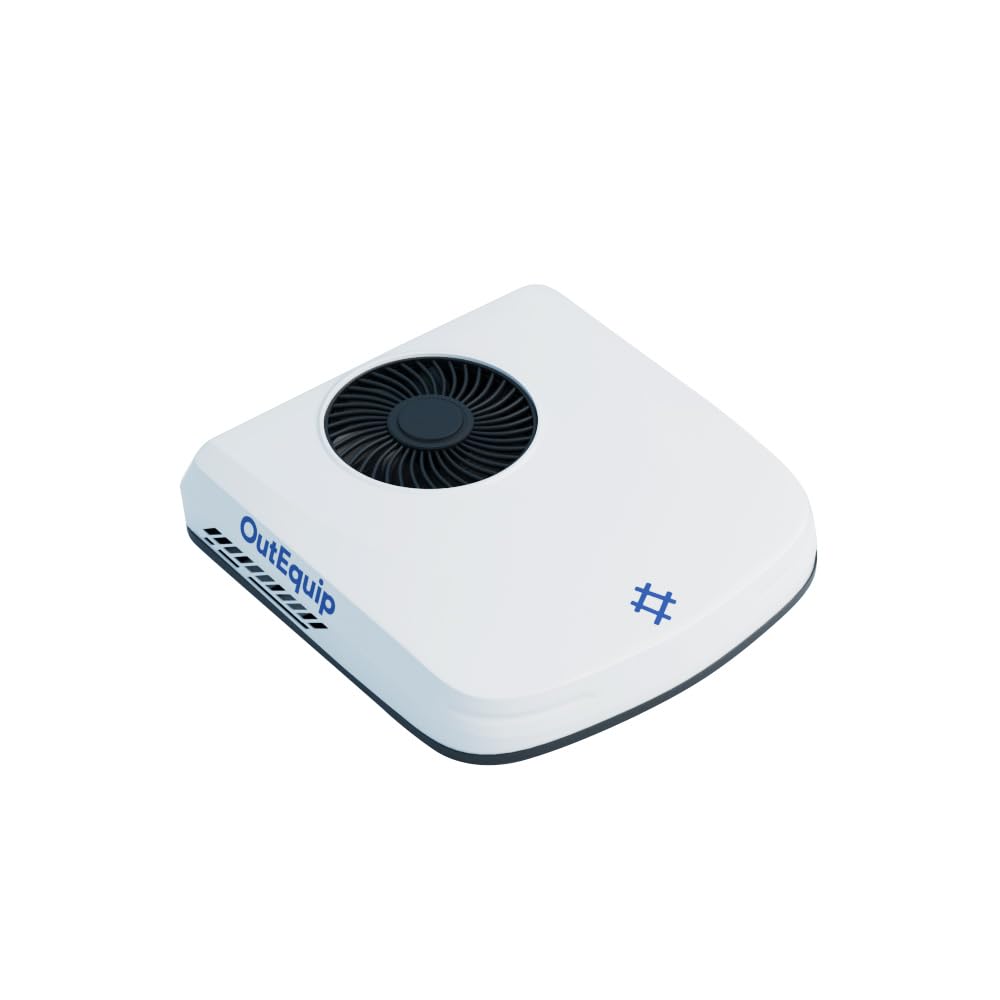
This 10000 BTU rooftop air conditioner is for RV and camper owners who want genuine cooling, not just airflow. The maker says it chills your rig in about 15 minutes, and the cooling performance gets the most praise by far—36 owners single it out. What wins people over is how it runs: a 43-pound unit that owners describe as quiet, efficient, and strong enough to protect electronics in a STEM trailer.
Power comes straight from your vehicle’s 12V system, so there’s no inverter needed. The spec sheet says it draws 960 watts, and real-world reports back that up—owners see roughly 50 amps while running, dropping to about 30 amps once it’s just maintaining the temperature. That translates to about 6 to 7 hours of cooling on a 360Ah battery in a van, or up to 10 hours with a larger 600Ah bank.
Buyers report it cools an insulated 7×14 trailer even in 100°F+ sun, and one noted it delivers 55-degree air. The brushless copper motor fans and spring-supported mounts keep noise low. The catch is installation: it needs a 14×14 roof opening, and sealing the condenser area is critical to prevent leaks. A DIY owner managed a solo install in two days with no roof modifications.
What Owners Rave About
- Cooling performance is the top praise, with fast 15-minute cooldown
- Draws about 50 amps running, 30 amps maintaining—battery-friendly
- Extremely quiet exterior and interior
Install Notes
- Requires a 14×14 roof cutout—measure twice
- Seal the condenser area well to avoid leaks
- Battery charging can compete for converter amps
Reach for this if: you own an RV, camper, or van and want a proven, quiet rooftop unit that runs on your existing 12V battery bank.
Look elsewhere if: your roof doesn’t have or can’t accept a 14×14 opening, or you’re not comfortable with a weekend DIY install.
2. jiaji A/C Evaporator Kit
The complete under-dash kit that gives an old truck factory-style cold air.
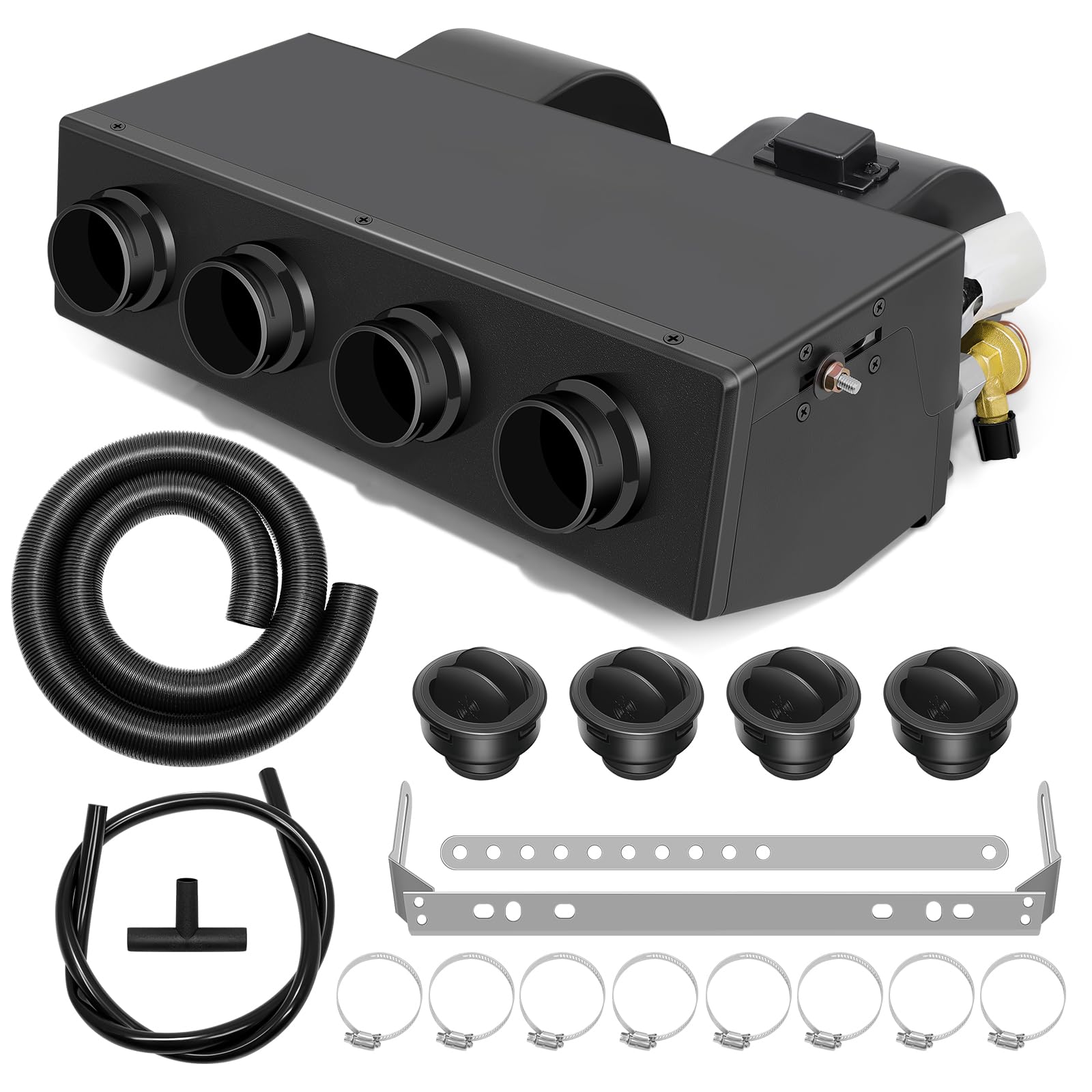
If you drive a classic truck or a work van with no factory AC, this evaporator kit is the direct answer. It comes with everything you need in the box: one ac evaporator, a 6.5-foot hose, four round vent caps, a drain hose, a T-joint, and all installation accessories. That complete package is exactly why owners call it a great value for trucks and vans without factory AC.
The cooling muscle here is serious—16500 BTU with 600 CFM of airflow, which is a 65% bigger cooling punch than the 10000 BTU rooftop units on this list. An all-aluminum coil and durable ABS plastic and copper construction handle the heat. The 3-speed fan and temperature knobs give you control, and the four swivel vents spread the cold air across the cab.
Owners mention the 6.5-foot hose reaches from the undercarriage to the driver seat, and the kit cools a small car in minutes on the high setting. One described the result as making their truck feel like a walk-in cooler. Install takes about a day, and the advice from owners is to dry-fit the vents before cutting anything. A 1-year warranty backs the kit.
Complete Package
- 16500 BTU and 600 CFM—powerful cooling for a small cab
- Everything included: hose, vents, drain, T-joint, hardware
- 3-speed fan with adjustable temperature knobs
Consider This
- Install takes about a day of work
- Dry-fit the vents before cutting into your dashboard
- One owner hit multiple issues—check your unit on arrival
Grab it for: the person with an older truck or van who wants real AC without ripping out the dashboard—the complete kit makes it a one-day project.
Think twice if: you expected a bolt-in drop; this still needs refrigerant and careful hose routing.
3. CNCEST 12V Split Air Conditioner
A budget-friendly split system that freezes you out in Georgia heat.
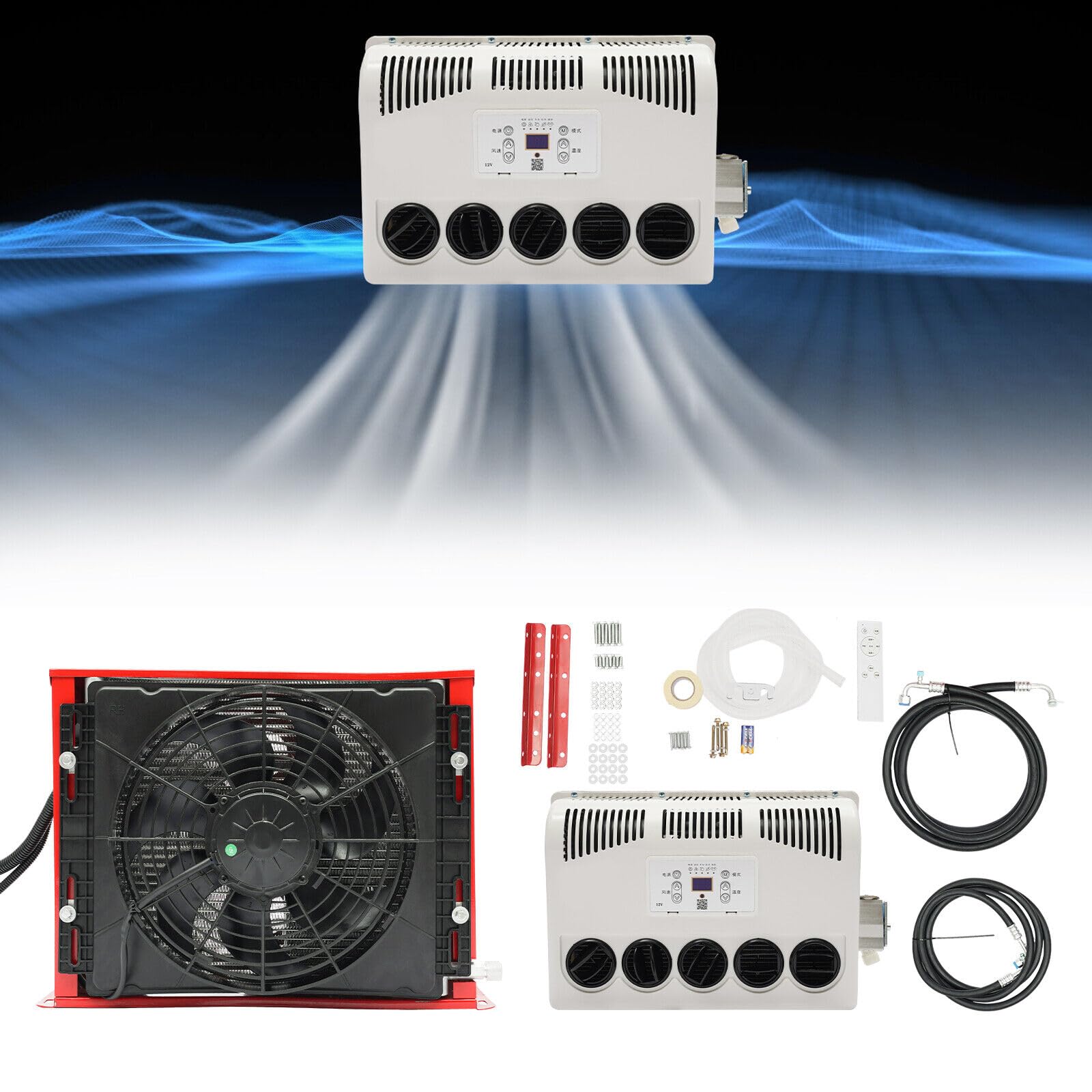
This 11000 BTU split unit is the cheapest real air conditioner on this list, and it makes the most of that price. Owners have mounted it in square drop campers, an 89 f900, and a mobile home toter. The verdict from the South Georgia heat: “it will freeze you out.” That’s the standout benefit—serious cold air for a budget price, delivered through a pure copper motor with a large 8828-15892 ft³/h air volume.
The energy story here is the headline. That efficiency, plus built-in under-voltage protection that cuts off below 11V, means it protects your battery. The maker says paired with a 100Ah battery it can run 1-3 hours after parking—ideal for overnight truck rests.
The trade-off is reliability. Customers note the condenser can develop a leak after about two months, and while one owner got a replacement condenser from customer service, another was told to buy a new unit. Control panels come labeled in a language some owners couldn’t read, and there are no instructions included. A 5-speed fan, digital display, and remote control handle daily operation.
Budget Cooling Power
- Only 400-600W draw—much easier on your battery
- Fits semi-trucks, RVs, trailers, and buses
- Low-voltage protection cuts off below 11V
The Honest Catch
- Condenser leaks reported after roughly two months
- No printed instructions; control panels in an unfamiliar language
- Customer service can be hit-or-miss on warranty
Best if: you want maximum cooling per dollar for a semi or camper and can handle a DIY install.
Pass on it if: you need rock-solid reliability and guaranteed warranty support for years of daily use.
4. Treeligo 12V Mini Split AC
A 20CC scroll compressor mini-split built to outperform most 8800 BTU units.
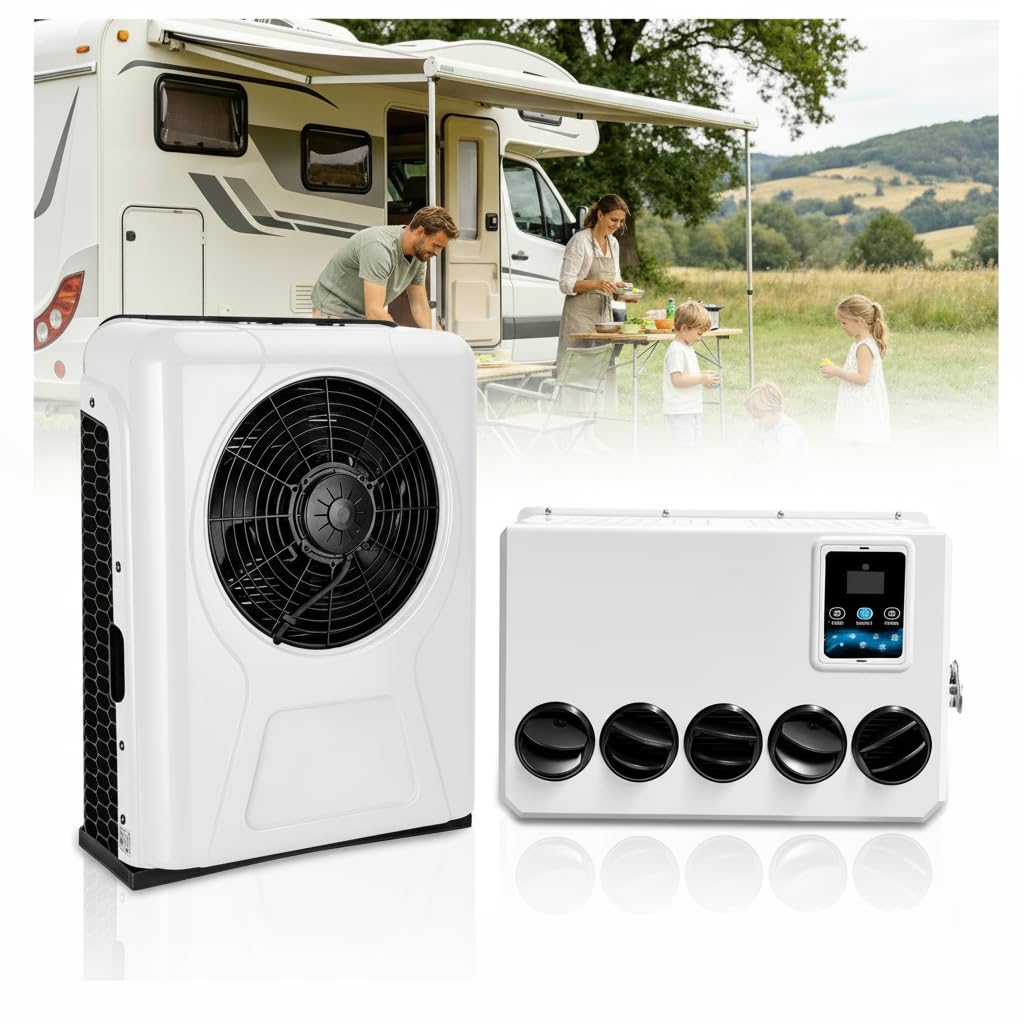
Treeligo’s mini-split is for truck and RV owners who want fast, aggressive cooling in a package that’s easier to mount than a rooftop hole. The secret is the 20CC variable-frequency scroll compressor, which pushes cooling up to 3000W (10000 BTU). The maker claims this runs stronger and faster than most 8800 BTU units on the market, and owners who installed it in a fully finished camper say it exceeded expectations and cools fast.
It runs on DC power from your auto battery instead of burning gasoline, which the maker says can cut over a month in fuel. With a 480Ah battery, expect about 8 hours of cooling when parked, or 3-4 hours while driving. Power consumption sits at 960W with a rated current of 60-80A, and it operates at a 45dB noise level—about as loud as a quiet conversation.
There’s a reason for the 3.6-star average: reliability is real but mixed. Reviewers point out the compressor can arrive with too little oil—one found only 25ml and added 100ml of POE 68—and the indoor unit can run loud. One unit died after about a year with an interior fan failure, while another owner calls it a solid, energy-efficient investment. The 3-mode system (fast cooling, sleep, energy saving) covers most needs.
Fast and Furious: the 20CC compressor delivers serious cold fast, but oil-level checks on arrival are a smart habit.
The Setup Ask: mini-split install needs both indoor and outdoor units mounted, with the outdoor 19x8x26-inch unit finding a home on your rig’s exterior.
Choose this for: faster, stronger cooling than typical 8800 BTU units in a split form factor, especially if you value the electric-over-gasoline fuel savings.
skip it if: you want a single-box install—this needs two units mounted, plus close attention to compressor oil and power draw.
5. Universal 12V Under Dash AC Kit

The rare under-dash kit that heats in winter and cools in summer.
Most 12V coolers only cool. This Universal kit adds real heating, using water heating that warms the water tank by heating engine coolant, then blows warm air into the cab. This dual-function unit works year-round in cars, trucks, RVs, and boats. In summer, it delivers 10000 BTU of cooling (rated 1800-3000W of cooling capacity); in winter, you get that greenhouse-warm atmosphere.
The specs tell a specific story: it runs on 12V DC at 40-60A, drawing 550-600W, and uses R134A refrigerant (not included—you’ll need to charge it with 500-550g). The refrigerant oil is POE71. The upgraded design combines the receiver dryer, condenser fan, and condenser into one integrated unit, which the maker says reduces leak points and improves heat exchange efficiency.
Owners who got a working unit report good air speed and pretty cold air. The problems start with installation: one buyer’s evaporator temperature regulator arrived broken, another says the premade hoses have wrong fittings, and the wiring can be mislabeled. The instructions are widely criticized as unclear. Most units need 2 days of install work plus refrigerant charging. Expect a multi-day install with wiring and refrigerant charging.
True Dual Season: the heating function is rare at this tier—it works by running warm engine coolant through the system for winter warmth.
Install Heavy: expect to wire it yourself, verify fittings, and charge the refrigerant; shipping comes in two separate packages that may arrive at different times.
Pick it for: year-round comfort in a car or van where you want both heat and AC from a single under-dash unit, and you’re handy with wiring and refrigerant.
Avoid it if: you want a simple weekend bolt-in—this unit demands careful fitting checks and troubleshooting from the start.
6. Cybertake S2 Pro Portable AC
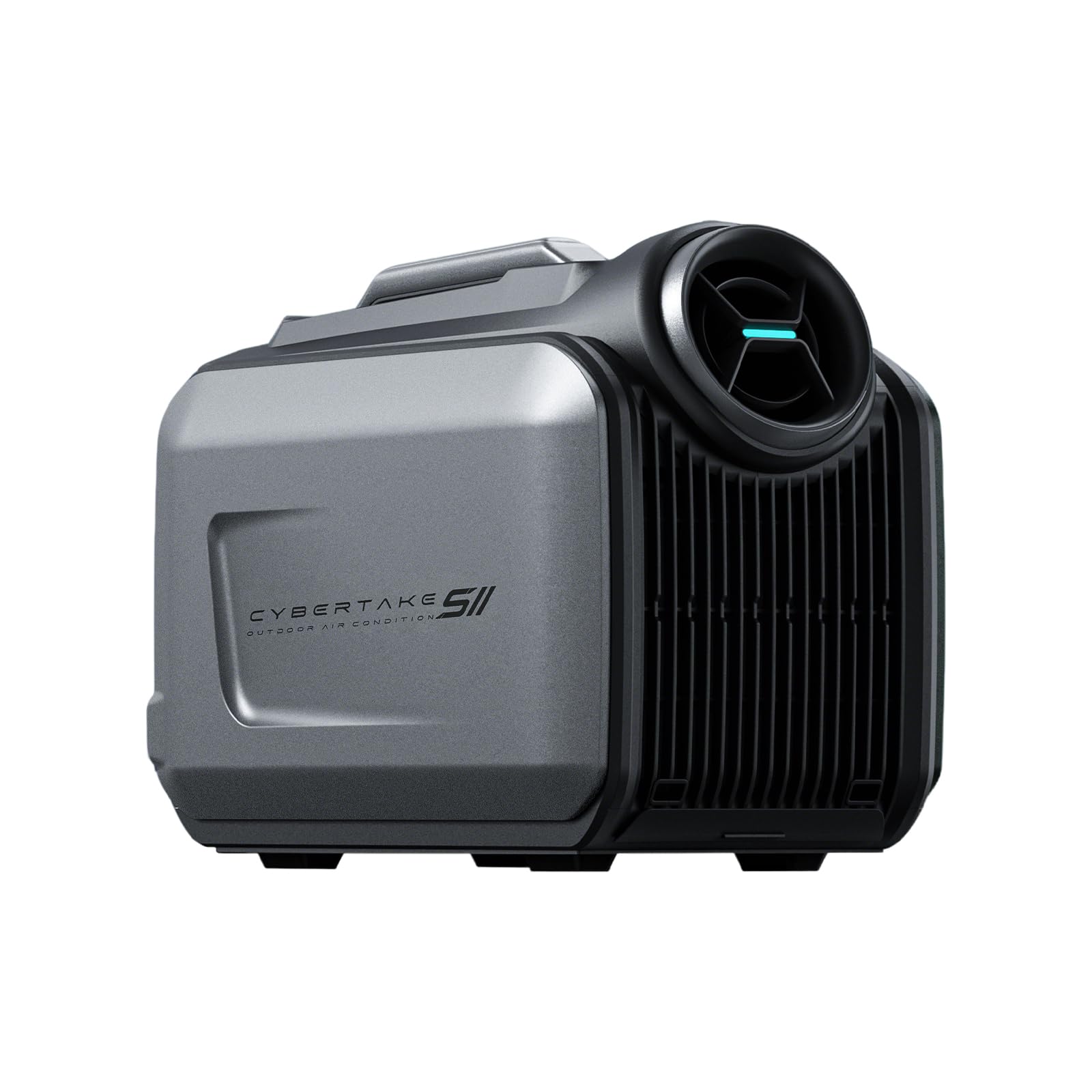
A 21-pound portable unit that runs on wall, vehicle, or power station juice.
The Cybertake S2 Pro is built for the person who wants one cooler that works everywhere. It manages 5100 BTU of cooling and 6100 BTU of heating—enough for spaces up to 130 sq. ft.—and it accepts three power sources: a standard wall outlet (100-240V), a vehicle’s 12V/24V system, or a portable power station at DC 48V. Setup takes 30 seconds with the included hoses and adapters.
Eco+ mode uses as little as 1kWh per 8 hours. In Eco+ mode, the maker says it uses as little as 1kWh per 8 hours, and it operates at just 40dB—quieter than a dishwasher. A 21-pound weight makes it easy to move from tent to truck bed to cabin. The IPX4 water-resistant shell shrugs off splashes and rain, and waterproof silicone buttons keep working in wet weather.
It won’t cool a sealed car cab effectively. Owners consistently report it works great outside a tent or vehicle, but it doesn’t cool the inside of an SUV effectively. It needs its hot exhaust vented outside, and it draws significant power—one owner measured 550W max. The Bluetooth app has connection issues on some phones. If you’re cooling a tent or roof-top tent, it shines; if you expect it to chill a parked car’s interior, you’ll be disappointed.
Versatile Power
- Runs on wall, 12V/24V vehicle, or DC 48V power station
- 41°F to 113°F operating range covers most climates
- IPX4 water-resistant shell for outdoor use
Know the Limits
- Doesn’t cool a car’s interior effectively—exhaust must vent outside
- Bluetooth app can fail to pair on some devices
- High power draw can drain a 2kWh battery in under 3 hours
Great for: campers who need a light, quiet unit for a tent or RTT, with flexible power options and 130 sq. ft. of coverage.
Not for: anyone wanting to cool a sealed car cab—buy a rooftop or under-dash unit instead.
7. Gidrox 10000 BTU Rooftop AC with Heater
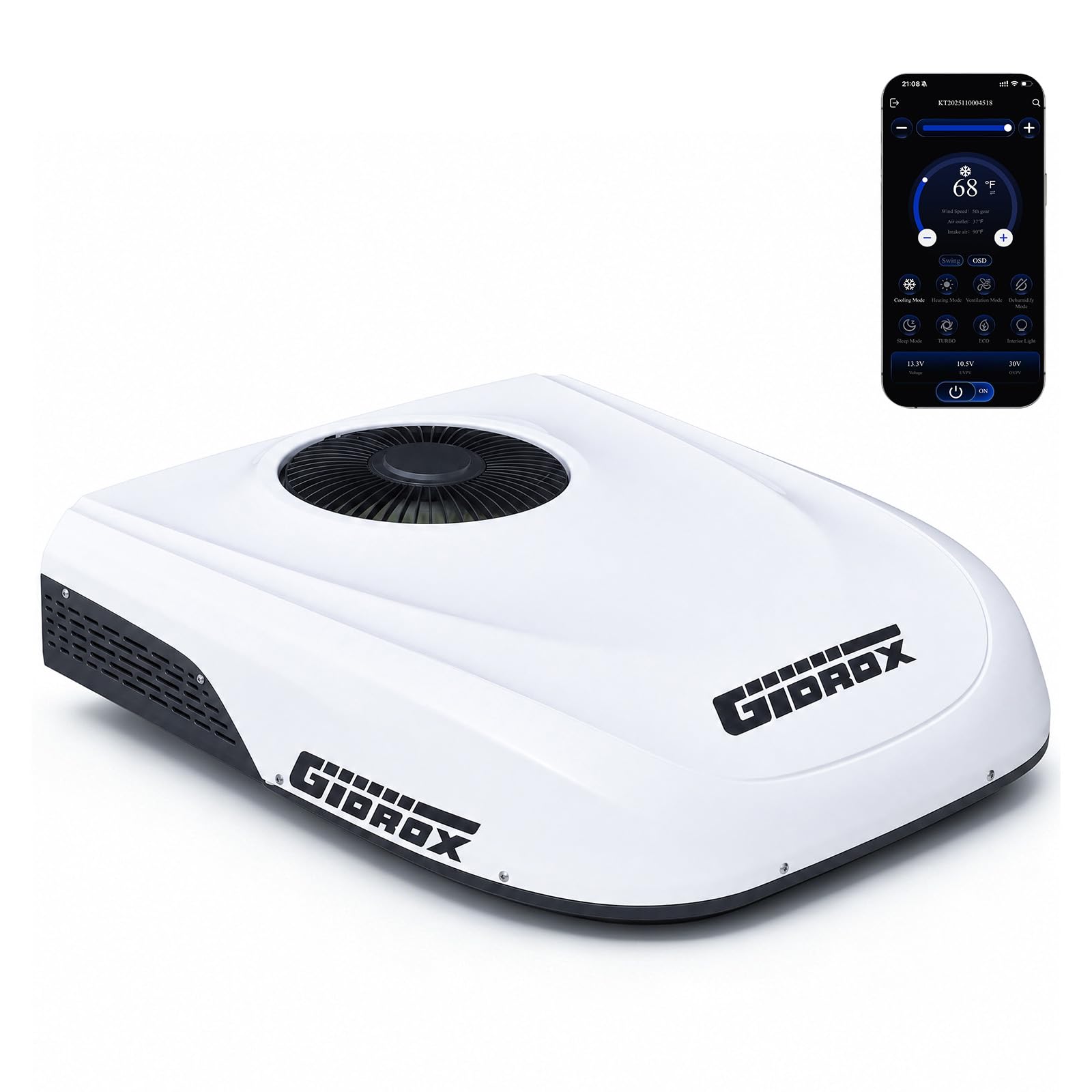
A 52-pound rooftop unit that heats below freezing and cools in 3 minutes.
Gidrox builds this 10000 BTU rooftop AC for camper van and truck owners who face all four seasons. Advanced PTC technology delivers instant heat even on below-freezing mornings, with no waiting, then switches to cooling in seconds. The maker says you reach your perfect temperature in about 3 minutes. An inverter compressor, brushless fan, and sound-insulation design keep it at a library-quiet 40dB in Sleep mode.
Its ~350W nighttime draw extends battery life. Tested average power consumption is about 350W during nighttime operation in 30°C ambient, which the maker claims saves about 60% energy versus traditional AC units. Owners confirm it—one reports eco mode using 300-350W versus the 1200W of their old unit, and calls it a literal life saver for a skoolie. When paired with a 400Ah battery, it can support all-night use.
Installation quality varies by roof thickness and hardware. At 52 pounds total it’s manageable, with all mounting hardware and a 19.7 ft power cable included, sized for the common 14″x14″ roof cutout and compatible with roof thicknesses from 1.5″ to 3.5″. But owners hit snags: on thick roofs, the interior screws run too short and there’s no duct bridge. One dropped the circuit board during install and got a sensor error, but Gidrox sent a free replacement board. Some shoppers say the compressor not engaging—functionality reviews are genuinely mixed.
Dual Season Comfort
- PTC instant heat in freezing weather plus fast cooling
- ~350W nighttime draw is gentle on a 400Ah battery
- 40dB Sleep mode and Bluetooth app control
Install Advisory
- Short interior screws on thick roofs—plan to add your own
- Hardware sizes and outlet can mismatch expectations
- Some buyers report the compressor failing to engage
Reach for this if: you want a single rooftop unit that heats and cools, with class-leading low power draw for off-grid nights.
Think twice if: your roof is thicker than 3.5 inches or you can’t handle hardware adjustments during a physical install.
Understanding the Specs
BTU and Cooling Power
BTU (British Thermal Units) tells you how much heat a unit can remove in an hour, so it directly affects how fast your cabin cools. For most car and RV cabs, 10000 BTU hits the balance, while a 16500 BTU unit like the jiaji evaporator delivers bigger, faster cold for larger trucks. A smaller 5100 BTU portable unit suits tents and compact spaces. Matching BTU to cabin size prevents wasted energy and money.
Power Draw and Battery Life
Every 12V unit pulls a specific wattage and amp rating. The Outequip draws 960 watts, running at about 50 amps and dropping to 30 amps to maintain temperature. The CNCEST split runs at just 400-600W, making it far gentler on your battery. If you sleep off-grid, look for units with eco or sleep modes that cut power to roughly 350W, like the Gidrox. Your battery capacity in Ah (amp-hours) directly decides your cooling hours.
FAQ
Will a 12V air conditioner drain my car battery overnight?
Can I install a roof AC unit on my van myself?
What’s the difference between a rooftop and an under-dash AC unit?
Does a portable AC unit work inside a car?
Which refrigerant do these 12V AC kits use?
How long does a 12V AC unit take to cool a vehicle?
Can I run a 12V air conditioner off a portable power station?
Are these 12V AC units quieter than portable ice coolers?
Final Thoughts: The Verdict
For most buyers, the air con for car winner is the Outequip RV Air Conditioner because it combines proven 10000 BTU cooling with quiet operation and reasonable battery draw—it’s a crowd favorite with a 4.7-star rating across nearly a hundred owners. If you want the biggest raw cooling punch per dollar for an old truck, grab the jiaji evaporator kit at 16500 BTU. And for tent campers who need one portable box that runs on wall, vehicle, or battery power, the Cybertake S2 Pro is the one to reach for.
How We Picked
We do not accept paid placement. Every pick is matched to a real buyer and a real use-case; we do not hands-on test units.
Sources & Methodology
Specifications: manufacturer listings and product documentation. Review insights: verified customer reviews, as of August 2026. Pricing: not shown on this page (it changes often); check the current price via the retailer link.
As an Amazon Associate, Gadgets Feed earns from qualifying purchases. This does not affect which products we feature.