
Our readers keep the lights on and my morning glass full of iced black tea. As an Amazon Associate, I earn from qualifying purchases.
Specs are compiled from manufacturer listings and verified buyer reviews and can change over time — please confirm the key details on the product page before buying.
When your central HVAC (heating, ventilation, and air conditioning system) can’t keep up or your window unit only blows cold air, you need one machine that handles both seasons without a swap-out. An air conditioner and heater window unit gives you cooling when the sun is relentless and supplemental heat when the chill creeps in — all from a single window opening. But not all combo units are created equal: some use a heat pump (a device that moves heat from outside air into your room) that sips power, while others rely on electric-resistance strips (metal coils that heat up when electricity passes through) that can spike your bill, and the BTU (British Thermal Unit, a measure of cooling power) rating determines whether your room actually gets comfortable or just lukewarm.
I’m Min — the founder and writer behind Gadgets Feed. This guide is built by comparing the manufacturers’ published specifications and the patterns across verified customer reviews, so you get each pick’s real strengths and trade-offs instead of marketing spin.
if you need to cool a small bedroom or a large living area, the right air conditioner and heater window unit balances BTU output, noise level, and energy efficiency to match your space without wasting money on overkill capacity.
Quick Picks
- Midea Inverter Window Air Conditioner with Heat – 12,000 BTU — Best Overall
- GE 8,000 BTU Smart Window Air Conditioner with Heat Pump — Premium Pick
- Frigidaire 8,000 BTU Window Air Conditioner with Supplemental Heat — Value Pick
- ROVSUN 12,000 BTU Window Air Conditioner with Heat — Large Room Pick
- ROVSUN 8,000 BTU Window Air Conditioner with Heat — Smart Pick
- Keystone 23,200 BTU Window Air Conditioner with Supplemental Heat — Giant Space Pick
- LG 23,000 BTU 230V Window-Mounted Air Conditioner with Supplemental Heat — Premium Heavyweight
How To Choose The Best Air Conditioner And Heater Window Unit
Before you sort through BTU numbers and smart features, boil your decision down to three things: the actual square footage of your room, whether your window can physically fit the unit, and if you want a heat pump (more efficient in mild cold) or electric-resistance heat (works in deeper cold but costs more to run).
Match the BTU to your room size
BTU (British Thermal Units) measures how much heat the unit can remove per hour. An 8,000 BTU unit typically handles up to 350 square feet, while a 12,000 BTU unit covers around 550 square feet. Oversizing — putting a 23,000 BTU unit in a 200-square-foot room — causes short cycling (the compressor turns on and off too often), which wastes energy and fails to dehumidify properly.
Understand heat pump vs electric-resistance heat
A heat pump moves heat from outside air into your room instead of generating heat directly. That makes it two to five times more efficient than resistive strip heaters — but it stops working when outdoor temperatures drop past a certain point (typically around 41°F for most models). Electric-resistance heat works in any temperature but draws more power, which shows up on your utility bill.
Check your window dimensions and voltage
Most units fit double-hung windows with widths between 24 and 38 inches. But some larger units (especially 23,000 BTU models) require 230V outlets — the same type your clothes dryer or oven uses. If your room only has a standard 115V outlet, you are limited to units under about 12,000 BTU. Always measure both the width and the vertical opening before buying.
Noise matters more than you think
A noisy window unit can ruin sleep or make TV unwatchable. Decibel (dBA) ratings give you a direct comparison: a unit rated at 45 dBA is whisper-quiet (about the level of a library), while a unit at 62 dBA is closer to normal conversation. Inverter models (units with a variable-speed compressor) tend to run quieter because the compressor doesn’t slam on and off — it ramps speed smoothly.
Quick Comparison
On smaller screens, swipe sideways to see the full table.
| Model | Best For | Cooling Power (BTU) | Floor Area | WiFi / Smart | Amazon |
|---|---|---|---|---|---|
| Midea 12,000 BTU Inverter | Best Overall | 12,000 | 550 sq ft | Yes | $449.97$499.99Amazon |
| GE 8,000 BTU Smart Window | Quiet Smart Heat Pump | 8,000 | 350 sq ft | Yes | $547.86Amazon |
| Frigidaire 8,000 BTU Supplemental Heat | Budget-Conscious Cooling | 8,000 | 350 sq ft | No | $459.00Amazon |
| ROVSUN 12,000 BTU | Larger Rooms, 208/230V | 12,000 | 550 sq ft | Yes | $455.99$479.99PrimeAmazon |
| ROVSUN 8,000 BTU | Affordable Heat Pump Starter | 8,000 | 350 sq ft | Yes | $399.99Amazon |
| Keystone 23,200 BTU | Large Spaces | 23,200 | 1,500 sq ft | Remote only | $654.00$769.99Limited time dealAmazon |
| LG 23,000 BTU | Large Rooms, 230V | 23,000 | — | Remote only | $789.00$859.00Amazon |
In‑Depth Reviews
1. Midea Inverter Window Air Conditioner with Heat – 12,000 BTU
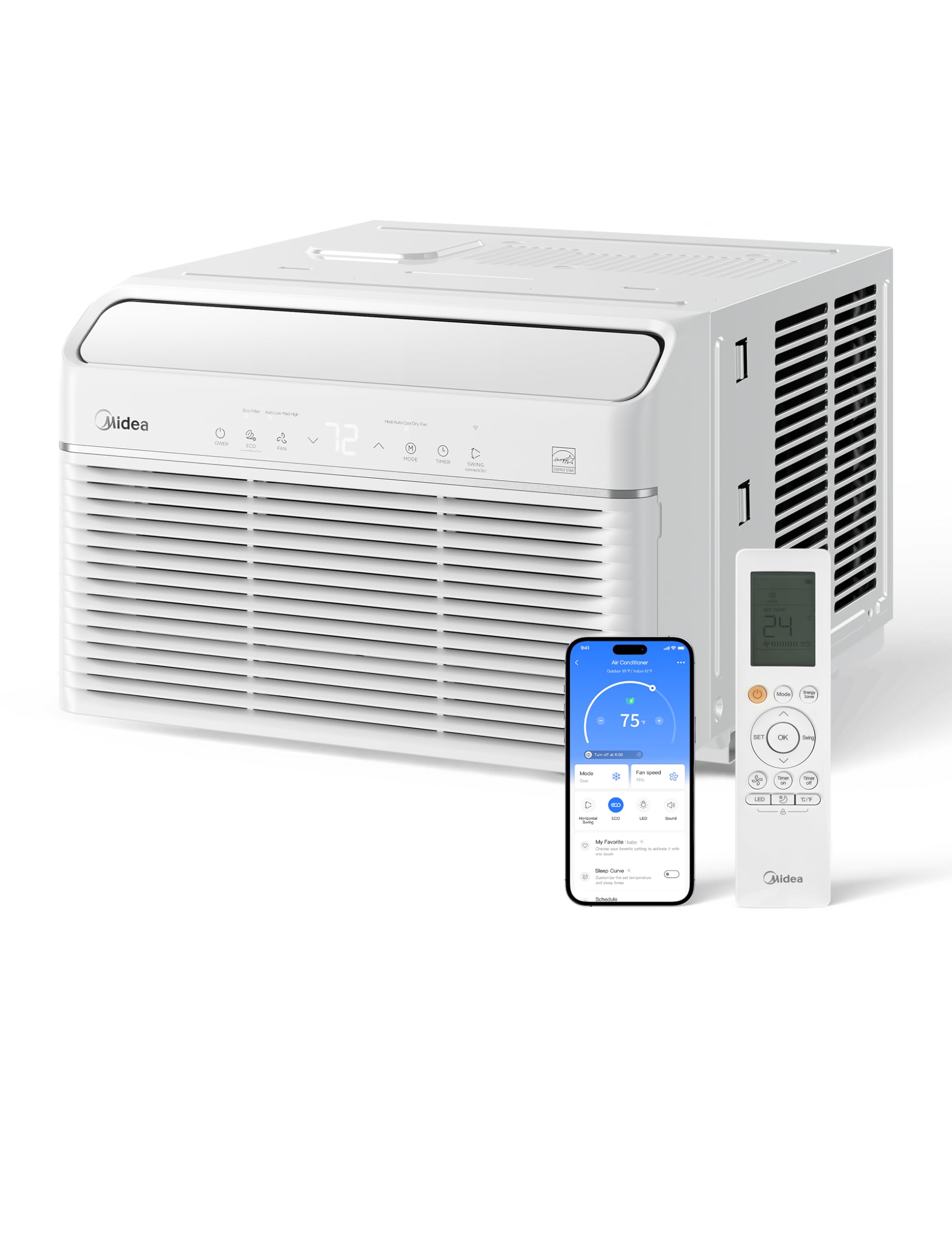
The Midea delivers 12,000 BTU of whisper-quiet inverter power to a 550-square-foot space — and buyers report it is nearly silent.
This is the unit that finally gives you both summer cooling and winter warmth without waking the whole house. The 12,000 BTU rating handles large rooms up to 550 square feet, and because it uses inverter technology (a variable-speed compressor that adjusts instead of slamming on and off), it runs at a noise level as low as 45 dBA — quiet enough for a bedroom. Inverter tech also delivers up to 35% energy savings compared to the Energy Conservation Standard, according to the manufacturer. The heat pump function works when the outside temperature is above 41°F, which covers most shoulder-season and mild-winter conditions.
Owners mention: “Easy self-install. WiFi app control. Very quiet. Cools 168 sq ft to 67°F in 90°F heat. Heat pump works to 41°F.” Another reviewer noted that it cooled a 350 sq ft room in under 15 minutes. The Midea SmartHome app lets you set schedules from your phone, and it works with Alexa and Google Assistant. The included dehumidifier mode handles humidity well, and the sleep curve adjusts temperature overnight automatically.
Installation requires a double-hung window with an opening width of 24 to 38.5 inches and a clear vertical opening of 14.5 inches. The unit measures 19.41 inches wide by 22.17 inches deep by 13.9 inches tall. While the 12,000 BTU output is significantly higher than the 8,000 BTU ROVSUN model (a 50% difference in cooling power), the Midea also covers 550 square feet versus 350 square feet for the smaller unit. The trade-off is that this is a heavy unit to lift into place — customers note installation is secure but requires a second person.
What stands out
- Ultra-quiet 45 dBA operation — quieter than most window units
- Inverter tech saves energy and holds steady temperature
- Smart control via app, Alexa, and Google Assistant
- Covers up to 550 sq ft with 12,000 BTU cooling
One catch
- Heat pump stops working below 41°F outside — not a primary heat source for deep winter
- Installation is heavy and may need two people
Grab this if: you want a quiet, energy-sipping combo unit for a large room and you have a standard 115V outlet.
Look elsewhere if: your winters regularly drop below 41°F and you need primary heating from the unit.
2. GE 8,000 BTU Smart Window Air Conditioner with Heat Pump

GE packs inverter quiet and smart-home smarts into a compact 8,000 BTU package that handles a 350-square-foot room.
This unit bridges the gap between raw power and everyday intelligence. Its 8,000 BTU cooling power covers rooms up to 350 square feet, but the real story is the heat pump — the manufacturer says it delivers 2 to 5 times higher efficiency than resistive electric heaters. The heat pump works down to 47°F outside and has an auto shut-off at 5°F, so it handles fall and early winter without resorting to expensive strip heat. The inverter compressor varies its speed instead of cycling on and off, which buyers confirm makes it “very quiet” compared to traditional window units.
Smart control comes through the GE SmartHQ app on iOS or Android, plus voice control via Alexa or Google Assistant. You get four modes (Cool, Heat, Fan, Eco) and multiple fan speeds with a digital display. Eco Mode cycles the fan off when the room reaches your set temperature, which reduces wasted operation. One reviewer noted that the unit held 66°F in a 288-square-foot space and called it “packed with the latest features.” The compact dimensions — 18.19 inches deep by 18.98 inches wide by 13.31 inches tall — fit single- or double-hung windows 24.5 to 36 inches wide and at least 14 inches high.
There is a genuine installation catch: reviewers point out the unit requires drilling into the window frame for the support bar and brackets, making it more involved than a simple slide-in install. The power cord measures over 6 feet, which helps with outlet placement. At 0.67 tons capacity (matching the 8,000 BTU ROVSUN and Frigidaire models), this is a mid-capacity unit — shoppers say it cannot keep up with an uninsulated 600-square-foot shop, so match it to the stated 350-square-foot rating for best results.
Why it stands out
- Heat pump runs down to 47°F with 2-5x efficiency vs resistive heaters
- Inverter compressor for quiet, steady temperature
- Full smart-home integration via SmartHQ app and voice
- Compact dimensions fit standard double-hung windows
Before you buy
- Installation requires drilling into the window frame
- Limited to 350 sq ft — underpowered for open-plan rooms
- Wi-Fi setup can be finicky, per some buyers
Reach for this if: you want a smart, quiet heat pump for a bedroom or office up to 350 sq ft and are comfortable with a drill-based install.
Pass on it if: you need a simple slide-in install or your winter temps stay below 47°F regularly.
3. Frigidaire 8,000 BTU Window Air Conditioner with Supplemental Heat
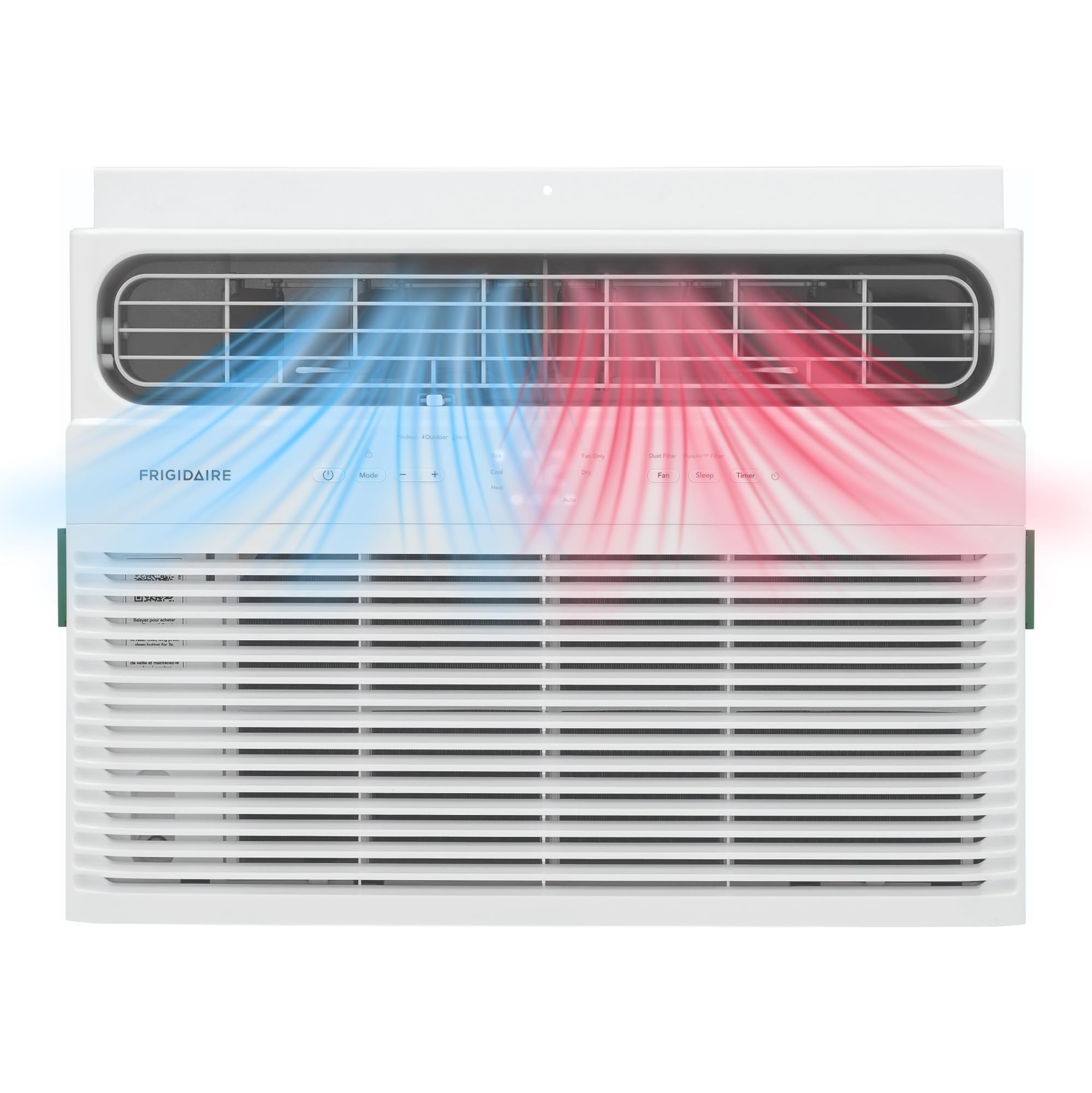
A straightforward 8,000 BTU cooler that adds supplemental heat at a budget-friendly price point for rooms up to 350 square feet.
The Frigidaire keeps things simple: no Wi-Fi, no voice control, just solid cooling and a supplemental heat mode that takes the edge off when your main furnace lags. With 8,000 BTU of cooling power and a floor area rating of 350 square feet, it directly matches the ROVSUN 8,000 BTU in capacity. The unit operates at 53 dBA — noticeably louder than the Midea’s 45 dBA but still quiet enough for most bedrooms, according to buyers. One buyer mentioned that it kept a 200-square-foot insulated shop at 60°F despite overnight lows below 30°F.
You get three fan speeds, six-way directional airflow, Eco Mode that maintains the set temperature, Sleep Mode for quieter overnight operation, and Dry Mode to pull excess moisture from the air. The 24-hour on/off timer works with the Auto Restart feature, which restores your previous settings after a power outage. A Clean Filter alert lights up when the washable pre-filter needs attention, so you do not have to guess about maintenance. The annual energy consumption is 550 kilowatt hours per year.
The catch is that the supplemental heat is electric-resistance, not a heat pump — so it costs more to run than the inverter heat pump units above. Some buyers have reported issues with the heating function not working as expected. And at 53 dBA, it is the loudest unit among the 8,000 BTU options here, though most buyers describe it as acceptable for small spaces. The Frigidaire is a reliable workhorse without the smart-home extras, which keeps the price down.
The highs
- Solid 8,000 BTU cooling for 350 sq ft
- Eco Mode and Sleep Mode for energy savings and quieter nights
- Auto Restart after power failure
- Clean Filter alert simplifies maintenance
The lows
- No Wi-Fi or smart control — remote only
- 53 dBA is louder than inverter models in this list
- Electric-resistance heat costs more to run than a heat pump
Best for: anyone who wants a no-fuss cooling-and-heat combo for a small room without paying for smart features they will not use.
Not for: buyers who need a heat pump’s efficiency or whisper-quiet operation.
4. ROVSUN 12,000 BTU Window Air Conditioner with Heat

The 12,000 BTU ROVSUN throws 50% more cooling power than its 8,000 BTU sibling and covers 550 square feet — but needs a 208/230V outlet.
This is the higher-voltage sibling of the ROVSUN lineup, and that 208/230V requirement is the single most important detail. The 12,000 BTU cooling power handles rooms up to 550 square feet, the same area as the Midea 12,000 BTU unit. One owner reported that it “outperforms 14K portable and old 10K window unit” and cooled a 350-square-foot space down to 62°F. The heat mode also works well, per reviewers. Like the smaller ROVSUN, it includes WiFi and voice control (Alexa and Google Assistant), five modes (Heat, Auto, Cool, Dry, Fan), three fan speeds, a 24-hour timer, and an ECO energy-saver mode.
The big difference from the Midea is voltage: this unit runs on 208/230V, which means you need a dedicated outlet like the one your clothes dryer or oven uses. Most standard bedrooms have 115V outlets, so this limits where you can install it. The unit fits windows 26 to 36 inches wide with a minimum height of 16 inches. Buyers report that the remote, the app, and the unit screen can fall out of sync with each other — a software quirk, not a cooling problem.
The strong points
- 12,000 BTU cooling covers up to 550 sq ft
- WiFi and voice control included
- Five modes and ECO energy-saver
- One-year warranty
The voltage hurdle
- Requires 208/230V outlet — not compatible with standard 115V rooms
- Owners mention syncing issues between remote, app, and unit display
Choose this if: you have a 230V outlet near your window and need 12,000 BTU for a large room.
Avoid it if: your room only has standard 115V outlets — you are limited to 8,000–12,000 BTU units that run on 115V.
5. ROVSUN 8,000 BTU Window Air Conditioner with Heat
An 8,000 BTU unit with both WiFi app control and a heat pump that plugs into a standard 115V outlet — no electrician needed.
This ROVSUN hits the balance for anyone who wants smart controls without upgrading their electrical panel. The 8,000 BTU cooling power handles rooms up to 350 square feet, and the 4,000 BTU heating (a heat pump, as customers note) provides supplemental warmth. One buyer summed it up: “Great little heat pump heater, read the fine print only 4000 btu heating, will heat a decent size room, cooling works great.” The unit runs on 115V, so it works with any standard bedroom outlet, unlike the 208/230V ROVSUN 12,000 BTU model.
The feature set mirrors the larger ROVSUN: five modes (Heat, Auto, Cool, Dry, Fan), three speeds, a 24-hour timer, ECO energy-saver mode, and a washable filter accessed from the front panel. The WiFi and voice control work with both Alexa and Google Assistant. Installation fits windows 26 to 36 inches wide with a minimum height of 16 inches. Buyers generally praise the quiet operation and ease of use, though some note the instructions can be vague and installation takes time — expect a full day for the wall mount if you are an experienced DIYer.
Why it works
- Runs on standard 115V — no special outlet needed
- Full WiFi, app, and voice control
- Heat pump provides supplemental heat
- Five modes plus ECO mode
Know this
- Heating is only 4,000 BTU — supplemental, not primary heat
- Installation can take a full day; instructions are vague
Reach for this if: you want a smart 115V combo unit for a medium room and are okay with a DIY-install project.
skip it if: you need serious winter heating — the 4,000 BTU heat pump is best for taking the chill off, not warming a cold room.
6. Keystone 23,200 BTU Window Air Conditioner with Supplemental Heat
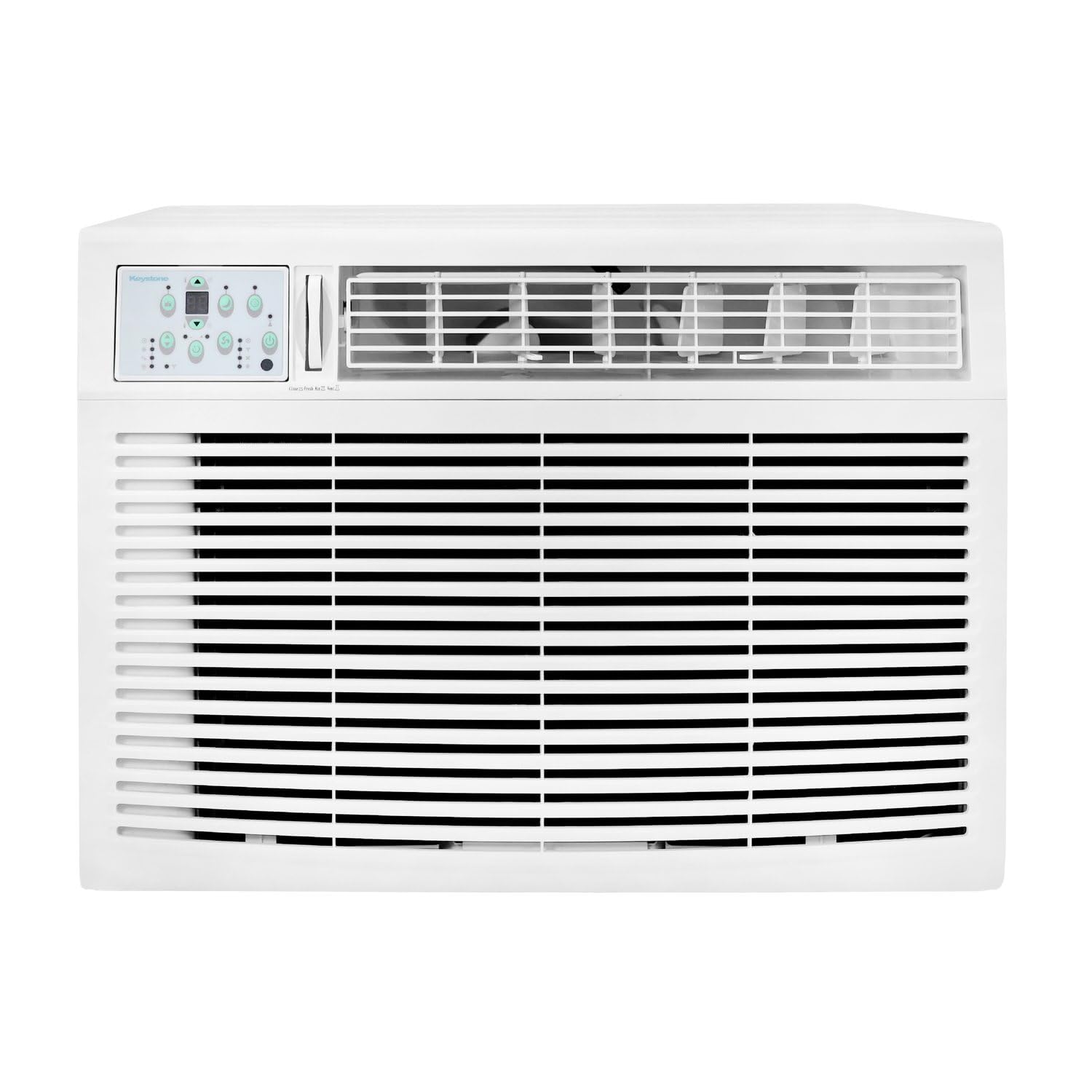
23,200 BTU of cooling muscle for a massive 1,500-square-foot area — this Keystone is a whole-room powerhouse that needs 230V.
When a standard 12,000 BTU unit cannot even touch the heat in your open-plan living area or large great room, the Keystone steps in with serious capacity. Its 23,200 BTU cooling power serves rooms up to 1,500 square feet, and the 16,000 BTU supplemental heating mode works when outside temperatures are between 23 and 76 degrees. The smart remote reads the temperature in the room you are standing in, displays it on the LCD screen, and sends a signal to the unit every 3 minutes for precise cooling. That is a feature you will not find on most window units.
Buyers have mixed experiences: one owner in Arizona reported the unit lasted over 5 weeks in extreme heat where a previous unit failed after 16 days, calling it “cool & happy.” But another reviewer noted an E3 error code within a month and said it failed to cool 746 square feet on an 86°F day. The unit includes a washable filter, Energy Saver and Sleep modes, and four-way swing louvers to direct airflow. The minimum window height is 19.5 inches — taller than the typical 16-inch requirement — so measure your window opening carefully.
The big perks
- Enormous 23,200 BTU capacity for up to 1,500 sq ft
- Smart remote with follow-me temperature sensing
- 16,000 BTU supplemental heat works from 23°F to 76°F
- Energy Saver and Sleep modes
The big catches
- Requires 230V outlet — not compatible with standard rooms
- Reviewers point out loud operation and reliability issues
- Minimum window height of 19.5 inches may not fit standard windows
Best for: large open-plan spaces or shops up to 1,500 sq ft where you have a 230V outlet and can handle a heavy, loud unit.
Not for: small bedrooms or quiet spaces — buyers consistently note it is loud and cycles oddly.
7. LG 23,000 BTU 230V Window-Mounted Air Conditioner with Supplemental Heat
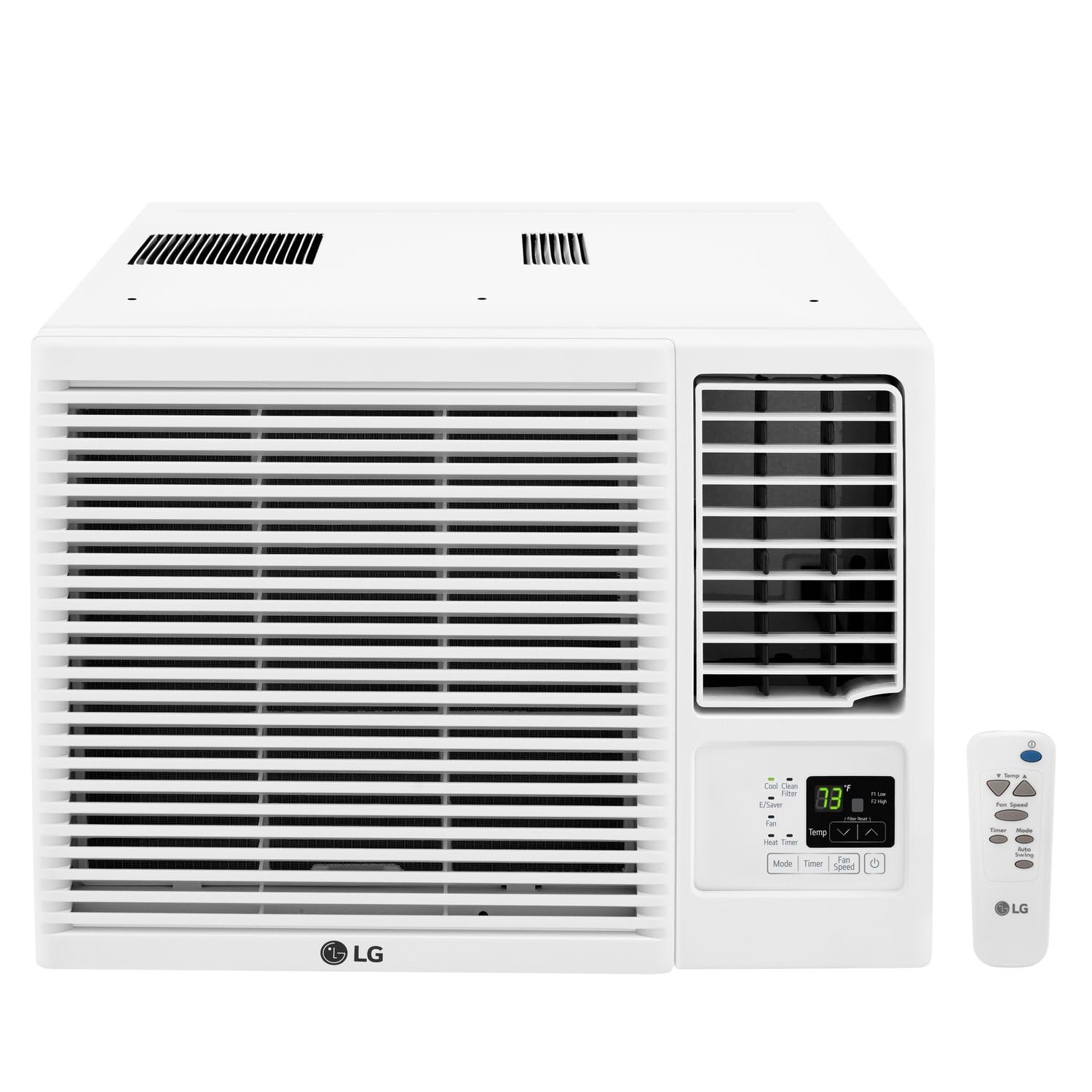
LG brings brand reliability to a 23,000 BTU monster, but the 62 dB noise level and 230V requirement mean it is not for every home.
The LG is built for serious cooling in large rooms or small apartments where a portable unit just will not cut it. With 23,000 BTU of cooling power and supplemental heat options of 9,200 BTU and 11,200 BTU, it has the raw capacity to handle big open spaces. The sound level is rated as low as 62 dB in low mode — louder than any of the 8,000 BTU or 12,000 BTU units in this list, but still manageable for a living room or den where background noise is less of an issue. Auto Restart is a practical feature: after a power failure, the unit turns back on with your previous settings saved, so you do not wake up sweating in the middle of a summer outage.
Buyers are split. One owner called it a “lifesaver especially in the winter months” and recommends it. Another reported it stopped cooling in under 6 months and could not find anyone to repair it. A third buyer said the AC does not blow cold air at all and the company refused to take it back. The unit runs on 230V (a dedicated outlet like a dryer plug), has two cooling, heating, and fan speeds, and includes a washable filter. The filter access is easy, per reviewers. This is a high-stakes purchase: the power is there, but reliability reports are inconsistent.
What it gives you
- 23,000 BTU cooling — the highest raw capacity on this list
- Supplemental heat at 9,200 or 11,200 BTU
- Auto Restart after power failure
- Washable filter with easy access
What holds it back
- Requires 230V outlet — not a standard 115V plug
- 62 dB is noticeably louder than inverter units
- Mixed reliability reports — some units fail within months
Consider this if: you need 23,000 BTU of cooling in a large room and already have a 230V outlet ready.
Be cautious if: reliability is your top priority — the buyer reviews show a pattern of early failures that the company does not always resolve.
Understanding the Specs
BTU — British Thermal Units
This is the number that tells you how much cooling power a unit has. One BTU removes the amount of heat needed to raise one pound of water by one degree Fahrenheit. For a window unit: 8,000 BTU covers about 350 square feet, 12,000 BTU covers about 550 square feet, and 23,000 BTU covers 1,500+ square feet. More is not always better — an oversized unit short-cycles (turns on and off too often) and leaves humidity in the air.
Inverter vs Non-Inverter Compressor
An inverter compressor varies its speed to match the cooling demand, so it runs continuously at a low speed instead of slamming on and off. This cuts noise (the Midea runs at 45 dBA) and saves energy (up to 35% versus standard units, per the manufacturer). Non-inverter units (like the Frigidaire) are cheaper but louder, with a harder on-off cycle that creates temperature swings.
CEER — Combined Energy Efficiency Ratio
CEER measures how many BTUs of cooling you get per watt of electricity in a combined cooling-and-standby test. A higher CEER means lower running costs. The Midea 12,000 BTU unit has a CEER of 13.3, which qualifies it for Energy Star certification (a government-backed label for energy efficiency). Units without a CEER rating or with a rating below 10.9 will cost more to run over a summer.
Voltage — 115V vs 208/230V
Standard household outlets in North America deliver 115V. Most 8,000 BTU and some 12,000 BTU units run on 115V. Larger units (23,000 BTU and some 12,000 BTU models) require 208V or 230V, which needs a dedicated circuit like the one your clothes dryer uses. If you do not have a 230V outlet near your window, you are limited to 115V units of 12,000 BTU or less.
FAQ
Will an air conditioner and heater window unit work as my primary heat source in winter?
Can I plug a window AC/heater unit into a standard wall outlet?
What size window AC and heater do I need for a 400-square-foot room?
Are inverter window AC units worth the extra cost?
How do I install a window unit with heat in a double-hung window?
How loud is too loud for a window AC with heat in a bedroom?
Do these units come with a remote control?
How do I clean the filter on a window AC and heater unit?
What does “supplemental heat” mean on a window AC unit?
Can I control a window AC and heater unit from my phone while away from home?
Final Thoughts: The Verdict
Across the board, the air conditioner and heater window unit winner is the Midea 12,000 BTU Inverter because it combines the quietest operation (45 dBA) with the largest standard-voltage coverage (550 square feet) and inverter energy savings. If you want a smart heat pump for a smaller room, grab the GE 8,000 BTU Smart Window. And for a budget-friendly 8,000 BTU option that keeps things simple, the standout is the Frigidaire 8,000 BTU.
How We Picked
We do not accept paid placement, and we did not hands-on test every unit. Instead, we match each pick to a real buyer and use-case by comparing the manufacturers’ published specifications against the patterns in verified customer reviews — so you get each pick’s real strengths and trade-offs instead of marketing copy.
Sources & Methodology
Specifications: manufacturer listings and product documentation. Review insights: verified customer reviews, as of July 2026. Pricing: not shown on this page (it changes often); check the current price via the retailer link.
As an Amazon Associate, Gadgets Feed earns from qualifying purchases. This does not affect which products we feature.
Product prices and availability are accurate as of the date/time indicated and are subject to change. Any price and availability information displayed on Amazon at the time of purchase will apply to the purchase of this product. As an Amazon Associate I earn from qualifying purchases.
CERTAIN CONTENT THAT APPEARS ON THIS SITE COMES FROM AMAZON. THIS CONTENT IS PROVIDED "AS IS" AND IS SUBJECT TO CHANGE OR REMOVAL AT ANY TIME.
Amazon and the Amazon logo are trademarks of Amazon.com, Inc. or its affiliates.