
Our readers keep the lights on and my morning glass full of iced black tea. As an Amazon Associate, I earn from qualifying purchases.
Specs are compiled from manufacturer listings and verified buyer reviews and can change over time — please confirm the key details on the product page before buying.
You want a unit that cools your 300 sq ft room without wasting energy or driving you crazy with noise. The trick is matching cooling power (BTUs, or British Thermal Units — the raw heat a unit can remove) to your space, not just picking the biggest number. Most buyers overestimate their BTU needs, which causes short-cycling (the unit turns on and off too often) and higher bills, so this guide focuses on units rated for 250–350 sq ft to find the best match for your room and your noise tolerance.
I’m Min — the founder and writer behind Gadgets Feed. This guide is built by comparing the manufacturers’ published specifications and the patterns across verified customer reviews, so you get each pick’s real strengths and trade-offs instead of marketing spin.
If you need a reliable cooler for a mid-sized room, the top recommendation holds a 4.2-star rating from over 500 owners and offers both portable flexibility and window-mounted efficiency. We’ve broken down the best air conditioner for 300 sq ft room into clear, decision-ready picks below.
Our Picks at a Glance


How To Choose The Best Air Conditioner For 300 Sq Ft Room
The first thing to understand is that bigger isn’t always better. For a 300 sq ft room, you generally want a unit rated for 250-350 sq ft. Oversized units cool too fast, shut off, and then cycle on and off — wasting energy and leaving the room feeling damp.
Match the BTU to your room, not your ego
BTU (British Thermal Units) measures cooling power. For 300 sq ft, look for 6,000 to 8,000 BTU. A 6,000 BTU unit is the minimum for this size, while an 8,000 BTU unit will handle sunny rooms, high ceilings, or kitchen heat better. Check the sq ft rating printed on the box, and don’t rely on the BTU number alone.
Check SACC, the honest efficiency number
SACC (Seasonally Adjusted Cooling Capacity) is the newer, more truthful rating for portable units. A portable AC might advertise 8,000 BTU ASHRAE, but its SACC could be as low as 4,550 or 5,000 BTU. For a 300 sq ft room, look for a portable with a SACC of at least 5,000 to 6,000 for real comfort.
Portable vs. window: the real trade-off
Window units are usually more efficient and quieter for each BTU they deliver, because the hot compressor (the part that does the heavy cooling work) sits outside. Portables sit inside, take up floor space, and push warm air out through a hose — but they roll from room to room and need no permanent install. For a 300 sq ft room, both can work; it depends on your window type and if you want the unit tucked into the glass or standing on the floor.
Quick Comparison
| Model | Best For | BTU Rating | Room Coverage | Type | Amazon |
|---|---|---|---|---|---|
| TOSOT 9,500 BTU★ Best Overall | Versatile portability | 9,500 (ASHRAE) | Up to 300 sq ft | Portable 3-in-1 | Amazon |
| GE 8,000 BTU SmartSmart Pick | Smart home control | 8,000 | Up to 350 sq ft | Window | Amazon |
| Midea 6,000 BTUBudget Value | Budget-friendly window | 6,000 | Up to 250 sq ft | Window | Amazon |
| Patikuin 5,000 BTU | Compact simplicity | 5,000 | Up to 250 sq ft | Window | Amazon |
| Frigidaire 8,000 BTU | Quiet window cooling | 8,000 | Up to 350 sq ft | Window | Amazon |
| PeakPursuit 8,000 BTU | Basement & bedroom | 8,000 | Up to 350 sq ft | Portable 4-in-1 | Amazon |
| Shinco 8,000 BTU | Self-evaporating portables | 8,000 (ASHRAE) | Up to 350 sq ft | Portable 3-in-1 | Amazon |
| ZAFRO 8,000 BTU | Quiet sleep mode | 8,000 (SACC 5,000) | Up to 350 sq ft | Portable 4-mode | Amazon |
| Towallmark 8,000 BTU | Fast room cooling | 8,000 (ASHRAE) | Up to 350 sq ft | Portable 4-in-1 | Amazon |
| LG 8,000 BTU | Reliable window install | 8,000 | Up to 350 sq ft | Window | Amazon |
| Midea U Shaped 8,000 BTU | Ultra-quiet smart cooling | 8,000 | Up to 350 sq ft | Window (inverter) | Amazon |
In‑Depth Reviews
1. TOSOT 9,500 BTU Portable AC
Our pick — over 4★ from 550+ verified ratings; the strongest balance of quality and price.
The roll-around that punches well above its 300 sq ft promise with 9,500 BTUs of raw cooling.
You get a 9,500 BTU unit (6,000 BTU under the 2017 DOE standard) that the maker rates for spaces up to 300 square feet. The floor area beats the smaller Midea 6,000 BTU window unit, which is rated for 250 square feet — a 40% gap in coverage that matters if your room runs hot or gets direct sun.
It doubles as a dehumidifier pulling 2.1 pints of water per hour. The auto-evaporation design flings condensation onto the internal parts to cool them down, so you rarely need to empty a bucket unless your home is very humid. The LED panel and remote work from up to 20 ft away, which makes it easy to adjust from the couch.
The weight is the real trade-off — it’s a 62-pound portable, so it’s not something you’ll easily haul upstairs daily. Buyers report it keeps rooms “very cold” and use it to help their central air run less. The most-discussed point in owner feedback is reliability, which is honestly mixed: some love it, others hit early shut-offs as a protection feature, so treat the brand’s sensor behavior as something to learn, not a flaw.
Why owners like it
- Cooling performance is the top praise — well over 70 owners single it out for handling heat and humidity
- Compact footprint with easy setup and clear instructions
- Auto-evaporation cuts the chore of draining water
Where it falls short
- Heavy at 62 pounds — plan the room before you roll it in
- Noise is typical for portables and draws the most mixed feedback
- Reliability reports vary, so buy with a good return policy in mind
Grab it if: you want one machine that cools, dehumidifies, and fans — and you value the freedom to move it between a bedroom and an office.
Think twice if: you need whisper-quiet operation or a permanently installed window unit; this is a floor-standing portable that makes its presence known.
2. GE 8,000 BTU Smart Window AC
A window unit you can command from your phone, tuned for rooms up to 350 sq ft.
This 8,000 BTU window AC targets the best value for money in owner feedback, and it’s the smartest of the window picks here. The SmartHQ app lets you schedule and monitor from anywhere, and it works with Amazon Alexa and Google Assistant — so you can say “set the bedroom to 74” without reaching for the remote. It also comes with a plain remote for the old-school nights.
Cooling power is 8,000 BTU versus the TOSOT’s 9,500 BTU for a 33% gap, but the GE actually covers more floor area — 350 square feet against the TOSOT’s 300. That’s because window units vent heat outside more efficiently than portables, so each BTU works harder. Eco Mode shuts off the fan and compressor once the room is cool, and the slide-out washable filter keeps the coils clean when you wipe it every 30 days.
Installation fits a double-hung window (W 24.5-36″ x H 13.375″) with the included EZ Mount kit. The honest catch: cooling performance gets mixed feedback in reviews — plenty of owners mention it blows “super cold air,” but a few say it under-delivers. The power cord exits the right side, so check your outlet placement before you commit.
Smart money: For the price, you get app control, voice control, and a washable filter that most window units charge extra for. The remote control is the second-most-praised feature — a rare combo at this tier.
Perfect for: the Alexa-or-Google household that wants to pre-cool a bedroom before arriving home. Not for: anyone with an outlet on the left side of the window or a need for absolute silence — the noise sits mid-pack.
3. Midea 6,000 BTU Window AC
A 6,000 BTU window unit that wins on price without skimping on cooling.
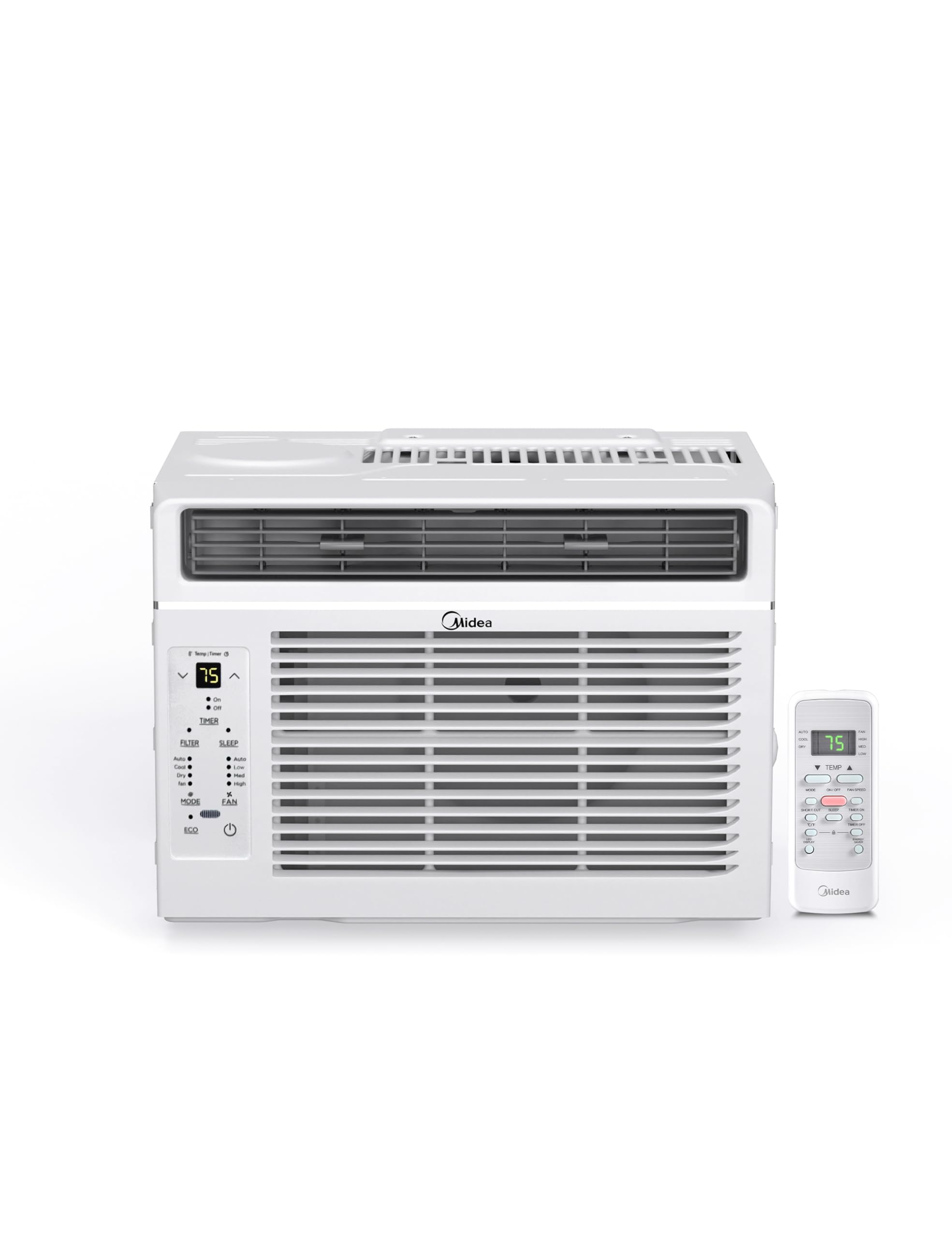
This EasyCool window AC earns its spot for a bedroom or small office, covering up to 250 square feet — the tight end of the 300 sq ft target. It gives you three modes — cool, fan, and dehumidifier (which pulls moisture from the air) — and cooling performance is the #1 praise in owner feedback, with performance close behind. The reusable air filter catches dust and pet hair, and the one-year parts-and-labor warranty adds confidence. If your room is closer to 300 sq ft or gets direct sun, you might want a unit with more headroom, like the Frigidaire below.
Noise dips as low as 52 dB in low mode, which is genuinely quiet for a window unit. The LED display and remote (batteries included) let you set time, temperature, and mode from across the room, and the Eco mode plus EasyTimer help keep your bill in check. Annual energy consumption runs 3,690 kilowatt-hours per year — the highest of any pick here, so it’s not the one for efficiency purists.
The main drawback surfaces on medium and high fan speeds, where owners split — some call it surprisingly quiet, others find it loud. Dry mode also draws some mixed feedback on effectiveness. For a 250 sq ft space at this price, the value is hard to argue with, and the slide-in install into a 23″-36″x14″ window frame takes minutes.
Solid start: If you want a cheap, reliable window unit for a small bedroom and don’t plan to run it on high all day, this is the smart budget call. The 12.1 CEER efficiency rating is respectable for the tier.
Reach for it if: budget is the priority and your room is closer to 250 sq ft than 300. Look elsewhere if: you need to cool a full 300 sq ft in deep summer — step up to an 8,000 BTU unit instead.
4. Patikuin 5,000 BTU Window AC
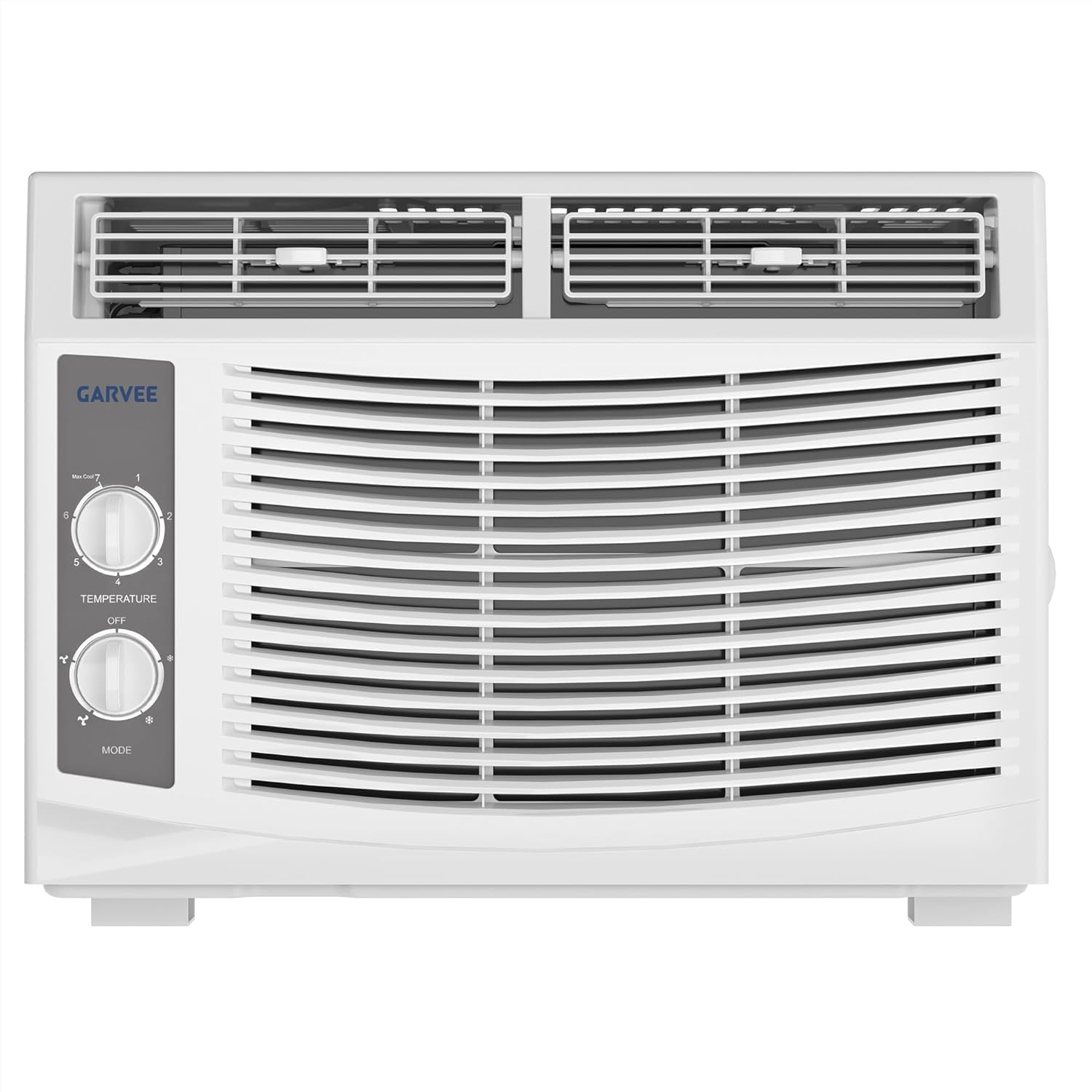
The featherweight window pick that blows ice cold on a low setting.
This 5,000 BTU window unit is the lightest pick here at 44 pounds, and customers note it works surprisingly hard for its size — one reviewer notes it cools a whole 4-room house with 12×14 average rooms, though that’s the exception, not the norm. The maker rates it for up to 250 square feet, so treat it as a bedroom or small-office companion rather than a whole-floor solution. If you need to cover the full 300 sq ft, the Frigidaire’s 350 sq ft rating gives you more margin.
The headline feature is simplicity: there’s no remote, no app, no frills. You get a quick-snap bracket install for single- or double-hung windows (min height 14.5 in), a slide-out washable filter, and three fan speeds plus a sleep mode that gradually raises the temperature overnight. Sound dips to 50 dB, which is quiet enough for light sleepers. It pulls just 200 kWh per year — the most energy-frugal unit in this entire lineup.
Performance and cooling performance are the top two praised aspects, and “blows ice cold” is a recurring theme in owner comments. The catch is noise: it’s the most-mentioned negative, with several buyers noting it runs loud. It also lacks a remote, so you’ll get up to change settings. For a compact, low-bill unit that installs in minutes, it’s a strong, simple choice.
Small but mighty: The energy draw of 200 kWh per year is the standout stat here — it’s the cheapest pick to run while still delivering real cold air. Just don’t expect library silence.
Best if: you want a no-frills, low-energy unit for a bedroom up to 250 sq ft and don’t mind getting up to change the dial. Skip if: remote control or ultra-quiet operation is non-negotiable for you.
5. Frigidaire 8,000 BTU Window AC
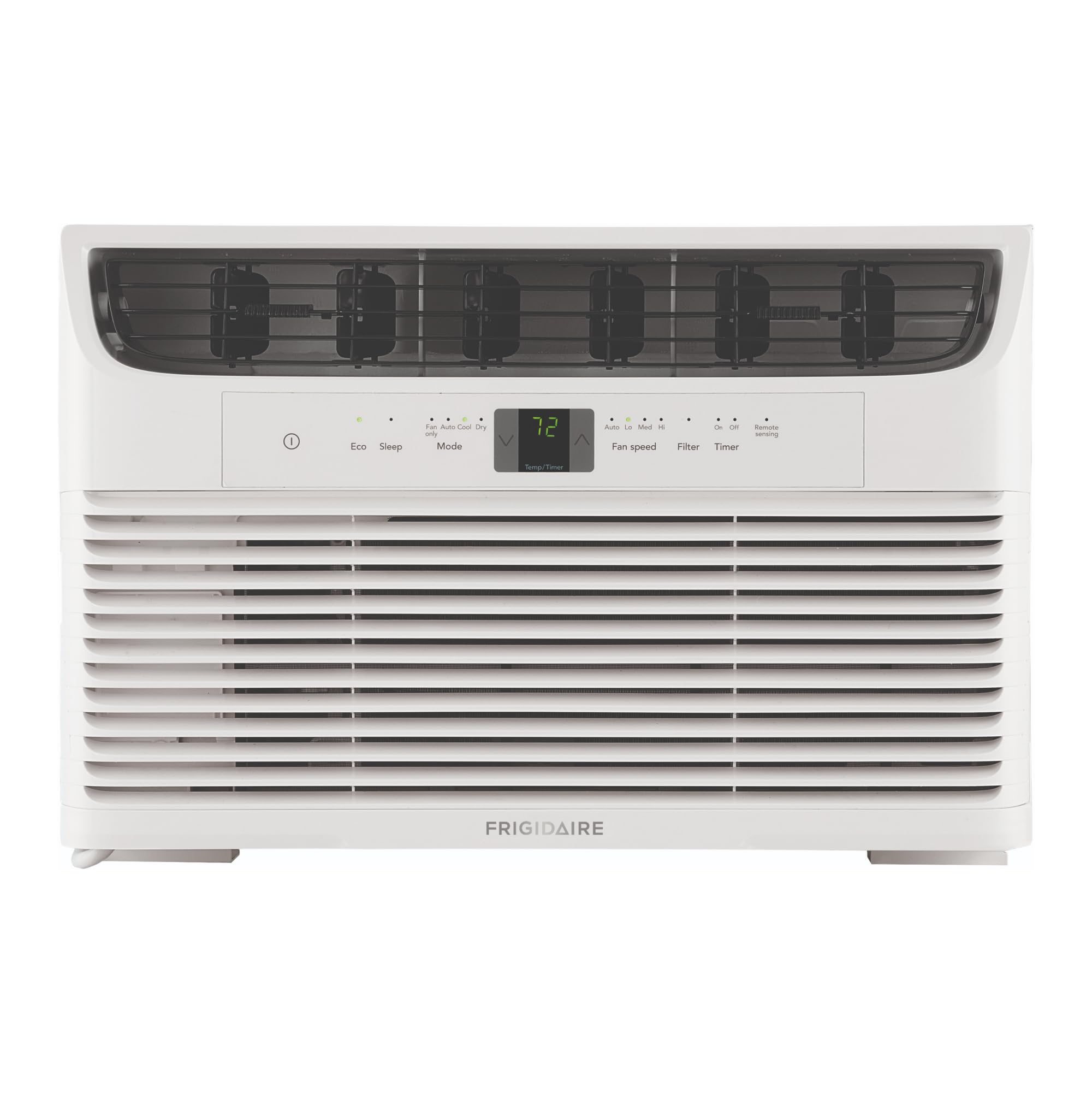
An 8,000 BTU window unit that keeps noise down to 54 dBA for bedroom comfort.
Frigidaire targets the bedroom crowd with this one, and the 54 dBA rating (a decibel scale where lower is quieter, roughly the level of a quiet library) is the spec that earns it a spot for light sleepers. It covers up to 350 square feet — the full 300 sq ft target plus headroom for sunny rooms — and owner feedback lines up cleanly: performance and value for money are the top two praised aspects, with a 17’x22′ living room coming up as a common success story. If you need more coverage than the EasyCool’s 250 sq ft, this is the one to pick.
The 6-way directional airflow lets you aim cold air where you need it, and three fan speeds plus a remote give you solid control. Eco Mode trims energy use while holding the temperature, and Sleep Mode gradually raises the set point overnight. The 24-hour on/off timer matches your schedule, and the Clean Filter alert reminds you to wash the dust filter, which keeps performance from sliding.
Annual energy consumption of 550 kWh per year is middle-of-the-pack — better than the Midea 6,000 BTU but not as frugal as the Patikuin. The catch in owner reviews is that “quiet” splits opinions: some call it super quiet, others say it’s as loud as a regular fan. A few also note the unit measures about 19 inches wide, not the 16 inches advertised, so measure your window opening before you buy.
What stands out
- 6-way airflow directs cold air precisely — rare at this price
- Clean Filter alert takes the guesswork out of maintenance
- Owners praise performance and value nearly equally
Keep in mind
- Noise perception varies — expect fan-level sound, not silence
- Advertised width may understate the real 19-inch footprint
- Remote build quality gets mixed notes
Go with it if: you want a feature-rich window unit for up to 350 sq ft with airflow control and a filter reminder. Pass if: you need absolute quiet or have a window narrower than 19 inches.
6. PeakPursuit 8,000 BTU Portable AC

A floor-standing 8,000 BTU unit aimed at basements and bedrooms with 7 cooling levels.
This portable AC delivers 8,000 BTU for rooms up to 250-350 sq ft, and owner feedback credits it with strong cooling performance — one buyer says it saved them during a Chicago heatwave. The 4-in-1 design (cool, fan, dry, sleep) keeps it useful year-round, and the 7 adjustable cooling levels give you fine-grained control that most portables lack. Simple mechanical dials mean no app to fiddle with.
Setup is genuinely tool-free: the included window kit fits most standard windows, which is ideal for renters or temporary spaces. The washable air filter supports long-term use, and the low-noise compressor hits around 50 dB in sleep mode for quieter nights. It’s built for slide windows specifically, so measure your track before ordering.
The honest downside: functionality gets the most mixed feedback of any aspect. While performance and cooling are praised, a small number of reviewers point out units failing within days — and one flagged the window hose not locking securely. That’s a fit-and-build concern note, not a dealbreaker for the majority who report it “keeps me cool for sleep ever since.” The 13.39″D x 27.32″W footprint means it needs floor space, unlike a window unit.
Cool on wheels: For a basement or apartment where you can’t install a window unit, the 7-level control and 4-in-1 modes make this a versatile pick. Just check the hose seal during setup — owner feedback flags it as the weak link.
Choose this if: you’re a renter or need a portable for a slide-window basement and want granular cooling control. Avoid if: you have a standard double-hung window or want a unit with a proven long-term track record.
7. Shinco 8,000 BTU Portable AC

An 8,000 BTU portable that self-evaporates 19.2L of humidity a day — no bucket to empty.
This Shinco portable brings 8,000 BTU ASHRAE / 4,550 BTU SACC cooling for up to 350 square feet, and the defining feature is the 19.2L/day self-evaporating dehumidifier. That means the unit flings collected moisture away on its own, so you rarely touch a drain bucket. That’s a big convenience win for a 300 sq ft bedroom or office where you just want to plug in and forget it.
Quality is the #1 praised aspect in owner feedback, with cooling performance close behind — a unit that cools a 200 sq ft room in 20 minutes is a common report. The 59″ telescopic exhaust hose and window sealing kit install without tools, and four smooth-rolling casters let you wheel it between rooms. The remote works up to 23 ft away, and the 24-hour timer raises the target temperature by 1.8°F every 2 hours to avoid overcooling overnight.
The trade-off is noise — it’s the most-mentioned negative, with owners calling it “loud, very loud” and noting it’s louder than window units. The 60°F-86°F adjustment range and 290m³/h airflow give you solid control, but this isn’t the pick for silent meditation. It also uses 555 kWh per year, which is mid-pack on energy. For a self-draining portable that cools fast, it’s a smart value.
Set-and-forget cooling: The self-evaporation system is the reason to pick this over comparable portables — you’ll spend zero time emptying water. The noise floor is the price you pay for that convenience.
Reach for it if: you want a portable you never have to drain and you’ll tolerate fan-level noise. skip it if: your room is a nursery or you need genuinely quiet operation — look at a window unit instead.
8. ZAFRO 8,000 BTU Portable AC
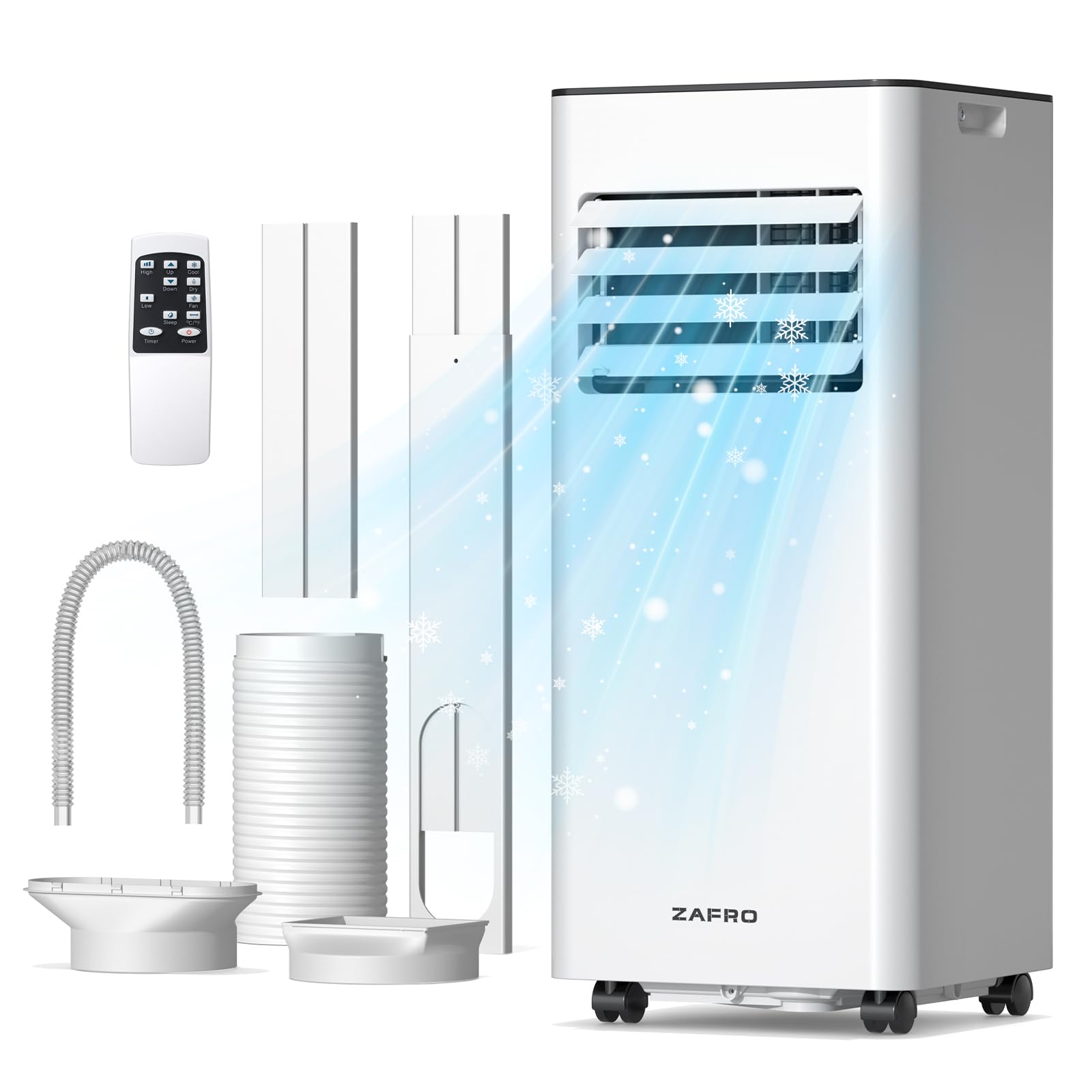
A compact 8,000 BTU portable that drops to 45 dB in sleep mode for lighter nights.
This ZAFRO portable cools up to 350 square feet with 8,000 BTU ASHRAE / 5,000 BTU SACC, and the standout spec is the 45 dB sleep mode — the quietest portable in this whole lineup. The 61°F to 90°F temperature range gives you wide control, and the 4 modes (cool, dehumidify, fan, sleep) cover year-round needs in a compact 27.28″ tall frame.
The 24-hour timer lets you schedule on/off times, and the smart thermostat control keeps the room at your set point without constant cycling. Setup is tool-free with the included window kit for sliding and double-hung windows. Owner feedback is near-unanimous praise for performance, with one buyer noting they “practically saved us” during a massive heat wave and another running it all last summer with zero drain issues.
The honest notes: it’s a newer, low-review-count unit, so the 27 ratings don’t carry the weight of a veteran like the Midea U. It’s also a touch noisy without other background sounds, per one owner — though that’s expected from a portable. The self-evaporation system reduces draining, and the child lock is a nice touch if you have curious kids or pets near the controls.
Quiet contender: At 45 dB, this is the portable to beat for light sleepers. The self-evaporation system and child lock round out a genuinely thoughtful design for bedroom duty.
Pick it if: you want the quietest portable cooling for a 300 sq ft bedroom and value the child lock. Hold off if: you prefer a brand with thousands of owner reviews behind it — this one’s track record is still building.
9. Towallmark 8,000 BTU Portable AC

An 8,000 BTU portable that pulls up to 50 pints of humidity daily while it cools.
That makes it a great fit for a damp basement or humid bedroom where moisture is half the problem. The 61–88°F range covers most comfort needs.
Owner feedback is uniformly positive on performance and cooling — one buyer notes it “cools off a room in no time,” and another says it handles a very warm upstairs bedroom with ease. The intelligent energy-saving function pauses operation when the room hits your set temperature, and the 24-hour timer lets you schedule around your day. The full-tank alert prevents overflow, so you’re not mopping up surprise water.
The catch: at 32.54″ tall, this is the tallest portable in the lineup, with a 13.15″D x 12.99″W footprint. The included window kit fits 22–47 inch windows, which is generous. One owner flags the lack of a drain pan, and the dehumidifier tank will need emptying in very humid conditions despite the alert. Annual energy use of 538 kWh is on par with the Shinco — solid for the cooling output.
Moisture master: If humidity is your real enemy, the 50-pints-per-day dehumidify mode blows past every other portable here. Just budget floor space — it’s the tallest unit in the lineup.
Choose this if: you’re cooling a humid space like a basement or upstairs bedroom and want max moisture removal. Pass if: floor space is tight or you want a low-profile unit that tucks under a desk.
10. LG 8,000 BTU Window AC
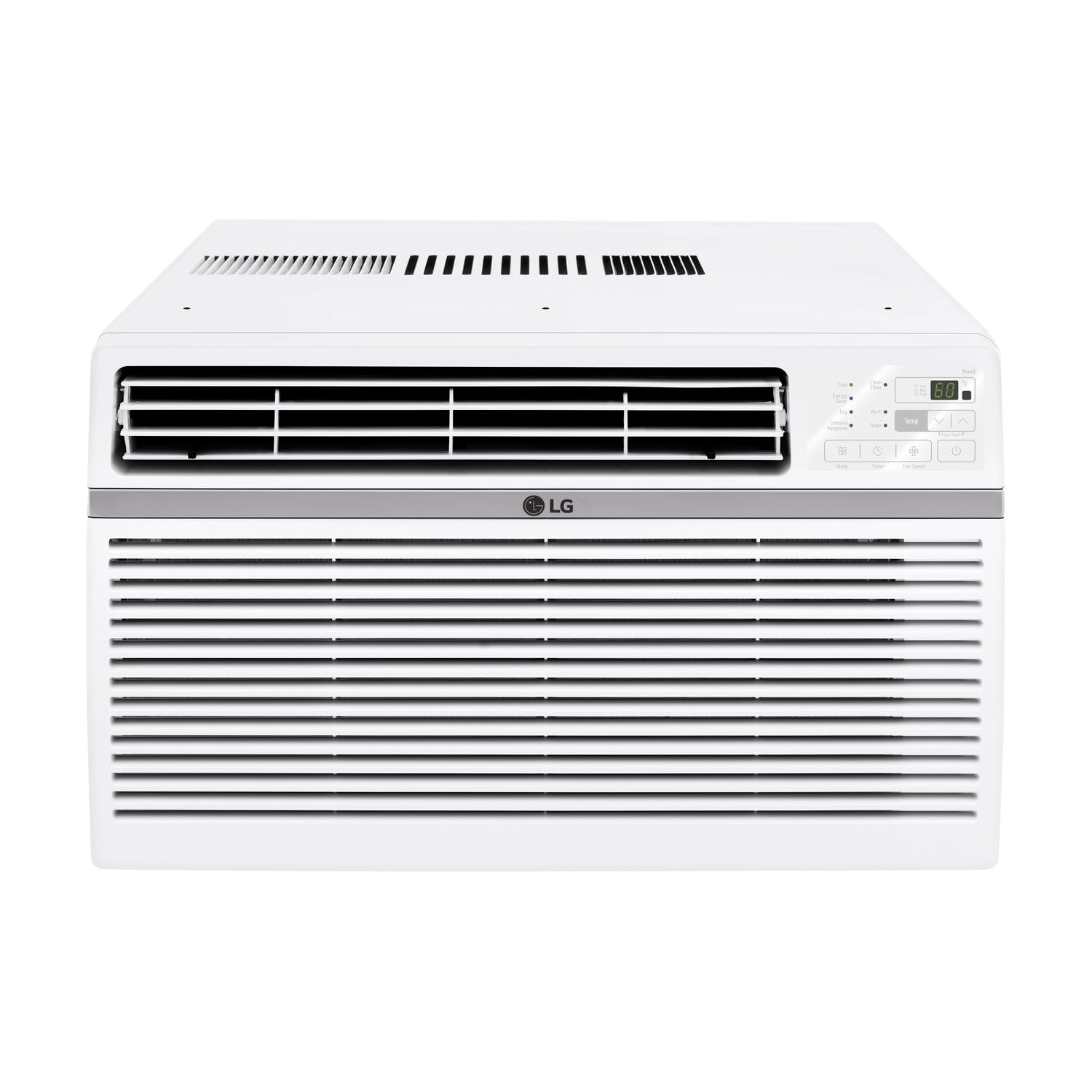
A 53 dB window unit that drops a room from 81°F to 73°F in about an hour.
This LG window AC covers up to 350 square feet (a 14′ x 25′ room), and cooling performance is the top praised aspect in owner feedback. One buyer saw their room drop from 81°F to 73°F in an hour, and another maintains 71°F in a 300 sq ft sunny room with poor venting — exactly the scenario this guide targets. The 53 dB low mode keeps it bedroom-friendly, and 3 cooling plus 3 fan speeds give you solid control.
Auto Restart is the standout reliability feature: after a power outage, the unit powers itself back on at your last settings, so you don’t wake up in a hot room. The electronic controls and remote make adjustments simple, and the washable filter keeps maintenance easy. A number of owners run multiples of these across rental properties in Georgia heat and report they perform wonderfully, with spares kept on hand.
The honest caveat: durability is the most-discussed weak point, with a few owners reporting units lasting about a year before losing cold air. Value for money also gets mixed feedback — the price sits above the GE and Frigidaire. It’s also a bit heavy and on the noisy side at higher speeds, per one detailed review. For the trusted LG name and proven cooling, it’s a strong, if pricier, window pick.
Why it earns the price
- Auto Restart restores settings after outages — a real comfort saver
- Proven cooling: 81°F to 73°F in an hour is a common owner report
- Energy efficiency draws praise, especially in saving mode
What to weigh
- Durability reports vary — some owners see about a year of life
- Higher price than comparable 8,000 BTU window units
- Noisy on higher speeds for some buyers
Worth it if: you want a trusted brand with proven cooling speed and outage auto-restart for up to 350 sq ft. Think twice if: budget is tight or you’re wary of durability reports — the Frigidaire covers similar ground for less.
11. Midea U Shaped 8,000 BTU AC
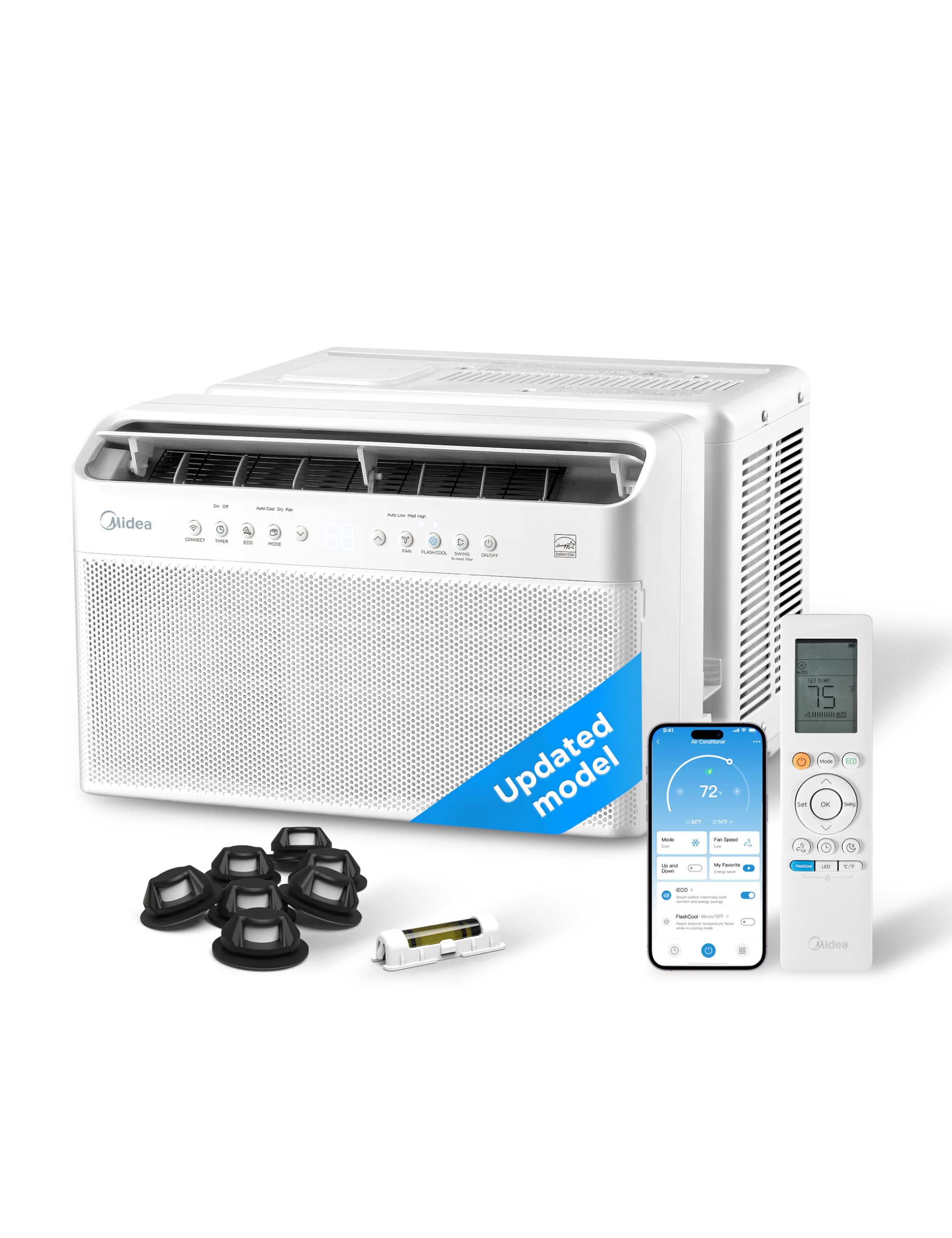
The window unit so quiet it runs at 32 dBA — and it still opens for fresh air.
This is the premium pick for a reason: the U-shape design shifts the noisy compressor and fan outside, so it operates as low as 32 dBA — the quietest unit in this entire guide by a wide margin. Owner feedback calls it “whisper quiet,” and quiet operation is the single most-discussed feature, with over 200 praising it. For a bedroom where noise keeps you awake, this is the answer.
The inverter technology delivers over 35% energy savings versus traditional units — the maker claims up to 37% — and it’s the first window AC to earn ENERGY STAR certification. It’s Wi-Fi enabled for the SmartHome app, works with Alexa and Google Assistant, and the U-shape lets you open the window while it’s installed, keeping your view and bringing in fresh air. The anti-theft mechanism locks the window shut when closed.
The trade-off is the premium price — it’s the most expensive pick here — plus the heavier install requiring two people, about 30 minutes, and a 9-inch clearance above the window. One owner warns about a mold issue with the drain, though the vast majority report excellent reliability and a 30% summer power-bill drop. Inverter cooling is far steadier than traditional on/off cycling, so the temperature holds without the constant hum.
The crowd favorite
- 32 dBA operation — owners rave it’s whisper quiet and fast-cooling
- Open-window flexibility keeps your view and fresh air
- SmartHome app, Alexa, and Google voice control built in
Premium price, premium quirks
- Most expensive unit here — the inverter tech costs more upfront
- Install is heavier: two people, ~30 minutes, 9″ clearance needed
- A rare report flags drain-related mold — monitor the plug
Spend for it if: you want the quietest, most energy-efficient window cooling for up to 350 sq ft and your window can handle the install. Skip if: you’re on a tight budget or can’t get two people to the window — this is a two-person job.
Understanding the Specs
BTU and SACC: the two numbers that matter
BTU (British Thermal Units) is the raw cooling power a unit can move. For a 300 sq ft room, 6,000 to 8,000 BTU is the balance, and 8,000 BTU gives you headroom for sunny or kitchen-heated spaces. The catch is that portable units are often rated two ways — ASHRAE (the old, optimistic number) and SACC (the newer, realistic number). A portable rated 8,000 BTU ASHRAE might only deliver 5,000 BTU SACC once you account for the heat the exhaust hose pushes back. Always check the SACC number on a portable; window units vent heat outside, so their BTU is closer to real-world output.
Efficiency and running costs
Window units typically beat portables on efficiency because the hot parts sit outside. Look for a CEER or Energy Efficiency number — higher is better, and the Midea 6,000 BTU at 12.1 CEER is a standout. Annual energy consumption in kilowatt-hours (kWh) tells you roughly how much juice it’ll pull per year; the Patikuin sips at 200 kWh while the Midea window unit uses 3,690 kWh. The Midea U Shaped inverter is the efficiency king in a different way — it claims over 35% savings versus traditional units by adjusting compressor speed instead of cycling on and off. If you run AC daily in summer, that difference shows up on your bill.
FAQ
Is 8,000 BTU enough for a 300 sq ft room?
What does the SACC rating mean on a portable AC?
Which is better for a bedroom: a portable or a window AC?
How many BTUs do I need to cool 300 sq ft?
Is a 5,000 BTU air conditioner enough for a 300 sq ft room?
How long does a window air conditioner last?
What does auto-evaporation mean on a portable AC?
Can I control a 300 sq ft AC with my phone or voice?
Is the Midea U Shaped worth the extra cost?
What window size do I need for these AC units?
Final Thoughts: The Verdict
Across the board, the air conditioner for 300 sq ft room winner is the TOSOT 9,500 BTU portable because it covers the full 300 sq ft with 9,500 BTUs while rolling anywhere you need it. If you want the quietest, most energy-efficient window cooling, grab the Midea U Shaped at 32 dBA. And for a budget-friendly window install that still hits the mark, the Midea 6,000 BTU is the one to reach for.
One honest nudge: the crowd favorite is the Midea U Shaped — with over 800 owners behind it and quiet operation the single most-praised feature, it’s the safest bet if your budget stretches that far. Whatever you choose, match the BTU to your actual room size, check the SACC on portables, and you’ll stay cool all summer without wasting a dollar on a unit that’s too big or too small.
How We Picked
We do not accept paid placement. Every pick is matched to a real buyer and a real use-case; we do not hands-on test units.
Sources & Methodology
Specifications: manufacturer listings and product documentation. Review insights: verified customer reviews, as of August 2026. Pricing: not shown on this page (it changes often); check the current price via the retailer link.
As an Amazon Associate, Gadgets Feed earns from qualifying purchases. This does not affect which products we feature.