
A golf cart without air conditioning turns a relaxing round into a sticky, exhausting ordeal. The sun beats down, the vinyl seat burns, and even a breeze kicks up dust instead of providing relief. Adding a proper cooling system transforms the cart into a mobile oasis, letting you focus on your game instead of the heat.
I’m Min — the co-founder and writer behind Gadgets Feed. I’ve logged countless hours researching and cross-referencing technical specs, real customer feedback, and installation requirements to find the most reliable and effective air conditioners tailored specifically for golf cart use.
This guide cuts through the noise to deliver the only analysis you need to find the perfect air conditioner for golf cart. We break down BTU ratings, power consumption, and battery integration so you can buy with total confidence.
How To Choose The Best Air Conditioner For Golf Cart
Selecting the right cooling unit for your golf cart involves more than just picking a model with a high BTU number. You have to consider the cart’s existing electrical architecture, the physical space available for installation, and how long you need it to run on a single battery charge.
12V vs. 48V Power Compatibility
Most golf carts run on a 48V battery system, but many entry-level and portable AC units are designed for 12V. You have three paths: install a separate 12V deep-cycle battery for the AC unit, use a hefty 48V-to-12V converter, or choose a 48V native system. A 48V unit is far more efficient because it avoids conversion losses and draws directly from the cart’s primary battery pack.
BTU Rating and Cart Size
British Thermal Units (BTU) measure cooling capacity. For a standard two- or four-passenger golf cart, 8,000 to 12,000 BTU is the sweet spot. An under-powered unit (under 8,000 BTU) will struggle on a direct-sun day. An oversized unit may cycle on and off too frequently, wasting battery and failing to dehumidify the air effectively.
Installation Type: Roof Mount vs. Under Dash vs. Portable
Roof-mount units are the most permanent and powerful option, but they require a reinforced roof and a cutout. Under-dash kits are more discreet and maintain the cart’s profile, but they are harder to install. Portable units offer the greatest flexibility—you can take them inside a tent or workshop—but they take up floor space and require a window exhaust setup.
Quick Comparison
On smaller screens, swipe sideways to see the full table.
| Model | Category | Best For | Key Spec | Amazon |
|---|---|---|---|---|
| Countrymod 12V DC | Rooftop | Quiet Efficiency | 10,000 BTU / 44dB | Amazon |
| Treeligo 11000 BTU | Rooftop | High Power Output | 11,000 BTU / 45dB | Amazon |
| Outequip 12V 10000 BTU (w/ heater) | Rooftop | All-Weather Use | 10,000 BTU / 4,500 BTU Heat | Amazon |
| Outequip RV AC (no heater) | Rooftop | Lightweight Build | 10,000 BTU / 45 lbs | Amazon |
| Gidrox 10000 BTU | Rooftop | Smart Control | 10,000 BTU / 40dB Sleep | Amazon |
| Aspligo Under Dash 10000 BTU | Under Dash | Discreet Install | 10,000 BTU / 550-600W | Amazon |
| IceCove Portable 2500 BTU | Portable | Low Power Draw | 2,500 BTU / 250W | Amazon |
| DC HOUSE 48V 100Ah Battery | Battery | Power Upgrade | 48V / 100Ah / 200A BMS | Amazon |
| BOPGA 48V 105Ah Battery | Battery | Compact Footprint | 48V / 105Ah / 200A BMS | Amazon |
| Cloudenergy 48V 105Ah Battery | Battery | High Discharge Rate | 48V / 105Ah / 250A BMS | Amazon |
| Furrion Chill Cube 18K BTU | Rooftop | Max Cooling Power | 18,000 BTU / R32 Refrigerant | Amazon |
In‑Depth Reviews
1. Countrymod 12V DC RV Air Conditioner
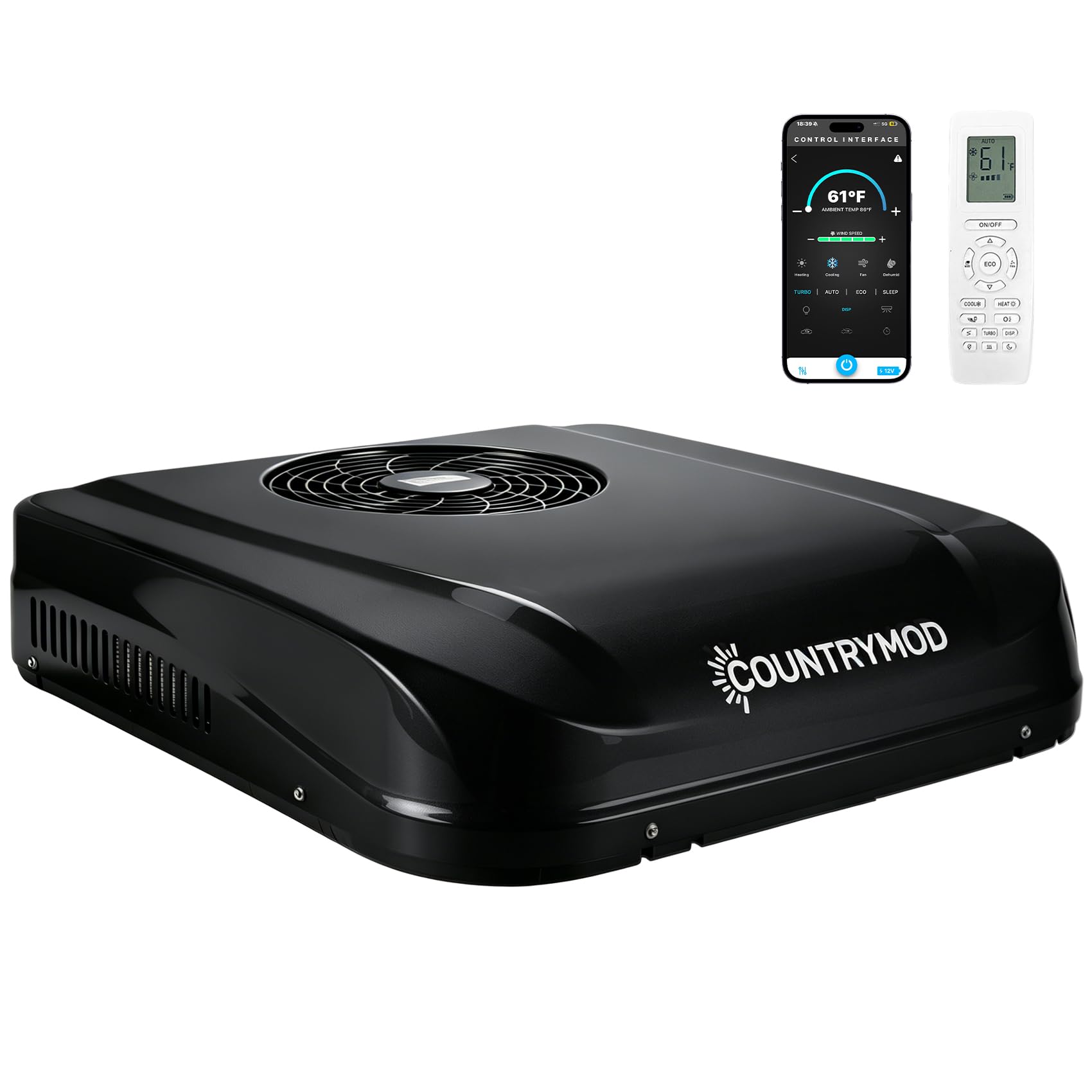
The Countrymod unit strikes the perfect balance between power, noise, and efficiency. Its 10,000 BTU inverter compressor delivers rapid cooling while the variable-frequency design sips power—consuming as little as 0.3 kWh per hour, which is roughly five times more efficient than a standard 1.5 kWh RV unit. That efficiency translates directly into longer runtimes on a golf cart’s battery.
At a whisper-quiet 44 dB in sleep mode, this AC won’t drown out conversation or disrupt the serene atmosphere of the course. Users have reported steady temperature hold with no humidity spikes, a common flaw in less refined units. The horizontal compressor also keeps the center of gravity low, reducing vibration during bumpy rides across the fairway.
Installation is straightforward for a 14×14-inch roof vent, though thicker roofs may require longer all-thread rods. The bundled remote and app control give you full command over temperature and timers. For a dedicated golf cart build, this is the unit that checks every box without demanding a massive battery bank.
Why it’s great
- Exceptional power efficiency (0.3 kWh/h) for extended battery life
- Ultra-quiet operation at 44 dB in sleep mode
- Steady temperature and humidity control
Good to know
- Stock bolts may be short for thicker roofs
- Instructions are sparse; installing from YouTube is easier
2. Treeligo 11000 BTU Rooftop AC
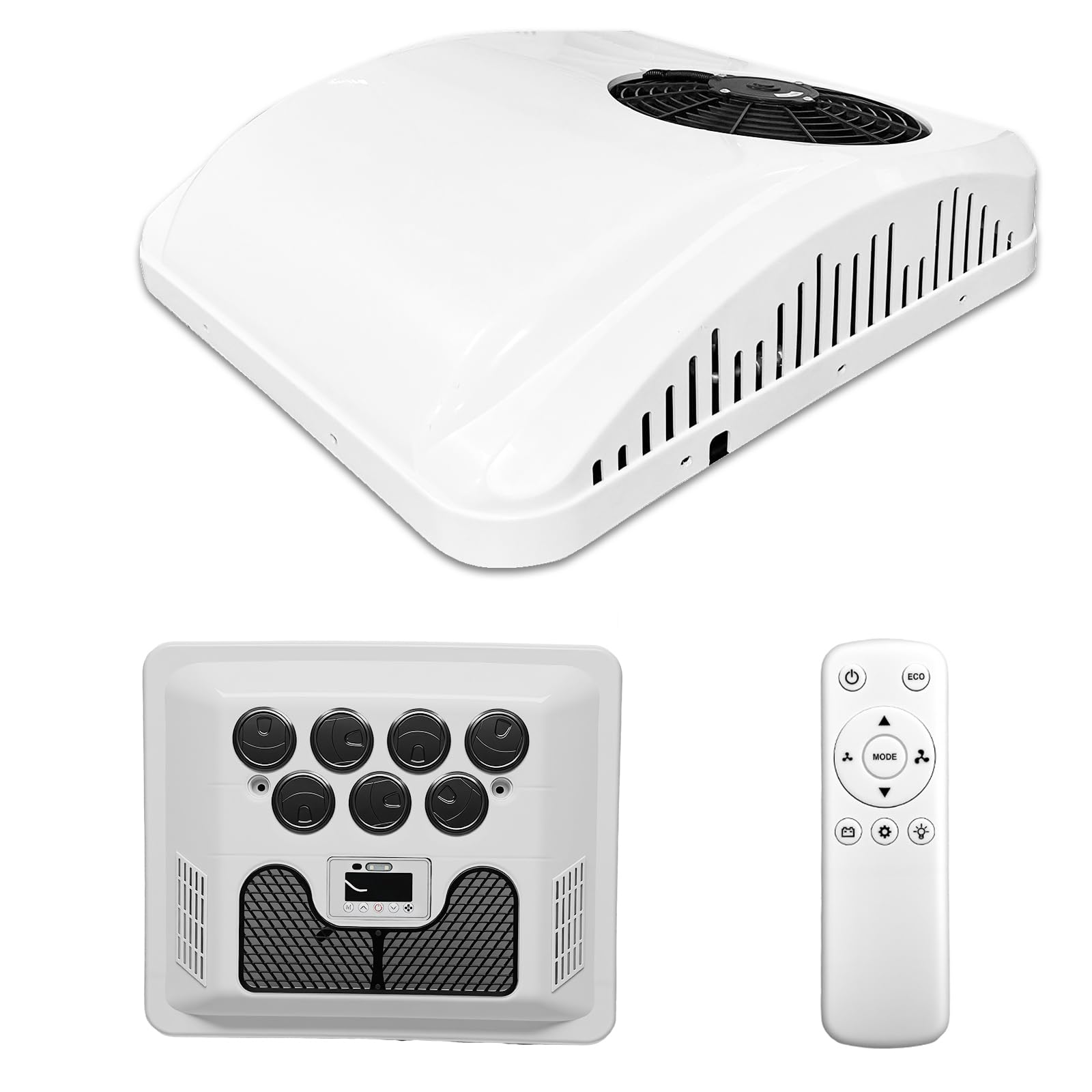
The Treeligo brings serious cooling muscle to the table with 11,000 BTU of raw capacity, capable of dropping the interior temperature of a golf cart within minutes even on a scorching afternoon. It runs on a pure 12V DC system, meaning you can pair it directly with a deep-cycle auxiliary battery without needing a bulky inverter. Owners report a 5-degree drop in under five minutes.
Noise levels stay below 45 dB thanks to the inverter compressor and sound-dampened internal structure. That’s quiet enough for a nap between rounds. The unit also includes a heating function, making it a year-round companion for early morning tee times when temps dip. The triple safety certifications (FCC, UL) provide peace of mind against electrical surges common in vehicle systems.
Installation requires only a 12.6″ x 10.24″ roof opening, which is smaller than the standard 14×14. However, some users found the stock 6-gauge power cables insufficient for the 200Ah battery bank they paired it with, recommending a 4-gauge upgrade for long wire runs. Factor that into your install budget.
Why it’s great
- Highest BTU in its class at 11,000 for maximum cooling punch
- Works on native 12V DC, no inverter needed
- Includes both cooling and heating functionality
Good to know
- May struggle in very high humidity environments
- Stock power cables should be upgraded to 4-gauge for long runs
3. Outequip 12V 10000 BTU Rooftop AC (with Heater)
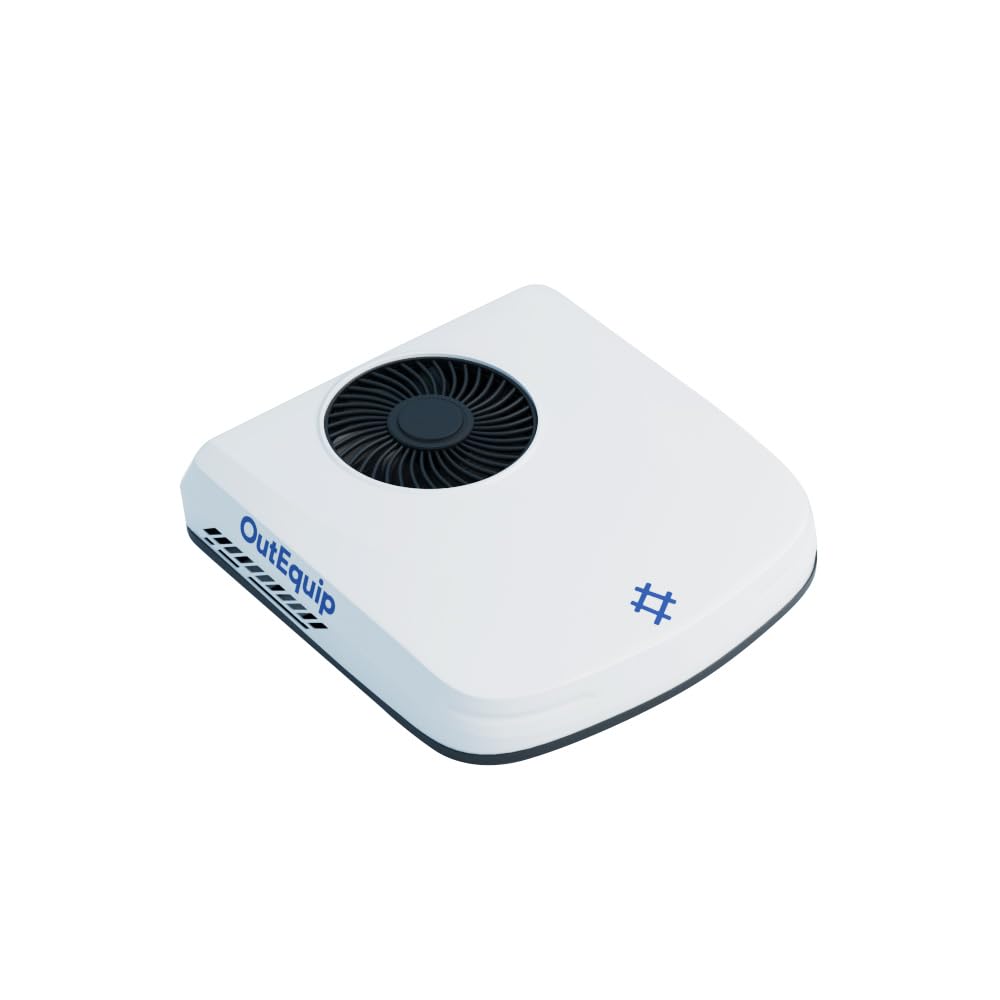
The Outequip unit delivers a compelling mid-range price-to-performance ratio. Its 10,000 BTU cooling capacity can chill a golf cart in about 15 minutes, and the integrated 4,500 BTU PTC heater takes the edge off chilly mornings or evening rides. The variable-speed inverter compressor sips as little as 200-300W in eco mode, making it a strong candidate for off-grid use.
Weighing only 43 lbs with a low 6-inch roof profile, this AC is light enough for a single person to hoist onto the roof. The UV-stabilized ABS shell and zinc-coated condenser resist weather degradation, which is critical for a cart parked outdoors. User reviews consistently praise the responsive customer service, with one customer receiving a free 24V swap after an ordering error.
On a 600Ah LiFePO4 battery bank, owners report running the AC for 6-7 hours straight in eco mode before hitting 50% discharge. The main caveat: the PTC heater is supplementary, not a primary heat source for sub-freezing temps. For a golf cart that doubles as a street-legal neighborhood cruiser, this is an excellent all-rounder.
Why it’s great
- Lightest rooftop option at 43 lbs for easy installation
- Integrated PTC heater adds year-round usability
- Extremely efficient in eco mode (200-300W draw)
Good to know
- Heater is not powerful enough for extreme cold
- Lid screws can be difficult to remove during installation
4. Outequip RV AC (No Heater)
This variant of the Outequip drops the heater to save weight and cost, coming in at just 45 lbs with a 6.3-inch low profile. It’s the perfect unit for a pure summer golf cart where you’ll never need cabin heat. The 10,000 BTU output handles direct sun exposure well, and the brushless copper motor fans keep the noise floor low.
Owners of Class B vans and pop-up campers have successfully installed this unit, noting that it draws about 55A on high speed and drops to roughly 20A on eco. That 20A draw is manageable even on a moderate battery setup—a 360Ah bank should get you 6-7 hours of use. The spring-supported mounts dampen vibration effectively, preventing rattling on uneven terrain.
The trade-off is that the heater-less design means you lose any winter utility, and the installation requires careful roof sealing to avoid water ingress. The included gasket is adequate, but adding a bead of sealant around the flange is a smart precaution. For a dedicated fairway machine, this is a budget-conscious winner.
Why it’s great
- Lowest profile at 6.3 inches for aerodynamic carts
- Very efficient eco mode draws only ~20A
- Excellent vibration dampening from spring mounts
Good to know
- No heating function limits seasonal use
- Roof sealing needs extra attention to prevent leaks
5. Gidrox 10000 BTU Rooftop AC
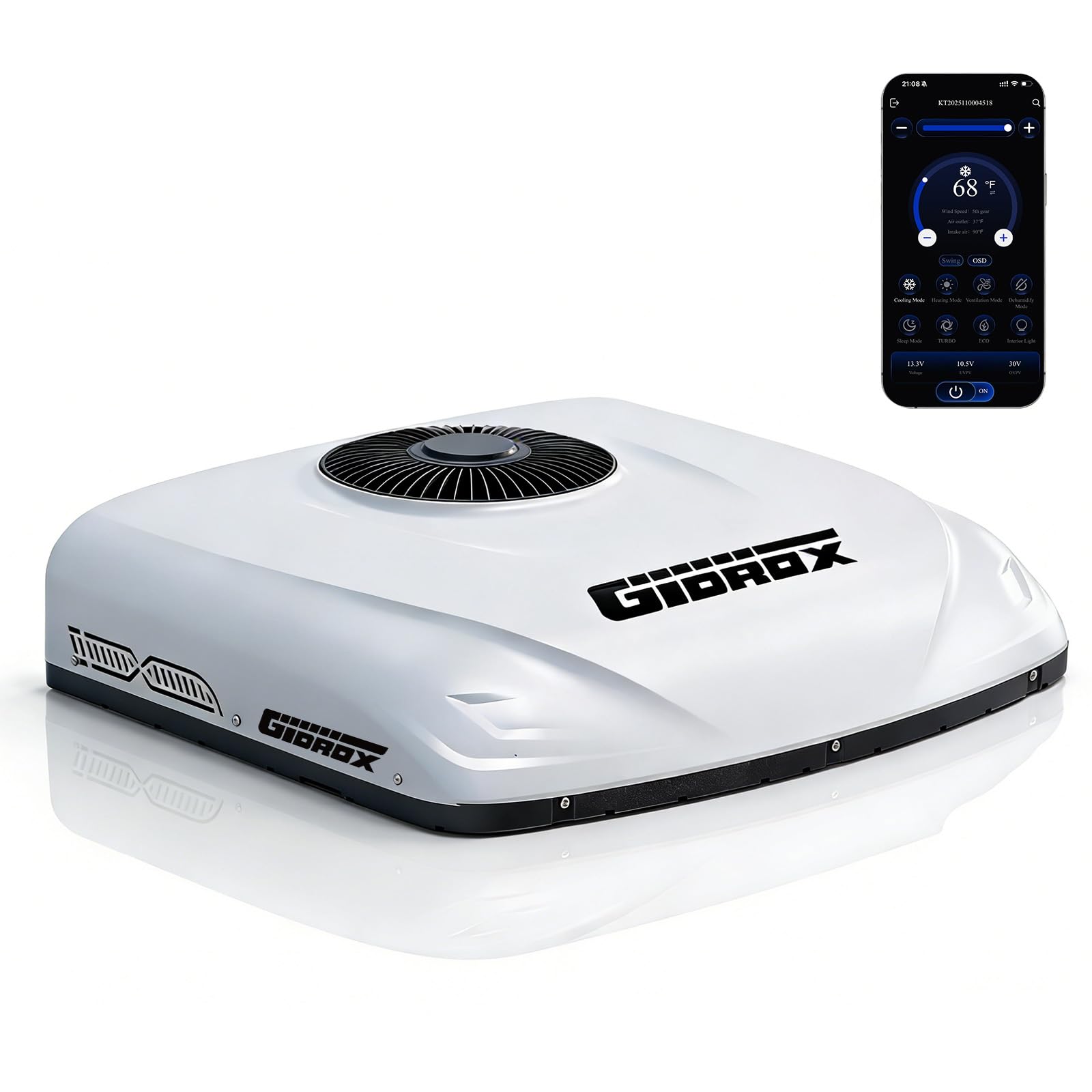
The Gidrox stands out for its three-way control—physical panel, infrared remote, and smartphone app via Bluetooth. That flexibility is a huge advantage when the remote inevitably slides under the seat. The 10,000 BTU cooling pairs with a PTC heater for chilly starts, and the brushless fan drops to a library-quiet 40 dB in sleep mode.
Pair this with a 400Ah battery and you can comfortably run it all night. The low-temperature cut-off protection prevents the battery from being drained below safe levels, a crucial safety feature for LiFePO4 packs.
Installation is a standard 14×14 roof vent fit, but the included threaded rods may be too short for thicker camper roofs. Some users purchased longer 8mm all-thread rods to compensate. Customer support is proactive—one buyer who damaged a circuit board during install received a free replacement promptly. For a tech-forward build, the Gidrox delivers convenience and reliability.
Why it’s great
- Smartphone app control for remote adjustment
- Sleep mode at 40 dB for undisturbed rest
- Low power consumption (~350W) for extended battery life
Good to know
- Included threaded rods may be too short for thicker roofs
- Remote control range can be limited
6. Aspligo Under Dash 10000 BTU AC Kit

The Aspligo kit takes a completely different approach—it’s a split-system under-dash unit rather than a rooftop mount. That’s a massive benefit if your golf cart has a canopy roof that can’t support the weight of a rooftop AC. The internal unit measures 15.9 x 13.6 x 6.1 inches and can be tucked under the front dash or seat.
Its 20CC electric scroll compressor and R134A refrigerant system pump out 10,000 BTU of cooling. The external condenser unit mounts externally (under the rear seat or bumper), and the pre-oiled compressor simplifies installation for anyone with basic mechanical skills. The low-voltage protection (LVP) prevents the battery from being drained below a safe threshold, extending battery life.
Power draw is a manageable 550-600W (40-60A at 12V). Users report that the system cools effectively and that the integrated receiver-dryer reduces potential leak points. The downside is that packaging is separate for indoor and outdoor units, so they may arrive on different days. Verify your cart’s battery voltage before purchase; this is a 12V system and won’t run directly on 48V without a converter.
Why it’s great
- Discreet under-dash installation preserves roof space
- Integrated design reduces potential refrigerant leak points
- Low voltage protection safeguards battery health
Good to know
- Units ship in two separate packages that may not arrive together
- Requires mechanical experience for proper installation
7. IceCove Portable Air Conditioner

The IceCove is the most accessible entry point for cooling a golf cart, thanks to its low power draw and complete portability. At just 250W and 2,500 BTU, it won’t freeze a large cabin, but on a small two-seater with a canopy, it can drop the temperature by 10°F in an hour. The R290 refrigerant is eco-friendly and efficient.
This unit is designed for maximum flexibility. It runs on 100-120V AC, a compatible battery, a car charger (12V), or solar panels (battery and panel not included). The touch control panel and LED lighting make it usable day or night. At 5.3 kg (under 12 lbs), it’s easy to move between the cart, tent, or workshop.
The main limitation is the hose adapter cooling effectiveness—some cold air can leak back into the cart through the window seal. Heat output from the exhaust hose also needs to be vented outside, which may be tricky on a cart without windows. For intermittent use on a hot day, however, the IceCove is a practical, low-cost solution that won’t strain a small battery.
Why it’s great
- Very low power consumption (250W) works with small batteries
- Ultra-lightweight design at under 12 lbs
- Multiple power source options for maximum flexibility
Good to know
- 2,500 BTU is insufficient for large or unshaded carts
- Window exhaust adapter can leak cold air if not sealed properly
8. DC HOUSE 48V 100Ah LiFePO4 Battery
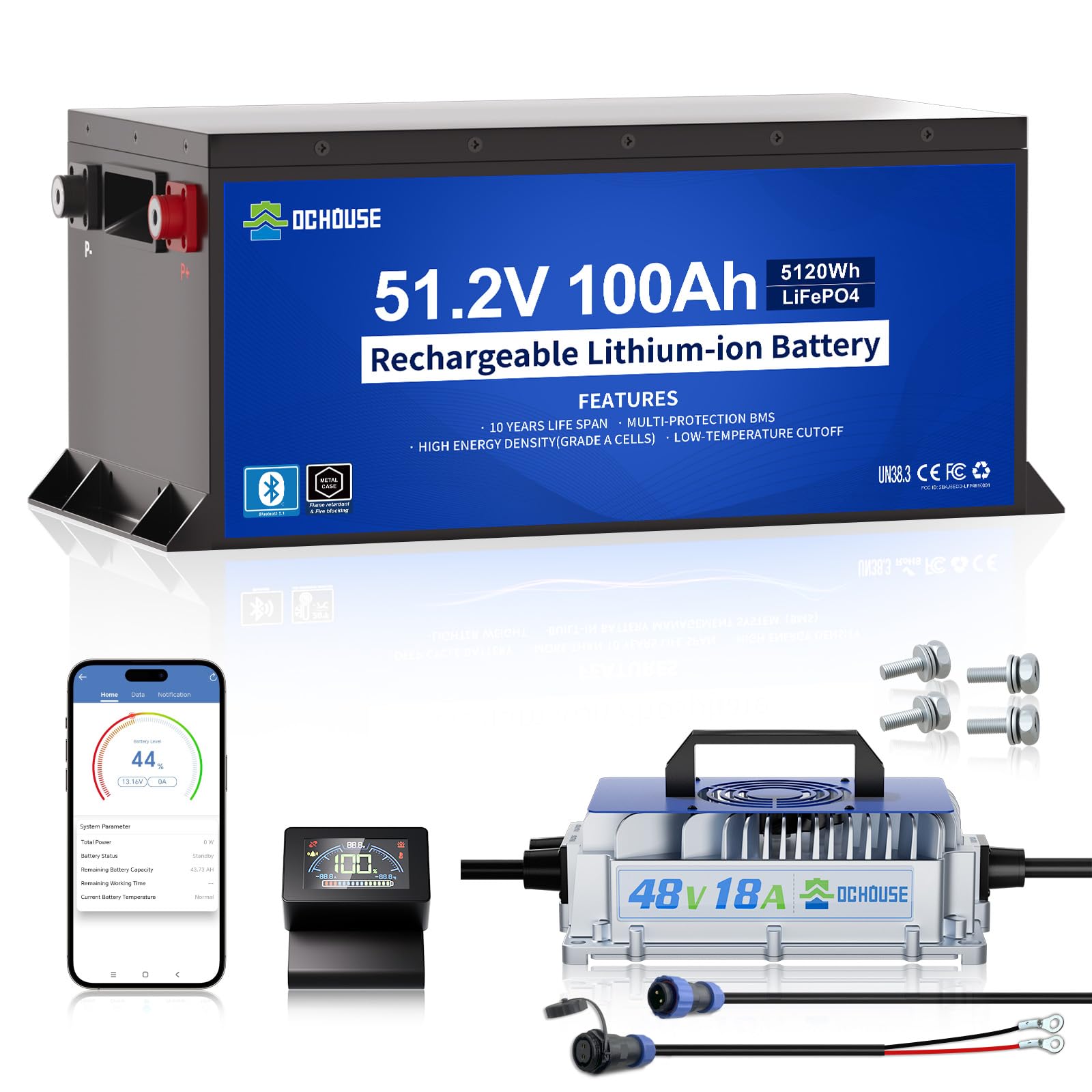
Before you can run an AC, you need a power source that won’t die after 18 holes. The DC HOUSE 48V 100Ah battery is a drop-in replacement for standard lead-acid golf cart batteries, meaning your existing wiring and charger port work as-is. Switching from 6 lead-acid batteries to this single 99-lb lithium unit cuts roughly 300 lbs, instantly improving acceleration and suspension height.
The built-in 200A BMS handles 250A surges for 30 seconds and peaks at 670A for 0.5 seconds—plenty of headroom for both the drive motor and a 12V AC unit via a converter. The Bluetooth app and LCD monitor give you real-time voltage, capacity, and fault codes. The 48V 18A charger fills the pack in about 5.5 hours.
After 18 holes on a hilly course, owners report still having 78% charge remaining. With 4,000+ deep cycles, this battery will outlast the cart itself. The metal case with a one-key safety switch is a significant safety upgrade over ABS plastic lithium batteries. If you’re building a cart for serious AC use, start with this battery.
Why it’s great
- Drop-in replacement for 6 lead-acid batteries, no wiring modification
- Massive weight savings (~300 lbs) improves cart handling
- 200A BMS with peak 670A for powerful acceleration
Good to know
- Check battery compartment dimensions for a perfect fit
- Battery and charger ship in separate packages
9. BOPGA 48V 105Ah LiFePO4 Battery
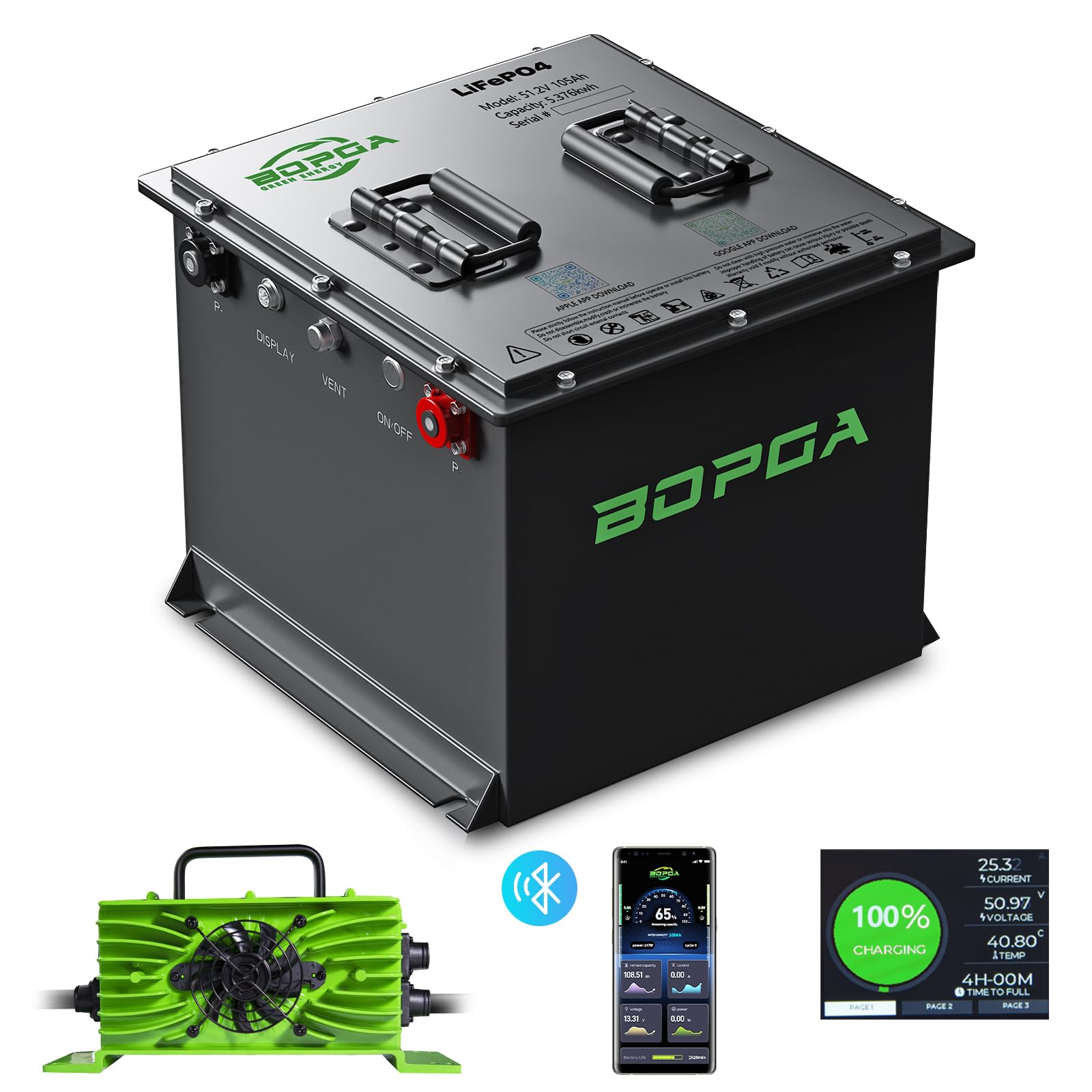
The BOPGA battery is engineered for tight compartments. It measures 12.79 x 12 x 10.43 inches—smaller than 90% of competing 48V lithium packs—making it ideal for carts like the Club Car DS where space under the seat is at a premium. At 92.6 lbs, it’s also about 20% lighter than standard 48V packs.
Inside, it uses EV-grade prismatic LiFePO4 cells with a 200A BMS that can burst to 400A for 35 seconds and 600A for 5 seconds. That means even with an AC unit running, you still have ample power for hill climbing. The 5.376 kWh capacity provides a 50-mile range under normal golf cart driving, and the included 20A smart charger fills it in around 5 hours.
The 2.8-inch LCD touch display and Bluetooth app provide dual monitoring paths. Owners praise the responsive customer support, often resolving emails within hours. The 5-year warranty adds extra peace of mind. Its smaller footprint leaves room for a 12V auxiliary battery if you’re using a 12V AC unit, making it a strategic choice for complex builds.
Why it’s great
- Extremely compact size fits in tight battery compartments
- 5.376 kWh capacity provides a 50-mile range
- 5-year warranty for long-term confidence
Good to know
- May require a new charger receptacle for some cart models
- Touch monitor needs careful mounting to avoid damage
10. Cloudenergy 48V 105Ah LiFePO4 Battery
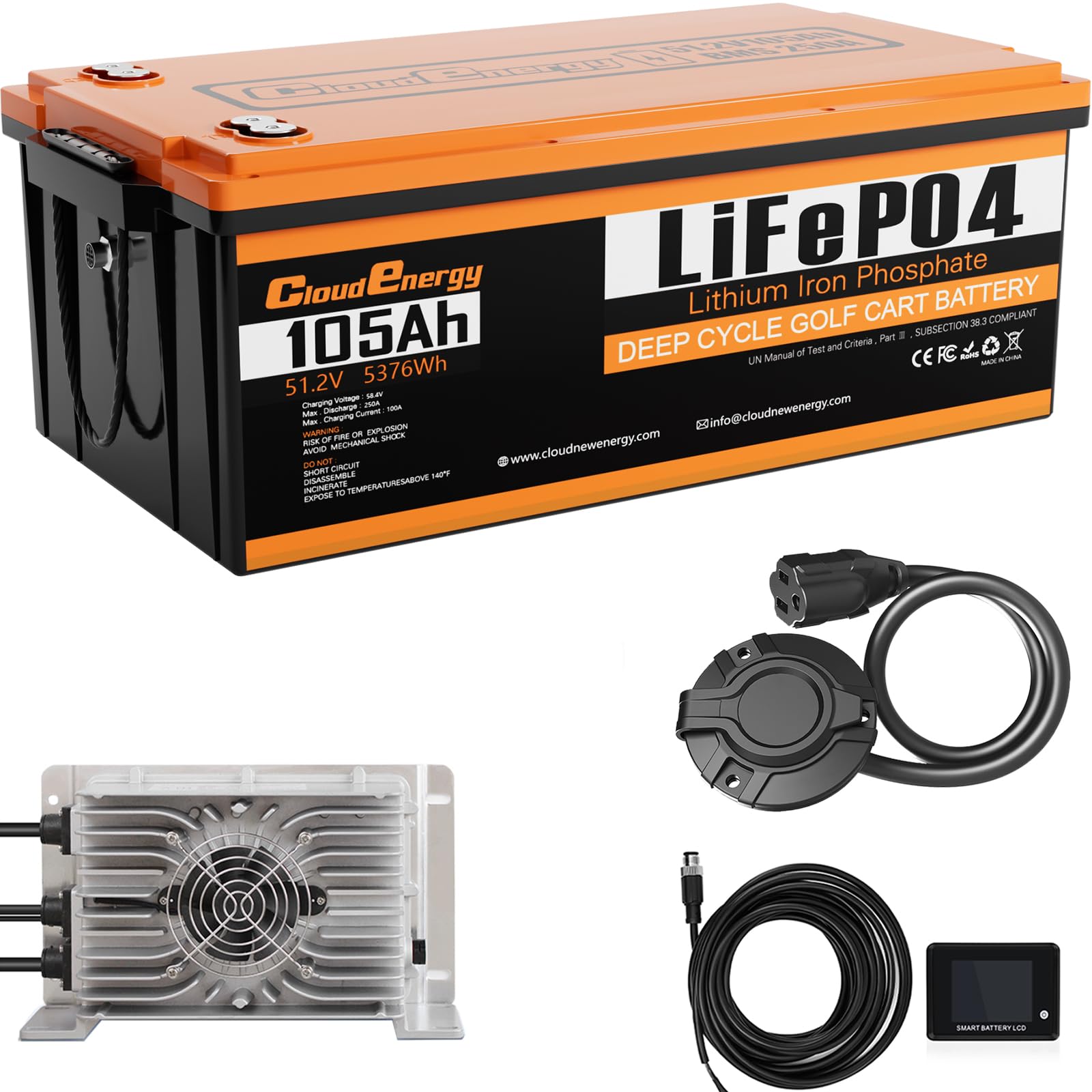
The Cloudenergy battery is built for owners who run aftermarket high-torque controllers and motors. Its 250A BMS can sustain 400A for 35 seconds and peak at 600A for 3 seconds, meaning you can keep an AC unit running while still having full throttle for steep hills. One owner reported pulling 219A up a steep grade while simultaneously reaching 25 mph.
With 6000+ deep cycles, this pack is rated for more than 10 times the lifespan of lead-acid. The ABS fireproof and shockproof case with IP67 rating protects against rain and dust, a crucial feature for a cart exposed to the elements. Dual M8 screw terminals (positive and negative) make wiring straightforward and accommodate thick cables.
Installation is a direct swap in many 2010+ Club Car and EZGO models. The included LCD touch monitor and Bluetooth app show cell-level status. Users have noted that the battery holds its charge for weeks when parked, a major benefit for carts without daily access to shore power. If your AC build demands maximum current draw, this is the battery to beat.
Why it’s great
- 250A BMS with 600A peak handles high-power AC and motor draws
- IP67-rated case for water and dust protection
- 6000+ deep cycles for exceptional longevity
Good to know
- No built-in on/off switch; disconnect manually for storage
- ABS case, while tough, isn’t as rigid as metal
11. Furrion Chill Cube 18K BTU Rooftop AC

The Furrion Chill Cube is overkill for a standard golf cart, but for a stretched limo cart or a luxury crew vehicle, nothing else comes close. Its 18,000 BTU variable-speed compressor generates over 1.5 tons of cooling, capable of dropping a large cabin from 89°F to comfortable in just 15 minutes. The R32 refrigerant is more efficient and environmentally friendly than R410A.
Despite the massive cooling output, the variable-speed design sips as little as 300W when maintaining temperature. That’s less than many 10,000 BTU units. The built-in dehumidifier prevents coil freezing in humid conditions, a common issue with fixed-speed units. At 72.4 lbs, it’s 10% lighter than competing 18K units, and the aerodynamic shroud reduces drag.
Installation requires a standard roof vent opening and a separate ADB (air distribution box) which is sold separately. The unit draws a max of 1100W, which means you’ll need a substantial 48V battery bank and a 2000W+ inverter. Owners who paired it with 1000Ah of LiFePO4 report running it for 10 hours off-grid—a feat impossible with a traditional 13.5K BTU unit.
Why it’s great
- Highest cooling capacity at 18,000 BTU for large cabins
- Variable speed compressor pulls only 300W when idling
- Built-in dehumidifier prevents coil freeze-up
Good to know
- Requires a separate ADB (sold separately) for full installation
- High initial draw (1100W) needs a substantial battery and inverter
FAQ
Can I run a golf cart AC unit directly off my cart’s 48V battery?
How much battery capacity do I need for a full day of golf?
Will a rooftop AC fit any golf cart roof?
Final Thoughts: The Verdict
For most users, the air conditioner for golf cart winner is the Countrymod 12V DC because its 10,000 BTU inverter compressor delivers class-leading efficiency (0.3 kWh/h) at a whisper-quiet 44 dB, perfectly balancing battery life and cooling power. If you need maximum cooling output, grab the Treeligo 11000 BTU. And for a pure off-grid build where every watt counts, the Outequip with heater offers the best eco-mode efficiency and year-round utility.