
A warehouse isn’t a living room. The air volume is enormous, the ceiling is high, and the heat sources—machinery, people, loading docks, direct sun through skylights—are relentless. A standard window unit or a bedroom-grade portable AC will run continuously, spike your electricity bill, and still leave the far end of the bay sweltering. Cooling a warehouse demands a very different spec sheet: raw BTU output that matches cubic footage, airflow measured in CFM rather than square feet, and a system built for continuous 8-to-12-hour duty cycles without breaking a sweat.
I’m Min — the co-founder and writer behind Gadgets Feed. For this guide, I’ve spent dozens of hours cross-referencing ASHRAE and SACC ratings, analyzing compressor types and CEER efficiency numbers, and reading hundreds of actual owner reviews from workshops, garages, auto shops, and storage facilities to find the machines that actually survive real warehouse conditions.
If you need serious, non-stop cooling for a large, open commercial space, you need to cut through the marketing and focus on the specs that matter. This is the definitive analysis for finding the absolute best air conditioner for warehouse.
How To Choose The Best Air Conditioner For Warehouse
Warehouse cooling is a math problem first, a shopping decision second. The biggest mistake is buying on BTU floor-area ratings meant for homes. A 1,500 sq. ft. warehouse with 20-foot ceilings has 30,000 cubic feet of air—triple that of a typical house. You need to calculate cubic footage and factor in heat gain from loading doors, insulation quality, and equipment. Once you know your load, you can choose between three fundamentally different system types.
Calculate Your True Cooling Load
Skip the “covers up to X sq ft” marketing labels. Measure length × width × ceiling height to get cubic feet. A rule of thumb for a moderately insulated warehouse is 20–25 BTU per cubic foot. For a 40′ × 60′ space with 18′ ceilings (43,200 cubic feet), you need roughly 864,000 to 1,080,000 BTUs of total capacity. That’s not one portable AC—that’s a mini-split system or multiple high-CFM evaporative coolers working in zones. If you’re cooling a small workshop bay or server room inside a larger warehouse, a single 14,000–16,000 BTU portable unit might handle 3,000–4,000 cubic feet effectively.
Mini-Split vs. Portable vs. Evaporative: Which System Fits?
Mini-split systems (multi-zone or single-head) are the gold standard for permanent warehouse cooling. They deliver high SEER efficiency, silent operation, and don’t block windows. The upfront cost is higher, and professional installation is mandatory for warranty coverage. Portable units with dual-hose, inverter compressors are a strong budget-friendly compromise for smaller zones—they offer drainage-free operation and reasonable efficiency but lose cooling power through the exhaust hose. Evaporative coolers (swamp coolers) are extremely energy-efficient and move massive CFM, but they only work in dry climates (humidity below 50%), and they add moisture to the air, which can rust equipment or damage inventory over time.
Ignore “Quiet” Ratings—Focus on Duty Cycle
A warehouse AC runs for hours without shutting off. Look for a compressor type that can handle extended runtimes without short-cycling. Inverter compressors (DC or full inverter) are ideal because they ramp down power when the target temp is near, reducing wear and energy draw. Rotary scroll compressors are durable and commercial-grade. Avoid budget units with cheap reciprocating compressors that burn out under continuous load. Also check that the unit has a condensate pump or self-evaporating system—the last thing you want is a full drain bucket in the middle of a shift.
Quick Comparison
On smaller screens, swipe sideways to see the full table.
| Model | Category | Best For | Key Spec | Amazon |
|---|---|---|---|---|
| Senville 36,000 BTU Mini Split | Mini-Split | Permanent whole-zone cooling | 36,000 BTU, 17.5 SEER, Inverter | Amazon |
| Goodman 3 Ton Packaged Unit | Packaged AC | Ducted warehouse or double-wide | 36,000 BTU, 13.4 SEER2, Scroll Compressor | Amazon |
| Senville 18,000 BTU Dual Zone | Mini-Split | Two separate workshop bays | 18,000 BTU, Dual Zone, Inverter | Amazon |
| Uthfy 8979 CFM Swamp Cooler | Evaporative | Dry-climate large spaces | 8,979 CFM, 36 Gal Tank, 120° Oscillation | Amazon |
| Hessaire 5300 CFM Evaporative | Evaporative | Garages and shops in arid regions | 5,300 CFM, 14.6 Gal Tank, 3-Speed | Amazon |
| SNOCOD 16,000 BTU Portable | Portable | Quiet spot-cooling with app control | 16,000 BTU, 40 dB, 5-in-1, Self-Evaporating | Amazon |
| ZAFRO 16,000 BTU Inverter | Portable | Energy-saving spot cooling | 16,000 BTU, 12.8 CEER, Dual Hose, 42 dB | Amazon |
| TECXERLLON 16,000 BTU Portable | Portable | Large rooms up to 850 sq ft | 16,000 BTU, 120 Pints/Day Dehumidifier | Amazon |
| Gasbye 14,000 BTU Dual Hose | Portable | Efficient spot cooling with DC inverter | 14,000 BTU, 13.6 CEER, Dual Hose, 45 dB | Amazon |
| DREO 12,000 BTU Portable | Portable | Quiet bedroom or small office zone | 12,000 BTU ASHRAE / 8,000 BTU SACC | Amazon |
| Big Ass Fans Haiku L | Ceiling Fan | Air circulation enhancement | 52” Blade, Whisper Quiet, 7-Speed | Amazon |
In‑Depth Reviews
1. Senville LETO Series 36,000 BTU Mini Split

This is the benchmark for serious warehouse cooling. The Senville LETO delivers 36,000 BTUs of actual cooling power through a DC inverter compressor that ramps up and down based on demand, preventing the energy waste and temperature swings of fixed-speed units. With a 17.5 SEER efficiency rating, it’s dramatically cheaper to run than a window unit or portable AC over a multi-month cooling season. The unit covers up to 1,800 square feet on paper, but in a warehouse with high ceilings, it’s more realistic for a 1,200–1,500 sq ft well-insulated zone.
The 4-in-1 functionality—air conditioning, heat pump (good down to 5°F), dehumidifier, and fan—means it pulls year-round duty. The Alexa-enabled app control lets you schedule pre-cooling before the morning shift or adjust temps remotely over the weekend. The outdoor condenser is surprisingly quiet compared to traditional HVAC units, which matters if your warehouse shares a wall with an office or residential space.
The installation kit includes a 16-foot line set and communication wire, but professional installation is required to keep the 5-year warranty intact. Owner reports confirm that self-install voids the compressor warranty, so budget for a licensed HVAC tech. Once properly charged and vacuum-tested, owners consistently report cooling entire 800–1,200 sq ft shop floors down to 65°F even when outside temps hit 100°F.
Why it’s great
- 36,000 BTU inverter compressor with 17.5 SEER efficiency
- Heat pump operation down to 5°F for winter use
- Quiet enough not to disrupt a warehouse office or break room
Good to know
- Professional installation required for warranty coverage
- 16-ft lines may be too short for second-floor or distant condenser placement
- No external thermostat included—app or remote only
2. Goodman 3 Ton 13.4 SEER2 Packaged Unit
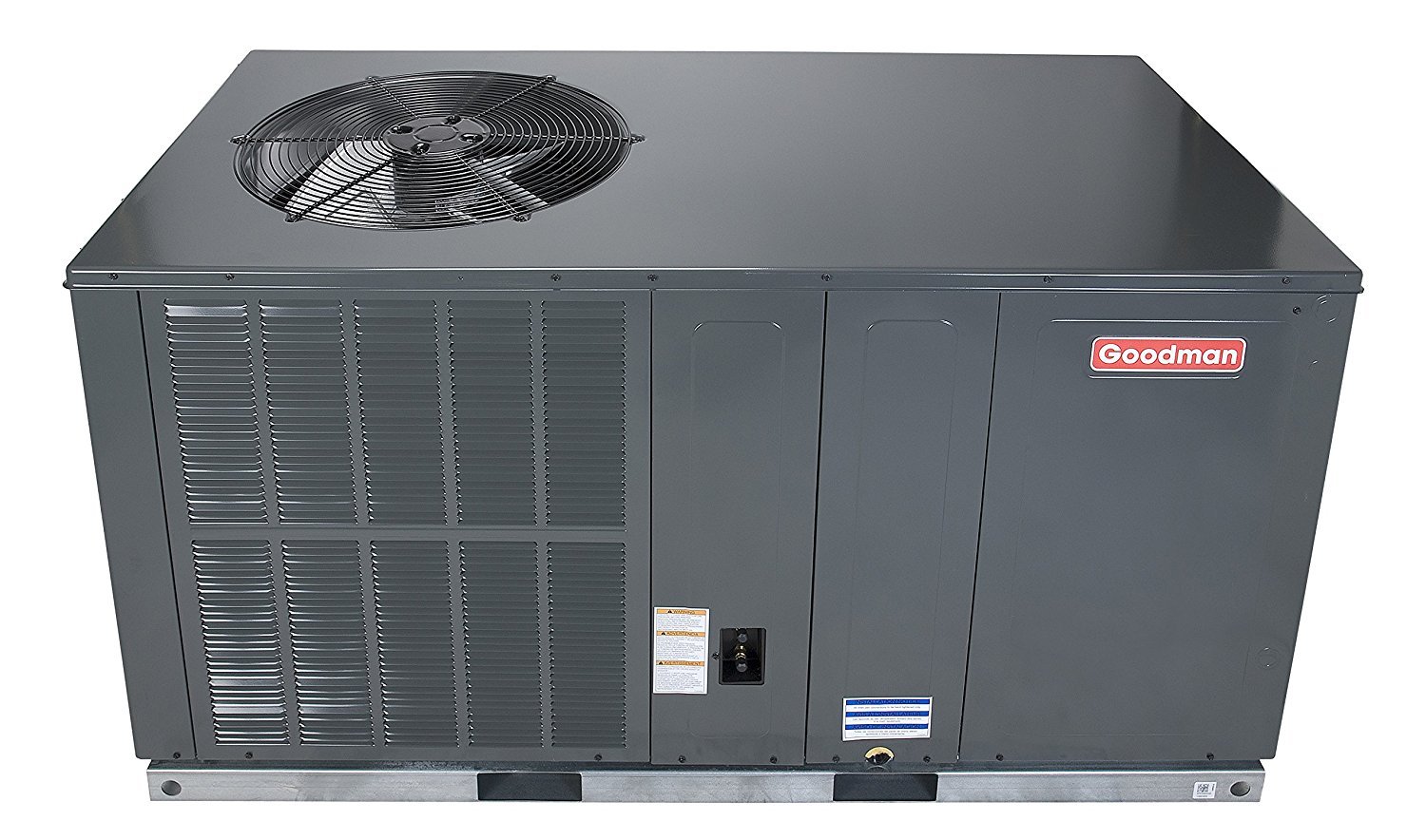
If your warehouse already has ductwork or you’re retrofitting a manufactured building (double-wide, modular office, prefab structure), this packaged unit is the most straightforward solution. It’s a complete system in one box: compressor, evaporator coil, and condenser are pre-assembled and pre-charged. No brazing, no running copper line sets, no separate indoor head. The scroll compressor is built for commercial-grade reliability and handles continuous runtime far better than cheap rotary compressors found in portable units.
At 36,000 BTUs with a 13.4 SEER2 rating, the efficiency isn’t class-leading but is adequate for a warehouse where the unit may run 10–12 hours straight. The horizontal discharge makes it ideal for slab mounting next to the building wall. Owner reviews consistently mention that installation is DIY-friendly for a homeowner with basic skills because there’s no refrigerant work—just connect the power and the duct. The unit is heavy (well over 200 lbs), so a lift or tractor forks are recommended for positioning.
One important consideration: this is an AC-only packaged unit with no heat pump. If you need winter heating, you’ll need to pair it with a separate furnace or heat strip. The Energy Star certification and 10-year parts warranty provide peace of mind, and Florida owners report reliable performance through multiple hurricane seasons. For a warehouse that needs a workhorse AC with minimal setup complexity, this is hard to beat.
Why it’s great
- Pre-charged, pre-assembled packaged system—no HVAC license needed for install
- Reliable scroll compressor designed for long commercial duty cycles
- 10-year parts warranty and Energy Star rated
Good to know
- AC only—no built-in heat pump or heating function
- Very heavy unit (200+ lbs), requires equipment to move and place
- 13.4 SEER2 is entry-level efficiency for modern standards
3. Senville 18,000 BTU Dual Zone Mini Split

This is the ideal solution for a warehouse with two distinct zones—a workshop area and a separate office or break room. The 18,000 BTU total capacity is split across two indoor air handlers, each with its own temperature control. That means you can keep the office at a comfortable 72°F while letting the shop run a few degrees warmer, without fighting over a single thermostat. The inverter compressor adjusts output based on the combined load of both zones, which significantly improves efficiency over running two separate units.
Owner reports highlight the dramatic electricity bill reduction compared to old central AC or window units—one reviewer noted a monthly savings minimum. The unit is whisper-quiet when running; you can barely tell it’s on, which is a huge advantage if the warehouse doubles as a client-facing retail space or fabrication studio where noise matters. The Alexa-enabled app control allows scheduling and remote adjustments, perfect for pre-cooling before a shift starts.
The included 16-foot line sets may be too short for some installations—one owner needed 25-foot sets to reach a second-story condenser location. Senville’s customer support exchanged the lines without hassle. Professional installation is required to maintain the warranty, and you’ll need to find a tech willing to vacuum and release the pre-charged refrigerant. The unit is designed for both residential and commercial use, and owners in auto shops and small factories confirm it handles the environment well.
Why it’s great
- Two independently controlled zones from one outdoor unit
- Inverter compressor for efficiency and quiet operation
- Significant energy savings reported vs. central AC or window units
Good to know
- 16-ft line sets may not be long enough for some placements
- Professional installation required; self-install voids warranty
- Condenser wall-mount vibrations can be an issue if not properly anchored
4. Uthfy 8979 CFM Swamp Cooler

If your warehouse is in Arizona, Nevada, Colorado, or any dry climate where humidity stays below 50%, this evaporative cooler is the most cost-effective way to move massive amounts of cool air. At 8,979 CFM with a 36-gallon water tank, it’s designed for spaces up to 1,800 square feet—and in an open warehouse with high ceilings, that CFM rating is more honest than BTU marketing because it actually measures air movement. The 120° oscillation helps eliminate dead zones that stationary fans cannot reach.
The build quality is rugged for the price point: galvanized iron body, copper motor, and a 3-side intake panel system that maximizes evaporation surface area. The 4-in-1 Composite Ice Curtain system filters air while adding extra chill when you load the five included ice packs. Owners report significant temperature drops in garages and partially enclosed deck spaces. In high heat, the unit brings a 105°F garage down to a tolerable working temperature.
The pump could be stronger for the water distribution—some owners note the cooling pads don’t saturate evenly, which reduces efficiency. Also, the unit is loud, which is expected for a commercial evaporative cooler moving nearly 9,000 CFM. It’s not suitable for indoor spaces with sensitive electronics or inventory that could be damaged by added moisture. For hot, dry workshops where noise isn’t a concern, this is a monster value at a fraction of the cost of a mini-split system.
Why it’s great
- Incredible 8,979 CFM airflow for large warehouse spaces
- 36-gallon tank means fewer refills during long shifts
- Very low electricity consumption compared to compressor-based AC
Good to know
- Only effective in dry climates (humidity below 50%)
- Loud operation—not suitable for quiet environments
- Pump distribution could be more even across cooling pads
5. Hessaire 5300 CFM Evaporative Cooler

The Hessaire MC61M is an established workhorse in the evaporative cooling world—some owners have run theirs for four-plus years with no issues. It pushes 5,300 CFM through a unique 3-panel intake system that provides 80% more evaporation surface than typical single-panel coolers. The 14.6-gallon tank provides 3–4 hours of continuous operation on a single fill, which is enough for a focused work session in a garage or small shop.
The build uses lightweight polypropylene resin, making it significantly lighter and easier to move than metal-bodied swamp coolers. The 3-speed fan gives you flexibility between a gentle breeze and max cooling output. In dry heat conditions (around 100°F with low humidity), owners report dropping temperatures by 10–15°F, bringing a garage from unbearable to comfortable. The cooling effect is immediate—you feel the temperature drop as soon as the air hits you.
Quality control can be inconsistent. Some units arrive with missing hardware, leaking float valves, or pump issues. The castors may not include the necessary hardware, and the noise level is comparable to a household box fan on high—noticeable but not deafening. It creates a “swampy” feel in enclosed spaces, which is the nature of evaporative cooling. If you need a reliable, low-cost solution for a dry-climate workshop, this unit has proven its longevity, but inspect every unit carefully on arrival.
Why it’s great
- Proven reliability with 4+ year service life reported
- 80% larger evaporation surface for better cooling efficiency
- Lightweight polypropylene construction for easy mobility
Good to know
- QC issues with leaking float valves and missing hardware
- Requires very dry climate to be effective
- Adds humidity to the air—not suitable for electronics storage
6. SNOCOD 16,000 BTU Portable AC
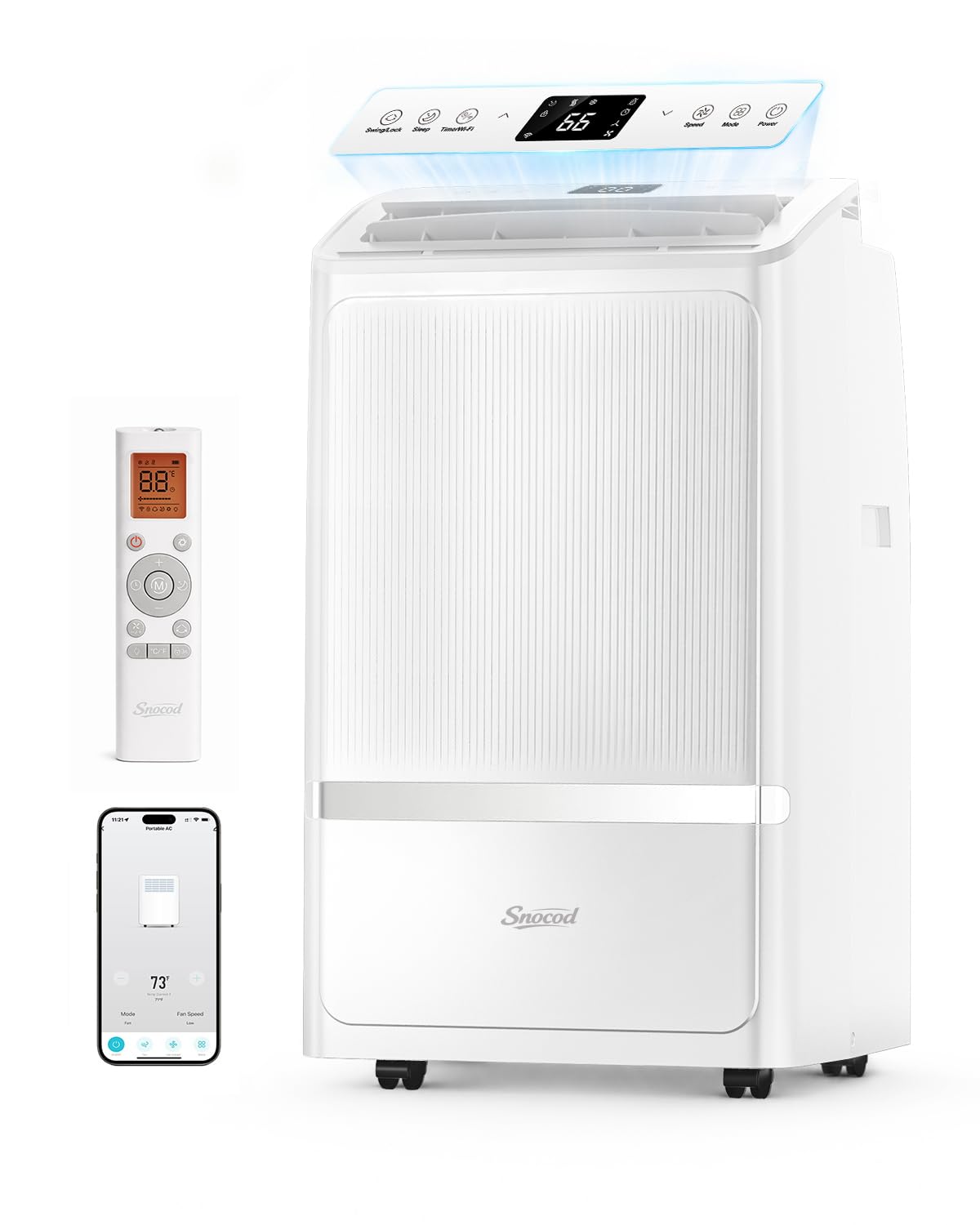
The SNOCOD hits a sweet spot for warehouses that need a portable unit running in a specific bay or server room without the complexity of a mini-split installation. Its 16,000 BTU rating (ASHRAE) is backed by a rotary scroll compressor and a self-evaporating system that eliminates manual draining in most conditions. The 5-in-1 functionality covers cooling, dehumidification, fan-only, sleep, and a programmable timer, making it versatile for a warehouse office or small workshop zone up to 800 square feet.
The standout feature here is noise control. At 40 dB in quiet operation, this is one of the most silent portable units at this BTU level. That matters if the AC is in a quality control area, a break room, or near a phone conversation space. The Smart Life app integration allows full remote control and sleep curve customization, so you can pre-cool the space before the crew arrives and let it ramp down overnight if the warehouse is unoccupied.
One owner noted that the unit may not be truly drainage-free—the self-evaporating system works well in moderate humidity but may require drain hose setup in high-humidity environments. Also, the claimed BTU is listed only on Amazon and not printed on the unit itself, which raises a transparency concern. However, the majority of owners confirm it cools a 350 sq ft room by 15°F within 5 minutes, indicating genuine cooling power. For a mid-range price point, this delivers a compelling balance of quietness, features, and performance.
Why it’s great
- Exceptionally quiet at 40 dB for a 16,000 BTU unit
- Full app and remote control with sleep curve customization
- Self-evaporating design reduces maintenance
Good to know
- Self-evaporating system may not keep up in high humidity
- BTU rating not printed on the unit itself
- Some owners question the value at its price point
7. ZAFRO 16,000 BTU Smart Inverter Portable AC
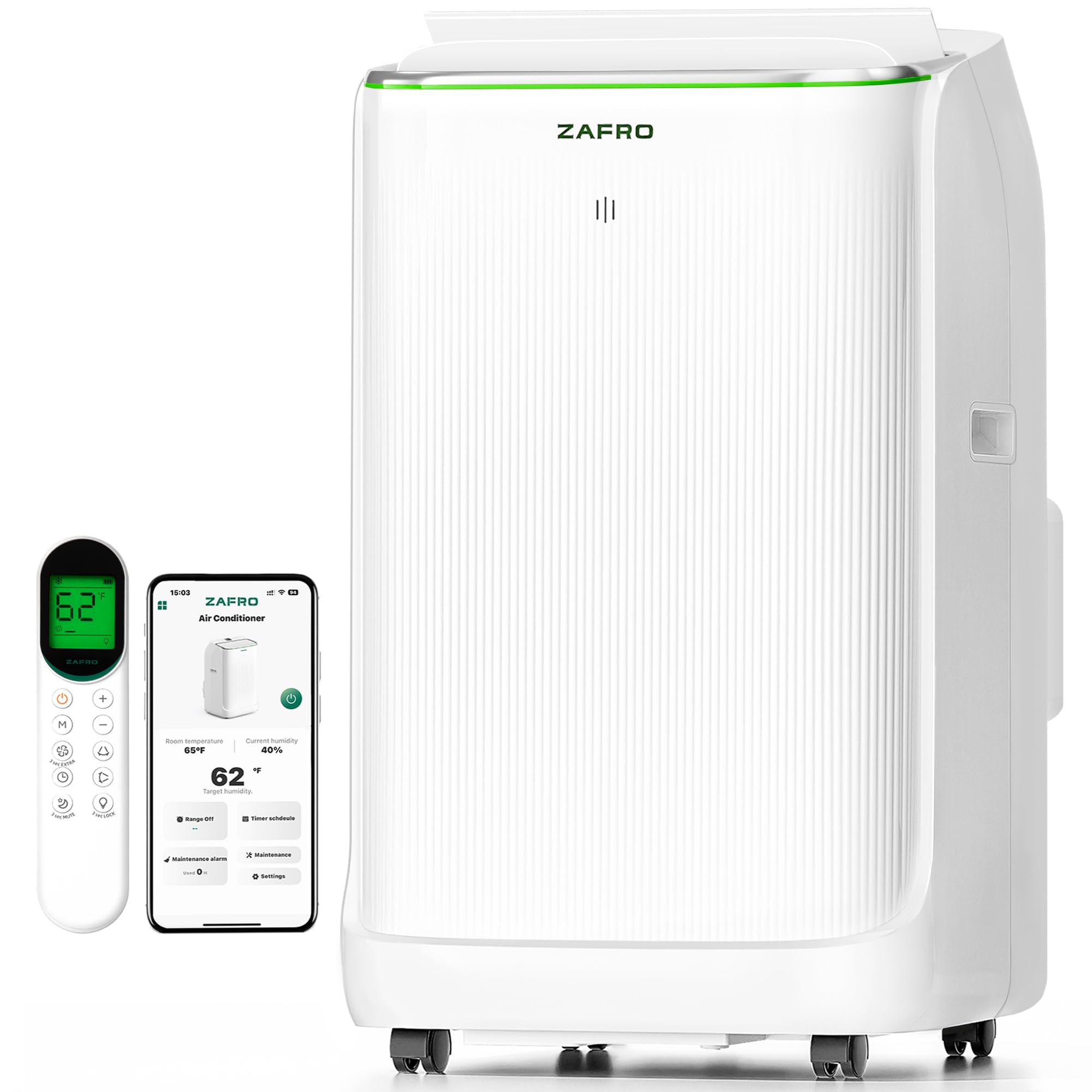
The ZAFRO is a strong contender for the most energy-efficient portable AC at this BTU level. Its 12.8 CEER rating blows past the federal minimum of 7.83, meaning it uses roughly 40% less electricity per cooling output than a standard portable unit. The full DC inverter compressor is the key—it doesn’t cycle on and off like a fixed-speed unit. Instead, it ramps up to 61°F in Extra Mode for quick blast cooling, then settles into Eco or Inverter mode that draws between 500–800 watts to maintain temperature.
The dual-hose system prevents the negative pressure problem that plagues single-hose units. In a warehouse, negative pressure can pull in hot outside air through gaps around loading doors, counteracting the cooling effort. The self-evaporating system claims up to 72 hours of drainage-free operation in humidity below 90%, which is a legitimate time-saver during a work week if you don’t want to babysit a drain bucket. The airflow of 500 cubic meters per hour is substantial for a portable unit.
Some owners note that the included window panel is thin and may leave gaps, which reduces efficiency—you may need to supplement with extra foam or tape for a tight seal. The app works well for scheduling and remote monitoring, but the active light indicator requires the remote to turn off. The customer support team is responsive, which helps mitigate any setup hiccups. For a warehouse zone where long runtime and low power draw are priorities, the ZAFRO is a smart pick.
Why it’s great
- Industry-leading 12.8 CEER for massive energy savings
- Dual-hose system prevents hot air infiltration
- 72-hour drainage-free operation in moderate humidity
Good to know
- Window panel may be too thin for a perfect seal
- App light indicator cannot be turned off without the remote
- Some customers report difficulty with initial setup
8. TECXERLLON 16,000 BTU Portable AC
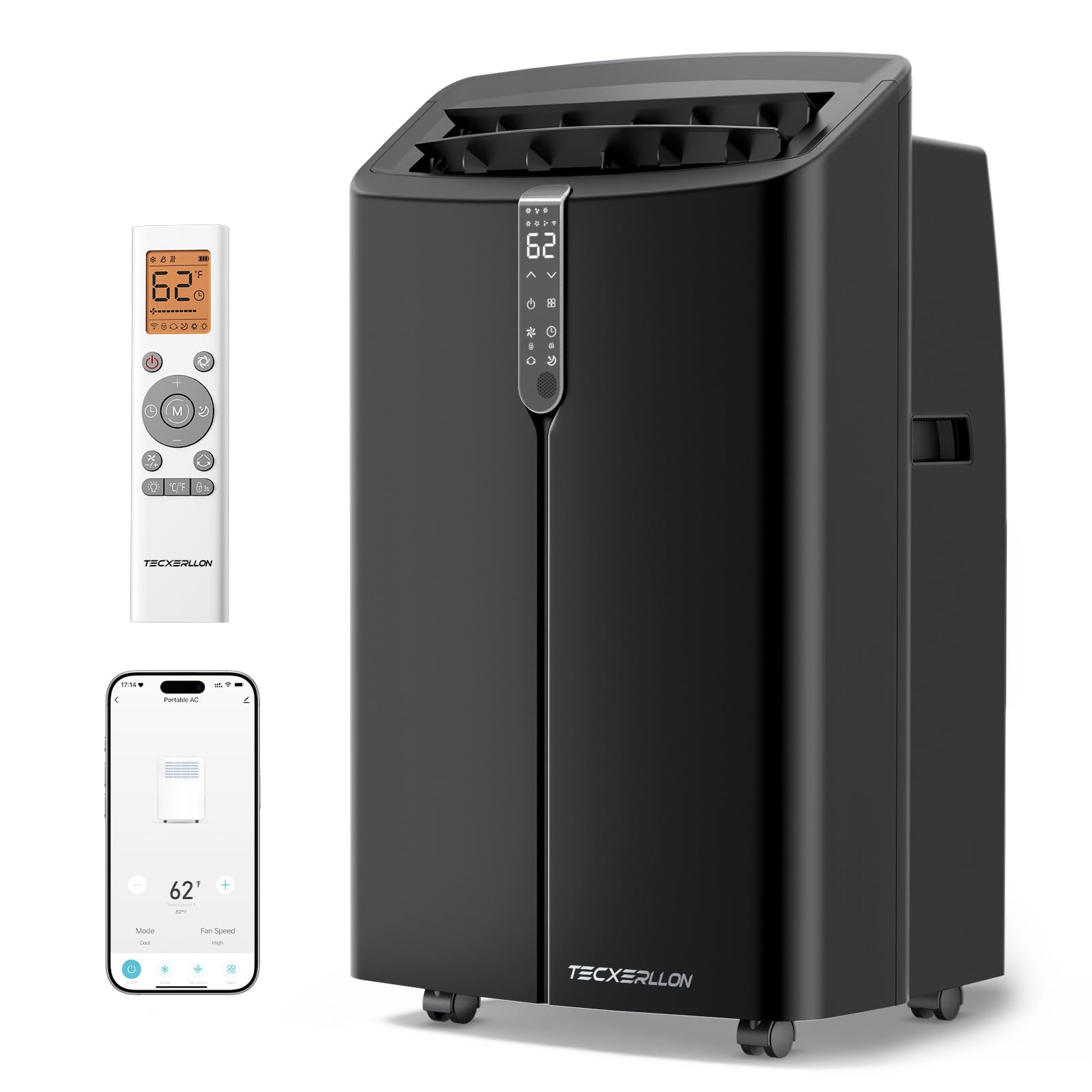
The TECXERLLON is designed as a “stand-alone” unit but functions best as a heavy-duty portable for warehouse zones up to 850 square feet. Its 16,000 BTU rotary scroll compressor is paired with a 120-pint-per-day dehumidification system, which is a monster dehumidifier for a portable unit. In a warehouse where humidity causes condensation on metal racks or contributes to rust on tools and inventory, this dual function is a major advantage over standard AC-only portables.
The self-evaporating system works in conjunction with the dehumidifier: in conditions below 90% humidity, the unit recycles moisture and evaporates it through the exhaust, so you don’t need to drain a bucket for up to 72 hours. In extreme humidity, a drain hose is provided. The Smart Life app lets you customize a sleep curve for the temperature, gradually adjusting fan speed and compressor activity overnight. The LED touch panel and remote control offer three ways to change settings without walking across a large warehouse floor.
One caveat: some owners report it’s louder than expected, though that’s typical for a 16,000 BTU unit with a rotary scroll compressor. The included window kit fits most sliding windows, but the exhaust hose needs to be kept as straight and short as possible for maximum efficiency. The 1-year overall and 3-year compressor warranty is decent, and U.S.-based phone support provides an easy escalation path if issues arise. For a humid warehouse environment where dehumidification is as important as cooling, this is a practical choice.
Why it’s great
- Powerful 120-pint/day dehumidification integrated with cooling
- Self-evaporating system reduces manual draining
- App control with customizable sleep curves
Good to know
- Noise level is noticeable, especially on high fan speed
- Exhaust hose length and routing critical for efficiency
- Window kit seal may require extra foam to be airtight
9. Gasbye 14,000 BTU Dual Hose Inverter AC
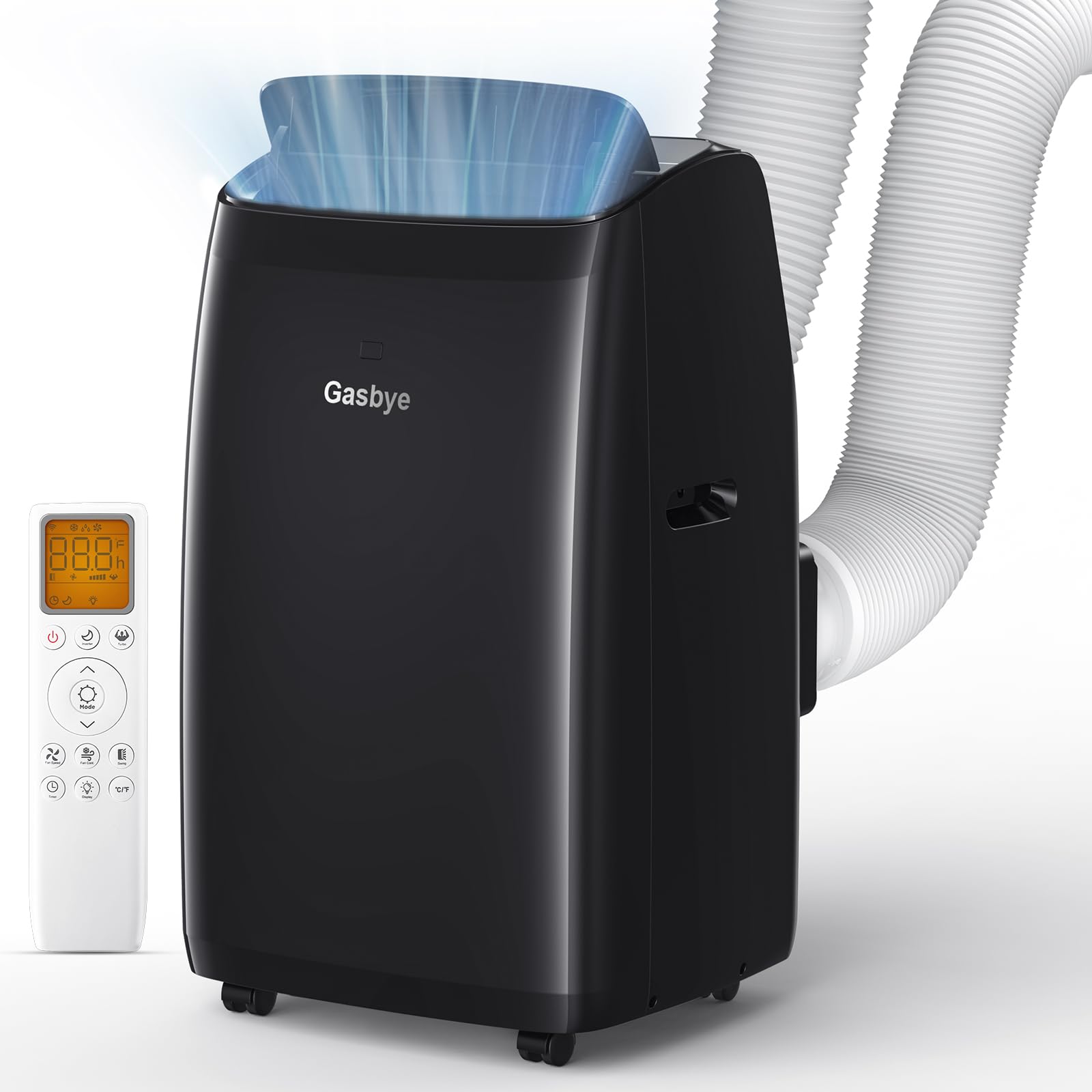
The Gasbye is an engineering-focused portable AC that doesn’t inflate its BTU rating—the company explicitly calls out competitors who label “mini” models as 14,000 BTU while putting out far less. This unit delivers a genuine 10,500 BTU SACC (14,000 BTU ASHRAE 128), backed by a full DC inverter compressor that achieves a 13.6 CEER rating, making it one of the most efficient dual-hose portables available. The inverter mode reduces compressor load by 50% within 2 minutes, drawing only 500–800 watts when maintaining temperature.
The dual-hose system is well-engineered with 5.9-inch diameter hoses. The backlit remote control and display-off feature make it usable in a dark warehouse corner without light pollution. The 3-year warranty is generous, and the company promises full refunds or new replacements rather than refurbished units, which shows confidence in their product. Customer service is highly responsive, with owners reporting 12-hour response times even for non-urgent questions.
The temperature control can be inaccurate—some owners report the unit reads about 4°F cooler than the actual room temperature, so you may need to set it 4°F higher than your target. In high-humidity conditions (above 85% RH), the self-evaporating system can’t keep up, and you’ll need to drain 1 gallon of water every 4–5 hours. The remote requires line-of-sight and has a weak signal. Despite these quirks, owners who have run the unit for two seasons confirm it’s reliable, cools fast, and sips power. If you’re upgrading from a cheap single-hose portable, the difference is night and day.
Why it’s great
- Honest BTU rating with genuine 13.6 CEER efficiency
- Inverter compressor reduces power draw to 500-800W in maintenance mode
- Excellent 3-year warranty with responsive US-based customer service
Good to know
- Temperature sensor may read inaccurately by 4°F
- Requires manual draining in high-humidity conditions
- Remote control range is limited and needs line-of-sight
10. DREO 12,000 BTU Portable AC
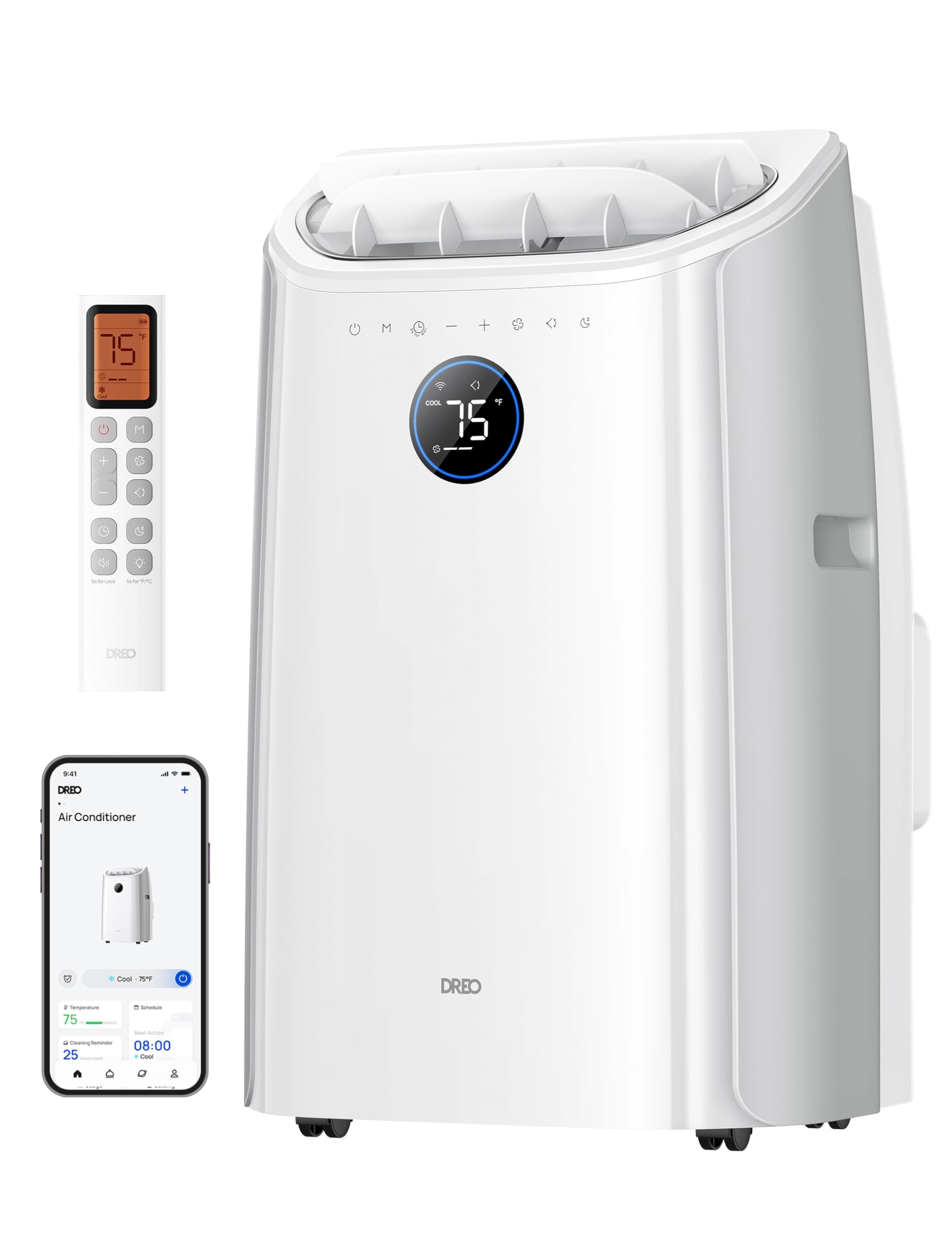
The DREO 515S is best suited for smaller warehouse zones—a manager’s office, a break room, or a small workshop bay up to 300–400 square feet. Its 12,000 BTU ASHRAE rating translates to 8,000 BTU SACC, which is adequate for these smaller spaces but won’t handle a wide-open warehouse floor. The IceCool system claims coverage up to 16 feet, which is realistic for a contained workspace. The patented Noise Isolation System brings operation down to 45 dB, making it one of the quieter options at this BTU level.
The true drainage-free system is a highlight—DREO’s patented algorithm and sensors manage condensation automatically in humidity up to 90%, so you don’t have to drain water during normal summer operation. The app integration with Siri, Alexa, and Google Home adds convenience, and the sleep curve function allows you to program gradual temperature changes across the night or a long shift. The build quality is solid, with a sleek, compact design and a magnetic remote holder that keeps the controller from wandering off.
Setup can be challenging. The window bracket fits standard windows but the sealing materials are finicky—some owners recommend using tape instead of the included foam adhesive. The unit is also best for dry climates; in humid conditions, the cooling performance drops noticeably. If you’re looking for a quiet, well-built portable AC for a small warehouse office and you’re willing to spend a bit more for premium styling and build, the DREO is a strong choice, but it’s not a primary warehouse cooler.
Why it’s great
- Very quiet operation at 45 dB—suitable for office or break room
- True drainage-free system with smart sensors
- Excellent build quality with magnetic remote holder
Good to know
- 8,000 BTU SACC is only adequate for small zones under 400 sq ft
- Window kit setup can be frustrating with finicky foam adhesive
- Cooling performance drops significantly in high humidity
11. Big Ass Fans Haiku L Smart Ceiling Fan

The Haiku L is not an air conditioner, but it’s arguably the most effective air circulation tool you can pair with your warehouse AC system. Designed for spaces up to 15′ × 15′, it moves significant air volume with virtually no noise—tested in a sound chamber, the motor produces zero detectable hum at speeds 1–6. The 7-speed settings and 16 dimmable LED lighting settings make it versatile for a warehouse office, reception area, or small workshop.
The built-in Wi-Fi module integrates with Alexa and Google Assistant for voice control, and the “Whoosh” mode creates a natural breeze pattern that feels more comfortable than constant direct airflow. The hybrid resin blades are hand-balanced to prevent wobbling—a critical detail in a high-ceiling installation where vibration can eventually loosen mounting hardware. The universal mount and 5-inch downrod fit standard 8–9 foot ceilings, and longer downrods are available for warehouse-height ceilings.
The price is undeniably high for a ceiling fan—well into premium territory. Some owners note a faint clicking or ticking noise from injection-molded shroud parts, and the remote control feels less premium than the fan itself. For a warehouse on a budget, a utility fan will move more air for less money. But if you want a silent, beautifully engineered fan that complements your dedicated cooling system and provides year-round circulation (reverse mode for winter heat destratification), the Haiku L is the gold standard.
Why it’s great
- Exceptionally quiet operation—ideal for quiet warehouse offices
- Smart app and voice control with Whoosh natural breeze mode
- Hand-balanced blades eliminate wobbling even at high speed
Good to know
- Very expensive compared to standard commercial ceiling fans
- Some owners report clicking noise from plastic shroud parts
- Only covers up to 15′ × 15’—not a whole-warehouse solution
FAQ
Can I use a residential portable AC in a warehouse?
How do I calculate the BTU needed for my warehouse?
Should I buy an evaporative cooler for my warehouse?
What is the difference between a mini-split and a packaged unit for a warehouse?
Final Thoughts: The Verdict
For most users, the best air conditioner for warehouse winner is the Senville LETO 36,000 BTU Mini Split because it combines commercial-grade 36,000 BTU cooling power with a high-efficiency inverter compressor and smart controls—making it the long-term cost champion for a large workshop or warehouse zone. If you need a simpler, duct-ready solution for a modular building or double-wide, grab the Goodman 3 Ton Packaged Unit. And for a smaller warehouse zone where a portable unit makes more sense, the ZAFRO 16,000 BTU Inverter Portable offers the best energy efficiency of any portable we tested, with a 12.8 CEER rating that dramatically cuts operating costs over a summer season.