
Our readers keep the lights on and my morning glass full of iced black tea. As an Amazon Associate, I earn from qualifying purchases.
Specs are compiled from manufacturer listings and verified buyer reviews and can change over time — please confirm the key details on the product page before buying.
The biggest headache with an air conditioner isn’t the cooling — it’s the constant fiddling. You leave for work, forget to adjust the temp, and come home to a room that’s either blasting cold air or stuffy. A programmable thermostat solves this by letting your AC follow a schedule, but choosing the right one means deciding between a simple unit you set once and a smart device you control from your phone.
I’m Min — the founder and writer behind Gadgets Feed. This guide is built by comparing the manufacturers’ published specifications and the patterns across verified customer reviews, so you get each pick’s real strengths and trade-offs instead of marketing spin.
You want to cut your cooling bills and keep your home comfortable without fiddling with the dial every day. This roundup of the best air conditioner programmable thermostat options shows you which models fit your setup—from a basic unit for a single-stage furnace to a WiFi controller for a mini-split—and what actually matters before you buy.
Our Picks at a Glance


How To Choose The Best Air Conditioner Programmable Thermostat
Before you pick a thermostat, you have to identify what kind of AC or heating system you own. A central forced-air furnace needs a wired thermostat, while a ductless mini-split runs on an infrared (IR) remote — and those two types take completely different products.
Match the Thermostat to Your System Type
Check whether you have a single-stage or multi-stage system. A single-stage unit has one speed of heating or cooling, while multi-stage and heat pumps (which both heat and cool) need a thermostat with more terminals like O/B and W2. Buying a basic 1 Heat/1 Cool model for a complex heat pump setup means it simply won’t fire up correctly.
Wired vs. WiFi vs. Smart Controller
Wired thermostats rely on low-voltage (24V) wires and often run on batteries alone. WiFi thermostats connect to your home network for phone control but usually require a “common” wire (C-wire) for power. Smart AC controllers are a third path entirely — they sit on a shelf and beam IR signals at your mini-split or window unit, adding smart features without touching any wiring.
Quick Comparison
| Model | Best For | System Type | Control Type | Scheduling | Amazon |
|---|---|---|---|---|---|
| Breez Max WiFi★ Best Overall | Smart mini-split control | Mini-Split / Window / Portable | WiFi + App + Touch | Weekly + Presets | Amazon |
| Suuwer S705Best Value | Budget single-stage | 1H/1C Conventional | Push Button | 5-1-1 Day | Amazon |
| Heagstat H705Best Display | Easy-read wall display | 1H/1C Conventional | Push Button | 5-1-1 Day | Amazon |
| Heagstat H725 | Heat pumps w/ aux heat | 2H/1C Heat Pump | Push Button | 5-1-1 Day | Amazon |
| Honeywell RTH20B | Simple 5-2 scheduling | 1H/1C Conventional | Touch | 5-2 Day | Amazon |
| meross Matter | Full smart home integration | HVAC (C-wire required) | WiFi + App + Voice | 24/7 Flexible | Amazon |
| Breez Lite | Lightweight IR controller | Mini-Split / Window / Portable | WiFi + App | Weekly | Amazon |
| Sensibo Air PRO | Air quality monitoring | Mini-Split / Window / Portable | WiFi + Bluetooth + App | Smart + Geofencing | Amazon |
| Honeywell Lyric T6 | Complex multi-stage HVAC | 3H/2C Heat Pump | WiFi + App + Voice | Auto-Scheduling | Amazon |
In-Depth Reviews
1. Breez Max Smart WiFi Thermostat
Our pick — over 4.5★ from 950+ verified ratings; the strongest balance of quality and price.
The smart AC controller that turns any mini-split into a phone-controlled, AI-driven thermostat.
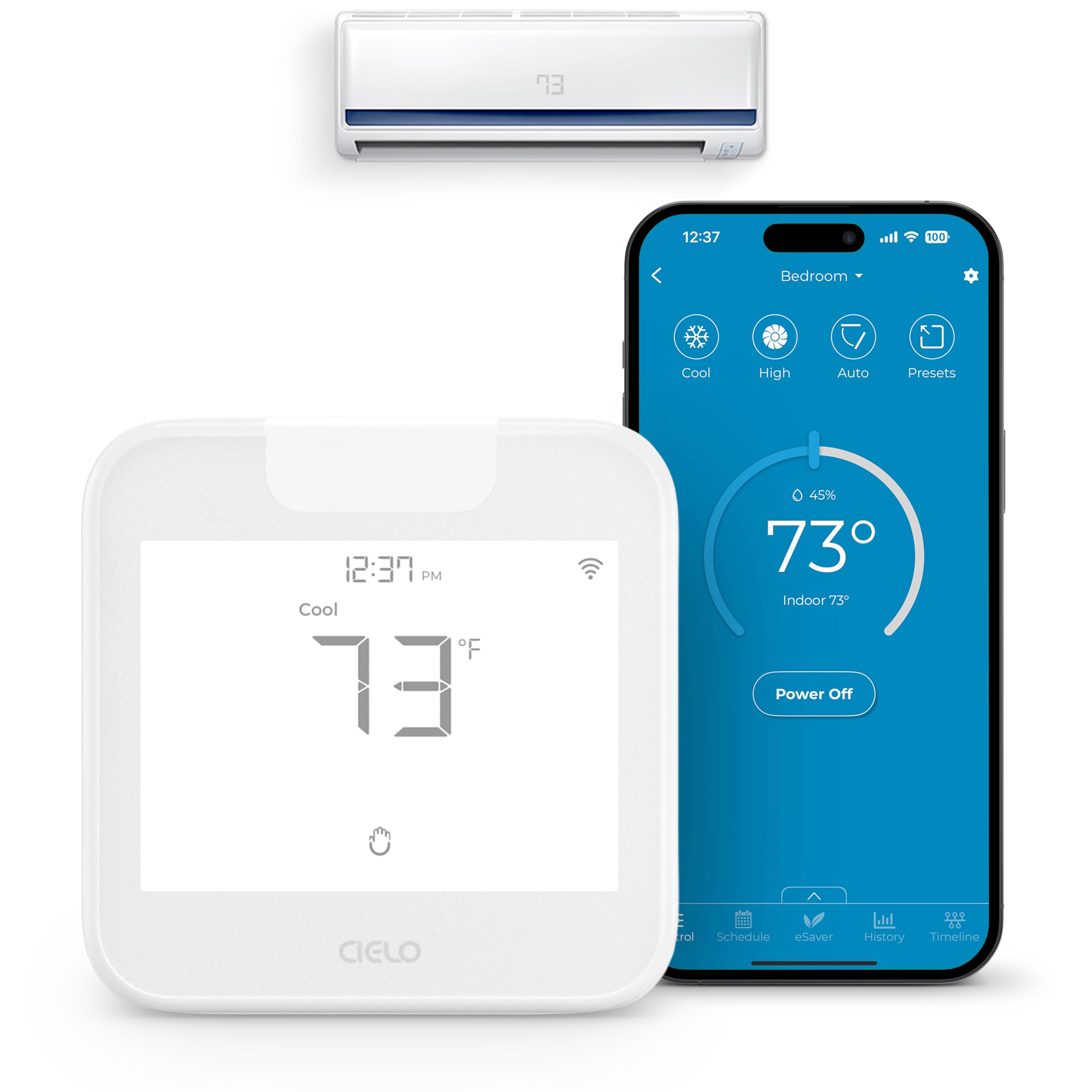
The Breez Max is the crowd favorite — a 4.6-star device trusted by a huge base of owners — because it turns a dumb wall unit into something genuinely smart. It connects to your 2.4 GHz Wi-Fi and sits within line of sight of your AC, beaming IR commands so you can control cooling from your phone anywhere. The built-in temperature and humidity sensors can even be calibrated through the app, so the readings match your real comfort.
What really wins people over is its reliability — far and away the most-discussed trait. Buyers report it works flawlessly with Carrier heat pump units and Mitsubishi mini-splits, often replacing expensive manufacturer thermostats that cost several times more. The one-line summary from buyers: “Comfy mode turns unit off at setpoint, works flawlessly.” That AI-based Comfy Mode learns when your room is comfortable and shuts the unit off to avoid overcooling.
The scheduling is the other standout: set one-time or weekly repeat schedules, and they keep running even if your internet drops. You can group multiple units into HVAC zones, and it talks to Alexa, Google Assistant, Siri Shortcuts, SmartThings, IFTTT, and Home Assistant — no subscription fees. At just 5.6 ounces, it’s a featherweight gadget that sticks to the wall or sits on its included table stand.
Why It Leads the List
- AI Comfy Mode prevents overcooling and overheating automatically
- Compatible with over 20,000 models of mini-splits, window, and portable units
- Weekly scheduling with presets for Home, Away, and Sleep
- Multi-zone sync avoids mode conflicts across indoor units
Fit Notes
- Requires a clear line of sight within 6-12 feet of the AC unit
- Unit beeps with each command, which some owners find noticeable
- Alexa can’t trigger routines directly from the thermostat itself
The smart upgrade: If you have a mini-split, window, or portable AC with an IR remote and want app control plus AI savings, this is the one to buy.
The trade-off: It’s a controller, not a wall-mounted thermostat, so it needs to be pointed at your AC to work.
2. Suuwer 5-1-1 Day Programmable Thermostat
The budget-friendly wall stat that installs in minutes and programs with zero fuss.
The Suuwer S705 is the classic 5-1-1 day programmable thermostat — separate schedules for weekdays and weekends, with four program periods per day covering wake, leave, return, and sleep. Owners consistently say it’s a “no-brainer” to install, with one buyer reporting it was “installed and programmed within 30 minutes.” The big blue backlit display is easy to read, especially for older users.
It runs on either 24VAC power or two AAA batteries, so it works without a common (C-wire) on most single-stage systems. Functionality is the most-praised aspect, and the ease of use follows close behind. You get a separate heat or cool swing setting (0.2°F to 2°F) so the system doesn’t short-cycle, plus a 5-minute compressor delay protection you can switch on or off.
There are honest limits: it’s built for 1 Heat/1 Cool conventional systems only — forced-air furnaces, boilers, gas fireplaces. It won’t handle multi-stage systems (1H/2C, 2H/2C), heat pumps, PTACs, or line voltage baseboards. Temperature control draws mixed feedback, with a few owners reporting it not calling for heat when needed, so stick with it if your wiring is the standard 2-5 wire setup it’s designed for.
A straight swap for analog: If you’re replacing a mercury or basic dial thermostat on a simple gas or electric furnace, this gives you real scheduling power without needing an electrician or a new C-wire.
Where it falls short: Multi-stage systems and heat pumps need a different class of thermostat entirely.
3. Heagstat H705 Programmable Thermostat
A 1H/1C workhorse with a big, bright screen that solves hard-to-read thermostat problems.
The Heagstat H705 is nearly identical to the Suuwer in wiring and scheduling, but it carves out its own identity with readability and easy-to-spot reliability. Its 4.5 square inch backlit LCD screen delivers clear visibility under any lighting, and owners rave about the “extra-large numbers” that are easy for older eyes to read from across the room. It also solves a classic annoyance: you can program it while sitting in your chair because it runs on AAA batteries.
Reliability is the #1 thing owners praise, with ease of installation a very close second — many describe a “5-minute swap” from their old unit. It supports standard RH, RC, W, Y, G, and C terminals, and uses simple 18-22 gauge thermostat wire. The temperature accuracy holds at ±1°F, with a manual calibration range of -4°F to +4°F to fine-tune against your home’s quirks.
The genuine trade-off is the build: owners note the plastic construction feels “very cheap” even though it functions perfectly. It’s also restricted to conventional single-stage forced-air systems, so it won’t work with heat pumps, PTACs, mini-splits, or 120-240V baseboard heaters. For a simple gas furnace with standard wiring, it’s a reliable, bright, and easy-to-program pick.
What Owners Rave About
- Large backlit display readable from across the room
- Battery-powered programming from your chair, no wall access needed
- 5-minute compressor delay protection as standard
- Perfect wiring diagrams that make DIY install a breeze
The Catch
- Plastic body feels less premium than its price suggests
- Some owners mention temperature readings that need manual calibration
- Not for heat pumps, multi-stage, or line voltage systems
Reach for it if: you want a no-frills, ultra-readable thermostat for a standard furnace and don’t care about fancy materials.
Look elsewhere if: you need heat pump support or want a metal, premium-feeling faceplate.
4. Heagstat H725 Programmable Heat Pump Thermostat

The non-smart 2 Heat/1 Cool thermostat built for heat pumps with auxiliary heat.
While most budget thermostats stop at 1 Heat/1 Cool, the H725 steps up for heat pump owners who need 2 heating stages and 1 cooling stage — perfect for systems with Auxiliary or Emergency heat. It’s a straightforward 5-1-1-day programmable unit with the same 4.5 square inch backlit LCD and a very similar body to the H705. Functionality is what owners praise most, especially how it “worked perfectly with a Carrier heat pump and emergency heat.”
It runs on 24VAC power or two AAA batteries and comes with standard R, W/E, W2, Y, O, B, G, and C terminals, using 18-22 gauge wire. The key detail for heat pumps is knowing whether your reversing valve uses O (for cooling) or B (for heating) — get that right and install is straightforward. Emergency heat requires a manual switch, not automatic, which keeps things simple and predictable.
The honest downsides: programmability gets mixed feedback, and a few customers note up/down buttons that can stick over time. The wiring diagram trips up people who aren’t experienced, so keep the manual handy during setup. It’s not feature-rich, but it reliably “gets the job done” for heat pump owners who don’t want to pay smart-thermostat prices.
A trustworthy stopgap: If you have a heat pump with backup heat and want dependable manual control without WiFi, this fills that gap cleanly.
Mind the wiring: You need to understand your reversing valve (O or B) to install it correctly.
5. Honeywell Home X2P Programmable Thermostat
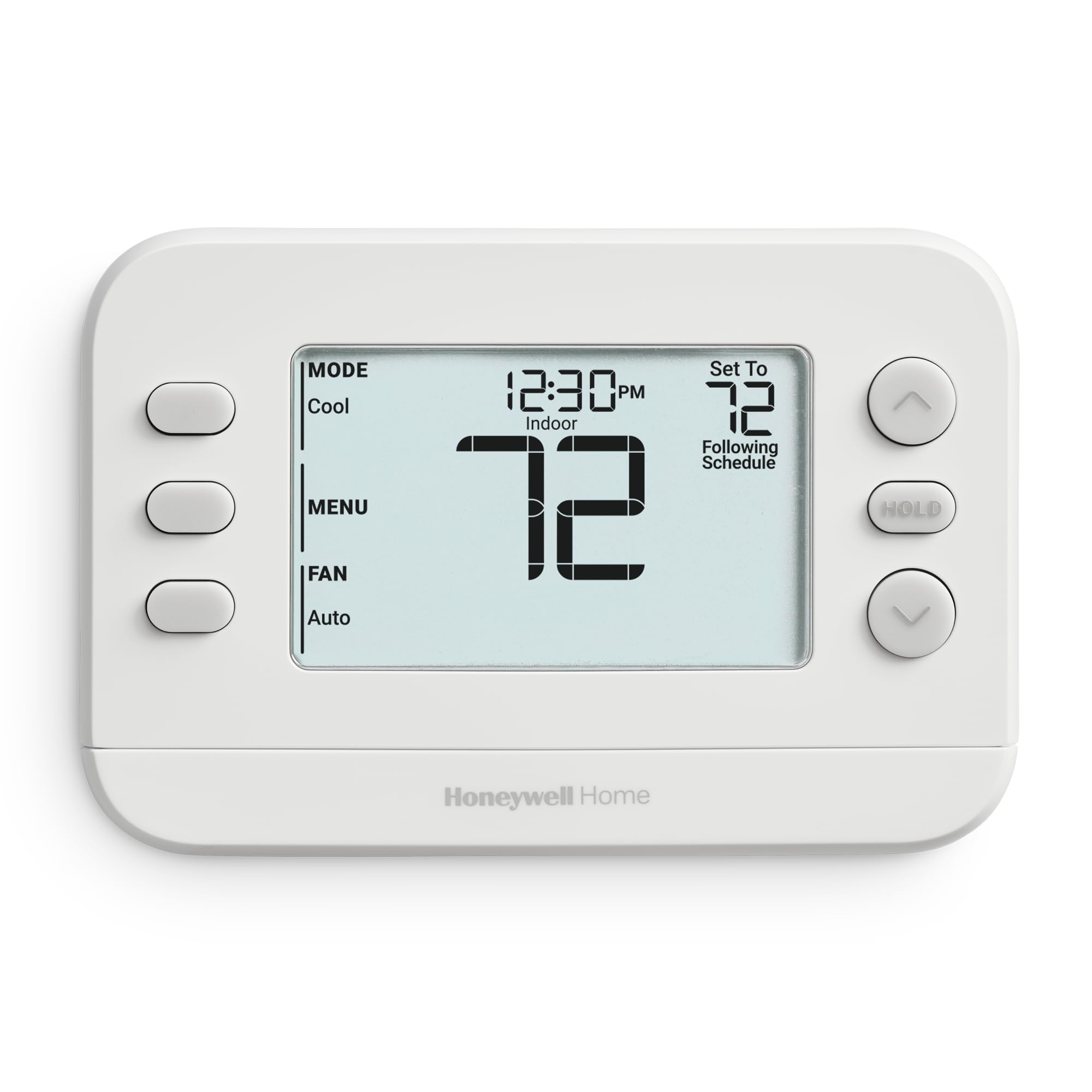
A trusted name in temperature control, offering big readable digits and simple 5-2 scheduling.
The Honeywell X2P (RTH20B) brings a trusted brand to the budget tier, and owners consistently rate it a quality product with accurate temperature control. Its large, clear font with bold digits is visible from across the room, and the 5-2 day scheduling lets you set one program for the work week and another for the weekend. It’s a direct replacement for the older RTH2300, making it a natural upgrade path for existing Honeywell owners.
It’s battery-powered with two AA batteries (not included), so no C-wire is needed for most installations — and it handles 1 Heat/1 Cool systems including hot water heat and forced air (gas, oil, or electric). The feature set is solid: backlit display, custom display settings, a change air filter reminder, and an extended 32°F low-heat setpoint for chilly spaces. Quality is the #1 praised aspect, with temperature control close behind.
The installation can be fiddly — owners note the manual assumes some expertise, with tiny cryptic labels for the 16 wire slots that make the white wire placement confusing. For a standard red/white boiler setup it works great, but if you’re new to wiring, you’ll want to read carefully. It’s a dependable “good value” pick that “works exactly as expected,” no more and no less.
The Strengths
- Bold, backlit digits readable from across the room
- Battery powered — no C-wire needed on most systems
- Change filter reminder keeps your HVAC breathing easy
- 5-2 day schedule plus a non-programmable option
The Friction
- Installation manual assumes prior wiring knowledge
- 16 wire slots with small labels can confuse beginners
- Not compatible with electric baseboard heat (120-240V)
A safe upgrade: If you’re replacing an old mercury thermostat on a simple system and want a brand you can trust, this is a clean, quality choice.
Not for novices: If you’ve never touched thermostat wiring, the cryptic label setup might leave you second-guessing.
6. meross Matter Smart Thermostat
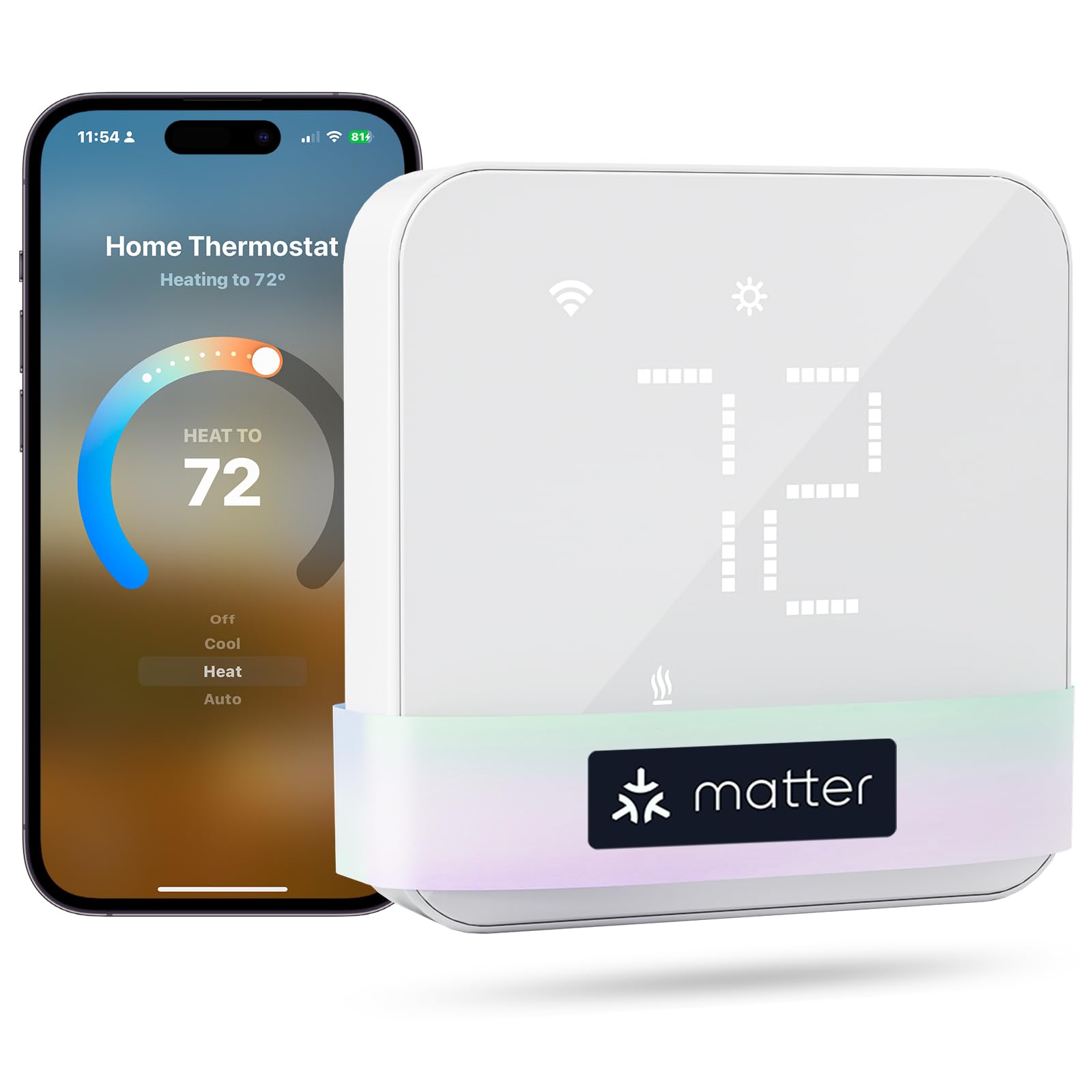
The sleek glass-panel WiFi thermostat that speaks Matter, Alexa, Google, and Apple Home fluently.
The meross smart thermostat is for people who already live inside a smart home ecosystem. It’s Matter-certified, which means it integrates locally with Apple Home, Amazon Alexa, Google Home, Home Assistant, and Samsung SmartThings without needing a separate hub for each. Installation is the most-praised aspect by a wide margin — owners describe connecting to Matter in about 3 seconds, with the app’s step-by-step guide making the whole setup painless.
Once it’s in, you get a 24/7 flexible schedule that adjusts your heating and cooling routine whether you’re home, away, or asleep. The app tracks HVAC usage so you can see exactly how long your system runs by day, week, month, or year — and adjust to cut your electric bill. It also smart-alerts you on filter life, system malfunctions, and long-term operation, so you catch problems before they become expensive.
The critical requirement: it needs a C-wire (common wire) for power, so check your existing setup before buying. It fits 95% of HVAC systems including heat pumps, furnaces, boilers, dehumidifiers, and humidifiers — but not 110V/120V/240V baseboard heaters or two-wire systems. The sleek glass panel in white or black fits any decor from minimalist to farmhouse, and on-device controls keep working even without WiFi.
Why It Stands Out
- Matter-certified for smooth Apple, Alexa, and Google integration
- 24/7 flexible scheduling with away and sleep modes
- App tracks HVAC run time to cut energy waste
- Glass panel design fits modern home decor
Before You Buy
- Requires a C-wire — not included with the unit
- Manual lacks depth on some optional app settings
- Not for baseboard heaters or millivolt systems
The connected choice: If your home runs on Apple HomeKit or Google Home and you want voice control plus scheduling, this is the most future-proof pick.
The prerequisite: Confirm you have a C-wire before purchase, or you’ll need an adapter.
7. Breez Lite Smart AC Controller
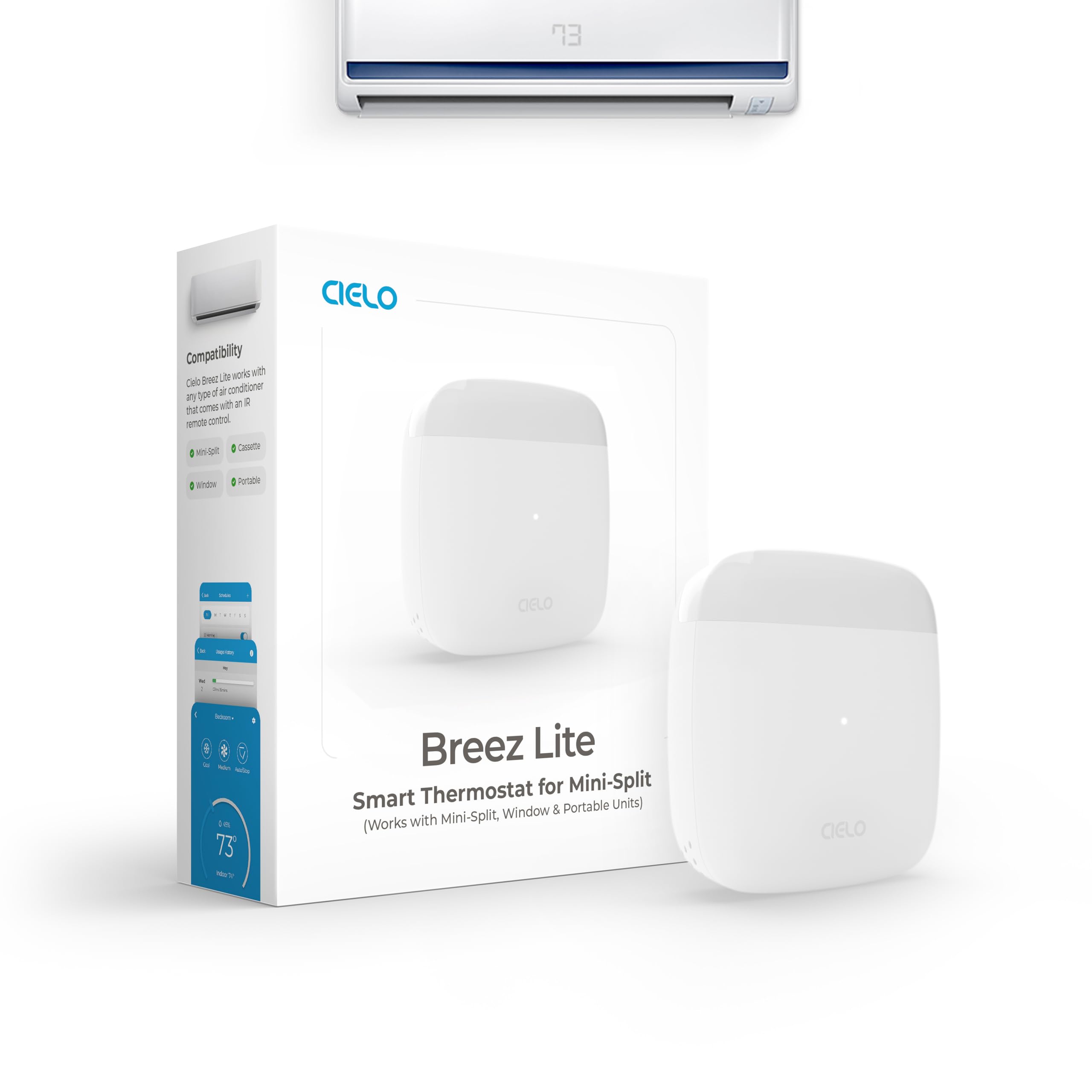
A featherweight 1.28-ounce IR blaster that adds smart control to any remote-controlled AC.
If the Breez Max is the flagship, the Breez Lite is the nimble little sibling that costs less while still delivering the core magic. It works with 20,000+ ductless mini-split, window, and portable AC and heat pump models, auto-detecting your remote control for a setup that takes about a minute. Owners say it “makes a basic window air conditioner smart” and praise its reliability as the #1 trait, with easy setup second.
It’s genuinely tiny at just 1.28 ounces, powered by a 5V DC adapter with a USB-C cable — so it plugs in anywhere and sits discreetly on a shelf. You get the full suite of smart features: weekly scheduling, Comfy Mode, geofencing, usage history, and air filter status tracking. It works with Google Assistant, Amazon Alexa, Siri Shortcuts, SmartThings, and IFTTT, and you can group multiple units into HVAC zones for whole-home control.
The trade-offs are worth noting: connectivity gets mixed feedback, with occasional WiFi drops that require re-pairing and can lose your settings. A few owners find the app sliders cumbersome, and temperature readings can run about 2°F high compared to a wall thermostat. For the price, though, it’s a reliable, economical way to avoid costly hardwired thermostat installs — as owners put it, “the best wireless mini-split system.”
What Shines
- Tiny 1.28-ounce form factor with USB-C power
- Compatible with 20,000+ AC models
- Free app with no subscription fees
- Geofencing and Comfy Mode for automatic savings
The Rough Edges
- Occasional WiFi drops can require re-pairing
- App sliders feel less precise than physical buttons
- Temperature sensor can read about 2°F high
Grab it for: a low-cost, no-wiring way to make a window unit or mini-split voice-controlled and schedulable.
skip it if: rock-solid WiFi reliability is non-negotiable for you.
8. Sensibo Air PRO Smart Controller

The smart AC controller that doubles as an air quality monitor for healthier rooms.
The Sensibo Air PRO stands apart by bundling a smart AC controller with a built-in air quality sensor. It doesn’t just keep your room at the right temperature — it continuously monitors the air for unhealthy particles, which owners find genuinely valuable for boosting energy levels and catching problems early. Setup is quick via WiFi or Bluetooth, with no tools required, and it works with any remote-controlled AC unit or mini-split.
Functionality is what owners praise most, with setup a close second. The app gives you full control — swing, temperature, schedules, and more — and owners note it works great with older Mitsubishi split ACs and LG portable units. Geofencing turns your AC on before you arrive and off when everyone leaves, while Climate React scans temperature and humidity to maintain a comfortable “real feel” temperature. The Sensibo Room Sensor can even detect motion to cool only occupied spaces.
The big caveat: temperature control gets mixed reviews, and some reviewers point out serious issues like the unit ignoring set points entirely — set for 77°F but the room stays at 72°F. The humidity sensor has also been called inaccurate (showing 80% when the real value is 50%). A few features require a paid subscription that isn’t advertised upfront. If it works for your system, it’s a pricey but capable device; if it doesn’t, support can be hard to reach.
The Differentiation
- Built-in air quality sensor with real-time alerts
- Climate React maintains comfort based on temp and humidity
- Geofencing auto-cools before you arrive home
- Works with Apple HomeKit, Google, Alexa, and Siri
Honest Concerns
- Temperature control reliability varies by system
- Some advanced features need a paid subscription
- Humidity sensor accuracy called into question
Choose this for: air quality monitoring plus smart AC control in one sleek device, if you have a compatible mini-split.
Think twice if: you need rock-solid temperature accuracy or want every feature free forever.
9. Honeywell Lyric T6 WiFi Thermostat
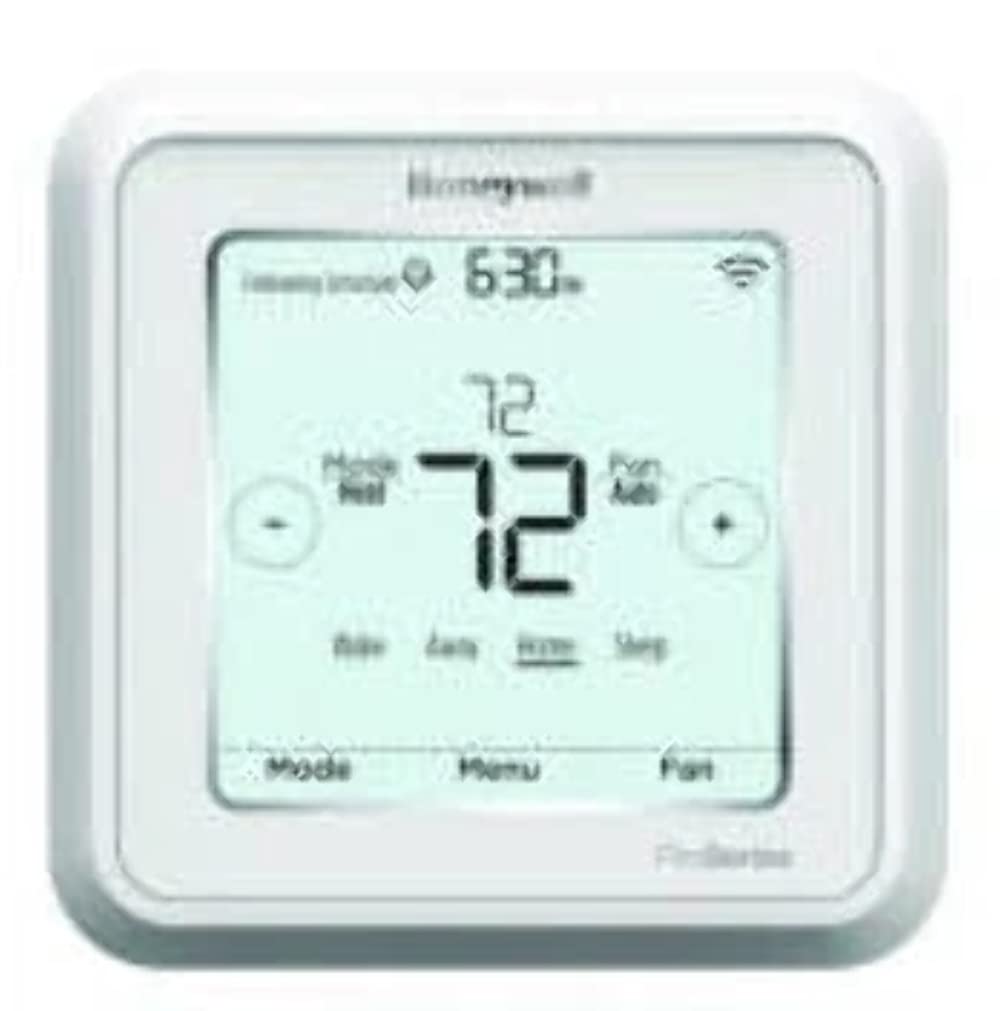
A powerful WiFi thermostat for complex multi-stage HVAC systems that demand serious compatibility.
When you have a complicated HVAC setup — say a 3 Heat/2 Cool heat pump or a 2 Heat/2 Cool conventional system — most budget thermostats simply can’t handle it. The Honeywell Lyric T6 is built for exactly those situations, supporting up to 3 heating stages and 2 cooling stages for heat pumps. It’s a “plug and play” replacement for older T6 models, with a setup wizard that walks you through every step and bright touchscreen controls.
Installation is the most-praised aspect, with functionality and ease of use close behind. Owners highlight the clear wiring labels and an intuitive app that makes remote control from your phone genuinely reliable. The auto-scheduling feature learns your preferences and builds a program around them, and it works with Amazon Alexa voice control along with major smart platforms. One owner uses a remote wired sensor in a tenant apartment to monitor temperature and catch issues early — a vote of confidence in its remote reliability.
The mixed feedback centers on temperature control and WiFi connectivity. A vocal minority reports severe issues after firmware updates, including auto-switching between heat and cool when leaving home and app showing stale data. Some of these owners switched to other brands entirely. At 12 ounces, it’s a substantial, glossy unit that feels premium, but its quirks mean it’s not the most predictable option here — if your system is simple, you may not need this much power.
The Power
- Supports 3H/2C heat pumps and 2H/2C conventional systems
- Setup wizard makes complex wiring manageable
- Auto-scheduling learns your routine
- WiFi remote control via a reliable app
Watch Out For
- Firmware updates have caused problems for some owners
- App data can occasionally show stale or delayed info
- Pricey for homes with simple single-stage systems
Ideal for: complex HVAC setups where basic 1H/1C thermostats just won’t cut it.
Overkill for: standard furnaces that a simple, reliable unit could handle for a fraction of the price.
Understanding the Specs
5-1-1 vs. 5-2 vs. 24/7 Scheduling
A 5-1-1 day schedule lets you program weekdays, Saturday, and Sunday separately, while a 5-2 day schedule treats the whole weekend as one block. Both give you multiple program periods per day. Smart thermostats go further with 24/7 flexible schedules that let you customize every single day, plus features like geofencing that adjust temperature based on your phone’s location.
C-Wire and Power Requirements
The C-wire (common wire) provides continuous 24V power to a smart thermostat. Many older homes lack it, which is why battery-powered and dual-powered units (running on 24VAC or AAA batteries) are so popular for simple replacements. WiFi smart thermostats like the meross typically require a C-wire, so always check your existing wiring before buying.
Compressor Delay Protection
This is a protection feature that prevents your AC compressor from turning on and off too rapidly, which can cause expensive damage. A 5-minute delay protection means the system waits at least 5 minutes between cycles. It’s a must-have for protecting your HVAC investment, especially if you live in a hot climate where the AC runs constantly.
Smart Controllers vs. Wired Thermostats
A wired thermostat physically replaces your wall unit and connects to your HVAC wires, so it works with central systems that have standard thermostat wiring. A smart AC controller (like the Breez or Sensibo) sits on a shelf and sends infrared signals to your existing AC’s remote receiver—the same way your remote does—so you get app control and schedules without touching any wiring. That makes it ideal for mini-splits and window units that lack standard thermostat wires.
FAQ
Will a programmable thermostat work with my mini-split air conditioner?
What is the difference between a 1H/1C and a 2H/1C thermostat?
Do I need a C-wire for these thermostats?
How long does it take to install a programmable thermostat?
Can a smart AC controller save me money on my electric bill?
What does “5-1-1 day” programming mean?
Is a smart controller the same as a smart thermostat?
Why does my new thermostat not call for heat or cool when it should?
Which thermostat works with Alexa and Google Assistant?
Final Thoughts: The Verdict
Across the board, the best air conditioner programmable thermostat winner is the Breez Max because it transforms any mini-split into a truly smart, app-controlled system with AI-powered energy savings and multi-zone support. If you want a simple wired thermostat for a standard furnace at a budget-friendly price, the Suuwer S705 is the no-fuss pick with easy scheduling. And for a full smart home integration with Matter support, the meross Matter thermostat is the one to reach for. The crowd favorite — 4.6 stars across 900+ owners — signals the Breez Max’s reliability is the real deal, so you’re buying into a proven solution.
How We Picked
We do not accept paid placement. Every pick is matched to a real buyer and a real use-case; we do not hands-on test units.
Sources & Methodology
Specifications: manufacturer listings and product documentation. Review insights: verified customer reviews, as of August 2026. Pricing: not shown on this page (it changes often); check the current price via the retailer link.
As an Amazon Associate, Gadgets Feed earns from qualifying purchases. This does not affect which products we feature.