
Watching your air conditioner blow warm air when it should be ice cold often points to one silent culprit: a refrigerant leak. Before you call a technician for a repair that could cost hundreds, a dedicated stop-leak additive can often seal small pinhole leaks in evaporator coils, condensers, O‑rings, and line sets, restoring your system’s cooling performance for a fraction of the price.
I’m Min — the co-founder and writer behind Gadgets Feed. I’ve spent years analyzing chemical sealant formulations, injection methods, and compatibility charts across residential, commercial, and automotive HVAC systems to help buyers choose the right product for their leak size and system type. (And Homer 🐱 supervised every product page with a suspicious sniff at the chemical aisle).
Temperature checks, refrigerant-loss timelines, and sealant chemistry all matter when picking a fix. That’s exactly what this guide to the best air conditioner stop leak will break down so you can make a confident, cost-saving decision.
How To Choose The Best Air Conditioner Stop Leak
Not every sealant formula works the same way. The wrong choice can clog a thermal expansion valve (TXV) or fail on a leak that is too large for the product’s intended range. Matching the sealant type, injection method, and compatibility to your system matters more than brand loyalty.
Polymer-Free vs. Polymer-Based Formulas
Polymer-free formulations — often organosilane or silicone-based — remain liquid in the system and only harden at the exact leak site where they contact air and moisture. These are safer for systems with TXVs, capillary tubes, and small metering ports because they reduce the risk of clogging. Polymer-based sealants use solid particles that bridge gaps mechanically; they can handle larger leaks but carry a higher chance of blocking internal passages.
Injection Method Matters
Direct‑inject products that use a 1/4″ SAE port or a specialized injector tube are cleaner and more precise than aerosol cans or syringe kits. For mini‑splits, you will need a 5/16″ to 1/4″ adapter; for automotive systems, a 134a to 1/4″ adapter is required. Pre-pressurized injectors work best when your system still holds some pressure — never inject sealant into a fully evacuated system.
Leak Size and Loss Rate
Most stop-leak products seal gaps up to about 0.3 mm in diameter — roughly the width of a human hair. If your system loses the entire refrigerant charge in less than seven days, the leak is likely too large for any chemical sealant. For slow leaks that take weeks or months to drain, a high‑quality sealant has a very high success rate.
Quick Comparison
On smaller screens, swipe sideways to see the full table.
| Model | Category | Best For | Key Spec | Amazon |
|---|---|---|---|---|
| Leak Saver Direct Inject | Mid-Range | Small residential systems up to 1 ton | 2.39 oz weight / direct-inject | Amazon |
| A/C Zero Leak (ComStar) | Mid-Range | Automotive evaporator and gasket leaks | 4 oz / polymer-free silicone | Amazon |
| Enviro-Safe ProSeal XL4 | Mid-Range | Heat pumps and commercial systems | Brass injector / one-time use | Amazon |
| RED TEK ProSeal22 | Mid-Range | Pin-hole leaks in evaporator coils | 2 fl oz / liquid lubricant | Amazon |
| ERRECOM Extreme Ultra | Premium | System leaks up to 0.3 mm | 6 mL / reusable 1/4 SAE adapter | Amazon |
| BlueDevil Red Angel | Premium | Permanent seal on condensers and hoses | 2 oz / chemical weld formula | Amazon |
| Leak Saver Ultimate 3-in-1 | Premium | Large central systems up to 5 tons | 3.2 oz / sealant + UV dye + drier | Amazon |
In‑Depth Reviews
1. Leak Saver Direct Inject AC Leak Sealer Small System

The Leak Saver formula has been used in over 4,000,000 units since 2015, making it one of the most field-tested sealants on the market. Its direct-inject design requires a manifold gauge set but no syringes or pressurized cans, which reduces mess and the risk of over-pressurizing the system. The 2.39‑ounce bottle treats systems up to 1 ton, covering small window units, mini‑splits, and compact central systems.
Compatibility is broad — it works with R‑410A, R‑22, R‑134a, R‑1234yf, and virtually every oil type except ammonia systems. The sealant reacts with air and moisture at the leak site to form a permanent plug, and it passes safely through TXVs, capillary tubes, and Schrader valves without clogging. Users have reported success on DIY mini‑split leaks and even commercial refrigeration units.
One review noted it failed to seal a slow leak in a wine fridge after two attempts, suggesting the formula works best when the leak is in a pressurized part of the system. For most standard residential or automotive AC applications under 1 ton, this is the most proven, reliable fix available.
Why it’s great
- Trusted formula with millions of units sold
- Simple direct-inject reduces installation mistakes
- Safe for all metering devices and refrigerants
Good to know
- Limited to systems up to 1 ton
- May not seal leaks larger than a pinhole
2. A/C Zero Leak (ComStar) – Fluorescent Yellow 4 Oz

The ComStar 90-700 uses a polymer-free silicone formula that stays soft in the system and only hardens at the leak interface. This characteristic makes it especially safe for automotive systems with aluminum evaporators and rubber gaskets — common failure points in vehicle AC. The 4‑ounce bottle includes a fluorescent yellow dye that helps pinpoint the leak location under UV light, making it a dual-purpose diagnostic and repair tool.
One Trailblazer owner sealed a substantial evaporator core leak where other products had failed, with the system running cold two months later. Another user on a Hyundai H100 van in the Philippines reported no refrigerant loss after two months, with no clogging of the expansion valve or filter drier. The formula is compatible with POE, PAG, and mineral oils, so it works across automotive and residential systems.
Most negative reviews mention that it struggled with larger leaks or had difficulty injecting past the Schrader valve without proper adapters. For slow evaporator or hose leaks in vehicles, however, this is one of the most forgiving formulas available.
Why it’s great
- Polymer-free formula won’t clog TXVs
- Built-in fluorescent dye aids leak detection
- Works with all common automotive lubricants
Good to know
- Requires adapter for Schrader valve injection
- Less effective on fast-loss leaks
3. Enviro-Safe ProSeal XL4 Inject
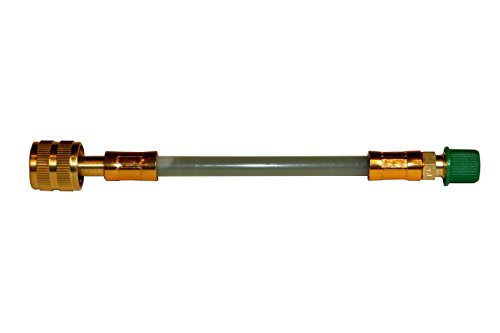
Enviro-Safe has more than 29 years of sealant manufacturing experience, and the ProSeal XL4 is their concentrated, one-time-use injector. The injector body is brass with a flexible plastic tube that can bend about an inch to fit into tight service ports — critical for rooftop units or condensing units with less than 7 inches of clearance. The concentrated formula requires less material in the system while still sealing condenser, evaporator, and line-set leaks.
One 26-year-old Lennox unit running R‑22 was saved with this injector; four months later the system was still maintaining 68°F in a heat wave. An RV owner with a 13,500 BTU Coleman AC successfully sealed a small evaporator leak after using a piercing valve and nitrogen pressure test. The sealant bonds with metal, O‑rings, gaskets, and solder joints, creating a durable long-term repair.
Some users reported that the flexible tube can collapse if forced, and one review received a defective injector. It also cannot be used in reverse (on the low side), so you must follow the directional markings closely. For techs working in confined spaces, this is the most service-friendly injector design on our list.
Why it’s great
- Brass injector with flexible tube for tight spaces
- Concentrated formula means less material in system
- 29+ years of sealant engineering experience
Good to know
- Single-use injector; cannot be reused
- Flexible tube may bend too much in very tight areas
4. RED TEK ProSeal22 A/C Seal Treatment (4 oz)
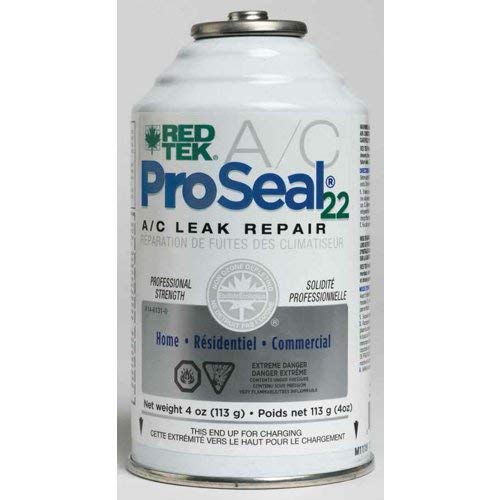
RED TEK ProSeal22 is marketed as a lubricant that also seals leaks, meaning it remains in the system to protect the compressor while actively sealing future leaks. The 2‑fluid-ounce dose treats systems up to 4 tons, with the active ingredient staying liquid and traveling with the refrigerant. It is compatible with R‑22, R‑410A, mineral oil, ester, and PAG lubricants, making it a safe add-in for most split and packaged systems.
One user slipped a single can into a 4‑ton unit with a pin-hole leak on the A‑coil; after two years the system still held its charge. Another customer reported a slow seasonal leak that fully stopped after two months of circulation, holding over the winter and summer months. The formula contains no poisonous methanol, keeping it safer to handle than many older stop-leak products.
The most common critique is that it takes time — sometimes weeks — to fully seal. A user with a 28‑year-old system applied it twice over three years and still lost the charge over winter, indicating that very old systems with multiple leaks may need a more aggressive product. For a single small leak in a well-maintained system, this is the most budget-friendly option.
Why it’s great
- Acts as both sealant and compressor lubricant
- No toxic methanol in formula
- Easy push-can injection for DIYers
Good to know
- Seal can take weeks to fully form
- May not hold across winter shutdown in old systems
5. ERRECOM Extreme Ultra – 6 mL HVAC/R Leak Stop

ERRECOM’s Extreme Ultra is an Italian-made cartridge that promises permanent repair for leaks up to 0.3 mm in systems up to 21 kW (about 6 tons). The syringe-like injector includes a reusable 1/4 SAE adapter, which is a smart touch for technicians who service multiple units. The 6 mL dose is universal across most HVAC/R systems, removing guesswork about how much to use.
The formulation is polymer-free, meaning it does not harden with moisture or oxygen in the air — it only reacts with the lubricant and refrigerant at the leak point. This design avoids the common problem of sealant forming a crust on the inside of the pipe and blocking flow. One user with a small gas leak in a pre‑installed mini-split line reported a complete seal after injection.
A handful of users found that the adapter did not seat perfectly on certain Schrader valves, causing some product to leak out during injection. The packaging is small (8.66 x 1.18 x 1.18 inches), so it fits in a standard tool pouch. For anyone who wants a precise, reusable injection system and a high‑tech polymer-free formula, this is the top choice.
Why it’s great
- Polymer-free formula prevents internal clogging
- Reusable 1/4 SAE adapter saves money over time
- Universal dose works up to 6‑ton systems
Good to know
- Adapter may not seal perfectly on all ports
- Small cartridge format can be fiddly to handle
6. BlueDevil Products Red Angel A/C Stop Leak – 2 oz

BlueDevil’s Red Angel succeeds where many sealants fail because it creates a “chemical weld” rather than simply plugging the leak with particles. The formula contains no solids or particulates, so it will not clog a recovery unit or damage the compressor. It is compatible with R‑12 and R‑134a systems, making it especially popular for older vehicles and residential units that still use those refrigerants.
One Florida car owner evacuated an old system, injected the Red Angel before air could enter, and reported the AC still blowing cold after six months of summer use. Another owner of a 2015 Nissan Versa with a leak that caused hot air within 1.5 months saw full restoration after one recharge with the sealant. The 2‑ounce bottle treats most systems with a single dose, and the manufacturer guarantees a permanent seal.
A small group of reviews mention that the product failed on pinhole evaporator leaks that lost about 0.5 lb per year — the leak was simply too controlled for the chemical weld to trigger. If your leak is small enough to hold vacuum for more than 20 minutes, this is one of the best permanent solutions available.
Why it’s great
- Chemical weld forms a permanent seal
- No solid particles to clog components
- Works on R‑12 and R‑134a systems
Good to know
- Requires system evacuation before injection
- May not activate on very slow weep leaks
7. Leak Saver Direct Inject Ultimate 3-in-1 (Up to 5 Tons)

The Leak Saver Ultimate 3-in-1 combines the proven sealant formula with a moisture remover and UV dye in a single injector. This is the strongest weapon for larger central systems up to 5 tons — the same 4,000,000-unit‑proven base formula but scaled up with additional system treatment capabilities. The moisture remover helps combat any water contamination that could cause acid formation, while the UV dye lets you illuminate the leak location for visual confirmation.
Another DIY homeowner traced a tiny leak they could not find with professional tools — after 11 days the UV dye pinpointed the exact coil location. The formula is polymer-free according to the SDS, making it safe for modern R‑410A inverter heat pumps with electronic expansion valves.
Because the bottle is larger and the dose treats up to 5 tons, the injection takes a bit longer to push through a manifold gauge set. Some users also note that the UV light is not included — you will need a separate UV flashlight to see the dye. For whole-house systems or commercial units with multiple potential leak points, this is the most complete single-shot treatment on the market.
Why it’s great
- Sealant + moisture remover + UV dye in one shot
- Treats systems up to 5 tons
- Polymer-free, safe for inverter compressors
Good to know
- UV light sold separately
- Larger dose takes longer to inject
FAQ
Can an AC stop leak damage my compressor or expansion valve?
How do I know if my leak is small enough for a stop leak to work?
Should I use a sealant with UV dye or buy the dye separately?
Can I use an AC stop leak in my car’s air conditioning system?
Final Thoughts: The Verdict
For most users, the best air conditioner stop leak winner is the Leak Saver Direct Inject because its proven 4-million-unit formula and direct-inject design make it the safest, easiest fix for small residential and mini-split systems. If you need a polymer-free option that doubles as a diagnostic tool for automotive use, grab the ComStar A/C Zero Leak. And for whole-house central systems up to 5 tons with hard-to-find leaks, nothing beats the Leak Saver Ultimate 3-in-1 with its built-in moisture remover and UV dye.