
Our readers keep the lights on and my morning glass full of iced black tea. As an Amazon Associate, I earn from qualifying purchases.
Specs are compiled from manufacturer listings and verified buyer reviews and can change over time — please confirm the key details on the product page before buying.
The root problem is almost never the HVAC itself — it is that the air stops short of the far bedroom. An air conditioner vent booster fan is a low-profile fan that sits inside your existing register hole and mechanically pulls or pushes conditioned air farther down the duct run, balancing temperatures room to room without touching the furnace or calling a contractor.
I’m Min — the founder and writer behind Gadgets Feed. This guide is built by comparing the manufacturers’ published specifications and the patterns across verified customer reviews, so you get each pick’s real strengths and trade-offs instead of marketing spin.
To make sense of the choices, we looked at the air-moving capacity in cubic feet per minute (CFM), the noise floor in decibels (dBA), the minimum and maximum duct opening sizes each unit fits, and real-world owner accounts of how much the temperature actually changed. The honest shortlist of the very best air conditioner vent booster fan options is below.
Our Picks at a Glance
How To Choose The Best Air Conditioner Vent Booster Fan
A booster fan is a targeted fix, not a whole-home solution. Picking the wrong size opening or too-low CFM for your room volume will leave you disappointed. Here are the three checks that matter most.
Measure the duct opening, not the vent cover
Pull the old cover off and measure the raw hole in the floor or wall — length and width. Every fan on this list ships in specific sizes like 4″ x 12″ or 6″ x 10″. If the fan neck is even a quarter-inch too wide, it will not drop in. Most returns happen because someone measured the painted grill instead of the hole.
Match CFM to your room size and duct length
CFM (cubic feet per minute) is how much air the fan moves. For a standard 12×12 bedroom 80 to 120 CFM is usually enough to feel the difference. For a large master suite or a room at the end of a long duct run, 130 to 150 CFM gives stronger results. A fan that is too weak for the space will hum along but change nothing.
Decide how much noise you can sleep through
The quietest units run below 18 dBA at low speed — about the level of a whisper. Most boosters have 10 speed levels, so you can dial it down for sleep and up when the room needs fast rebalancing. If white noise bothers you, look for a blower-style fan rather than a propellor fan; the squirrel-cage wheel generates less turbulence noise.
Quick Comparison
| Model | Best For | Airflow | Noise Floor | Duct Opening | Amazon |
|---|---|---|---|---|---|
| VELLEE 4″x12″★ Best Overall | Best Overall value | 120 CFM | 18 dBA | 4” x 12” | Amazon |
| Hisummer 4″x10″Quietest Pick | Quietest operation | 150 CFM | 17 dBA | 4” x 10” | Amazon |
| AC Infinity AIRTAP T4Smart Premium | Smart home integration | 120 CFM | 17 dBA | 4” x 12” | Amazon |
| MATULSA 4″x12″ | Even room temps | — | — | 4” x 12” | Amazon |
| VIVOHOME 6″x12″ | Adjustable louver control | 120 CFM | 18 dBA | 6” x 12” | Amazon |
| SANYCASA 6″x10″ | Great with small rooms | 140 CFM | 18 dBA | 6” x 10” | Amazon |
| Tjernlund RB12 | Budget simplicity | 75 CFM | — | 4” x 12” | Amazon |
| Suncourt HC500-B | Floor vent fit | 132 CFM | — | 4” x 10” | Amazon |
In‑Depth Reviews
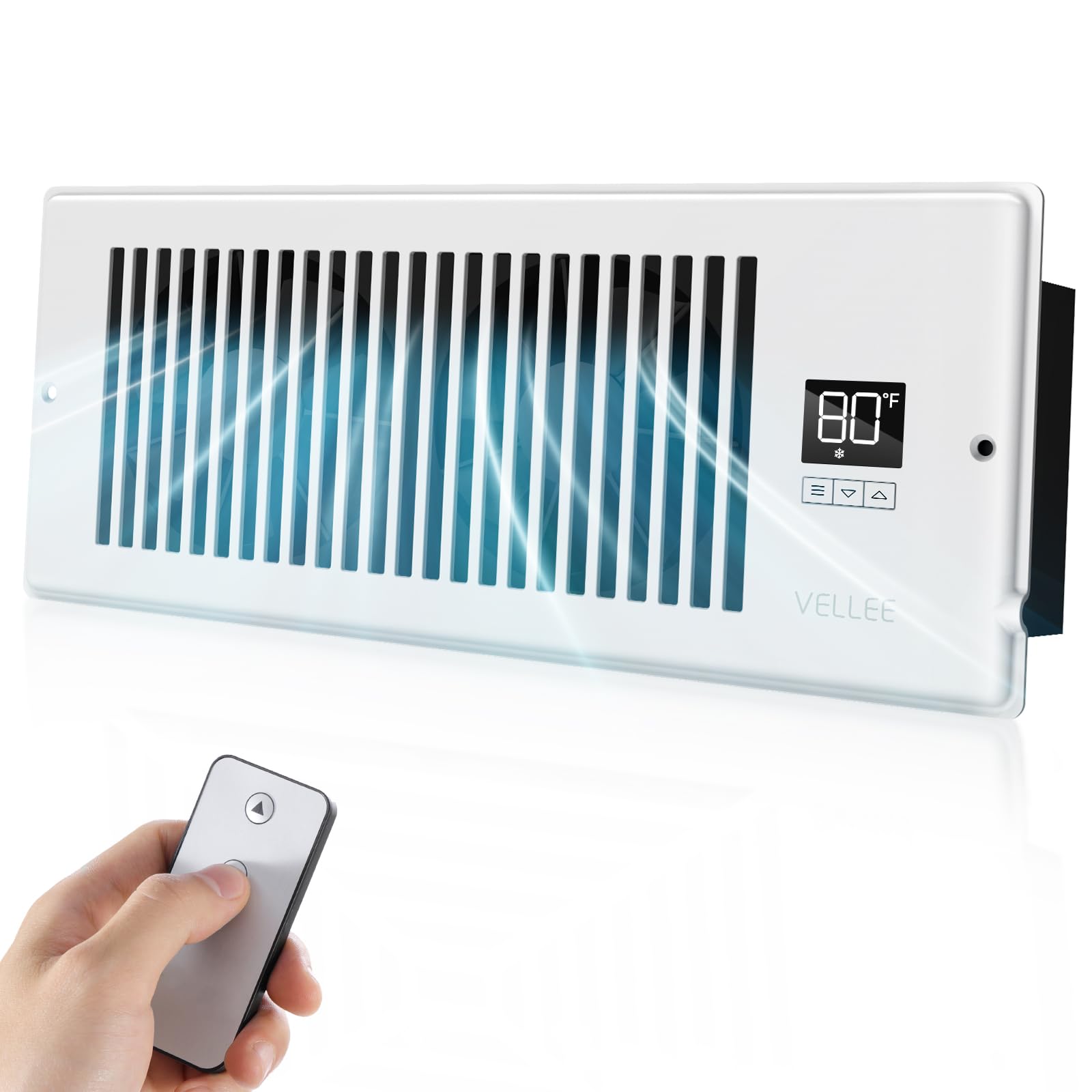
1. VELLEE Quiet Register Booster Fan 4″x12″ (White)
Our pick — over 4★ from 450+ verified ratings; the strongest balance of quality and price.
A 22-year-experienced team designed this around a single mission: quiet airflow that starts and stops on its own.
The VELLEE uses a high-static-pressure PWM motor (pulse-width modulation — a smart power delivery that lets the motor spin smoothly at very low speeds without shuddering) to push 120 CFM while the noise floor sits at just 18 dBA — roughly the sound of a library. The unit reads the vent air temperature through a high-sensitivity sensor and turns the fan on or off based on the heating or cooling trigger you set, so you do not have to flip a switch when the season changes.
Buyers report the fan reduces room temperature by 3 to 5°F in real-world use. It draws only 6 watts of power, runs on a 12-foot cord with a wall adapter, and has 10 speed levels that let you go from near-silent sleep mode to full boost. The consensus among buyers is that once installed, it fades into the background — the fan just works.
Smart set-and-forget: Three operating modes — cooling, heating, and fan-only — plus a power-off memory that saves your last settings so a flickering grid does not reset your preference.
Caveat worth knowing: The instruction booklet has a learning curve; a few owners felt the setup guide was unclear. The fan also produces a mild hum at higher speeds that some notice in a dead-silent room.
Reach for this if: you want a single plug-and-play booster that handles both summer AC and winter heat with zero app fuss and a proven track record across hundreds of owners.
Look elsewhere if: you need a duct opening smaller than 4″x12″ or you prefer app-based controls over a standard remote.
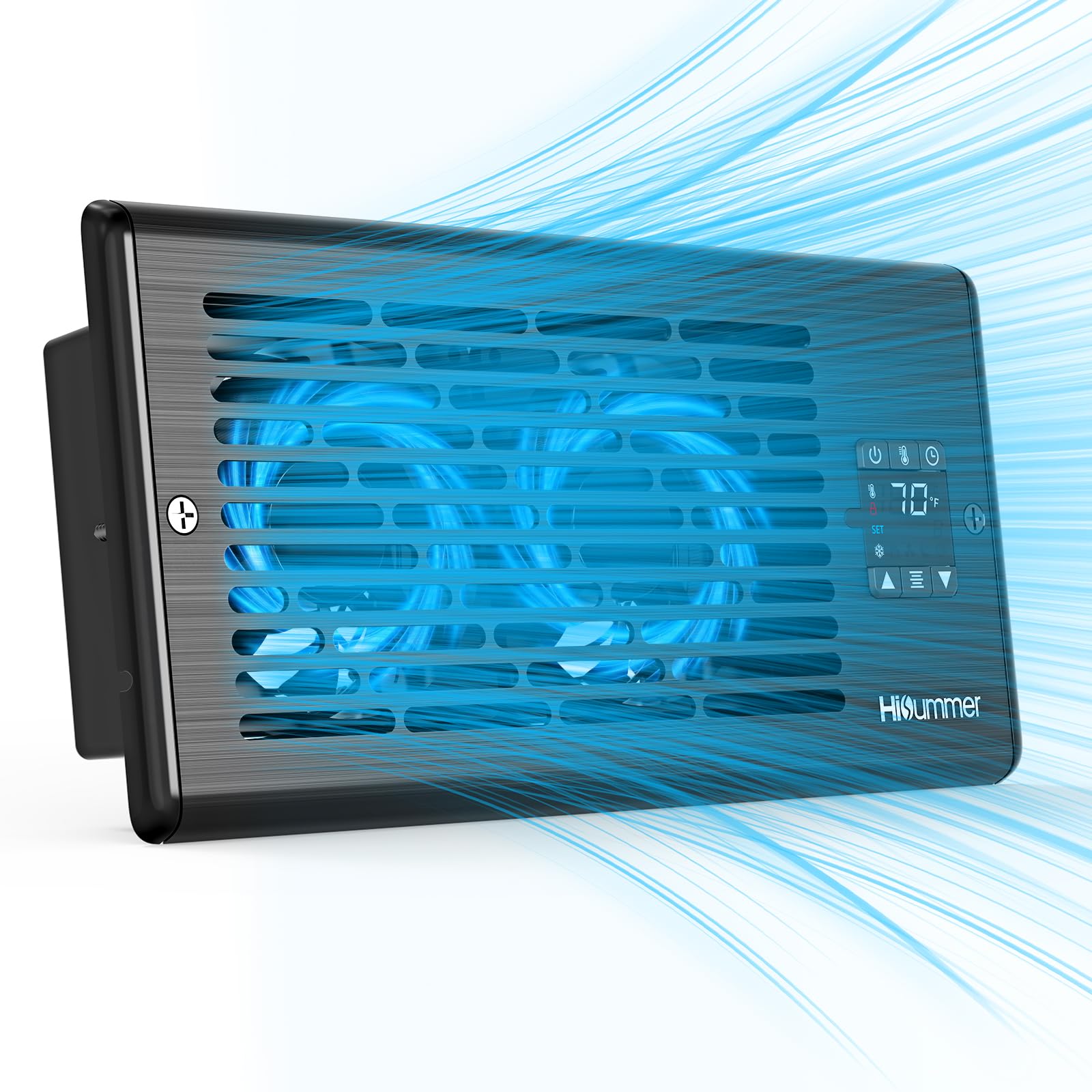
2. Hisummer Register Booster Fan 4″x10″ (Black)
A three-part quieting system — PWM motor, dual deep-groove ball bearings, and dynamically balanced blades — drops the noise floor to 17 dBA in sleep mode.
The Hisummer pushes 150 CFM through a precision-angled 95.13° air-guide grille that reduces backflow and sends air forward rather than letting it spill sideways. It fits only 4″ x 10″ duct openings, so measure your hole before buying. The smart NTC temperature sensor (a negative temperature coefficient thermistor — a chip that reads air temperature very close to the intake) auto-adjusts the fan speed as the vent air warms or cools, so the room stays stable without you touching a button.
At full tilt the fan moves serious air, but the real crowd-pleaser is the 26-foot remote range — you can change speeds from across the room without getting off the couch. The anodized aluminum faceplate sits flush and supports 300 lb of foot traffic, making it safe for floor registers in hallways or under desks.
Silent when it counts: Owners consistently praise the nearly inaudible operation at speeds 1 through 4, with one calling it “so quiet you will forget it is on.” The 5.8 mm anti-finger grille and 94V-0 flame-rated housing add safety for homes with kids and pets.
The fine print: This fan works only with 4″x10″ openings — there is no size variation available. A few owners noted that the remote is small and easy to lose between couch cushions.
Grab it for: a child’s bedroom, nursery, or any space where noise is the number one dealbreaker — 17 dBA is barely audible.
skip it if: your duct opening is not exactly 4″x10″ or you want a fan that also fits wall registers with minimal depth.
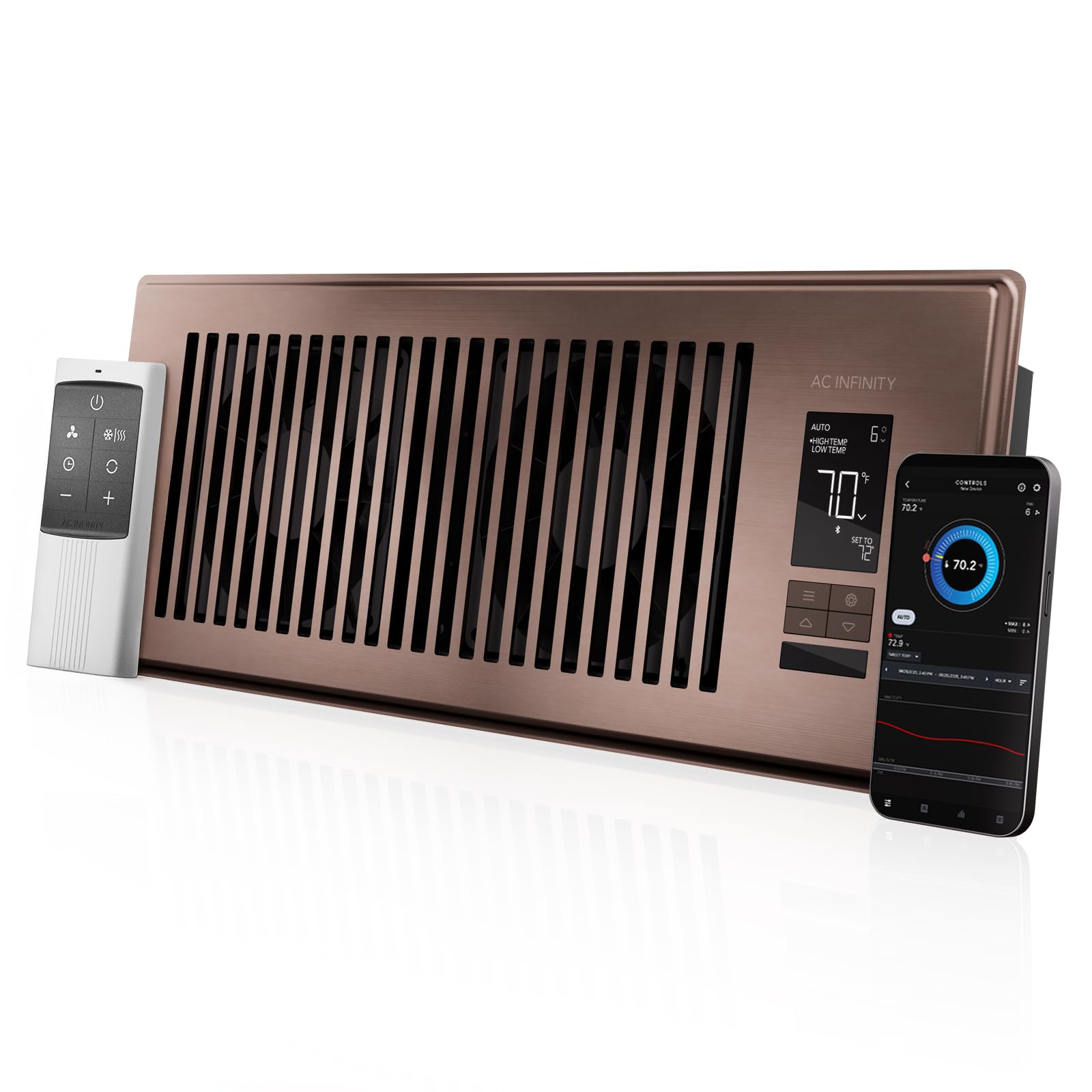
3. AC Infinity AIRTAP T4 Smart Register Booster Fan (Bronze)
The crowd favorite with 23,000+ ratings — a premium anodized aluminum frame with app control and a wireless LCD thermostat.
The AC Infinity AIRTAP T4 fits 4″x12″ duct openings and moves 120 CFM through dual 92 mm blower fans at a 17 dBA noise floor. It ships with a wireless remote controller that features a detailed LCD display showing duct temperature, fan speed, timer, and mode, plus Bluetooth app connectivity for deeper programming — schedules, alarms, temperature notifications, and historical climate data. The CNC-machined aluminum faceplate sits perfectly flush and gives a built-in look rather than an aftermarket add-on.
What stands out across thousands of owner accounts is the sheer energy savings — owners mention the fan pays for itself within a month or two by letting them set the main thermostat higher while the booster pushes cold air exactly where it is needed. The master bedroom temperature difference in one owner’s home dropped from 5-8°F to 1-2°F. The fan draws only 6 watts and runs 24/7 without a noticeable electric bill impact.
What wins people over
- App and LCD remote give full control without walking to the vent
- Premium anodized aluminum construction — sturdy, flush-fit, looks intentional
- Auto heating/cooling triggers work reliably across seasons
Honest trade-offs
- Noisy at higher speeds — the white noise helps some sleepers but can bother light sleepers
- Digital display shows duct temperature, not room temperature — a common point of confusion
Smart-home favorite: best for the tinkerer who wants schedules, alarms, and data logging without stepping away from the couch.
Think twice if: you want a dead-silent fan at maximum speed or you only need a basic on/off device with no app involvement.
4. MATULSA Register Booster Fan 4″x12″ (Bronze)
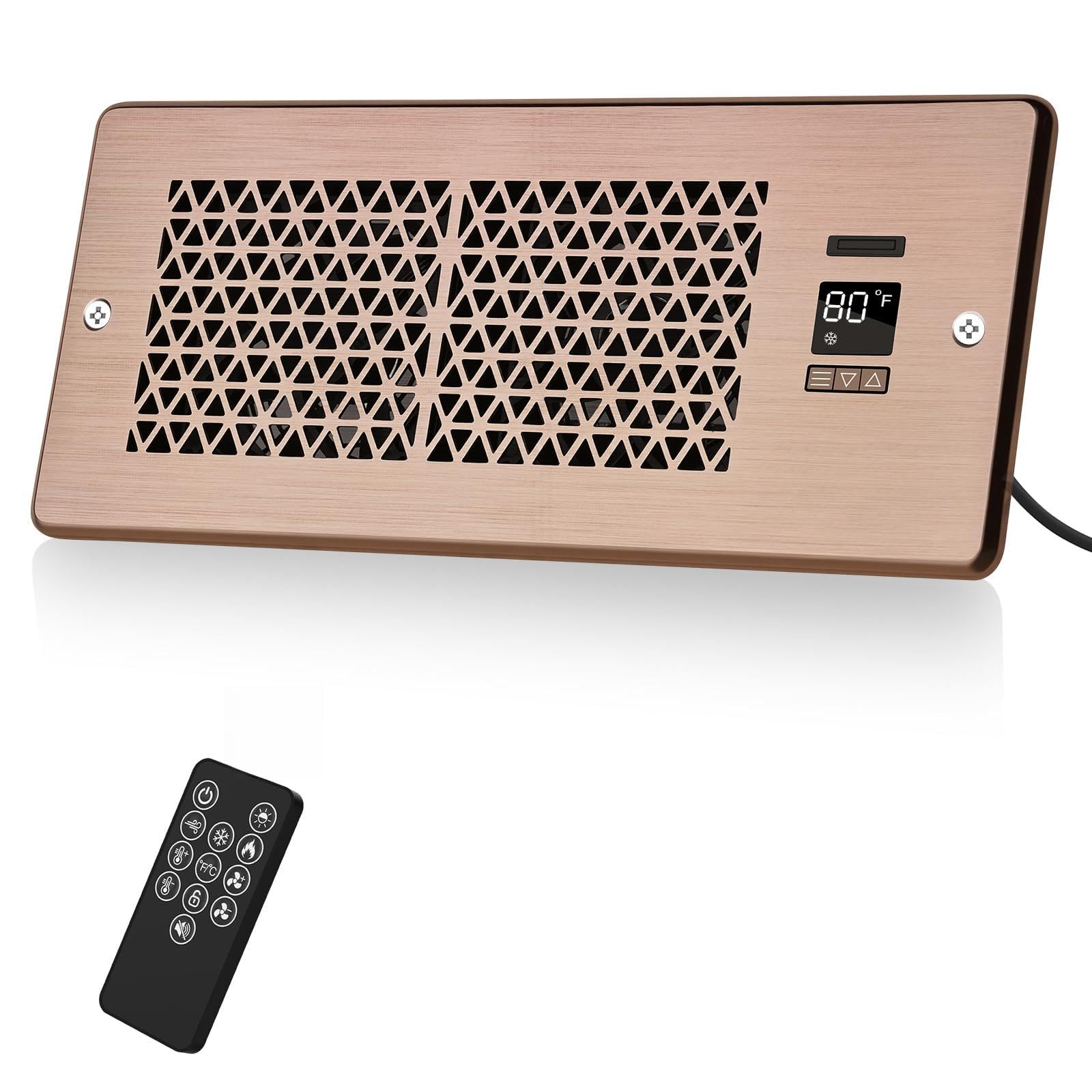
A bronze-finished booster with a triangular hollowed surface that boosts safety for little fingers and eliminates hot spots.
The MATULSA fits duct openings measuring 11.65 to 12 inches in length and 3.93 to 4.5 inches in width — a slightly wider tolerance than many competitors. It uses dual 120 mm fans with 10 speed levels and a built-in temperature sensor that auto-detects whether the HVAC is blowing hot or cold air and switches modes accordingly. Owners say the temperature control is the standout feature: the room cooled 5°F within 24 hours in one west-facing bedroom above a garage.
Installation takes minutes — pop out the old vent cover, drop in the fan, secure it. The remote controls on/off, cooling and heating triggers, fan speed, timer, and a mute function. The consensus among the nearly 450 ratings is that the fan works great while it works, but a small number of customers note noise at the higher speed settings.
Even heat distribution: The triangular hollowed surface is designed to prevent fingers from reaching the blades without restricting airflow — a thoughtful touch for homes with curious toddlers.
Worth knowing: a handful of owners experienced a developing noise after about 5-6 months of daily use, suggesting the mechanical longevity is a variable. The fit is tight — measure carefully before ordering.
Pick it for: a single room that swings from hottest in summer to coldest in winter — the auto temp trigger handles both seasons without seasonal adjustments.
Think twice if: you need a fan that will run 24/7 for years without any maintenance — the long-term durability is not as proven as the AC Infinity or VELLEE.
5. VIVOHOME Register Booster Fan 6″x12″ (White)
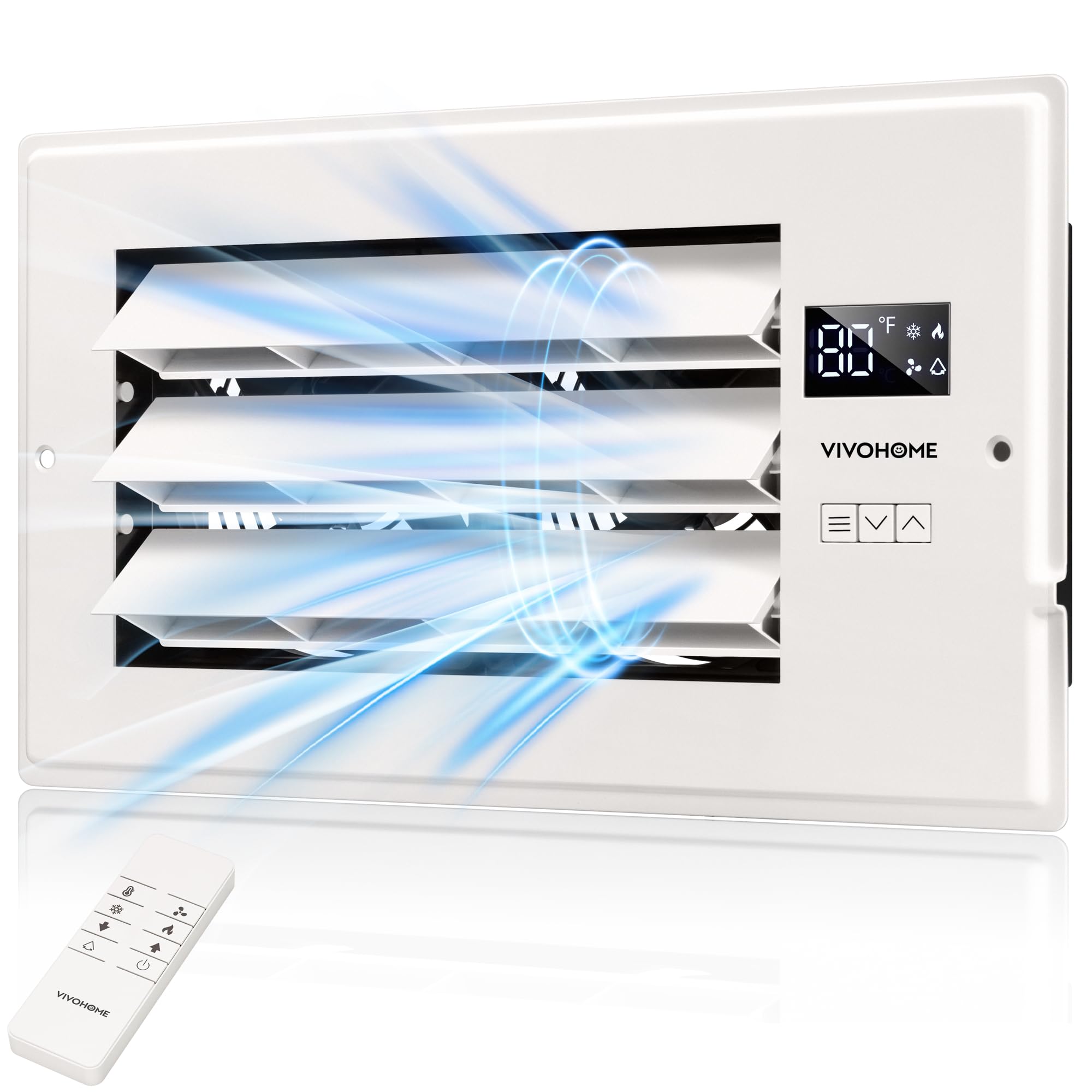
This is the only booster on the list with motorized louvers that open, close, and swing — giving you directional control over the boosted air.
The VIVOHOME operates on a 6″x12″ duct opening and delivers 120 CFM at a 18 dBA noise floor. Its EC motor (electronically commutated motor — a brushless design that is more efficient and quieter than a standard AC motor) powers both the fan and the auto-swing louvers. You can set the louvers between 60° and 120° or lock them in place, and when the fan is off the louvers close fully to seal the vent and prevent conditioned air from escaping into the ductwork. A child safety lock prevents the buttons from being pressed accidentally.
The built-in thermostat turns the fan on automatically when the HVAC starts blowing and turns it off when the system rests, saving you the trouble of manual operation across seasons. Owners consistently say the fan makes a clear temperature difference — one buyer called it “worth the money” after seeing their room cool within hours. The trade-off is that if the fan is off, the vent is sealed, so forgetting to turn it on when the AC cycles means zero airflow into the room.
Directional airflow bonus: You can aim the boosted air toward a desk, bed, or corner that usually stays cold — a feature no other booster on the list offers.
Caveat: The motorized louver mechanism is an extra moving part that can fail — one owner reported the fins breaking after 3 months. The fan also requires a nearby outlet because the cord is on the shorter side.
Best for: a home office or bedroom where you want to direct the air stream exactly where you sit or sleep, and you want the vent to seal completely when off.
Skip if: you need a simple no-moving-parts fan that just spins — the VIVOHOME’s complexity is a feature but also a potential long-term risk.
6. SANYCASA Register Booster Fan 6″x10″ (Satin Nickel)
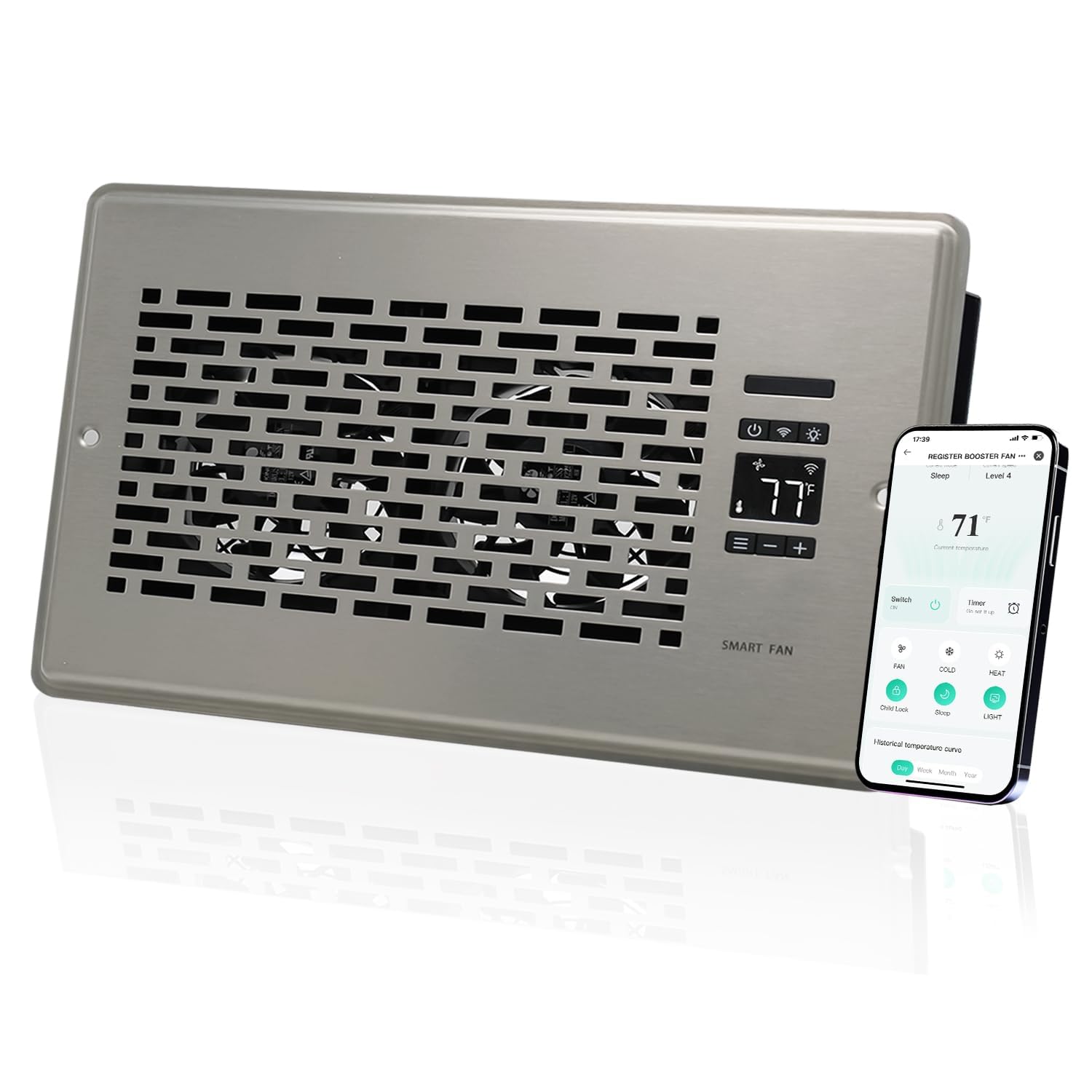
A Manhattan-inspired satin nickel faceplate with 140 CFM — the strongest airflow on the list — and app-based control for multi-device management.
The SANYCASA fits 6″x10″ register openings and uses stator-blade PWM fans with hydro-mechanical blades to push air at ultra-low noise — below 18 dBA. The room-temperature display on the faceplate is a useful daily touch: you can see the current vent temperature at a glance without needing a separate thermostat. The app allows you to control multiple SANYCASA fans from one screen, which is handy if you are adding boosters to several rooms.
Performance is the most-praised aspect — reviewers point out temperature drops of 7-10°F in top-floor bedrooms, with one noting the quiet humming actually works as white noise. The fan is noticeably effective in small guest rooms and rooms far from the furnace, though several owners found it had minimal impact in larger master bedrooms. A recurring note is that the LED lights on the faceplate can be bothersome in a dark room at night.
Energy-efficient brains: The fan auto-adjusts speed based on room temperature, which lowers energy consumption and electricity bills over time — a detail buyers with older homes appreciated.
The big caveat: A small but notable number of shoppers say the fan stopped working after around 10 months, and customer support responsiveness has been inconsistent — a genuine long-term reliability concern for a device you expect to last years.
Ideal for: small guest rooms, spare bedrooms, or offices where 140 CFM of directed airflow makes a dramatic difference and you want multi-fan app control.
Think twice if: you need the fan to run daily for years without interruption or if you dislike glowing LEDs in a dark room.
7. Tjernlund RB12 Register Booster Fan 4″x12″ (Brown)
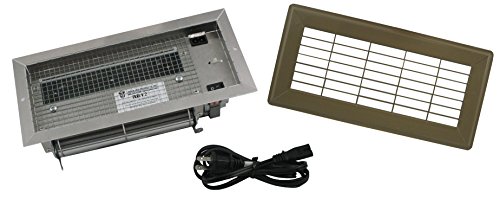
A Made-in-USA blower-wheel fan that is designed for quiet operation — with no speed settings, no remote, just raw airflow at 75 CFM.
The Tjernlund RB12 is the simplest device on the list: plug it into a standard 120V outlet and it spins at a fixed 1,800 RPM. It uses a blower wheel (a cylindrical cage that pulls air in from the side and pushes it straight out the front) rather than a propellor, which produces a smoother, quieter airflow that owners describe as near-silent — closer to laptop fan noise than a box fan buzz. The commercial-grade grill is paintable so you can match it to your existing floor or wall register.
The simplicity is a double-edged sword. There is no auto on/off thermostat, so the fan runs constantly once plugged in. Most owners solve this by pairing it with a smart plug and a separate temperature sensor to create automated on/off cycles. The unit requires a duct opening with at least 4 inches of clearance depth and no sharp 90° bends, because the blower wheel is physically larger than a propellor. Buyers report temperature drops of 6-10°F in rooms that were previously 78-80°F, making it a very effective brute-force solution for the price.
Durable beyond belief: Multiple owners mention the fan running 24/7 for two years straight without a hiccup. The squirrel-cage blower wheel is inherently more reliable than a propellor because it experiences less blade fatigue.
Honest limitation: At 75 CFM, it delivers enough airflow for a single small room, but may be underpowered for a large master or open-concept space. The manual switch is also located behind the vent cover, making it awkward to reach without lifting the grill.
Best for: a single small-to-medium room where you want near-silent, reliable airflow with zero digital complexity — the low-maintenance crowd.
Not for: anyone who wants speed control, auto thermostatic operation, or a larger duct opening size. You must accept the manual on/off and the 75 CFM limit.
8. Suncourt Flush Fit Register Booster Fan 4″x10″ (Brown)
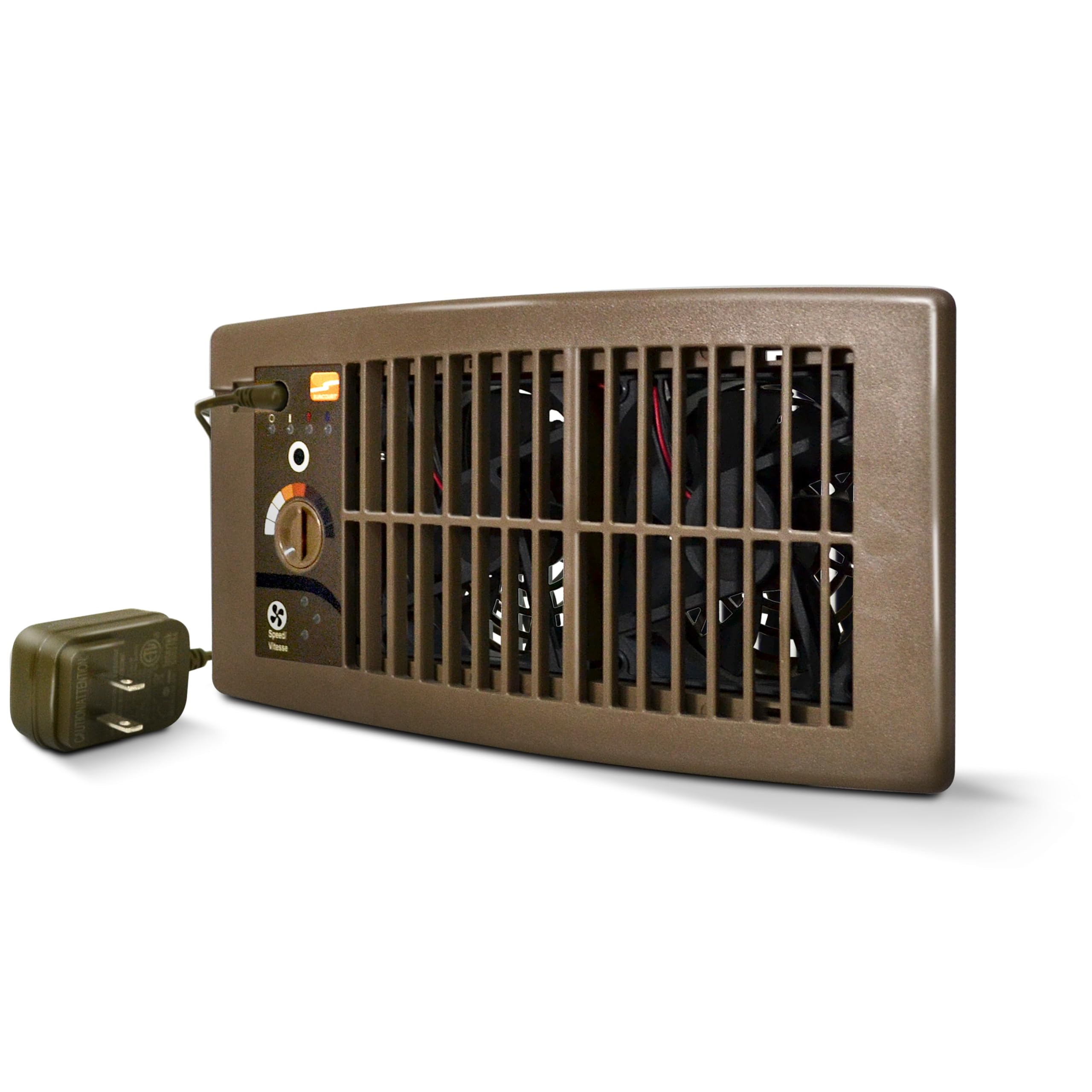
Suncourt’s patented smart technology senses when the HVAC is running and turns the fan on automatically — no seasonal adjustments needed.
The Suncourt Flush Fit fits 4″x10″ floor or wall registers and pushes up to 132 CFM through five adjustable fan speeds. It is engineered and assembled in the USA, a detail that matters to buyers who prioritize domestic manufacturing. The auto on/off detection is the main differentiator here: a built-in sensor detects the vibration or temperature change of the HVAC starting up and activates the fan without any manual intervention. This is a genuinely hands-off solution that works across heating and cooling seasons automatically.
The unit sits flush with the floor or wall, so it does not stick up and present a tripping hazard. Owners praise the temperature difference — one called it “life changing” for a room that went from 85°F to comfortable. The noise level is mixed: at low speed it is very quiet, but at high speed it produces an audible hum and vibration that travels through the ductwork. A subset of technically inclined owners modify the unit by swapping the internal fans for quieter computer-grade fans, but that requires disassembly.
What stands out
- Auto-sense detects HVAC activity and turns on/off — no thermostat programming needed
- Five speed settings give useful range from gentle airflow to strong boost
- Flush-mount design blends with existing vent covers and avoids tripping hazards
Where it falls short
- Higher speeds produce a noticeable buzzing or humming sound through the duct
- No remote control — you adjust the speed via a touch panel on the grill itself, which can be accidentally triggered by stepping on the register
Grab this for: a room where you want the fan to operate completely hands-free across seasons — the auto-sense truly works without seasonal setup.
Think twice if: you are sensitive to humming noises in the ductwork, or you want to control the fan from across the room without bending down to the floor register.
Understanding the Specs
CFM (how much air moves)
CFM stands for cubic feet per minute — the volume of air the fan pushes every 60 seconds. For a standard 12×12 bedroom 80 to 120 CFM is usually enough to feel a 5°F difference. Rooms with longer duct runs or larger square footage benefit from 130 to 150 CFM. A fan that is too weak will spin but leave the far end of the room unchanged. A fan with too much CFM for a very short duct can actually pull air away from other vents — it is a targeted tool, not a whole-house solution.
dBA (noise floor)
dBA measures sound level with a weighting that matches human hearing. 18 dBA is roughly the sound of a quiet library — a very faint hum. 25 dBA is closer to a whisper. Most boosters drop to 17 or 18 dBA at their lowest speed. The noise comes from three sources: the motor itself, the blades cutting air, and the vibration transmitted through the metal duct. A good booster fan minimizes all three through PWM motor control, dynamically balanced blades, and rubber vibration dampeners.
FAQ
Will a vent booster fan work with my window AC or portable AC?
How do I measure my duct opening correctly?
Can I install a booster fan in a ceiling vent?
Will a booster fan make my furnace or AC work less?
Does a register booster fan fit in a 4×12 opening that is slightly smaller or bigger?
How long do register booster fans typically last?
Do I need an electrician to install a register booster fan?
Can I use a booster fan with a heat pump or baseboard heating?
How much electricity does a register booster fan use?
Final Thoughts: The Verdict
For the majority of shoppers, the best air conditioner vent booster fan to buy is the VELLEE Quiet Register Booster Fan because it balances 120 CFM of airflow with a 18 dBA noise floor, auto thermostatic control, and 10 speed levels at a mid-range price that thousands of owners have validated. If you need the quietest possible operation for a nursery or light sleeping room, the Hisummer at 17 dBA with 150 CFM is the specialist. And for smart-home integration with app control and a premium aluminum build, the AC Infinity AIRTAP T4 is the one that over 23,000 raters have made the category’s most trusted name. Measure your duct opening first, pick your noise tolerance, and any of these three will fix that one room that never seemed to get the air it needed.
How We Picked
We do not accept paid placement. Every pick is matched to a real buyer and a real use-case; we do not hands-on test units.
Sources & Methodology
Specifications: manufacturer listings and product documentation. Review insights: verified customer reviews, as of July 2026. Pricing: not shown on this page (it changes often); check the current price via the retailer link.
As an Amazon Associate, Gadgets Feed earns from qualifying purchases. This does not affect which products we feature.