
Our readers keep the lights on and my morning glass full of iced black tea. As an Amazon Associate, I earn from qualifying purchases.
Specs are compiled from manufacturer listings and verified buyer reviews and can change over time — please confirm the key details on the product page before buying.
If you are an HVAC pro or a serious DIYer, you already know the feeling — chasing a refrigerant leak with a bubble bottle in a cramped attic, or guessing whether a line is properly evacuated by the sound it makes. The right diagnostic and service tools strip the guesswork out, turning every service call into a data-driven repair. This guide cuts through the marketing to find the gear that actually helps you finish the job faster and with less frustration.
I’m Min — the founder and writer behind Gadgets Feed. This guide is built by comparing the manufacturers’ published specifications and the patterns across verified customer reviews, so you get each pick’s real strengths and trade-offs instead of marketing spin.
Whether you are topping off a home mini-split or diagnosing a commercial system, you need the best air conditioning tools that match your skill level, budget, and most frequent tasks — from accurate multimeters and wireless psychrometers to complete vacuum pump kits that make evacuation a one-person job.
Our Picks at a Glance

How To Choose The Best Air Conditioning Tools
A single misdiagnosis on an AC system can cost you hours of backtracking. Picking the right tool starts with matching the device to the job you do most — measuring electrical draw, checking refrigerant pressure, or inspecting a coil for a temperature delta. Focus on safety ratings and measurement range first; every other feature is secondary.
Safety Ratings Protect You First
For any electrical tool you put on a live circuit, the safety rating (CAT III or CAT IV) tells you how well the meter can survive a voltage spike without sending that surge through your hands. A CAT III 600V rating is the minimum for residential HVAC work; CAT IV is for utility-level connections. Ignore this number, and a cheap meter can become a hazard the moment you touch a mis-wired panel.
Refrigerant Compatibility is Non-Negotiable
Older systems run R22, newer units use R410a, and automotive systems still use R134a. A single manifold gauge set that covers all three refrigerants — like the Lichamp set — saves you from owning three separate kits. Check that the hoses are rated for at least 600 psi working pressure on the high side, because R410a runs at significantly higher pressures than R22.
Wireless Connectivity Changes How You Work
Modern diagnostic tools like the Fieldpiece Job Link system let you take a psychrometer reading inside a duct, then walk 100 feet away to look at the data on your phone. That Bluetooth range (up to 1000 feet for some models) means you do not have to perch on a ladder just to log a supply temperature — you can stand at the thermostat and get the data from the vent.
Quick Comparison
| Model | Best For | Best Spec 1 | Best Spec 2 | Best Spec 3 | Amazon |
|---|---|---|---|---|---|
| Fluke 15B+ Multimeter★ Best Overall | Voltage & Current Diagnosis | AC/DC Voltage up to 1000V | AC/DC Current up to 10A | CAT III 600V Safety Rating | Amazon |
| Fieldpiece JL3RH ProbePro Choice | Real-Time Environmental Data | 1000 ft Bluetooth Range | Dry / Wet Bulb & Enthalpy | –40 °F to 250 °F Range | Amazon |
| UEi DL379B Clamp Meter | Non-Contact In-Line Current | AC Amps Clamp Measurement | Capacitance up to 2000µF | CAT IV 300V / CAT III 600V | Amazon |
| TOPDON TC004 Camera | Thermal Leak & Hotspot Hunt | 128×128 (240×240 TISR) IR | -4°F to 842°F Temp Range | 15-Hour Battery Life | Amazon |
| Orion Motor Tech Pump + Gauge Set | Full AC Evacuation Service | 1/3 HP / 4.5 CFM Pump | 4-Way Manifold Gauge | Works with R134a, R22, R410a | $135.99$159.99Amazon |
| Lichamp Manifold Gauge Set | Basic Refrigerant Charging | R134a R22 R12 R502 Refrigerants | 500 psi / 350 psi Max Dials | 5 ft Hoses (600 psi working) | $59.99Amazon |
| RectorSeal Mighty Pump | Clearing Condensate Blockage | Hand-Operated PVC Pump | Clears Slime, Mold, Dirt | 20”L x 9.5”W x 8”H | $78.49Amazon |
In‑Depth Reviews
1. Fluke 15B+ Digital Multimeter
Our pick — over 4.5★ from 850+ verified ratings; the strongest balance of quality and price.
The 4.8-star-rated multi-tool that every tech should keep in the truck for voltage, continuity, and capacitance checks.
When you lean on a multimeter every service call, the brand matters — and Fluke is the name techs trust. The 15B+ measures both AC and DC voltage up to 1000V, which means you can confidently check everything from a low-voltage thermostat wire to a high-voltage compressor contactor without switching tools. It also handles AC and DC current up to 10A, so you can diagnose whether a blower motor is pulling too many amps and heading for a failure.
The safety rating here is a key differentiator. With a CAT III 600V rating, the 15B+ is built to survive transient voltage spikes that would destroy an uncertified multimeter — that certification matters when you are poking into a live electrical panel. The unit weighs 460 grams (just over a pound) and fits into a standard tool pouch with dimensions of 8.46 x 2.76 x 5.91 inches.
Buyers report that the dial feel and button response are noticeably better than entry-level meters, and the included TL75 test leads are flexible enough to reach into crowded junction boxes. Unlike the UEi DL379B, which adds non-contact clamp functionality, this is a pure handheld meter — it does not measure in-line current without breaking the circuit. For techs who need a rugged, dead-accurate voltage and resistance tool first, this is the pick.
Where It Excels
- 1000V AC/DC range covers both low-voltage controls and line-voltage equipment.
- CAT III 600V safety certification adds real protection during live electrical work.
- Includes capacitance, diode, and continuity modes for comprehensive troubleshooting.
The Trade-Off
- No clamp-style current measurement means you must break the circuit to measure amps.
- No temperature probe input for checking superheat or subcool from the meter itself.
Reach For This If: you want a bulletproof, safety-rated digital multimeter for diagnosing voltage, resistance, and capacitance across residential and commercial systems.
Look Elsewhere If: you need to measure in-line amps without disconnecting wires — a clamp meter like the UEi will serve you better for that.
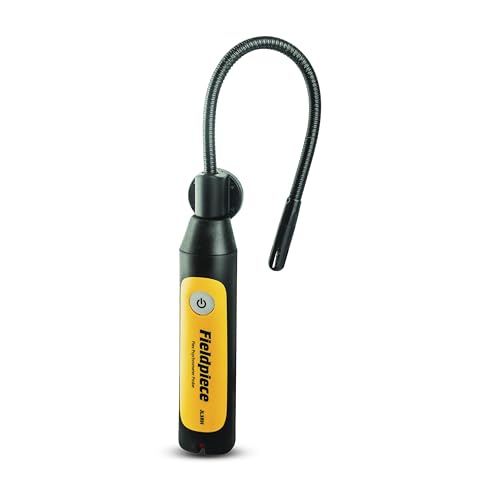
2. Fieldpiece JL3RH Job Link Wireless Psychrometer Probe
The palm-sized probe that hands you wet-bulb and enthalpy data from 1000 feet away without climbing a ladder.
This is not a typical handheld thermometer. The Fieldpiece JL3RH is a wireless psychrometer probe designed for HVAC professionals who need accurate supply and return air readings without crawling through ductwork. It measures dry bulb, wet bulb, relative humidity, dew point, and enthalpy — the five core data points you need to calculate system performance and superheat targets. The flexible 9.25-inch wand with a built-in sliding magnet lets you attach the sensor right inside a supply register or plenum and walk away to read the results on your phone.
The Bluetooth range is the standout spec here — up to 1000 feet line-of-sight, which on a large commercial roof or multi-zone residential job means you can take a reading at one end of the building while standing at the condenser. The housing measures just 1.8 x 4.8 x 9 inches and weighs only 8 ounces, so it fits into a shirt pocket without dragging your tool belt down. It is also built for extreme conditions, with a rated operating range from –40 °F to 250 °F and a water-resistant housing that holds up on wet rooftops.
Owners mention that pairing with the Job Link app is instant, and the ability to log and timestamp readings creates a service record you can share with a homeowner. Compared to the Fluke 15B+, which gives you electrical data, this probe gives you air-side diagnostics — they complement each other rather than compete. The only limitation: you need a smartphone or compatible Fieldpiece manifold to view the data; the probe has no standalone display.
Real-World Edge: One reviewer described walking the roof of a strip mall, collecting supply temp from six different registers without moving the ladder once — the 1000-foot reach makes zone-by-zone testing a one-person job.
The Kick: Without a Job Link manifold or the free app, the probe is just a sensor — you are relying on your phone as the display, so keep it charged.
Best For: the service pro who needs fast, remote air-side data to nail superheat, subcool, and delta-T across multiple zones without retracing steps.
Not For: pure electrical troubleshooting — this probe is about air, not amps; pair it with a meter for a complete diagnostic kit.
3. UEi DL379B Digital Clamp Meter

The clamp meter that reads AC amps without breaking the circuit and packs a magnetic mount for dark attic work.
When you need to measure the current draw of a running compressor or condenser fan motor, a clamp meter is the fastest way — you simply clamp the jaws around one wire and get the reading. The UEi DL379B measures AC amps directly this way, up to 2000 microamps for pilot-duty circuits and standard AC amperage for full-load motors. It also measures AC/DC volts, capacitance up to 2000µF, frequency, duty cycle, and temperature via the included K-Type thermocouple probe.
Safety-wise, this meter carries a CAT IV 300V and CAT III 600V rating, meaning it is certified for the highest-surge environments you are likely to encounter in commercial HVAC. At 1.5 x 3.25 x 8.5 inches, the DL379B is significantly more compact than the Fluke 15B+ (compared to the Fluke 15B+’s 8.46 x 2.76 x 5.91 inches), making it easier to slip into a crowded tool bag. It also includes a magnetic mount that sticks to a metal panel or electrical box, freeing both hands for probing. The backlit dual display and work light help in dimly lit mechanical rooms.
Buyers mention the test lead storage wrap on the body keeps the leads from tangling, and the auto-power-off saves battery life between calls. The trade-off versus the Fluke: while this clamp meter is far more convenient for amp draws, the Fluke leads on pure voltage accuracy at the 1000V ceiling. If you mostly measure in-line current and ground continuity, this UEi is a stronger daily driver.
Strengths
- Non-contact clamp measurement lets you read current on a running motor without disconnecting wires.
- Includes a K-Type temperature probe for checking duct temps or superheat at the line.
- Magnetic mount plus work light make attic and crawlspace readings much easier.
Limitations
- Maximum AC/DC voltage stops at 600V, not 1000V like the Fluke — cannot probe high-voltage industrial panels.
- Capacitance maxes out at 2000µF, which covers most start/run caps but not very large power-factor correction banks.
Grab This For: the tech who measures motor amp draws daily and values the safety of a CAT IV-rated clamp in compact packaging.
Skip It For: primary voltage diagnosis above 600V — for that, keep the Fluke 15B+ in the bag.
4. TOPDON TC004 Mini Thermal Imaging Camera

The pocket thermal camera that finds a refrigerant-starved coil or an overloaded breaker without disassembling anything.
Thermal imaging changes how you diagnose HVAC problems. Instead of running system checks and guessing where the restriction is, you look at the coil or line set through the TOPDON TC004 and see the temperature delta in real time. It captures a base 128×128 infrared resolution and enhances it to 240×240 using TISR (Thermal Image Super Resolution) technology, with a 40°x30° field of view and a 25Hz refresh rate for smooth live video. A 25Hz refresh rate means the image updates 25 times per second, so moving the camera across a duct register feels fluid, not choppy.
The temperature range spans from -4°F to 842°F with an accuracy of ±3.6°F or 2% — wide enough to spot a frozen evaporator coil or a hot electrical splice. The camera automatically highlights the highest, lowest, and center temperature spots on the screen, and you can set high and low temperature alerts that trigger an on-screen warning and a photo capture. The built-in 512MB eMMC storage holds up to 8,000 photos, so you can document a service call without pulling out your phone. Battery life hits 15 hours on a full charge, with auto-shutdown intervals at 5, 10, or 20 minutes to save power between jobs.
At 1.03 pounds and with a 9 x 4 x 3.5-inch body, the TC004 is small enough to clip onto a belt. Customers note the IP54 water resistance means it survives a light rain on a roof job. The 2-meter drop rating adds confidence on ladders. The only real catch is the lack of a paper manual — you scan a QR code to download the electronic version, which some older techs find less convenient than a printed quick-start card.
Diagnostic Superpower: You can literally see a restriction — a plugged TXV or a starved evaporator shows up as a cold spot before you ever connect a gauge. Reviewers point out it turns a 30-minute guess into a 30-second confirmation.
Before You Buy: This is a diagnostic aid, not a repair tool. Combine it with a manifold gauge set and multimeter to confirm what the thermal image shows.
Reach For This If: you want to spot electrical hot spots, refrigerant line restrictions, and insulation gaps instantly without disassembly.
Look Elsewhere If: your work is strictly R&R (remove and replace) on known bad components — the camera is a diagnostic luxury, not a daily necessity for every tech.
5. Orion Motor Tech AC Vacuum Pump and Gauge Set
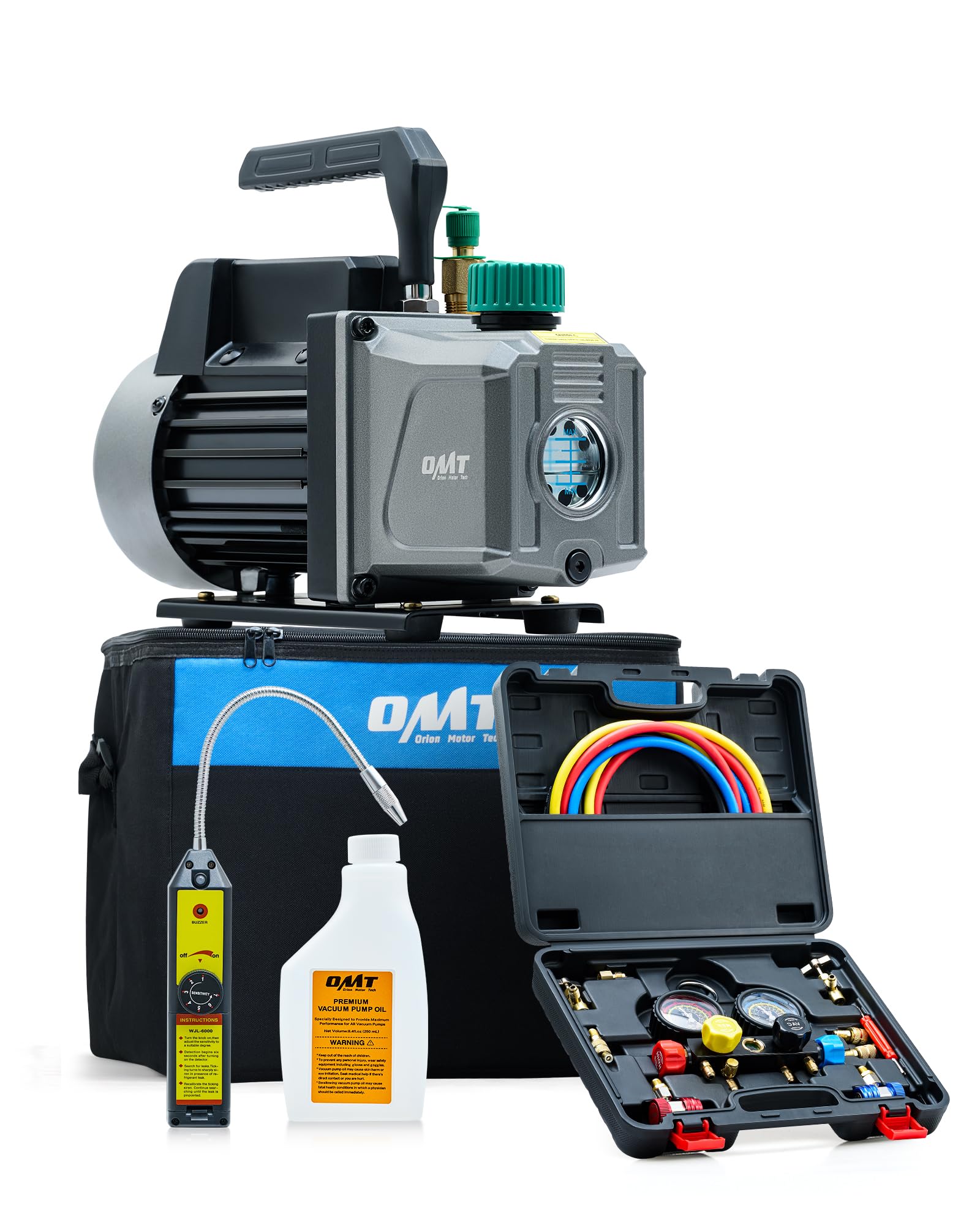
The all-in-one vacuum kit that pulls a 500-micron deep vacuum and measures refrigerant pressure from the same box.
Evacuating an AC system before charging is not optional — moisture and non-condensables will kill a compressor fast. The Orion Motor Tech kit bundles everything you need for a complete evacuation and charge cycle: a 1/3 HP 4.5 CFM vacuum pump, a four-way manifold gauge set with color-coded hoses, an electronic leak detector, R134a can taps with quick couplers, R410a adapters, a bottle of vacuum oil (0.26 qt included), and a durable carrying case. The all-copper motor in the pump delivers fast pull-down, and the aluminum alloy casing dissipates heat to prevent overheating during longer pulls.
The four-layer hoses are rated for 800 psi working pressure and 4000 psi burst pressure — substantially higher than the Lichamp set’s 600 psi working pressure, which gives this kit a safety margin for high-pressure R410a systems. The manifold gauge gives you real-time low-side and high-side pressure readings for accurate refrigerant charging. An oil sight glass on the pump lets you check the oil level at a glance, and the bottom drain valve makes changing oil a clean process.
At 21.9 pounds, this is a heavy kit compared to the 5.62-pound Lichamp gauge set — it is designed for truck storage, not a tool pouch. Shoppers say that the included case keeps everything organized, and the tethered brass safety caps on the pump prevent oil spills during transport. The electronic leak detector helps you find small leaks before you start the evacuation, saving you from pulling a vacuum on a system that will not hold it.
Why It Stands Out
- Complete evacuation kit — pump, manifold, hoses, leak detector, and adapters in one purchase.
- 800 psi working pressure hoses provide extra safety headroom for R410a service.
- Oil sight glass and bottom drain valve make maintenance straightforward.
The Weight Truth
- 21.9 pounds makes this a truck-only kit — not something you carry up three flights of stairs on a service call.
- The included electronic leak detector is a basic unit; a standalone sniffer will outperform it for pinpointing tiny leaks.
Safe Bet For: the tech or serious DIYer who wants one kit that does full evacuation, charging, and leak detection without shopping for parts separately.
Too Much For: simple top-off jobs on a single R134a car AC — the lightweight Lichamp gauge set covers that scenario with less bulk.
6. Lichamp AC Gauges Manifold Set
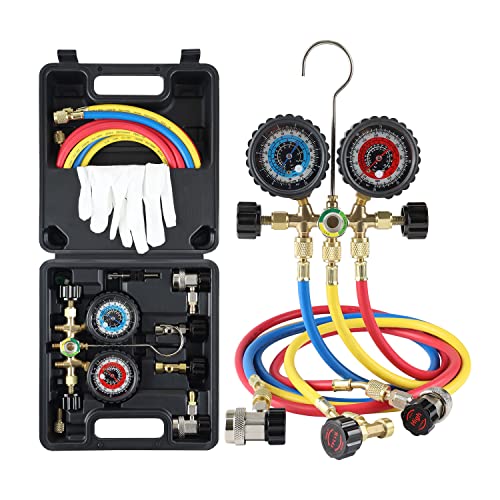
The affordable manifold gauge set that covers four refrigerant types and includes a sight glass for flow checks.
If you are maintaining a car AC or a home window unit and do not need a full vacuum pump kit, the Lichamp manifold gauge set gives you the essential diagnostic gear at a budget-friendly price. It works with R134a, R22, R12, and R502 refrigerants — covering most older and current systems outside of high-pressure R410a. The dials are large and color-coded: the red high-side gauge reads up to 500 psi, and the blue low-side gauge reads up to 350 psi. A sight glass in the manifold lets you see the liquid refrigerant flowing as you charge, giving a visual confirmation that the system is taking gas.
The three included hoses are 5 feet long, rated for 600 psi working pressure and 3000 psi burst pressure. Each hose has a 45-degree bend on one end, which makes it easier to reach the service port on a tight compressor in a car engine bay. All metal parts are brass and aluminum — no cheap plastic to crack under pressure. The set also includes two adjustable R134a adapters, two can taps (one puncture-style, one self-sealing), an ACME adapter for R134a bulk tanks, a valve core remover, and gloves.
Buyers report that the set is a direct replacement for the classic yellow-jacket style gauges used in home garages for years. The 5.62-pound weight is manageable for carrying in a small tool tote. The trade-off vs the Orion Motor Tech kit: no vacuum pump, no leak detector, and no R410a compatibility — so if you work on modern mini-splits, you will need separate adapters or a different gauge set.
Value Points
- Covers four common refrigerants (R134a, R22, R12, R502) in one compact set.
- Sight glass gives real-time visual feedback of liquid refrigerant flow during charging.
- Brass and aluminum construction resists corrosion and stands up to daily garage use.
Feature Gaps
- No R410a capability — contemporary mini-splits and residential split systems require separate adapters.
- No vacuum pump included — you need a separate pull-down tool for full system evacuation.
Best For: the home mechanic or hobbyist who tops off R134a car AC systems and wants a complete, durable gauge set without spending on a full kit.
Not For: R410a mini-split service — you need hoses rated for higher pressure or dedicated R410a gauges for that work.
7. RectorSeal Mighty Pump 97795

The hand pump that blasts clogged condensate lines clear without electricity or compressed air.
A clogged condensate drain line is among the most common residential AC service calls — and usually the simplest to fix with the right tool. The RectorSeal Mighty Pump is a hand-operated, high-volume, low-pressure PVC pump that forces water through the drain line to push out slime, mold, and dirt blockages. It does not need electricity, batteries, or expensive nitrogen tanks — you just connect the hose, pump by hand, and the pressure clears the obstruction. It measures 20 inches long by 9.5 inches wide by 8 inches tall and weighs only 6.1 pounds, so it fits in a maintenance bag without dominating the space.
Beyond condensate lines, it can pump standing water out of air handler overflow pans and water heater overflow pans, making it multi-purpose for any flat-water drainage issue. The pump body is heavy-duty PVC that resists cracking, and replacement hoses are available separately so the pump body lasts through many seasons. Owners mention this tool turns a 20-minute drain snake struggle into a 30-second pump-and-go procedure, especially on lines that are only mildly sludged.
The catch is that it is a specialty tool — it does nothing for refrigerant systems, electrical diagnostics, or temperature measurement. It solves exactly one problem (wet, clogged drains) and solves it perfectly. If you already have a wet-dry vacuum that can suck out a condensate line, you may not need this. But for a light, fast, no-power solution, it is tough to top the simplicity.
The Simplicity Win: One pump stroke creates enough pressure to clear a standard 3/4-inch PVC condensate line in one go. No extension cord, no compressor, no mess.
Context Check: This is not a daily diagnostic tool — it is the maintenance weapon you pull out when the emergency float switch trips and the pan is full of water.
Reach For This If: you do routine residential maintenance and want to clear condensate blockages in under a minute without hauling a generator or vacuum.
skip it if: your work is primarily on commercial rooftop units with metal drain pans — a wet-vac with a narrow tip is usually faster at that scale.
Understanding the Specs
Safety Ratios (CAT III / CAT IV)
A CAT rating tells you how much energy a meter can absorb without turning into a hazard. CAT III 600V means the meter survived a transient spike up to 6000V on a 600V circuit — it is the minimum for residential and commercial HVAC panels. CAT IV 300V is even tougher for utility-level connections. Ignore this rating, and a cheap meter can fail dangerously during a surge.
Vacuum Pump CFM and Horsepower
The pump’s efficiency is measured in CFM — cubic feet per minute. A 4.5 CFM pump like the Orion Motor Tech pulls moisture and air out of the system much faster than a smaller 1.5 CFM pump. A faster pull means you spend less time waiting for the micron gauge to drop. Horsepower (1/3 HP in this case) indicates the motor’s ability to sustain that CFM under load, especially on long runs with larger-diameter hoses.
Refrigerant Compatibility (R134a, R22, R410a)
Different AC systems use different refrigerants, and each runs at a different pressure range. R410a operates at a higher pressure than R22. A gauge set that handles R134a and R22 may not be safe for R410a unless the hoses and dials are specifically rated for the higher pressure. Always check the working pressure rating on the hose — 600 psi minimum for R410a work.
Thermal Resolution and Refresh Rate
Infrared resolution (measured in pixels like 128×128) determines how detailed the temperature image looks. A higher base resolution gives you sharper outlines of hot and cold spots. The refresh rate in Hz tells how many times per second the image updates — 25Hz (25 times a second) produces smooth, fluid video instead of a laggy, stuttering display when you pan across a surface.
FAQ
Can I use an R134a gauge set on a R410a mini-split?
Do I really need a CAT III rated multimeter for HVAC work?
How often should I change the oil in a vacuum pump?
What is the difference between a psychrometer probe and a regular thermometer?
Will a thermal camera show me a refrigerant leak directly?
How long should I pull a vacuum on an AC system?
Can I use a hand pump like the RectorSeal on a frozen condensate line?
Is a clamp meter better than a standard multimeter for HVAC?
Why does my gauge set show a different pressure than the electronic manifold?
Can the Fieldpiece JL3RH probe connect to my phone without a separate meter?
Final Thoughts: The Verdict
For most buyers, the best air conditioning tools winner is the Fluke 15B+ Digital Multimeter because it delivers the safety certification and voltage range you need for 90% of residential and commercial electrical diagnostics, with the brand reliability that pro techs trust. If you want to measure in-line motor amps without breaking the circuit, grab the UEi DL379B Digital Clamp Meter. And for full system evacuation and charging in one kit, the standout is the Orion Motor Tech AC Vacuum Pump and Gauge Set.
How We Picked
We do not accept paid placement. Every pick is matched to a real buyer and a real use-case; we do not hands-on test units.
Sources & Methodology
Specifications: manufacturer listings and product documentation. Review insights: verified customer reviews, as of July 2026. Pricing: not shown on this page (it changes often); check the current price via the retailer link.
As an Amazon Associate, Gadgets Feed earns from qualifying purchases. This does not affect which products we feature.
Related Guides
Product prices and availability are accurate as of the date/time indicated and are subject to change. Any price and availability information displayed on Amazon at the time of purchase will apply to the purchase of this product. As an Amazon Associate I earn from qualifying purchases.
CERTAIN CONTENT THAT APPEARS ON THIS SITE COMES FROM AMAZON. THIS CONTENT IS PROVIDED "AS IS" AND IS SUBJECT TO CHANGE OR REMOVAL AT ANY TIME.
Amazon and the Amazon logo are trademarks of Amazon.com, Inc. or its affiliates.