
Our readers keep the lights on and my morning glass full of iced black tea. As an Amazon Associate, I earn from qualifying purchases.
Specs are compiled from manufacturer listings and verified buyer reviews and can change over time — please confirm the key details on the product page before buying.
Your motor starting on the first pull and running cool all day is what separates a great outing from a frustrating one. Air-cooled outboards skip the water-pump maintenance entirely, using fins and airflow to shed heat, so they’re simpler and lighter for tinnies, inflatables, and kayaks. The real question is which one matches your boat’s size and your patience for the quirks that come with budget-friendly machinery.
I’m Min — the founder and writer behind Gadgets Feed. This guide is built by comparing the manufacturers’ published specifications and the patterns across verified customer reviews, so you get each pick’s real strengths and trade-offs instead of marketing spin.
You’ll find the best air cooled outboard motor for your dinghy or jon boat, with honest notes on starting, noise, and durability from real on-the-water use.
Our Picks at a Glance

How To Choose The Best Air Cooled Outboard Motor
Choosing an air-cooled outboard is about matching the engine’s muscle to the weight of your boat and gear. A 6 hp motor on a 14-foot jon boat feels very different from that same motor on a loaded 20-foot pontoon, so think about what you’ll actually be hauling before you commit.
Match horsepower and displacement to your boat
Engine displacement, measured in cubic centimeters (cc), is the volume of the engine’s cylinders and usually tracks with horsepower. A 52cc motor rated at 4 hp suits small inflatables and lightweight fishing boats, while a 200cc engine pushing 7.5 hp gives you the muscle to move a loaded pontoon or a heavy duck boat. Buy enough power for your biggest realistic load, not your lightest solo trip.
Understand the fuel tank and runtime
Fuel capacity dictates how long you can stay out, and an air-cooled engine’s efficiency matters just as much. A 0.37-gallon tank on a 52cc motor and a 0.32-gallon tank on a 140cc motor both burn roughly 0.26 gal/hour, so the smaller engine gets you more time per fill. If you plan long days on the water, look for a bigger tank or plan to carry spare gasoline.
Check the shaft length for your transom
Shaft length determines whether the propeller sits deep enough in the water. Short-shaft models around 40 cm (about 15.7 inches) suit small boats and inflatables with lower transoms, while longer shafts fit deeper-hulled fishing boats. Measure your transom height before buying to avoid a prop that cavitates and loses grip.
Consider the ignition system for easy starts
CDI or TCI ignition systems deliver a stronger spark, which means fewer pulls on a cold morning. Buyers report that motors with these systems often start on the first or second pull, even below freezing. If you hate fighting with a stubborn pull cord, prioritize a model with a modern electronic ignition.
Quick Comparison
| Model | Best For | Horsepower | Displacement | Fuel Capacity | Amazon |
|---|---|---|---|---|---|
| HANGKAI 6HP★ Best Overall | Jon boats and rivers | 6 hp | 140 cc | 0.32 gal | Amazon |
| Cbhfmljd 4HPBest Value | Budget jon boats | 4 hp | 52 cc | 0.37 gal | Amazon |
| CLIENSY 4HP | Inflatable rafts | 4 hp | 55 cc | — | Amazon |
| KTYHNPM 7.5HP | Pontoons and heavy loads | 7.5 hp | 200 cc | 0.95 gal | Amazon |
| CUKUSIN 4.0HP | Light dinghies | 4 hp | 54 cc | 0.32 gal | Amazon |
| FiueStur 7.5HP | Duck boats | 7.5 hp | 200 cc | 0.34 gal | Amazon |
| CUKUSIN 7.5HP | Premium small boats | 7.5 hp | 196 cc | — | Amazon |
In‑Depth Reviews
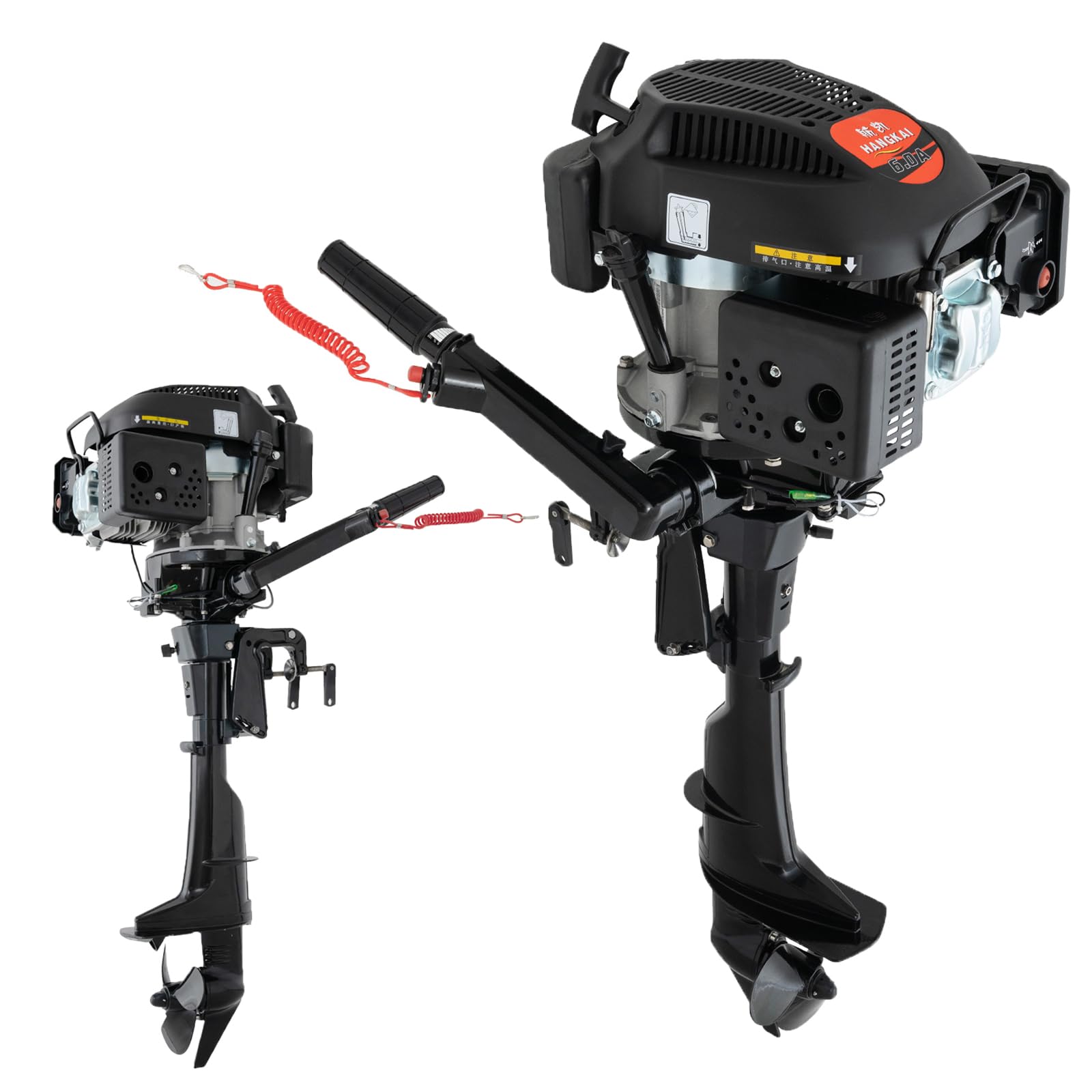
1. HANGKAI 4-Stroke 6HP Outboard Motor
Our pick — over 4★ from 20+ verified ratings; the strongest balance of quality and price.
The quiet six that sips fuel and fires on the second pull
This 6 hp motor with a 140cc displacement is the crowd favorite for small jon boats, and the reason is fuel economy that feels almost unreal. Owners mention spending 8 plus hours on the water and barely using a full gallon of fuel, which tracks with its listed burn rate of 0.26 gal/hour. On a 14-foot boat, the engine runs great and the three-blade propeller keeps water resistance low so you get more thrust per pull.
The TCI ignition system is what makes cold starts painless — owners describe firing it up on the second pull right after pouring gas in. The air-cooled design uses dense heat dissipation holes on the casing to shed heat quickly, and the air filter keeps dust and sand from wearing the engine down. At 46.2 pounds, it’s heavy enough to feel solid but manageable for one person to mount on a transom.
Safety touches include an emergency flameout rope for quick shutdown and an automatic shutoff if the engine overheats. The suspension tilt adjustment pins let you set the boat’s sailing attitude to keep the ride smooth. Owners running it on the Yazoo river measured about 4 mph up river and 7 mph down after break-in, which is plenty for a fishing day.
trusted brand power
- Remarkably quiet for a 6 hp gas motor
- Starts on the first or second pull with TCI ignition
- Fuel-efficient — 8+ hours on under a gallon
premium price tag
- Requires strict break-in and regular oil/air filter checks
- At 46.2 pounds, not the lightest option to carry
for reliability: you run a 14-foot jon or small river boat and want the best mix of power, quiet operation, and fuel savings.
if budget-bound: you need to carry the motor long distances every trip, since 46.2 pounds is a real lift.
2. Cbhfmljd 4HP 4-Stroke 52CC Outboard Motor
A featherlight 52cc that starts on the third pull even in freezing weather
This 4 hp motor at 52cc is the budget champion, and what wins people over is reliability — it starts on the third pull and runs great, even below freezing. The 0.37-gallon fuel tank is the largest on any 4 hp pick here, which means fewer refills during a long fishing session. At 9.7 kg (about 21.4 pounds), it’s light enough to carry one-handed, which owners say beats dragging an electric trolling motor around.
The 360-degree steering and clutch control make maneuvering in tight spots easy, and the large heat dissipation holes on the housing keep it from burning out on long runs. Compared to a two-stroke, the four-stroke design is noticeably quieter. The three-blade propeller cuts water resistance, and the baffle above the prop reduces wave splash that would wet the boat deck.
The key caveat is setup: this motor ships without gear oil, so you must add it before first use and replace it after the run-in period. Owners who swapped the plastic prop for aluminum found it more durable, and one even survived a kayak flip and kept running after an oil change and carb clean. The 4 hp rating at 52cc is a smaller gap from the 6 hp HANGKAI’s 140cc, but the weight savings are huge.
for small boats: budget-minded jon boat owners who want a dependable, easy-to-carry motor and don’t mind adding gear oil at setup.
if need speed: you run in icy conditions, since the plastic prop is vulnerable to ice damage.
3. CLIENSY 4HP 4-Stroke 55CC Outboard Motor

The compact 55cc that suits inflatables and runs all day on spare gas
This 4 hp motor at 55cc is built around its patented engine air cooling system, which lets you fish all day without overheating worries. Owners running it on a Mariner 4 inflatable raft found it quiet at idle, though at full power you’ll need to raise your voice to talk over it. The 360-degree steering rotation gives you reverse without any gear shifting, which is a real convenience on small rafts.
You get a motor that starts reliably and sips fuel, according to buyers who report first-pull starts when the kill switch is set right. The aluminum build and a comparable lubricating system for a 4-stroke keep things running smoothly. The 5-year warranty is the longest of any pick in this guide, which signals maker confidence in the design.
However, durability is the honest concern: the clutch and propeller have been known to fail after a few uses, and a stripped bolt hole on a brand-new unit prevented one owner’s prop differential gasket from sealing. A few units arrive damaged in shipping. If you buy this one, check all fluids and chase the bolts before your first trip, and change fluids by the 5-hour mark twice during break-in.
compact and portable: light, 4-stroke quiet at idle, and 360° reverse makes it a natural fit for inflatables and small fishing boats.
needs regular care: the 5-year warranty is generous, but inspect the clutch and prop early — a minority of units show parts failure within a few outings.
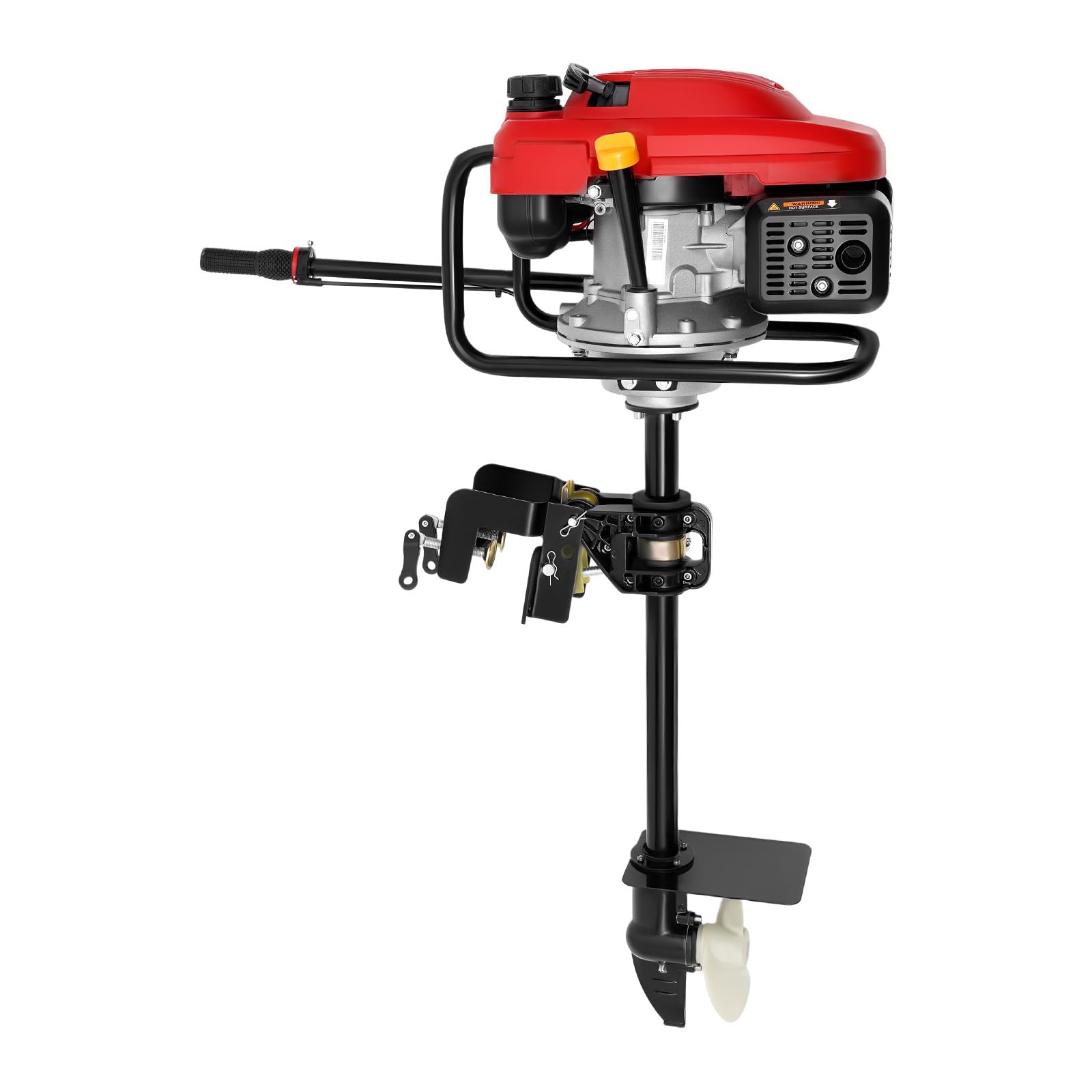
4. KTYHNPM 4-Stroke 7.5HP 200CC Outboard Motor
The 200cc workhorse that cruises a loaded 24-foot pontoon with ease
This 7.5 hp motor at 200cc is the strongest pick here for big loads, and the proof is in the owners running 20 and 24-foot pontoons. One buyer tows a 24-foot pontoon floating dock around with people loaded on it, and the motor cruises it just fine. The 0.95-gallon fuel tank is nearly triple the capacity of the HANGKAI’s 0.32 gallons, so you get far more runtime between fills.
The 4-stroke engine spins at 3600 rpm with a maximum power of 3.5 kW, which translates to a strong 7.5 hp that starts after one pull. Multiple dissipation holes on the housing shed heat fast, and the air-cooling system speeds up cooling to cut the failure rate. The 360-degree steering and clutch control make it easy to handle special water environments like tight channels or weedy shallows.
The honest read on this one is that it’s a beast for the money, but it’s not a true 7.5 hp feel — one owner notes it runs like a 5 hp. At 52.4 pounds, it’s also the heaviest motor in this lineup, so plan for a sturdy mount. A single harsh review describes rings wearing out after an hour, but the broader pattern across owners is strong performance on heavy pontoons.
for heavy loads: every smaller displacement pick here for hauling heavy loads, thanks to 200cc and a 0.95-gallon tank.
if solo handling: it’s 52.4 pounds and feels more like a strong 5 hp than a true 7.5, so manage expectations on top speed.
5. CUKUSIN 4-Stroke 4.0HP 54CC Outboard Motor

A 22-pound dinghy engine that reverses by swinging the whole head 180 degrees
Weighing just 10 kg (22 lb), this 4 hp motor at 54cc is the easiest pick here to carry to the water’s edge, and it’s rated for boats carrying 2-3 people. The standout design feature is the easy reverse — a hook-size handle lets you rotate the motor 180 degrees to back the boat up without any gear shift. It’s built for inflatable boats, sailboats, and small yachts, and the metal-and-alloy construction handles freshwater and saltwater.
The 4-stroke air-cooled design delivers reliable power that owners say is quiet and plenty strong enough to push a dinghy. It starts easily with the choke, and you can adjust the height between the propeller and fixation point to match different boat transoms. The engine positions at several angles for optimal performance in different directions.
The durability picture is genuinely mixed: some customers note it’s a tough little engine that survives bays, rivers, and rain, while others found the propeller cage flimsy and the throttle spring loose after a summer. One engine failed in the water twice after running 3-3.5 hours, though it ran fine out of water. The 180-day warranty is shorter than rivals, so budget for potential repairs.
easy to operate
- Ultra-light 22 lb design is genuinely one-hand portable
- 180° reverse without gear shifting
- Quiet for a 4-stroke gas engine
not for rough seas
- Propeller cage and throttle spring reported as fragile
- Some units failed in water after a few hours
for calm lakes: a lightweight dinghy or canoe where carrying weight matters more than raw speed.
if choppy waters: you need guaranteed all-day reliability on open water — the 180-day warranty reflects the mixed durability reports.
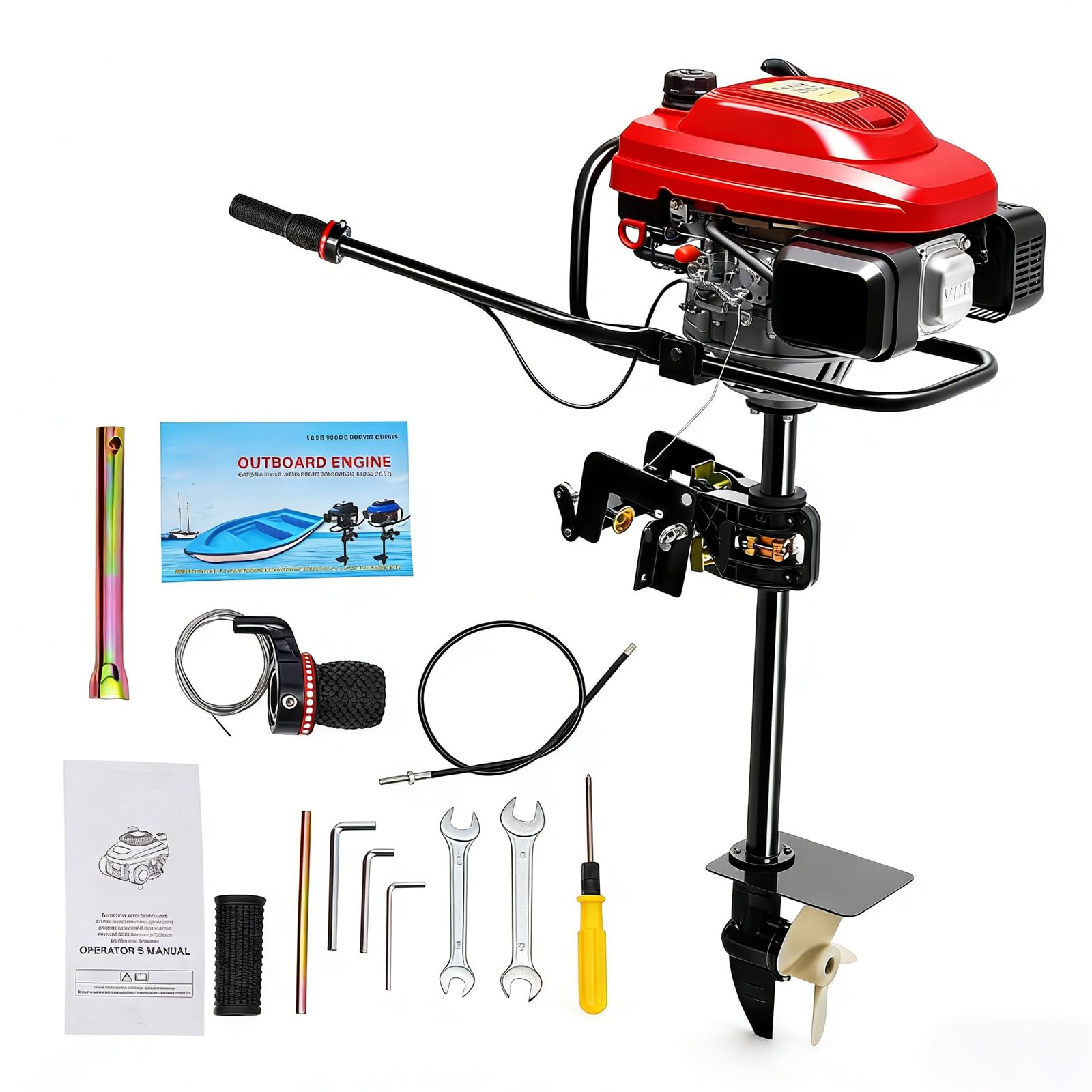
6. FiueStur 7.5HP 4-Stroke 200CC Outboard Motor
The 200cc hauler proven with two hunters, 5 dozen decoys, and a loaded duck boat
This 7.5 hp motor at 200cc delivers a maximum power of 3.5 kW, and it’s proven itself in the toughest test a small outboard faces: a loaded duck hunt. Owners ran it on a 12-foot flat bottom boat with two guys, 5 dozen decoys, and all their gear, and it pushed them up river at an okay pace. The 0.34-gallon fuel tank provides 2+ hours of runtime on standard 92-octane unleaded gas, with no oil mixing required.
You get a heavy-duty unit that resists wear, rust, and corrosion, weighing 66.14 pounds and built for boats 13.1-19.7 feet. The CDI electronic ignition (a capacitor discharge ignition that delivers a strong spark) and easy-pull starter make starting easy, while the continuously variable speed control gives smooth gear transitions with zero sticking. The multi-port cooling system with enhanced airflow prevents overheating during prolonged use, which is critical for a duck boat sitting in frigid water.
The honest problems here are the plastic prop and the documentation. The plastic propeller broke off within the first 5 minutes on one boat, and after 4 uses another owner’s prop stopped turning entirely. The included manual is in poor English with figures that don’t match the motor, and there’s nothing on the unit to indicate which model it covers. If you buy this, budget for an aluminum prop upgrade immediately.
for long trips: hunters and heavy-load boaters who need 200cc of grunt and don’t mind replacing the weak plastic prop.
if eco-minded: you want a motor that works perfectly from the start — the prop and manual need immediate attention.
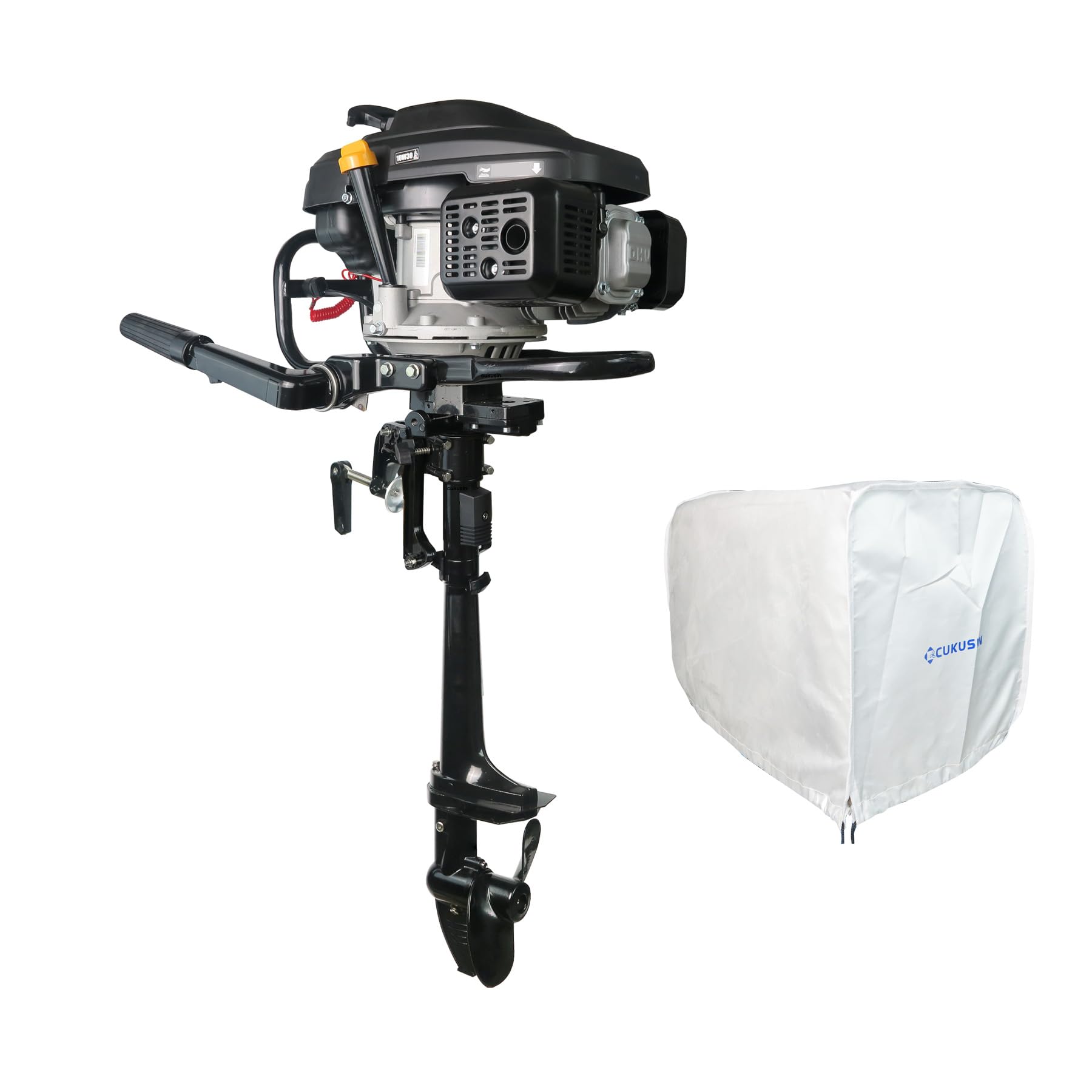
7. CUKUSIN 4-Stroke 7.5HP 196CC Outboard Engine
The premium 196cc with a safety lanyard and fold-up luxury handle
This 7.5 hp motor at 196cc is the most feature-complete pick here, led by safety gear you don’t see on budget rivals: a Kill Urgent Stop Switch with a Safety Lanyard Tether Cord, plus Start-In-Gear protection that keeps the prop from spinning while idling. Owners praise the quality and value, and it starts on the first or second pull reliably. The luxury handle folds up when not in use, making storage and transport a breeze.
The aluminum and stainless steel construction gives it a premium feel, and the easy pull-off engine cover with a push-button latch gives instant access for maintenance. It’s designed for inflatable boats, fishing boats, sailboats, and small yachts, and it positions at several angles for optimal performance. The 24-hour online support is a real bonus for first-time outboard owners who need setup help.
The main gripe is the propeller — one owner was stranded mid-lake when the prop fell off while idling, and another found loose bolts on arrival (easy to fix with an Allen wrench). A few units arrived with minor issues, but the seller’s customer service is responsive, including swapping a short shaft for a long shaft free of charge. For an 11-foot inflatable, owners call it a good little motor.
safety-first design: the lanyard tether and Start-In-Gear protection make it the most security-minded 7.5 hp in this guide.
higher maintenance: the prop is the weak link — check and tighten it before every outing, since a few owners lost theirs mid-trip.
Understanding the Specs
Displacement and Horsepower
Displacement, in cubic centimeters (cc), measures the total volume of the engine’s cylinders and is the main driver of power output. A 52cc engine makes about 4 hp, while a 200cc engine makes 7.5 hp — that’s a 2.7x gap in displacement for roughly 50% more horsepower. For a small inflatable, 4 hp is plenty; for a loaded pontoon, you’ll want the 7.5 hp class.
Air Cooling vs Water Cooling
Air-cooled engines use heat dissipation holes and fins on the casing to shed heat, with no water pump to maintain or fail. This makes them simpler, lighter, and easier to service than water-cooled outboards. The trade-off is that they can run hotter under sustained full throttle, so the cooling system design matters — look for dense holes and multi-port airflow for better heat management.
FAQ
Will a 4 hp air-cooled outboard push my 14-foot jon boat?
Is a 7.5 hp motor too heavy for an inflatable boat?
Do air-cooled outboards need gear oil added before first use?
How many hours can I run on one tank of fuel?
What is the difference between CDI and TCI ignition?
Can an air-cooled motor handle saltwater?
Why does the propeller stop turning after a few uses?
How do I break in a new air-cooled outboard motor?
Is a 360-degree steering outboard better than a standard one?
Final Thoughts: The Verdict
For most buyers, the air cooled outboard motor winner is the HANGKAI 6HP because it pairs the strongest fuel economy with quiet, reliable starts and enough 140cc muscle for a 14-foot jon boat. If you want a featherlight carry option, the Cbhfmljd 4HP at 9.7 kg is the budget pick that still starts below freezing. And for heavy pontoon work, the KTYHNPM 7.5HP with its 0.95-gallon tank is the workhorse to reach for.
How We Picked
We do not accept paid placement. Every pick is matched to a real buyer and a real use-case; we do not hands-on test units.
Sources & Methodology
Specifications: manufacturer listings and product documentation. Review insights: verified customer reviews, as of August 2026. Pricing: not shown on this page (it changes often); check the current price via the retailer link.
As an Amazon Associate, Gadgets Feed earns from qualifying purchases. This does not affect which products we feature.