
Our readers keep the lights on and my morning glass full of iced black tea. As an Amazon Associate, I earn from qualifying purchases.
Specs are compiled from manufacturer listings and verified buyer reviews and can change over time — please confirm the key details on the product page before buying.
You want the door open for customers but not the heat, dust and flies that walk in with them. An air curtain is not an air conditioner — it is a fan that hangs above your doorway and blows a wall of air down across the opening. That wall pushes back hot air, cold draughts, dust, flies and cooking smoke, so your shop or kitchen keeps its inside climate while the door stays open. Two numbers decide whether it actually works. The first is CFM (cubic feet per minute — how much air it moves). The second is noise in dB (decibels — how loud it runs), because a door fan that roars gets switched off within a week.
I’m Min — the founder and writer behind Gadgets Feed. This guide is built by comparing the manufacturers’ published specifications and the patterns across verified customer reviews, so you get each pick’s real strengths and trade-offs instead of marketing spin.
Below you will find eight wall-mounted units sorted by what they genuinely do best, from a 36-inch workhorse that owners keep running for a decade to a 48-inch wide-span blower for double doorways. Each one is unheated and uncooled by design, so read the CFM and dB figures before you commit to any air curtain door.
Our Picks at a Glance


How To Choose The Best Air Curtain Door
The most common mistake is buying one of these expecting cool air. Every unit on this list blows ordinary room-temperature air only — the job is to separate inside from outside, not to chill the room. Once you accept that, three figures decide your purchase: the air volume in CFM, the door width it covers, and the noise in dB.
Match the width before anything else
A 36-inch unit covers a standard single door and a little more. A 48-inch unit is built for double or wide commercial openings. If your doorway is wider than the unit, the air wall stops short and the gap at the edge lets everything straight back in. TURBRO states plainly that for doors wider than one unit you should install two or more in parallel, and it gives a spacing figure of 0.8 to 1.6 inches between them. Measure the actual opening, not the frame, and buy to that.
CFM versus FPM: volume against push
CFM tells you how much air moves each minute; FPM tells you how fast it leaves the nozzle. You want both decent, because a high-volume fan with slow exit speed gets knocked sideways by a breeze. High-CFM units in this group run from 800 CFM up to 1527 CFM, and the difference is very real on a windy street corner. If your door faces wind or a busy pavement, lean toward the higher figure.
Noise is the spec people regret ignoring
A dB rating is a loudness measure, and small gaps matter more than they look on paper. Anything in the high 50s is roughly the level of a normal conversation with background hum; a jump into the 60s is noticeably pushier in a quiet room. Several makers here openly advise against buying if you are sensitive to sound, and that honesty is worth taking seriously in a café or a home kitchen.
The magnetic switch: convenience with a catch
A magnetic door switch is a pair of parts that senses when the door opens and tells the fan to start, then stops it when the door closes. It saves power and keeps hands free. On TURBRO’s unit the switch has an effective sensing distance within 0.8 inches, and once installed it disables manual and remote operation while the door is shut. That is fine for a shop; for a home you may prefer the button.
Quick Comparison
| Model | Best For | Airflow (CFM) | Width | Noise | Amazon |
|---|---|---|---|---|---|
| Awoco 36″ Super Power★ Best Overall | Busy shop doorways | 1177 high / 942 low | 36 in | 58 dB high | Amazon |
| Hanchen 36″ 2026 VersionTop Airflow | Max airflow on a single door | 1527 high / 1292 low | 36 in | 60 dB | Amazon |
| LEOKV 36″ WhiteQuietest Pick | Quiet home entryways | 1500 | 36 in | 55 dB | Amazon |
| TURBRO AC48 | Wide patios and cafés | 1530 | 48 in | 60 dB | Amazon |
| DuraSteel 48″ Titan-2 | Restaurants and warehouses | 1500 m³/h | 48 in | — | Amazon |
| VEVOR 48″ | Large openings on a budget | 1650 | 48 in | — | Amazon |
| VEVOR 36″ | Everyday shop entry | 900 | 36 in | — | Amazon |
| HXCOCKCROW 36″ | Tight budgets and small doors | 800 high / 500 low | 36 in | 58 dB low | Amazon |
In‑Depth Reviews
1. Awoco 36″ Super Power 2 Speeds 1200CFM Commercial Indoor Air Curtain
Our pick — 4.5+★ from 350+ verified ratings; the strongest balance of quality and price.
The 36-inch workhorse that shop owners keep running door-to-door for years without a hiccup.
For a doorway that opens fifty times an hour, the spec that earns its keep is the running cost: this unit draws 300W at 120V, which is 0.4HP and 3.13A. Unlike heavier industrial blowers, that low draw means you can leave it going through a full business day without flinching at the electricity bill. One motor drives two ABS fan wheels, and Awoco credits German electrical machinery design for the continuous-duty rating.
Volume and noise come in two steps. High speed pushes 1177 CFM at 58 dB; low speed drops to 942 CFM at 56 dB. Against the Hanchen 36-inch unit below, that high figure falls well short — 1177 CFM versus 1527 CFM — but the Awoco runs a touch quieter at 58 dB compared with the Hanchen’s 60 dB. For most single-door shops, 1177 CFM is already more push than the doorway needs.
Daily life gets easier with the magnetic door switch. Mount it and the fan starts the moment the door swings and stops when it shuts. Skip the switch and the Lo/Off/Hi rocker (a three-position button for low, off and high) gives you 8 hours of continuous running per press — handy if you want a barrier up all morning regardless of traffic. Buyers report it functions exactly as promised, and owners in warm climates give steady approval for mosquito prevention. Noise splits opinion down the middle: a good share find it very quiet, others find it too loud for a small room. Judge it by your own tolerance rather than the dB number alone.
What keeps it on top
- Toolless-ish three-step install: mount the plate, hang the unit, wire the optional switch
- Magnetic switch circuit is US-patented (US10584889B2) — the automation is the headline feature
- Slim body at 10-3/8 inches high, so it hugs the wall above the frame
- UL Certified, with a 1-year parts, repair or exchange window
Where it asks a little back
- 1177 CFM trails the 1527 CFM Hanchen on raw high-speed volume
- Noise divides opinion — very quiet to some ears, too loud for others
- 33.1 LBS means two people are safer on the lift
Made for: shop and restaurant doors that see constant foot traffic and want set-and-forget automation.
Look elsewhere if: your door faces a stiff prevailing wind and you need the biggest CFM number on the shelf.
2. Hanchen 36 Inch Air Curtain 2026 New Version, 1527/1292 CFM
The biggest raw air volume on a 36-inch frame — and it makes no secret of the trade-off.
If your single door faces a gusty street, the figure that matters is 1527 CFM on high, dropping to 1292 CFM on low. That high number leads the Awoco’s 1177 CFM and outruns the VEVOR 36-inch unit’s 900 CFM by a wide margin. Hanchen gets there with a through-flow integrated wind rotor paired to an upgraded pure copper motor, shaped — the company says — to hold volume up while pulling noise down.
Three ways to run it suit three different doorways. The new magnetic door switch needs no hard wiring — it sticks on the frame, senses the door, and blows only while the door is open. There are also body buttons for a manual override and a remote control for adjusting from across the room. An adjustable air guide lets you angle the stream so it lands where the gap actually is, which is a detail cheaper units skip.
Here is the honest part: reliability splits the room. Some owners get a solid, effective barrier; others report a unit that stopped working after a few months, and the bug-blocking results divide the same way. Hanchen backs it with a 12-month warranty plus lifetime technical support, and the 60 dB rating comes with a candid warning to buy with caution if you are sensitive to noise. Treat this as the high-output pick where the warranty matters as much as the CFM.
Barrier strength: 1527 CFM high / 1292 CFM low gives you more push at the doorway than any other 36-inch unit here, and the adjustable air guide helps you aim it.
The warranty question: mixed long-term reports mean you should register the unit and keep the 12-month cover in easy reach rather than filing it away.
Pick this if: maximum airflow over a single door matters more to you than long-term track record.
Think twice if: you want a fan you never think about again — the durability feedback here is genuinely split.
3. LEOKV Air Curtain White 36 Inch, Remote Control, All-Copper Motor
A 55 dB rating is the lowest on this list, which makes it the one for a home entry or quiet kitchen.
Most of these fans land at 58 to 60 dB. This LEOKV sits at 55 dB and still pushes 1500 CFM, so you are not trading volume for quiet the way you would on the Awoco’s low setting. That combination is the whole case for it in a home hallway, a small café or a kitchen where the door stays open through service.
LEOKV says the all-copper motor runs stronger and lasts longer than an aluminium-wound one — a maker’s claim, not a spec you can check on arrival. What you can use is the hands-free magnetic switch, which fires the fan the moment the door opens, plus the included remote for speed and on/off from across the room. It is a single-blade blower rated at 1500 CFM.
The caveat comes straight from the manual: this unit is strictly not for rain exposure, and it is not recommended for long stretches in high humidity or direct sunlight. That rules it out of an open-air patio or a wet commercial kitchen doorway. Keep it under a roof, in a dry indoor spot, and it is the most discreet unit here.
Suits: indoor doors where conversation carries and a fan hum would be noticed.
Not for: exposed patios or damp, sun-baked openings — the maker rules those out directly.
4. TURBRO 48 in Air Curtain for Doors, AC48, 1530 CFM
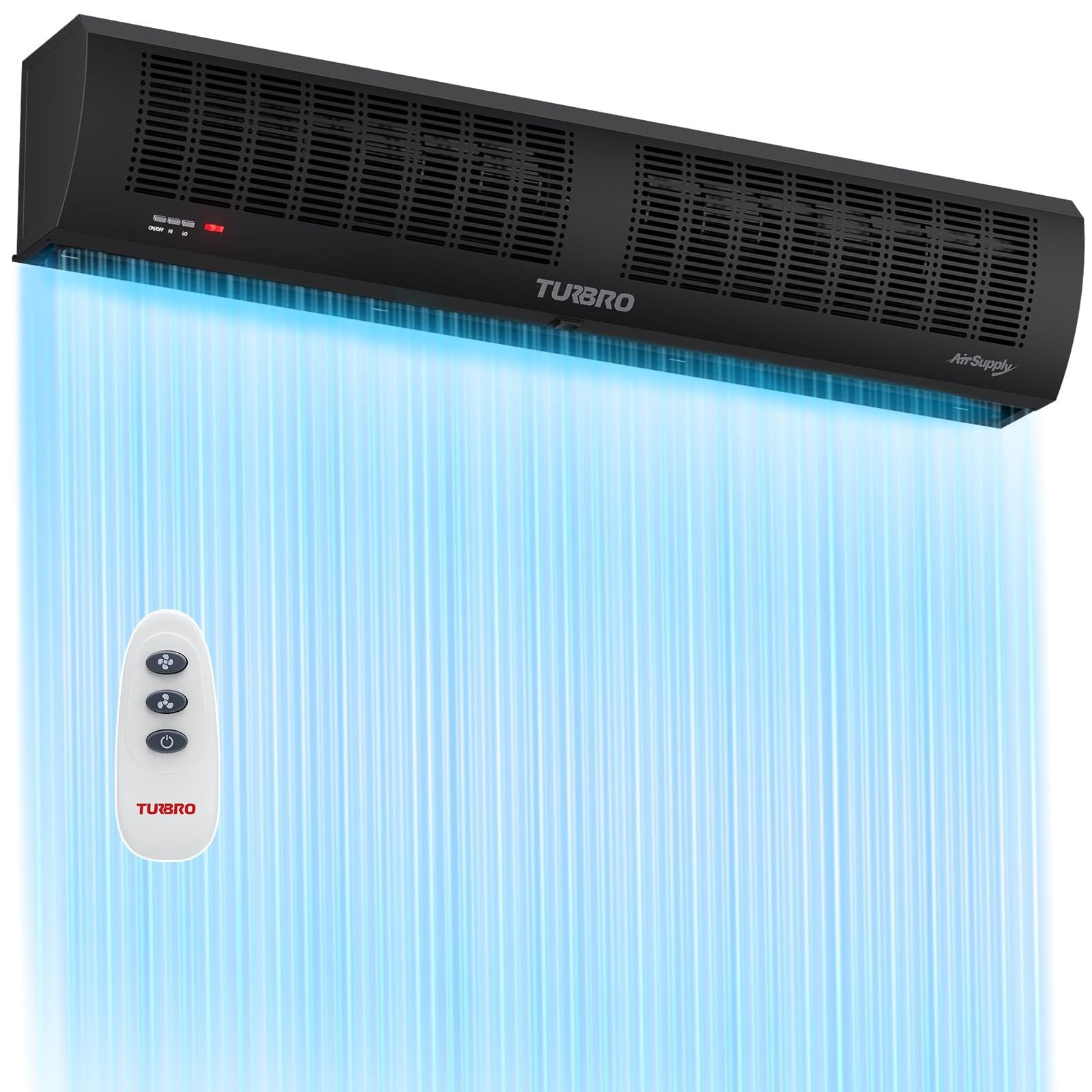
Forty-eight inches of black blower for patios and café fronts that a 36-inch unit cannot span.
Width is the deciding spec on this one. The AC48 covers a 48-inch opening with 1530 CFM of volume, and speed at the nozzle reads 2559 FPM on high and 1969 FPM on low. That FPM figure matters more than CFM on a wide door, because the air has to travel further down the opening without being knocked aside. TURBRO also gives you a manual deflector to angle the stream.
Controls are unusually flexible. Without the magnetic switch you run it from the built-in buttons or the remote. Fit the switch — two magnetic parts with an effective sensing distance within 0.8 inches — and the fan works only while the door is open, with manual and remote disabled when it shuts. For a wide double door, TURBRO says install two or more units in parallel with 0.8 to 1.6 inches between them.
Two things to weigh. The 60 dB figure is at the louder end and will be audible in a small café. And at 32.6 pounds, hanging it above a patio door is a two-person job. Neither is a fault; both are simply the cost of the extra width.
Where it wins: a genuine 48-inch span with 2559 FPM exit speed, which is the combination wide doorways actually need.
The practical hitch: fit the magnetic switch and you lose the remote whenever the door is shut — plan your control choice before you drill.
Best fit: café and patio doors where one unit has to cover the full opening.
Skip if: your doorway is a standard single width — a 36-inch unit does the same job with less bulk.
5. DuraSteel 48 Inch Wall Mounted Air Curtain, Titan-2

Built for roll-up and sliding doors in restaurants and warehouses, with a UL certified motor meant for long shifts.
Where most units here list CFM, DuraSteel rates the Titan-2 at 1500 cubic meters per hour — a different unit entirely, so do not read it as 1500 CFM. The pitch is commercial endurance: a UL certified motor engineered for thousands of hours of continuous operation, wrapped in an aluminium alloy cover bonded to high-precision ABS.
Door compatibility is the standout. It works with push, pull, roll-up and sliding doors — the sliding-door case is where a lot of 48-inch buyers get stuck with other brands. A magnetic switch is included for door-triggered running, and DuraSteel claims the curtain cuts up to 80% of the energy lost through an open door. Controls run through a Hi/Lo/Off key switch rather than a touch panel.
The reception is warm but not unanimous. Value for money lands as the clearest praise, and the fit and finish reads as sturdy. Installation splits, though — some find it straightforward, others report the box arrives without full instructions, so download the manual before you start. Airflow and insect reduction divide opinion the same way, and noise draws the most consistent criticism. This is the pick for a roll-up or sliding commercial door where you want a tough case and a certified motor, not the quietest unit on the list.
Reasons it earns a commercial slot
- Handles push, pull, roll-up and sliding door types — unusual flexibility for a 48-inch unit
- UL certified motor built for continuous operation, not just opening hours
- Rust-resistant aluminium alloy and ABS shell for a warehouse or kitchen doorway
- Magnetic switch bundled in, not sold as an extra
Set your expectations here
- Paperwork can be thin — check for the manual before mounting day
- Noise is the most common complaint, so a quiet room is not its home
- Ratings are in cubic meters per hour, which makes direct CFM comparison awkward
Chosen by: warehouse, restaurant and shop owners with sliding or roll-up doors who need a tough housing.
Reconsider if: the doorway opens onto a quiet dining room — noise is the recurring theme in owner feedback.
6. VEVOR 48″ Commercial Indoor Air Curtain, 1650 CFM
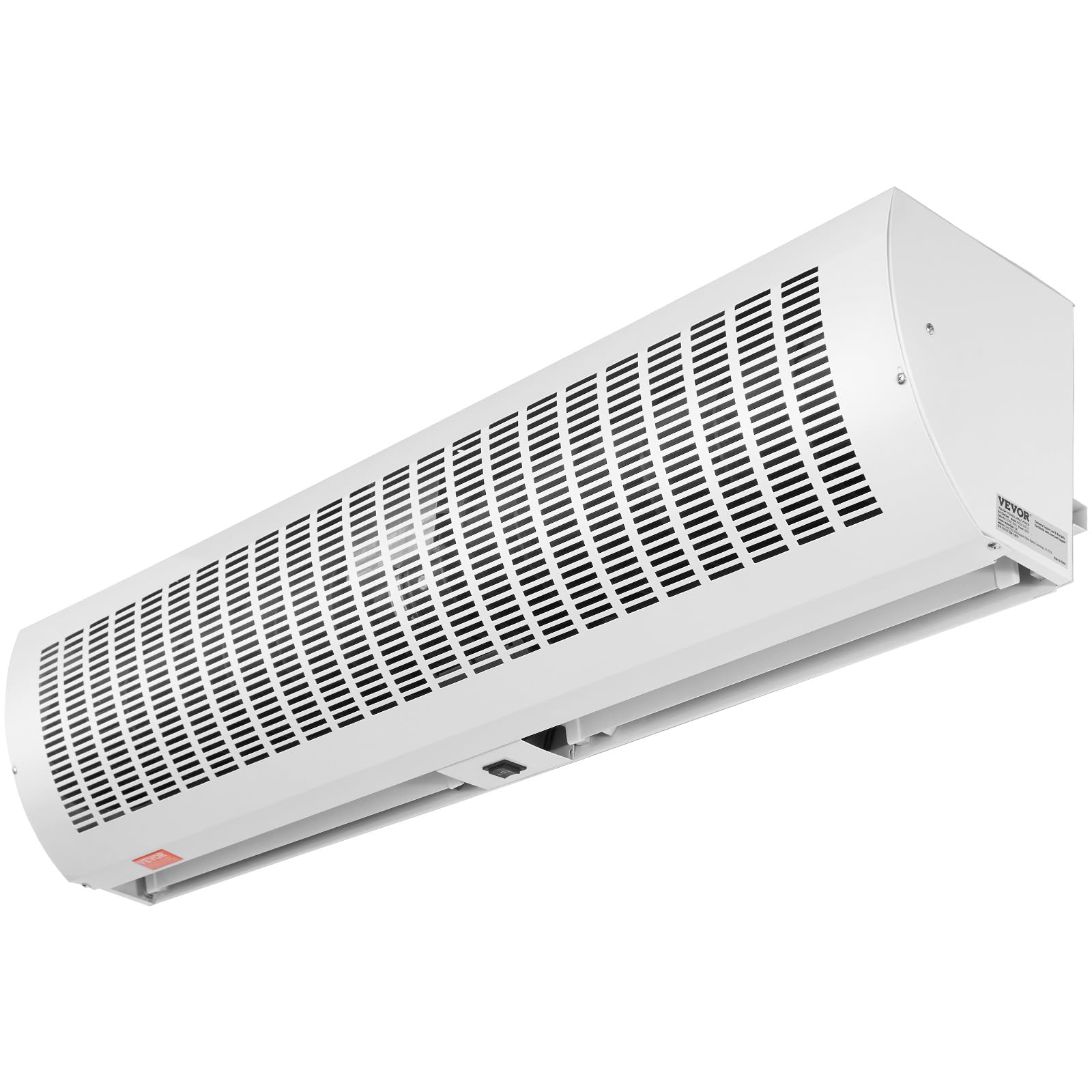
The highest airflow number in the whole group — 1650 CFM across a 48-inch opening.
On sheer volume, nothing here touches it. The 1650 CFM figure beats the TURBRO’s 1530 CFM and the 36-inch picks by a distance, which is exactly what you want on a wide warehouse or supermarket entrance where the outside air has room to push back. A pure copper motor drives a large-diameter fan wheel inside an aluminium alloy core that VEVOR rates for stable running.
Two speeds let you pick your season. Low speed keeps the draw down and the sound low; high speed seals hard. The swing-type stroke switch is included, so the fan can trigger from the door, and there is a remote in the box. The slim metal body is built to resist corrosion and rust, which suits a food or storage doorway where cleaning happens daily.
Now the part you need to know before buying: this is the lowest-rated pick on the list, and the published figures include an annual energy consumption of 3162 kWh and a noise figure of 67.6±5 dB. That noise band is far louder than the 55 to 60 dB units here, and the tolerance means it can land at the high end. Buy it for the CFM and the 48-inch span, and go in expecting a working-commercial sound level rather than a quiet one.
The airflow case: 1650 CFM is the biggest number on this page and the reason a wide, busy opening would pick it.
The honest cost: 67.6±5 dB is a working-machine volume, and 3162 kWh a year is a real running cost to plan for.
Right for: large commercial entrances that need maximum push and can live with machine noise.
Wrong for: a home or quiet dining space — the noise band alone rules it out there.
7. VEVOR 36″ Commercial Indoor Air Curtain, 900 CFM

A simple 900 CFM dual-speed blower for the shop door that just needs a reliable barrier.
Not every doorway needs 1500 CFM. This 36-inch VEVOR delivers 900 CFM with a two-speed switch — low for quiet, efficient running through the day, high when the door is busy or the weather turns. That is enough to hold a barrier over a standard single door in a sheltered spot, and it keeps the motor working gently rather than flat out.
The hardware is honest commercial kit. A pure copper motor sits inside a slim, corrosion-resistant metal shell, and the large-diameter fan wheel is shaped for quieter, more even airflow. A swing-type stroke switch is included so the fan can respond to the door, and a remote lets you change speed without reaching up to the unit.
It is a straightforward tool with no clever extras — no adjustable guide, no touch panel, just a dual-speed curtain that does the job. If your doorway is sheltered and you do not need the biggest push on the street, this is the sensible-value route into a 36-inch unit.
Good buy for: a sheltered single shop door where 900 CFM covers the opening and you want simple controls.
Step up if: your door faces wind or constant traffic — the 1527 CFM Hanchen gives meaningfully more push.
8. HXCOCKCROW 36″ Wall Mounted Air Curtain, 800 CFM
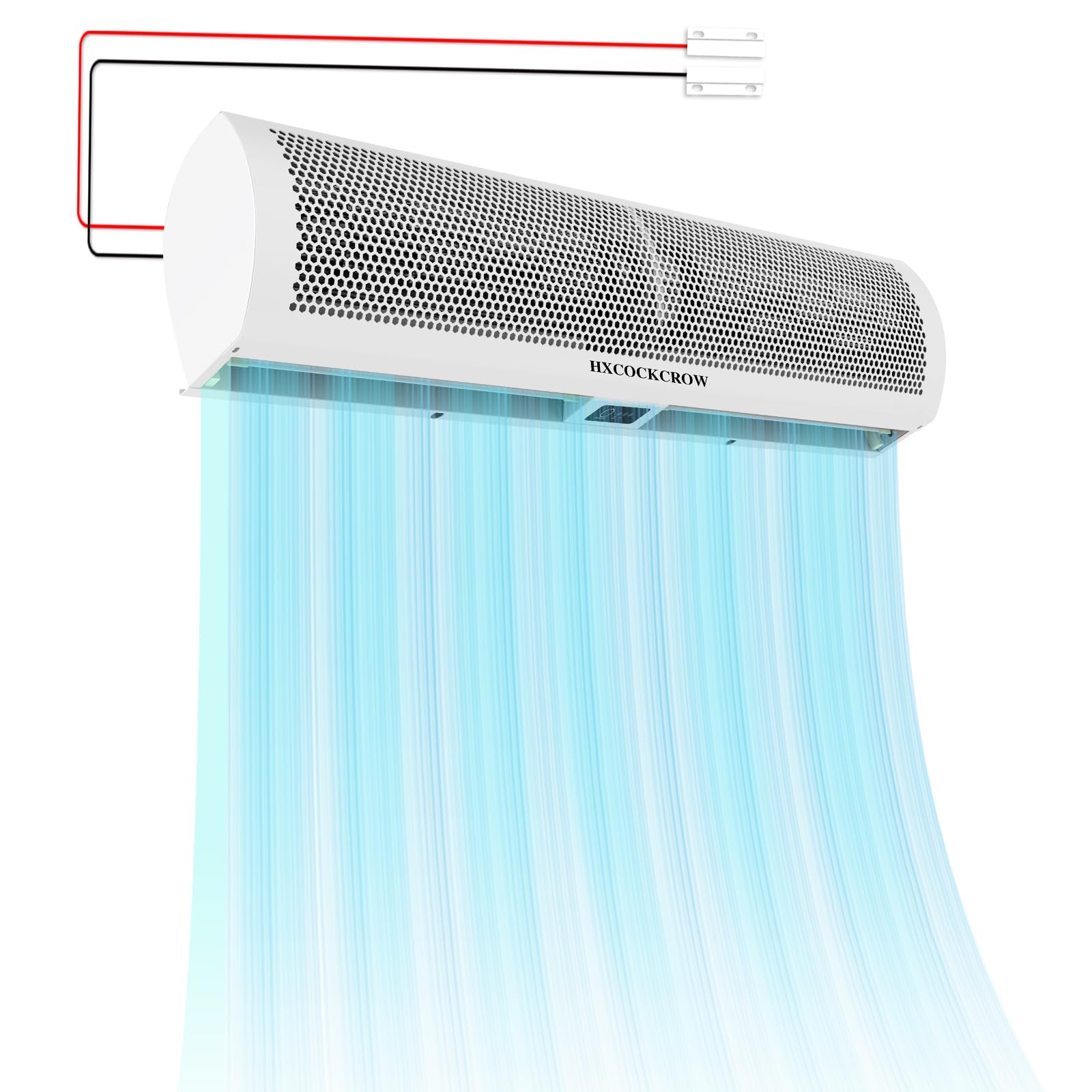
An entry-level 36-inch blower that trades raw volume for a slim body and a lower outlay.
The airflow tells you where it sits. High speed gives 800 CFM at 1870 FPM; low speed drops to 500 CFM at 1181 FPM. Against the VEVOR 36-inch’s 900 CFM and the Hanchen’s 1527 CFM, this is the least push on the page — fine for a small, sheltered doorway and a modest household, less suited to a windy shopfront. The compact housing is 6.3 inches deep by 7.5 inches high, which keeps it tight against the wall.
For the tier, the control options are generous: the new magnetic door switch sticks to the frame and fires the fan as the door opens, plus two manual methods if you would rather not rely on it. A high-speed pure copper motor and an integrated cross-flow wind wheel do the moving. HXCOCKCROW lists the low speed at 58 dB and warns that if you are sensitive to noise, buy with care.
One figure needs flagging. The listing names 60 dB in its noise description, which reads a little differently from the 58 dB low-speed figure — treat the higher number as your working expectation. It is a budget unit with budget output, and that is the fair way to read it.
Worth considering for: small home or garage doors on a tight budget where 800 CFM covers the gap.
Move up if: the door is wide, exposed or busy — the extra CFM of the Awoco or VEVOR 36 pays for itself in barrier strength.
Understanding the Specs
CFM and FPM: volume and speed
CFM (cubic feet per minute) measures how much air moves each minute — the raw volume behind the barrier. FPM (feet per minute) measures how fast the air leaves the nozzle. A wide 48-inch door needs high FPM so the stream still reaches the floor with force; a compact 36-inch door can be sealed with less. When a listing shows both, use CFM to compare brands and FPM to judge how far the curtain will project.
dB ratings and what they mean
A dB figure is a loudness measure on a scale where each small step is noticeable in a quiet room. The units on this list range from 55 dB up to a 67.6±5 dB band. A “±” tolerance means the real unit can land above or below the stated figure, so plan for the upper end. If the fan sits above a dining table or a checkout, the lower dB units are the safer match.
Magnetic door switches and sensing distance
You get hands-free operation from a magnetic switch, which is two parts — one on the frame, one on the door — that sense the opening and start the fan, then stop it when the door closes. TURBRO lists an effective sensing distance within 0.8 inches, so the two halves must sit close or the fan will not trigger. Some units disable the buttons and remote once the switch is wired, so decide if you want automation or manual control before you install.
Heating, cooling and what an air curtain is not
Every unit here is unheated and uncooled — they blow room-temperature air only. An air curtain separates inside from outside; it does not chill or warm the room. If you want heated air over a doorway, you need a different product class entirely. Makers on this list say so plainly, and buying one expecting cool air is the fastest route to disappointment.
FAQ
Will an air curtain cool my shop down in summer?
Do I need a 36-inch or a 48-inch unit for my doorway?
How loud is a door air curtain in a normal room?
What does the magnetic door switch actually do?
Can I leave an air curtain running all day?
Is a higher CFM always better for blocking flies and dust?
What power supply do these units need?
Will an air curtain stop condensation and draughts on a cold day?
How difficult is installation — can I mount it myself?
Can I use a door air curtain on a sliding or roll-up door?
Final Thoughts: The Verdict
For most shop and restaurant doorways, the air curtain door to beat is the Awoco 36″ Super Power. It pairs a 1177 CFM high speed (how much air it moves per minute) with the patented magnetic switch you will actually want. It runs at 58 dB (decibels — how loud it is) without cooking your power bill at 300W (watts — how much electricity it draws). If your door faces wind and you want the biggest push on a single opening, reach for the Hanchen 36″ 2026 Version at 1527 CFM, keeping the 12-month warranty in easy reach. For a wide café or patio opening, the TURBRO AC48 spans 48 inches with 2559 FPM exit speed (feet per minute — how fast the air leaves the unit). One honest nudge: the Awoco holds the top score among the busiest-rated units here at 4.5+ stars across 380+ ratings, so it is the safest first pick if you want to buy once and stop thinking about it.
How We Picked
We do not accept paid placement. Every pick is matched to a real buyer and a real use-case; we do not hands-on test units.
Sources & Methodology
Specifications: manufacturer listings and product documentation. Review insights: verified customer reviews, as of November 2026. Pricing: not shown on this page (it changes often); check the current price via the retailer link.
As an Amazon Associate, Gadgets Feed earns from qualifying purchases. This does not affect which products we feature.