
Our readers keep the lights on and my morning glass full of iced black tea. As an Amazon Associate, I earn from qualifying purchases.
Specs are compiled from manufacturer listings and verified buyer reviews and can change over time — please confirm the key details on the product page before buying.
If the room at the end of your duct run always feels stuffy while the rooms near the furnace are fine, an inline booster fan is the fix — a small powered fan that sits inside the duct itself and pushes conditioned air the rest of the way. This list covers eight of them, from quiet multi-speed units with app control to a plain galvanized workhorse built for a 3.25-inch gap above a ceiling. One note before you scroll: these picks use flexible matching for “designed to mount inline in or on an HVAC air duct,” so not every unit is the exact model number you typed into the search bar. The nearest same-type size and wattage serves the same job, and you will never be handed a freestanding floor fan pretending to be duct hardware.
I’m Min — the founder and writer behind Gadgets Feed. This guide is built by comparing the manufacturers’ published specifications and the patterns across verified customer reviews, so you get each pick’s real strengths and trade-offs instead of marketing spin.
Duct sizing, motor type and control style decide most of the outcome here, so the picks below are grouped by what they actually solve. Every fan here mounts in or on ductwork and is a genuine booster — the strongest all-rounder on this list of air duct booster fan options balances 388 CFM of airflow with quiet EC-motor operation and app control.
Our Picks at a Glance

How To Choose The Best Air Duct Booster Fan
The biggest mistake with duct boosters is buying airflow you cannot use. A fan rated far above what your duct can carry just adds noise, not comfort. Start with the duct, then work outward to motor and controls.
Match the fan to your duct diameter first
A booster has to slip into or onto the duct you already have, so the diameter decides your shortlist before anything else. Round runs are usually 4, 6 or 8 inches across, and one pick here also fits rectangular duct as shallow as 3.25 inches. Measure the duct opening, not the register grille, because the grille is almost always wider than the pipe behind it.
Get the size wrong and you will spend an afternoon with foil tape and a reducer. Get it right and the fan drops in with the included brackets or slings.
Read CFM against your real run, not the spec sheet
CFM stands for cubic feet per minute — the volume of air the fan shifts in a minute. A long, winding run with several bends and a filter loses a lot of that volume along the way, so a higher CFM number earns its keep there. On a short straight run, a modest 130 CFM fan can be more than enough, and it will be easier on your ears.
Think of it like water pressure: the fan is the pump, and every elbow in the duct costs you pressure. A fan with more push beats a fan with more raw volume on a long run.
EC or AC motor — the difference you will hear
An EC motor (electronically controlled, which runs cooler and uses less power) tends to run quieter and more efficiently than a traditional AC motor. Several picks here use one, and a couple pair it with a variable speed controller so you can dial the fan down to a whisper. AC-motor fans are often cheaper and perfectly capable, but usually louder and thirstier on power.
Controls decide whether you actually use it
A pressure switch turns the fan on by itself whenever it senses a change in duct pressure — meaning it kicks in when your furnace or air handler starts pushing air. A manual knob means you walk over and turn it. App control adds scheduling and remote checks.
If the fan lives in an attic or crawlspace you rarely visit, automatic activation is worth far more than a few extra CFM.
Quick Comparison
| Model | Best For | Airflow | Duct Size | Noise | Amazon |
|---|---|---|---|---|---|
| VIVOSUN G6 6″ Inline Fan & Smart Controller★ Best Overall | Smart whole-room climate control | 388 cfm | 6 in | 45 dB | Amazon |
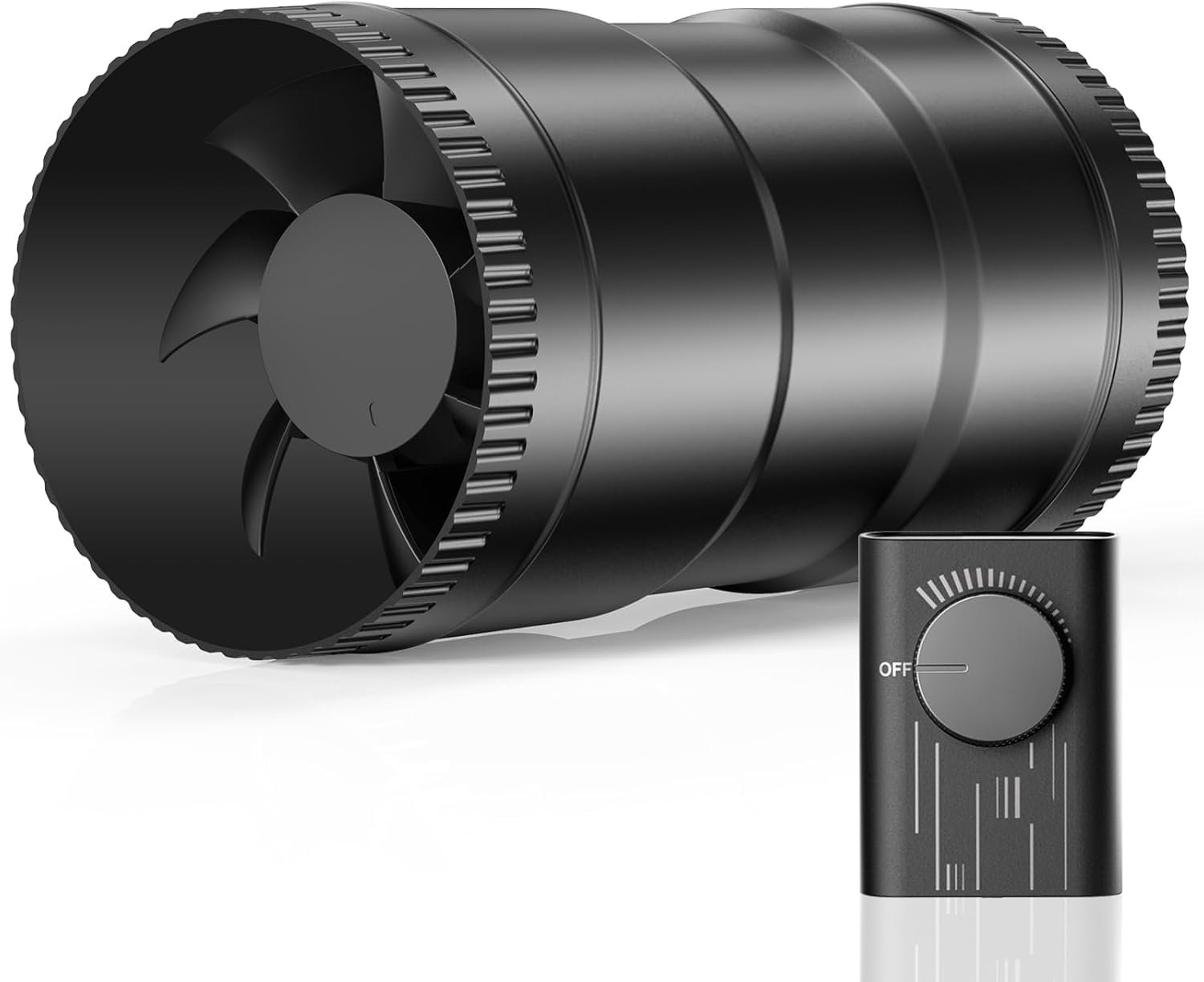
| Hon&Guan 4 Inch Inline Duct Fan with ControllerWhisper Pick | Whisper-quiet small-duct boost | 130 cfm | 4 in | 26 dBA | Amazon |
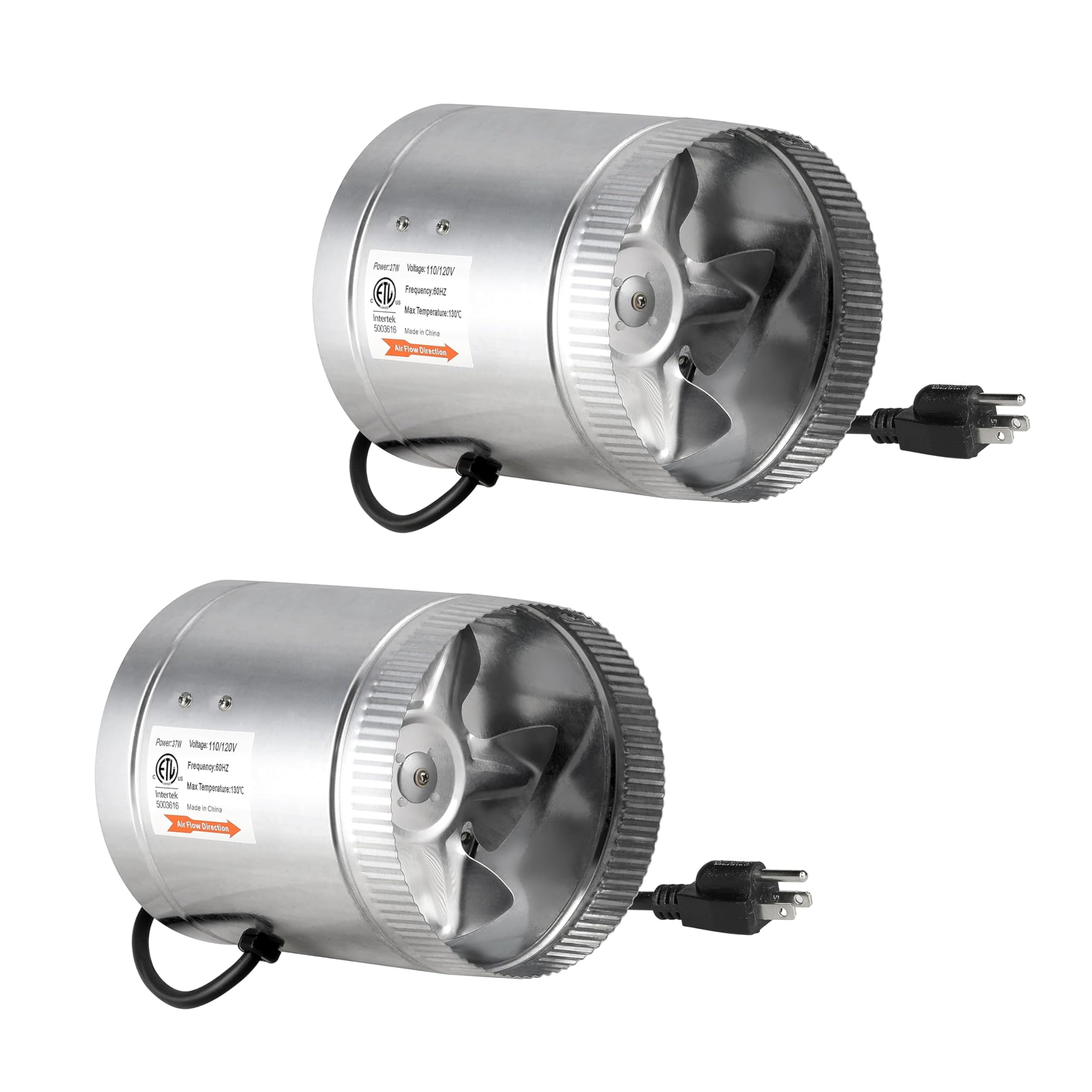
| iPower 6 Inch 240 CFM Booster Fan (2-Pack)Two-Run Pick | Two runs, one order | 240 cfm | 6 in | 37 db | Amazon |
| VEVOR 6-Inch 400 CFM Inline Duct Fan | Big airflow on a budget | 400 cfm | 6 in | 34 db | Amazon |
| AC Infinity Automatic Booster Duct Fan 4″ | Fully hands-off drying boost | 230 cfm | 4 in | 60 dBA | Amazon |
| Hon&Guan 6 inch Inline Duct Fan 469 CFM | Moving air down long runs | 469 cfm | 6 in | 55 dB | Amazon |
| Tjernlund DB-2 Duct Booster | Retrofit into tight rectangular duct | 275 cfm | 5–8 in / 3.25 in rect. | — | Amazon |
| Tjernlund M-6 Metal Inline Duct Booster | Hot attics and high-moisture areas | 460 CFM | 6 in | — | Amazon |
In‑Depth Reviews
1. VIVOSUN G6 6″ 388 CFM Inline Fan & Smart Controller
Our pick — 4.5+★ from 350+ verified ratings; the strongest balance of quality and price.
Set it once from your phone and let the app run the room.
This is the pick for someone who treats duct airflow as part of a bigger climate system, not a one-off fix. Its built-in controller — the GrowHub E42A+ — ties the fan, lights, and humidity gear into a single app, and the fan itself moves 388 cfm through a 6-inch duct. That is a serious volume for a home ventilation run, enough to pull stale air out of a grow tent, an attic, or a stuffy basement. The EC motor (electronically controlled, which runs cooler and sips power) is paired with PWM control, the same pulse method that lets a fan hold a steady low speed instead of hunting up and down.
At the settings you will actually use, quiet is the real story. VIVOSUN quotes operation as low as 45 dB (a decibel is a unit of sound loudness), which puts it near the level of a quiet conversation in the next room. Cranked flat out it is audible, but that is true of any fan pushing near-400 cfm (cubic feet per minute, a measure of airflow). The bigger draw is the automation: you can program the fan to react to a temperature or humidity threshold you set, so it ramps up on its own when the room gets muggy and settles back when it clears.
What wins people over, though, is the build. The corrosion-resistant metal base and rugged housing read as sturdier than the plastic-bodied fans at this end of the market — and that solid construction is what owners talk about most. The catch is the sensor side: the temp and humidity probe is the one piece that draws real grumbles, so treat it as a nice-to-have and keep a separate thermometer for anything critical. Connectivity is the other honest note — the app is the whole point of this fan, so if Wi-Fi in your attic is patchy, the smart controls lose their shine.
What earns it the top spot
- 388 cfm through a 6-inch duct, with a mixed-flow design built for long duct runs
- EC motor with PWM control runs as low as 45 dB and trims energy use versus an AC fan
- One app runs the fan, lights, and humidity gear with stage-specific schedules
- Corrosion-resistant metal base and rugged housing feel sturdier than most plastic rivals
Where it asks patience
- The temperature and humidity probe is the least-loved piece — a separate thermometer is smart for critical rooms
- App-first design means patchy attic Wi-Fi undercuts the smart features
Built for: anyone running a ducted grow room, greenhouse, or basement who wants the fan to look after itself — 4.5+ stars across 300+ owners backs that up.
Think twice if: you just want a dumb fan on a wall switch; the controller would be wasted on you.
2. Hon&Guan 4 Inch Inline Duct Fan with Upgrade Controller
The quietest fan here at 26 dBA — barely audible on low speed.
Start with the number that matters here: 6 watts. That is the maximum power this 4-inch fan pulls, and it is the whole reason it can run all day without you noticing it on the bill. It spins at 4,500 RPM (revolutions per minute, how fast the blades turn) to push 130 cfm (cubic feet per minute, a measure of airflow) — a fraction of what the big 6-inch units move, but far more than enough for a bathroom, a small closet, or a short 4-inch run that just needs a nudge.
The 26 dBA rating (roughly the sound of a quiet library) is the headline, and it holds on low speeds. Owners say it can slow down to silence. Push it to full tilt and the sound creeps up — the noise feedback is genuinely split, with some finding it quiet and others finding it loud at the top end. That is the honest shape of it: a fan this small doing real work will make itself heard when you ask for everything it has.
Compare it to the VEVOR’s 400 CFM and it clearly gives away volume — 130 cfm versus 400 cfm is a different class of fan. But the Hon&Guan is also a fraction of the power draw, and for a 4-inch duct a 400-cfm blower would be wasted anyway. Installation is genuinely easy thanks to the plastic blade-and-body design, which pops apart for cleaning in seconds.
Best value on the list: for a small duct and a tight budget, nothing here does more per watt than this little fan.
The honest caveat: 130 cfm will not rescue a long, bendy run — that is a job for a 6-inch unit.
Reach for this if: you have a 4-inch duct, a small room, and low tolerance for background hum.
Look elsewhere if: you need to push air down a long hallway’s worth of ductwork.
3. iPower 6 Inch 240 CFM Booster Fan Inline Duct Vent Blower (2-Pack)
Two 240 CFM fans in one box for two weak 6-inch runs on one budget.
Here is the practical angle: this is a two-pack, so it solves two problem ducts at once. Each fan moves 240 cfm through a 6-inch duct at 2,960 RPM and draws 37W — a modest, steady draw that suits a fan running alongside your air handler. The balanced blades and a permanently lubricated bearing are designed for a long service life with no maintenance, so you are not oiling anything.
Reliability is the trait that stands out — owners trust these to keep working, and the 37 db noise rating is genuinely moderate. But air delivery is the honest split point. Some find the airflow short of the number on the box, especially on a long run. The motor’s 37W also makes it the thirstiest of the small units here — compare it to the Hon&Guan’s 6W and you can see the difference in efficiency. The 37 db figure also lands slightly above the VEVOR’s 34 db, so on noise alone it is not the quietest 6-inch option.
Also worth knowing: those 240 cfm are real but you will want to clean the blades if anything gets into the duct, because a stuck blade under power needs the unit switched off straight away. Straightforward care, and the 2-pack math makes it the value play for a two-duct job.
Why two is smart: matched airflow across two runs beats one oversized fan and an unstuffed second duct.
Keep in mind: airflow runs lighter than the spec suggests on long ductwork, so aim these at shorter runs.
Made for: the two-duct household — a pair of basement runs or two grow tents that both need a push.
Not the one if: you have a single long run; you would be paying for a spare fan.
4. VEVOR Inline Duct Fan, 6-Inch 400 CFM with Variable Speed Controller

400 CFM on a manual speed knob, at a rated 34 dB.
Raw air movement is the pitch: 400 cfm through a 6-inch duct, which out-pushes every other 6-inch unit here except the 469-cfm Hon&Guan. That volume is enough to handle dehumidification and smoke-clearing in a wide space, and the manual knob lets you back it down to whatever the room needs. It holds 34 dB — the quietest rating of any 6-inch fan on this list and a whisper below the iPower’s 37 db.
Its AC motor spins at 2,600 RPM, lower than the iPower’s 2,960 RPM. Installation kit is generous: hang-up slings, rubber mats, and screws are all in the box so you can hang it or wall-mount it without a trip to the hardware store. Performance and build stick out as the strengths owners trust.
Two honest notes shape this one. First, noise — 34 dB is the rating, but the feedback on sound is mixed, with some finding it quiet and others reporting it noisy at speed. Second, and more important for anyone using it to vent something sensitive: some report it lets exhaust gases escape. For clear-air circulation that is a non-issue; for a sealed grow room or fume exhaust, keep that in mind. Durability feedback is also mixed, so budget for a unit that works hard rather than survives forever.
Value read: you are getting near-top airflow with a full mount kit at a mid-range price — the volume-per-cost here is the story.
Fit note: if the duct carries fumes rather than plain air, a unit graded for smoke containment is the safer call.
Pick it for: a wide grow room, basement, or kitchen that needs serious air volume on a manual dial.
Skip it for: a fume-critical exhaust where leaking is a real concern.
5. AC Infinity Automatic Booster Duct Fan 4″ Inline Fan

It listens for the pressure change and switches itself on — no manual knob, ever.
Here the star is a pressure switch — a sensor that detects the change in duct pressure when your air handler kicks on and starts the fan automatically. That is the feature that turns a booster into a hands-off helper. Mount it in any position, and it steps through five speed levels on its PWM-controlled EC motor. The fan moves 230 cfm through a 4-inch duct — the most airflow of any 4-inch pick here, well ahead of the Hon&Guan’s 130 cfm.
The buyers who love it use it on a dryer vent or a long run where air really needs a shove. Owners on dryer vents report clothes drying in roughly half the time. Airflow through the duct is strong and installation is straightforward.
The trade-offs are clear. At 60 dBA this is the loudest fan on the entire list, so it belongs somewhere you are not sitting next to it. And the pressure sensor gets mixed feedback — the recurring gripe is that it can be too sensitive and cycle on when you would rather it stayed quiet. A dual ball-bearing motor promises steady long-term running, which offsets some of the noise concern.
Standout spec: 230 cfm from a 4-inch duct with automatic pressure-triggered activation — an unusual combination.
Where it fits least: a laundry room next to a living space, where 60 dBA will announce itself.
Choose this if: the duct lives in an attic or utility space and you want it to run without a thought.
Pass if: it will sit near a quiet room — the noise is the real cost of the convenience.
6. Hon&Guan 6 inch Inline Duct Fan 469 CFM with Variable Speed Controller

The highest airflow here at 469 CFM — built to shove air down a long duct run.
If your duct is long and bendy, this is the fan that overcomes the distance. Its mixed-flow design and EC motor push 469 cfm at 4,300 RPM and pull 77W, which tops the airflow chart on this whole list. It is rated for air temperatures from -4℉ to 140℉ and carries an IP44 protection class (resistant to splashes and particles), so it handles a range of attic and basement conditions.
It works for moving heating or cooling to a far room, cooling an AV closet, or clearing odors. The 6-inch blade assembly is light and the duct ends pop off with locking tabs for quick cleaning.
Noise is the honest split. The 55 dB rating is louder than the VEVOR’s 34 db, and feedback is mixed — surprisingly quiet to some, pretty noisy to others. On a long run you want the power, so treat the extra sound as the price of that 469 cfm. Compare it to the small Hon&Guan 4-inch and you are looking at very different tools: 469 cfm versus 130 cfm is a gap that matters.
Best for: the long, winding run where a small fan would simply not reach the far room.
Not ideal if: quiet matters more than reach — a lower-cfm fan will serve a short run with far less sound.
7. Tjernlund DB-2 Duct Booster, 275 CFM
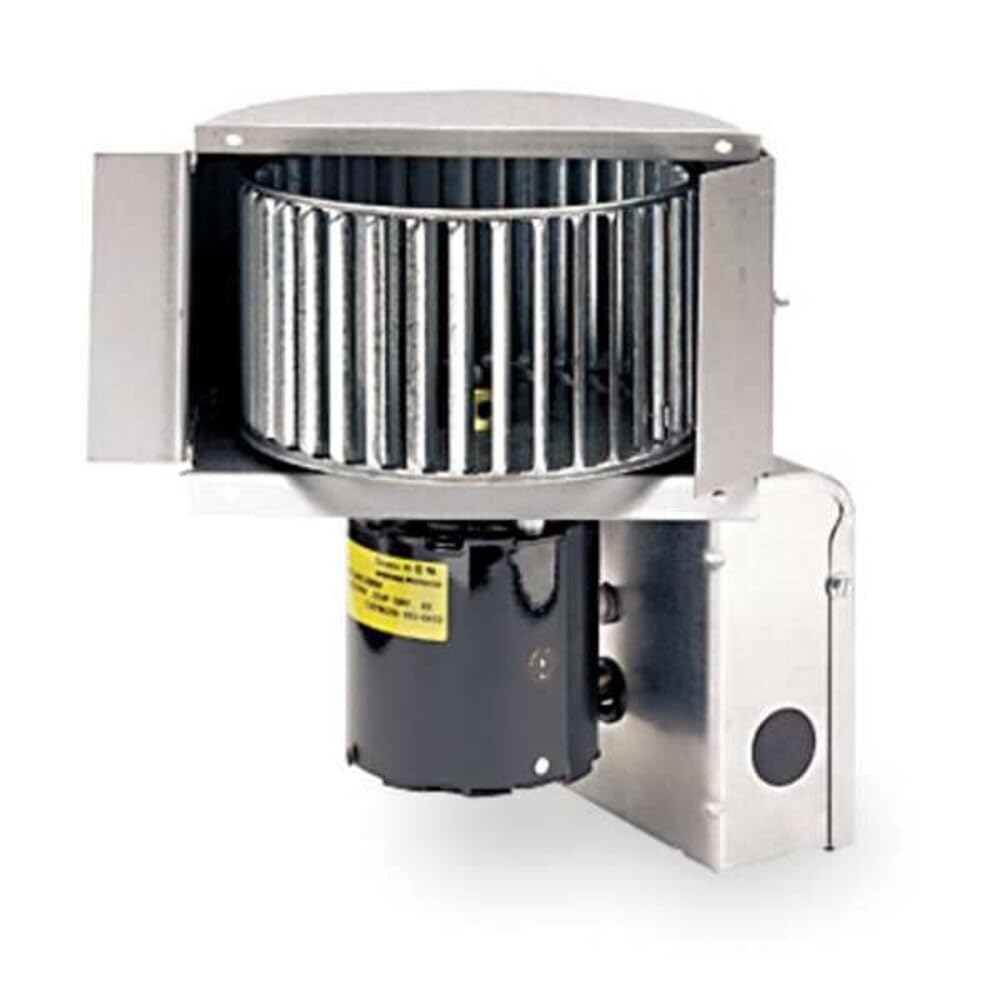
The duct-shape problem-solver — it squeezes into rectangular duct as shallow as 3.25 inches.
Most boosters assume you have a round duct. This one does not. It fits round duct from 5 to 8 inches across and rectangular duct as shallow as 3.25 inches, which means it slots into the tight gap above a ceiling where nothing else will go. It is rated to 200F, so it tolerates the warm side of a heating system, and it moves 275 cfm.
What earns it its place is quality and ease of install — the build and the straightforward fitting are what owners trust most. It is a genuine retrofit answer for the room that never gets warm, and it is built in the United States. The honest split shows up in performance: airflow feedback is mixed, with some saying it really boosts the flow and others finding it does not move enough air. Noise is split the same way, and heat output gets mixed reports too.
The lesson here is sizing. On a short duct it does its job quietly and well. Point it at a long, high-demand run and you will wish you had a higher-cfm unit. Get the fit and the run right, and it is among the most dependable shapes you can buy.
Why it stands out: that 3.25-inch rectangular fit is a rare capability — a real answer when a round booster physically will not go in.
Match it to the run: 275 cfm shines on a short duct and strains on a long one.
Ideal for: a retrofit into shallow rectangular duct where a round fan cannot fit.
Look elsewhere if: your run is long and demanding — go up in airflow.
8. Tjernlund M-6 Metal Inline Duct Booster Fan, 6 in, 460 CFM

A heavy-duty metal rotor that shrugs off attic heat and moves serious air.
The build is what separates this one. A heavy-duty metal rotor — not plastic — with no wobble while running, moving 460 cfm through a 6-inch duct. That airflow is nearly a match for the Hon&Guan’s 469 cfm, but this fan earns attention for how it takes abuse. It handles high-moisture areas and hot spaces, standing up to the kind of attic heat that cooks lesser fans. Owners trust the airflow, the cooling, and the value here more than almost anything else on the list.
It is speed controllable, though the speed control device is sold separately — a detail to plan for if you want to dial it down. Mounting brackets and hardware are included so the install has what it needs from the start.
Two honest notes. Noise is the big split — some find it runs quietly, others find it a little noisy, so treat quiet as a bonus rather than a promise. And the mounting bracket gets real criticism for its design; the fan itself is solid, but you may end up improvising the mount. Neither undercuts the core appeal of a metal-bodied fan built to last.
What the data shows: airflow and durability are the standout strengths — heavy-duty metal construction that holds up where plastic fans fail.
The one to plan around: you must buy a separate speed control and may need to rethink the included bracket.
Suits you if: the fan goes in an attic or damp space and you want metal that takes the heat.
Reconsider if: you want speed control built in and a fuss-free mount — this one asks you to add both.
Understanding the Specs
CFM (Airflow)
CFM means cubic feet per minute — the volume of air the fan shifts in sixty seconds. A higher number moves more air but usually costs more noise and power. Match CFM to duct length: short runs do fine on modest airflow, while long, winding runs need a fan with more push to reach the far room.
Motor Type — EC vs AC
An EC motor is electronically controlled and typically runs cooler and more efficiently than a traditional AC motor. Several picks here use one, some with a variable speed controller for fine dialing. AC-motor fans tend to cost less but draw more power and often run louder — fine for occasional use, less so for a fan running all day.
Duct Diameter
Boosters come sized for 4, 6, or 8-inch round duct, with some also fitting rectangular duct as shallow as 3.25 inches. Measure the actual duct opening, not the wall register. A wrong-size fan means a reducer or an afternoon of rework.
Noise Rating (dB / dBA)
Decibels measure loudness — lower is quieter. Ratings here span from 26 dBA (library-quiet) to 60 dBA (normal conversation, but constant). Remember that a fan’s noise rises the harder it works, so a quiet low-speed rating can become a noticeable hum at full power.
Controls — Pressure Switch vs Manual Knob
A pressure switch senses the change in duct pressure when your air handler runs and switches the fan on automatically. A manual knob or app control needs you to set it. For a fan living in an attic or crawlspace, automatic activation saves daily hassle.
Power Draw (Watts)
Watts measure how much electricity the fan pulls. A 6W unit can run all day cheaply; a 37W or 77W unit costs more to run but usually moves far more air. Weigh power against how hard the fan will need to work on your particular run.
FAQ
Will a 4-inch booster fan fit my 6-inch duct?
What size booster fan do I need for a long duct run?
Does an inline booster fan really improve heating and cooling?
Is an EC motor better than an AC motor in a duct fan?
How do I know if my duct is round or rectangular?
Can a booster fan run all the time or should it switch on and off?
Will a duct booster fan be loud in the room below?
Does a booster fan help dry clothes faster in a laundry room?
Can I mount a duct booster fan at any angle?
Final Thoughts: The Verdict
If you want the fan to think for itself, the VIVOSUN G6 is the clear winner — 388 cfm on a 6-inch duct, a corrosion-resistant metal build, and app control that manages the whole climate setup. For the long, stubborn run, go with the Hon&Guan 469 CFM for raw push, or the VEVOR if you want big airflow on a manual dial. And if your duct is simply the wrong shape for a round booster, the Tjernlund DB-2 fits that tight rectangular gap where nothing else will.
How We Picked
We do not accept paid placement. Every pick is matched to a real buyer and a real use-case; we do not hands-on test units.
Sources & Methodology
Specifications: manufacturer listings and product documentation. Review insights: verified customer reviews, as of November 2026. Pricing: not shown on this page (it changes often); check the current price via the retailer link.
As an Amazon Associate, Gadgets Feed earns from qualifying purchases. This does not affect which products we feature.