
Our readers keep the lights on and my morning glass full of iced black tea. As an Amazon Associate, I earn from qualifying purchases.
Specs are compiled from manufacturer listings and verified buyer reviews and can change over time — please confirm the key details on the product page before buying.
The invisible cloud of fumes and ultrafine particles from ABS, ASA, and even PLA is the one thing most 3D printing enthusiasts eventually lose sleep over. You get the perfect print, but your workshop smells like a chemical lab, and you start wondering what that stuff is doing to your lungs. The right air filter for a 3D printer is the difference between a hobby you love and a health risk you ignore.
I’m Min — the founder and writer behind Gadgets Feed. This guide is built by comparing the manufacturers’ published specifications and the patterns across verified customer reviews, so you get each pick’s real strengths and trade-offs instead of marketing spin.
if you need to capture styrene from a heated chamber or just want the air in your office to smell clean, this guide to the air filter for 3d printing breaks down the real-world performance of six top contenders so you can print with confidence.
Our Picks at a Glance

How To Choose The Best Air Filter For 3D Printing
Picking the right fume extractor for your 3D printer depends on understanding what you’re printing and where you’re printing it. A unit that works beautifully for occasional PLA on a desk won’t handle the heavy VOC load from a chamber full of ABS. Here is what to look at.
Filter Media: HEPA vs. Activated Carbon
A HEPA filter (a high-efficiency particulate air filter) catches solid particles like the ultrafine plastic dust a printer throws off — think of it as a net for microscopic debris. But fumes (VOCs, or volatile organic compounds) are a gas, not a particle. That is where activated carbon comes in. You need both layers for a true air filter for a 3D printer: HEPA for the dust, carbon for the smell and the chemical vapors.
Airflow and Suction Power
Measured in CFM (cubic feet per minute) or m³/h (cubic meters per hour), this tells you how much air the fan moves. More airflow means the filter can cycle the air in your room or chamber more times per hour. For a desktop hobby setup, anything over 50 CFM is generally enough. For a large enclosure or a whole workshop, you’ll want 150 CFM or more to pull fumes away before they spread.
Size and Noise
A powerful extractor is useless if you can’t stand being in the same room with it. Most desktop units run between 50 and 60 decibels — think of a quiet conversation or a running refrigerator. Heavier industrial units can hit 70+ dB, which is loud enough to require hearing protection over long sessions. Also consider the physical footprint: a 27-pound unit with a 15-inch chassis is a permanent installation, while a 4-pound portable can slide onto a shelf.
Quick Comparison
| Model | Best For | Airflow | Filtration Stage | Weight | Amazon |
|---|---|---|---|---|---|
| FumeClear FC-2002A★ Best Overall | Heavy Duty Workshop | 153 CFM | 3-Stage (Pre + HEPA + Carbon) | 27 lb | Amazon |
| Mintion V1Also Great | Bambu Lab Enclosures | 60 m³/h | Triple (Pre + HEPA H13 + Carbon) | 3.61 lb | Amazon |
| KQZ B1 | Compact Desktop Use | 168 m³/h | Dual (H13 HEPA + Carbon) | 4.02 lb | Amazon |
| M-T MT308 | Budget Hobbyist | 168 m³/h | Triple (Pre + HEPA + Carbon) | 3.89 lb | Amazon |
| KOTTO Smoke Absorber | Light Soldering/PLA | 52 CFM | Dual (Carbon or HEPA) | 4 lb | Amazon |
| KQZ Laser Fume Extractor | Multi-Tool Workshops | 280 m³/h | Dual (H13 HEPA + High Iodine Carbon) | 27.5 lb | Amazon |
In‑Depth Reviews
1. FumeClear FC-2002A Laser Fume Extractor with Outdoor Vent
Our pick — over 4.5★ from 50+ verified ratings; the strongest balance of quality and price.
The 27-pound workhorse that pulls your workshop air clean.
If your 3D printing setup lives in a garage or a dedicated workshop, the FumeClear FC-2002A brings near-industrial suction at 153 CFM (260 m³/h). Its 3-stage filtration system — a pre-filter, a HEPA filter, and a main carbon filter made from highly iodized coconut shell activated carbon — achieves a 99.97% purification rate for particles down to 0.3 microns. That same carbon filter is rated for up to 4,000 hours of use before replacement, which is a long stretch between costs.
Owners of 30W fiber lasers and 3D printers running ASA report that the suction at settings 3 or 4 captures particles effectively and that the room stays odor-free after an overnight print. The aerospace-grade noise-reduction design keeps the noise under 55 dB — quieter than the M-T unit despite the FumeClear being weighing 27 pounds versus the M-T’s 3.89 pounds. The five locking casters and all-metal housing make it feel like a permanent piece of shop equipment, not a temporary fan.
The catch is the size: at 27 pounds and over 15 inches in each dimension, this is not something you stash on a shelf between prints. It is a workstation appliance. Buyers also note the remote needs line-of-sight, and the gooseneck could be longer for reaching into deep enclosures.
Why It Stands Out
- 153 CFM suction — highest raw airflow in this roundup
- All-metal construction with locking casters for stability
- Ultra-quiet at under 55 dB despite the power
- Carbon filter lasts up to 4,000 hours
The Trade-Off
- Weighs 27 lb — a permanent installation, not portable
- Price is significantly higher than desktop models
- Remote control requires line-of-sight
Best suited for: dedicated workshop setups where you want the strongest possible air exchange without the roar of an industrial fan.
skip it if: you need a portable desktop unit to tuck beside an office printer — the footprint is closer to a small trash can.
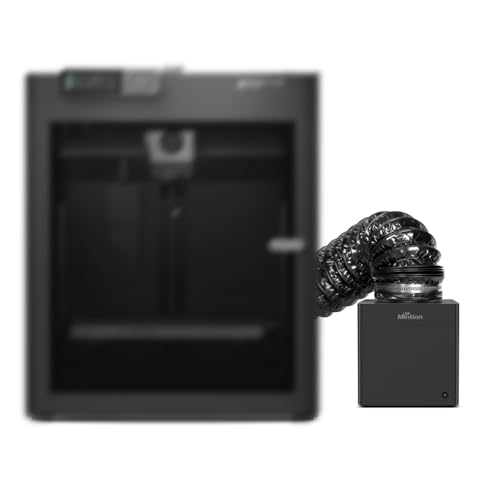
2. Mintion V1 3D Printer Filter System for Bambu Lab P1S/X1C
The dedicated air scrubber that fits a Bambu Lab like a factory part.
Instead of a generic box that you awkwardly tape to the side of your printer, the Mintion V1 is purpose-built for additive manufacturing. Its triple-layer filtration system starts with a pre-filter for large debris, then a True HEPA H13 (which captures over 99.97% of ultrafine particles down to 0.3 microns), and finishes with a chemically-activated carbon bed targeting the specific VOCs that ABS, ASA, and Nylon release — like styrene and caprolactam. The result is air that actually smells clean after an overnight print.
The centrifugal fan delivers a stable 60 m³/h airflow with an outlet velocity of up to 10 m/s, which is enough to maintain negative pressure inside an enclosed printer. Owners consistently call it quiet and effective, with one noting it “removes VOCs and odor” so well that they ditched two noisy standalone purifiers. The main trade-off is the price: it competes with larger machines but offers less raw CFM. The design is also tool-free for filter swaps, so you pop the old one out and slide the new one in without reaching for a screwdriver.
Compatibility is a strong point. It ships with a default connector for the Bambu Lab P1S and X1C, and the manufacturer provides adapter files for a long list of other popular enclosed printers including Creality, Prusa, and Anycubic models.
What Owners Appreciate
- True HEPA H13 captures >99.97% of ultrafine particles
- Chemically-activated carbon targets ABS/ASA VOCs specifically
- Compact 3.61-pound design fits inside or beside an enclosure
- Tool-free filter swaps for fast maintenance
Keep in Mind
- Lower airflow (60 m³/h) than larger workshop extractors
- Some early P2S units may need an adapter for a proper fit
Grab this if: you own a Bambu Lab P1S or X1C and want a drop-in filter that targets the exact fumes those printers produce.
Think twice if: you need high-volume suction for a whole workshop or an open-frame printer — the 60 m³/h airflow is for enclosure recirculation, not room-wide capture.
3. KQZ B1 Solder Fume Extractor with H13 HEPA

A compact desktop cleaner that punches well above its price point.
The KQZ B1 is a strong contender for anyone who wants serious filtration without the heavy investment. It pushes 168 m³/h through a 9mm thick pre-filter and an H13 HEPA carbon filter cartridge that traps 99.99% of dust, odors, and 0.3-micron particles. That dual-layer design — with a coal-based activated carbon filter — also adsorbs heavy metals like lead and mercury, plus chemical vapors, making it useful for soldering and light welding as well as 3D printing.
Owners consistently praise the variable speed knob, calling the unit “very quiet” and “well-built.” The suction is adequate for desktop use when the nozzle is positioned 3 to 4 inches from the source, and the 360-degree adjustable gooseneck allows precise aiming. One five-month owner reports it working great on their 3D printer without any drop in performance. The main filter is rated for 2,500 hours, so you are looking at long stretches between replacements.
The flexible hose can droop over time — some buyers wished for a stiffer, wider tube. It is not designed for heavy industrial use, but as a desktop companion for occasional ABS or frequent PLA printing, it delivers a superb balance of cost and capability.
What Wins Owners Over
- 99.99% filtration with H13 HEPA + activated carbon
- Variable speed knob for quiet operation at low settings
- Includes 5 pre-filters in the box
- Compact 4.02-pound metal body
One Limitation
- Flexible hose may not hold position without support
- Adequate for desktop use but not heavy continuous running
Reach for this if: you print indoors on a desk and want a compact, quiet filter that doesn’t break your budget.
Look elsewhere if: you run a multi-printer workshop and need the brute-force suction of a 150+ CFM machine.
4. KQZ Laser Fume Extractor with Display & Remote

The remote-controlled powerhouse that thinks for you.
This 27.5-pound fume extractor from KQZ is the smartest option in the lineup, pairing a 150W brushless motor that delivers 280 m³/h of airflow with a digital control panel and an included remote. The motor is a step up from standard brush units: it runs quieter (reported at around 55 dB) and uses a filter-clog monitor that alerts you exactly when the main filter needs changing, so you never run the machine at reduced efficiency.
The filtration uses an H13 HEPA paired with a 1,000 iodine value activated carbon — the high iodine number means it has superior adsorption for toxic gases and odors. The unit ships with 10 pre-filters (9mm thick each), which catch coarse debris and extend the life of the main filter. Owners of 20W and 30W diode lasers report that it “nearly eliminated smell indoors,” outperforming standard window-venting setups. The flexible and rigid hose kit (two 50mm x 1.2m tubes) gives you options for closed enclosures or open workstations.
Occasional reports of suction loss after several months are balanced by KQZ’s responsive customer service — multiple reviews describe them replacing units quickly when issues arise. For the price, you get a lot of tech for a large workshop filter.
Smart Features
- 280 m³/h airflow — the highest in this selection
- Remote control with stepless speed adjustment and auto on/off timer
- Filter clog monitor prevents performance drops
- Dual hose kit (flexible + rigid) for enclosure and open use
Considerations
- 27.5 lb — not a desktop toy
- A few buyers report suction loss after 6–12 months; KQZ offers replacements
Ideal for: anyone running a small workshop with a laser engraver and a 3D printer who wants remote control and a filter-health monitor built in.
Not for: a tight shelf in an office — this is a floor unit that needs dedicated space and a power outlet nearby.
5. M-T Solder Fume Extractor 80W with HEPA Filter
The affordable entry point that handles the basics with surprising competence.
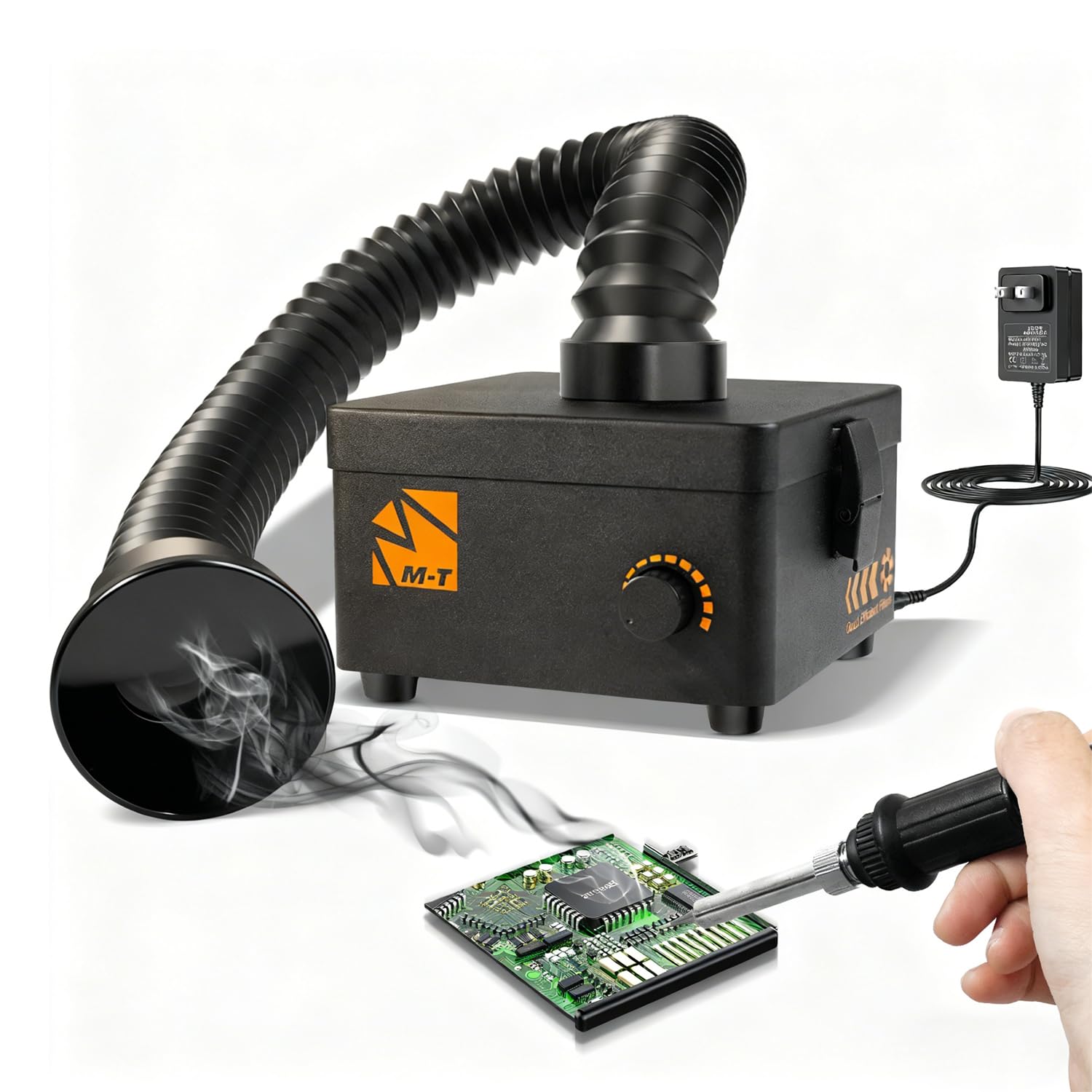
For the lowest price in this roundup, the M-T MT308 gives you a 168 m³/h airflow from a compact 3.89-pound metal-shell unit. It uses a 15,000 RPM motor that runs under 60 dB (a touch noisier than the FumeClear’s 55 dB), and a triple-layer filter setup — pre-filter, HEPA, and carbon — that is effective for hobbyist soldering and light 3D printing. Owners of 3D printers specifically confirm it works great for keeping the air clean during long prints.
The 360-degree adjustable hose extends from 7 to 25 inches, offering flexible placement on a shelf or a desk. The design is intentionally simple: three fan speeds, a metal body with no unnecessary frills, and an 80W power draw that keeps electricity costs low. The noise is described as a consistent fan hum that headphones easily handle, though running on the mid-speed setting is noticeably quieter and still effective for pulling fumes within a 5-inch range.
Some build-quality teething issues come up in longer-term reviews — a particular mention of the exhaust hose connection, and the non-polarized plug requiring specific orientation. It is a unit that works best for the careful owner who doesn’t mind a small quirk in exchange for an accessible price.
What Owners Like
- 168 m³/h airflow for a compact 3.89-lb package
- Triple-layer HEPA + carbon filtration
- 3-speed fan for matching noise to need
- 3-year warranty backed by responsive support
Build Notes
- Some owners mention quirks with hose threads and plug orientation
- Noisier than premium units at max speed (over 60 dB)
Grab this if: you need a budget-friendly setup for a home office printer and accept a few minor build imperfections for the price savings.
Think twice if: you plan to run the filter at full speed for hours daily — the noise and plastic hose threads might wear on your patience.
6. KOTTO Strong Suction Smoke Absorber
A light desktop helper that is ready to go right from the start.
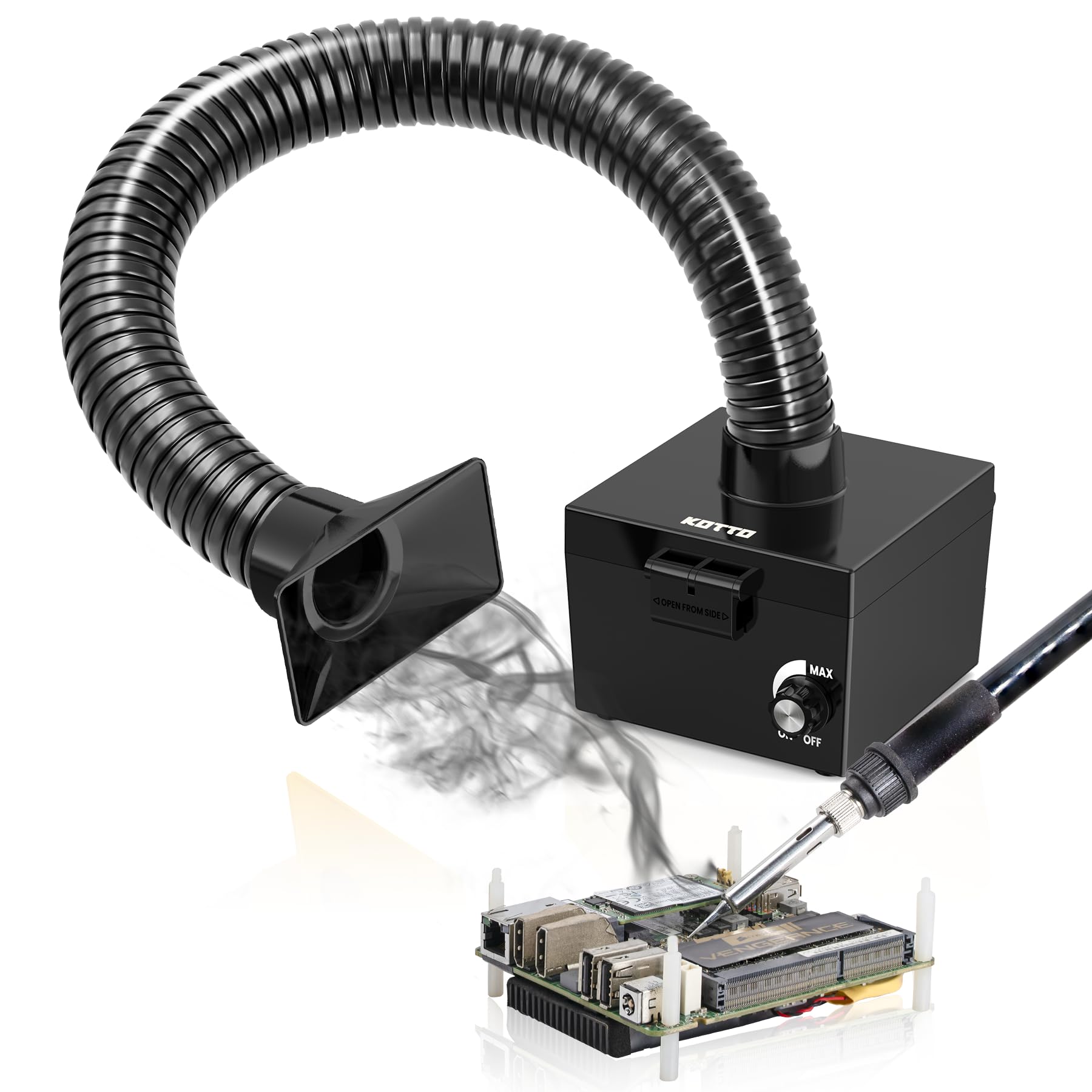
KOTTO’s smoke absorber is the simplest entry in this list: a pre-assembled unit with a 24-inch flexible tube and a 6000 RPM fan that moves 52 CFM at 40W of power. The hose is pre-attached, so there is zero assembly — just plug it in and adjust the direction of the hood. The fan speed is adjustable, and you can choose between a carbon or HEPA filter cartridge depending on what you are printing.
With a noise rating of 55 dB, it is one of the quieter options at moderate speed, though some owners note it gets a bit loud at full blast. The fan itself has a rated life expectancy of 50,000 hours, so it should outlast several filter changes. It works best within 5 to 6 inches of the fume source — effective for a desktop soldering station or a small PLA printer. The unit includes one replacement filter, which is a nice touch for the price.
The most common criticism is that the weighted base tends to slide on smooth surfaces, and some owners describe it more as a “smoke relocator” than a true absorber — it pulls the fumes away from your face but may not capture every particle. For light, occasional use, it is a functional and affordable solution.
Why It Works
- Pre-attached hose — no assembly required
- Quiet at 55 dB and small footprint for a tidy desk
- Long fan lifespan at 50,000 hours
- Includes a replacement filter in the box
The Downside
- 52 CFM is lower than other picks — only effective within 6 inches
- Base slides easily; could use better rubber feet
Best for: a casual desktop printer user who wants a no-hassle, plug-and-play filter for PLA and light soldering.
pass on it if: you run ABS or ASA regularly — the 52 CFM suction will not capture heavier VOCs before they spread through the room.
Understanding the Specs
CFM vs. m³/h (Airflow)
These are two units for the same thing: how much air the fan moves each hour or minute. One CFM (cubic foot per minute) equals roughly 1.7 m³/h. More airflow means the filter can pull a larger volume of contaminated air through the media. For a single enclosed 3D printer, 50-100 CFM is typically sufficient. For an open workshop with multiple machines, you want 150 CFM or more to keep ahead of the fumes.
HEPA and Carbon Filtration
A HEPA filter (high-efficiency particulate air) traps solid particles like plastic dust and resin powder. True HEPA H13 is the standard used in premium filters, capturing 99.95% of particles sized 0.3 microns. But particles are only half the problem. The VOCs (volatile organic compounds) released by ABS and ASA are gases that pass right through a HEPA. That is where activated carbon comes in: its porous surface chemically binds to gas molecules, removing smells and toxic vapors. A filter for 3D printing needs both layers to be effective.
FAQ
Is a HEPA filter enough for 3D printer fumes?
Can I use a standard room air purifier for my 3D printer?
How often do I need to replace the filters?
Will a fume extractor fit inside my enclosed 3D printer?
How loud are these filters during a long print?
Which materials produce the most dangerous fumes?
Do I need an inline exhaust to the window or is a recirculating filter enough?
What does 99.97% filtration actually mean for my health?
Final Thoughts: The Verdict
Across the board, the air filter for 3d printing that hits the sweetest balance is the FumeClear FC-2002A because it offers the highest raw suction power (153 CFM) with an ultra-quiet noise profile (under 55 dB) and a long-lasting carbon filter rated for 4,000 hours — ideal for a dedicated workshop. If you want a Bambu-specific drop-in that targets the exact VOCs your printer emits, grab the Mintion V1. And for a budget-friendly desktop option that still packs a HEPA and carbon layer, the KQZ B1 is the one to reach for.
How We Picked
We do not accept paid placement. Every pick is matched to a real buyer and a real use-case; we do not hands-on test units.
Sources & Methodology
Specifications: manufacturer listings and product documentation. Review insights: verified customer reviews, as of July 2026. Pricing: not shown on this page (it changes often); check the current price via the retailer link.
As an Amazon Associate, Gadgets Feed earns from qualifying purchases. This does not affect which products we feature.