
Our readers keep the lights on and my morning glass full of iced black tea. As an Amazon Associate, I earn from qualifying purchases.
Specs are compiled from manufacturer listings and verified buyer reviews and can change over time — please confirm the key details on the product page before buying.
That cool, heavy feeling when you walk downstairs is not just the temperature — it is moisture and airborne particles working together. A basement operates on a different air physics than the rest of the house, and the right filtering machine turns that damp, stale atmosphere into something you want to spend time in, store valuables in, or finish into livable square footage. This guide covers both dedicated air purifiers and dehumidifiers that handle the unique load of below-grade spaces.
I’m Min — the founder and writer behind Gadgets Feed. This guide is built by comparing the manufacturers’ published specifications and the patterns across verified customer reviews, so you get each pick’s real strengths and trade-offs instead of marketing spin.
The right unit tackles basement-specific challenges: trapped pet odors, fluctuating humidity, and stale air that never fully circulates., and the nine models below represent the real contenders for air filter for basement use.
Our Picks at a Glance


How To Choose The Best Air Filter For Basement
A basement is not a bedroom. The air is denser, damper, and often carries a different mix of pollutants — mold spores, dust from unfinished surfaces, and odors from storage or laundry. The machine that handles that needs a wider coverage zone and often a different technology focus. You need to decide first whether your main enemy is particles (dust, dander, smoke) or moisture (humidity that feeds mold).
Coverage Reality Check
Manufacturers list square-foot ratings under ideal conditions. In a basement, you often have a lower ceiling and less airflow than an open living area, so the real zone a unit handles is smaller than the listed number. A machine rated for 1,000 square feet comfortably covers a 600- to 800-square-foot basement. If you plan to run it on a lower fan speed for noise, shrink that range further.
Particles vs. Moisture — The Big Fork
A standard HEPA purifier captures airborne allergens and dust. It does nothing for the humidity that makes a basement feel clammy and encourages mold growth on walls. A dehumidifier pulls water vapor out of the air, which makes the space less hospitable to mold and mildew — but it does not filter fine particles. The right choice depends on whether your basement smells musty (moisture issue) or dusty (particle issue). Many basements need both.
Filter Type and Maintenance
True HEPA filters capture 99.97% of particles at 0.3 microns. H13 and H14 grades improve on that slightly. Pre-filters are crucial in a basement — they catch the larger dust and debris common in these spaces and extend the life of the main filter. Washable pre-filters save you money over time. Activated carbon layers handle odors and VOCs (volatile organic compounds) from stored chemicals or laundry.
Noise Tolerance in a Basement
If your basement is a workshop or home gym, fan noise matters less. If it is a guest room or home office, whisper-quiet sleep modes and low decibel ratings are a priority. Decibel ratings below 30 dB are essentially silent in a quiet room, while 40-50 dB is noticeable but not intrusive for most activities.
Quick Comparison
| Model | Best For | Coverage Area | Noise Level | Weight | Amazon |
|---|---|---|---|---|---|
| LEVOIT Core 300-P★ Best Overall | Best Overall | 1,073 sq ft | 24 dB | 7.9 Pounds | Amazon |
| AMEIFU F1Budget Champion | Budget Champion | 3,000 sq ft | 15 dB | 9.25 Pounds | Amazon |
| DAYETTE AP303Value With H14 | Value with H14 | 3,000 sq ft | 22 dB | 8 Pounds | Amazon |
| Dhyala KJ03 | Smart Control | 3,000 sq ft | 15 dB | 8.82 Pounds | Amazon |
| WINIX 5510 | Proven Performer | 1,882 sq ft | 23.5 dB | 13.3 Pounds | Amazon |
| KNKA PD30MA-20 | Quiet Dehumidifier | 4,500 sq ft | 40-45 dB | — | Amazon |
| AEOCKY LEO-Lite | Energy Star Dehumidifier | 4,500 sq ft | 44 dB | 31 Pounds | Amazon |
| Coway Airmega AP-1512HH | Editor’s Choice | 361 sq ft | 24.4 – 53.8 dB | 12.5 Pounds | Amazon |
| DECIUU DER32S01-50 | High Capacity Dehumidifier | 5,000 sq ft | — | 32.78 Pounds | Amazon |
In‑Depth Reviews
1. LEVOIT Core 300-P Air Purifier
Our pick — over 4.5★ from 108,000+ verified ratings; the strongest balance of quality and price.
The crowd favorite that makes basement air feel as fresh as the upstairs.
The first thing you notice about the LEVOIT Core 300-P is how quiet it runs. At just 24 dB in sleep mode, it is near-silent — you will not hear it while you work or sleep nearby. That matters in a basement that doubles as a home office or guest room. Its 56W high-torque motor and 143 CFM CADR (Clean Air Delivery Rate) push air with real authority, covering up to 1,073 square feet once per hour or a 222-square-foot room 4.8 times per hour.
The AHAM Verifide seal means the numbers are independently tested, not just marketing claims. The 3-in-1 HEPA-grade filter handles dust, smoke, pet dander, and pollen with 99.97% efficiency on particles down to 0.3 microns. The noise level is significantly quieter than the larger AMEIFU model, which runs at a 15 dB floor but reaches 9.25 pounds compared to the LEVOIT’s 7.9 pounds, making it lighter and easier to move.
The trade-off is coverage. The 1,073-square-foot rating is honest, but a larger finished basement may need two units. The display lights can be turned off completely, and the timer runs in 2, 4, 6, or 8-hour increments. Multiple filter options let you switch to a Toxin Absorber or Pet Allergy filter depending on your specific basement pollutants.
Quiet HEPA champion
- Near-silent 24 dB sleep mode
- AHAM Verifide independently tested CADR
- Lightweight 7.9 lb unit, easy to reposition
- Multiple specialized filter options available
Filter costs add up
- Larger basements may need a second unit
- Off-brand filters may damage the unit per the maker
Budget pick: you want the most-proven, whisper-quiet purifier that handles a standard basement without fuss.
High upkeep: humidity is your main issue — this is a particle filter, not a dehumidifier.
2. AMEIFU F1 Air Purifier
The entry-level unit that delivers 3,000-square-foot coverage at a budget-friendly price.
For the money, the AMEIFU F1 delivers an outsized punch. Its dual-sided intake design pulls air from both sides simultaneously, and the maker claims this delivers 2x faster purification than single-intake models. The CADR of 400 m³/h feeds coverage up to 3,000 square feet — a number normally reserved for mid-range and premium units. Buyers report it “gets rid of smells in the basement,” and the auto air quality sensor reacts to room changes by adjusting fan speed automatically.
The H13 HEPA filter captures 99.99% of particles as small as 0.1 to 0.3 microns, covering pollen, dust, pet hair, and smoke. The sleep mode drops to 15 dB, which is impressively quiet — though at 9.25 pounds it is heavier than the LEVOIT above by about 17%, and some owners note the fan noise on level 1 is audible wind noise, not silence. The real-time PM 2.5 display and infrared sensor show you the air quality reading, and the included remote control handles timers, child lock, and filter life checks.
The strong suit here is value-for-money with wide coverage. The catch is noise at higher speeds — this is not a unit you want on high in a quiet bedroom. But in a basement workshop or storage area, that is rarely an issue. The filter replacement reminder lights up every 3 to 6 months, and the official replacement filter is available on Amazon.
Compact ozone-free: Buyers consistently praise its effectiveness, with over a hundred calling it out specifically. The auto sensor is the standout feature — it catches smells like cooking or pet odors and ramps up before you even notice.
Tiny space: you need wide coverage on a tight budget and plan to run it in a utility or workshop basement.
Larger rooms: absolute silence on mid-speed is non-negotiable.
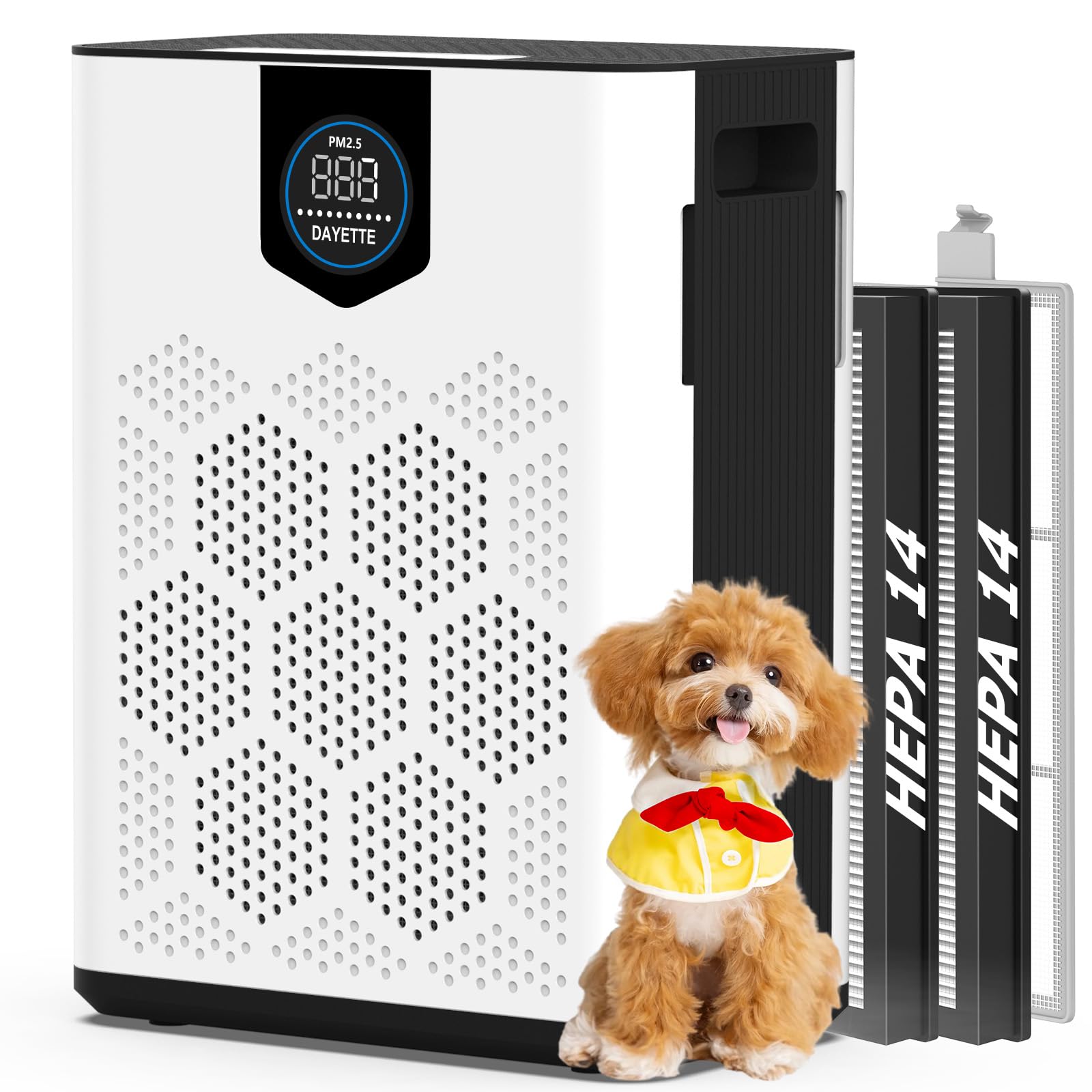
3. DAYETTE AP303 Air Purifier
The H14 filter upgrade that outperforms H13 rivals for a minimal price increase.
HEPA grade matters in a basement, and the DAYETTE AP303 jumps straight to H14 — the tier above the common H13. Its two H14 filters capture 99.997% of particles as small as 0.3 microns, which is a meaningful step up for catching the finer mold spores and VOCs that hang around below grade. The dual-sided intake design pushes air circulation at up to 3,000 square feet per hour in turbo mode, according to the maker.
The washable fine-mesh pre-filter catches pet hair and larger debris first, which keeps the main filter working longer and lowers replacement costs — owners note saving per cleaning. Sleep mode runs at a whisper-quiet 22 dB, and the auto mode uses the built-in PM2.5 smart detector with color-coded and numerical display (red for poor, orange for moderate, green for good, blue for excellent). The aromatherapy box is a useful extra: add 6-10 drops of essential oil, flip on turbo mode, and it distributes a gentle fragrance through the room.
Owners of three DAYETTE units report the air quality monitor showing 98-99% compared to 90% on other models, and the unit is light enough at 8 pounds to move between rooms. The child lock and 2/4/6/8-hour timer add practical value for a family basement. The catch? The 22 dB sleep mode is genuinely silent, but one owner notes a cat may knock over the lightweight unit — place it securely.
Bedroom use: pet owners and allergy sufferers who want the highest filter grade without stepping to premium pricing.
Heavy smoke: you need Wi-Fi or app control — this unit keeps it simple with physical controls only.
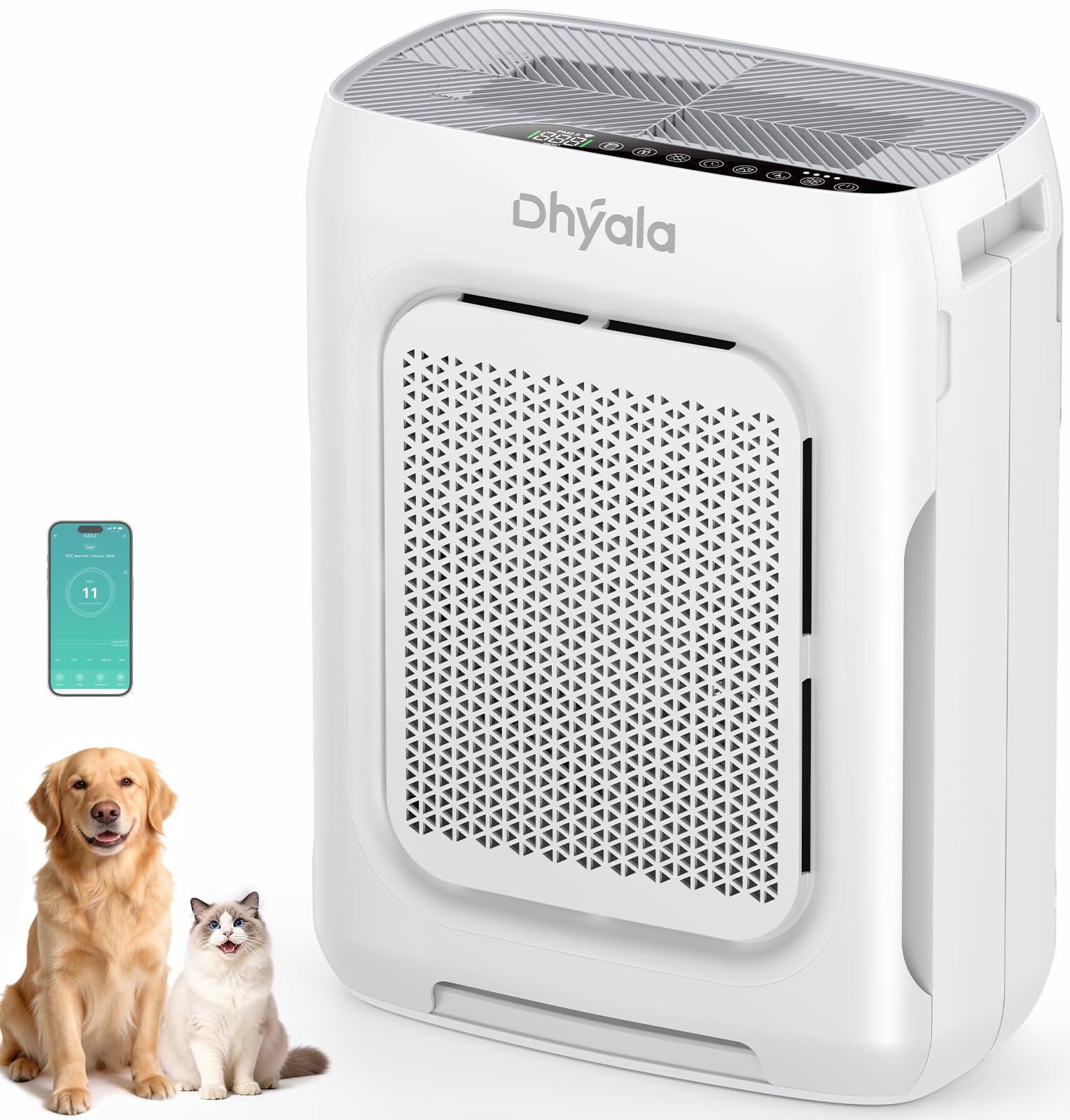
4. Dhyala KJ03 Air Purifier
The smart-enabled purifier you can control from your phone, even from upstairs.
If you want to check your basement air quality without walking downstairs, the Dhyala KJ03 makes that happen. Smart Wi-Fi connectivity with Alexa and Google Assistant support means you can adjust fan speed, check filter life, and set timers from anywhere. The dual-sided multi-intake design pulls air from front, rear, left, and right sides, achieving a CADR of 265 CFM and coverage up to 3,000 square feet.
The dual 3-stage filters (pre-filter, HEPA, activated carbon) capture everything from pet hair to fine particles. The washable pre-filter extends the main filter’s life, and a filter replacement indicator light takes the guesswork out of maintenance. Sleep mode drops to 15 dB — quieter than the LEVOIT’s 24 dB — and the built-in aromatherapy box includes three pads so you can scent the air without a separate diffuser. Safety features include a child lock, a 1.83-meter anti-chew power cord for pets, and an auto shut-off when the unit tilts more than 45 degrees.
Owners mention it works well across a 2,200-square-foot open plan, with one noting it removed a burnt smell within 30 minutes. The auto mode detected a PM2.5 spike to 500 from burning plastic and ramped up immediately. The honest trade-off is that at 8.82 pounds, it is mid-weight for its size, and some owners note the auto mode is so sensitive it may kick in during cooking or even strong perfume use — which is actually a sign it is working, not a flaw.
Smart sensor tech: This unit holds a stellar reputation among its owners. The Dhyala comes with a 24-month warranty and lifetime tech support — real backup for a connected device.
Auto mode: the tech-savvy homeowner who wants app control and pet-safe design in a finished basement.
Filter scarcity: you simply want a set-and-forget unit without connecting anything to your phone.
5. WINIX 5510 Air Purifier

The brand with a decade of trust, now updated with smart features.
The WINIX 5510 is the updated version of the 5500-2, a unit that has been a Wirecutter-style internet darling for years. AHAM Verifide at 392 square feet, it also cleans rooms up to 1,882 square feet in one hour — meaning it cycles a large basement’s air well within reasonable time. The True HEPA filter paired with a high-deodorization carbon filter tackles VOCs and household odors from cooking, pets, and smoke, and the washable fine-mesh pre-filter catches the larger stuff first.
The ultra-quiet operation hits 23.5 dB on the slowest speed, and the light-automated sleep mode is a smart touch — when the room darkens, the unit switches to quiet, energy-efficient sleep mode, then returns to auto mode when the light comes back. The Winix Smart App lets you control and monitor remotely. The Plasmawave ionizer is an optional extra for those who want ion-assisted purification.
Customers note it is efficient at reducing dust significantly, with one owner noting it requires monthly vacuuming of the front grid and prefilter. The sensor is notably sensitive — it reacts to cologne, nail polish remover, and smoke, automatically adjusting fan speed and then returning to low. At 13.3 pounds, it is heavier than most of the competition here, but that weight comes with a sturdy build. The honest downside is that the Wi-Fi connectivity receives mixed feedback from owners, and the CADR rating for the standard room size (392 sq ft) is smaller than the headline 1,882 number — the larger figure is for the one-hour air change, not the continuous CADR zone.
Allergen control: you want a proven track record with smart features and a brand that has been a top-ten reviewer favorite.
Sensitive lungs: Wi-Fi reliability is critical for your setup.
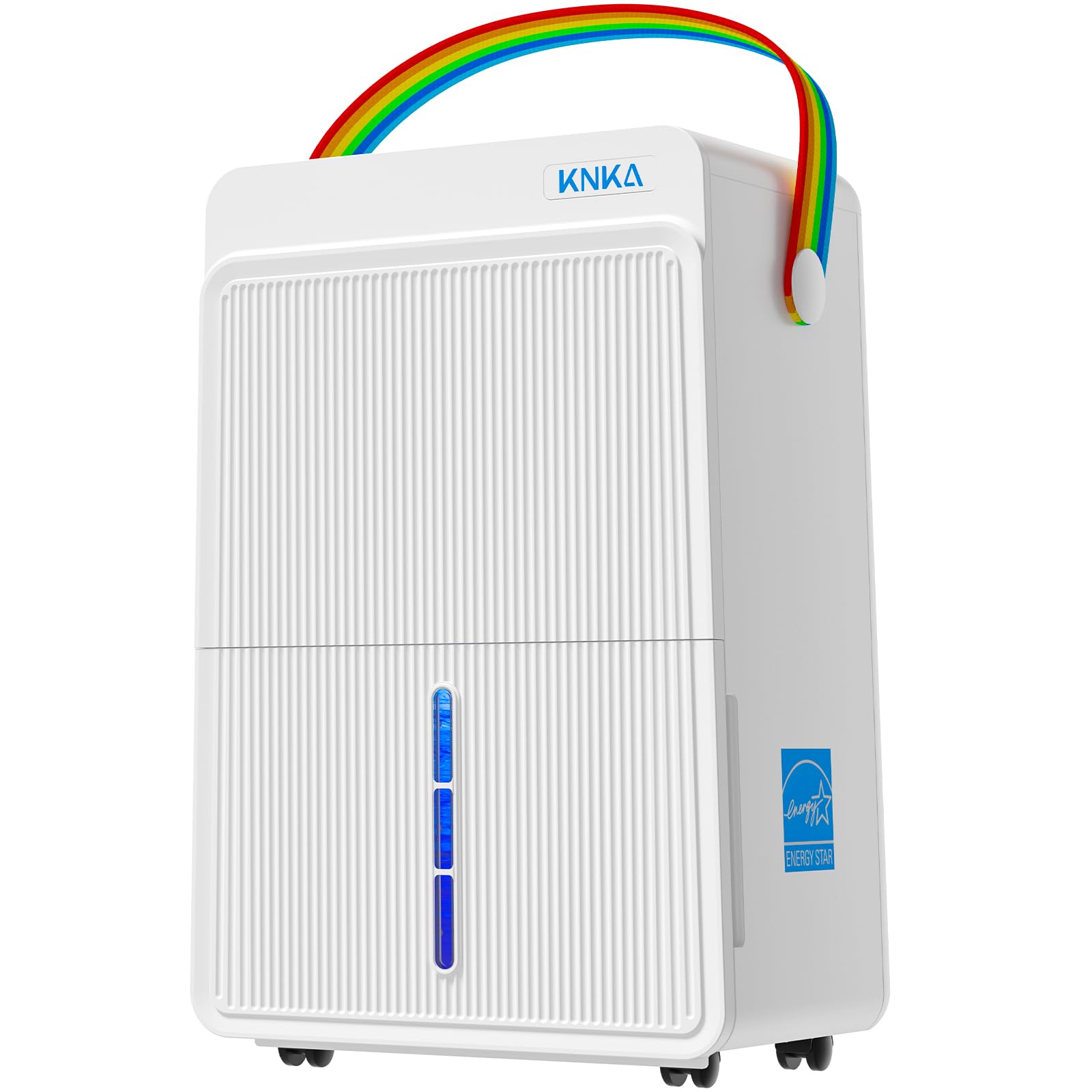
6. KNKA PD30MA-20 Dehumidifier
The moisture vacuum that removes 80 pints per day while operating quietly.
When your basement’s problem is dampness rather than dust, the KNKA PD30MA-20 is the right tool. It removes up to 80 pints per day in humid mid-summer conditions (95°F, 95% RH) and 56 pints per day in typical basement conditions (86°F, 80% RH). That is serious moisture removal for spaces up to 4,500 square feet. The Energy Star certification means it does it without punishing your electricity bill.
The noise level sits at 40-45 dB — quiet enough for a basement that doubles as a living space. The built-in 1.45-gallon tank is supplemented by a 6.56-foot drain hose for continuous drainage, and an optional 2.64-gallon external tank is available if you prefer less emptying. The humidity display shows real-time readings with a color-changing indicator light: you can glance at it from across the room and know whether your basement is in the comfort zone. Three smart modes cover most scenarios: AUTO at default 50% RH, DRY mode for faster drying, and SETTING mode for custom levels between 30% and 80% RH.
Owners praise the quick moisture removal and quiet operation. The 360-degree casters and rainbow-woven handle make it easy to maneuver, and the 12-hour timer supports energy-saving schedules. The catch is that this is a dehumidifier, not a particle filter — it handles moisture that feeds mold but does not capture airborne allergens. In a basement with both humidity and dust, you would pair this with a HEPA unit.
Basement use: basements with musty air, visible moisture, or humidity readings over 60%.
Quiet spaces: users who need particle filtration — this removes water vapor, not dust or pollen.
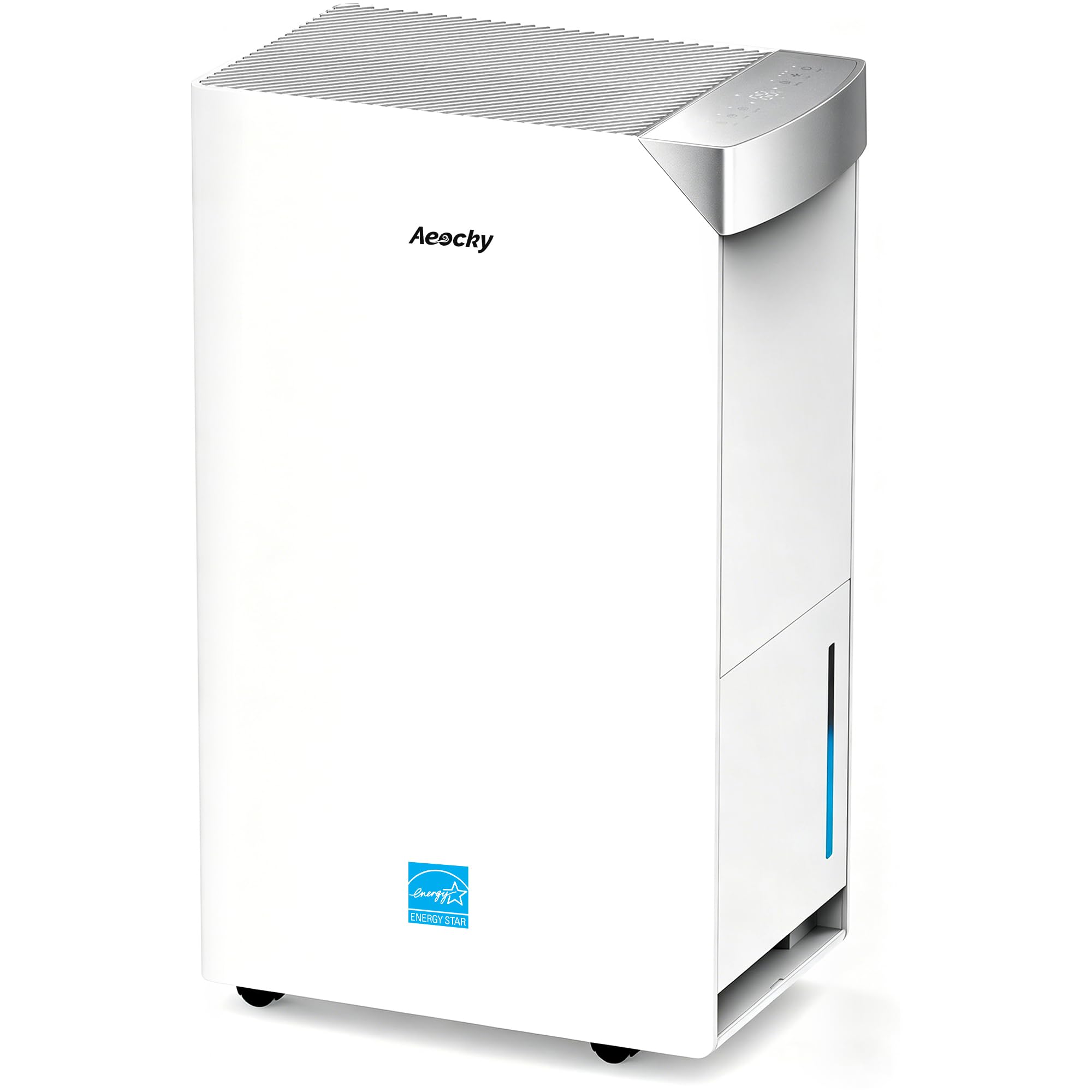
7. AEOCKY LEO-Lite Dehumidifier
The Energy Star Version 6.0 leader that promises significant savings on operating costs.
The AEOCKY LEO-Lite is built around Energy Star Version 6.0 compliance — the current highest standard for efficiency. It removes 74 pints per day in humid mid-summer (95°F, 95% RH) and 52 pints per day in typical basement conditions (86°F, 80% RH), covering up to 4,500 square feet. The Rotor Compressor Pro+ uses 7mm diameter high-tooth internal thread pure copper tubes (not aluminum, which fails faster) and a plastic-sealed AC motor driving a large biomimetic Archimedes Wind Tunnel for quiet operation.
The noise floor is 44 dB on the lowest fan speed, which owners describe as white noise — not silent, but unobtrusive. The smart humidity control uses a millisecond-level dynamic detection chip and a proprietary humidity compensation algorithm to keep the room within your target range. The auto-defrost system is a genuine differentiator for basements: it keeps working in cooler environments where many dehumidifiers frost up and shut down. At 31 pounds and measuring 14.4 x 8.6 x 23.3 inches, it is larger and heavier than the KNKA, but the hidden handle and casters make it manageable.
Reviewers point out it extracts 5-6 quarts in 12-13 hours in a furnished basement and eliminates all basement odor. One honest note from the reviews: actual performance at 77°F measured around 46 pints per day, lower than the 74-pint rating (which is at 95°F/95%RH). In cooler basements, the unit may not reduce humidity below 55%. The warranty covers 3 years for the unit, but a few owners had compressor issues resolved through responsive customer service.
Low power: energy-conscious buyers who run a dehumidifier 24/7 and want the lowest long-term power consumption.
Frequent emptying: actual moisture removal in typical basement temperatures is lower than the headline number.
8. Coway Airmega AP-1512HH
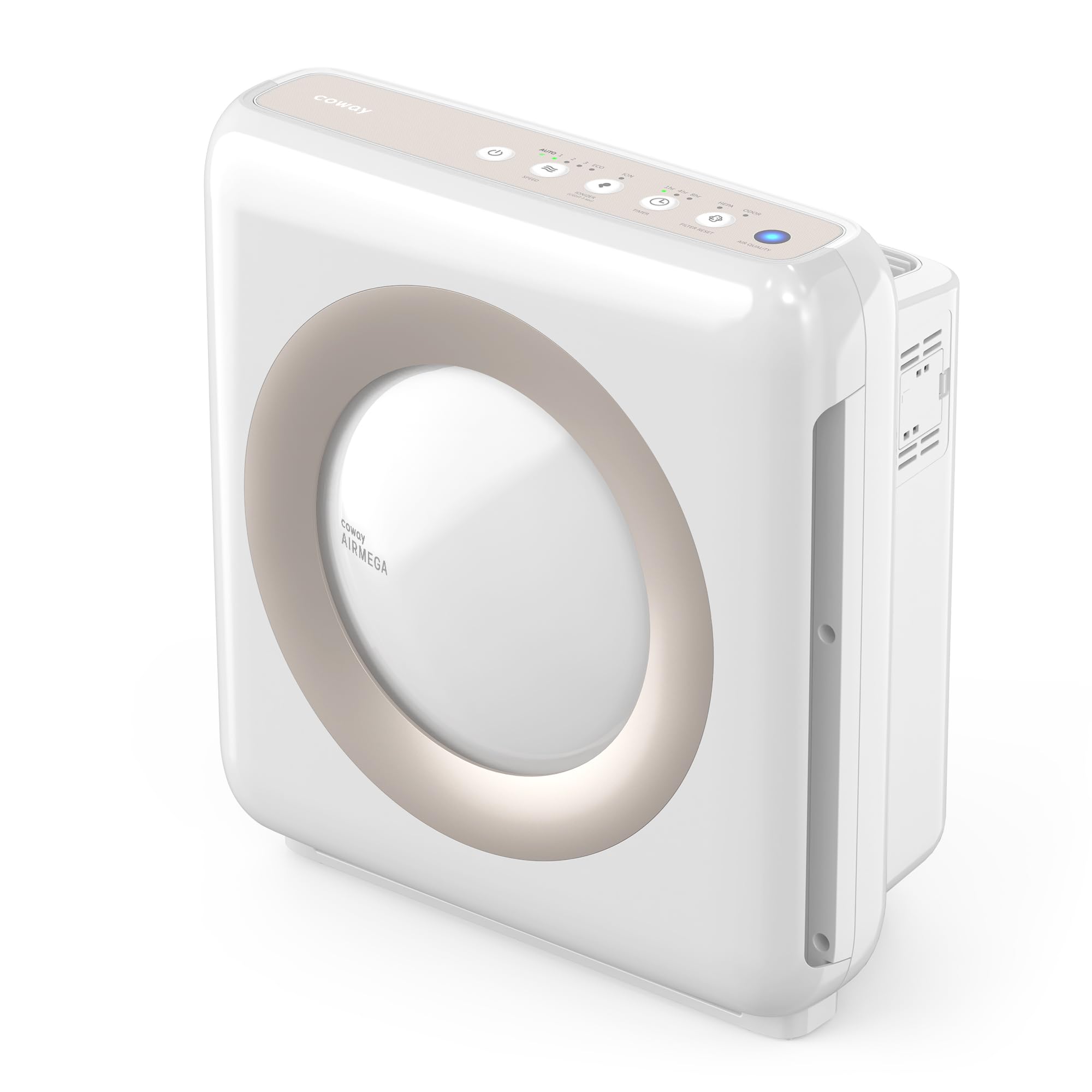
The Wirecutter legend that earned its reputation through years of real-world use.
The Coway Airmega AP-1512HH is among the most-reviewed, most-recommended air purifiers in the consumer space — it won Best Air Purifier of 2018 at Wirecutter and ranked first at TopTenReviews. Its 4-stage filtration system (pre-filter, deodorization filter, True HEPA, and Vital Ion) captures up to 99.97% of particles 0.3 microns, including pollen, pollutants, and allergens. The CADR ratings are solid at Dust 246 / Pollen 240 / Smoke 233 cubic feet per minute, covering rooms up to 361 square feet.
The pollution sensor communicates indoor air quality in real-time with a brightly colored LED. When no pollution is detected for 30 minutes, the fan automatically stops and switches to Eco mode to save energy. The noise level ranges from 24.4 dB to 53.8 dB — the lower end is practically silent, while the high setting is noticeable but effective for quick air turnover. Power consumption is 77 watts.
Owners note it is astoundingly effective: one reported it cleared wildfire smoke from red to blue in about 5 minutes. Another used it for 4 years primarily as a sleep aid, noting the fan frequency drowns out external noise. The honest factor here is that noise level is the most-discussed topic, and it earns a MIXED verdict from owners — some find it super quiet on low, others say the high setting is kinda loud. For a basement, that is rarely a problem since the space is often separate from main living areas. The filter replacements last about a year, and the unit weighs 12.5 pounds.
Living room: you want a decade of positive owner consensus and a unit that has been a standard recommendation for good reason.
Tight corners: this is a 361 sq ft unit — you may need two for a large basement, or run it continuously on medium.
9. DECIUU DER32S01-50 Dehumidifier
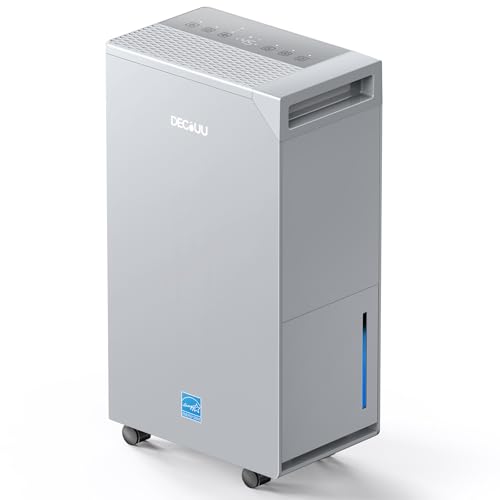
The 5,000-square-foot beast that moves water like a sump pump for the air.
The DECIUU DER32S01-50 is the highest-capacity unit on this list, removing up to 100 pints of moisture per day under high-humidity conditions (95°F, 90% RH) and 70 pints per day at 86°F and 80% RH. It covers spaces up to 5,000 square feet, which makes it the go-to for sprawling basements, garages, and crawl spaces. The ENERGY STAR Most Efficient 2024 certification means it meets the top tier of efficiency standards.
Three drainage options cover every scenario: a 1.45-gallon tank for spot collection, a 6.56-foot drain hose for continuous drainage, or a standard 3/4-inch garden hose adapter for extended operation with minimal maintenance. The intelligent humidity control lets you set a target between 35% and 80% RH, and the auto defrost technology ensures reliable performance in cooler basement temperatures where frost might otherwise stop a unit. The 360-degree swivel casters and hidden handle make it possible to move the 32.78-pound unit between rooms.
Shoppers say impressive results: one owner reduced humidity from 75% to 45-50% in a week, another dropped from 64% to 52% in 7 hours. Owners specifically note it is quieter than their previous Hisense unit and that the tank is easy to remove and pour. The catch from owner feedback is that the packaging can be an issue — the unit may rattle in transit due to oversized boxes, so inspect the unit carefully on arrival. The 2-year product protection adds confidence.
Garage use: the largest basements, especially unfinished ones where moisture is a clear, measurable problem above 60% RH.
Continuous drain: your basement is under 1,500 sq ft — this is overkill for a smaller space and you would be carrying extra weight and size.
Understanding the Specs
CADR (Clean Air Delivery Rate)
This number tells you how much air a purifier moves in cubic feet per minute. Higher CADR means faster cleaning. For a basement, look for a CADR of at least 200 CFM to cycle the air in a typical 500-square-foot basement roughly 4 times per hour. The AHAM Verifide seal means a third party confirmed the number — not all brands pay for this certification, so a unit without it may have inflated claims.
HEPA Grade: H13 vs H14
True HEPA captures 99.97% of particles at 0.3 microns — the most penetrating particle size. H13 (99.99%) and H14 (99.997%) are incremental improvements that matter most for very fine particles like mold spores and some smoke compounds. In a basement, the difference between H13 and H14 is small for most users, but allergy sufferers or those with respiratory conditions may notice the tighter tolerance.
Dehumidifier Pints Per Day
This is the moisture removal rate, typically measured at two conditions: high (95°F, 95% RH) and basement-standard (86°F, 80% RH). The lower number is what you will actually get in a cool basement. A 70-pint unit in a 1,000-square-foot basement is usually adequate. Anything above 50 pints counts as high capacity. Energy Star certification ensures the unit does not waste power running for hours.
Sleep Mode and Decibel Levels
Decibels (dB) measure noise. A difference of 3 dB is a noticeable change. Below 25 dB is near-silent — you have to listen for it. 25-35 dB is the level of a quiet refrigerator hum. 40-50 dB is noticeable but not disruptive, comparable to moderate rainfall. For a basement that doubles as a bedroom or office, prioritize units under 30 dB in sleep mode.
FAQ
Do I need an air purifier or a dehumidifier for my basement?
Can one unit handle a whole basement?
What is the difference between HEPA, H13, and H14 filters?
How often should I replace the filter in a basement air purifier?
Will a dehumidifier help with mold?
What CADR rating do I need for a basement?
Is a washable pre-filter worth it?
Can a basement air purifier help with radon?
How loud is too loud for a basement air purifier?
Should I leave my basement air purifier on all the time?
Final Thoughts: The Verdict
For most basements, the air filter for basement winner is the LEVOIT Core 300-P because it brings AHAM-verified performance, near-silent 24 dB operation, and proven owner satisfaction across tens of thousands of reviews. If your primary issue is humidity rather than dust, grab the KNKA PD30MA-20 for its 80-pint/day capacity and quiet 40-45 dB operation. And for the largest finished basements where both particle and odor control matter, the DAYETTE AP303 delivers H14-grade filtration and dual-sided intake at a mid-range price that outperforms many more expensive alternatives.
How We Picked
We do not accept paid placement. Every pick is matched to a real buyer and a real use-case; we do not hands-on test units.
Sources & Methodology
Specifications: manufacturer listings and product documentation. Review insights: verified customer reviews, as of July 2026. Pricing: not shown on this page (it changes often); check the current price via the retailer link.
As an Amazon Associate, Gadgets Feed earns from qualifying purchases. This does not affect which products we feature.