
Our readers keep the lights on and my morning glass full of iced black tea. As an Amazon Associate, I earn from qualifying purchases.
Specs are compiled from manufacturer listings and verified buyer reviews and can change over time — please confirm the key details on the product page before buying.
I’m Min — the founder and writer behind Gadgets Feed. This guide is built by comparing the manufacturers’ published specifications and the patterns across verified customer reviews, so you get each pick’s real strengths and trade-offs instead of marketing spin.
After comparing the specs and real buyer experiences for five models, here is the breakdown you need to choose the right air filter for dust mites for your home and your budget.
Quick Picks
- WINIX 5520 Air Purifier — Best Overall
- Clorox Turbo Air Purifier — Premium Pick
- Medify MA-14 Air Purifier — Great Value
- ECOSELF HAP603 Air Purifier — Silent Giant
- Crane EE-5077 True HEPA Air Purifier — Bedroom Fit
How To Choose The Best Air Filter For Dust Mites
Here is what makes the difference between a filter that helps and one that just hums.
Prioritize True HEPA, not “HEPA-like” or “HEPA-style”
A True HEPA filter is a mechanical standard. It physically traps particles down to 0.3 microns in size, which covers dust-mite allergens. Many budget models use vague terms like “HEPA-type” or “electrostatic” — these do not meet the same standard. For dust mites, stick with a True HEPA filter.
Match the room size to the CADR
CADR (Clean Air Delivery Rate, the measure of how fast the filter cleans the air in cubic feet per minute) tells you the volume of air a filter can clean per minute. A filter rated for 300 sq ft will struggle in an 800 sq ft living room. Look for a model whose maximum room coverage is at least as large as the room you plan to use it in. Using a unit in a room bigger than its rating means the air never gets fully cleaned.
Check the noise level at low speed
Because you will likely run this filter while you sleep, the noise level at its quietest setting is a critical spec. A unit rated at 22 dB or 23.5 dB is nearly silent — akin to a quiet room. A unit at 55 dB is closer to a conversation level and may disrupt sleep. If you need a filter for a nursery or a shared bedroom, prioritize the decibel rating on the lowest fan speed.
Factor in ongoing filter costs
The unit itself is just the start. A cheap machine with expensive, hard-to-find filters can cost you more over two years than a pricier unit with affordable replacements. Always check the price and availability of the official replacement filter before buying the main unit.
Quick Comparison
| Model | Best For | Room Coverage | Noise Level | Weight | Amazon |
|---|---|---|---|---|---|
| WINIX 5520 | Large smart rooms | 1,882 sq ft | 23.5 dB | 13.3 lbs | $179.99Amazon |
| Clorox Turbo | Medium room speed | 1,000 sq ft | Whisper quiet | 5.2 lbs | $99.95Amazon |
| Medify MA-14 | Small to mid rooms | 470 sq ft | 55 dB | — | $88.99Amazon |
| ECOSELF HAP603 | Huge room coverage | 2,400 sq ft | 22 dB | 6.92 lbs | $89.99$148.99Amazon |
| Crane EE-5077 | Bedrooms & nurseries | 300 sq ft | Whisper quiet | 4.44 lbs | $99.99Amazon |
In‑Depth Reviews
1. WINIX 5520 Air Purifier
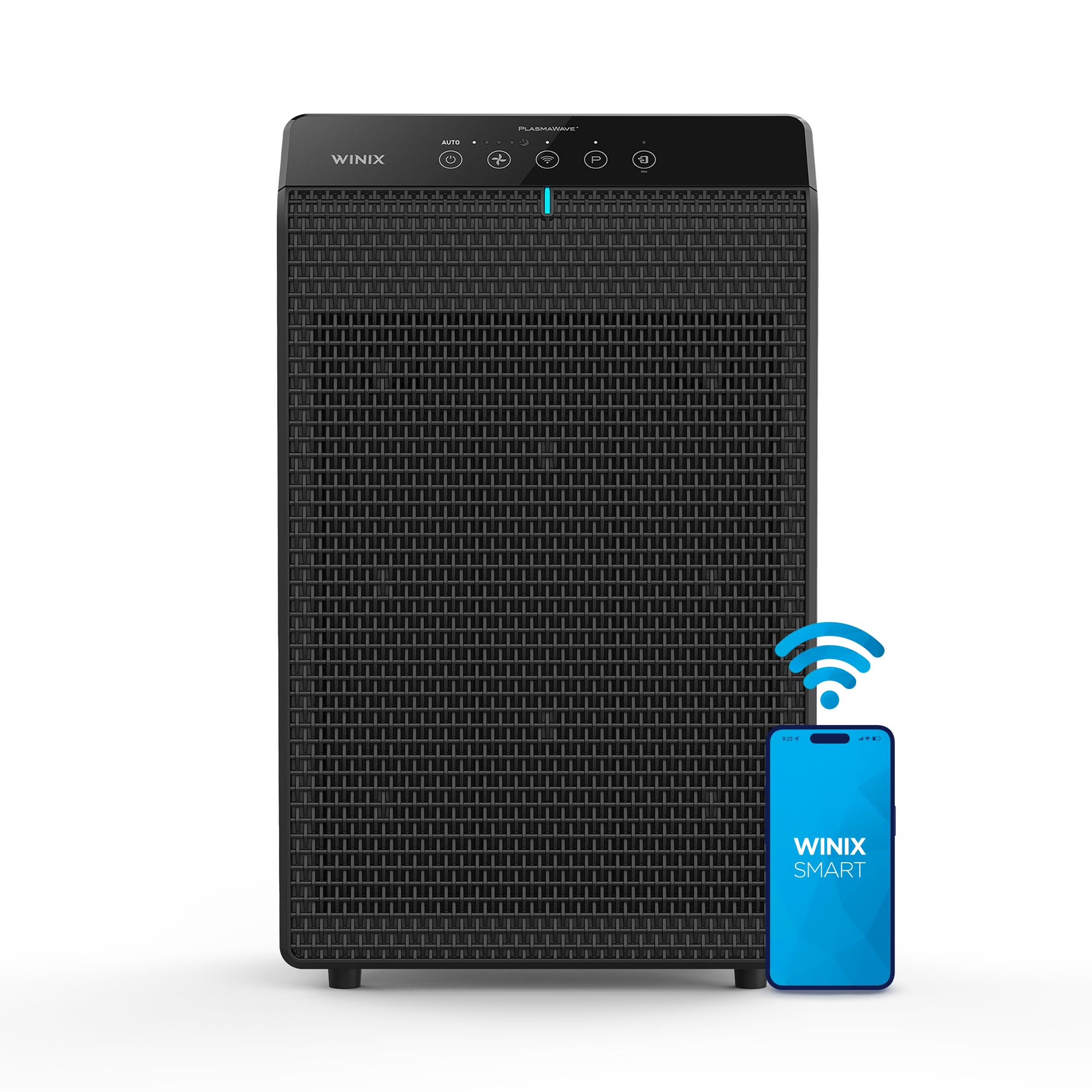
The powerhouse that scrubs the air in large open spaces nearly silently.
This is the filter to pick if you want the air quality displayed, the fan speed adjusted automatically, and the whole thing controlled from your phone. The WINIX 5520 uses a four-layer system: a washable pre-filter that traps big stuff first, a deodorizing carbon filter for cooking and pet smells, a True HEPA filter that catches the microscopic dust-mite debris, and a PlasmaWave ionizer. The air quality sensor measures particles in real time and shows them with a color-coded indicator (blue for good, orange for fair, red for poor), switching to Auto Mode to speed up or slow down as needed.
At its quietest setting, the unit hums along at 23.5 dB — the ECOSELF model runs at 22 dB, though both are nearly silent. Buyers report that the “auto mode adjusts speed based on dust” and that the “app and Alexa/Google Home control” works well for remote scheduling. The replacement HEPA and carbon filters are thicker than many competitors, lasting about 12 months,
The catch is weight and size. At 13.3 pounds and 22.7 inches tall, this is the heaviest unit here, . You are not going to move it from room to room; it is a low-maintenance machine for a specific large space.
Reasons to pick this
- Covers up to 1,882 sq ft in one hour and fits rooms as large as that: one of the widest ranges here
- Real-time air quality monitor with smart Auto Mode adjusts fan speed on its own
- At 23.5 dB on the lowest speed, it is nearly silent for bedrooms or nurseries
What to know before buying
- Alexa integration is finicky — owners mention it requires the Winix app and a QR code scan
- At 13.3 lbs, this is a stationary unit best left in one room
Best for the whole-home hunter: This is the pick if you want dust-mite control across a large living area or open floor plan, plus the convenience of app and voice control.
The one limitation to know: The weight (13.3 lbs) means you probably will not move it between rooms — commit it to one spot.
2. Clorox Turbo Air Purifier
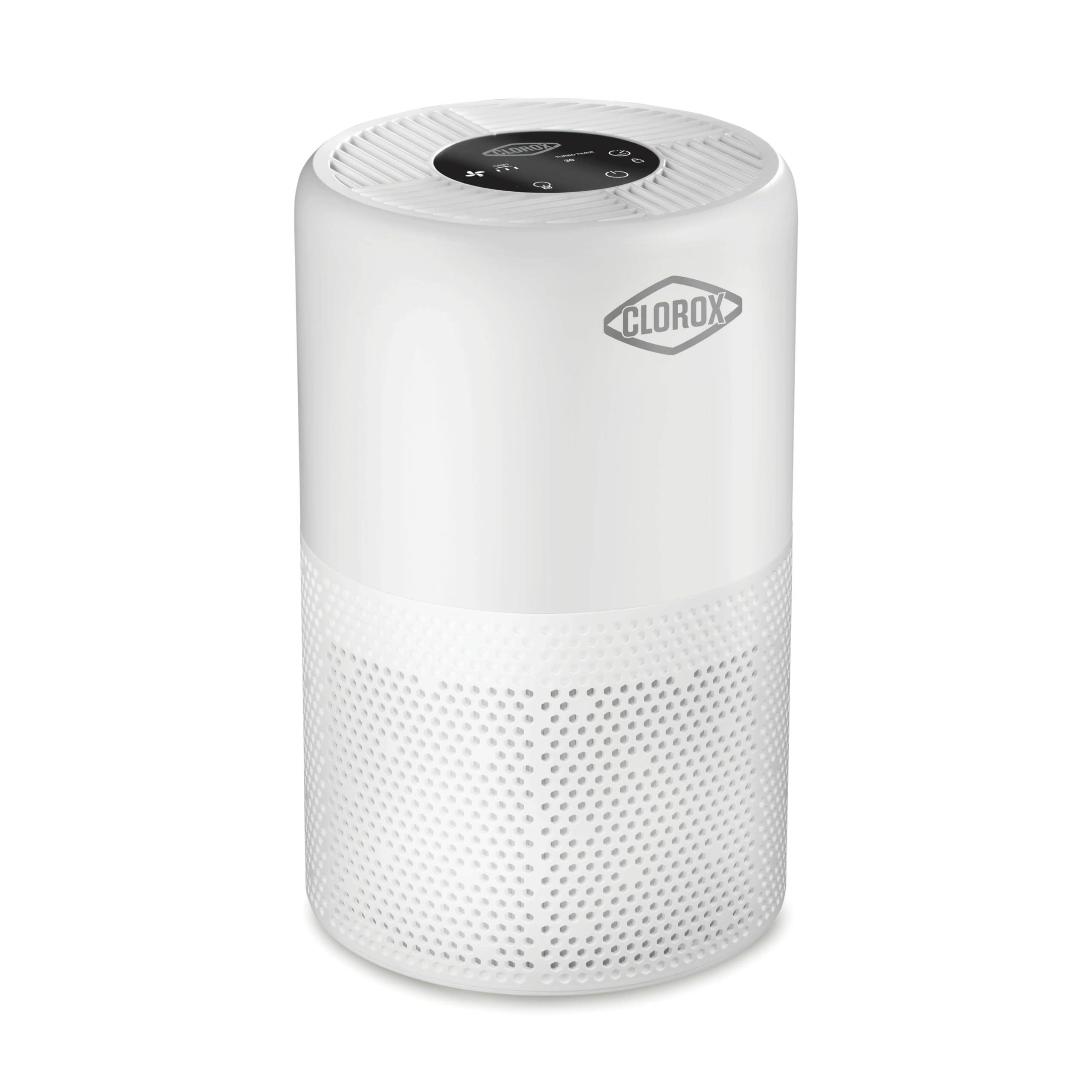
The medium-room specialist that can blast a kitchen or bedroom clean in minutes.
If you need to clean a large room fast, the Clorox Turbo pulls air from all sides through a three-stage system. First, a pre-filter catches large particles like hair. Then a True HEPA filter (a dense fiber mat that traps 99.97% of particles as small as 0.3 microns, including dust-mite debris) captures allergens. Finally, an activated carbon filter absorbs cooking smells and VOCs (volatile organic compounds — airborne chemicals from cleaners and paints). It covers a room up to 1,000 sq ft, compared to the Crane model’s 300 sq ft, so it works well in open living spaces.
A standout feature here is the Turbo Timer. You can set it for 10, 20, or 30 minutes of maximum airflow to clear out smoke or kitchen odors quickly, then it automatically drops back to a lower speed. At the first speed, customers note it is “near-silent,” and at Turbo it gets louder, so this is less ideal for a nightstand but great for a kitchen or living area where you need bursts of power. One reviewer noted their allergies improved after placing it in their room.
At 5.2 pounds, it is noticeably lighter than the bulky WINIX (13.3 lbs) and sits in a compact 13.78-inch tall body. The filters need replacing every 6 to 12 months, and the monthly cleaning of the pre-filter is straightforward. The only real omission is the lack of a built-in air quality display — you do not get a real-time PM2.5 number like you would on the ECOSELF or WINIX units.
Quick cleaning champ: If you want to blast dust-mite allergens out of a medium-sized bedroom or living room in a short burst and appreciate the flexibility of a timer, the Clorox is a strong, lightweight contender.
Trade-off to note: There is no air-quality screen or smart app — this is a manual, no-frills approach to clean air.
Reach for this if: you have a medium room (up to 1,000 sq ft) and you want a lightweight, fast-cleaning unit with a dedicated turbo mode for cooking odors or allergen spikes.
Look elsewhere if: you want to monitor your air quality in real time or control the filter from your phone.
3. Medify MA-14 Air Purifier

The compact unit that punches above its size in a small to mid room.
If your goal is to clean a single bedroom or a small apartment living room of dust-mite allergens without spending too much, the Medify MA-14 is a natural fit. Its True HEPA H13 filter traps 99.9% of particles down to 0.3 microns — that is finer than the standard 0.3-micron requirement, meaning it captures even the tiniest mite debris. It covers up to 470 sq ft in one hour, which puts it squarely between the smaller Crane (300 sq ft) and the larger Clorox (1,000 sq ft).
The noise is where the Medify separates from the pack. At a maximum of 55 dB, it is significantly louder than the ECOSELF at 22 dB On low speed it is described as “virtually silent,” but the top speed is distinctly audible. Reviewers point out that “speeds 1-3 are quiet; high is loud,” so this is best used on auto or lower speeds while you sleep. One buyer mentioned that after 24 hours, their daughter slept well with no stuffy noses and the house smelled fresh despite pets.
The main downside is the ongoing filter cost. The official replacement filter (B07VF25QJ6) lasts about 2,500 hours (roughly 3–4 months of continuous use) and costs more than the WINIX replacements. The unit is backed by a USA-registered Lifetime Warranty against manufacturing defects. Its dimensions are 20 x 15.2 x 11 inches, so it takes up more floor space than the slender ECOSELF (6.3 x 12.2 x 15.75 inches).
Where it shines
- True HEPA H13 filter captures particles down to 0.3 microns, beating the standard 0.3-micron spec
- Covers up to 470 sq ft, ideal for a larger bedroom or combined living space
- USA-registered Lifetime Warranty adds long-term protection
Where it falls short
- 55 dB max noise level is loud on high — not the quietest pick for a nursery
- Replacement filters last only 3-4 months
Best for the single-room warrior: This is your pick if you want a strong H13-rated filter for a medium bedroom and you are fine replacing the filter every few months to keep that performance.
skip it if: you want a very quiet machine for sleeping or you want low long-term filter costs; the ongoing expense here is steeper than the competition.
4. ECOSELF HAP603 Air Purifier
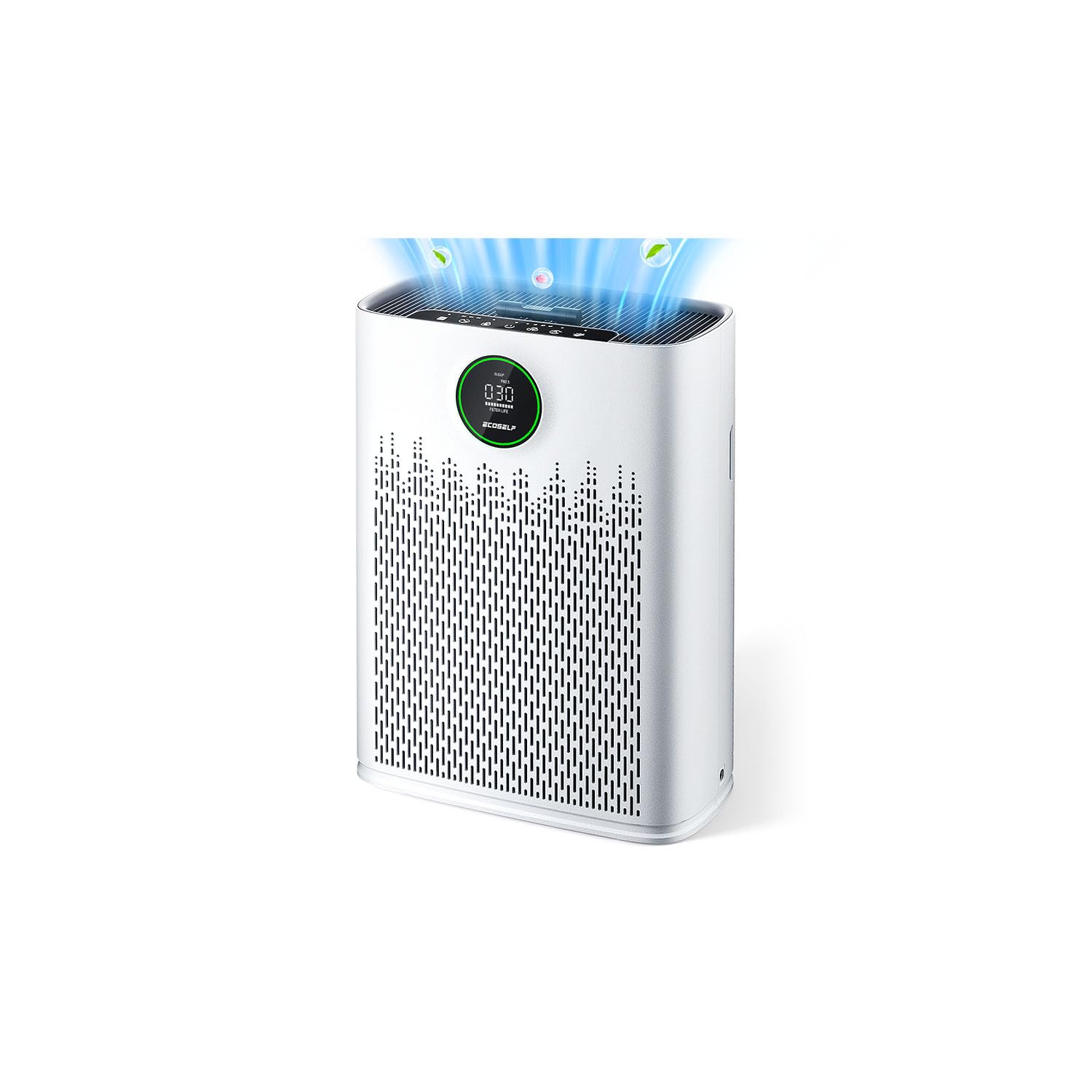
The near-silent workhorse that covers huge spaces without waking anyone.
This ECOSELF model was built to solve one specific problem: cleaning a very large room without making a sound. At 22 dB on its Sleep Mode, it is quieter than the WINIX (23.5 dB) and dramatically quieter than the Medify MA-14 (55 dB). The 2.5x noise gap between this and the Medify means you can place this in a nursery or a master bedroom without hearing it. It covers an enormous 2,400 sq ft — far larger than the Clorox Turbo (1,000 sq ft) — making it one of the few units that can handle a big basement, garage, or open-concept apartment.
The unit also features a PM2.5 display and an infrared sensor that shows the current air quality and automatically adjusts the fan speed to match. Shoppers say sinus congestion and itchy eyes cleared within 24 hours of using it. A useful bonus is the aromatherapy function, which allows you to add a few drops of scented oil to the reservoir for a gentle fragrance — though one owner reported the scent is “short-lived.”
Its slim dimensions (6.3 x 12.2 x 15.75 inches) mean it tucks into a corner easily. The catch is that ECOSELF recommends using only its own official replacement filter, which you must track down through the brand’s store to maintain warranty coverage and performance. Off-brand filters, the company warns, may compromise the seal and filtration quality.
Big room, no noise: If you need dust-mite filtration for a large space and you cannot tolerate a humming machine in your bedroom or baby’s room, the ECOSELF delivers the best silence-to-coverage ratio in this list.
What to watch for: Stick to the official ECOSELF replacement filters to keep the warranty valid and the performance up to spec; don’t buy off-brand.
Best for the silence seeker: This is the filter to grab if you have a large room (up to 2,400 sq ft) and you need the absolute quietest operation — 22 dB is library-level quiet.
Look elsewhere if: you want a brand with broadly available replacement filters at big-box retailers; the official ECOSELF filters may be less convenient to source.
5. Crane EE-5077 True HEPA Air Purifier
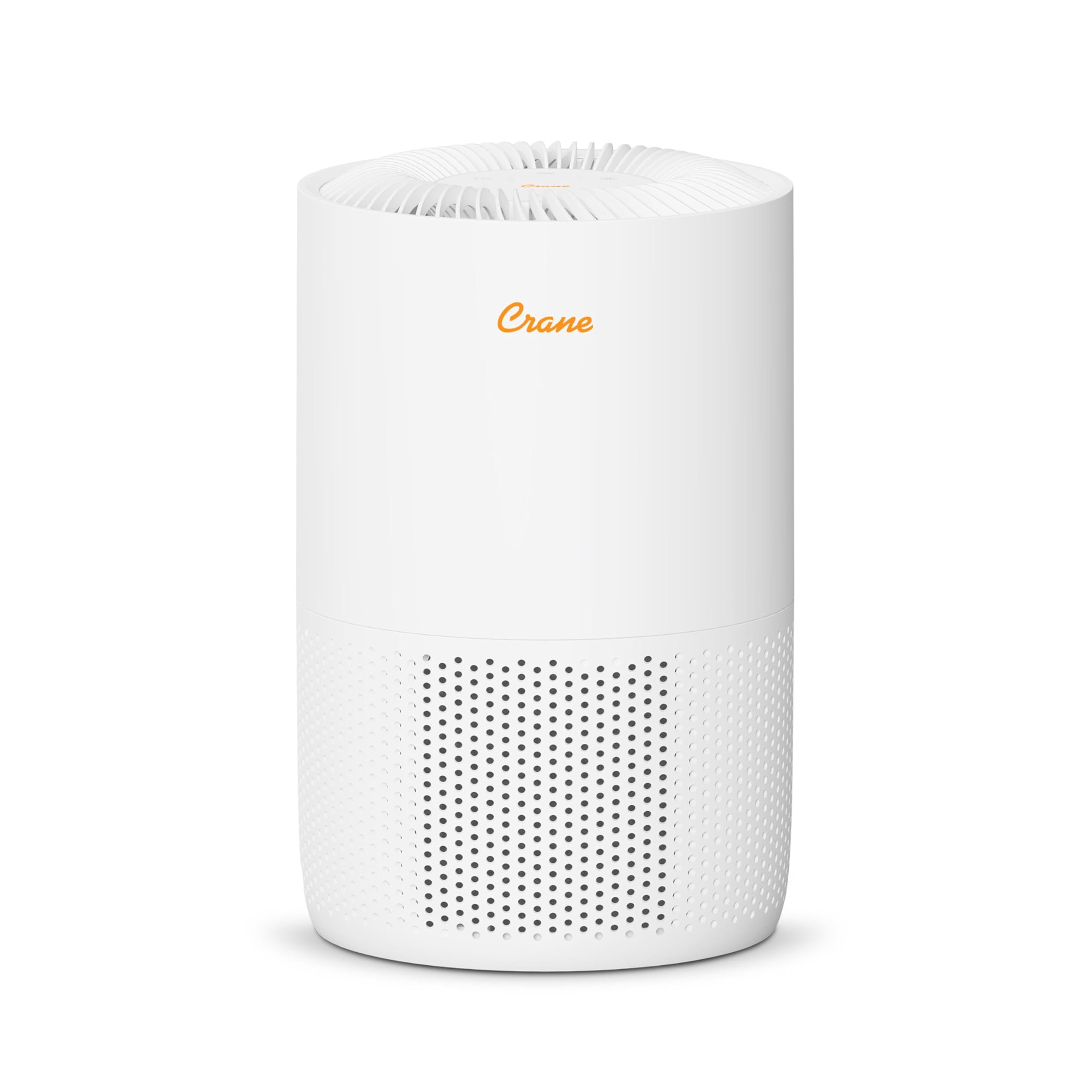
The compact bedside ally built specifically for small bedrooms and nurseries.
Where the ECOSELF and WINIX are built for whole-home coverage, the Crane is a dedicated bedroom companion for up to 300 sq ft. Its True HEPA filter removes 99.95% of airborne particles — a slightly tighter spec than the standard 99.97%, but still well within the range that traps dust-mite debris. At 4.44 pounds, it is the lightest unit here, more portable than the ECOSELF (6.92 lbs) and much easier to move than the WINIX (13.3 lbs).
For a nursery or a child’s room, the child lock feature is a genuine safety advantage. It prevents little hands from turning the fan speed or turning the machine off. The timer also runs at 2, 4, or 8 hours, so you can set it to run only through the night and save power during the day. Buyers report that a husband’s severe allergies improved from stuffy and runny nose to much better breathing with the filter. and that the nightlight is a welcome addition for overnight use.
The limitation is the coverage. At 300 sq ft, this unit covers roughly the same area as a large bedroom, and its coverage area is 300 sq ft, while the Clorox Turbo covers 1,000 sq ft. It is not meant for open-floor plans. The unit’s simple design also lacks an air quality sensor or auto mode — you control the three fan speeds manually. It is whisper-quiet on sleep mode, making it ideal for sensitive ears.
Perfect for
- Child lock prevents curious kids from accidentally changing settings
- Weighs just 4.44 lbs, making it easy to move from a nursery to an office
- Timer options of 2, 4, or 8 hours help you save energy overnight
Not ideal for
- Limited to 300 sq ft — will not keep up in a large living room or open plan
- No automatic air quality monitoring or auto mode; you adjust fan speeds manually
Best for the nursery or small bedroom: If you need a light, quiet, compact filter with a child-safety lock and a simple timer for a room up to 300 sq ft, the Crane is a perfect fit.
pass on it if: you need coverage for a larger space or you want a filter that adjusts itself based on the air quality; this is a manual machine.
Understanding the Specs
True HEPA vs HEPA-type
A True HEPA filter is a mechanical standard that traps at least 99.97% of particles that are 0.3 microns in diameter. Dust-mite allergens are around 10 to 20 microns, and the fecal pellets they leave behind are about the same size. A True HEPA filter catches these easily. “HEPA-type” or “HEPA-like” filters do not meet this standard and may let smaller allergen particles slip through. For dust-mite control, always look for the words “True HEPA” on the box.
Noise Level (dB)
Decibels (dB) measure sound pressure. Normal conversation is around 60 dB. A quiet bedroom at night is around 30 dB. A filter at 22 dB is nearly silent — you will have to put your ear near it to hear it. A filter at 55 dB is about as loud as a conversation or a fan on medium speed. If you are a light sleeper or placing the filter in a nursery, look for models rated at or below 23.5 dB on their lowest setting.
CADR and Room Coverage
CADR stands for Clean Air Delivery Rate, measured in cubic feet per minute (CFM). It tells you how fast a filter cleans a specific room size. A higher CADR means faster cleaning. Manufacturers also list a maximum room coverage in square feet — this is the largest room the filter can clean in one hour if the unit runs continuously. A filter rated for 1,000 sq ft can clean a 1,000 sq ft room once per hour. In a larger room, the air would not get fully cleaned.
Filter Replacement Schedule
Every air filter needs its True HEPA filter replaced. A typical replacement interval is 3 to 12 months, depending on usage and air quality. Some units have a washable pre-filter that you clean with a vacuum or water monthly, which extends the life of the main HEPA filter. Always check the cost and availability of the OEM (Original Equipment Manufacturer, the brand’s own) filter before buying the unit. A cheap machine with expensive filters can cost you more over two years than a pricier unit with affordable replacements.
FAQ
Do I need a True HEPA filter for dust mites?
What room size air filter do I need for a bedroom?
How often do I need to change the filter?
Can an air filter get rid of dust mites completely?
Is it better to run the filter all day or just at night?
What does the CADR rating mean?
Are there filters that destroy dust mites instead of just trapping them?
What is the difference between a HEPA filter and a carbon filter?
How do I know when to change the filter without an indicator light?
Final Thoughts: The Verdict
For the majority of shoppers, the best air filter for dust mites overall is the WINIX 5520 because it balances the widest room coverage (1,882 sq ft) with near-silent operation (23.5 dB) and smart auto-adjusting controls. If you want the absolute quietest filter for a large open space and do not need app control, the ECOSELF HAP603 delivers 22 dB silence with a real-time air quality display. And for a dedicated nursery or small bedroom, the Crane True HEPA is a lightweight, child-safe, whisper-quiet option that fits on a nightstand.
How We Picked
We do not accept paid placement. Every pick is matched to a real buyer and a real use-case; we do not hands-on test units.
Sources & Methodology
Specifications: manufacturer listings and product documentation. Review insights: verified customer reviews, as of July 2026. Pricing: not shown on this page (it changes often); check the current price via the retailer link.
As an Amazon Associate, Gadgets Feed earns from qualifying purchases. This does not affect which products we feature.
Related Guides
Product prices and availability are accurate as of the date/time indicated and are subject to change. Any price and availability information displayed on Amazon at the time of purchase will apply to the purchase of this product. As an Amazon Associate I earn from qualifying purchases.
CERTAIN CONTENT THAT APPEARS ON THIS SITE COMES FROM AMAZON. THIS CONTENT IS PROVIDED "AS IS" AND IS SUBJECT TO CHANGE OR REMOVAL AT ANY TIME.
Amazon and the Amazon logo are trademarks of Amazon.com, Inc. or its affiliates.