
Our readers keep the lights on and my morning glass full of iced black tea. As an Amazon Associate, I earn from qualifying purchases.
Specs are compiled from manufacturer listings and verified buyer reviews and can change over time — please confirm the key details on the product page before buying.
You want to know if the air inside your home is actually clean, but the numbers on these little devices can feel like a confusing mess. This guide cuts through the jargon to help you pick an air filter sensor that gives you honest, useful readings for your specific space.
I’m Min — the founder and writer behind Gadgets Feed. This guide is built by comparing the manufacturers’ published specifications and the patterns across verified customer reviews, so you get each pick’s real strengths and trade-offs instead of marketing spin.
Whether you are tracking wildfire smoke, keeping a nursery safe, or just curious about your bedroom’s CO2, we break down which air filter sensor actually earns a spot on your shelf with clear, plain-English guidance.
Our Picks at a Glance


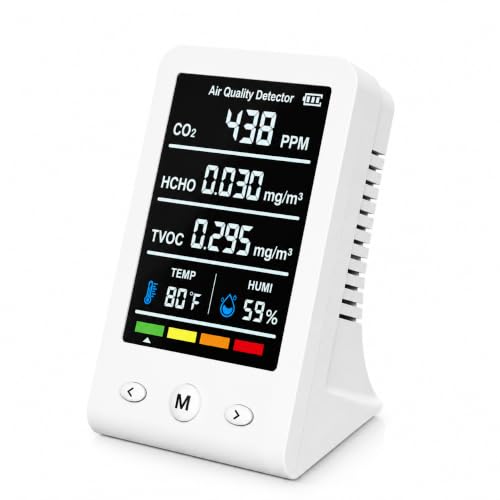
How To Choose The Best Air Filter Monitor
Most people shop for these by looking at how many things the device can detect. A “16-in-1” sounds better than a “5-in-1,” but the real question is whether those extra readings are accurate enough to trust.
Match the Sensor to the Problem
Start with why you want one. If you are worried about wildfire smoke, you need a reliable PM2.5 particle counter. If you are trying to ventilate a stuffy bedroom or office, you need a CO2 monitor with a decent accuracy rating. Knowing your primary goal stops you from overpaying for features you will never use.
Check the Real-Time Response
Air quality can shift in seconds. A sensor that only updates every few minutes will miss the spike when you are cooking or the drop when you open a window. Look for devices that sample every second or two, so you see what is happening right now, not what happened ten minutes ago.
Consider the Battery Reality
A long battery life on the spec sheet is great, but a monitor that dies overnight isn’t. Check if the device can run plugged in for continuous use, and remember that some high-drain sensors will struggle to hit their promised run times. Decide if you want a portable gadget or a dedicated wall unit.
Quick Comparison
| Model | Best For | Key Pollutants | Response Time | Portability | Amazon |
|---|---|---|---|---|---|
| SwitchBot CO2 Detector★ Best Overall | Smart home integration | CO2, Temp, Humidity | 1 second | Yes (4.8 oz) | Amazon |
| Temtop S1+Best Value | Portable daily checks | PM2.5, AQI, Temp, Humidity | 3 min auto | Yes | Amazon |
| Dienmern 8-in-1Budget Champion | Budget-friendly all-rounder | CO2, AQI, HCHO, TVOC | 1 second | Yes (1600mAh) | Amazon |
| LifeBasis 11-in-1 | Colour-coded simplicity | CO2, PM, HCHO, TVOC | Fast | Yes (2500mAh) | Amazon |
| Sainlogic 16-in-1 | Whole-room viewing | CO2, PM, HCHO, TVOC | 1.5 seconds | Yes (2500mAh) | Amazon |
| YNAK 16-in-1 | Wildfire season alerts | CO2, PM, HCHO, TVOC | Fast | Yes (10.56 oz) | Amazon |
| AirKnight AT1000 | VOC and fume spotting | CO2, PM, TVOC, HCHO | 1.5 seconds | Yes (3000mAh) | Amazon |
| EG Air Quality Monitor | Multipurpose spot checks | PM2.5, TVOC, HCHO | Real-time | Yes (2200mAh) | Amazon |
| BREATHE Airmonitor Plus | Data lovers and trend trackers | CO2, PM, TVOC, HCHO | Real-time | Yes (6 hrs) | Amazon |
In‑Depth Reviews
1. SwitchBot CO2 Detector
Our pick — over 4★ from 300+ verified ratings; the strongest balance of quality and price.
The smart-home pick with a precision Swiss sensor that syncs with your life.
You will know exactly when to crack a window because this sensor checks CO2 every 1 second with an accuracy of ±50 ppm across a range of 400-9000 ppm. It uses a Swiss-made NDIR sensor (a light-based method that detects gas), which is the most reliable tech for CO2. The 92-millimeter screen shows CO2, temperature, humidity, time, date, and a comfort level all at once, so you skip the menu hunting.
What makes it stand out is how it fits into a connected home. The review consensus lands on a 4.3-star crowd favorite, praised for ease of use and a readable display. What wins people over here, though, is its compatibility — owners say the readings track closely against other quality monitors, and it works directly with Home Assistant without needing extra hardware for basic use. It offers three alert methods: audible, visual on the screen, and app notifications (the app alerts need a separate SwitchBot Hub).
There is a trade-off. Some buyers report inconsistent readings if the unit isn’t given fresh air, and plug-in mode can occasionally show “frozen” readings for hours. Switching to battery mode, where it checks every 5 minutes, solves that quirk. Battery operation is silent and efficient, so it works as a discreet guardian for a bedroom or office.
What Makes It a Winner
- Rapid 1-second response for real-time CO2 tracking
- Works with Home Assistant for smart automation
- Large, easy-to-read display shows five data points
- Solid build quality that owners trust
The Honest Trade-Offs
- App alerts require an extra SwitchBot Hub
- Readings can occasionally feel slow to update
- No dark color options for discreet placement
Reach for this if: you want a reliable CO2 watchdog that plays nicely with your existing smart home gear and gives you fast, accurate feedback
Think twice if: you need loud, obvious alerts without buying additional hub hardware, or you want a gadget that covers more than just CO2
2. Temtop S1+ Smart Air Quality Monitor
The set-and-forget guardian with two months of battery in a pocket-sized body.
This one is for people who just want to glance at a number without fussing over chargers. The Temtop S1+ tracks PM2.5, AQI, temperature, and humidity, and its real superpower is the up to 60-day battery life — that means you are charging it roughly once every two months, not every night. It is compact and discreet, so it fits into a nursery, classroom, or office without looking like a lab instrument.
The review data shows a clear split. Quality is the headline praise, and owners with respiratory sensitivities call it brilliant for keeping tabs on air quality and humidity. PM readings respond well to open windows and HEPA filters — meaning when you improve the air, you see it on the screen. But the display has a quirk: owners note it is hard to read from more than 10 feet away, so you’ll want it close to where you sit. Accuracy gets mixed feedback, with some finding it spot-on and others finding it unreliable compared to official outdoor readings.
Before you buy, know the measurement intervals. It samples automatically every 3 minutes, every 30 minutes in eco mode, and every 1.5 seconds when plugged in. For fast updates, you must keep it connected to power. And the companion app has been described as problematic when servers are down, so treat it as a bonus rather than a core feature.
Great pick if: you want a simple, long-lasting PM2.5 and humidity tracker at a comfortable price. The battery life alone separates it from most rivals in this range.
Not the one if: you need lightning-fast readings on a wireless device, or you rely on a flawless companion app for your data.
3. Dienmern 8-in-1 Indoor Air Quality Monitor
A palm-sized all-rounder that tracks eight air factors while staying affordable.
For a budget-friendly entry into air quality monitoring, this little device covers a lot of ground. It tracks CO2, AQI, temperature, humidity, HCHO (formaldehyde), and TVOC (volatile organic compounds — the gases from paints and cleaners) in real time, refreshing every second. The 1600mAh rechargeable battery promises up to 72 hours of continuous use on a single charge, and it charges via USB-C, which is convenient for travel.
Owners appreciate the clear display, the beep on high levels, and the fact that it actually shows CO2 numbers rather than just an alarm. It arrived quickly and set up easily, with temperature and humidity readings matching other monitors. The value-for-money angle is strong — it does a lot for the price.
The catch is accuracy. While many find it stable, there are reports of CO2 readings spiking to 5000 ppm indoors (which would be unhealthy) while showing healthy levels outdoors — a classic sign of a unit that needs recalibration. Restarting it without recalibration only fixes things temporarily. If you need a trustworthy CO2 number for health decisions, this budget flexibility comes with a trust cost.
Choose it for: a compact, feature-packed monitor that offers great visual feedback and solid value. It’s perfect for getting a general sense of your air quality.
Be aware: the CO2 accuracy can drift, so it’s best for relative trends rather than absolute health-critical readings.
4. LifeBasis 11-in-1 Air Quality Monitor

The straightforward choice with clear color alerts that anyone can understand at a glance.
If you don’t want to decode numbers, this monitor translates air quality into colors. It tracks 11 different indices — including AQI, CO2, PM1.0, PM2.5, PM10, HCHO, and TVOC — and color-codes each one from Good (Green) to Abnormal (Red). When levels exceed normal, it pings a ticking alert sound and flashes the indicator light, so you notice it even without staring at the screen. The adjustable screen brightness (a 6.3-inch LCD) helps it fit into a bedroom without being intrusive at night.
Portability is a theme in owner feedback, with the built-in stand making it easy to place anywhere. The 2500mAh battery gives up to 11-12 hours of continuous use, and the Type-C charging port means you can top it up with standard cables. It’s a solid choice for monitoring air quality, and the value-for-money angle comes up repeatedly. The durable build and accurate PM2.5 readings make it a credible tool, even in wildfire conditions — it successfully detected smoke from fires hundreds of miles away.
The honest caveat is sensor consistency. While PM2.5, CO2, and VOC sensors work well, the TVOC and HCHO readings get mixed reviews, and some owners note CO2 always skews a bit high. Accuracy and functionality both receive mixed feedback overall. It’s best treated as a trustworthy guide for particles, not a lab-grade instrument for every chemical.
Who it suits: families who want an easy-to-read, color-coded display and a portable monitor that doubles as a bedside clock
Who might pass: anyone needing precise formaldehyde or TVOC numbers, since those readings are the least consistent here
5. Sainlogic 16-in-1 Air Quality Monitor

The room-filling display that flashes “Open Windows” when you need to act.
This is the monitor you don’t need to walk up to. The 7.2-inch display offers three brightness levels — Dim, Medium, and Bright — and automatically jumps to the brightest setting when any parameter triggers an alert. That alert is smart: once any reading hits Level 4 or higher, the screen prompts a flashing “Open Windows for Ventilation” suggestion, turning confusing numbers into a clear action. It tracks 9 environmental indicators including CO2, PM2.5, PM10, PM1.0, AQI, HCHO, TVOC, temperature, and humidity.
What’s refreshing is the simplicity of operation. There’s no app to install and no WiFi connection needed — just power it on and it works. The high-precision sensor samples at 1.5-second intervals and refreshes readings every 1 to 2 seconds. Temperature accuracy ranges from ±1°F to ±3°F across a 14°F to 122°F span. Owners find it accurate and easy to use, with quick setup. The 2500mAh battery provides up to 8 hours of wireless use, and charging via USB-C means modern cables work fine.
The trade-off for that clean, standalone design is a lack of remote monitoring. You can’t check your air quality from work or get a push notification on your phone. But for a fixed spot in a living room, nursery, or home office, the instant visual feedback and the ventilation reminder make it a great hands-on tool.
Buy it for: a large, legible display and an uncomplicated, app-free experience that’s perfect for family spaces.
skip it if: you want app connectivity, historical data logs, or remote alerts — this one is all about real-time, on-device feedback.
6. YNAK 16-in-1 Air Quality Monitor
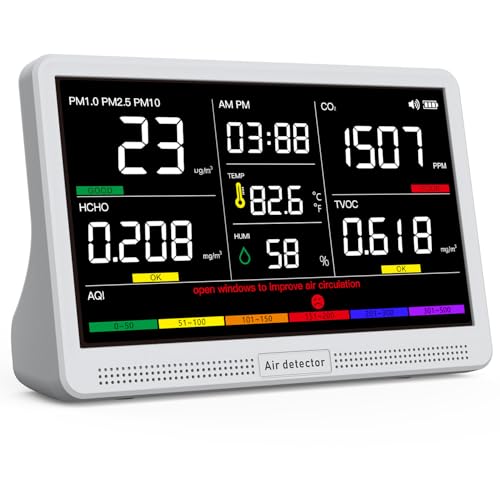
A feature-dense monitor with external sensors built for wildfire season.
Wildfire smoke is a specific and serious threat, and this monitor is built with that in mind. The “16-in-1” refers to 9 detectable parameters (CO2, PM2.5, PM1.0, PM10, HCHO, TVOC, Temperature, Humidity, AQI) plus 7 distinct AQI alert buzzers. It uses external high-precision sensors that sample the air directly, boasting 0.001 accuracy, with an enhanced airflow design for fast response. The 7-inch LED display gives you an instant, comprehensive view without navigating menus.
Owner feedback is notably positive, especially around the clear, easy-to-read display and the confidence it provides. It tracks multiple air factors effectively, with responsive alerts that react to cooking smoke and changes in the home. Build quality gets praised, it doubles as a clock, and it’s considered worth the price. It even helped one owner rule out home air quality as a cause of their pets’ breathing issues — the vet attributed the problem to humidity instead.
There are a couple of things to note. Some owners are skeptical of the accuracy, noting the readings stayed green even with strong chemical cleaner use — though this is exactly the kind of scenario where a sensor’s limits show. Also, the WiFi and mirror display icons aren’t well documented in the manual. It is a sturdy, feature-packed device, but treat very clean readings with a bit of skepticism if you’re using harsh chemicals.
Why It Stands Out
- Fast, responsive alerts to real pollution events
- Clear and highly readable 7-inch display
- Doubles as a functional clock for the whole house
- Lightweight at 10.56 ounces for easy moving
Keep in Mind
- Accuracy is questioned under some chemical stress tests
- WiFi features are not clearly documented
7. AirKnight Premium AT1000
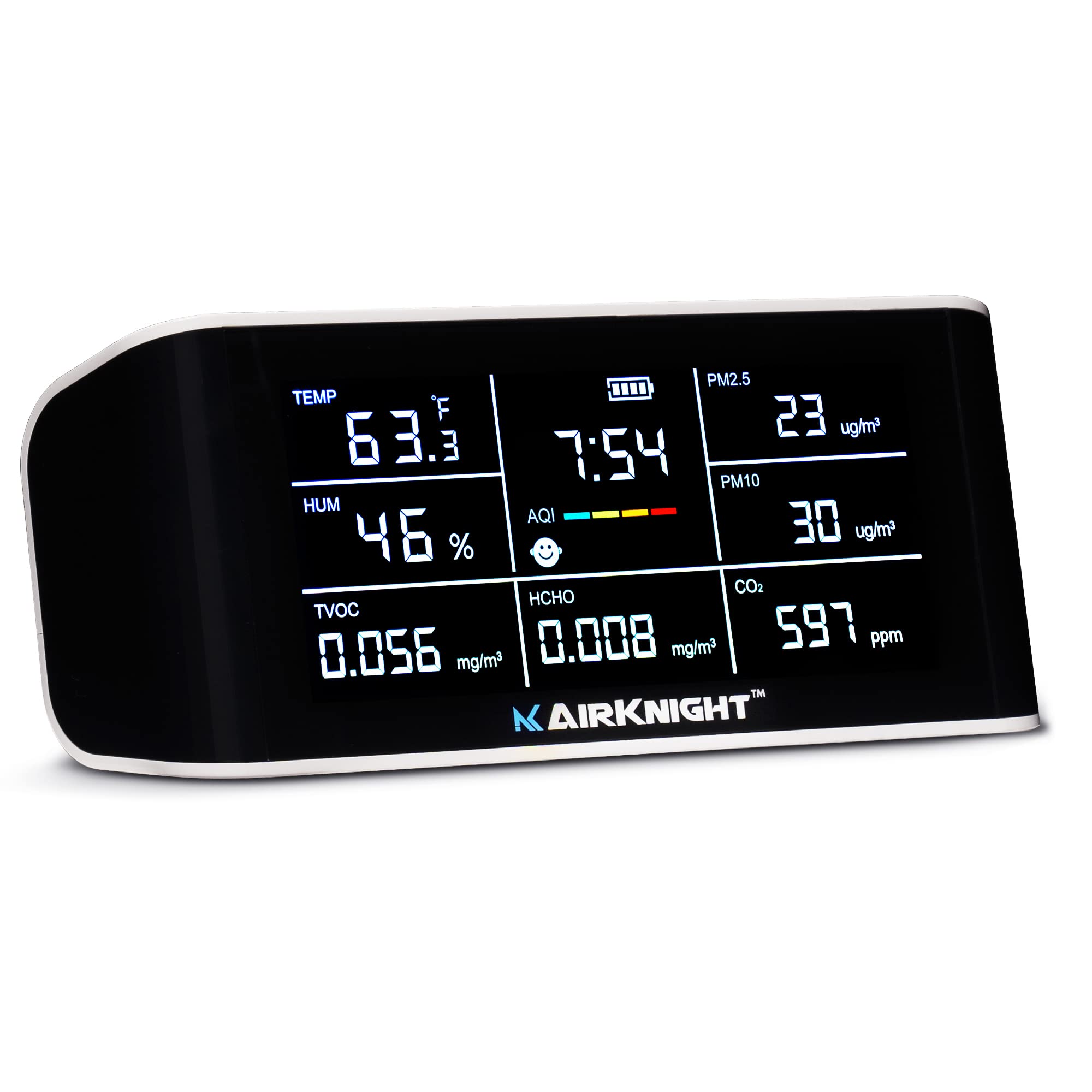
The portable specialist with a huge battery and a nose for dangerous fumes.
This is the monitor to grab when you want one device that roams the house, car, and workshop. The AirKnight AT1000 packs a 3000 mAh rechargeable Lithium-Polymer battery — one of the biggest in this roundup — in a body that weighs a portable 12 ounces. It detects the most threatening pollutants: CO2, PM2.5 & PM10, TVOC, and HCHO (formaldehyde), all shown on a large, easy-to-read LCD screen. Owners note it’s handy for monitoring 3D printer fumes and checking purifier effectiveness.
among the most striking owner reports is that it “immediately detects dangerous fumes” — a key feature for those with older appliances or who live in wildfire zones. The review pages sum it up: it’s a helpful, easy-to-read device that earns trust. For VOC and formaldehyde detection, it’s been called reliable, rarely “zero-locking” (a common failure where sensors read a constant low value) and recovering without needing a reboot. The US-based business and support infrastructure is a plus for confidence.
The trade-off for that portability is battery discipline. The auto-off after 12 hours is either a feature or a frustration depending on your use case, and some owners mention the battery drains in under 11 hours, with slow recharging. The bright screen can be bothersome at night, and the 1.5-second refresh rate causes constant blinking. It’s a dedicated spot-check tool, not a 24/7 bedside display.
Pick it up if: you move between rooms or spaces and need a reliable VOC/fume detector that travels well and charges rarely
Look elsewhere if: you want a permanent, dim-friendly night display or need PM2.5/PM10 accuracy, which some owners find lacking
8. EG Air Quality Monitor

The veteran tester with a built-in fan that hunts down hidden pollution sources.
Sometimes you need to find the source of a smell, not just monitor a room. This monitor from EG has a built-in fan that actively draws air in over its sensors, enabling real-time measurements. It uses a laser sensor for dust particles (PM2.5) and a separate electrochemical semiconductor sensor for formaldehyde and organic compounds. This active sampling makes it a great tool for “spot checking” — walking around to find whether it’s the new cabinet or the paint that’s off-gassing.
The functionality is the most-praised aspect here — owners use it to detect improve TVOC and formaldehyde in a cabinet store, guiding their purchasing decisions. It’s described as genuinely handy and a real help, capable of running continuously for up to 2 days on its 2200mAh battery. The 2.8-inch color LCD is compact and clear. What many appreciate is the included 20+ page eBook on gas and air quality hazards — real educational value.
The critical caveat is battery longevity and calibration. The battery is soldered in and non-replaceable, which is a major flaw for a long-term device — one owner used it for 4 years in a truck before the battery died. It still works plugged in, but that’s a design limitation. Calibration is not optional: you should let it run in fresh outdoor air for about 30 minutes to establish a baseline, and readings can drift if you skip this. Accuracy gets mixed feedback, with some calling it spot-on (a side-by-side HCHO test showing 0.058 vs 0.065 on another unit) and others finding it inconsistent.
Good for: investigating specific pollution sources and comparing products, thanks to its active fan and sensitive VOC/formaldehyde detection.
Avoid if: you want a permanent, low-maintenance display — the calibration routine and non-replaceable battery make it a spot-check tool, not a set-and-forget device.
9. BREATHE Airmonitor Plus Gen 2
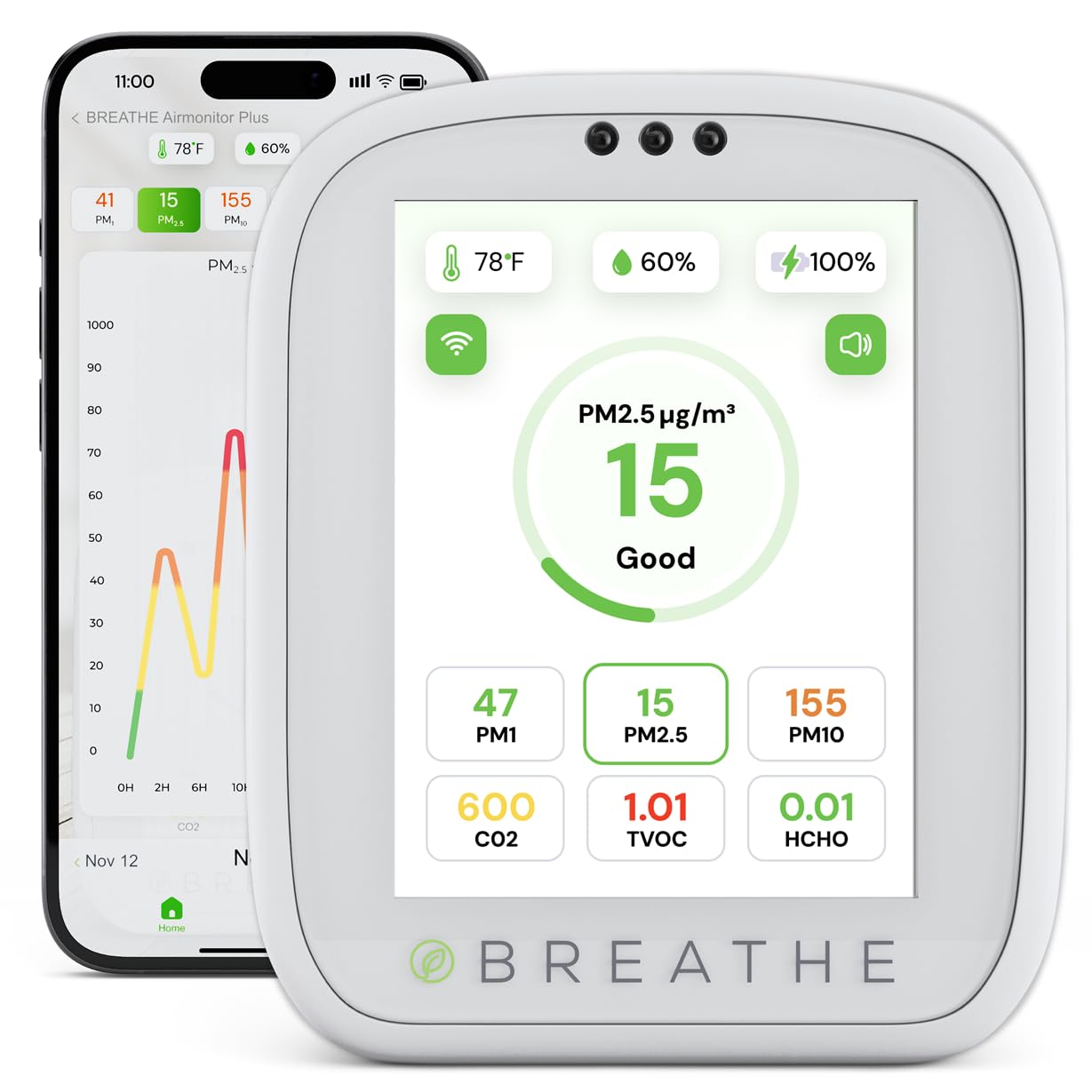
The app-connected analyzer that shows you 90 days of trends, not just a moment.
If you love a good chart, this is your device. The BREATHE Airmonitor Plus Gen 2 connects to your phone via 2.4 GHz Wi-Fi, giving you remote readings, configurable alerts, and up to 90 days of stored data history that you can export for deeper analysis. This is the only pick here that turns your air quality into a real trend analysis tool, helping you see how cooking, cleaning products, or occupancy change your air over time. It tracks CO₂, PM1, PM2.5, PM10, TVOC, formaldehyde, temperature, and humidity.
The build quality and reliability are the highest-praised aspects. Owners find it very easy to set up and calibrate, with one comparison to commercial instruments from a neighbor showing it tested “spot-on accurate.” It is described as a great little device that works well and is easy to use. The 6-hour battery life makes it portable enough to move from bedroom to office, and it can run continuously when plugged into USB-C. The information it provides is considered informative and worth the cost.
The major red flag for some users is the auto-calibration (ABC) feature. In homes with consistently high CO2, the ABC logic can drop readings from 850 to 450 ppm, falsely showing safe levels. This is a safety concern for those using it to monitor ventilation in stuffy homes. It also has a short battery life compared to others here, and the Wi-Fi pairing process can be finicky (a hard reset is needed sometimes). For data lovers, the export feature is powerful, but the smart calibration needs to be understood and watched.
Choose for: the most detailed picture of your air over time — ideal for tracking trends, exporting data, and understanding patterns in your home
Be mindful: the smart calibration can under-report high CO2, so verify baseline readings outdoors if you are concerned about ventilation safety
Understanding the Specs
CO2 vs. PM2.5
These are the two most common measurements, and they tell different stories. CO2 (carbon dioxide) levels tell you about ventilation — if it’s high, you’re breathing in a lot of your own exhaled air, which can make you drowsy. PM2.5 is a particle measurement (the “2.5” refers to microns, or 2.5 millionths of a meter), and it tracks smoke, dust, and allergens. A sensor that only does one may not solve the problem you actually have.
What NDIR Means
NDIR (Non-Dispersive Infrared) is the gold-standard tech for CO2 sensing. It shines a light through air and measures how much gets absorbed. It’s more accurate and stable than cheaper chemical sensors. When you see “NDIR” in a spec, it generally means the CO2 reading is more trustworthy — that’s why the SwitchBot, with its Swiss-made NDIR sensor, earns its top spot.
FAQ
What is the difference between an air filter and an air quality monitor?
What is the difference between CO2 and VOC detection?
How long do air quality sensors last before needing recalibration?
How often should I replace the air purifier filter based on the sensor?
Can I use an air quality monitor in my car?
Should I look for a specific measurement range for CO2?
What does the AQI reading on these devices mean?
Can an air quality monitor detect mold?
How do I know if the readings from my monitor are accurate?
Final Thoughts: The Verdict
For the majority of shoppers, the SwitchBot CO2 Detector is the smartest starting point because its Swiss NDIR sensor and rapid 1-second response deliver CO2 accuracy you can build trust on. If you prefer to skip apps and want the clearest display for a living room, the Sainlogic with its 7.2-inch screen is the standout. And for tracking changes over time and exporting data, the BREATHE Airmonitor Plus is the one to reach for.
How We Picked
We do not accept paid placement. Every pick is matched to a real buyer and a real use-case; we do not hands-on test units.
Sources & Methodology
Specifications: manufacturer listings and product documentation. Review insights: verified customer reviews, as of July 2026. Pricing: not shown on this page (it changes often); check the current price via the retailer link.
As an Amazon Associate, Gadgets Feed earns from qualifying purchases. This does not affect which products we feature.