
An air flow meter is the difference between guessing at your HVAC system’s health and knowing its exact performance. Whether you are balancing ductwork, checking a fume hood, or optimizing a dust collection system, a precise reading of cubic feet per minute (CFM) and air velocity in feet per minute (FPM) is the only way to diagnose problems without tearing walls open.
I’m Min — the co-founder and writer behind Gadgets Feed. I’ve spent over 200 hours analyzing the technical specifications, real-user feedback, and market positioning of dozens of portable air flow meters to bring you this definitive guide.
This guide breaks down the top handheld and probe-style meters for HVAC professionals, serious DIYers, and shooting enthusiasts, helping you find the absolute best air flow meter for your specific needs and budget.
How To Choose The Best Air Flow Meter
Choosing the right air flow meter means matching its sensor technology and measurement range to your primary task. A vane anemometer works well for high-velocity ductwork, while a hot-wire probe is more sensitive for low-flow environments like fume hoods. A differential pressure manometer is essential for static pressure testing across filters and coils. The key is to understand the specific units you need — CFM for volume, FPM for velocity, and inH2O for static pressure.
Sensor Technology: Vane vs. Hot-Wire vs. Differential Pressure
Vane anemometers use a rotating impeller to measure wind speed, making them accurate for a wide range (0.4 to 30 m/s) and ideal for outdoor use or large ducts. Hot-wire probes use a heated wire that cools as air passes, offering superior sensitivity at low velocities (under 0.5 m/s) and excellent response time for in-duct and fume hood work. Differential pressure manometers measure the pressure drop across an obstruction (like a filter or orifice plate) and calculate airflow, which is critical for system-level diagnostics.
Connectivity and Data Logging
Modern wireless anemometers with Bluetooth 4.0 or newer sync directly to smartphone apps. This lets you log readings, calculate averages, generate reports, and share data without manual transcription. For professionals who document every job, this feature saves hours of paperwork and virtually eliminates transcription errors. Look for a battery life that supports a full workday and data export in .csv or .pdf formats.
Form Factor and Durability
For handheld meters used in tight ducts, look for a telescopic probe (15 inches or longer) that can reach deep into vents. For static pressure testing, a magnetic back is a lifesaver for hands-free operation on metal panels. Ruggedness matters — an IP rating is rare in this category, but check for water-resistant construction and shock-resistant ABS plastic if you work in attics or construction sites.
Quick Comparison
On smaller screens, swipe sideways to see the full table.
| Model | Category | Best For | Key Spec | Amazon |
|---|---|---|---|---|
| Fieldpiece SDMN5 | Manometer | Static pressure / Duct balancing | ±60.0 inH2O, 0.01″ resolution | Amazon |
| Testo 405i | Hot-Wire Probe | In-duct / Low-velocity airflow | 15″ telescopic shaft, Bluetooth 4.0 | Amazon |
| BTMETER BT-100APP | Vane Anemometer | Wireless data logging / General use | 0.67–67.1 mph, Bluetooth, 1/4″ tripod mount | Amazon |
| Klein Tools ET180 | Manometer | Gas pressure / HVAC troubleshooting | ±60 inH2O, 11 units, magnetic back | Amazon |
| Fieldpiece JL3RH | Psychrometer Probe | Supply/Return air diagnostics | 1000 ft Bluetooth, flexible wand, –40–250 °F | Amazon |
| Proster Handheld | Vane Anemometer | Budget-friendly / Outdoor wind speed | 0.4–30 m/s, CFM/CMM, LCD backlight | Amazon |
| Testo 510i | Manometer | Pressure drop / Filter diagnostics | Bluetooth, magnetic back, pitot tube ready | Amazon |
In‑Depth Reviews
1. Fieldpiece SDMN5 Dual-Port Manometer
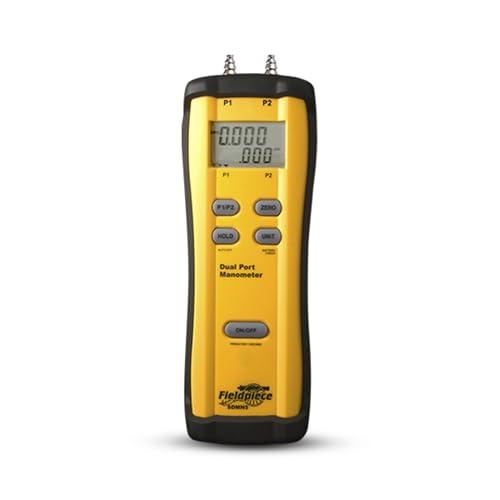
The Fieldpiece SDMN5 is the industry-standard dual-port manometer for precise static pressure measurement up to ±60.0 inH2O with a resolution of 0.01 inH2O — critical for balancing residential and light-commercial duct systems. Its 2 3/16-inch brass fittings and included adapters connect to standard pitot tubes and static pressure probes without adapters, making setup fast and reliable.
Fieldpiece builds this meter with a rugged rubberized overmold that survives drops from ladders and the grit of daily HVAC service. The large digital display is legible in most lighting, though the lack of a backlight is a trade-off for battery life. The 9-volt battery (included) lasts through extended diagnostic sessions, and the auto-off feature prevents accidental drain.
Reviewers consistently praise its consistency across multiple duct tests, noting that its accuracy matches much more expensive lab-grade instruments. For any professional who needs to measure filter pressure drop or total external static pressure, this is the tool that pays for itself on the first job.
Why it’s great
- 0.01 inH2O resolution enables fine-grained static pressure diagnostics.
- Dual-port design with brass fittings allows simultaneous high/low reading.
- Proven durability from a brand trusted by HVAC technicians for years.
Good to know
- No backlight — working in dark attics requires an external light source.
- Does not calculate CFM from pressure drop; you need to reference a duct chart.
2. Testo 405i Hot-Wire Anemometer

The Testo 405i is a hot-wire anemometer purpose-built for in-duct air velocity, temperature, and CFM measurement. Its hinged telescopic shaft extends to 15 inches, letting you reach deep into supply and return ducts to get a representative velocity reading. The hot-wire sensor is sensitive down to very low FPM, making it the go-to choice for fume hood face velocity checks and exhaust system balancing.
Bluetooth 4.0 pairs instantly with the Testo Smart Probe app, which graphs real-time FPM, temperature, and calculated CFM once you enter duct dimensions. The app lets you log data, create PDF reports, and set high/low alarms for pressure drops across filters. The probe itself is compact at 7.87 inches long (retracted) and weighs only 0.23 kg, fitting easily into a tool pouch.
HVAC professionals value its fast response time — the hot-wire element reacts to air movement in under a second, unlike vanes that need a few seconds to spin up. Reviewers note the accuracy is excellent for spots where a pitot tube won’t fit, and the temperature reading is accurate within ±0.9 °F, which is adequate for most diagnostic tasks.
Why it’s great
- Hot-wire sensor excels at low-velocity airflow measurement in ducts and fume hoods.
- Telescopic shaft extends to 15 inches for hard-to-reach vents.
- Bluetooth app integration enables wireless data logging and report generation.
Good to know
- Max velocity is around 6000 FPM — not suitable for high-speed industrial fans.
- Hot-wire bulb is delicate; must be stored carefully to avoid damage.
3. BTMETER BT-100APP Vane Anemometer

The BTMETER BT-100APP is a feature-packed vane anemometer that hits the sweet spot between affordability and data connectivity. It measures wind speed from 0.67 to 67.1 mph across five units (m/s, km/h, ft/min, knots, mph) and also tracks temperature from 14 °F to 113 °F with two sensor elements. The 8-vane impeller is sensitive enough to register very low air flows, making it useful for HVAC duct vent checking.
What sets it apart in the mid-range is its Bluetooth wireless connectivity. It auto-pairs with iOS and Android devices via the companion app, allowing data logging, min/max/avg tracking, and export to .xls or .txt files. The 1/4-inch metal tripod mount at the bottom lets you set up long-duration monitoring on a camera tripod — ideal for weather station logging, shooting range wind checking, or continuous filter performance tests.
Users consistently report that the app’s data saving function requires manual configuration, but the raw wind readings are consistent and responsive. The rechargeable battery via USB is a welcome convenience, eliminating the need for disposable 9-volt cells. At 188 grams, it’s light enough to carry in a jacket without fatigue.
Why it’s great
- Bluetooth app allows data logging and export for job documentation.
- Rechargeable via USB — no disposable batteries to replace.
- 1/4″ tripod mount enables continuous monitoring setups.
Good to know
- App interface could be more polished; data saving requires manual steps.
- Temperature sensor can be off by a few degrees without calibration.
4. Klein Tools ET180 Differential Manometer

Klein Tools brings its trademark build quality to the ET180, a differential digital manometer that measures static and gas pressure with a range of ±60 inH2O and full-scale accuracy of ±1.5 percent. It is one of the most versatile manometers on the market, letting you toggle between 11 different units — inH2O, bar, psi, kPa, inHg, mmHg, kg/cm², ftH2O, and more — which is invaluable when working on equipment from different manufacturers or regions.
Practical design touches define this meter: a strong magnet on the back secures it to metal air handler panels, freeing both hands for port connections. The large backlit LCD is easy to read in low-light crawlspaces, and the hold button locks the reading when you need to record a number before moving on. It comes with 2 meters of silicone tubing, 3 AAA batteries, and a storage pouch right in the box.
HVAC and appliance pros confirm it works reliably for gas manifold pressure, filter pressure drop checks, and building pressurization. The dual-port design with a zeroing function lets you zero out the hose resistance before measuring. For the price, you get Klein’s robust warranty and a meter that feels solid in hand.
Why it’s great
- 11 measurement units cover pressure standards across multiple HVAC applications.
- Magnetic back provides hands-free operation on metal surfaces.
- Large backlit LCD improves readability in dim environments.
Good to know
- Cannot display high and low ports simultaneously on the same screen.
- May require annual lab calibration to maintain certification standards.
5. Fieldpiece JL3RH Job Link Psychrometer Probe
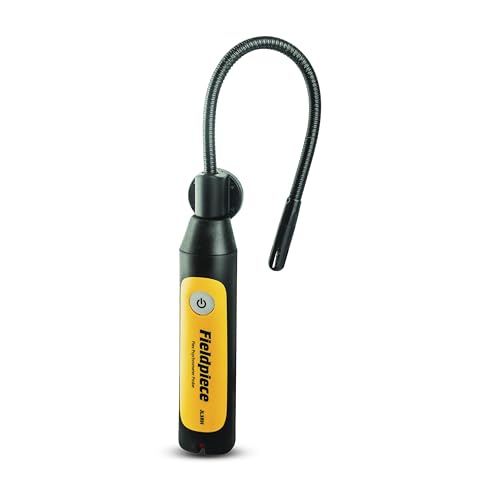
The Fieldpiece JL3RH is not just an air flow meter — it is a full psychrometer probe that measures dry bulb, wet bulb, relative humidity, dew point, and enthalpy. That makes it essential for calculating sensible and latent heat loads in supply and return ducts. Its flexible 9.25-inch bendable wand with a sliding magnet lets you position the sensor securely inside a duct, plenum, or directly in front of a register.
The standout feature is its Bluetooth range of up to 1000 feet, enabling you to take readings at the air handler while monitoring them on your phone at the thermostat, saving countless trips up and down ladders. It operates from -40 °F to 250 °F, covering extreme attic temperatures and refrigeration line temps. The water-resistant housing protects against condensation and accidental splashes.
Technicians who use the Job Link app can log all readings, create full system reports with charts, and share PDFs with clients immediately. The integrated supply/return switch lets you toggle between measurement modes without climbing back. For extreme diagnostics and documentation, this is the most capable probe in its class.
Why it’s great
- 1000-foot Bluetooth range lets you monitor data at a distance from the probe.
- Flexible wand with magnetic mount positions sensor precisely in any duct.
- Measures enthalpy, dew point, and wet bulb for complete psychrometric analysis.
Good to know
- Battery life could be better under continuous heavy daily use.
- Price point is high; best suited for professionals who need full system diagnostics.
6. Testo 510i Differential Pressure Manometer

The Testo 510i is a compact, wireless differential pressure manometer designed for static pressure, airflow, and volume flow measurement when paired with a pitot tube. Its Bluetooth connectivity syncs to the Testo Smart Probe app, which includes measurement menus for pressure drop alarms — you can set thresholds to alert you when a filter is fouled or a duct is blocked. The magnetic back attaches to any ferrous surface for hands-free use at the air handler.
Configuration is straightforward: enter the pitot tube factor and duct dimensions in the app, and the 510i calculates volume flow in CFM automatically. The meter itself is small — 5.83 x 1.42 x 0.91 inches — and weighs only 0.21 kg, so it slips into a pocket when not in use. The app stores data that can be retrieved and included in custom service reports.
Daily users — HVAC contractors and service techs — confirm it works great for measuring total external static pressure and pressure drops across coils. One recurring note is that the magnet can occasionally pull the battery slightly out of contact, causing a power failure. It’s a minor annoyance, but one to be aware of if you’re constantly sticking it to metal panels.
Why it’s great
- Bluetooth app calculates CFM and alerts you to pressure drops.
- Compact size and magnetic back enable easy hands-free positioning.
- Works seamlessly with Testo Smart Probe ecosystem for integrated reporting.
Good to know
- Magnet can dislodge battery if removed roughly from metal.
- Instructions are in German; English setup guides are available online.
7. Proster Handheld Digital Anemometer

The Proster Handheld Digital Anemometer is the entry-level vane meter that delivers reliable wind speed measurement at a very accessible price. It measures in m/s, ft/m, km/h, mph, and knots, and also calculates CFM and CMM (cubic meters per minute) when you enter the duct area. The LCD display has a backlight for reading in dim conditions, and it runs on a single 9-volt battery (included) that users report lasting over two months with regular use.
Its build is straightforward: a durable plastic body with rubber grip, weighing 11.3 ounces. It records min, max, and hold readings, and includes an auto-power-off function to save battery. For sailboat racing, kite flying, drone flying, and basic HVAC vent checks, it performs admirably — one user compared its accuracy favorably to a Kestrel meter for wind speeds under 35 mph.
The main limitation is in CFM mode, where the built-in area calculation can produce wildly inaccurate numbers if the input values aren’t perfectly matched. Users recommend using it mainly for velocity measurement and doing CFM calculations manually. It also lacks a tripod mount or lanyard loop, which would be nice for hands-free monitoring. Still, for the price, it’s a fantastic tool for occasional measurements.
Why it’s great
- Accurate wind speed readings proven comparable to expensive Kestrel meters.
- CFM and CMM calculation modes useful for quick duct volume estimates.
- Compact and lightweight with rubber grip for comfortable handheld use.
Good to know
- CFM mode can output inaccurate numbers if duct area is entered incorrectly.
- No threaded base or lanyard for mounting; you must hold it or set it down.
FAQ
Can I use a vane anemometer to measure static pressure?
What is the difference between CFM and FPM readings?
How often should I calibrate my air flow meter?
Final Thoughts: The Verdict
For most users, the best air flow meter winner is the Fieldpiece SDMN5 because of its dual-port precision, proven durability, and 0.01 inH2O resolution that meets professional static pressure testing needs. If you want a wireless hot-wire probe for in-duct measurements, grab the Testo 405i. And for the best budget-friendly option, the Proster Handheld Anemometer delivers accurate wind speed readings at a fraction of the cost of premium meters.