
An air-fuel ratio that leans out under boost or runs rich at idle can silently damage your engine, waste fuel, and rob you of power. The only way to see exactly what your engine is doing is to monitor the exhaust gas with a wideband sensor and gauge that reads from 10:1 to 20:1 AFR in real time, giving you actionable data for tuning, diagnostics, and peace of mind.
I’m Min — the co-founder and writer behind Gadgets Feed. I’ve spent hundreds of hours cross-referencing sensor response times, controller output types, display readability, and connector compatibility across the leading wideband kits to separate the performance tools from the mere dash ornaments.
Whether you’re tuning a boosted build or just want to verify your fuel trims are within spec, this guide will help you match the right controller, sensor, and gauge to your specific vehicle and your specific goals by breaking down the very best air fuel ratio monitor kit options available today.
How To Choose The Best Air Fuel Ratio Monitor Kit
Not all AFR kits are created equal. Some are just replacement sensors, while others are full tuning dashboards with data outputs and logging. To avoid buying twice, you need to understand the three main components of any monitor kit.
Sensor Type: Narrowband vs. Wideband
Factory narrowband O2 sensors only read accurately around stoichiometric (14.7:1) — useless for tuning. A wideband UEGO sensor (typically the Bosch LSU 4.2 or 4.9) reads across a 10:1 to 20:1 range with better than 0.1 AFR resolution. Every kit in this guide uses wideband technology; avoid any “AFR gauge” that doesn’t include a wideband controller.
Controller Outputs: Analog, Digital, and CANbus
If you plan to feed the AFR signal into an ECU for closed-loop tuning, you need a controller with a configurable 0-5V analog output. For data logging with a standalone system, look for RS232 serial or CANbus outputs. Some modern kits offer Bluetooth for direct smartphone monitoring, eliminating the need for a physical gauge entirely.
Display Readability and Form Factor
Gauges come in 52mm or 2 1/16-inch sizes. Consider daylight visibility (some LED displays wash out in direct sun), dimming capability for night driving, and overall depth if you’re mounting in a tight pod. “Blackout” faces that disappear when powered off offer a clean OEM+ look.
Quick Comparison
On smaller screens, swipe sideways to see the full table.
| Model | Category | Best For | Key Spec | Amazon |
|---|---|---|---|---|
| Denso 234-9002 | Sensor Only | Direct OEM replacement | Measuring range 10:1–18:1 | Amazon |
| AEM 30-0300 X-Series | Gauge + Controller | Modern 87% larger display | CANbus + 0-5V outputs | Amazon |
| Innovate 3795 DB BLUE | Gauge + Controller | Dual programmable analog outputs | DirectDigital technology | Amazon |
| Prosport EVO Wideband | Gauge + Controller | Ultra-thin profile mounting | 1.5-inch depth | Amazon |
| GlowShift Black 7 Color | Gauge + Controller | Color-matching interior lighting | 7 color modes + dimmer | Amazon |
| Auto Meter 4379 Ultra-Lite | Gauge + Controller | 0.1 AFR resolution precision | Bosch LSU 4.2 sensor | Amazon |
| PE-Wideband Bluetooth Kit | Bluetooth Module | Smartphone-only monitoring | 30-ft Bluetooth range | Amazon |
| Innovate Dlg-1 Dual Lambda | Dual Channel Gauge | V-engine bank monitoring | Dual LC-2 controllers | Amazon |
| AEM X-Series 3-Gauge Combo | 3-Gauge Kit | Comprehensive engine monitoring | AFR + Boost + Oil Pressure | Amazon |
In‑Depth Reviews
1. Denso 234-9002 Air Fuel Ratio Sensor

The Denso 234-9002 is not a gauge kit — it is the wideband sensor itself, and it earns the top spot because it is the exact OEM supplier for Toyota, Lexus, and Honda. When your car throws a P1135 or P0135 code for heater circuit failure on the A/F sensor, this is the drop-in fix that restores factory fuel trim behavior. The zirconium dioxide element reads across a 10:1 to 18:1 AFR window with a maximum supply voltage of just 5 volts, matching the ECU’s internal reference perfectly.
Real-world install data from owners of 2002 4Runners and 2003 Tacomas shows heater circuit resistance at 1.4 ohms versus a failed sensor reading 20 ohms — a clear open-circuit failure. At 0.25 pounds and with a flange mount pattern identical to the factory unit, installation takes under 15 minutes with a 12mm and 10mm wrench. Owners report cleared codes and normalized long-term fuel trims within a single drive cycle, saving to versus a dealership replacement.
If your specific need is a direct factory-spec repair without adding a gauge or controller, this is the most precise and reliable sensor you can buy. It is not a tuning tool — it is a stock restoration part, and for that job, nothing else in this list matches its accuracy and fitment guarantee.
Why it’s great
- OEM-spec zirconium element for exact factory calibration
- Proven fix for P1135/P0135 heater circuit codes
- Ultra-light 0.25 lb and 15-minute install
Good to know
- Sensor only — requires existing or separate controller
- Limited to 10:1–18:1 measuring range
2. Innovate Motorsports 3795 DB BLUE Wideband Kit

The Innovate 3795 kit bundles the LC-2 controller with a Bosch LSU 4.9 sensor and a blue digital gauge, giving you two configurable 0-5V analog outputs that can be programmed for narrowband simulation if your ECU requires it. This is a critical feature if you are replacing a factory narrowband with a wideband unit — some ECUs will throw a check engine light without that simulated signal. The DirectDigital technology reads and reports values that threshold-based controllers miss, which is especially useful for detecting transient lean spikes during gear changes.
Owners have installed this on supercharged F-150s and high-compression Honda Preludes, using the free LogWorks software to capture AFR traces and correlate them against RPM and MAP data. The gauge features a blackout appearance when unpowered, blending into the dash without drawing attention. The included weld-in bung, programming cable, and 400-gram total kit weight make it a complete all-in-one solution.
One recurring note from motorcycle and RX-7 builders is that the harness is larger than expected and may require creative routing in tight engine bays. Sensor calibration must be done in free air before first use, and some units have shown intermittent 8 AFR readings if the sensor is mounted too close to the exhaust port where heat soak exceeds the sensor’s tolerance. Keep the bung at least 24 inches from the exhaust valve for stable readings.
Why it’s great
- Two programmable 0-5V analog outputs for ECU integration
- Free LogWorks data logging software included
- Complete kit with sensor, gauge, controller, and bung
Good to know
- Large harness requires careful stashing in tight bays
- Sensor can overheat if mounted too close to exhaust port
3. AEM 30-0300 X-Series Wideband UEGO Gauge
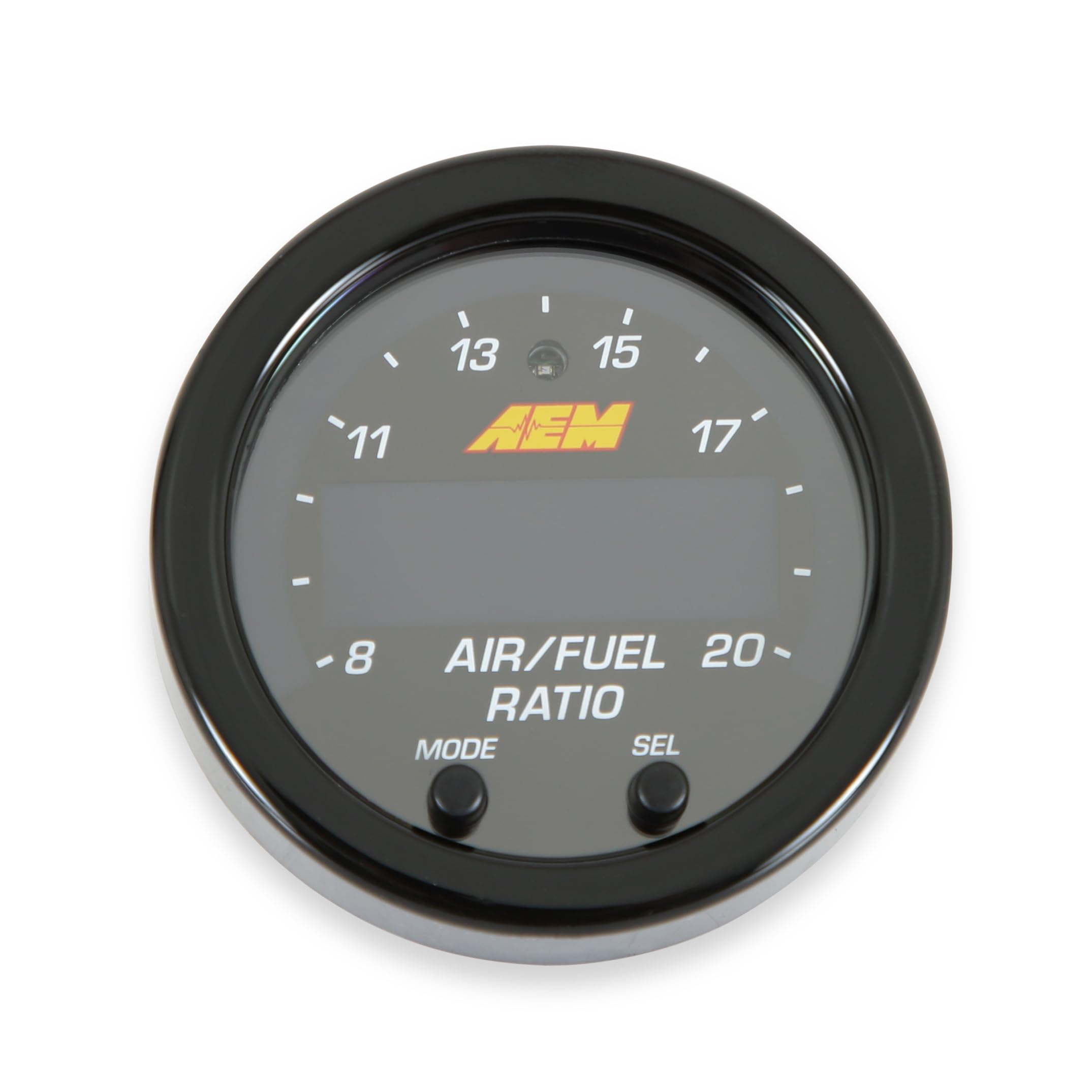
The AEM X-Series 30-0300 packs a seven-segment center display that is 87% larger than the outgoing 30-4110 model, and it includes both a 0-5V analog output and an AEMnet CANbus output for data logging. This means you can feed the AFR signal directly into an AEM ECU or any aftermarket EMS that supports CAN protocols without converting signals. The X-Digital wideband technology also reports values during sensor transition periods that older controllers simply mark as invalid, giving you a fuller picture of transient fueling.
At just 0.01 ounces for the gauge face, this is a lightweight option that is designed for modern tuner cars — owners have installed it in 2017 Sierra trucks and 1995 Firebirds with straightforward wiring. The faceplate uses a visually striking modern font with a sweeping startup animation that signals proper initialization. The RS232 serial port is available for PC-based logging if you prefer laptop tuning over CAN integration.
For serious tuners who already run or plan to run an AEM ECU or another CAN-capable engine management system, the native CANbus integration eliminates wiring complexity and potential signal noise. The gauge itself does not include a sensor bung or mounting cup in the box, so factor in those costs if you do not already have a welded bung in place.
Why it’s great
- Native CANbus output for direct ECU integration
- 87% larger display for easier reading at speed
- X-Digital tech captures transient AFR values others miss
Good to know
- Does not include weld-in bung or mounting cup
- RS232 port may need adapter for modern laptops
4. Prosport EVO Wideband Digital AFR Gauge Kit

The Prosport EVO Series is built around the Bosch LSU 4.9 sensor and offers a broad 10.0:1 to 20.0:1 AFR display range, but its standout engineering win is the housing depth. At roughly 1.5 inches deep including mounting studs, this is the thinnest full-feature wideband gauge in this roundup — a critical advantage for custom center-console pods, motorcycle fairings, or any space-starved mounting location where a standard 2.5-inch depth simply will not fit.
The dual-color green/white display can be switched to match your dashboard theme, and the blackout face disappears completely when unpowered. A 270-degree digital sweep with an outer LED bar graph provides quick peripheral-vision glances at AFR trend direction without needing to stare at the numeric readout. The included 0-5V output signal supports data logging for dyno sessions or standalone ECU integration.
Daytime visibility is a known trade-off with this unit — some owners report that the LED digits wash out in direct sunlight, while the display is excellent at night. This makes the EVO Series better suited for vehicles that see limited direct-sun exposure or for drivers who prioritize night-time aesthetics. The complete kit includes the sensor, weld-in bung, 10-foot harness, and instructions, making it a true plug-and-play bundle.
Why it’s great
- Ultra-thin 1.5-inch profile for tight mount locations
- Bosch LSU 4.9 sensor with 10–20 AFR range
- Blackout face blends into dash when off
Good to know
- Display washes out in direct sunlight
- Daytime brightness may be insufficient for open-top cars
5. GlowShift Black 7 Color Digital Wideband AFR Gauge Kit

The GlowShift 7 Color kit delivers seven solid color modes and two color-cycle modes — blue, red, green, teal, purple, white, and yellow — allowing you to match your gauge exactly to your dashboard backlighting. The kit is also E85-compatible, with a separate reading calibrations of 6.00 to 12.00 AFR for FlexFuel vehicles. The included dimmer wire drops brightness by 30% when connected to the headlight circuit, preventing night glare.
This is a complete package: Bosch 4.9 LSU wideband sensor, weld-in bung, control box, 10-foot sensor harness, 7-foot gauge harness, 5-foot power harness, 3-foot data logging wire, gauge visor, and mounting bracket. Race bike owners have confirmed that readings match dyno AFR values within 0.1, validating the sensor accuracy. The data logging wire gives a 0-5V analog output suitable for recording AFR during dyno pulls.
The most common long-term observation is that the gauge itself may stop powering up after roughly two years of continuous daily use — the control box and wiring stay functional, but the display LED driver can fail. It is also worth noting that some units intermittently freeze at 14.7 AFR until the engine is restarted. For a budget-friendly kit with exceptional color versatility, these are trade-offs to weigh against the lower entry cost.
Why it’s great
- Seven color modes for dash customization
- E85-compatible with dedicated 6–12 AFR range
- Complete kit includes everything for installation
Good to know
- Display LED may fail after ~2 years of use
- Occasional AFR freeze at 14.7 requires restart
6. Auto Meter 4379 Ultra-Lite Wide Band AFR Kit

The Auto Meter 4379 Ultra-Lite is calibrated to 0.1 AFR resolution using a custom-tuned Bosch LSU 4.2 sensor, and it is one of the few kits specifically rated for 12V and 16V electrical systems — a critical compatibility point for race cars running lithium-ion battery packs or higher-voltage charging systems. The kit includes an 8-foot wiring harness, a 304 stainless steel weld-in bung, and mounting hardware.
The gauge itself combines a digital segment display with an LED radial bar graph, and the 0-4V linear data output feeds directly into an ECU, data acquisition unit, or laptop. One owner crafted a portable diagnostic tool by mounting the entire kit inside a Harbor Freight case and adding a tailpipe adapter for the O2 sensor, enabling carburetor tuning on multiple classic vehicles without cutting into any exhaust system. Another owner used it to fine-tune a 200ci Ford six-cylinder with a Carter BBD carburetor, dialing in step-up piston travel at WOT.
The 2.3125-inch gauge diameter is slightly larger than the standard 52mm size, so verify your pod or bracket can accommodate the extra width before buying. This is a purpose-built racing gauge with a focus on absolute reading precision rather than cosmetic flourishes, making it a top pick for track-day builders and carburetor tuners who want laboratory-grade data.
Why it’s great
- 0.1 AFR calibration accuracy for precision tuning
- Works with 12V and 16V systems
- 304 stainless steel bung resists corrosion
Good to know
- 2.3125-inch diameter may not fit standard 52mm pods
- Uses LSU 4.2 sensor vs. newer 4.9
7. PE-Wideband O2 Bluetooth Kit

The PE-Wideband Bluetooth kit is a gauge-free solution — you weld in the included Bosch LSU 4.9 sensor and bung, connect the controller module, pair your iPhone or Android via Bluetooth at up to 30 feet, and monitor live AFR on the free smartphone app. This is ideal for classic car owners who want modern wideband monitoring without cutting into a pristine dashboard or installing a permanent gauge pod. Owners have installed it on 1974 Triumph Spitfires and Weber DCOE-equipped vintage race cars with excellent results.
The controller does not require sensor calibration before first use, which simplifies installation significantly compared to Innovate or AEM controllers that need a free-air calibration step. The replacement sensor (50070008) is available separately, and a 6-foot extension cable (99005001) can be purchased if your bung location is far from the controller mounting spot. Multiple classic car owners report using one kit across several vehicles by swapping the wired bung adapter between exhausts.
The trade-off is that the app does not log data permanently — real-time readings disappear when the ignition cycles off. One owner reported that after extended storage, the controller failed to pair with the phone entirely, with no customer support available to resolve the issue. If continuous data recording or absolute reliability on a daily driver matters, a wired gauge kit is safer. But for occasional tuning sessions on vintage iron, this is the most elegant option.
Why it’s great
- No gauge pod or dash cutting required
- 30-ft Bluetooth range for live tuning feedback
- No sensor calibration needed at setup
Good to know
- No data logging capability
- Bluetooth connectivity may fail after storage periods
8. Innovate Motorsports Dlg-1 Dual Lambda Gauge Kit

The Innovate Dlg-1 is the only kit in this guide that monitors both exhaust banks on a single gauge. It comes with two LC-2 controllers and two Bosch LSU 4.9 sensors, displaying left and right AFR simultaneously on a 52mm gauge face. This is indispensable for V-configured engines — V6, V8, and V12 — where one bank can run lean while the other runs rich, causing drivability issues that a single-sensor kit will never detect.
The kit is compatible with leaded, unleaded, diesel, and E85 fuels, making it a versatile tool for race teams that switch between fuel types. The gauge is clear and responsive, and the included software allows custom programming of the analog outputs for each bank. Several owners have mounted the entire system inside a steel ammo can to create a portable dual-wideband diagnostic tool for tuning multiple vehicles without permanent installation.
Installation requires welding two bungs — one per bank — and the harnesses are substantial. One owner reported that channel B (the second LC-2 module) was defective from the factory, showing incorrect readings on that bank. While Auto Meter (the current owner of the Innovate brand) eventually resolved the issue with a replacement, double-check both channels during initial setup. Also ensure your bungs are standard 1/4-inch O2 bungs; a 1-inch bung will cause erratic readings on both channels.
Why it’s great
- Monitors both exhaust banks on one gauge
- Compatible with leaded, diesel, and E85 fuels
- Can be built into portable diagnostic tool
Good to know
- Requires welding two bungs for installation
- Second channel may have factory defects in some units
9. AEM X-Series 3-Gauge Combo Set

The AEM X-Series 3-Gauge Combo is the ultimate all-in-one monitoring solution: a wideband AFR gauge (30-4110), a turbo/boost gauge (30-4406), and an oil pressure gauge (30-4401), all in a matching 52mm digital format. Each gauge has a 0.825-inch overall depth for easy mounting, a large center LED display, 24 outer LEDs for quick visual reference, and user-selectable warning thresholds that trigger an alert when any parameter exceeds your set limits.
The wideband gauge uses AEM’s X-Digital technology and reads across multiple fuel types including gasoline and E85. The boost gauge includes a MAP sensor for absolute or relative pressure readings, and the oil pressure gauge uses a 100-psi sender suitable for both naturally aspirated and boosted applications. All three gauges include analog and CANbus outputs, allowing full integration with an AEM ECU or third-party data logger. Owners have installed this set in Subaru WRX STI A-pillar pods and even on snowmobiles, noting that the black face matches factory gauges cleanly.
At 3.64 pounds and a 3-gauge footprint, this is a significant installation project. The boost gauge requires plumbing a vacuum/pressure line into the intake manifold, and the oil pressure sender requires an adapter if your engine block uses a different thread pitch. For tuners who want a complete engine monitoring dashboard in one order, this bundle saves the hassle of mixing brands and matching display styles.
Why it’s great
- Three critical engine parameters in one matching set
- Thin 0.825-inch depth for tight pods
- Analog + CANbus outputs on all three gauges
Good to know
- Hydraulic/boost plumbing required for oil and boost gauges
- Heavy 3.64 lb kit needs solid mounting structure
FAQ
Can I use a wideband gauge with a stock ECU?
Where should I weld the O2 sensor bung in the exhaust?
Why does my wideband gauge show 8 AFR or 14.7 and never move?
Final Thoughts: The Verdict
For most users, the air fuel ratio monitor kit winner is the Innovate Motorsports 3795 because its DirectDigital technology, dual programmable 0-5V outputs, and included LogWorks software give you both a clear gauge for real-time monitoring and a data path for serious tuning. If you want Bluetooth convenience without cutting a dash hole, grab the PE-Wideband Bluetooth Kit. And for comprehensive engine monitoring across AFR, boost, and oil pressure, nothing beats the AEM X-Series 3-Gauge Combo.