
Our readers keep the lights on and my morning glass full of iced black tea. As an Amazon Associate, I earn from qualifying purchases.
Specs are compiled from manufacturer listings and verified buyer reviews and can change over time — please confirm the key details on the product page before buying.
You need one machine that can handle both a sticky August night and a chilly November morning without turning your living room into a swamp or an icebox. The real trick is finding a window unit that does not just blow lukewarm air when you switch modes — one that delivers real cooling in summer and genuine warmth when the season turns. This guide breaks down the eight best air and heat window units on the market, comparing the specs that actually matter for year-round comfort so you know exactly which one fits your room size, your window dimensions, and your tolerance for noise.
I’m Min — the founder and writer behind Gadgets Feed. This guide is built by comparing the manufacturers’ published specifications and the patterns across verified customer reviews, so you get each pick’s real strengths and trade-offs instead of marketing spin.
If you want a single appliance that keeps your bedroom cool in summer and takes the edge off in fall, you are looking for the best air & heat window unit for your specific window and square footage.
Quick Picks
- Midea 8,000 BTU Smart Inverter Air Conditioner Window Unit with Heat and Dehumidifier — Best Overall
- LG 12,200 BTU Window Air Conditioner with Supplemental Heat — Top Performer
- ROVSUN 8000 BTU Window Air Conditioner with Heat — Smart Pick
- Frigidaire 8,000 BTU Window Air Conditioner with Supplemental Heat — Solid Value
- LG 23,000 BTU 230V Window-Mounted Air Conditioner with Supplemental Heat — Large Room Champion
- Friedrich CEW24B33A Chill Premier Smart Air Conditioner Window Unit — Ultra High Capacity
- Keystone 8,000 BTU Window Air Conditioner with 3,500 BTU Supplemental Heating — Budget-Friendly Cooling
- Keystone 23,200 BTU Window Air Conditioner with 16,000 BTU Supplemental Heat and Dehumidifier — Budget Champion
How To Choose The Best Air & Heat Window Unit
Buying a window unit that both cools and heats means balancing three things: the size of your room, the type of heat it uses, and whether it will physically fit your window. Get these right and you get one appliance that handles two seasons. Get them wrong and you end up freezing or stuck with a unit that does not fit.
BTU: The Number That Matches Your Room Size
BTU (British Thermal Unit) is the measure of how much cooling power the unit has — higher BTU means it can cool a larger space. An 8,000 BTU unit typically handles rooms up to 350 square feet. A 12,000 BTU unit can cover around 550 square feet. If you go too small, the unit runs constantly and never catches up. Too large, and it cycles on and off too fast, failing to remove humidity properly.
Heat Pump vs. Electric Strip Heat
Most air and heat window units use a heat pump — it reverses the cooling cycle to pull warmth from outside air. The catch is that heat pumps stop being effective below about 41°F, as one Midea unit’s data states. Below that temperature, you need supplemental electric heat (a resistive heating element). Some units advertise “supplemental heat” specifically for this reason. The heating BTU number tells you how much warmth it can add, but always check the minimum operating temperature for the heating mode in the specs.
Window Fit: Measure Before You Click Buy
Every unit needs a specific window width and clearance height. Standard double-hung windows typically accept widths from 24 to 38 inches, but some large units like the Friedrich need a 27-inch width and 18 ⅝ inch height. Always measure your window opening before ordering — the single biggest cause of returns is buying a unit that physically does not fit the frame.
Quick Comparison
| Model | Best For | Cooling BTU | Heating Type | Noise Level | Amazon |
|---|---|---|---|---|---|
| Midea 8,000 BTU | Energy savings & quiet bedroom | 8,000 | Heat pump | 45 dBA | $339.99$399.99Amazon |
| Keystone 8,000 BTU | Budget-friendly cooling | 8,000 | Electric supplemental | — | $365.00$429.99Amazon |
| ROVSUN 8,000 BTU | Smart home & app control | 8,000 | Electric (4000 BTU) | — | $399.99Amazon |
| Frigidaire 8,000 BTU | Reliable supplemental heat | 8,000 | Electric supplemental | 53 dBA | $415.04Amazon |
| LG 12,200 BTU | Medium-large rooms | 12,200 | Electric supplemental | 50 dB (low) | $499.99$639.00Amazon |
| Keystone 23,200 BTU | Large open spaces | 23,200 | Electric supplemental | — | $654.00$769.99Limited time dealAmazon |
| LG 23,000 BTU | Whole-room heating & cooling | 23,000 | Electric supplemental | 62 dB (low) | $789.00$859.00Amazon |
| Friedrich 24,000 BTU | Premium long-term durability | 24,000 | Electric strip | — | Amazon |
In‑Depth Reviews
1. Midea 8,000 BTU Smart Inverter Air Conditioner Window Unit with Heat and Dehumidifier

The inverter-driven heat pump that sips power and whispers while it works.
The standout feature here is the variable-speed inverter compressor — it lets the unit run at lower, steadier speeds instead of clunking on and off like a traditional AC. This is why it operates at just 45 dBA, which is quieter than a refrigerator hum. Reviewers confirm it saves on electric bills and is almost whisper-quiet in a bedroom.
The heat pump function works when the outside temperature is above 41°F, and buyers report that on a south-facing concrete porch the effective range extends a bit further. The 5 modes — Heat, Auto, Cool, Dry, Fan — and the 24-hour timer give you precise control. The washable filter slides out from the front for quick cleaning.
One real trade-off: if you live where temps regularly drop below freezing, the heat pump shuts off. As one reviewer noted, “Heat pump shuts off below 41°F, but south-facing concrete porch extends heating.” That means you will need a backup space heater for the coldest winter nights.
Why it earns the top spot
- Ultra-quiet 45 dBA operation at low speed — great for sleep
- Inverter tech uses significantly less energy than standard units (407 kWh/year)
- App, remote, and voice control (Alexa/Google Assistant) included
The one limitation
- Heat pump shuts off below 41°F, so not a full winter heater
- Some owners mention thermostat inconsistency with room temperature varying
Reach for this if: you want the most energy-efficient, quietest 8,000 BTU option for a bedroom or small apartment where comfort and low noise matter.
Look elsewhere if: you need reliable heating in freezing weather — the heat pump cuts out below 41°F.
2. LG 12,200 BTU Window Air Conditioner with Supplemental Heat
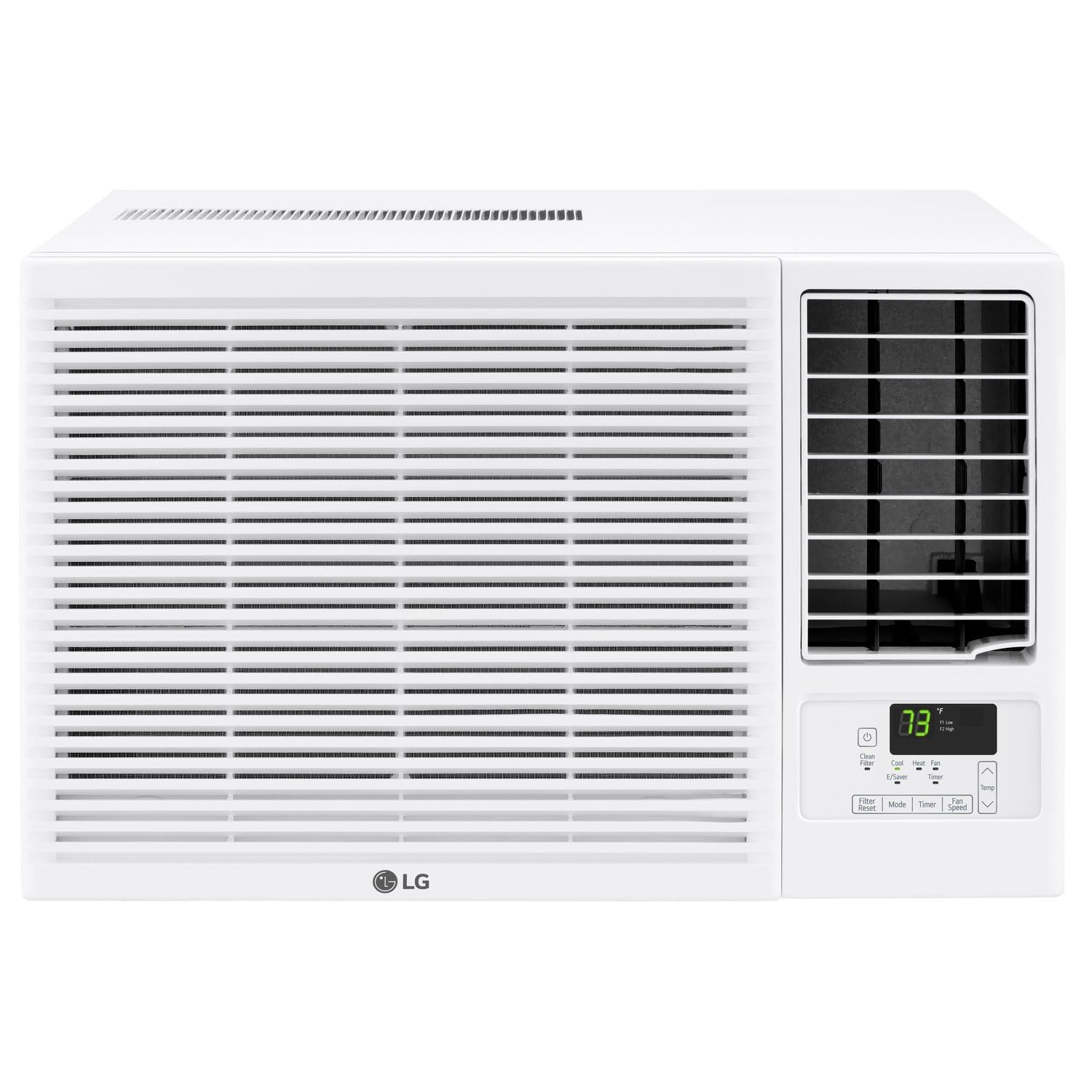
More BTU for the bigger room that needs both cool and warm air.
This LG steps up to 12,200 BTU of cooling power, making it a good fit for rooms up to 570 square feet (roughly 19 by 30 feet). It operates at just 50 dB on low mode, which is quiet enough for a living room or bedroom. The supplemental heat option uses electric resistance to add warmth — it is not a heat pump, so it does not shut off in cold weather, but it will cost more to run than a heat pump.
Unlike the Midea, this unit requires a 220V outlet (the same plug a dryer uses), so you need to check your electrical setup before buying. Some reviewers mention the easy slide-in mounting and good value for the cooling capacity. The 2 cooling speeds and 2 heating speeds give you some flexibility, and the Auto Restart feature turns the unit back on after a power outage — useful if you lose power overnight.
The obvious follow-up question is whether the heat is strong enough for a cold room. The heating BTU is supplemental, not primary. Customers note the cooling works well for the price, but one buyer had trouble with two units producing a loud compressor noise. The 220V requirement also means it will not work in standard 110V outlets without an electrician.
What makes it strong
- 12,200 BTU cools up to 570 sq. ft. — more than any 8,000 BTU unit
- 50 dB low-mode operation is bedroom-friendly
- Auto Restart after power failure is a nice safety net
What holds it back
- Requires a 220V outlet (not standard in many rooms)
- Heating is supplemental — not meant as a primary heat source
Grab this for: a medium-large room where you have a 220V outlet and need both cooling and backup heat.
skip it if: your room only has standard 110V outlets or you need a primary heat source for winter.
3. ROVSUN 8000 BTU Window Air Conditioner with Heat

The Wi-Fi-connected unit that brings smart routines to your window.
This ROVSUN unit packs an 8,000 BTU cooling capacity and a 4,000 BTU electric heater into a single box, and the real selling point is the full Wi-Fi control. You can adjust temperature, set routines, or turn it on from anywhere using the phone app — and it works with Alexa and Google Assistant. That means you can cool the room before you walk in the door. The 5 modes (Heat, Auto, Cool, Dry, Fan) and 3 speeds give you the same flexibility as the Midea.
Unlike the Midea, this uses an electric heating element rather than a heat pump, so there is no minimum outdoor temperature limit — it will produce warm air no matter how cold it is outside. One buyer mentioned it kept them warm all winter after their central unit went out, pairing it with a fireplace. Another buyer noted that the unit cools a 34-foot bumper-pull camper well, suggesting it works in small RVs too.
A few reviewers flagged that the remote display is hard to read, and some found that phone and remote settings can conflict. The unit is also a bit louder than some competitors — one buyer described the condenser making a liquid movement noise.
What stands out
- Full Wi-Fi and voice control via app, Alexa, and Google Assistant
- Electric heat works in any outdoor temperature — no cold-weather cutoff
- Easy installation with included side panels for windows 26 to 36 inches wide
Something to know
- Can be noisier than inverter-based units like the Midea
- Phone and remote control settings sometimes conflict
Best choice when: you want app-based smart control and a heater that works in any weather without a temperature cutoff.
Not the one if: whisper-quiet operation is your top priority, or you have a very tight window opening.
4. Frigidaire 8,000 BTU Window Air Conditioner with Supplemental Heat
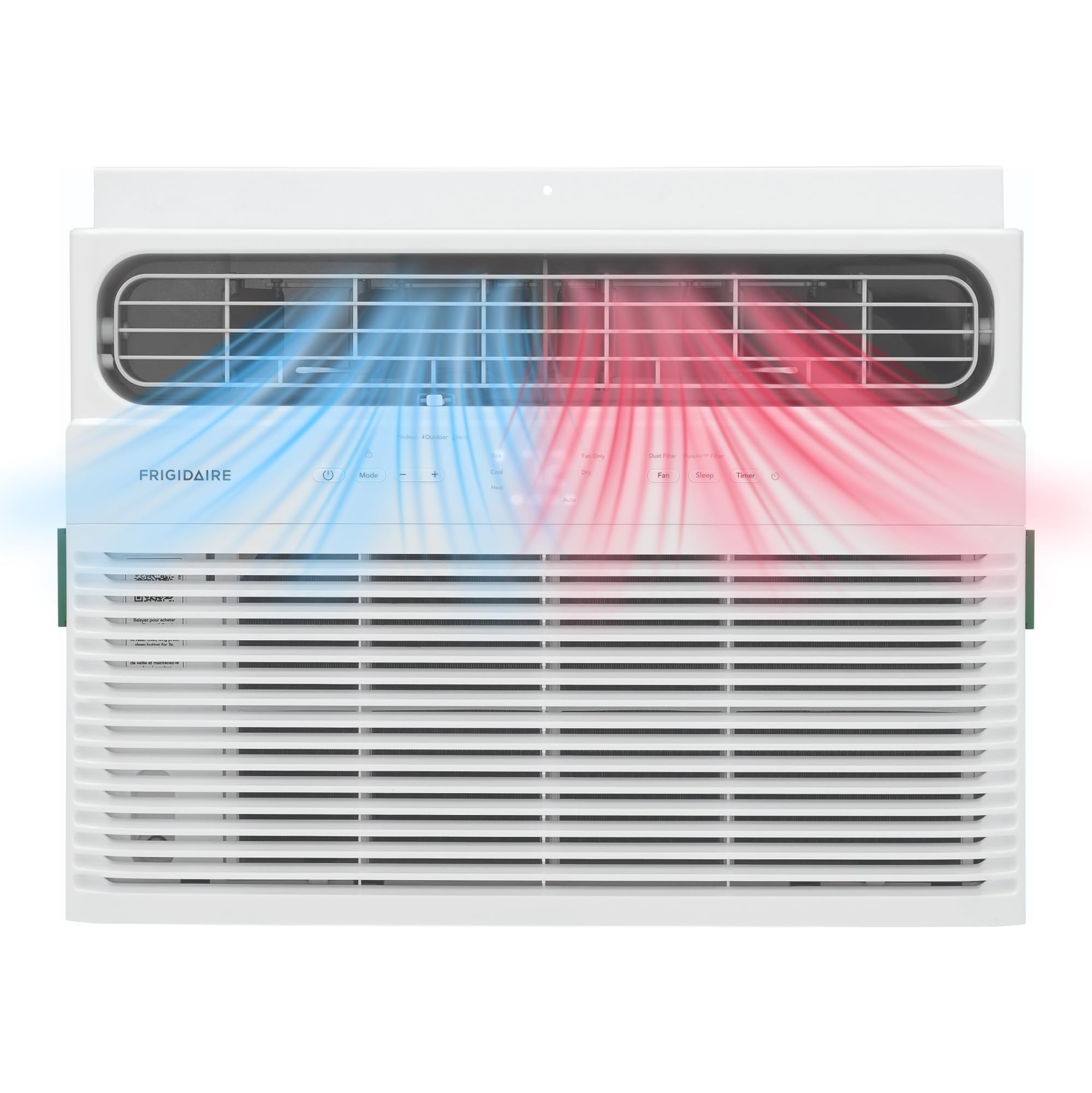
A familiar name with a 53 dBA noise level and a filter reminder you will actually use.
The Frigidaire 8,000 BTU unit offers electric supplemental heat, and its annual energy consumption is 550 Kilowatt Hours Per Year — that is higher than the Midea’s 407 kWh figure, so it is not the most efficient pick on the list. It operates at 53 dBA, which is louder than the Midea’s 45 dBA but still quiet enough for a bedroom. What it does well is simplicity: a 24-hour timer, Eco Mode, Sleep Mode, and Dry Mode for humidity removal are all controlled by the remote.
The “Clean Filter” alert light is a thoughtful touch — it flashes when the washable dust filter needs attention, which helps keep the unit running efficiently. Reviewers mention it kept a 200 square foot insulated shop warm when outside temps dropped below 30°F, with the heat function supplementing well. One owner reported no odd noises and easy installation.
But not every review is positive. One customer observed the heating function was nonexistent, and another called it “horrible” — this suggests the supplemental electric heat may not satisfy everyone in cold climates. Like the Keystone, this unit relies on electric resistance heat rather than a heat pump, so it will not lose capacity in very cold weather, but it will draw more power to produce warmth.
What works
- Clean Filter alert helps you maintain efficiency without remembering
- 53 dBA is quiet enough for a bedroom
- Electric heat works at any outdoor temperature — no cold-weather cutoff
What could be better
- 550 kWh/year is less efficient than the Midea’s 407 kWh/year
- Heating function has mixed reviews for effectiveness
Choose it when: you prioritize easy maintenance and need a unit with a filter reminder light and straightforward controls.
Pass it by if: energy efficiency or reliable electric heat in very cold weather is your main concern.
5. LG 23,000 BTU 230V Window-Mounted Air Conditioner with Supplemental Heat
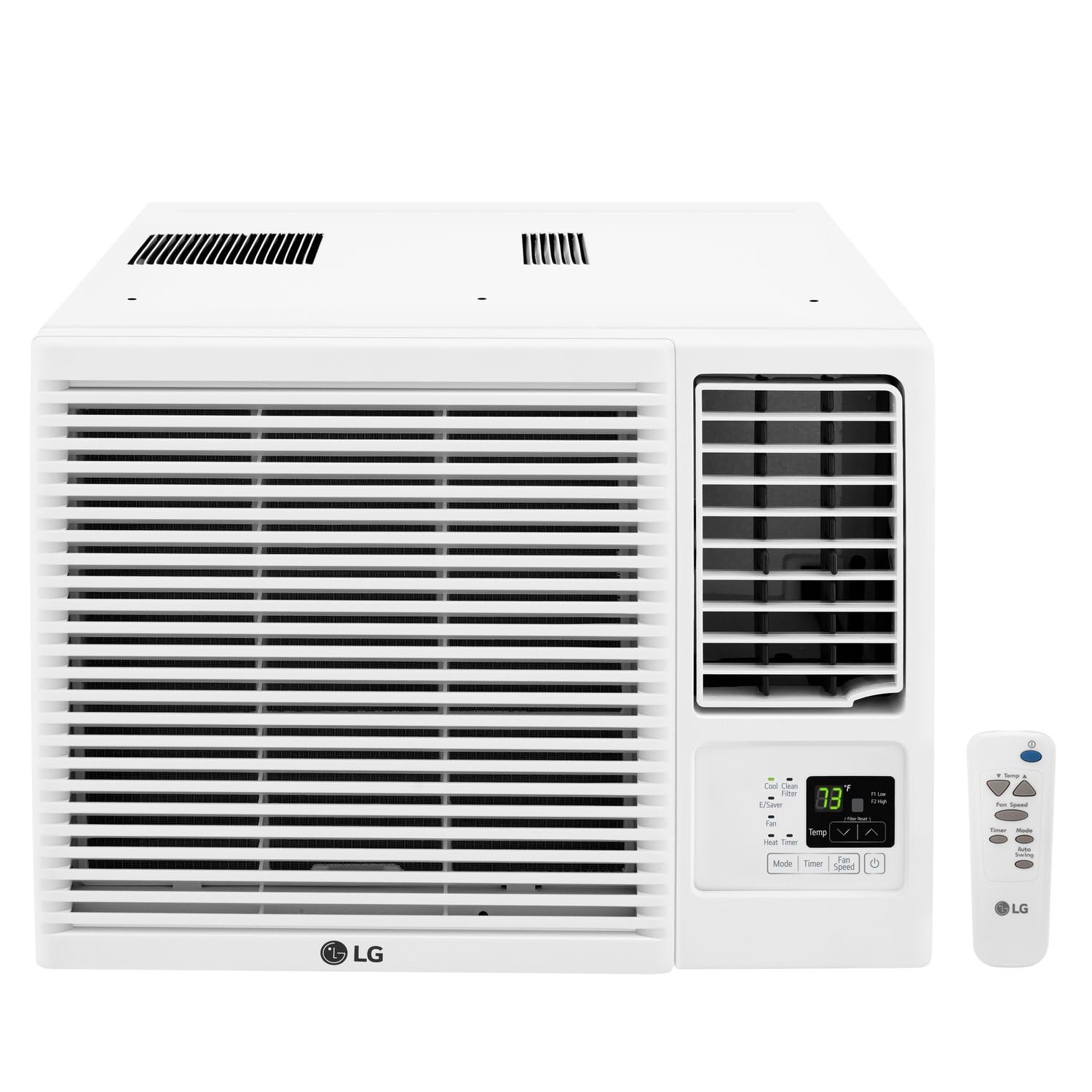
Serious BTU for a living area that demands real cooling and backup heat.
With 23,000 BTU of cooling power, this LG is built for open-plan areas, large living rooms, or even small commercial spaces. It operates at 62 dB on low mode — noticeably louder than the smaller units, but that is the trade-off for moving that much air. The supplemental heat function adds 9,200/11,200 BTU of electric warmth, which can take the chill off a large space on cooler days.
The 230V requirement means you will need a dedicated circuit — this is not a plug-and-play unit for standard outlets. Reviewers point out that the Auto Restart feature is helpful after power outages, and the washable filter keeps maintenance simple. One reviewer called it a “lifesaver” during winter months, while another said it worked great in summer and winter and was not too loud.
There is a real durability concern here: one user highlighted the unit stopped cooling in under 6 months, and another said it never blew cold air at all and the company only refunded. The mixed reliability reviews mean you should buy from a seller with a good return policy.
The big pluses
- 23,000 BTU cools very large rooms that smaller units cannot handle
- Auto Restart and washable filter reduce maintenance hassle
- Multiple heating and cooling speeds for custom comfort
The big catches
- Requires a 230V outlet — professional electrical work may be needed
- Customer reviews show inconsistent reliability with some units failing quickly
Ideal if: you have a large room (up to 1,000+ sq. ft.) and a 230V outlet, and need a single unit for both cooling and supplemental heat.
Think twice if: you cannot handle a potential repair or return situation — quality control seems spotty.
6. Friedrich CEW24B33A Chill Premier Smart Air Conditioner Window Unit

The premium unit that marries a heavy-duty chassis with smart WiFi control.
The Friedrich Chill Premier is the most expensive unit on this list, and it earns that position with a 24,000 BTU cooling capacity that covers up to 1,500 square feet — matching or beating any other unit here. It uses an electric heat strip that produces 10,600 BTU of heating, and it runs quieter than other units thanks to heavy-duty insulation and a stiffened sheet metal casing. The slideout chassis design makes it compatible with both windows and in-wall installations.
WiFi control through the Friedrich Go App means you can change settings from anywhere, and it syncs with Amazon Alexa and Google Home. The 8-way airflow command gives you very precise directional control, and the Money Saver and Sleep settings help manage energy usage. The washable air filter uses R-410A refrigerant, which is more environmentally friendly than older refrigerants.
The most common buyer complaints involve durability at this price point. One unit’s compressor died after 47 days, and another buyer reported that the buttons stopped working after a year, forcing reliance on the app or remote. The unit’s size — 27 inches wide and 26 ⅝ inches deep — also means it needs a very large window opening, so measure carefully.
Why it commands the premium
- 24,000 BTU covers up to 1,500 sq. ft. — the most raw cooling here
- Runs up to 25% quieter than other large units due to heavy insulation
- Full WiFi and voice control, plus dual window/wall installation flexibility
The premium price caveats
- Reliability issues reported — some units fail within weeks
- Very large physical size needs a big window or wall opening
Worth it for: someone who needs to cool and heat a very large space (1,500 sq. ft.) and values smart home integration and quiet operation.
Not for: budget-conscious buyers or anyone without a truly large window or wall opening — reliability is a roll of the dice at this price.
7. Keystone 8,000 BTU Window Air Conditioner with 3,500 BTU Supplemental Heating
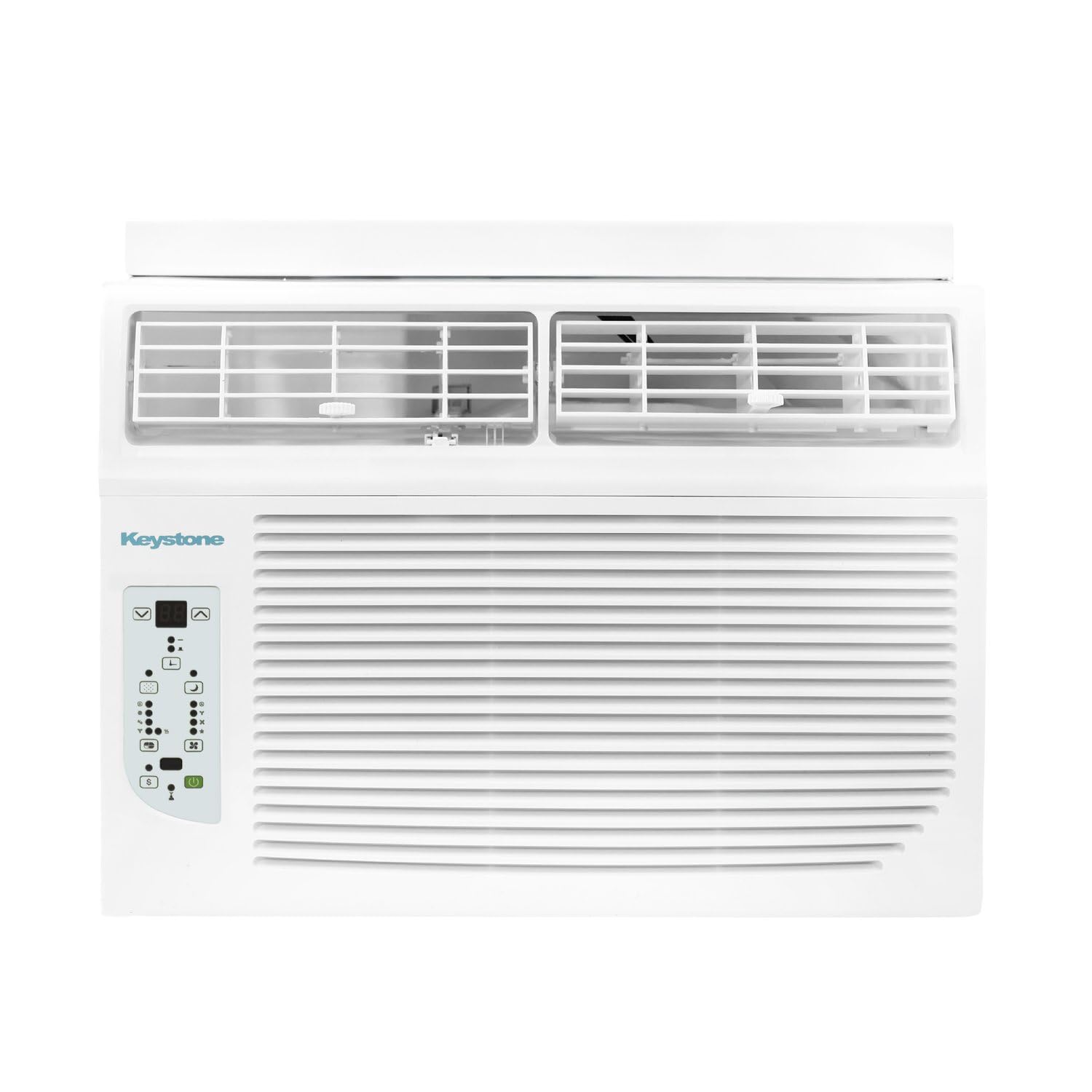
An affordable entry point into room cooling with a backup heat option.
Keystone offers an 8,000 BTU cooling capacity that can handle rooms up to 350 square feet, with a 3,500 BTU supplemental heating element for cooler nights. The heating function uses electric resistance and is designed to operate when outside temps are between 23 and 76 degrees — notably, the company explicitly states this is “NOT meant as primary heat source.” The I Sense remote is a unique feature: it takes the temperature in your actual room, displays it on the remote’s LCD, and sends a signal to the unit every 3 minutes for more accurate cooling.
Buyers consistently report that the cooling works great — one shopper added it is “perfect for our needs” in a guest room, keeping noise low and comfort high. Another called it “better than expected” for general performance. One customer even said it keeps their room “extra cold,” which is exactly what you want in summer.
The catch, as one reviewer put it bluntly: “The air conditioner cools great but the heating function leaves a lot to be desired.” Multiple buyers reported that the heat stops working after the first week of use, turning into plain fan air. This makes the heating feature a questionable addition if you actually rely on it for warmth.
What it does well
- Solid 8,000 BTU cooling for rooms up to 350 sq. ft.
- I Sense remote improves thermostat accuracy by sampling room temperature
- Low noise level works well for a guest bedroom
Where it falls short
- Heating function is unreliable according to multiple reviews
- Supplemental heat is weak and not meant as primary warmth
Perfect for: budget buyers who need reliable cooling most of the time and occasionally want a tiny bit of extra warmth.
Not for: anyone who needs the heating function to actually work — buy a separate space heater instead.
8. Keystone 23,200 BTU Window Air Conditioner with 16,000 BTU Supplemental Heat and Dehumidifier
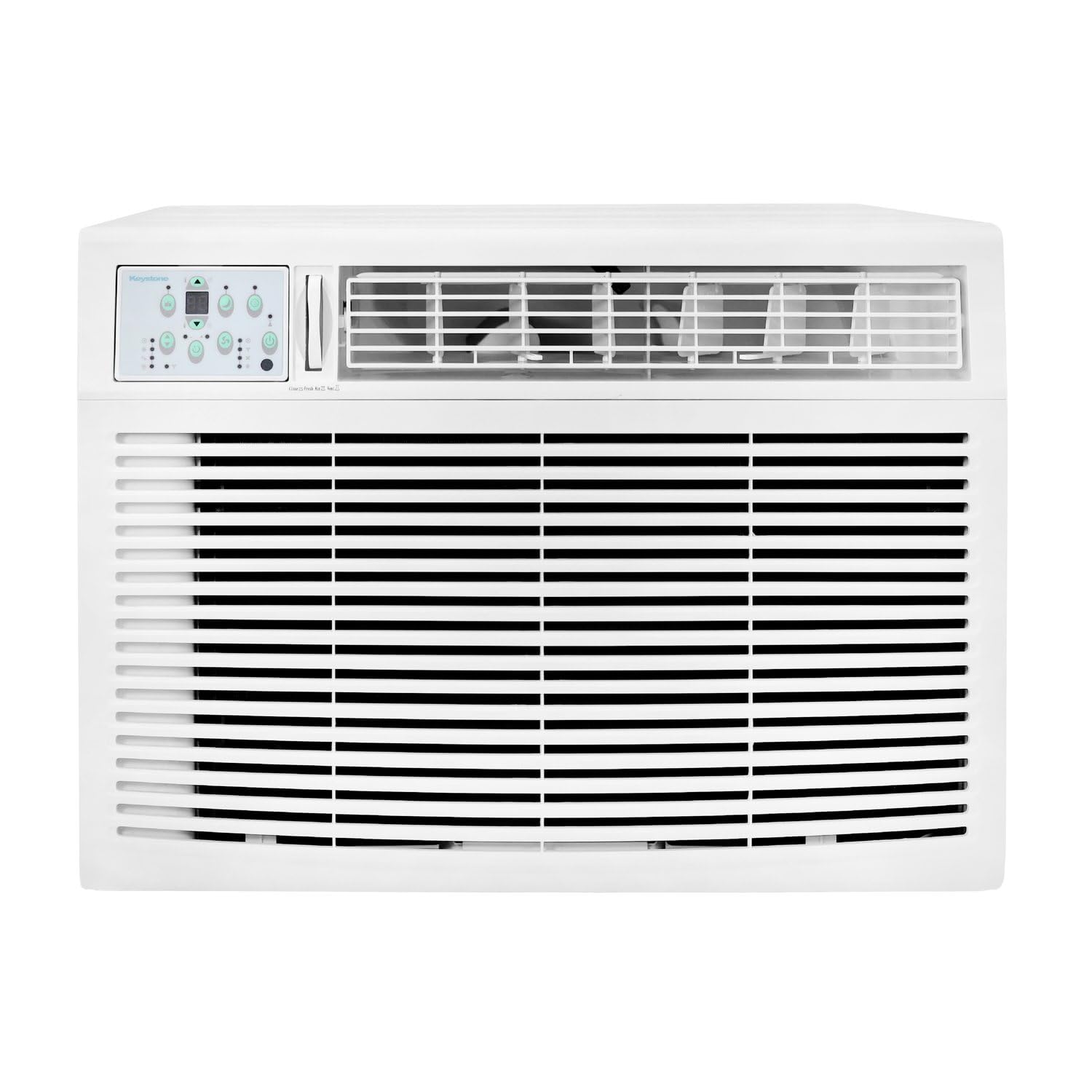
A massive 23,200 BTU unit for open-floor homes that also offers strong supplemental heat.
This Keystone serves large spaces up to 1,500 square feet with 23,200 BTU of cooling and 16,000 BTU of supplemental heating — making it one of the highest heating capacities on this list. Like its smaller sibling, the heating mode is designed for outside temperatures between 23 and 76 degrees and is explicitly labeled as supplemental, not primary. The I Sense remote is included here too, sampling room temperature every 3 minutes for better thermostat accuracy.
One Arizona reviewer reported that after a double-inverter unit broke in 16 days, this Keystone has lasted far longer and keeps the house cool in extreme heat. The unit cycles on and off, and the reviewer noted the electric bill was not bad. Another user has been using it in a tiny home for 6 months with good heat and cooling performance.
The downsides: the unit is loud, with one reviewer saying it “kicks on for a few minutes for a warm-up” and then cycles on and off in a noticeable pattern. An E3 error code popped up on another unit within a month, leaving the owner with 86°F indoor temps and no manufacturer support. The 230V requirement also limits where you can plug it in.
What makes it worthwhile
- 23,200 BTU cooling and 16,000 BTU heating for large spaces up to 1,500 sq. ft.
- 4-way swing and dehumidifier function add comfort flexibility
- Some users report multi-year reliability in extreme climates
The compromises
- Loud operation — not suitable for quiet bedrooms
- Some units fail with error codes and lack of manufacturer support
Good for: large, open spaces where you can tolerate noise and need a single unit to handle both extreme heat and cold.
Not for: quiet sleep environments or anyone who cannot risk a unit failure with minimal support.
Understanding the Specs
BTU (British Thermal Unit)
This is the standard measure of cooling power. A higher BTU number means the unit can cool a larger room. An 8,000 BTU unit handles about 350 square feet. A 12,000 BTU unit handles about 550 square feet. A 23,000 BTU unit covers up to around 1,500 square feet. Matching the BTU to your room size is critical — too small and the unit runs constantly, too large and it cycles on and off too fast without removing humidity.
Heat Pump vs. Electric Supplemental Heat
A heat pump reverses the AC cycle to pull warmth from outside air. It is efficient because it moves heat rather than generating it, but it stops working when outdoor temps drop below about 41°F. Electric supplemental heat, on the other hand, uses a resistive heating element that works at any outdoor temperature — but it draws more power. Some units list “supplemental heat” specifically to indicate the heat function is not meant as a primary winter heat source, just a backup for cool fall or spring nights.
FAQ
Will an air and heat window unit work as my main winter heater?
What size window unit do I need for a 400 square foot room?
Can I install a 220V unit in a standard 110V outlet?
What does the I Sense remote do on Keystone units?
Why does my heat pump unit stop heating when it gets very cold outside?
How often do I need to clean the filter on a window AC unit?
What is the difference between “supplemental heat” and “heat pump” in the specs?
Can I install one of these units in a wall instead of a window?
How quiet is 45 dBA compared to 53 dBA?
What is the minimum window height for installing a large 23,000 BTU unit?
Final Thoughts: The Verdict
For most people, the best air & heat window unit winner is the Midea 8,000 BTU Smart Inverter because it delivers the quietest operation at 45 dBA, the lowest annual energy consumption at 407 kWh/year, and a heat pump that handles mild temps efficiently. If you want a larger, app-controlled unit with reliable electric heat that works in any weather, grab the ROVSUN 8000 BTU. And for massive open spaces up to 1,500 square feet, the standout is the Friedrich Chill Premier 24,000 BTU — just be prepared for the premium price and potential reliability risk.
How We Picked
We do not accept paid placement. Every pick is matched to a real buyer and a real use-case; we do not hands-on test units.
Sources & Methodology
Specifications: manufacturer listings and product documentation. Review insights: verified customer reviews, as of July 2026. Pricing: not shown on this page (it changes often); check the current price via the retailer link.
As an Amazon Associate, Gadgets Feed earns from qualifying purchases. This does not affect which products we feature.
Product prices and availability are accurate as of the date/time indicated and are subject to change. Any price and availability information displayed on Amazon at the time of purchase will apply to the purchase of this product. As an Amazon Associate I earn from qualifying purchases.
CERTAIN CONTENT THAT APPEARS ON THIS SITE COMES FROM AMAZON. THIS CONTENT IS PROVIDED "AS IS" AND IS SUBJECT TO CHANGE OR REMOVAL AT ANY TIME.
Amazon and the Amazon logo are trademarks of Amazon.com, Inc. or its affiliates.