
Our readers keep the lights on and my morning glass full of iced black tea. As an Amazon Associate, I earn from qualifying purchases.
Specs are compiled from manufacturer listings and verified buyer reviews and can change over time — please confirm the key details on the product page before buying.
Your air hockey puck drifts instead of glides. The game feels sluggish. The culprit is almost certainly the fan hidden under the table — that box is the heart that makes the puck float. A good replacement fan restores fast, floating action and keeps the match alive. This guide compares six options, from compact budget swaps to high-performance upgrades, so you can pick the motor that fits your table’s opening and your tolerance for noise.
I’m Min — the founder and writer behind Gadgets Feed. This guide is built by comparing the manufacturers’ published specifications and the patterns across verified customer reviews, so you get each pick’s real strengths and trade-offs instead of marketing spin.
Every fan is matched to a specific air hockey use case. You will know which size fits, which moves the most air, and which runs quietest before you pull out a screwdriver. These are the hard specs and honest trade-offs for a confident choice on the best air hockey table fan.
Our Picks at a Glance
How To Choose The Best Air Hockey Table Fan
Picking the right fan is simpler than it looks. You match three things: the physical opening size, the airflow power (CFM), and the power type (AC or DC). Get these right and your table will play like new.
Size: The Physical Fit Comes First
Most air hockey tables use a standard 6-inch (150mm or 172mm square) fan opening. Measure the hole in your table’s top or the mounting bracket before buying anything. A 120mm fan is small and may struggle to push air across a full-sized table. A 200mm fan is large and likely needs an adapter plate to fit. The 172mm size is the balance for most home tables.
Airflow (CFM): What Makes the Puck Float
CFM (cubic feet per minute) is how much air the fan moves every minute. For an air hockey table, you want at least 180 CFM to lift the puck off the surface so it does not drag. Higher CFM numbers — like 238 CFM or 280 CFM — give you a stronger hover that keeps the puck moving faster for longer.
Noise: The Trade-Off for Power
More airflow almost always means more noise. A fan pushing 280 CFM will be louder than one pushing 180 CFM. Noise is measured in decibels (dBA). A fan at 40 dBA is whisper-quiet, barely noticeable under the table. A fan at 52 dBA is clearly audible during play. Consider where the table sits — a basement game room can tolerate more noise than a living area.
Quick Comparison
| Model | Best For | Airflow (CFM) | Noise (dBA) | Dimension | Amazon |
|---|---|---|---|---|---|
| GDSTIME 12038 Muffin★ Best Overall | Budget-friendly 120mm swap for small tables | — | Noticeable | 4.72″ x 4.72″ x 1.5″ | Amazon |
| AC Infinity AXIAL 1751Also Great | Reliable brand with strong warranty | 211 CFM | 52 dBA | 6.77″ x 5.91″ x 2.01″ | Amazon |
| PANO-MOUNTS DC 17251 | Quiet operation with speed control | 180 CFM | 40 dBA | 6.77″ x 2″ x 6″ | Amazon |
| Wathai 172mm 238 CFM | Highest airflow in a 172mm frame | 238 CFM | 50 dBA | 6.77″ x 6″ x 2″ | Amazon |
| WDERAIR 150mm Metal | Mid-size 6-inch fit with metal housing | 236 CFM | 51 dBA | 5.9″ x 2″ x 5.9″ | Amazon |
| Wathai 200mm 280 CFM | Maximum airflow for large commercial tables | 280 CFM | 39-51 dBA | 7.87″ x 7.87″ x 2.36″ | from $18.99Amazon |
In‑Depth Reviews
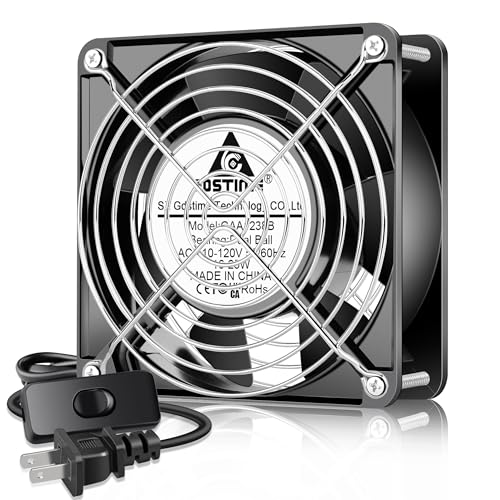
1. GDSTIME AXIAL 12038 Muffin Fan, 120V AC 120mm x 38mm, Dual Ball Bearing
Our pick — over 4★ from 600+ verified ratings; the strongest balance of quality and price.
The budget-friendly 120mm fan fits smaller tabletop and kid-sized games — but not full-size tables.
Not every air hockey table needs a high-CFM giant. If you have a small tabletop or kid-sized air hockey game, this GDSTIME 120mm fan is a practical, affordable option. At 4.72 inches square, it is the smallest fan in the roundup and fits openings that 150mm or 172mm fans would be too large for. The dual ball bearings are rated for 67,000 hours of continuous operation — the same lifespan rating as the premium AC Infinity and Wathai 200mm fans.
Buyers describe it as a fan that “moves the advertised air volume” with “good build quality” and note that the removable metal grills are handy for cleaning. The aluminum frame with plastic blades keeps the weight low at 15.4 ounces. It uses about 25 watts on 120V AC and includes mounting screws and a wiring connector. Compared to the Wathai 172mm fan, this 120mm unit moves less air (the GDSTIME does not list a CFM rating, but 120mm fans typically move around 80-100 CFM), so it works best on small surfaces where the puck does not need a massive air cushion.
The main limitation is airflow — one reviewer was unhappy, saying “there is no way this fan moves the advertised air” and that the output felt weaker than a 4-inch computer fan. For a full-size table, this fan will likely struggle to float the puck consistently. Keep it for youth tables, repair projects, or as a secondary fan in a multi-fan setup.
Why it is a useful backup
- 67,000-hour dual ball bearing lifespan matches premium fans at a lower cost
- Small 4.72-inch size fits compact openings other fans cannot
- Aluminum housing with removable metal grills for easy cleaning
The performance limit
- CFM rating is unlisted but likely under 100 — too low for a full-size table
- Some buyers found the actual airflow weaker than expected from a 120mm fan
Ideal for small tables: If you are repairing a kid’s air hockey table or a tabletop game with a 4.72-inch mounting hole, this is the right fit.
Not for standard play: A full-size 6-foot or 7-foot table requires a 172mm fan with at least 180 CFM — this GDSTIME fan will not provide enough air for proper puck float.
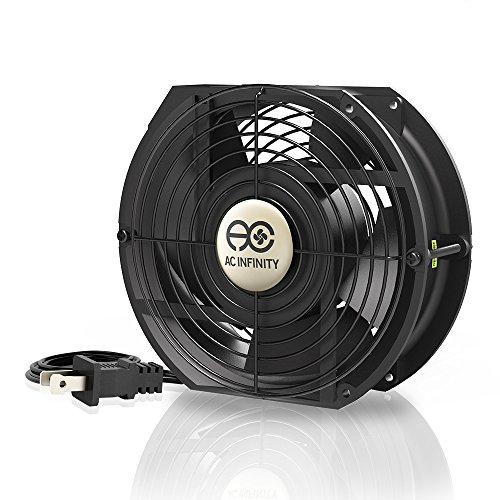
2. AC Infinity AXIAL 1751, Muffin Fan, 120V AC 172mm x 150mm x 51mm High Speed
This fan pushes 211 CFM from a compact 172mm frame and is safety-certified — the proven workhorse for standard tables.
You need enough air to float the puck and a fan that survives years of flat mounting. The AC Infinity AXIAL 1751 delivers 211 cubic feet per minute of airflow from a 172mm x 150mm body, which is enough lift for a standard home table. Its dual ball bearings (two ball races supporting the shaft for smooth rotation) are rated for 67,000 hours of use, so you are not replacing it every season.
Compared to the Wathai 238 CFM model, the AC Infinity moves about 27 fewer CFM, but buyers consistently mention build quality as the reason to pick it. One reviewer who used it as a replacement for a kids’ air hockey table noted it was quieter than the old fan during active play. The included fan guards and mounting screw set save a separate trip to the hardware store. It is UL-certified (Underwriters Laboratories tested it for basic safety).
The catch is noise. At 52 decibels, this is the loudest fan on the list at full speed. For a basement game room where the kids are making noise anyway, it is fine — for a quiet living room, the PANO-MOUNTS DC fan is a better fit. The AC Infinity requires a separate speed controller if you want to dial it back, and the power connector is a 4-pin type that some buyers found fragile.
Why it earned the top spot
- 211 CFM airflow that floats the puck easily on a standard table
- Dual ball bearings rated for 67,000 hours of continuous use
- UL-Certified safety rating gives confidence under the table
One honest limitation
- 52 dBA noise level is noticeable; needs a speed controller to quiet it down
- Mounting hole pattern is non-standard, may require drilling new holes on some tables
Reach for this if: You want a proven, safety-certified fan in the popular 172mm size and do not mind some noise during play.
Look elsewhere if: Your table sits in a quiet room and you need something quieter, or you want variable speed built-in without buying an extra part.
3. PANO-MOUNTS 172mm DC 17251 Axial Ventilation Fan (3300 RPM)
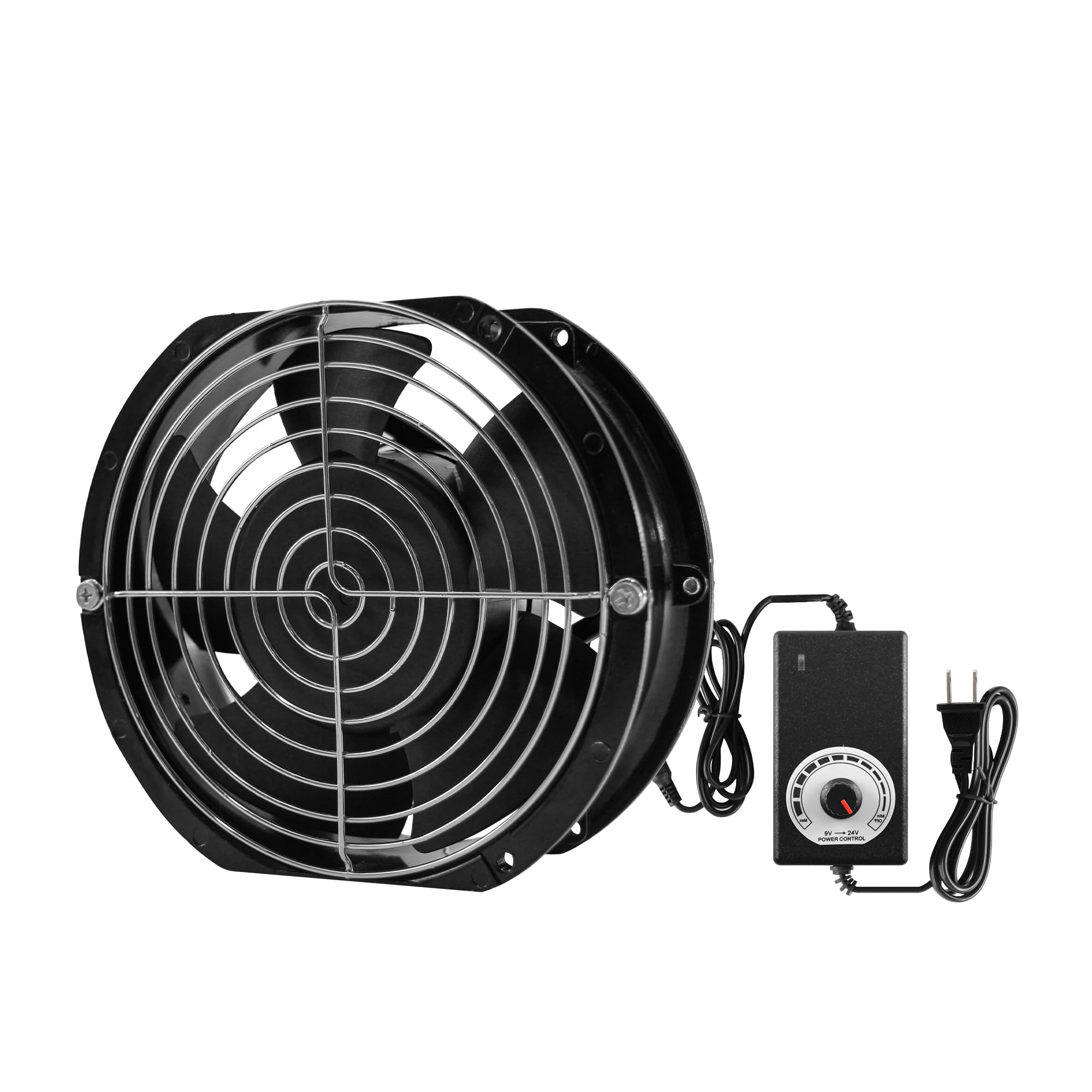
At just 40 decibels, this DC fan lets you hear the puck and the players, not the motor — the quietest option here.
If the noise of the AC Infinity bothers you, this DC-powered fan from PANO-MOUNTS is your answer at just 40 decibels. That is 12 dBA quieter than the AC Infinity — a significant difference that makes it nearly inaudible during play. It still pushes 180 cubic feet per minute of airflow, which is the baseline for floating a puck on a standard home table.
This is also the only fan on the list with an IP44 moisture-proof rating (Ingress Protection 44 — protected from splashing water and particles larger than 1mm), meaning it handles humidity up to 85% relative humidity. That makes it a good choice for basements or garages. It runs at 3300 RPM (revolutions per minute), 22% faster than the Wathai 172mm model’s 2700 RPM. Buyers report it was “easy to mount to my table” and that the adjustable speed switch is a nice feature for matching airflow to table size.
The trade-off is lower total airflow — 180 CFM versus 238 CFM on the Wathai 172mm. For a full-size commercial table, that difference may mean a slightly slower puck. The construction is a mix of metal and plastic rather than all-metal, so it feels less heavy-duty than the AC Infinity.
Its quiet credentials
- Only 40 dBA — the quietest fan in this guide by a clear margin
- Built-in speed controller for adjusting airflow without a separate purchase
- IP44 rated for moisture and high-humidity environments like basements
Its power limit
- 180 CFM is adequate but less than the 238 CFM of the Wathai 172mm
- Metal and plastic construction may not feel as premium as all-metal fans
Best for quiet spaces: Choose this if the table is in a living room, family room, or anywhere you want the fan to stay out of earshot.
Not for max power: If you have a large commercial table that needs every possible CFM, the Wathai 238 CFM model above will give you more float.
4. Wathai 172mm x 150mm AC Axial Fan 110V 120V Air Hockey Table Replacement (238 CFM)

At 238 CFM, this is the maximum-airflow 6-inch fan — it turns a sluggish table into a tournament-ready game.
This Wathai fan pushes 32% more air than the PANO-MOUNTS DC fan (238 CFM vs 180 CFM). That extra volume makes a real difference — the puck floats higher and glides faster, and the air cushion stays even across the surface even if the table has slight warps. It runs at 2700 RPM and draws 32 watts of power, about the same as a small light bulb.
One buyer who replaced their old fan said, “The fan on my old air hockey table was noisy and not delivering enough air any longer. Replacing it with this quiet and more powerful unit worked perfectly.” They noted they needed to make a simple adapter plate out of 1/2″ MDF (medium-density fiberboard) to fit the fan, which is common if your table has a non-standard opening.
The noise level is 50 dBA — noticeable but not intrusive, with a clean wind sound rather than a rattle. The metal construction feels solid, and the included power plug with a 59-inch cable gives plenty of length to reach an outlet under the table.
Why this is the power pick
- 238 CFM is the highest airflow among all the 172mm fans reviewed here
- All-metal construction for durability under the table
- 59-inch power cable included for flexible placement
The honest catch
- At 50 dBA, it is louder than the PANO-MOUNTS DC fan by 10 dBA
- 50,000-hour bearing life is solid but lower than the 67,000 hours of some rivals
Who this fits: Anyone with a full-size home table who wants the strongest possible puck float from a 172mm fan without moving up to a 200mm frame.
One drawback to consider: You need basic DIY skills to create an adapter plate if the fan does not bolt directly to your table’s existing bracket.
5. WDERAIR Big Airflow Axial 110V 120V AC 150mm x 50mm Metal Fan
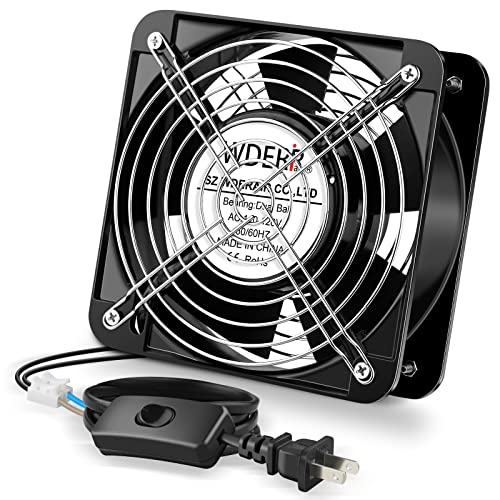
A metal-housed 150mm fan packing almost as much punch as the 172mm models — 236 CFM in a smaller frame.
This WDERAIR fan is slightly smaller than the 172mm options at 150mm x 150mm x 50mm (roughly 5.9 inches square), yet it delivers an impressive 236 cubic feet per minute of airflow. It runs at 2700 RPM and includes a convenient switch on the power cord so you can turn it on and off without unplugging.
Reviewers found it worked perfectly for smaller setups — one said, “The airflow is perfect for a small kid sized air hockey table.” The metal frame with polished stainless grates gives it a clean, durable feel, and the dual ball bearing system supports continuous operation. Compared to the GDSTIME 120mm fan, this 150mm model moves significantly more air while being only about an inch wider.
At 51 decibels, it is on the louder side, similar to the AC Infinity. Some buyers noted the included power wires are thin gauge (under 18 AWG), which is safe for a table-mounted fan but may not suit high-load or permanent building use. If you want a fan that fits a 6-inch round duct, this one works well because the 5.9-inch dimension matches standard duct size closely.
Why it fits many builds
- 236 CFM is near the top of the class despite the smaller 150mm frame
- Comes with a convenient on/off switch on the power cord
- Metal housing with stainless grates for durability
A point to check
- 51 dBA noise is noticeable — not ideal for a quiet space
- Thin power wires may need an insulation upgrade for some installations
Best fit if: Your table has a 150mm opening or you want to run a 6-inch inline duct to the fan. The switch on the cord is a simple convenience most fans here lack.
Check before buying: If your table opening is 172mm, you will need an adapter plate — the Wathai 172mm model above will bolt right in without extra parts.
6. Wathai AC Axial 2060 200mm Case Muffin Fan 110v 120V Dual Ball 200x60mm (280 CFM)

The 200mm fan delivers 280 CFM for oversized or commercial tables — the maximum airflow in this roundup.
If your table is a commercial-size model or you simply want the most air possible moving under the playing surface, this Wathai 200mm fan is the king of CFM here. The fan measures 7.87 inches square, significantly larger than the standard 172mm (6.77-inch) fans, so it will not fit a typical home table without modification.
The noise rating spans from 39 to 51 dBA depending on speed (it runs between 1800 and 2400 RPM), with the lower end being surprisingly quiet for the volume of air it moves. The dual ball bearings are rated for 67,000 hours, matching the lifespan of the AC Infinity. It draws 0.58 to 0.67 amps, about twice the current of the smaller fans, so make sure your table’s wiring can handle it.
Owners mention it is “well made and fairly quiet” for its size and works well for cooling enclosure boxes or adding airflow to reach-in cooler condensers. The included AC power plug has a 59-inch cable and a switch, but some reviewers noted the power cord is not permanently attached — you need to connect it using spring terminals, solder, or wire nuts inside a junction box.
Why size matters
- 280 CFM is the highest airflow of any fan in this guide
- 67,000-hour dual ball bearing lifespan matches the longest in the category
- Speed range from 1800 to 2400 RPM gives flexibility to balance airflow and noise
The physical reality
- 7.87-inch size will not fit a standard 172mm table opening without extensive modification
- Power cord requires wiring (soldering or wire nuts) — not a simple plug-and-play setup
For the big tables: If you own or are building a jumbo-sized or commercial air hockey table and want the maximum air cushion possible, this is the fan to choose.
Skip it for standard tables: A typical home table has a 6-inch (172mm) opening — this fan is 1.1 inches wider and requires cutting or an adapter plate to fit.
Understanding the Specs
CFM: Cubic Feet per Minute
This number tells you how much air the fan moves every minute. For an air hockey table, it is the power behind the air cushion. A fan rated at 180 CFM lifts the puck just enough to glide. A fan rated at 238 CFM lifts it higher so it moves faster and stays floating even if the table surface is not perfectly flat. Higher CFM also means the puck recovers more quickly after a hard hit. The fans in this guide range from about 80 CFM (the small GDSTIME 120mm) up to 280 CFM (the giant Wathai 200mm), and you want at least 180 CFM for a satisfying game on a standard home table.
dBA: Decibels (Noise Level)
Decibels measure sound pressure. Every 10 dBA increase sounds about twice as loud to your ear. A fan rated at 40 dBA is quiet enough that you hear the puck and the players clearly. A fan at 50 dBA is clearly audible — you hear a steady whoosh during play. At 52 dBA (the loudest in this guide), the fan noise becomes part of the game-room atmosphere. Noise from a fan mounted under a table is muffled somewhat by the tabletop and the playing surface, so the actual sound you hear during a game will be a bit lower than the raw rating.
FAQ
What size fan fits a standard air hockey table?
Will a 200mm fan work on a standard home table?
How much airflow (CFM) does an air hockey table need?
Can I use a computer case fan for my air hockey table?
How long do air hockey table fans last before needing replacement?
Are all air hockey table fans wired the same way?
Can I adjust the speed of an air hockey table fan?
Why is my air hockey table fan so loud all of a sudden?
Does the direction of airflow matter under an air hockey table?
Can I replace just the fan blade or do I need to buy a whole new fan?
Final Thoughts: The Verdict
For the majority of shoppers, the best air hockey table fan winner is the AC Infinity AXIAL 1751 because it combines a proven 211 CFM output, a 67,000-hour bearing lifespan, and UL-Certified safety in the standard 172mm size that fits most home tables. If you want the quietest possible operation with built-in speed control, grab the PANO-MOUNTS DC 17251. And for maximum puck float that turns any table into a tournament-speed experience, the standout is the Wathai 172mm 238 CFM fan.
How We Picked
We do not accept paid placement. Every pick is matched to a real buyer and a real use-case; we do not hands-on test units.
Sources & Methodology
Specifications: manufacturer listings and product documentation. Review insights: verified customer reviews, as of July 2026. Pricing: not shown on this page (it changes often); check the current price via the retailer link.
As an Amazon Associate, Gadgets Feed earns from qualifying purchases. This does not affect which products we feature.
Related Guides
Product prices and availability are accurate as of the date/time indicated and are subject to change. Any price and availability information displayed on Amazon at the time of purchase will apply to the purchase of this product. As an Amazon Associate I earn from qualifying purchases.
CERTAIN CONTENT THAT APPEARS ON THIS SITE COMES FROM AMAZON. THIS CONTENT IS PROVIDED "AS IS" AND IS SUBJECT TO CHANGE OR REMOVAL AT ANY TIME.
Amazon and the Amazon logo are trademarks of Amazon.com, Inc. or its affiliates.