
Our readers keep the lights on and my morning glass full of iced black tea. As an Amazon Associate, I earn from qualifying purchases.
You want a camping air mat that keeps you off the hard ground all night, not one that deflates by 3 AM or slides around inside the tent. The real question is which mat actually holds air, packs small enough to hike with, and keeps you warm when the temperature drops below 40 degrees. The answer depends on three things — thickness (how far you sit above the ground), weight, and how you inflate it.
I’m Min — the founder and writer behind Gadgets Feed. This guide is built by comparing the manufacturers’ published specifications and the patterns across verified customer reviews, so you get each pick’s real strengths and trade-offs instead of marketing spin.
For most people, the one air mat for camping that balances comfort, reliability, and value is the OGERY Sleeping Pad — its 6-inch thickness keeps side sleepers off the ground, the built-in foot pump inflates it fast, and buyer reviews consistently report no overnight air loss. If you need a warm, lightweight mat for multi-day backpacking in cold weather, the Big Agnes Rapide SL is the better choice.
How To Choose The Best Air Mat For Camping
Picking the right camping air mat really depends on three trade-offs: how thick it is (which decides whether your hip touches the ground), how heavy it is (which decides whether you want to carry it all day), and how you get air into it (foot pump, hand pump, or blowing with your mouth). Below is what each spec actually means in the tent.
Thickness — How High You Sit Off the Ground
A mat that is 2 inches thick usually feels fine if you sleep on your back, but side sleepers often bottom out (your hip or shoulder presses through to the hard ground). Mats around 3 to 4.25 inches keep most side sleepers off the dirt. The extra-thick options at 6 inches are essentially a different category — they feel like a real mattress and eliminate ground feel entirely, but they weigh more and pack larger.
Weight & Packed Size — What You Can Carry All Day
Every extra pound on your back adds fatigue over miles. For backpacking, an ultralight mat around 1.4 to 1.8 pounds and a packed size close to 10 inches by 5 inches is ideal — small enough to slide into a side pocket of your pack. For car camping, weight matters far less, so you can prioritize thickness and comfort over portability.
Inflation Method & Reliability
Built-in foot pumps are convenient — you stamp on the mat and it fills with air in 30-60 seconds. But buyer reviews show that foot pumps can fail after a few trips if the internal valve gets a small tear. A separate inflation sack (like the pump sack on premium mats) avoids introducing moisture from your breath and lets you control firmness precisely. Mats without any pump require mouth inflation, which adds moisture inside the mat and can lead to mold over time.
Quick Comparison
On smaller screens, swipe sideways to see the full table.
| Model | Best For | Thickness | Weight | R-Value | Amazon |
|---|---|---|---|---|---|
| OGERY Sleeping Pad | Side sleepers wanting a real mattress feel | 6 Inches | 2.4 lbs | — | $31.99$42.11PrimeAmazon |
| Big Agnes Rapide SL | Three-season backpackers who want warmth | 4.25 Inches | — | 4.8 | $169.95Amazon |
| VALEHOWL Ultralight Pad | Budget-conscious 3-season hikers | 2.7 Inches | 1.8 lbs | 3.0 | $37.98Amazon |
| KASIMO Camping Pad | Couples or tall campers wanting space | 6 Inches | 1.8 lbs | — | Amazon |
| Amazon Basics Camping Pad | Ultralight occasional backpacking | 2.2 Inches | 1.4 lbs | — | $26.23Amazon |
In‑Depth Reviews
1. OGERY Sleeping Pad for Camping

The 6-inch thick mat that side sleepers and bigger campers actually stay on all night.
This mat is 6 inches thick — a full 2.7 times thicker than the Amazon Basics pad — so your hip never touches the ground even if you shift onto your side. It also stretches 79 inches long and 24.5 inches wide, giving you more legroom than most mats at this price. A built-in foot pump inflates it in about 200 stomps, and buyers report no sagging even with a 100-pound weight difference between two sleepers.
One owner mentioned it is “noisy when shifting” — the material crinkles like a heavy-duty tarp when you roll over, so light sleepers may notice it. The foot pump also adds bulk when packed, and the pillow design works best for back sleepers rather than side sleepers. At 2.4 lbs, it is 33% heavier than the 1.8-pound VALEHOWL pad, so it is better suited for car camping or shorter hikes than multi-day backpacking trips.
The case for it: The thickest pad here at 6 inches gives you genuine mattress-level comfort — no bottoming out for side sleepers, and the built-in pillow saves carrying one more item. It also held up during temperature changes without losing air overnight.
The catch: It is bulky and noisy. The foot pump adds noticeable packed size, and the surface crinkles loudly when you shift weight, which might bother a tent partner who is a light sleeper.
Best for: Side sleepers and car campers who want a thick, comfortable sleep surface that does not deflate overnight.
Skip if: You are a minimalist backpacker who needs a quieter, lighter mat that packs smaller.
2. Big Agnes Rapide SL Insulated Sleeping Pad

The premium insulated pad that keeps you warm in cold tents without adding bulk.
This mat uses two layers of heat-reflective film to reach an R-Value (a measure of how well it blocks ground cold) of 4.8 — meaning it blocks ground chill effectively for three-season use and even some winter nights. At 4.25 inches thick, it sits between the thin budget pads and the 6-inch giants, offering a comfortable platform for side sleepers without the weight penalty of the thickest options. The outer chambers are larger (4.25 inches) than the center, creating a cradle that stops you from rolling off the edge, which owners say is a real advantage for active sleepers.
The included Pumphouse inflation sack fills the mat in about 4 minutes without introducing moisture — a significant improvement over blowing with your mouth or relying on an internal foot pump that can fail. Owners mention it is “quiet compared to others,” with minimal crinkle noise during the night. One reviewer noted it is heavier than some competitors like the Klymit, but the downside is consistent comfort and no air loss over a 5-day trip. It packs to about 10 x 5 x 5 inches, similar to ultralight options.
Why it’s great
- R-Value 4.8 keeps you warm well below freezing — ideal for spring and fall backpacking
- Offset I-Beam construction gives a stable, pillowy surface without excessive bounce
- Pumphouse inflation sack avoids moisture buildup and is fast once you learn the technique
Good to know
- At 20 inches wide in the Regular size, it is narrower than most competitors — bigger sleepers may feel the edges
- The Pumphouse sack takes practice — some users initially struggle to get a tight seal
Best for: Serious backpackers who camp into shoulder seasons and need reliable insulation without sacrificing comfort.
Skip if: You are a car camper who wants the thickest possible pad for the lowest price — this is a premium investment for weight-conscious hikers.
3. VALEHOWL Ultralight Camping Sleeping Pad
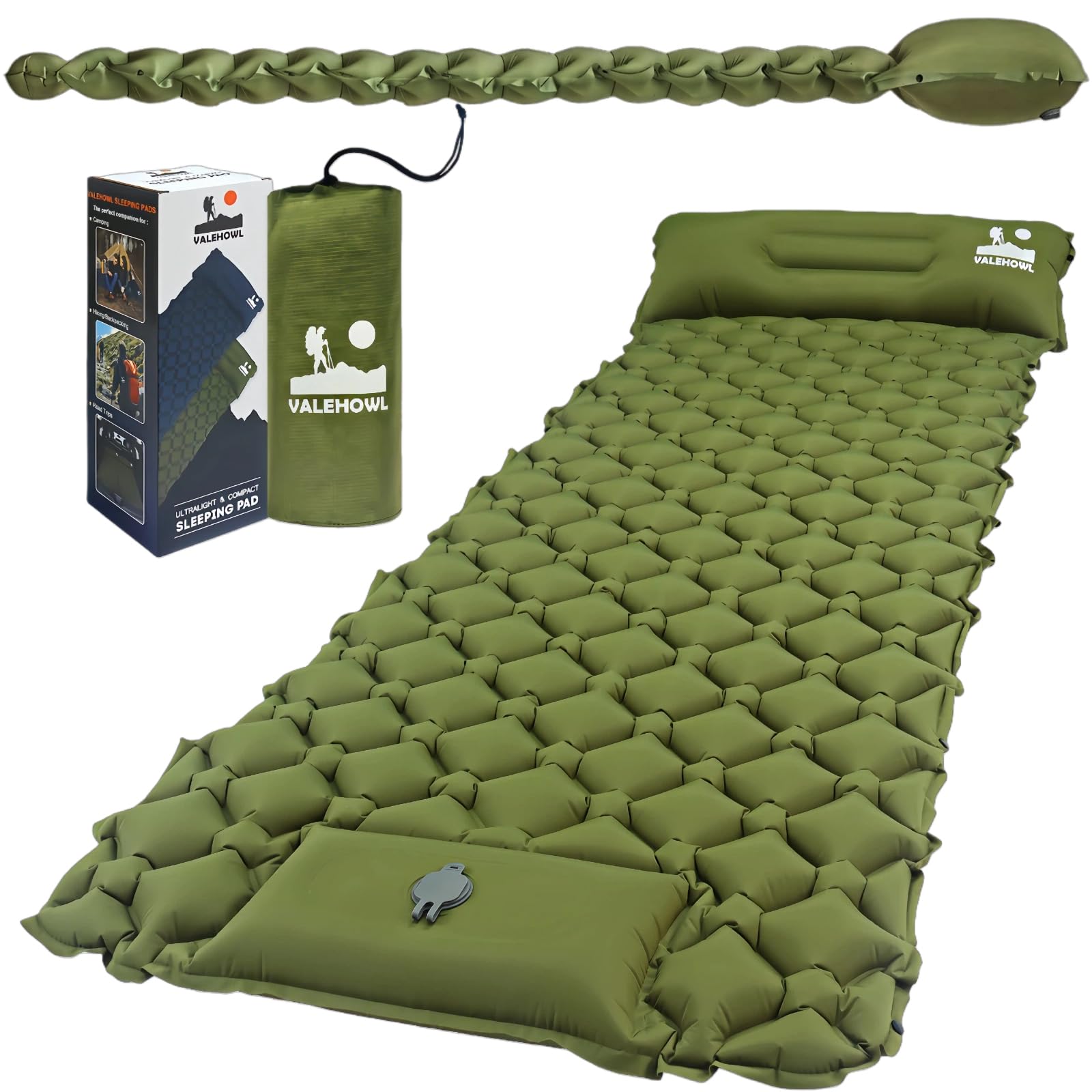
A sub-2-pound hiking pad that inflates in 40 seconds and keeps ground chill away down to 35°F.
This mat is a good balance for three-season hikers who need a mix of weight, warmth, and price. It weighs 1.8 pounds and packs down to 10 inches by 5 inches — small enough to fit in a backpack side pocket. The built-in foot pump inflates it in about 40 seconds, and the R-Value of 3.0 blocks ground chill in temperatures from about 35 to 95 degrees Fahrenheit, which covers spring through fall camping for most people. It also supports up to 400 pounds with a honeycomb air chamber design that distributes pressure evenly.
A few owners noted an issue: the integrated pillow is in an awkward position for some sleepers, making it less comfortable for those who prefer a specific neck angle. The 40D nylon outer layer is durable but thin, so camping on rough ground without a footprint risks punctures. Compared to the 6-inch thick OGERY, this pad is only 2.7 inches thick — fine for back sleepers, but side sleepers may feel the ground through the mat after a few hours.
Why it’s great
- R-Value 3.0 makes it genuinely usable in spring and fall, not just summer
- Very portable at 1.8 lbs and packs to water-bottle size — easy to carry for day hikes to basecamp
- Side snap buttons let you connect two pads together for a double-wide setup
Good to know
- At 2.7 inches thick, side sleepers may find their hip touches the ground on soft terrain
- Some customers note the pillow sits too high or in an uncomfortable position for their sleeping style
Best for: Hikers and backpackers who want a lightweight, warm mat that packs small and inflates quickly.
Skip if: You are a side sleeper or car camper who needs more than 3 inches of thickness to stay comfortable.
4. KASIMO Camping Sleeping Pad

The ultralight pad that holds three times more weight than the budget alternative and buttons into a double.
One spec tells the story here: this mat supports 661.4 pounds while the Amazon Basics pad supports only 220 pounds — a 3.0x gap that makes the KASIMO feel much sturdier under larger sleepers. It measures 78 inches long and 26 inches wide with a 6-inch thickness, which is actually wider and slightly longer than the OGERY while weighing the same at 1.8 pounds. The real standout feature is the side button system: you can connect two KASIMO pads side-by-side to create a double-wide bed, which makes it an excellent choice for couples who want individual firmness control without a gap between mats.
Reviewers point out it is easy to inflate in about a minute and holds air all night without leaking — one owner stated it “performed just as expected” and kept them warm above the ground. The trade-off is that the surface material is noisy: reviewers compare the sound to “crunching up paper” when you shift position. The built-in foot pump is convenient but adds a small bit of bulk when packed; it folds down to about 11 x 3.9 inches.
The case for it: The side-snap system for connecting two pads into a double bed is unique at this weight — couples get the benefit of two separate mats (no air transfer when one person rolls over) that stay locked together. At 1.8 lbs and 6 inches thick, it matches the plushness of the OGERY while being lighter.
One limitation: It is noisy. The 40D nylon and TPU coating makes a loud crinkling sound every time you move, which can wake a light sleeping tent partner. And while the pillow is built-in, some buyers found it too low or awkward for their preferred sleep position.
Best for: Couples who camp together and want a pad that connects into a double without the bounce of a single large air mattress.
Skip if: You are a light sleeper who will be bothered by crinkling noises every time you shift in the night.
5. Amazon Basics Camping Sleeping Pad

The lightest mat here at 1.4 pounds — but thin enough that you will feel every root.
If weight is your single biggest concern, this is the lightest option at just 1.4 pounds — 0.4 pounds lighter than the KASIMO (a 29% gap). It packs down to 12 x 4 x 4 inches, which is about the size of a water bottle. The built-in foot pump uses “Insta-Pump Technology” (the brand’s claim) to inflate it in under 60 seconds, and the 190T polyester fabric is water-resistant to handle damp ground. It is compatible with Amazon Basics sleeping bags if you want a full matching sleep system.
The big catch is endurance and comfort. At only 2.2 inches thick, side sleepers will likely bottom out quickly on uneven ground. More importantly, buyer reviews report the foot pump can fail — one owner shared a “test run seemed good” but the mat “failed on 5-night trip” and deflated by morning. Another reviewer had to blow it up with their mouth because the built-in pump stopped working. The capacity is capped at 220 pounds, which is the lowest here by a wide margin.
The case for it: For a quick weekend trip where every ounce matters, this is nearly half the weight of the OGERY while still having a built-in pump. It also does not make the crinkling noise that the KASIMO makes, which owners mention as a plus for light sleepers.
The compromise: Reliability is a real gamble. Multiple reviewers report foot pump failure after a few uses, and the 2.2-inch thickness means your hips and shoulders will press into the ground if you are a side sleeper. It is best treated as a backup or very occasional-use pad.
Best for: Ultralight backpackers who want the lowest possible pack weight for short trips and are comfortable with the risk.
Skip if: You need a reliable pad for multi-day trips or you sleep on your side — the thin profile and pump reliability make it a poor choice for extended use.
Understanding the Specs
R-Value — How warm the mat keeps you
R-Value measures how well the mat blocks cold from the ground. A value of 1-2 works for summer only, 3-4 covers spring through fall (about 35-95°F), and anything above 4.5 is good for near-freezing conditions. The VALEHOWL pad has an R-Value of 3.0, which handles most three-season camping but will feel cold if you camp in winter. The Big Agnes Rapide SL has an R-Value of 4.8, which is noticeably warmer on frosty ground.
Thickness (in inches) — Ground isolation
Thickness is simply how far the mat lifts you off the ground when fully inflated. A 2-inch mat works for back sleepers on flat ground, but side sleepers need 3 to 4.25 inches to avoid feeling rocks through the mat. The OGERY and KASIMO at 6 inches are thick enough that you barely feel the ground beneath you — closer to a real mattress than a typical sleeping pad. The Amazon Basics at 2.2 inches is the thinnest here.
FAQ
Which is thicker — 6 inches or 2.2 inches and why does it matter?
Will a 1.4-pound mat hold up for a week-long backpacking trip?
What is an R-Value of 3.0 good for in real camping?
Can I connect two separate camping pads together?
How long does a built-in foot pump last before it breaks?
Is a camping air mat noisy when you move around?
What packed size fits in a standard backpack side pocket?
Can I use a camping air mat indoors as a guest bed?
Final Thoughts: The Verdict
For most campers, the air mat for camping that balances comfort, reliability, and value is the OGERY Sleeping Pad — the 6-inch thickness keeps side sleepers off the ground, the built-in foot pump works consistently, and the price stays in the mid-range. If you are a serious backpacker who camps into cold weather and needs a lightweight, warm mat that packs small, grab the Big Agnes Rapide SL. And for couples who want separate pads that connect into a double bed without air transfer, the KASIMO Camping Pad with its 661.4-pound capacity and side-snap system is the clear pick.
How We Picked
We do not accept paid placement, and we did not hands-on test every unit. Instead, we match each pick to a real buyer and use-case by comparing the manufacturers’ published specifications against the patterns in verified customer reviews — so you get each pick’s real strengths and trade-offs instead of marketing copy.
Sources & Methodology
Specifications: manufacturer listings and product documentation. Review insights: verified customer reviews, as of July 2026. Pricing: not shown on this page (it changes often); check the current price via the retailer link.
As an Amazon Associate, Gadgets Feed earns from qualifying purchases. This does not affect which products we feature.
Product prices and availability are accurate as of the date/time indicated and are subject to change. Any price and availability information displayed on Amazon at the time of purchase will apply to the purchase of this product. As an Amazon Associate I earn from qualifying purchases.
CERTAIN CONTENT THAT APPEARS ON THIS SITE COMES FROM AMAZON. THIS CONTENT IS PROVIDED "AS IS" AND IS SUBJECT TO CHANGE OR REMOVAL AT ANY TIME.
Amazon and the Amazon logo are trademarks of Amazon.com, Inc. or its affiliates.