
The single biggest mistake campers make is buying an air mattress that sags by 2 a.m., leaving you shivering on cold hard ground. A superior air mattress for camping is defined by its ability to hold air, insulate from the cold, and provide spinal support on uneven terrain — none of which your guest-room spare bed can reliably deliver under a tent.
I’m Min — the co-founder and writer behind Gadgets Feed. I’ve spent hundreds of hours cross-referencing R-values, foam densities, pump mechanisms, packed weights, and user-reported durability patterns across the outdoor sleep category to build this guide around measurable performance, not marketing claims.
After combing through thousands of verified buyer experiences and laboratory specs, I’ve assembled the definitive list of the best air mattress for camping choices that actually keep you warm, comfortable, and off the ground through the night.
How To Choose The Best Air Mattress For Camping
The camping air mattress market spans from ultralight backpacking pads at 1.7 pounds to car-camping behemoths approaching 7 pounds. Your choice hinges on three critical specs: R-value for warmth, thickness for ground comfort, and packed size for your mode of travel.
R-Value and Insulation
R-value measures the pad’s resistance to conductive heat loss from your body to the ground. A 3-season pad typically offers R 4.0–5.0, while winter and 4-season pads hit R 7.0 or higher. If you camp below 40°F, anything under R 4.0 will leach warmth all night, regardless of how thick the pad feels.
Thickness and Comfort Profile
Thicker is not always better. A 4-inch pad with high-density foam and air cells supports side sleepers without hip-bottoming, while a 3-inch pure foam pad can feel like memory foam at home. The trade-off is pack volume — thicker pads with foam cores compress to larger rolls that demand more trunk or backpack space.
Pump Mechanism and Reliability
Self-inflating foam pads rely on open-cell foam to draw air in when the valve opens, requiring no battery. Electric pumps inflate in under two minutes but drain battery capacity — typically 4–7 cycles per charge. Manual pump sacks are infinitely reliable but require physical effort. Never assume a built-in battery pump will have enough charge after three days off-grid.
Quick Comparison
On smaller screens, swipe sideways to see the full table.
| Model | Category | Best For | Key Spec | Amazon |
|---|---|---|---|---|
| Luxchoice Queen | Queen Bed | Car camping & guest use | 9″ thick, rechargeable pump | Amazon |
| NYECHTO 3.14″ Foam | Foam Hybrid | Winter camping & side sleepers | R-Value 9.5, 665 lb capacity | Amazon |
| Naturehike 27oz | Ultralight | Backpacking & weight-sensitive hikers | 27.2 oz, R-Value 4.6 | Amazon |
| Wise Owl 4″ Pad | Self-Inflating | Solo tent & SUV sleep setups | 4″ thick, 4 lbs, electric pump | Amazon |
| Sea to Summit Camp Plus | Foam-Air Hybrid | Versatile 4-season car camping | R-Value 4.3, 2.4 lbs | Amazon |
| Hikenture 4″ Foam | Insulated Hybrid | 4-season comfort & couples | R-Value 9.5, 80×28″ | Amazon |
| Big Agnes Rapide SL | Ultralight Insulated | Backpacking & bike packing | 18 oz, R-Value 4.8, 4.25″ thick | Amazon |
| Acacia Y-Shaped Foam | Telescopic Foam | Luxury car camping & glamping | R-Value 6, 4.3″ thick, 440 lb cap | Amazon |
| Therm-a-Rest MondoKing 3D | Self-Inflating Premium | Extreme cold & bed-like comfort | R-Value 7.0, 4.25″ thick, 80×30″ | Amazon |
In‑Depth Reviews
1. Therm-a-Rest MondoKing 3D Self-Inflating Camping Sleeping Pad

The MondoKing 3D sets the gold standard for car-camping luxury with a 4.25-inch thick mattress featuring vertical sidewalls that maximize usable sleep surface. Its StrataCore construction layers continuous thermal foam between alternating ridges of air and foam, delivering a 7.0 R-value that insulates effectively even below freezing — no ground chill penetrates this pad.
The TwinLock dual-valve system separates inflation and deflation into two dedicated one-way valves, making setup intuitive and pack-down fast. The XX-Large size (80×30 inches) accommodates restless sleepers and larger body types, with a weight capacity of 1,440 pounds. The included pump sack inflates the pad in under 10 minutes without introducing moisture from breath.
At 5.5 pounds and a rolled size of 31×10.3 inches, this pad is strictly for car camping or glamping — it’s far too heavy for backpacking. The stretch knit fabric surface feels soft against skin and produces no crinkle noise, and the limited lifetime warranty backs construction defects. Owners report it solves persistent cold-ground and re-inflation issues that plague thinner pads.
Why it’s great
- Exceptional 7.0 R-value for extreme cold
- No crinkle or noise during sleep
- Vertical sidewalls prevent roll-off
- Lifetime warranty from a trusted brand
Good to know
- Too bulky and heavy for backpacking
- Self-inflation can be slow; pump sack recommended
- Valve issues reported on some units
2. NYECHTO 3.14″ Ultra-Thick Memory Foam Sleeping Pad

This foam-and-air hybrid pad punches far above its price tier with a 9.5 R-value — the highest in this lineup — making it genuinely viable for sub-zero winter camping. The 3.14-inch thickness uses 28D high-density resilient memory foam that evenly distributes weight and supports up to 665 pounds without sagging, a spec that rivals pads costing three times as much.
The detachable electric pump contains dual 1,200 mAh batteries charged via USB-C, inflating the pad in under a minute and running for about 7 cycles per full charge. The 50D elastic knit fabric cover is breathable, moisture-wicking, and tear-resistant, and the built-in pillow adds head support without an extra accessory. When deflated, the pad compresses to a 0.7-inch thickness for storage.
Buyers consistently report no soreness after consecutive nights, especially side sleepers and heavier individuals. The first inflation takes slightly longer as the foam expands from vacuum packaging. At 5.95 pounds and 26.37 x 9 inches packed, it suits car camping and SUV trips but not extended backpacking. The detachable pump means you can recharge it separately without hauling the entire pad to a power source.
Why it’s great
- Class-leading R-Value 9.5 for winter use
- 665 lb capacity supports all body types
- USB-C rechargeable detachable pump
- Memory foam comfort without ground contact
Good to know
- Heavier and bulkier than backpacking pads
- First inflation requires patience
- Built-in pillow may not suit all sleepers
3. Big Agnes Rapide SL Insulated Sleeping Pad

The Rapide SL weighs just 18 ounces but delivers a 4.8 R-value and 4.25-inch thickness, an extraordinary warmth-to-weight ratio for backpackers who refuse to compromise on comfort. Two layers of heat-reflective film sandwich the offset I-Beam construction, creating a quilted top surface that cradles side sleepers without the trampoline bounce typical of thin air pads.
The high-volume valve with micro-adjustment allows fine-tuning of firmness without losing air, and the included Pumphouse inflation sack fills the pad in seconds — no moisture from breath, no batteries to fail. The outer chambers are 0.75 inches taller than the center, keeping you centered on the pad and preventing roll-off. At 20 inches wide (Regular), it fits standard backpacking tents, while the 25-inch wide version adds luxury at 22 ounces.
Backpackers and bike packers report consistent overnight inflation retention and quiet fabric that doesn’t crinkle during movement. The superlight double ripstop nylon with aviation-grade TPU lamination resists punctures well for its weight class. This is not a car-camping pad — the 20-inch width feels narrow for spread-out sleepers — but for multi-day carries, it’s the most comfortable sub-20-ounce option available.
Why it’s great
- Excellent 4.8 R-value at only 18 oz
- Quilted top eliminates air mattress bounce
- Taller outer chambers prevent roll-off
- Inflation sack works without moisture or batteries
Good to know
- 20″ width feels narrow for some sleepers
- Not suitable for car camping due to narrow profile
- Premium price reflects ultralight engineering
4. Hikenture 4 Inch Thick Self Inflating Sleeping Pad

Hikenture matches the NYECHTO’s R-Value 9.5 but does so with a full 4 inches of thickness and a wider 28-inch profile — a material advantage for stomach and side sleepers who need extra lateral space. The self-inflating open-cell foam core draws air automatically when the patented 2-way valve is opened, requiring only a few pump-sack puffs to reach full firmness.
The 80×28-inch surface accommodates sleepers up to 6’3″ without feet hanging off, and the 6.5-pound weight is reasonable for car camping given the insulation. The one-way deflate valve prevents air back-flow, making roll-up significantly easier than standard self-inflating pads — users with bad knees or limited mobility report no struggle packing it away. The polyester surface is quiet and skin-friendly.
Verified owners praise its ability to stay inflated with no air loss overnight and its warmth on below-freezing ground. Some units arrived with manufacturing tears, but the company replaced them without requiring returns — a sign of quality control that benefits the buyer. The pad packs to a relatively compact roll but is too heavy for backpacking and better suited to tent, SUV, or rooftop tent use.
Why it’s great
- R-Value 9.5 with 4-inch thickness
- Easy one-way deflate valve for packing
- Wide 28-inch profile for restless sleepers
- Excellent customer service on defect replacement
Good to know
- Too heavy for backpacking at 6.5 lbs
- Initial self-inflation is slow
- Some units had minor manufacturing defects
5. Acacia 4″ Thick Self Inflating Sleeping Pad with Y-Shaped Telescopic Foam
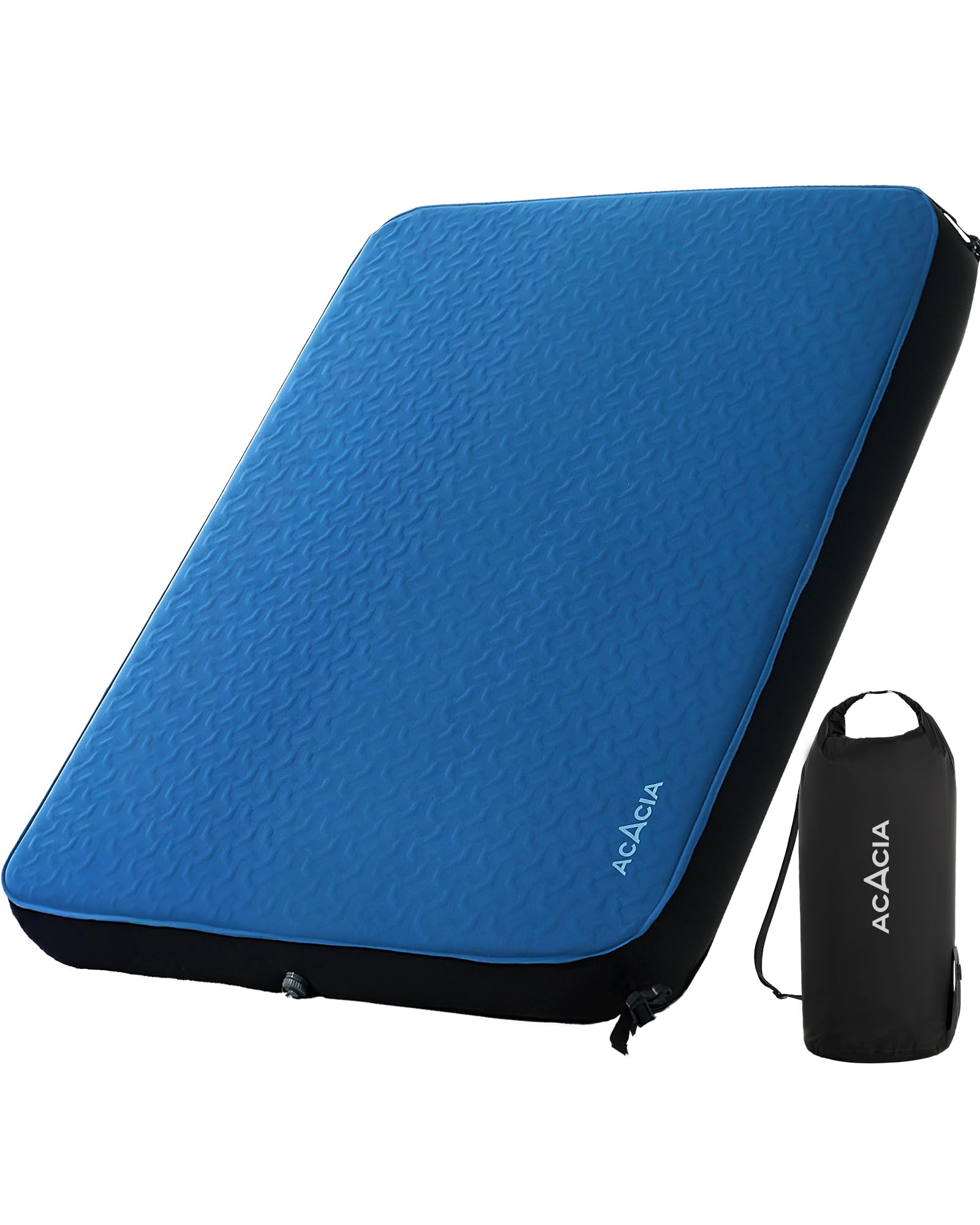
The Acacia pad solves the biggest pain of thick foam mattresses — pack volume — with a Y-shaped telescopic foam structure that compresses the pad’s volume by up to 60% after deflation. The 4.3-inch thickness and R-Value 6 provide bed-like comfort for cold-weather car campers, with a capacity of 440 pounds that accommodates larger sleepers without bottoming out.
A built-in crease line forms naturally as the pad deflates, guiding the roll into a compact cylinder that fits into the included carry bag. The 2-way valve handles most inflation automatically, and the bag doubles as a pump sack for fine-tuning firmness — or you can use an electric pump (sold separately) for faster setup. The 30D elastic fabric with TPU coating resists abrasion and tears.
Side buckles allow connecting multiple pads for couples or families, expanding usable space. Buyers note the packed size is still substantial — roughly the volume of a large laundry basket — which limits it to car camping. Some users found the inflation bag attachment fiddly at first but reported excellent comfort once they learned the technique. The 80×60-inch double size is also available.
Why it’s great
- Y-shaped foam compresses 60% smaller than standard
- High R-Value 6 for 4-season use
- Side buckles connect multiple pads
- Rugged TPU-reinforced fabric resists punctures
Good to know
- Bulkier than expected for car camping
- Inflation bag requires practice to use effectively
- Not suitable for backpacking
6. Naturehike 27oz Ultralight Insulated Sleeping Pad
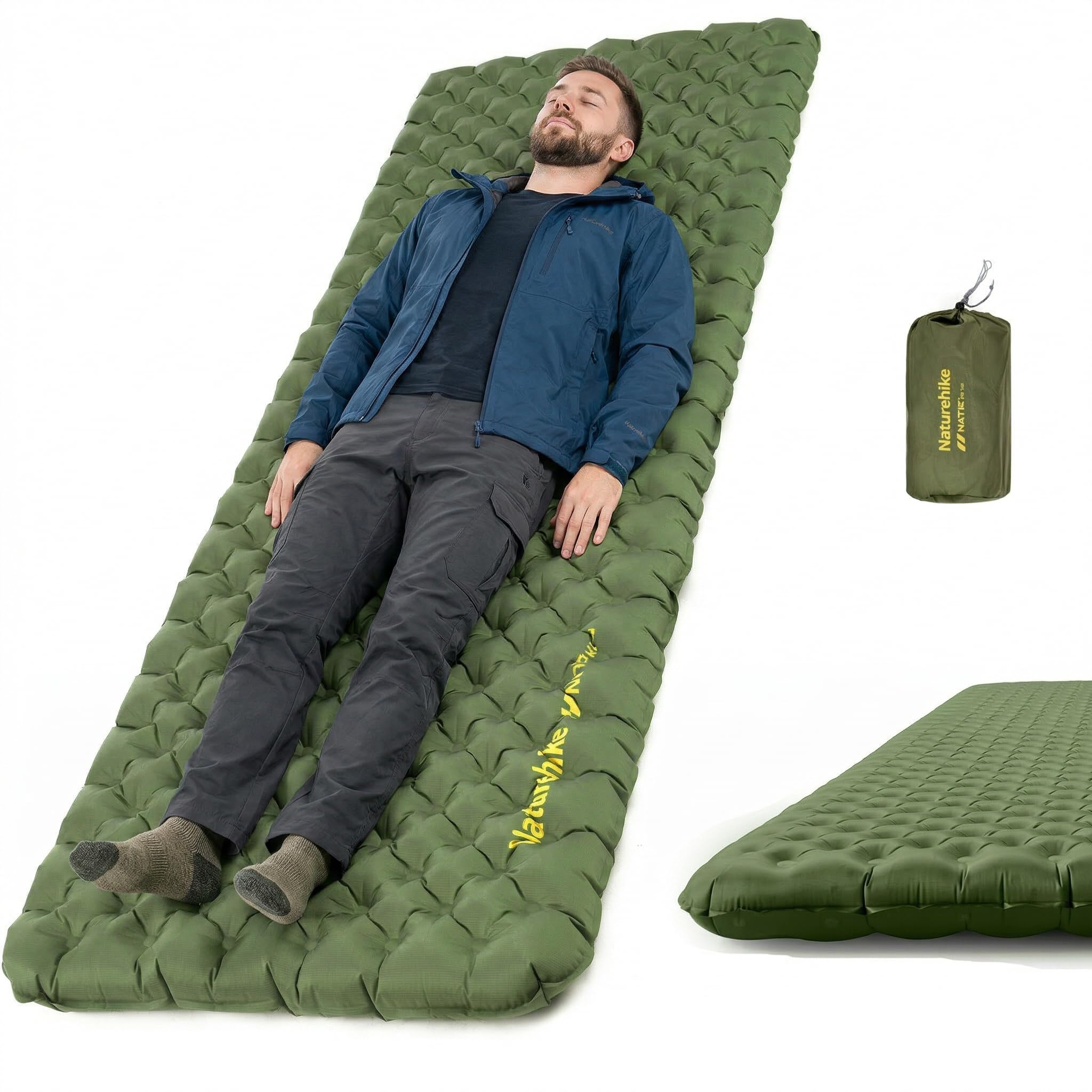
At just 27.2 ounces (770 grams), the Naturehike pad delivers a 4.6 R-value using an eight-layer aluminum-molded 3D insulation structure — a heat-reflective system that prevents convective heat loss without adding bulk. The 3.2-inch thickness is sufficient for side sleepers with bony hips, and the TPU lamination over 20D nylon provides excellent wear resistance at this weight class.
The patented dual-vent valve lets you inflate with the outer cover open for one-way flow, then open the inner cover for rapid deflation. The included pump sack inflates the pad in about four squeezes — owners report it’s faster and more reliable than blowing by mouth. The pad can handle temperatures down to -4°F/-20°C, making it viable for early-spring and late-fall backpacking.
Hikers consistently praise its comfort relative to weight, with many reporting better sleep scores than their home mattresses. The rectangular XL size (77×25 inches) fits most two-person tent floors without wasting space. The pump sack doubling as a dry bag adds utility for multi-day trips. Some users struggled with the pump sack attachment; the manual could be clearer. This is a specialist piece for weight-conscious adventurers only.
Why it’s great
- Ultralight at 27.2 oz with 4.6 R-value
- Eight-layer aluminum insulation at low weight
- Pump sack doubles as dry bag
- Handles -4°F temperatures
Good to know
- Pump sack attachment can be confusing
- Narrow 25″ width for some sleepers
- No electric pump option
7. Luxchoice Queen Air Mattress with Cordless Rechargeable Pump
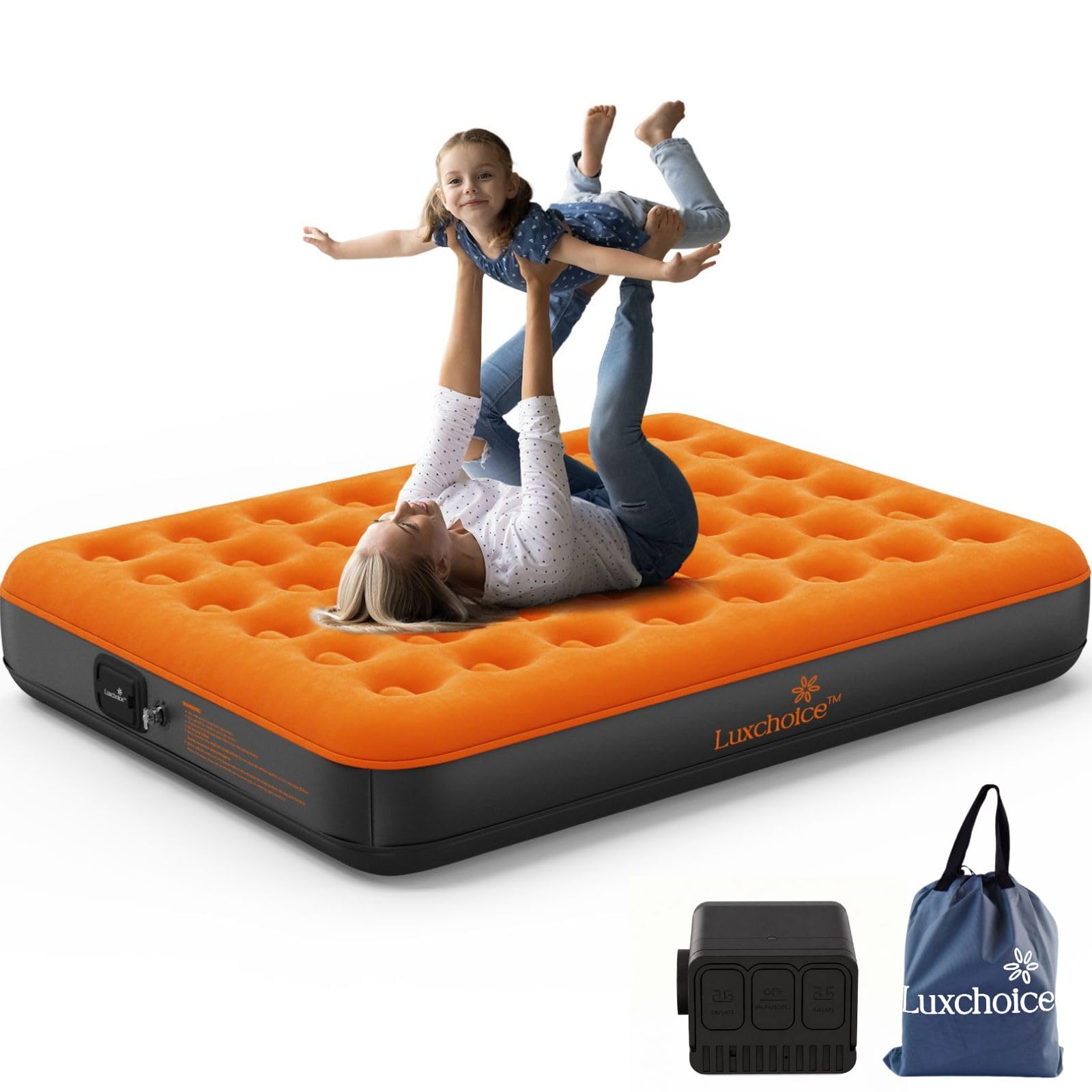
This queen-sized mattress uses an upgraded cordless rechargeable pump that inflates the 9-inch thick PVC bed in exactly two minutes via a button press — no outlet, no tangle, no foot pump. The flocked surface feels soft against skin, and the air coil beam structure provides enough spinal support for back and stomach sleepers at 210 pounds without sagging in the middle.
The pump battery lasts about four inflation cycles per charge and recharges via a USB-C car charger or wall adapter. At 80×60 inches, it fits standard queen sheets and two adults, though reviews suggest it’s better for solo use due to motion transfer on the single air chamber. The included carry bag compresses the mattress to a manageable roll for trunk storage.
Standout feature is the 2-minute automatic deflation — holding the deflate button vents all air without manual rolling. Some units developed slow leaks after 5-10 uses, but the manufacturer replaced them free. The PVC material stretches slightly during first use, so topping off air after initial inflation is normal. This is best for car campers who prioritize electric convenience over insulation or weight.
Why it’s great
- 2-minute cordless electric inflation
- Queen size fits standard bedding
- 9-inch thickness for ground clearance
- Fast automatic deflation
Good to know
- Some units developed leaks over time
- Single chamber causes motion transfer
- PVC material stretches initially
8. Wise Owl Outfitters 4″ Self Inflating Sleeping Pad with Electric Pump
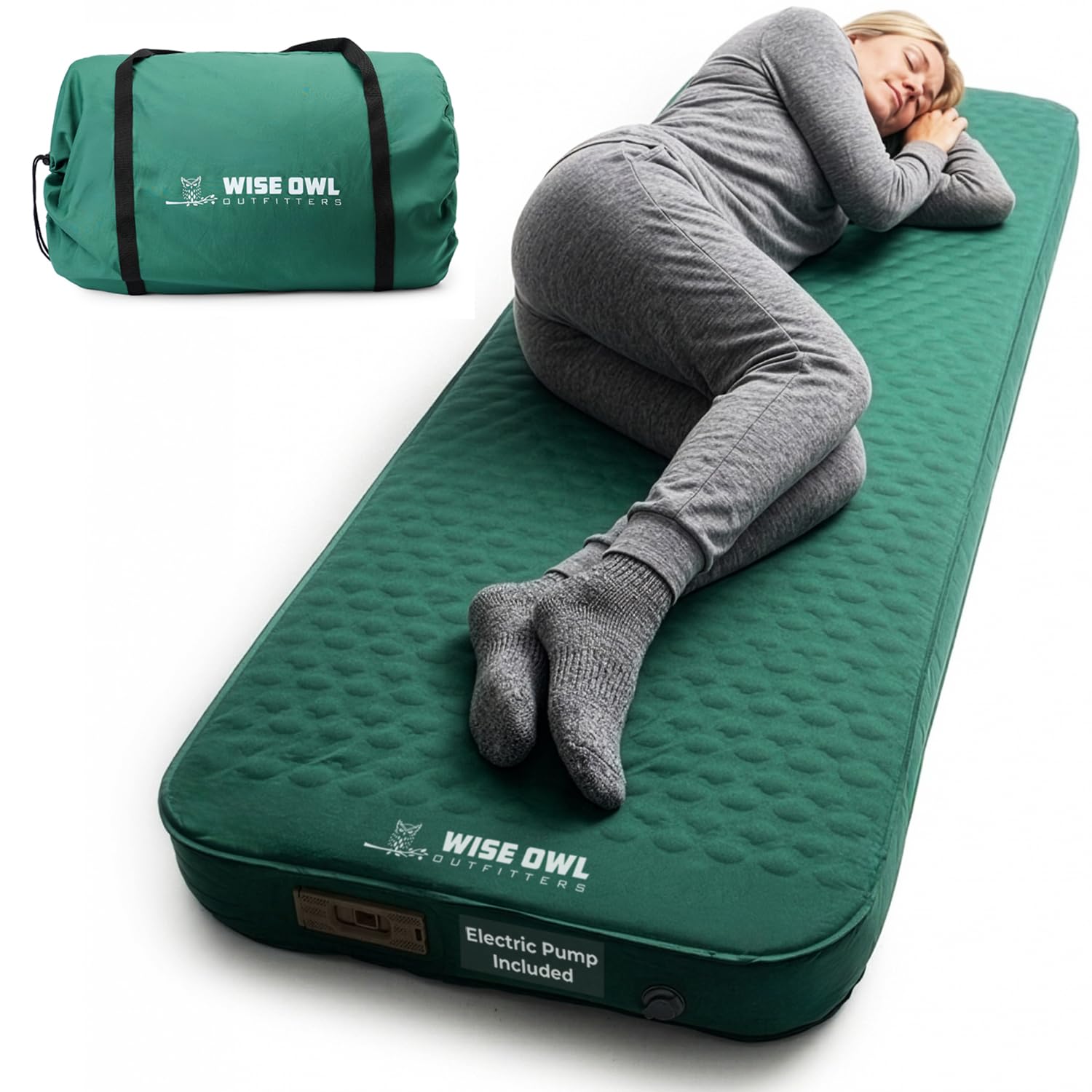
At 4 pounds and 4 inches thick, the Wise Owl pad strikes a sensible compromise between comfort and packability for car camping and SUV sleep setups. The combination of open-cell foam and air creates a cushioned yet supportive surface that supports up to 200 pounds without bottoming out — enough for most solo campers.
The removable electric pump with USB-C charging inflates the 78×28-inch pad in about 90 seconds, and the adjustable firmness lets you dial in the feel from plush to firm. The pump also works for deflation, making pack-down faster than manual rolling. The multi-layer design includes a 50D polyester cover that resists abrasion and is easy to clean.
Buyers note that the self-inflating function is minimal — the foam core partially inflates on its own, but the electric pump is necessary to reach full thickness. The pad holds air well overnight with no sagging reported over several trips. It’s slightly heavy for backpacking but ideal for tent camping, rooftop tents, and guest use. The included compression strap and carry bag help manage bulk.
Why it’s great
- 90-second electric inflation and deflation
- Adjustable firmness for personalized comfort
- Good overnight air retention
- Portable at 4 lbs
Good to know
- Self-inflating feature is limited
- 200 lb weight capacity restricts heavier users
- Foam takes time to fully expand after packaging
9. Sea to Summit Camp Plus Self-Inflating Foam Sleeping Mat
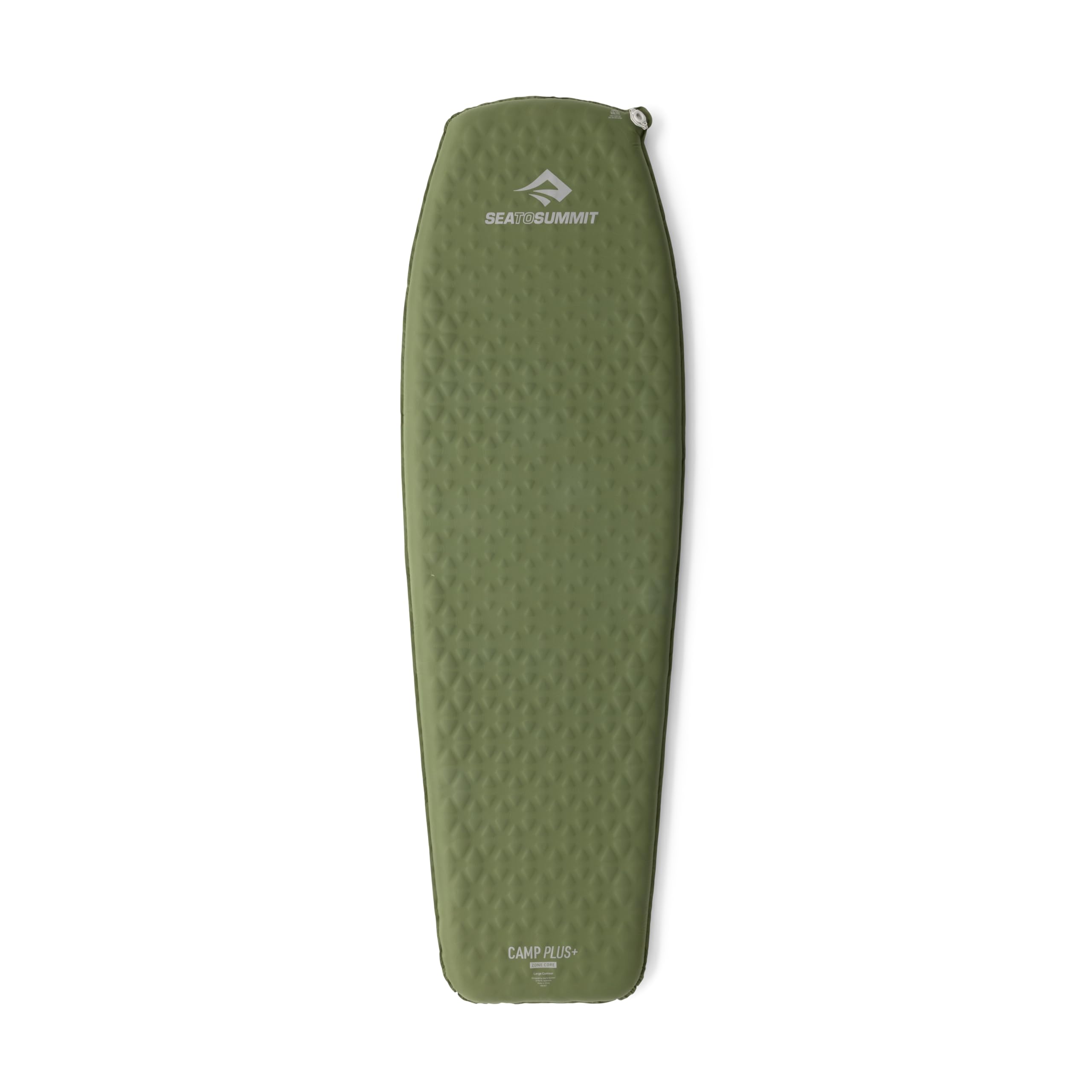
The Camp Plus uses a foam-air hybrid construction called Delta Core, where body-mapped air zones insulate where needed while minimizing bulk in less critical areas. At 2.4 pounds and just 2.6 inches thick, it’s lighter than most foam pads but delivers an R-value of 4.3 — sufficient for three-season use down to about 20°F. The tapered Regular size (72×22 inches) saves weight and pack volume.
The multi-function reversible valve offers fast inflation, one-way deflation, and fine-tuning of air pressure. An updated xPel valve allows tighter rolls for space-saving storage — the pad packs to 11×6.3 inches, which is impressively compact for a foam hybrid. The 75D polyester face fabric is durable and survived extreme heat, sand, and rocks in owner testing.
A notable feature is the 12% greater taper-curve surface area compared to rectangular pads, accommodating a wider range of sleep styles within the 22-inch width. The included PillowLock patches let you attach a Sea to Summit pillow securely. This pad suits campers who want foam comfort without the bulk — it’s too heavy for ultralight backpacking but excellent for car camping and bike touring where weight matters but pack volume is critical.
Why it’s great
- Lightweight 2.4 lbs with foam comfort
- Compact 11×6.3 inch pack size
- Durable 75D polyester face fabric
- PillowLock patches for accessory attachment
Good to know
- 2.6″ thickness may feel thin for side sleepers
- Tapered shape reduces usable width
- Requires manual inflation assistance
FAQ
What R-value do I need for winter camping?
Can I use a regular air mattress for camping?
How do I inflate a self-inflating pad correctly?
Why does my camping air mattress lose air overnight?
Final Thoughts: The Verdict
For most users, the best air mattress for camping winner is the Therm-a-Rest MondoKing 3D because it combines genuine car-camping luxury — 7.0 R-value, 4.25-inch thickness, and silent fabric — with a lifetime warranty. If you want winter-capable warmth without the premium price, grab the NYECHTO 3.14″ Foam Pad with its class-leading R-Value 9.5. And for backpackers who prioritize ultralight weight, nothing beats the Big Agnes Rapide SL at 18 ounces with a 4.8 R-value.