
Selecting the right pressure redistribution surface for a loved one confined to bed rest is one of the most critical caregiving decisions you will make. A standard mattress, no matter how plush, cannot dynamically shift pressure away from the bony prominences of the hips, sacrum, and heels—the very areas where painful pressure injuries begin forming after just two hours of immobility. The wrong choice means constant turning schedules, frustrated caregivers, and potential skin breakdown that is far easier to prevent than to treat.
I’m Min — the co-founder and writer behind Gadgets Feed. I’ve spent countless hours analyzing the medical-grade specifications, pressure mapping technologies, and real-world caregiver reviews across the leading air and foam mattress systems designed specifically for hospital beds and home care environments.
This guide breaks down the performance, durability, and practical usability of seven leading options to help you confidently choose the best air mattress for hospital bed for your specific care situation and budget.
How To Choose The Best Air Mattress For Hospital Bed
Choosing the wrong pressure relief surface can accelerate skin breakdown and complicate care routines. You need to match the technology—alternating air, foam, or low air loss—to the patient’s mobility level, skin condition risk, and the caregiver’s ability to manage the equipment. Focus on three core factors: the type of pressure redistribution, the noise profile of any included pump, and the durability and cleanability of the mattress surface.
Alternating Air Pressure vs. High-Density Foam
Alternating air pressure mattresses use a pump to cycle inflation and deflation across groups of air cells, typically every 10–12 minutes. This dynamic movement redistributes pressure continuously without needing to manually reposition the patient as frequently. These systems are ideal for patients with Stage 1 or Stage 2 pressure injuries or those assessed at high risk. High-density foam mattresses, like those using fortress-cut (egg-crate) or zoned IFD technology, provide static pressure redistribution through material density. They are silent, require no power, and are more durable for long-term use, but they rely entirely on the mattress material itself to manage pressure, without active relief cycles.
Pump Noise and Sleep Disruption
For an air mattress with a pump, the decibel level is a defining usability factor. A pump operating above 30 dBA will likely disturb light sleepers, while models rated at 23–28 dBA are generally described as whisper-quiet or nearly silent. Caregivers sharing a room or monitoring through the night should prioritize the quietest available pump. Some pumps also include a static mode, which stops the alternating cycle and holds all cells fully inflated—useful for sitting up during meals or watching television without the constant shifting sensation.
Waterproofing, Cleanability, and Material Safety
Incontinence, spills, and sweat are daily realities in hospital bed care. The mattress cover must be fully waterproof and easy to wipe down with medical-grade disinfectants. Medical-grade PVC or polyurethane covers with welded (heat-sealed) zippers provide the best fluid resistance. Avoid standard sewn zippers, which create entry points for liquids. Also check that the material is latex-free and phthalate-free to avoid allergic reactions or skin sensitivities in long-term contact.
Quick Comparison
On smaller screens, swipe sideways to see the full table.
| Model | Category | Best For | Key Spec | Amazon |
|---|---|---|---|---|
| Drive Medical Med-Aire Low Air Loss | Alternating Air / Low Air Loss | High-risk pressure injury prevention | 20 individual 8-inch air bladders | Amazon |
| Invacare Softform Premier | High-Density Foam | Long-term care and heavy patients | 6-inch thick, 3-zone foam support (500 lb capacity) | Amazon |
| Invacare Solace Fortress-Cut | Zoned Therapeutic Foam | Targeted pressure relief with cooling | 3-zone IFD: 36.2 / 40.5 / 35.4 | Amazon |
| Kölbs NSR Long Term Care Foam | High-Density Foam | Budget-friendly foam replacement | 5.5-inch thick, fire retardant, waterproof cover | Amazon |
| Lunderg Alternating Air with Static Mode | Alternating Air Pressure | Quiet operation with static mode flexibility | 23 dBA whisper-quiet pump | Amazon |
| Kekoy Alternating Air Pressure Pad | Alternating Air / Low Air Loss | Budget-conscious alternating air therapy | 28 dBA pump, 5 pressure modes | Amazon |
| Alcedo Alternating Air Pressure Pad | Alternating Air Pressure | Surgery recovery and home care | 300 lb capacity, 5 pressure settings | Amazon |
In‑Depth Reviews
1. Drive Medical Med-Aire Low Air Loss Mattress Replacement System
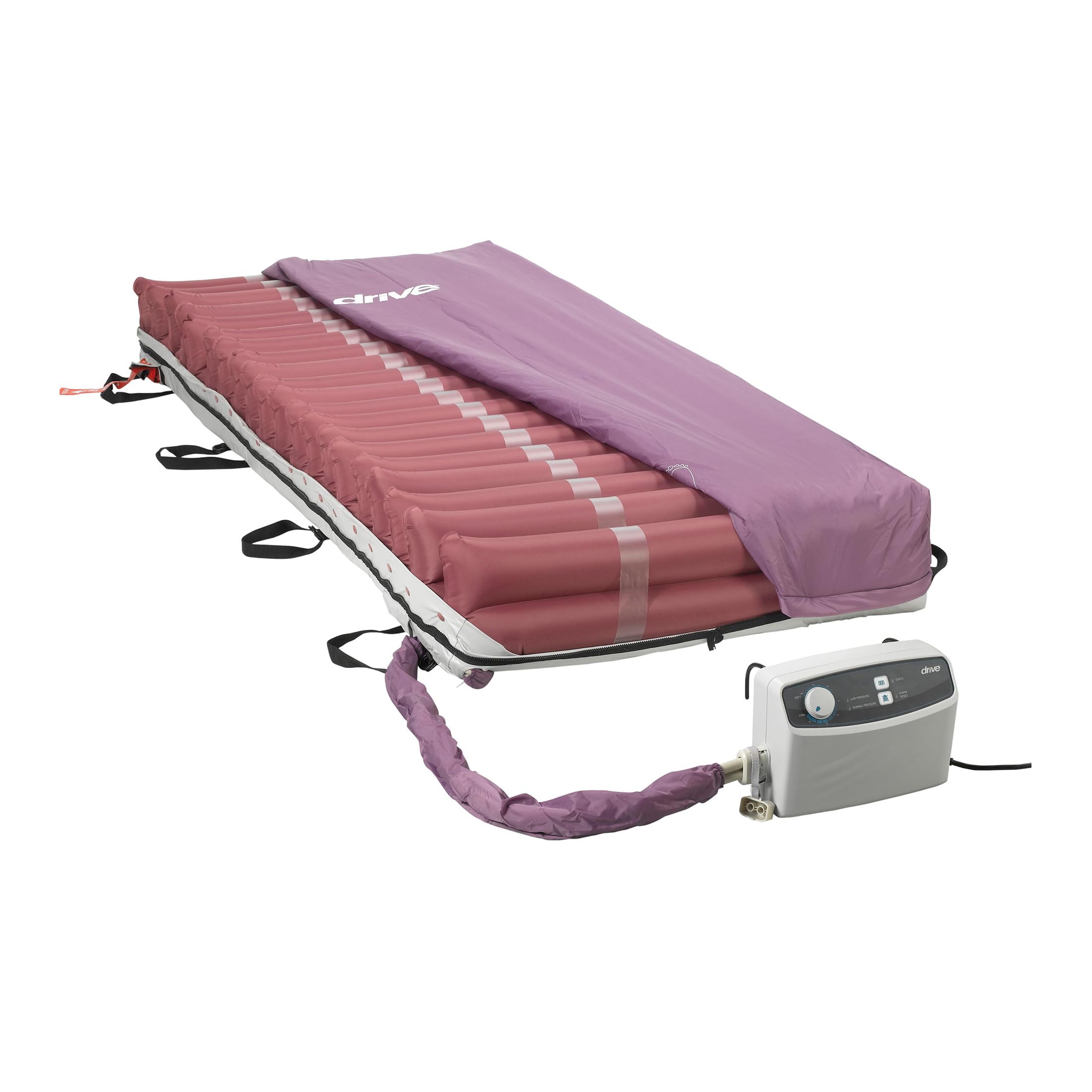
The Drive Medical Med-Aire is the closest you can get to a hospital-grade alternating pressure and low air loss system without a prescription. Its 20 individual 8-inch tall air bladders provide targeted immersion and stability, while the vapor-permeable, shear-reducing cover actively manages moisture and friction—two primary contributors to skin breakdown. The built-in pillow feature at the head end adds head stability without requiring an extra pillow.
The pump system offers both continuous low air loss and alternating pressure modes, controlled through an audio-visual alarm that alerts caregivers to low pressure. This is a real safety net for overnight care. At approximately 3.8 pounds for the pump and control unit, the setup is manageable, but users consistently note that while the pump hum is low, it can transmit vibration through the bed frame—a thin pillow under the pump mitigates this. The mattress requires a full hour to inflate and set up properly.
Long-term durability is excellent; the individual air bladders are replaceable, extending the system’s life significantly beyond cheaper all-in-one air pads. Some users have reported pump failure after extended use, but this is often manageable through the manufacturer’s warranty. For a patient at high risk of pressure injuries, this system provides the most comprehensive active pressure redistribution available here.
Why it’s great
- Combines low air loss and alternating pressure in one system
- Replaceable 8-inch bladders extend mattress lifespan
- Audio/visual low-pressure alarm improves caregiver peace of mind
Good to know
- Pump noise and vibration can transmit through the bed frame
- Deflates completely during a power outage—backup power recommended
2. Invacare Softform Premier Hospital Bed Mattress

The Invacare Softform Premier is the best-selling hospital bed mattress for a reason: its two independent layers of high-density foam, working with a single-piece U-core and contoured foam insert, achieve a level of pressure redistribution suitable for patients up to Very High Risk on the Braden Scale. The 3-zone construction uses different foam densities for the head, mid-section, and foot, providing firm lateral support for safe transfers while keeping the heels and head in a softer immersion zone.
The fluid-resistant four-way stretch polyurethane cover is washable and designed to reduce shear forces when the patient shifts position. At 28.7 pounds, this is a heavy, dense mattress that holds its shape exceptionally well over years of use. Users report that the mattress remains in good condition even after two years of continuous hospital bed use. The warranty—8 years on the foam and 4 years on the cover—reflects its construction quality.
One common issue: the foot section of the mattress is notably stiff, which can make it difficult to bend the bed into a full chair position under the patient’s own weight. This is a design trade-off for the firm edge support that aids in transfers. If your patient requires frequent foot elevation, this stiffness may be a drawback. For general long-term care and pressure injury prevention, however, this is the benchmark foam mattress.
Why it’s great
- Dual-layer foam with U-core construction for superior immersion
- 8-year foam & 4-year cover warranty indicates long-term durability
- Four-way stretch cover reduces skin shear during repositioning
Good to know
- Foot section is stiff and resists bending under its own weight
- At 28.7 lbs, it is heavy to move or rotate
3. Invacare Solace Hospital Bed Mattress
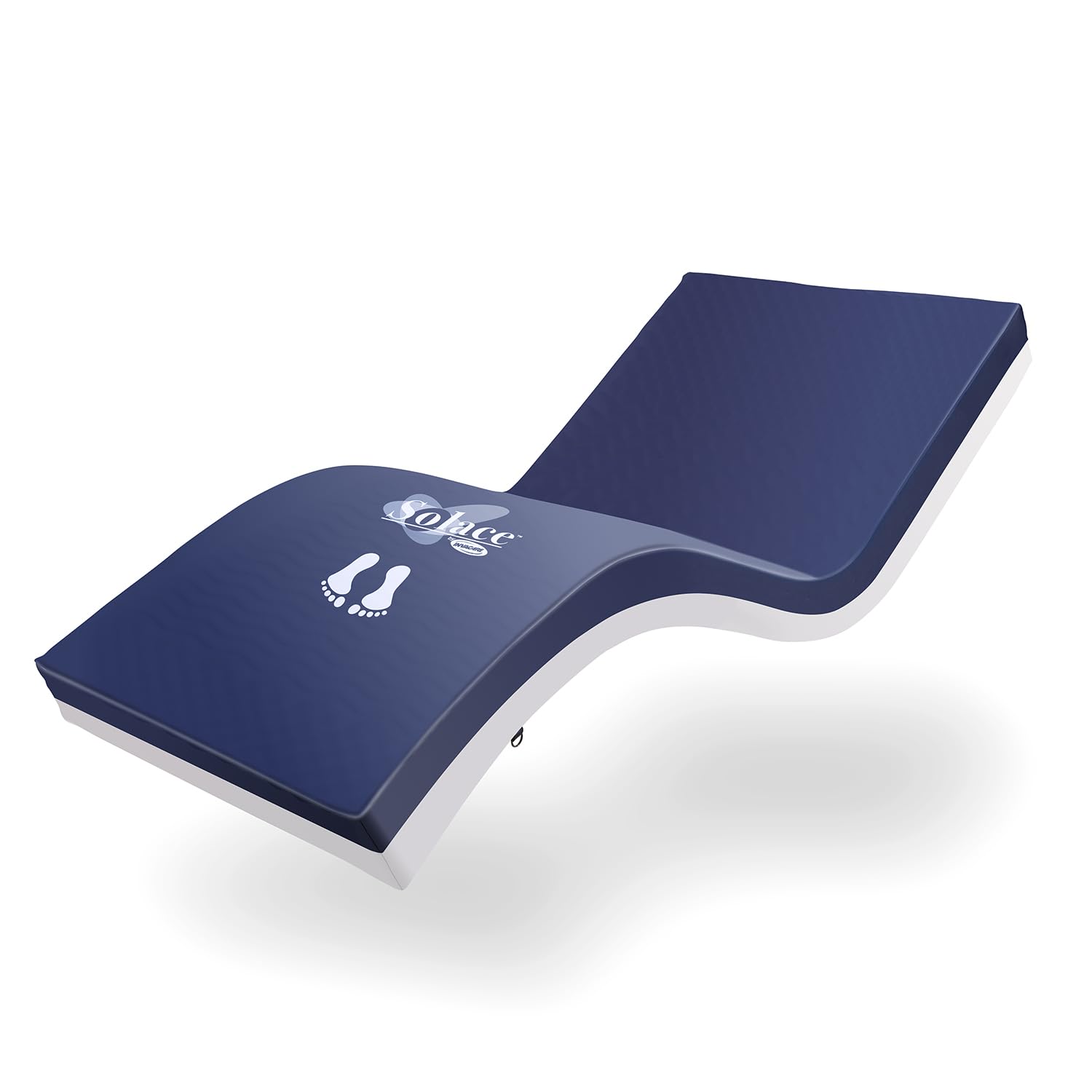
The Invacare Solace is engineered for precision pressure redistribution, using ultra-deep fortress-cut (egg-crate) cells that provide 360-degree airflow alongside targeted firmness zones defined by Indentation Force Deflection (IFD) ratings. The head zone uses a medium-firm 36.2 IFD, the lower back and hips get a firm 40.5 IFD for critical support, and the heels are a lighter 35.4 IFD—a logical progression that matches body weight distribution.
The dual-layer anti-bottoming design prevents the patient from feeling the bed frame, even at lower air settings. The welded zipper on the waterproof cover is a significant upgrade over sewn zippers, eliminating a common failure point for fluid ingress. The cover is also a 2-way vertical stretch fabric, which actively reduces shear on the skin—a feature rarely seen at this price point. Integrated side handles and bottom anchor straps make positioning on the bed frame simple.
Users report that the mattress provides noticeably better support for the neck, shoulders, and tailbone compared to standard hospital mattresses. One caregiver noted that the mattress stays much cooler than their previous foam mattress, likely due to the fortress-cut airflow channels. The mattress is 6 inches thick, which may be too tall for some lower-profile bed frames. At 84 inches, it requires an 84-inch hospital bed frame; it will not fit a standard 75-inch twin frame.
Why it’s great
- 3 distinct IFD zones match body weight distribution precisely
- Deep fortress-cut cells provide 360-degree airflow for cooling
- Welded waterproof zipper prevents fluid ingress
Good to know
- 6-inch thickness may be too tall for some low-profile bed frames
- Only fits 84-inch hospital bed frames, not standard 75-inch twins
4. Kölbs NSR Long Term Care Pressure Redistribution Foam Mattress

The Kölbs NSR is a straightforward, no-electronics foam replacement mattress designed for long-term care environments. Its high-density foam core distributes weight more evenly than a standard spring or thin foam mattress, reducing pressure buildup on bony prominences. The mattress measures 80 x 36 x 5.5 inches, making it a perfect fit for standard hospital bed frames—but it will not fit 75-inch twin beds.
The non-slip underside is a practical feature that keeps the mattress from shifting during head-of-bed elevation or patient turns. The waterproof, removable cover is easy to clean, and the mattress is fire retardant, which is a required compliance feature for nursing homes and hospice environments. At 22 pounds, it is significantly lighter than the Invacare foam options, making it easier for a single caregiver to handle during replacement or rotation.
The main limitation is that this is static foam pressure redistribution—there is no active cycling, low air loss, or adjustable firmness. For patients already showing signs of pressure injuries or those assessed at very high risk, this foam may not provide sufficient pressure relief. The 5.5-inch thickness is also thinner than the Invacare options, which may be noticeable for heavier patients. Users also report that the waterproof cover is slippery, causing fitted sheets to slide off—a mattress topper or an elastic sheet retainer is a simple fix.
Why it’s great
- Lightweight at 22 lbs, easy for one caregiver to handle
- Fire retardant and waterproof cover for safety and easy cleaning
- Non-slip underside keeps mattress stable during bed adjustments
Good to know
- Static foam provides no active pressure redistribution
- Waterproof cover is slippery, causing sheets to slide off easily
5. Lunderg Alternating Air Pressure Mattress Pad with Static Mode
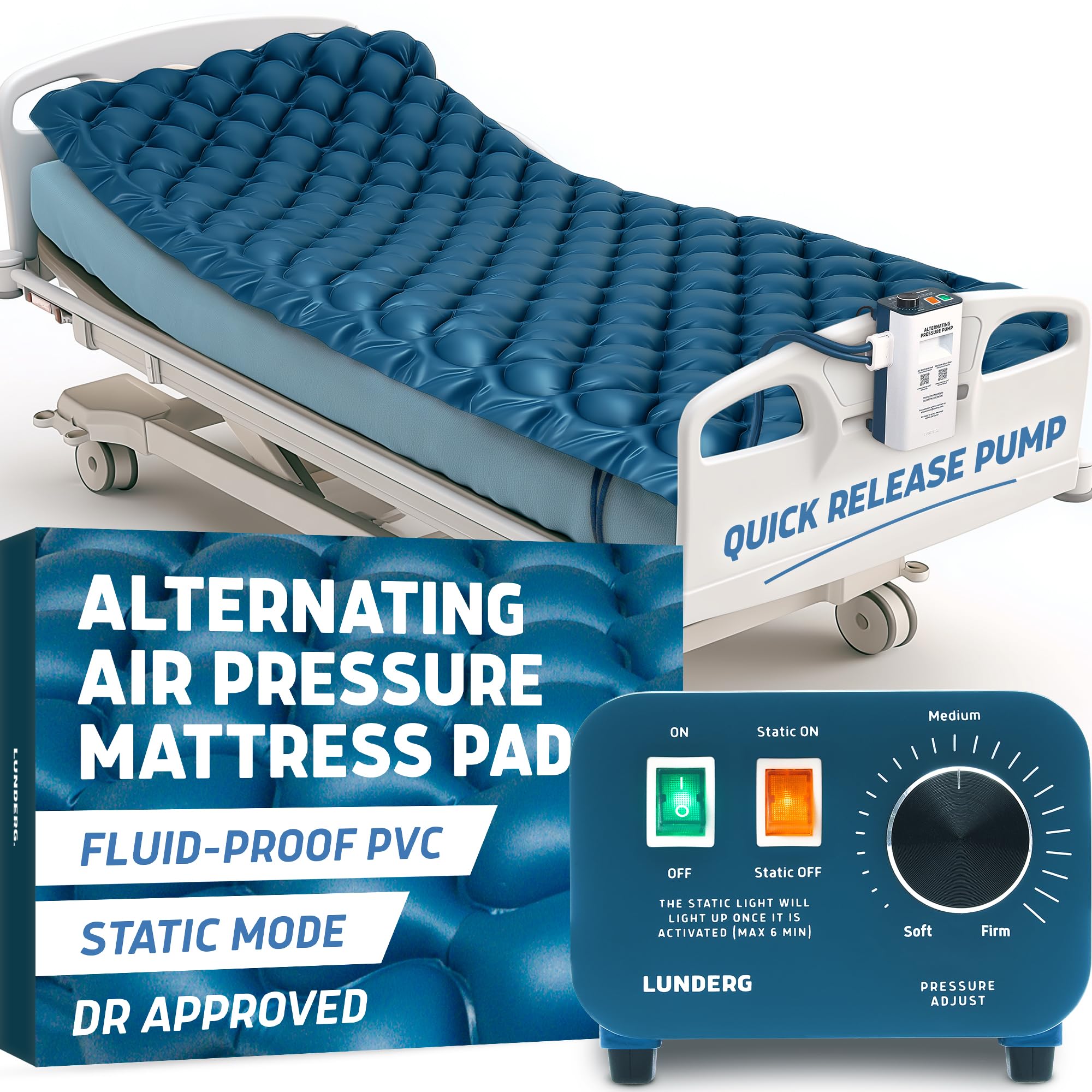
The Lunderg alternating pressure pad stands out for its exceptionally quiet pump, rated at just 23 dBA—quieter than most refrigerators and virtually inaudible in a quiet room. The pump also includes a static mode, which stops the alternating cycle and holds all cells fully inflated. This is a genuinely useful feature for sitting upright during meals or watching TV, as the constant shifting sensation of alternating therapy can be disorienting for some patients.
The mattress pad uses individual alternating cells rather than continuous tubes, which provides smoother pressure transitions and a more targeted relief pattern. Setup is straightforward: unroll, connect the quick-connector hoses, and inflate. The manufacturer recommends a 20-minute inflation period over three cycles before final pressure adjustment. The pad fits standard twin-size beds (35 x 75 inches) and is designed to be placed on top of an existing mattress, with excess material tucked under after inflation.
Users consistently report that the pad is comfortable enough to use without the alternating motion enabled, thanks to the static mode. Some users found the alternating motion relaxing and fell asleep during the initial setup. The 300-pound weight capacity covers most adult patients, but heavier users may find that the pad compresses noticeably when sitting upright. The pad is waterproof and can be spot-cleaned, but the PVC material can feel warm against the skin—a thin cotton sheet on top solves this.
Why it’s great
- 23 dBA pump is nearly silent, ideal for shared or quiet rooms
- Static mode provides a stable, non-alternating surface when needed
- Individual alternating cells deliver smoother pressure transitions
Good to know
- PVC material can feel warm; a sheet or cover is recommended
- Heavier users may feel the pad compress when sitting upright
6. Kekoy Alternating Air Pressure Mattress Pad
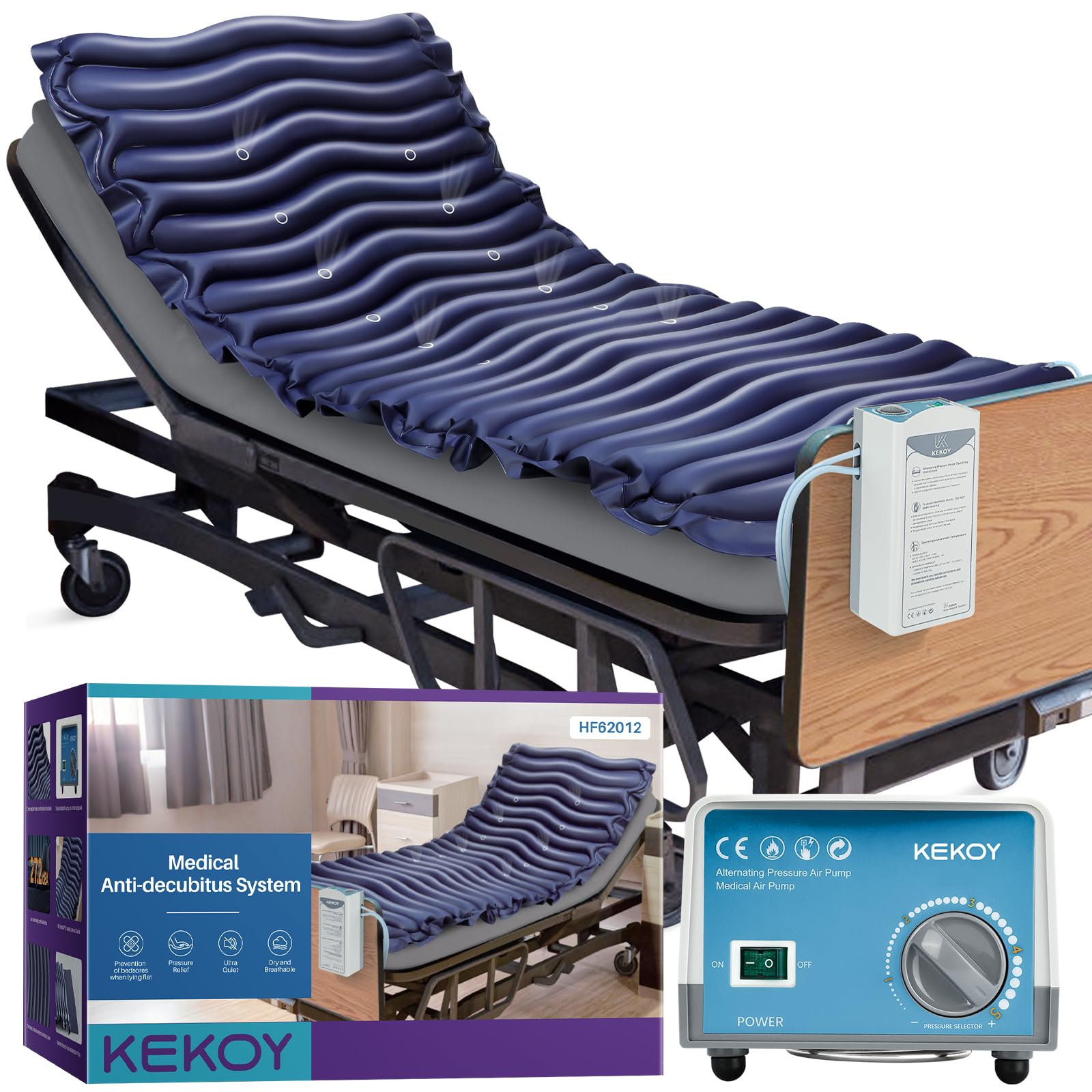
The Kekoy alternating air pressure pad combines alternating pressure therapy with low air loss airflow technology in an entry-level package. The 28 dBA aluminum pump is quieter than many competitors but still audible in a completely silent room—comparable to a quiet library. The pump offers five adjustable pressure levels and runs a consistent 10–12 minute cycle, providing adequate pressure redistribution for Stage 1 and early Stage 2 pressure ulcer prevention.
The medical-grade PVC surface is fully waterproof and heat-sealed at the seams to prevent leaks. The wider tube air chambers create a smoother transition between inflation and deflation compared to older bubble-style pads, reducing the jostling sensation that some patients find uncomfortable. The pad is designed for continuous 24-hour operation and fits most bed types after inflation to its actual sleeping size of 75 x 36 inches.
This pad requires continuous power to stay inflated—it will deflate when unplugged, which is typical for this category but worth noting for caregivers who may need to move the patient. Some users report that the pad can slide around on the mattress, particularly on smooth hospital bed surfaces. Using a zippered mattress encasement or elastic straps is a practical workaround. For the price, this is a capable entry into alternating pressure therapy, but the build quality and quieter pump of the Lunderg pad justify the upgrade for long-term use.
Why it’s great
- Combines alternating pressure and low air loss in one pad
- Five pressure settings allow customization for different body weights
- Heat-sealed medical-grade PVC construction
Good to know
- Pad can slide on smooth mattress surfaces without secure straps
- Deflates immediately when unplugged—requires constant power
7. Alcedo Alternating Air Pressure Mattress Pad
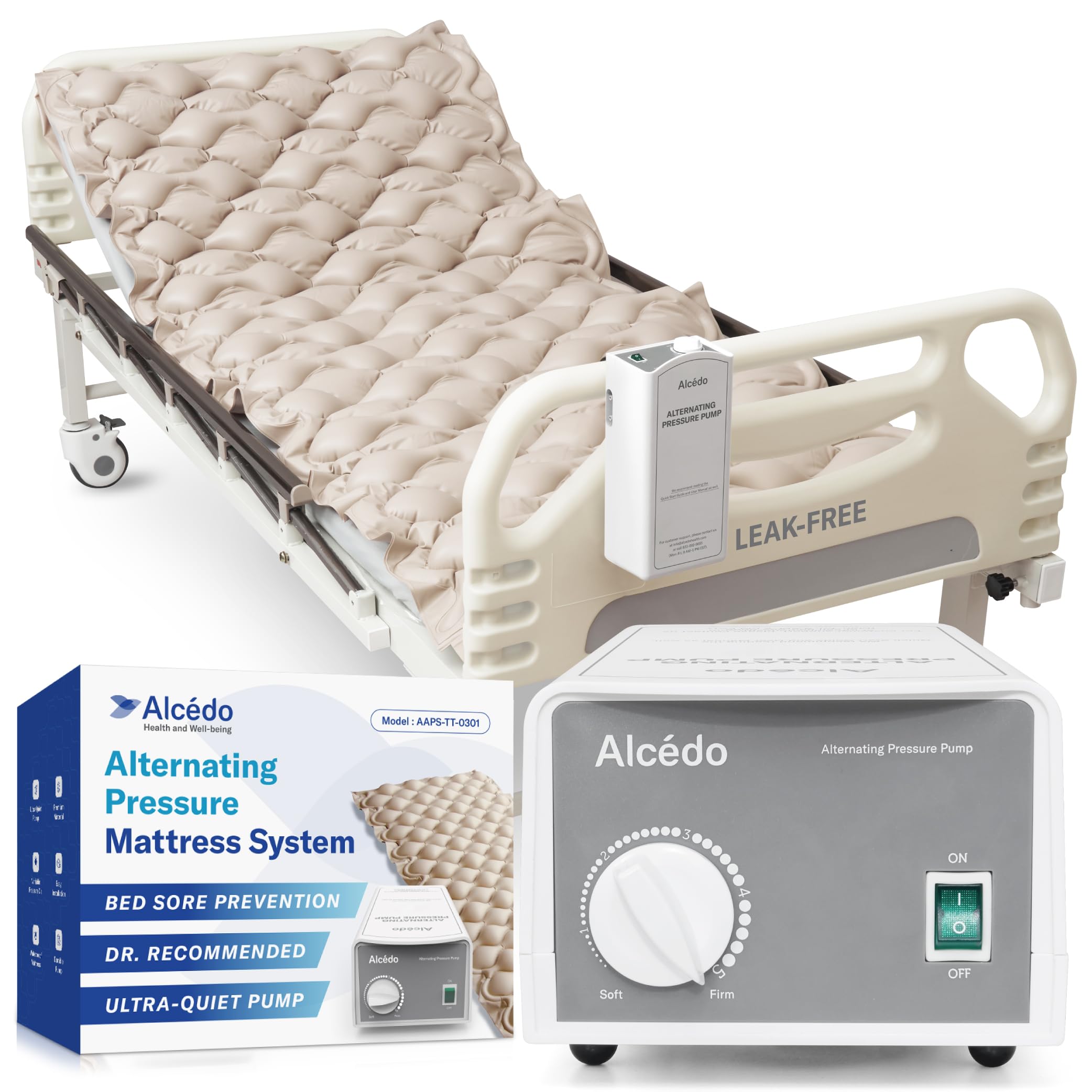
The Alcedo alternating air pressure pad is designed with a straightforward focus: preventing bedsores and relieving pressure after surgery or during extended bed rest. It uses an alternating pressure system with five adjustable settings, and the pump is reinforced with metal hooks for a secure attachment to the bed frame. The inflated bubble area measures 75 x 35 inches, and users should expect the uninflated portion to extend beyond the mattress—this must be tucked under to keep the pad from sliding.
The high-density vinyl construction is strong, with reinforced seams to support up to 300 pounds without leaking. The pump is described as ultra-quiet by most users, though some note it is quieter than expected rather than silent. The pad is FSA/HSA eligible, which can help offset the cost for eligible healthcare spending accounts. Setup is simple, and the pad inflates evenly without requiring extended leveling time.
Users recovering from hip surgery specifically praise this pad for relieving pressure on the buttocks and surgical site without sacrificing stability. However, on deeper mattresses (like a king-size with a pillow top), the pad’s uninflated edges can cause the entire unit to slide toward the foot of the bed. If the flaps are not properly tucked under the mattress, the pad will migrate during the night. A non-slip mattress cover is a recommended addition for deeper beds.
Why it’s great
- Relieves pressure on surgical sites, especially post-hip surgery
- FSA/HSA eligible, reducing out-of-pocket costs
- Reinforced metal pump hooks provide secure bed attachment
Good to know
- Pad slides on deep mattresses if flaps are not fully tucked under
- Uninflated edges extend beyond the sleeping area on smaller beds
FAQ
Can I use an alternating air pressure mattress on top of my existing foam hospital mattress?
What dBA level should I look for in a pump to avoid disturbing sleep?
Will my patient’s bed sores heal faster with a low air loss mattress compared to a standard alternating pressure pad?
Final Thoughts: The Verdict
For most users, the best air mattress for hospital bed winner is the Drive Medical Med-Aire Low Air Loss System because it combines hospital-grade alternating pressure and low air loss technology in a durable, replaceable-bladder design that addresses both prevention and existing pressure injuries. If you want a quiet, versatile alternating pressure pad with static mode for flexible daily use, grab the Lunderg Alternating Air Pad. And for a zero-maintenance, silent, long-term foam solution that rivals institutional quality, nothing beats the Invacare Softform Premier.