
Our readers keep the lights on and my morning glass full of iced black tea. As an Amazon Associate, I earn from qualifying purchases.
Specs are compiled from manufacturer listings and verified buyer reviews and can change over time — please confirm the key details on the product page before buying.
Renting a flooring nailer or framing gun for a weekend project costs real money and eats a full day of your life. Owning the right pneumatic tool means you work on your own schedule, and the per-job cost drops to almost nothing after the first use. This guide breaks down the best air-powered nailers for DIYers and pros, sorted by what each one does best.
I’m Min — the founder and writer behind Gadgets Feed. This guide is built by comparing the manufacturers’ published specifications and the patterns across verified customer reviews, so you get each pick’s real strengths and trade-offs instead of marketing spin.
You need an air nail gun that matches your project’s weight, nail gauge, and power—so you get clean results without fatigue or misfires. Here’s how to pick the right one for your trim, framing, or flooring work.
Our Picks at a Glance


How To Choose The Best Air Nail Gun
An air nailer is a simple machine: compressed air pushes a piston that drives a nail into wood. But the nail size it accepts and the weight you hold all day decide whether it’s the right tool for your shelf. Matching the gun to the material is the whole game.
Match the Gauge to the Job
The gauge number tells you the thickness of the nail shaft — smaller numbers mean thicker nails. An 18-gauge brad nailer leaves tiny holes perfect for trim and furniture, while a 15-gauge angled finish nailer has the holding power for window casings and wainscoting. For structural work like framing a wall or building a deck, you need a 21-degree framing nailer that drives thick 3-1/2-inch nails.
Check Your Compressor’s Pressure
Every pneumatic nailer needs a compressor behind it, and not all compressors are equal. Framing nailers typically need 85-90 PSI (pounds per square inch of air pressure) to sink long nails into hard wood. If your compressor is small or slow to refill, you’ll feel the gun lose power mid-strip. Finish nailers are more forgiving since they drive shorter, thinner nails.
Weight Is a Real Cost
A flooring nailer that sits at 14.7 pounds is fine when you’re kneeling on a floor, but that same weight would be exhausting held overhead on a ladder. Framing guns around 8.5 pounds balance power with all-day use. If you’re doing finish work all day, the lightest option — some brad nailers hit just 2.9 pounds — keeps your wrist fresh for precise placement.
Quick Comparison
| Model | Best For | Nail Type | Weight | Nail Length | Amazon |
|---|---|---|---|---|---|
| Bostitch Flooring Nailer★ Best Overall | Hardwood Floors | 15.5-Ga Staples & Cleats | 14.7 lbs | 1-1/2″ to 2″ | Amazon |
| 3PLUS Angled Finish NailerBest Value | Fences & Framing | 15-Gauge DA Nails | 5.51 lbs | 1-1/4″ to 2-1/2″ | Amazon |
| Metabo HPT Brad NailerLightest Pick | Trim & Furniture | 18-Gauge Brad Nails | 2.9 lbs | 5/8″ to 2″ | Amazon |
| Freeman Framing Nailer | Framing & Subfloors | 21-Degree Framing Nails | 8.5 lbs | 2″ to 3-1/2″ | Amazon |
| 3PLUS Flooring Nailer/Stapler | Engineered Floors | 15.5-Ga Staples & Cleats | 3.28 kg | 1-1/2″ to 2″ | Amazon |
| NuMax Framing Nailer | House Framing | 21-Degree Framing Nails | 8.6 lbs | 2″ to 3-1/2″ | Amazon |
| Makita Finish Nailer | Cabinet Work | 16-Gauge Straight Nails | 3.8 lbs | Up to 2-1/2″ | Amazon |
| Senco FinishPro | Baseboards & Molding | 15-Gauge Finish Nails | 9 lbs | 1-1/4″ to 2-1/2″ | Amazon |
| Makita Framing Nailer | Production Framing | 21-Degree Framing Nails | 8.3 lbs | 2″ to 3-1/2″ | Amazon |
In‑Depth Reviews
1. Bostitch Staples Flooring Pneumatic Nailer
Our pick — over 4.5★ from 700+ verified ratings; the strongest balance of quality and price.
This 14.7-pound mallet-actuated flooring nailer drives 15.5-gauge staples and 16-gauge cleats through hundreds of square feet of hardwood without jamming.
It’s built for dedicated flooring jobs, not quick trim work. It drives 15.5-gauge staples and 16-gauge cleat nails from 1-1/2-in to 2-in long, and it’s built around a mallet-actuated pneumatic action — you strike the top with the included mallet and the air does the driving. The non-marring base plates swap between 1/2-in (12.7 mm) and 3/4-in (19.1 mm) flooring so the same gun handles both common plank thicknesses.
Buyers report pushing through “several hundred sq feet of solid hickory flooring no issues no jams,” and another ran 8,000+ 2″ cleat nails into maple with zero failures. Owners consistently praise its jam-free performance and build quality. It’s genuinely easy to load, and the longer handle with a comfortable rubber grip makes the 14.7-pound body easier to manage when you’re kneeling for hours. At 14.7 pounds it’s more than four times heavier than the Metabo HPT brad nailer (2.9 pounds) — but those two tools do completely different jobs, so the weight is a feature here, not a flaw.
The main thing to know is that durability gets a mixed reaction: most owners find it a tank, but a few report issues over the long haul. A 1-7 Year Limited Warranty backs it, and the kit includes the tool, mallet, oil, wrenches, and a 1/4-in (6.4 mm) air fitting so you’re not hunting for accessories on day one.
Why It Wins for Flooring
- Drives staples and cleats from one tool — 2-in-1 convenience
- Interchangeable base plates handle 1/2-in and 3/4-in flooring
- No-jam track record through hundreds of square feet
What to Weigh First
- 14.7 pounds makes it a dedicated floor tool, not a ladder gun
- Durability reports are split, not unanimous
The floor-finisher’s pick: if you’re laying hardwood, engineered planks, or hickory in volume, this is the one to own.
Not your tool if: you need a trim nailer for baseboards — this stays on the floor, not in your hand.
2. 3PLUS HDA1564SP 15 Gauge Angled Finish Nailer
A budget-priced 15-gauge finisher that survived a quarter-acre fence build with zero jams.
For DIY fences, shelves, and trim, this angled finish nailer delivers pro-level features at a price one owner called “great compared to box stores.” It drives 1-1/4″ to 2-1/2″ 15-gauge “DA” style angled nails and weighs just 5.51 pounds, so you can use it all day without arm strain. The tool-free depth adjustment lets you set flush fastening without a wrench, and the 360° fully adjustable exhaust portal spins to keep air blast out of your face.
Owners mention putting 1,000+ nails through it with a single jam that was “user error, easy clear,” and one finished an entire 1/4 acre shadow box wood fence with “no issues, no jams worked great.” Functionality is the most-praised aspect, with value for money right behind. The interchangeable trigger switches between single shot and bumper fire (hold-down continuous shooting) for precision or speed. A Work Contact Element stops accidental firing, and the no-mar tip protects your work surface from dents.
The honest trade-off: build quality is a notch below the premium brands, and the nail holding gets mixed feedback with 15-gauge nails specifically. There’s also no case — a few owners were surprised it arrives bare. But for the money, you’d have to spend several times more to get meaningfully more gun.
The smart-buy read: this is the highest-value 15-gauge finish nailer on the list — you get adjustable exhaust, depth control, and dual triggers for a fraction of premium pricing.
The one compromise: it’s not a pro-trade toolbox centerpiece, and a case is not included.
3. Metabo HPT Pro Brad Nailer
The 2.9-pound featherweight that pros reach for during 12-hour trim days.
This is the nailer you hold, not the one you haul. At just 2.9 pounds, it’s dramatically lighter than the 14.7-pound Bostitch flooring tool, and that weight difference is the whole point for finish work. It drives 18-gauge brad nails from 5/8″ up to 2″ — the small nail size that leaves barely-visible holes in trim, furniture, and reupholstery work. In fact, one owner’s exact verdict was “perfect tool for reupholstering.”
The high-grade aluminum magazine is built to resist jams and take a beating, backed by a 5-year warranty. A selective actuation switch lets you pick between bump fire (rapid repeated shots) and sequential fire (one precise shot per trigger pull), so you control the pace. The tool-less depth of drive dial adjusts how deep nails sink for a professional-looking finish, and an integrated air duster blows sawdust clear before you shoot. The ambidextrous belt hook mounts on either side to match how you carry it.
Owners with decades of experience call Metabo HPT (formerly Hitachi) the best pneumatic nailers they’ve used, with three of their units still going past 15 years old. The trade-offs are minor: it’s not a 2-in-1 (it only shoots brads, not staples), and there’s no carrying case in the box — though you do get a tool bag, safety glasses, and a no-mar tip. A swivel adapter on the air fitting isn’t included, which a few owners wish it had, but the build quality and reliability earn the praise it gets.
The all-day comfort pick: if your job is precision — trim, molding, furniture, upholstery — the light weight and jam-resistant magazine make this the one you’ll grab first, every time.
A fair caveat: it’s a single-purpose brad nailer, so keep a stapler or finish nailer around for bigger fasteners.
4. Freeman PFR2190 Pneumatic Framing Nailer

A 21-degree framing gun with a 7-year warranty that made a 1200 sq ft remodel fly.
This is the workhorse for structural builds — framing, subfloors, roof decking, pallets, crates, and wood fencing. It drives 21-degree plastic collated full round head framing nails from 2″ to 3-1/2″ long, and the one-piece hardened steel drive blade plus anodized aluminum magazine and cylinder are built to shrug off jobsite abuse. At 8.5 pounds it’s substantial but balanced for a day of overhead work, and the comfort grip handle cuts down hand fatigue during long sessions.
Owners highlight its performance and value, making it a popular first framing nailer. One DIYer framed an entire shed flawlessly, and another ran about 340 nails at 85 psi with no issues at all. The dual-mode trigger flips between single sequential firing for precision and bump firing for speed, while the tool-free depth wheel adjusts drive depth by hand. A 360-degree adjustable exhaust lets you redirect air away from your face, and the anti-dry-fire mechanism stops the gun from firing when it’s empty, protecting the internals. The blow-molded case and adjustment tools come included, and Freeman backs it with a 7-year limited warranty plus a 90-day wearable parts warranty.
The honest reality: at 8.5 pounds it’s heavy, and some owners find it bulkier than premium brands like Bostitch. Two quirks surface repeatedly — bump fire requires a trigger swap, and the gun always stops with a few nails left in the strip as a safety feature, so loading a fresh strip carries a small jam risk. The manual is thin, and oil is needed before first use despite some confusing labeling. Still, the consensus is clear: for the money, this is a lot of framing nailer.
The Case for It
- 3-1/2″ nail capacity handles structural framing
- Dual-mode trigger for precision or speed
- Case, oil, and Allen screws included in the box
The Trade-Offs
- Heavier and louder than premium framing guns
- Safety stop leaves a few nails in the strip
Reach for this if: you’re framing a shed or renovating and want a reliable, warrantied gun without paying premium-brand money.
Look elsewhere if: you frame every day and need the lightest, most balanced gun on the market.
5. 3PLUS HFSNSP 2-in-1 Pneumatic Flooring Nailer/Stapler

A 2-in-1 floor nailer that paid for itself versus renting on a single 450 sq ft job.
When a 2-day rental costs more than owning the tool, the math makes itself. This 2-in-1 flooring tool uses 15-1/2 gauge staples and 16 gauge L cleats from 1-1/2″ to 2″, and it’s the pick for anyone laying hardwood or engineered flooring on a real budget. Customers note installing 450 sq ft of 3/4″ oak with about 5,000 2″ staples and zero jams or misfires, which is exactly the reliability you want when your knees are already sore.
Owners most often praise its performance and value for money. The pneumatic driving action is smooth, the interchangeable flooring plates handle all the common plank sizes, and the removable long reach handle plus included white-rubber mallet make it easier to swing in tight spaces. One owner summed it up: it worked “better than expensive alternatives.”
There are honest quirks to know. It performs best at 70-90 psi (one owner liked 70-75 psi for 1/2″ engineered hardwood), and misaligned mallet strikes or low pressure can leave incomplete staples. The jams that do happen are harder to clear — you have to remove four bolts. And like most flooring nailers, it can’t reach the first and last rows of a room, so those need hand-nailing or a different tool. But for the price, it’s a genuine bargain that keeps paying off job after job.
The rental-beater: if one flooring project covers the cost, every future job is pure savings — and the performance holds up.
The fine print: jam clearing is more involved, so feed it the right pressure and mallet strikes from the start.
6. NuMax SFR2190WN Pneumatic Framing Nailer

The 21-degree framing gun that framed an entire two-story house as its only nailer.
This framing nailer shows up ready to work — literally, since it includes 500 count of 21-degree 3″ bright framing nails. It drives 21-degree plastic collated full round head nails from 2″ to 3-1/2″ long and 0.113″ to 0.131″ in diameter. That’s the same spec range as the more expensive Freeman above it, which makes this a genuine value candidate for anyone building walls, decks, fences, or crates. One owner built a 1,600 sq ft house using this as the only nail gun, driving 3-1/2″ framing nails and 2-inch sheathing nails “perfect” for subflooring and exterior sheathing.
The lightweight body is the selling point for extended use, and owners call it a “workhorse” and “extremely useful.” The dual-mode trigger switches between bump and sequential firing, the anti-dry-firing design protects internal components from empty-fire damage, and the easy-to-load magazine uses a simple pull-back pusher. Tool-free depth adjust and a comfort grip handle round out a spec sheet that reads well above its price tier. It’s covered by NuMax’s 1 Year Limited Tool Warranty and a 30 Day Wearable Parts Warranty.
At 8.6 pounds, weight feedback is genuinely mixed — some find it “not too heavy,” others say it’s heavier than certain models. It’s a touch heavier than the Freeman at 8.5 pounds, and the warranty is shorter. But for someone who wants a capable framing gun plus a starter box of nails in one buy, this is a hard package to beat at the price.
The build-a-house pick: the included nails and proven track record make this the easiest entry into framing without a rental.
Know before you buy: it’s a heavier gun, so plan breaks on long framing days.
7. Makita AF601 16 Gauge Straight Finish Nailer
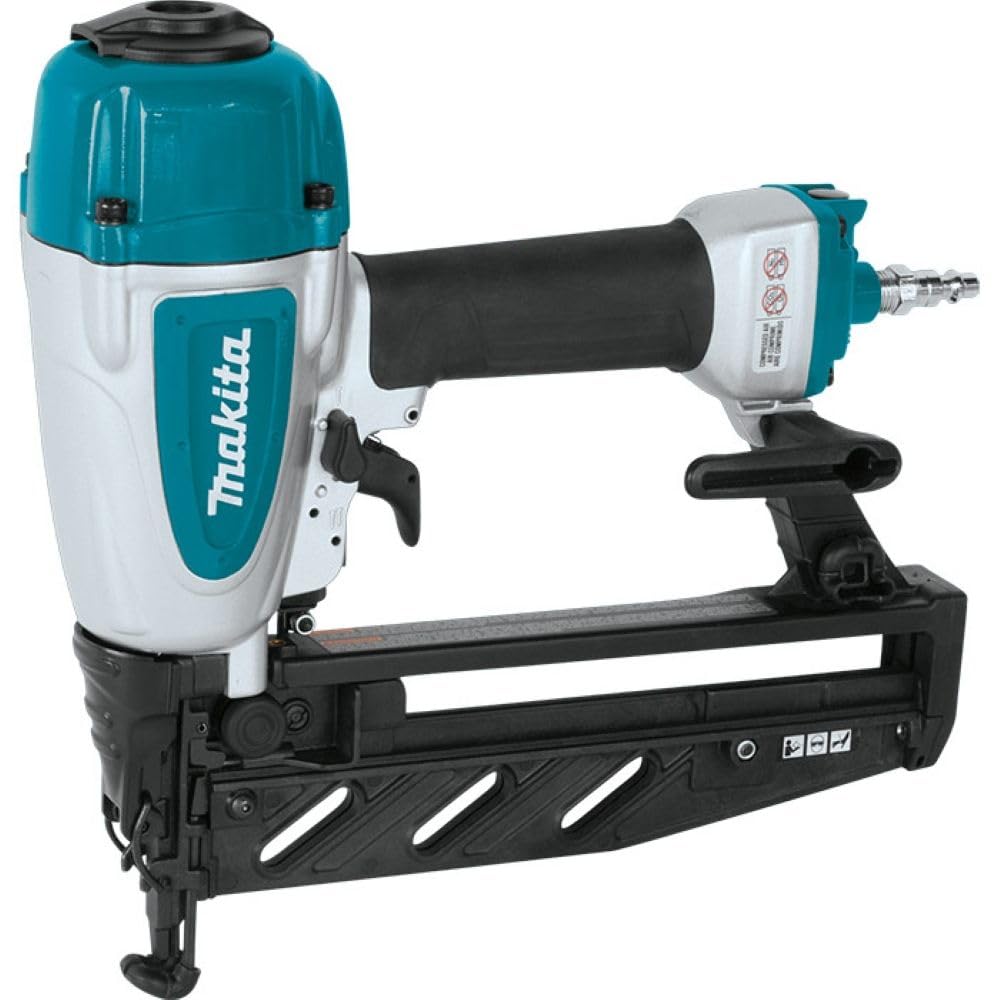
The 16-gauge finisher that sets nails cleanly even through tough 3/4″ oak.
When the finish has to look flawless, professionals reach for a precision tool like this one. The Makita AF601 drives 16-gauge straight nails up to 2-1/2″ long, and the efficient motor design delivers power that surprises first-time owners — one was impressed it sets nails “accurately and consistently even through 3/4″ oak.” At just 3.8 pounds, it’s light enough for all-day cabinet work, and the quality build is the most-praised aspect in the owner feedback.
The nail lock-out mechanism protects both the tool and your work surface from dry-fires (firing with an empty magazine), which is a small thing until it saves a piece of trim from a scuff. A “tool-less” depth adjustment lets you dial in flush or countersunk nailing by hand, and the built-in air duster clears sawdust from your work surface before you drop the next nail. A 2-mode selector switch gives you control over the nailing operation — either precise sequential firing or faster contact firing.
Buyers rate its build quality above competing brands, with one switching from Dewalt and calling the Makita “significantly better.” The included kit is generous: two no-mar tips, an air fitting, pneumatic nailer oil, safety glasses, and a tool case. The honest caveats: durability gets mixed long-term feedback, and one owner found the hand grip wearing after about 100 nails. But for finish and trim work that demands accuracy, this earns its premium reputation.
What Justifies the Premium
- Sets nails straight and clean in hard oak
- 3.8-pound body is easy on the wrist
- Full kit: case, oil, tips, glasses
What Owners Question
- Long-term durability reports are split
- Grip wear is an occasional complaint
Choose this for: high-end trim, cabinetry, and finish carpentry where precision is non-negotiable.
Pass if: you only need a handful of trim nails now — the premium price needs volume to justify itself.
8. SENCO 4G0001N FinishPro 42XP

The oil-free 15-gauge finisher that ran 800+ nails flawlessly and never spills a drop.
For baseboards, crown molding, window casings, and wainscoting, this Senco is the finish nailer that owners call “top class.” It drives 1-1/4″ to 2-1/2″ 15-gauge finish nails from a reinforced metal cylinder wrapped in a lightweight magnesium main body. The defining feature is the oil-free design — no lubrication means maintenance-free operation and zero risk of oil spillover staining your freshly painted trim. One owner had theirs “worked flawlessly after shooting more than 800 nails.”
Owners most often praise its build quality, with functionality a close second. The tool-free depth adjustment lets you switch between flush and countersunk drives in seconds, and the quick clear latch opens by hand to clear jams or misfeeds without hunting for a tool. It’s a 15-gauge gun, meaning the nails are beefier than the 16-gauge Makita above — better holding power for heavier moldings, at the cost of slightly larger holes you’ll need to fill. At 9 pounds, it’s heavier than the Makita’s 3.8 pounds, so it’s a trade of weight for nail strength.
Owners with serious mileage are loyal here — several replaced aging Senco and Porter Cable guns with this newer version and found it equal or better. The downside is that Senco nails are gun-specific and pricier than generic strips, and the power can occasionally overdrive and leave marks if you’re not careful with depth settings. It also chews through nails fast when you’re in a rhythm. But for a finish carpenter, the reliability earns every bit of the “worth the higher cost” verdict.
The trim pro’s pick: oil-free operation plus a tool-free jam latch make this the fastest, cleanest finish nailer on this list.
Budget note: the specialty nails cost more, so this is a pro-grade tool for regular finish work, not a one-off fix.
9. Makita AN924 21º Full Round Head Framing Nailer

The 8.3-pound Makita that frames all day and feels lighter than it is.
This is the framing nailer for the person who builds walls, decks, and fences regularly and wants the brand that owners describe as “solid” and “reliable for years.” The Makita AN924 drives 21º plastic collated framing nails from 2″ to 3-1/2″ in length, and the large capacity air chamber delivers the power to sink 3-1/2″ nails X. 148 in diameter into dense lumber. The solid top-loading aluminum magazine is built for longer life, and at 8.3 pounds, the balanced design makes it feel lighter than its weight suggests.
Owners praise its build quality and note the balanced aluminum construction makes it feel lighter than its 8.3-pound spec. One put 1,000+ nails through it with zero issues, and another framed extensively and called the depth adjustment keyless and easy to use. The offset air chuck and reversible belt clip are thoughtful touches for jobsite work. A 3-Year Limited Warranty backs the whole thing.
Versus the Freeman framing nailer above, this costs meaningfully more but brings the Makita name, top-loading magazine, and the balanced feel that trades precision for comfort. The durability feedback is honestly split — most call it the best on the market, but a minority report problems over the long run. And it has no rafter hook included, which some owners miss. But if you frame often, this is the gun you’ll keep reaching for.
The production framer’s choice: balanced weight, top-loading reliability, and Makita build quality make this the premium pick for regular structural work.
The honest catch: you pay more for the name, and a minority of reviewers point out durability surprises.
Understanding the Specs
Nail Gauge Explained
Gauge numbers describe nail thickness — lower numbers are thicker, stronger nails. An 18-gauge brad nail leaves a tiny hole, ideal for trim and furniture where you don’t want to fill much. A 15-gauge finish nail has real holding power for casings and moldings but leaves a slightly bigger mark. A 21-degree framing nail (the thickest here) is for structural framing, subfloors, and decks where strength is everything.
Weight and Balance
Tool weight is the difference between a good day and a brutal one. A 14.7-pound flooring nailer is fine — you use it kneeling down low, and the mallet does the work. A 2.9-pound brad nailer is for holding overhead and on ladders all day, where every ounce counts. Framing guns around 8.3-8.6 pounds balance power and all-day usability, so check the balance and grip, not just the number, when choosing.
FAQ
What size air compressor do I need to run an air nailer?
What is the difference between a brad nailer and a finish nailer?
Can I use a flooring nailer for framing?
How heavy is an air nailer, and does it matter?
What does a 21-degree framing nailer mean?
What is bump fire versus sequential fire?
Do air nailers jam often, and how do I clear a jam?
Is an oil-free air nailer better than one that needs oil?
Can a 16-gauge finish nailer drive into hardwood like oak?
Final Thoughts: The Verdict
For most floor-installers, the air nail gun winner is the Bostitch Flooring Nailer because its no-jam performance through thousands of square feet of hardwood is exactly what that job demands. If you’re doing trim and molding, grab the Metabo HPT Brad Nailer. And for framing projects on a budget, the Freeman PFR2190 is the one to reach for with its 7-year warranty.
How We Picked
We do not accept paid placement. Every pick is matched to a real buyer and a real use-case; we do not hands-on test units.
Sources & Methodology
Specifications: manufacturer listings and product documentation. Review insights: verified customer reviews, as of August 2026. Pricing: not shown on this page (it changes often); check the current price via the retailer link.
As an Amazon Associate, Gadgets Feed earns from qualifying purchases. This does not affect which products we feature.